GUIDEBOOK

GUIDEBOOK
From the American College of Lifestyle Medicine (ACLM) and American College of Occupational and Environmental Medicine (ACOEM)

Manijeh Berenji, MD, MPH, FACOEM, FACPM
Health Sciences Associate Clinical Professor, University of California Irvine School of Medicine and the Joe C Wen School of Population and Public Health; A Society for Total Worker Health® Founding Member
Robert McLellan, MD, MPH, FAAFP, FACOEM
Professor, Emeritus, Medicine, Community and Family Medicine, and The Dartmouth Institute for Health Policy and Clinical Practice, Geisel School of Medicine at Dartmouth; A Society for Total Worker Health® Founding Member
Connie Chuang, MD, MPA, MPH, MSc, DipABLM, NBC-HWC
Health Life Work Medical Care, LLC
Marielle Borom, DO
Annemieke De Wilde, MD, MPH, FACOEM, DipABLM
Samuel Ko, MD, MPH
Health and Human Performance Section,
ACOEM
Muhammad Asif, MBBS, MPH, FACOEM, DoccMed
Saudi Aramco ExxonMobil Refinery, Ltd
Marina Mathew, MD, MPH, FACOEM, DipABLM Occidental Petroleum Corporation
Beth Garver, MS
Lifestyle Medicine and Community Health Center Consultant
Divya Hedgren, MD, DipABLM Adult & Geriatric Psychiatrist
Nathan M. Jones, MD, MPH, DipABLM
Occupational Medicine Physician (International SOS, Beacon Occupational Health, and United States Air Force)
Martha Shepherd, DO, MPH, FAAFP, DipABLM, FACLM Vanderbilt University Medical Center
Valeria S. Tivnan, MPH, Med Vice-President of Population Health Strategy & Well-being, IMA Financial Corp.
Acknowledgement:
The authors wish to thank Nathan Jones, MD, MPH the ACOEM - ACLM Board Liaison, for guidance and consultation, George Friedman-Jimenez, MD, DrPH for review and edits, and Alyssa Schultz, PhD for editing and document preparation.
© 2026 American College of Lifestyle Medicine. All rights reserved.

Introduction
RATIONALE FOR ADVANCING WORKPLACE HEALTH, SAFETY, AND WELL-BEING THROUGH AN OCCUPATIONAL & ENVIRONMENTAL MEDICINE (OEM) MODEL INFORMED BY LIFESTYLE MEDICINE (LM) PRINCIPLES
THE INTEGRATION OF LM AND OEM
CORE FRAMEWORKS AND METHODOLOGY
CREATING A CULTURE OF HEALTH
PUTTING THE GUIDE INTO ACTION
DEFINING ELEMENT #1: DEMONSTRATE LEADERSHIP COMMITMENT TO WORKER SAFETY AND HEALTH AT ALL LEVELS OF THE ORGANIZATION
DEFINING ELEMENT #2: DESIGN WORK TO ELIMINATE OR REDUCE SAFETY AND HEALTH HAZARDS AND PROMOTE WORKER WELL-BEING
DEFINING ELEMENT #3: PROMOTE AND SUPPORT WORKER ENGAGEMENT THROUGHOUT PROGRAM DESIGN AND IMPLEMENTATION
DEFINING ELEMENT #4: ENSURE CONFIDENTIALITY AND PRIVACY OF WORKERS
DEFINING ELEMENT #5: INTEGRATE RELEVANT SYSTEMS TO ADVANCE WORKER WELL-BEING
ORGANIZATIONAL ASSESSMENT
ORGANIZATIONAL SYSTEMS EVALUATION
ORGANIZATIONAL READINESS
ASSEMBLE YOUR WORKPLACE WELLNESS TEAM
WORKPLACE HEALTH, SAFETY, AND WELL-BEING ASSESSMENT
CONCEPTUALIZED FRAMEWORKS FOR ORGNAIZATIONAL STRESS AND WORK STRUCTURE
COMPARISON OF MAJOR WORKPLACE WELL-BEING AND PSYCHOSOCIAL ASSESSMENT TOOLS
INTEGRATED ASSESSMENT STRATEGY FOR COMPREHENSIVE WORKPLACE HEALTH
PRACTICAL CONSIDERATIONS FOR ORGANIZATIONAL IMPLEMENTATION
DEVELOP IMPLEMENTATION STRATEGY
BEHAVIORAL NUDGES
CHOOSE OPTIMAL PARTNERS
EXECUTE STRATEGY
EVALUATE EFFECTIVENESS
CONCLUSION
RATIONALE FOR ADVANCING WORKPLACE
“People are an organization’s most valuable asset and the key to its success.”
— Dave Bookbinder, The NEW ROI: Return on Individuals
A healthy workforce is essential for a prosperous business, as healthy workers (used interchangeably with employees) are more productive, engaged, and aligned with an organization’s mission and goals.1 However, the existing health landscape in the United States presents substantial challenges that directly affect workforce performance and organizational cohesion. Currently, the U.S. faces a significant chronic disease burden, with 50% of adults having at least one chronic condition, including one in five with diabetes, one in 20 with heart disease, and one in three with obesity.2 These conditions, compounded by mental health conditions affecting nearly one in five adults, are the leading drivers of healthcare costs and productivity loss through absenteeism and presenteeism.3 For instance, diabetes alone costs $413 billion annually in medical expenses and lost productivity.3 Because the majority of chronic illnesses are directly linked to unhealthy lifestyle habits, lifestyle medicine offers a strategic investment to target the root causes of poor health. For the lifestyle medicine and OEM practitioner, this Guide provides the framework to reposition an organization’s relationship with healthcare from a rising cost burden to a
strategically managed investment approach. The time-tested OEM model guided by lifestyle medicine principles is what allows prevention, clinical care, workplace adaptations, and financial stewardship to move in the same direction.4, 5, 6, 7
This Guide is the result of a burgeoning collaboration between the American College of Occupational and Environmental Medicine (ACOEM) and the American College of Lifestyle Medicine (ACLM). This collaboration represents the structural integration of two complementary but very distinct disciplines. ACOEM has spent decades contributing to health promotion, injury and disease prevention, worker engagement strategies within workplace systems, control of occupational hazards, and the advancement of regulatory and organizational policy frameworks, elevating the science of return-to-work and disability management. Its focus has traditionally centered on how work environments, policies, and operational structures influence safety, function, and recovery while ACLM has brought domain expertise grounded in evidence-based, whole-person prescriptive lifestyle change to treat, reversal, and prevent chronic disease through the application of the six pillars of lifestyle medicine—a whole-food and plantpredominant eating pattern, physical activity, restorative sleep, stress management, avoidance of risky substances, and connectedness. While OEM has traditionally focused on protecting workers from hazards and on improving health-
related productivity, it is now systematically integrating lifestyle medicine principles to address the interaction between occupational risk factors and personal health behaviors and to enhance worker health and performance.8 This alignment supports a Total Worker Health® (TWH) approach, viewing the worker as a whole being—biological, psychological, and social— whose health is shaped by the interplay of work, life, and environment. The OEM field focuses on protecting and promoting the health and safety of the workforce – addressing the root causes of chronic illness through evidence-based lifestyle interventions – this resource establishes a framework in which the workplace becomes an environment that supports physical, mental, and social health across the entire spectrum of prevention and treatment. By embedding lifestyle medicine concepts into workplace practice
While some may consider healthy workers and workforce health to be interchangeable, they are not fully synonymous. To begin, consider the difference in approach between population health management and clinical medicine. The former necessitates attention to regulatory frameworks, interventions on populationlevel social determinants, environmental considerations, and engagement strategies designed to provide access and the motivation to promote the participation of a large percentage of the population. On the other hand, the clinician, while sensitive to the impact of these same factors, directs their attention to the individual in their consultation room. Further, viewing individuals as whole beings whose health is shaped by the interaction between work, life, and environment, rather than as a collection of symptoms or risk factors is critical. From this perspective, work is recognized as a social
determinant of health, with individuals spending nearly one-third of their lives in the workplace. Workers are therefore biological, psychological, and social beings whose job demands, workplace culture, physical environment, and personal lives all influence their health, safety, and ability to function at work. Rather than focusing solely on injuries or exposures, OEM emphasizes how lifestyle factors like workload, stress, sleep, social support, and personal health behaviors affect overall well-being and performance. The ultimate goal is to help people remain healthy, productive, and fulfilled at work by preventing illness and injury, accommodating individual needs, and promoting environments that support physical, mental, and social health. In this way, OEM and lifestyle medicine align with a holistic, person-centered approach, recognizing that a healthy work environment is focused on caring for the whole person, not just managing isolated health risks. The overlap between lifestyle medicine and OEM provides the foundation for building a cohesive system that promotes the health, safety, and well-being of workers in the workplace (see Figure 1).
FIGURE 1
Interaction between Lifestyle Medicine and Occupational and Environmental Medicine
PHYSICAL ACTIVITY
OPTIMAL NUTRITION
RESTORATIVE SLEEP
STRESS MANAGEMENT
AVOIDANCE OF RISKY SUBSTANCES CONNECTEDNESS
PREVENTION
WELLNESS
SAFETY
HEALTH
WORKPLACE SAFETY
ERGONOMICS
EXPOSURE CONTROL
INJURY PREVENTION
9 Use Pillars of LM
LIFESTYLE MEDICINE
PRODUCTIVITY
PSYCHOLOGICAL WELL-BEING
CHRONIC DISEASE MANAGEMENT
MENTAL HEALTH RETURN-TO-WORK
POPULATION HEALTH MANAGEMENT
ILLNESS/INJURY TREATMENT
OCCUPATIONAL AND ENVIRONMENTAL MEDICINE
The Guide utilizes evidence-based interventions to address the root determinants of health, safety, and well-being across three levels of prevention:
9 Primary: Preventing disease before it starts through habits like nutritious eating and stress management.
9 Secondary: Identifying and reversing early-stage disease through screening and intensive lifestyle modifications.
9 Tertiary: Reducing complications and improving the quality of life for those with established diagnoses.
ACLM describes lifestyle medicine through six lifestyle intervention pillars: whole food, plantpredominant dietary pattern; physical activity; restorative sleep; stress management; avoidance of risky substances; and connectedness. In this Guide, to incorporate lifestyle medicine and OEM principles, the PERFORM acronym is used to describe foundational healthy behaviors: Physical activity, Eat well, Restorative sleep, Form positive social connections, Optimize your attitude and mindset, Reduce or avoid risky substances, and Manage stress.
These guiding principles are the foundation of ACLM, which also advocates for broader changes at the organizational and societal level, raising awareness in workplaces and communities about policies and environmental changes that can support individuals on their journey towards better health and wellness. This has a ripple effect, benefiting businesses and the community by improving health and reducing costs.
While smart organizations are good at the classic fundamentals of business, such as strategy, marketing, finance, and technology they largely neglect the other half – workforce wellbeing . Signs that an organization has a strong culture of health include having clear and intentional goals and objectives around well-being, high morale and productivity, and very low turnover among tenured workers. Creating a culture of psychological safety is often a key element.
The ultimate goal is to achieve a healthy organizational culture AND a sustainable Culture of Health. A true culture of health uses the workplace environment and peer cues to “nudge” workers toward healthy choices. Unlike fragmented “health camps” or peripheral wellness programs, this Guide offers a systematic yearlong programmatic approach focused on the core lifestyle medicine pillars, translated into specific KPIs and performance measurements and aligned with the principles of TWH. To achieve this, the Guide provides systematic methods and resources to:
• Evaluate organizational health status through survey-based data.
• Implement industry-specific KPIs and performance metrics.
• Connect with evidence-based resources and programs.
By creating work conditions that empower workers, lifestyle medicine in the workplace can integrate OEM principles and strategies to promote safety, health, and well-being, creating a thriving organization where people are motivated to perform at their highest level.
This culture change not only improves health in the long run but also creates real-time
improvement in an organization’s ability to deliver on tasks and commitments. It sets itself apart from benefits programs, which bring wellness and chronic disease management programs to the workforce (and their dependents) with messages for healthy lifestyle behaviors typically focused on behaviors performed outside working hours. Changing culture in the workplace is a powerful way to also change behaviors in the home environment.9 For all of the abovementioned reasons, workplaces are an ideal place to start changing our social perspective on health from “my doctor will fix me” to “I am the owner of my health.”
Every leader recognizes that their company would be transformed if they could achieve the characteristics of a healthy organization. They immediately recognize the practical connection between poor physical and psycho-social work conditions, poor health and overall performance. Yet even with this awareness, even wellintentioned leaders return to work and gravitate back to what they are accustomed to doing.
People who work for organizations that do not prioritize health will eventually come to approach work with depletion instead of vitality. This leads to a diminished sense of hope and lower selfesteem, which leaks beyond the walls of the companies where they work, into their families and the entire community. If leaders focus on creating a healthy organization, and nudge the workforce towards better health, productivity will increase and organizational performance will transform.
A good way to view organizational health is to see it as an intelligence multiplier. The healthier an organization is, the more effectively it can
access and use its collective intelligence. Most organizations exploit only a fraction of the knowledge, experience, and intellectual capital that is available to them. But the healthy ones tap into almost all of it.
This Guide will equip you and your team with information and materials to evaluate your organization’s well-being and health status. Once assessed, it will guide you in developing a plan, collaborating with available resources, and fostering a supportive work environment to maintain positive organizational health. Systematically implementing the pillars of lifestyle medicine, translating them into industryspecific KPIs and performance metrics, and formulating organization-wide health promotion campaigns to optimize the impact of lifestyle medicine, OEM, and TWH are the purposes of the Guide. This curated approach distinguishes it from arbitrarily selected health promotions by providing an organized program with a consistent emphasis on core lifestyle medicine factors, moving away from fragmented “health camps.” Improving company culture is crucial for employers and can impact the following metrics:
9 Worker Satisfaction and Retention: A positive work culture can lead to higher job satisfaction among workers, which in turn improves retention rates. Workers are more likely to stay with a company where they feel valued and supported.
9 Productivity and Performance: A healthy work culture can foster a supportive environment where workers feel motivated to perform at their best. This can lead to increased productivity and better overall performance. Sickness absence reviews are a high-impact area for identifying
frequent illness patterns and addressing specific wellness needs. To enhance this, we recommend integrating analytics to monitor both individual and overall organizational health trends.
9 Attracting Talent: A strong company culture can be a key factor in attracting top talent. Job seekers often look for organizations with a positive reputation and a culture that aligns with their values.
9 Worker Health and Well-being: A positive work culture improves worker well-being, resulting in fewer instances of burnout, stress-related illnesses, and earlier return to work post medical absence.
Any program will need to evolve. New challenges and areas to refine will need consideration, and revisiting certain aspects of the toolbox will become necessary. As such, refer to those sections. A critical next step in this strategy is gathering survey-based data to answer ‘How Healthy is the Organization?’ in the context of specific risk factors. By utilizing a checklistbased questionnaire aligned with ACLM guiding principles and TWH approaches, employers can identify key organizational, occupational, and workforce health factors to inform strategy development and establish industry-focused KPIs with success attributes tailored to their specific work environments and operational risks.
In this time of rising chronic disease, escalating costs, and growing workforce strain, physicians, especially those formally trained in lifestyle medicine and/or OEM, are uniquely positioned to help organizations shift from reactive care to proactive health creation. The purpose of this Guide is to provide a simple and evidencebased roadmap for comprehensive workplace health approach that integrates OEM, TWH, and lifestyle medicine principles uniformly. This Guide is not simply a collection of programs; it is a structured roadmap for aligning prevention, clinical excellence, organizational and financial stewardship. By integrating OEM expertise with lifestyle medicine principles, physicians can help transform the workplace into a living system that supports human flourishing and organizational resilience. When implemented with intention and measured through meaningful KPIs, the result is more than reduced risks or lower costs; it is a sustainable Culture of Health improving workers to operate at their best, leaders manage with clarity, and organizations fully harness their collective intelligence. The work begins here, with assessment, alignment, and decisive action.
In an environment marked by rising healthcare costs, workforce shortages, and increasing productivity pressures, the economic case for employer investment in workforce health has never been stronger. Research conducted by the McKinsey Health Institute in collaboration with the World Economic Forum estimates that improving worker health and well-being could unlock as much as $11.7 trillion in global economic value.10 Employers have many opportunities and responsibilities to optimize their workers’ health, safety, and well-being.11 Robust evidence shows that employers are uniquely positioned to play an active role in optimizing worker health, safety, and well-being. A meta review evaluating the effectiveness of workplace health promotion interventions between 2011 and 2024 found that the strongest evidence supported interventions focused on stress reduction and mental health promotion, with positive effects seen for those interventions aimed at reducing sedentary behavior and, to a lesser extent, promoting physical activity, healthier diets, improved glucose control, and, among healthcare workers, increased vaccination uptake.12 The literature on workplace health promotion continues to present a mixed and often inconclusive picture, a reality reinforced by a recent systematic review evaluating the effectiveness of workplace health promotion programs for industrial workers.13 This review overall found variability in outcomes, modest
effect sizes, and inconsistent long-term impact. While there were positive effects identified on mental health and musculoskeletal disorders, the overall evidence base remains heterogeneous and difficult to interpret definitively. This raises an important question for employers, policymakers, and occupational health leaders on how to interpret and act upon such mixed findings.13 A seminal work by Goetzel and colleagues analyzed the effectiveness of workplace health promotion programs and found that organizational culture was a critical component, as well as the importance of measuring broader success metrics including health outcomes, job satisfaction, attrition, company performance, and more.14
Given the substantial influence that workplace environments exert on physical and psychosocial health outcomes, employers must adopt comprehensive, evidence-based frameworks that integrate the principles of TWH and lifestyle medicine to guide health promotion efforts by aligning organizational policies, hazard controls, and workplace design with strategies that address psychosocial risk factors and the root causes of chronic disease through nutrition, physical activity, restorative sleep, stress management, avoidance of risky substances, and connectedness. Lifestyle behavior practices can be powerful tools for optimizing personal health and performance.15, 16 However, health promotion
programs, in the absence of a comprehensive strategy that fully utilizes the organizational levers within an employer’s control, are unlikely to create a program that sustainably optimizes the health of the entire workforce. If a lifestyle medicine initiative is perceived as an isolated effort disconnected from real working conditions in a workplace that does not prioritize worker well-being, it will ultimately fail. When leadership visibly champions and commits to worker health, intentionally embeds it into short- and longterm strategic planning, develops the structural and organizational infrastructure, devotes the necessary resources, ties it to performance metrics, and role models healthy behaviors, they create the cultural and operational conditions for success.
Once worker health is embedded as a core organizational value rather than a peripheral concept, it creates a stable foundation upon which clinical expertise and evidence-based health behavior strategies can meaningfully contribute. OEM and lifestyle medicine-trained health professionals can be leveraged to develop comprehensive, effective workforce health programs.
When a workplace adopts a TWH-aligned lifestyle medicine approach, it should be evidence-based and implemented with sufficient rigor to achieve meaningful therapeutic benefit. This means these programs must have a robust methodology with clear timelines and benchmarks with organizational support to produce measurable, sustained changes in health behaviors outcomes. Employers often accomplish this by deploying chronic disease management programs that target individuals with established disease. However, those with risk factors that can lead to chronic disease are
often excluded from these programs. At this sub-threshold level, unfortunately, the workers’ health and performance are already affected. Therefore, systematically identifying upstream risk factors through robust data collection and analysis is essential to detect sub-threshold health risks early, ensure inclusion of at-risk workers, and intervene before declines in health and performance become clinically significant. To ensure this approach becomes integrated into the organization’s culture, TWH’s key defining elements must be considered.17
TWH is an approach developed and promoted by the Centers for Disease Control and Prevention’s (CDC) National Institute for Occupational Safety and Health (NIOSH). The five elements are: demonstrating leadership commitment, designing work to eliminate hazards, promoting worker engagement, ensuring confidentiality, and integrating relevant systems for comprehensive, holistic health. It emphasizes fully integrated workplace programs, policies, and practices that synergistically promote worker health and well-being across all levels of an organization. The program’s website includes manuals and workbooks that can guide the application of this approach.18
The Harvard T.H. Chan School of Public Health, Center for Work, Health, and Well-being also emphasizes an Integrated Approach, outlining the six key characteristics to an effective integrated approach to worker safety, health, and well-being: leadership commitment; participation; policies, programs, and practices focused on positive work conditions; comprehensive and collaborative strategies; adherence; and data-driven change.19
This section demonstrates how the TWH’s 5
Key Defining Elements17, in conjunction with the Integrated Approach philosophy, can be used to introduce lifestyle medicine initiatives into the workplace to improve “healthcare spending reduction, productive enhancement, individual worker health and recovery, leadership engagement, workplace culture, strategic planning, and human performance.”15
Strong, visible leadership commitment to advancing the health, safety, and well-being of its workforce is foundational to successful interventions. Although individual divisions/ departments within a large organization can create favorable conditions for a culture of health, senior leadership has the platform to set the tone and ultimately improve workforce health. In addition, leaders who fall between the highest executive tier and midlevel management need to be involved to demonstrate organizational-wide commitment. Successfully integrating lifestyle medicine with a TWH approach and securing leadership’s buy-in and sustained support requires aligning with the company’s business vision, mission, and goals.20 This would require a risk-based approach that prioritizes cross-domain coordination, such as among Human Resources (HR) benefits and wellness, Health, Safety, Environment (HSE), and occupational and environmental health professionals (e.g., MDs and industrial hygienists), to ensure the strategic integration of evidence-based lifestyle medicine in ways that meaningfully support occupational outcomes.15
Examples of how to communicate clear leadership commitment to an organizational health and well-being strategy through accessible omnichannels include:
9 Consistently communicating the message that leadership is committed to the clear priorities of worker safety, health, and well-being for all workers in the entire organization. Leaders drive accountability and provide the necessary resources and environment to create positive working conditions that support healthy lifestyle behaviors.19
9 Making easy access to the necessary resources to create working conditions that lead to frictionless adaptation to lifestyle changes.
9 Showing commitment to cultivating an environment, both at the workplace and at home, conducive to initiating and sustaining healthy lifestyle behavioral changes. In conjunction with providing resource access, employers should create positive working conditions that demonstrate that health and well-being are embedded in the company’s strategy.
9 Adhering to “federal and state regulations, as well as ethical norms, such as a respectful workplace that advances worker safety, health, and well-being.”19 Allowing workers to feel confident that regulations reduce exposure to hazards can create the physical and psychological safety and security that the U.S. Surgeon General has deemed necessary to protect workers from harm.21
The TWH approach promotes a hazard-free work environment that is consistent with the “traditional occupational safety and health prevention principles of the Hierarchy of Controls”17 (see Figure 2). Designing controls and strategies that protect your workers’ safety, health, and well-being is presented in order of expected effectiveness, with a strong emphasis on organizational-level interventions to eliminate and reduce recognized work hazards. Applying the Hierarchy of Controls to TWH also allows you to measure, evaluate, and redesign lifestyle medicine programs, keeping them current and responsive rather than reactive to support continuous improvement, maintain participant trust, and ensure limited resources are not wasted. Combining health and safety with health promotion, rather than treating them as separate silos, helps to address work-related and personal lifestyle risks simultaneously.
Organizations can follow the Hierarchy of Controls framework to identify unhealthy conditions that could be removed such as poor food availability, excessive overtime, toxic team dynamics, high-stress workflows, or substance exposures. Next, consider things that could be swapped for better options such as healthy cafeteria options, sleep-supporting schedules, flexible shifts, organizational culture initiatives (aimed at reducing psycho-social risk factors), and workload redesign. Third in the hierarchy is the use of engineering controls to alter the physical workspace to make healthier choices easier, such as walking paths, fitness facilities, standing desks, and noise reduction. The following level is administrative controls to create policies and programs that can reinforce health such as manager training, wellness education, burnout monitoring, and schedule redesign. The final step in the hierarchy of controls is tools to support workers in managing their own health and safety. Examples of these include personal protective equipment, counseling, health coaching apps, nutrition programs, and lifestyle medicine interventions offered in the workplace.
FIGURE 2 | Hierarchy of Controls Integrating TWH and Lifestyle Medicine Principles in the Workplace. (Adapted from Lee et al. for NIOSH, 2016)
ELIMINATION
Remove the hazard entirely
SUBSTITUTION
Replace with a healthier option
HIERARCHY OF CONTROLS
ENGINEERING CONTROLS
Redesign the workplace
ADMIN CONTROLS
Change policies and practices
BEHAVIOR CHANGE
Healthy and safe choices
PERFORM FRAMEWORK
Example: Make stairwells visible, accessible, attractive, and safe.
Eat Well
Example: Healthy meals subsidized by employer at 20% below less healthy options.
Example: Eliminate rotating shift work in favor of permanent shifts.
Example: Voluntary peer mentoring program pairing early-career staff with experienced employees.
Example: Replace performance reviews to focus on growth and celebrate process goal achievement.
Example: Offer Employee Assistance Program (EAP) with rapid access to counseling and treatment referrals.
Example: Implement Mindfulness-Based Stress Reduction program and continually reinforce strategies.
Leaders can launch initiatives and drive change strategically, but creating the sustainable culture necessary to advance workforce health requires a hybrid approach that combines bottomup engagement in intervention design with top-down support.22 Worker disengagement is a common reason why health promotion interventions fail. The key to success is designing interventions in collaboration with your workers, including members of worker groups vulnerable to safety and health risks. The Center for the Promotion of Health in the New England Workplace, a TWH Center of Excellence (CPHNew) has created a toolkit that can guide this approach.23
To enhance workers’ health and well-being, employers can involve them in designing, implementing, evaluating, and refining internal initiatives in the following specific ways.
1. Promote Work-Life Balance: Encourage workers to take breaks, use their vacation time, and avoid overworking. Implement policies that support flexible work arrangements, such as remote work options or flexible hours.
2. Provide TWH-aligned Lifestyle Medicine Programs: provide lifestyle medicine programs as a clinical intervention focused on the six pillars of lifestyle medicine. Employers can establish an on-site lifestyle medicine clinic, contract with a lifestyle medicine certified education or treatment program, or include lifestyle medicine providers in their health plan provider network. These strategies can be supported by gym
memberships, mindfulness sessions, or counseling services.
3. Foster a Supportive Environment: Create a culture of support and open communication where workers feel comfortable discussing their challenges and seeking help when needed. Encourage managers to check in regularly with their team members and provide support and guidance.
4. Recognize and Reward Workers:
Acknowledge workers’ hard work and achievements through verbal praise, recognition programs, or rewards. Feeling appreciated boosts morale and contributes to a positive work environment.
5. Invest in Professional Development: Provide opportunities for workers to learn and grow in their careers. Offer training programs, workshops, and mentorship opportunities to help workers develop new skills and advance in their roles.
6. Ensure Fairness and Transparency: Be transparent about company policies, decision-making processes, and opportunities for advancement. Ensure that policies are fair and equitable for all workers.
7. Promote a Diverse and Inclusive Culture: Foster a culture that celebrates and values diversity and inclusion. Encourage diversity in hiring practices, provide diversity training, and create inclusive policies and practices. Collaborative employer-employee engagement can foster a positive work culture that supports worker health and well-being, leading to improved, sustained satisfaction, retention, and performance.24 The Johns Hopkins Office of Well-being offers many resources for managers and leaders to develop the skills needed to effectively promote a healthy culture, including key elements of creating such a culture.25
The use and management of worker health assessments, electronic health records, management systems, program evaluations, and self-reported surveys that collect and track protected health and personal information can inadvertently lead to stigma, discrimination, or other adverse employment consequences. The handling of this type of information is subject to laws such as the Health Insurance Portability and Accountability Act (HIPAA), the Americans with Disabilities Act (ADA), and the Genetic Information Nondiscrimination Act (GINA). Practices such as data aggregation, data de-identification, and encryption are vital to designing safe and respectful workplace health interventions. In the absence of a methodology that guarantees personal privacy, an employer risks legal liability and fails to build the trust necessary for employee engagement.
Building trust and securing active workforce participation are essential to successful integration. Doing so requires a set of foundational strategies, including:
9 Adhering to legally recognized medical confidentiality standards, supported by safeguards and processes that comply with all applicable regulatory and countryspecific requirements.
9 Clear assurance that workers’ health information is used exclusively to support well-being, regardless of individual differences in job position, and never for punitive or disciplinary purposes.
Care should be taken to ensure members of worker groups vulnerable to safety and health risks are involved while avoiding any discrimination or disciplinary action.
An essential component of lifestyle medicine is recognizing all factors that affect worker health. Employer attempts to improve workplace health with lifestyle interventions may fail without addressing key social determinants of health, such as fair pay, human resource policies, benefits, supervisor behavior, and occupational safety. “Working conditions, home and community life, and personal health behaviors and conditions all contribute to the risk of injury and disease.”4 Figure 3, created by CPH-NEW, shows an integrative approach to addressing health. By using all levers, an organization can generate synergistic benefits while efficiently using limited resources, including time, money, and human resources.
The CPH-NEW Total Worker Health® model of integration.
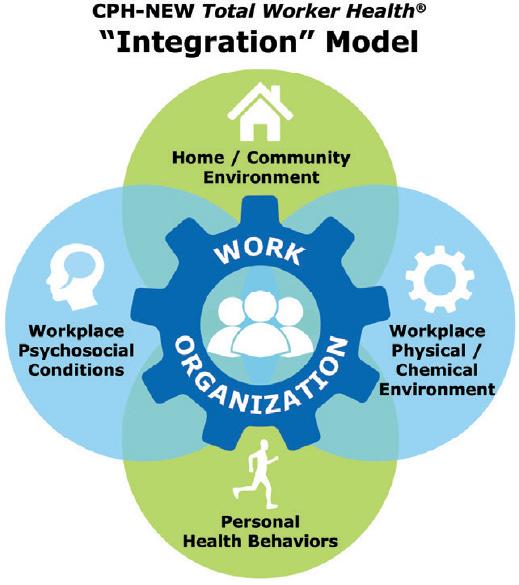
Reproduced from Punnett L, Cavallari JM, Henning RA, et al. Defining “Integration” for Total Worker Health®: A New Proposal. Ann Work Expo Health. 2020;64(3):223–235. doi:10.1093/ annweh/wxaa003. © 2020 The Authors. Used under CC BY-NC 4.
As understanding grows that many diseases have multiple contributing causes, prevention strategies that target several interacting risk factors at once can have a much greater impact than focusing on just one. For example, noise and solvent exposure together increase the risk of hearing loss8, so prevention efforts both in and outside of the workplace could significantly reduce cases by addressing multiple sources of exposure simultaneously, a strategy that could also apply to other conditions like transmissible diseases.
To predict or evaluate the success of a workplace health and wellness programs, CPH-NEW proposes a set of four TWH-specific metrics for
integrated interventions19:
1. Coordination of goals and activities between the occupational safety and the health promotion functions across domains;
2. Assessment of both work and non-work hazards that impact worker safety, health, and well-being;
3. Emphasis on interventions that prioritize mitigation of workplace contributors to poor worker health, safety, and well-being; and
4. Participatory engagement empowering workers to collaborate “in pivotal ways during intervention prioritization and planning to develop self-efficacy in addressing root causes, skill transfer, building program ownership, empowerment, and continuous improvement.”
Integrating lifestyle medicine within a TWH framework offers employers a strategic, evidence-based pathway to create healthier, safer, and more resilient organizations. When leadership commitment, hazard elimination, worker engagement, confidentiality, and systems integration are aligned, workplace health initiatives move beyond isolated programs to become embedded components of organizational culture. This comprehensive approach recognizes that worker well-being is shaped not only by individual behaviors but also by working conditions, organizational policies, and the broader social context in which workers live and work. By prioritizing prevention, fostering trust, and engaging workers as partners in design and implementation, employers can build sustainable programs that enhance health outcomes, strengthen performance, reduce avoidable costs, and cultivate a culture in which people and business thrive together.
The first step in bringing lifestyle medicine into the workplace is to conduct a comprehensive organizational assessment. This assessment moves beyond individual health risk appraisals and examines the broader systems that shape worker health—leadership priorities, job design, workload, scheduling practices, physical environment, benefits structure, food environment, psychosocial climate, and existing safety infrastructure. By evaluating both quantitative data (e.g., health claims, absenteeism, turnover, workers’ compensation trends, productivity metrics) and qualitative input (e.g., worker surveys, focus groups, frontline feedback), organizations can methodically identify upstream drivers of chronic disease risk. An effective assessment also distinguishes between the theoretical and the lived experience of workers. It evaluates whether healthy
behaviors are realistically feasible within current workflows, whether supervisors role model and reinforce them, and whether organizational incentives align with worker health goals. This diagnostic phase establishes a baseline, surfaces structural barriers, and prioritizes highimpact opportunities. Ultimately, organizational assessment ensures that lifestyle medicine interventions are not generic or performative but instead are strategically focused, culturally aligned, and operationally embedded within the enterprise.
The CDC has developed a Workplace Health Model (see Figure 4) that brings “a coordinated approach to workplace health promotion results in a planned, organized, and comprehensive set of programs, policies, benefits, and environmental supports designed to meet the health and safety needs of all workers.”1 The CDC Workplace Health Model provides an effective framework that can lead to success.
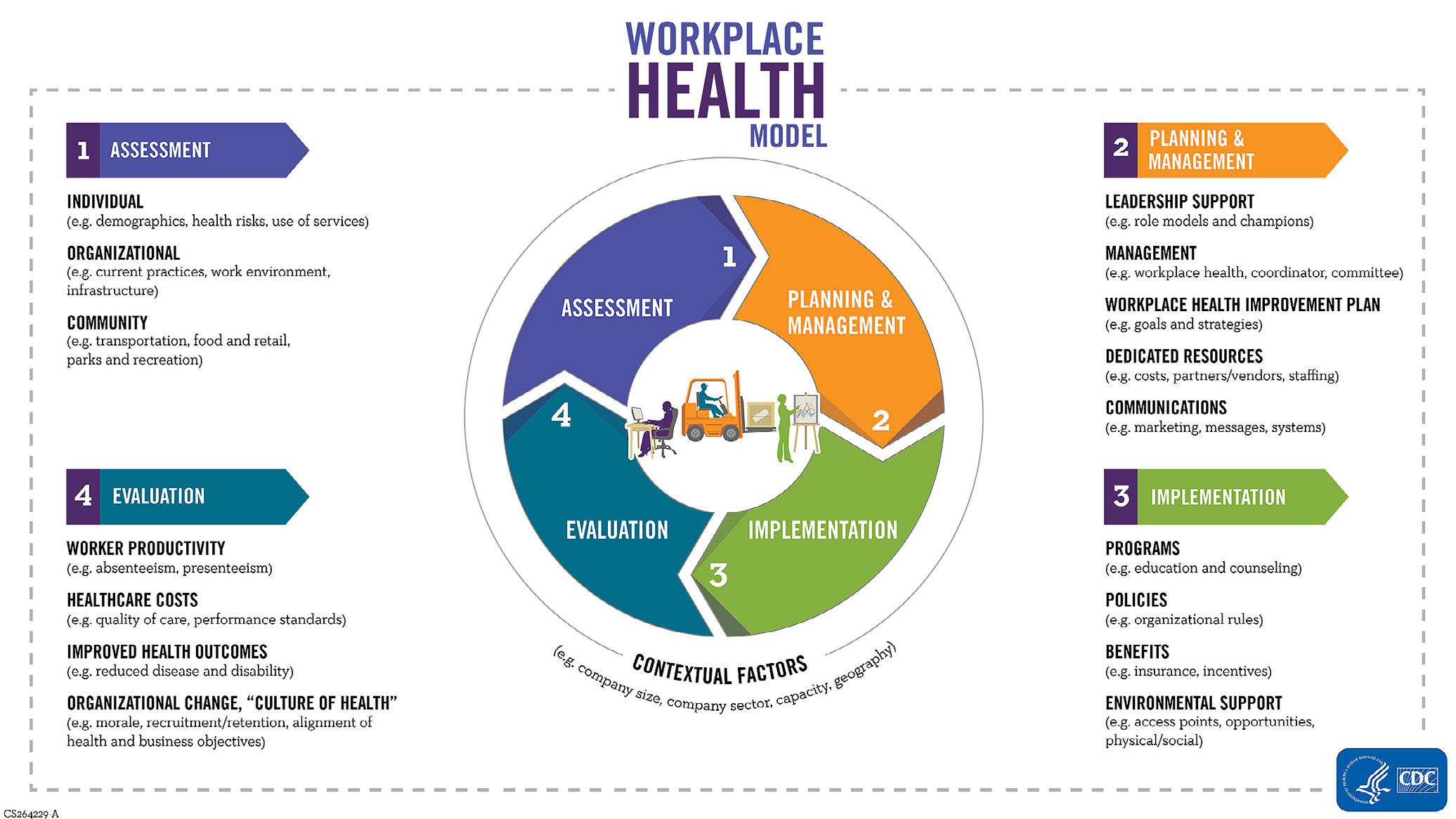
Reproduced from the Centers for Disease Control and Prevention (CDC). CDC Workplace Health Model. Published July 15, 2024. https://www.cdc.gov/workplace-health-promotion/php/model/index.htm
In the CDC’s Workplace Health Model, conducting a pre-intervention assessment is foundational to building effective, evidenceinformed workplace health and well-being programs. According to CDC guidance, the first key step in the systematic development of a workplace health promotion initiative is an organizational workplace health assessment, which helps employers understand existing conditions, worker health needs, and the organizational capacity to support change. This assessment typically examines a broad range of factors, including individual health risks and behaviors, the physical and social work environment, and organizational policies, practices, and culture that influence worker health outcomes. Tools such as the CDC Worksite Health ScoreCard26 can be used to capture this information, identify gaps, and prioritize improvements based on evidencebased strategies. By conducting a readiness assessment early in the process, employers can tailor interventions to meet the specific needs of their workforce and ensure that planning and implementation efforts are well grounded in data and organizational context, improving the likelihood of sustained success over time.
It is necessary to identify and overcome potential barriers to successful implementation before beginning the initiative. These barriers might include:
Organizations seeking to conduct a workplace assessment in preparation for a TWH-aligned lifestyle medicine initiative often face several structural and cultural barriers. Common obstacles include limited executive prioritization, insufficient staffing or analytic capacity,
availability and feasibility of the health initiative27, fragmented communication systems, competing operational demands, and organizational cultures that do not support participatory engagement or open feedback.
It is important to understand the workforce’s demographic composition as age distribution, gender mix, socioeconomic status, race and ethnicity, educational attainment, and health literacy levels all shape health risks, engagement patterns, and intervention effectiveness.
Different demographic groups experience varying prevalence of cardiometabolic disease, musculoskeletal conditions, sleep disruption, caregiving demands, and stress exposure. Socioeconomic factors influence access to healthy food, transportation, stable housing, and healthcare, while cultural background and lived experience may affect trust in employersponsored initiatives and responsiveness to behavior change strategies.
After understanding workforce demographics, organizations must then examine industryspecific characteristics, including sector, job demands, scheduling patterns, regulatory environment, physical and psychosocial exposures, and employment structure (e.g., hourly vs. salaried, unionized vs. nonunionized, remote vs. on-site). Industry context determines feasibility: shift work, production quotas, emotional labor, sedentary roles, and decentralized work sites each require different structural supports. Aligning interventions with both demographic realities and industry conditions ensures that lifestyle medicine strategies are practical, equitable, and embedded within the operational realities of work.
With these demographic and industry considerations in mind, the current evidence base indicates that lifestyle behavioral health change interventions show variable effectiveness across workplace settings and populations, underscoring the need for context-specific
design rather than uniform implementation.
Table 1 contains a list of industries, demographic groups, and professions that have been studied to assess the most effective lifestyle health behavior change interventions in their respective workplace settings.
TABLE 1.
Studies of Workplace Wellness Programs focused on Physical Activity among Various Industries, Professions, and Demographic
Ernawati et al., 202228
Reed et al., 201729
Systematic review of workplace wellness programs for working mothers found reductions in stress, depression, and burnout, with improvements in mental health, healthy behaviors, and work–life balance across included studies.
Systematic review and metaanalysis showed workplace physical activity interventions modestly improved cardiometabolic markers (BMI, LDL, glucose), with inconsistent effects on moderate-to-vigorous physical activity levels.
Healthcare
Higher Education
Hybrid Remote Workers
Bischoff et al., 201930
Di Mario et al., 202331
Upadhyaya et al., 202032
Evaluation of workplace health promotion programs found small improvements in health behaviors, though effects on productivity, absenteeism, and clinical outcomes were inconsistent.
Umbrella review found yoga and mindfulness interventions reduced stress, anxiety, and burnout among healthcare workers, though study quality varied and stronger trials were recommended.
Review of workplace wellness interventions found improvements in employee well-being and stress outcomes, with mixed evidence for sustained clinical or economic impact.
Worley et al., 202233
Plotnikoff et al., 201534
Systematic review of hospitalbased dietary and physical activity interventions found most programs improved staff health behaviors, particularly multicomponent and incentivebased approaches.
Review of workplace physical activity interventions found small but positive effects on fitness and activity levels, with greater benefits in structured, supported programs.
Crane et al., 202235
Scoping review identified limited but emerging evidence that work-from-home interventions can improve physical activity and reduce sedentary behavior, highlighting gaps in intervention design.
Industrial Workers
Javanmardi et al., 202513
Male Workers
Maritime Workers
Bezzina et al., 202236
Baygi et al., 202037
Systematic review of workplace health promotion for industrial workers found generally positive but heterogeneous health effects, limited by high risk of bias across studies.
Review of workplace mental health initiatives found modest improvements in stress and well-being, emphasizing the role of organizational context in effectiveness.
Systematic review of maritime workplace lifestyle interventions found limited and inconsistent health benefits, with overall modest study quality.
Nurses
Chan & Perry, 201238
Chappel et al., 201739
Chong & Shorey, 202240
Systematic review of lifestyle interventions for nurses found few high-quality studies, but reported improvements in smoking reduction, fitness, and body composition in limited trials.
Review of workplace wellness initiatives found improvements in employee engagement and selected health behaviors, with mixed evidence for clinical outcomes.
Review of workplace mental health interventions showed reductions in stress and burnout, particularly when programs were sustained and multicomponent.
Kelly & Wills et al., 201841
Power et al., 202142
Stanulewicz et al., 201943
Systematic review found workplace health promotion programs produced small improvements in health behaviors, with limited evidence of long-term impact.
Review of workplace wellness programs found modest improvements in diet and physical activity, particularly in multicomponent interventions.
Review of physical activity interventions in occupational settings found small but positive effects on activity levels and fitness outcomes
Public Safety Workers
MacMillan et al., 201744
School Staff
Shift Workers
MacMillan et al., 202045
Review of workplace interventions targeting physical activity reported modest improvements, with greater effectiveness when interventions were structured and supported by leadership.
Updated review found continued evidence of small improvements in workplace physical activity, emphasizing the importance of sustained program delivery.
Hill et al., 202246
Nathan et al., 202047
Flahr et al., 201848
Monnaatsie et al., 202149
Review of workplace well-being interventions found reductions in stress and improvements in employee well-being, though effects varied by intervention type.
Randomized workplace wellness trial found increased selfreported healthy behaviors, but no significant changes in clinical outcomes or healthcare utilization.
Review of workplace lifestyle programs found modest improvements in physical activity and health behaviors, with limited long-term evidence.
Review of workplace health promotion in low-resource settings found improvements in health knowledge and behaviors, with variability in program sustainability.
Lassen et al., 201850
Review of workplace nutrition interventions found improvements in dietary behaviors and small reductions in cardiometabolic risk factors.
Truck Drivers
Lalla-Edward et al., 201651 Evaluation of workplace health programs in healthcare settings showed improvements in health behaviors, with limited evidence for broader system-level outcomes.
Virraga, et al., 202452
Recent review found workplace wellness interventions improved employee well-being and selected health behaviors, though heterogeneity limited conclusions about long-term effectiveness.
The organization begins by first determining whether it is ready for such organizational change. It then has to ascertain whether it has the internal expertise to conduct a robust needs assessment, plan and implement an evidence-based lifestyle medicine intervention, and accurately measure and evaluate results. If it does not, the organization should retain the services of a trustworthy external consultant or consulting firm. (See Appendix for suggestions.) Ideally, this third-party organization will bring both experience and expertise, as well as an uncompromising commitment to data-driven initiatives. Additional essential components of a successful intervention include an internal multidisciplinary steering committee with representatives from various stakeholders at every level of the organization, as well as seasoned subject-matter experts well-versed in TWH and/or the targeted pillars of lifestyle medicine. Stakeholder participation is not only a means of gathering diverse perspectives but also fosters a sense of ownership, increases commitment to change, and improves the fit between intervention activities and actual work conditions. Moreover, by engaging internal stakeholders early and often, organizations can clarify goals and objectives, surface relevant practices that support those goals, anticipate potential barriers, and adapt intervention components in real time to maintain relevance and effectiveness.53 This internally grounded, participatory approach increases the likelihood that the program will be integrated into existing processes, sustain engagement, and ultimately produce meaningful improvements in worker health and organizational well-being. There are six relevant key characteristics to an
effective integrated approach to worker safety, health, and well-being17:
• Leadership commitment. Leadership makes worker safety, health, and well-being a clear priority for the entire organization. Leaders drive accountability and provide the necessary resources and environment to create positive working conditions.
• Participation. Stakeholders at every level of an organization, including workers and organized labor, help plan and carry out efforts to protect and promote worker safety and health.
• Policies, programs, and practices focused on positive working conditions. The organization enhances worker safety, health, and well-being with policies and practices that improve working conditions.
• Comprehensive and collaborative strategies. Workers from across the organization collaborate to develop comprehensive health and safety initiatives.
• Adherence. The organization adheres to federal and state regulations, as well as ethical norms— such as a respectful workplace—that advance worker safety, health, and well-being.
• Data-driven change. Regular evaluation guides an organization’s priority setting, decision-making, and continuous improvement of worker safety, health, and well-being initiatives.
Effective workplace health promotion programs tended to be more effective when there were at least weekly contacts between participants and program staff or activities, suggesting that frequent, repeated engagement with the program (e.g., regular check-ins, followup prompts, or structured interactions) helps reinforce behavior change and sustain participation in physical activity initiatives in workplace settings.54
Organizational readiness refers to an institution’s preparedness to adopt, implement, and sustain a new intervention or program before it begins. In the context of health-related interventions, readiness is not simply about resources on paper but encompasses a shared psychological and structural state: workers and leaders must not only value the change and understand its necessity but also believe in their collective capability to achieve it and have the organizational structures in place to support meaningful action.55
The researchers at the Center for the Promotion of Health in the New England Workplace (CPHNEW) highlight an Organizational Readiness Tool (ORT) grounded in a conceptual model to operationalize this readiness for participatory health and well-being programs. Although originally tailored to TWH initiatives, the dimensions identified—such as existing health and well-being programs, organizational approaches to health, resource availability, teamwork, worker participation capacity, and communication about priorities—are directly related to lifestyle medicine interventions.55 Supportive policies and structures are essential for lifestyle medicine programs which include coordinated efforts across clinical care focused on nutrition, physical activity, stress management, sleep, and social support.
Finally, assessing readiness before implementation allows an organization to identify strengths and gaps that could facilitate or hinder success and sustainability. For example, an organization that lacks management commitment or cross-departmental coordination may struggle to embed lifestyle medicine
principles into practice, despite wanting to do so, if it does not first address these foundational elements.57 Conversely, high readiness (as reflected in shared commitment, adequate resources, clear communication, and active team member involvement) increases the likelihood of successful adoption, smoother implementation, and ongoing integration into organizational routines.55
A successful workplace wellness initiative begins with assembling a multidisciplinary team that reflects the diversity of the workforce and the complexity of organizational systems. Rather than positioning wellness as a human resources add-on, organizations should adopt a participatory strategy in which workers, supervisors, frontline staff, leadership, and subject-matter experts collaboratively shape the program from the outset. The participatory approach, as outlined in the CPH-NEW Healthy Workplace Toolkit56, emphasizes joint problemsolving, shared decision-making, and continuous feedback loops. This structure ensures that interventions are grounded in TWH principles, aligned with operational realities, and responsive to both health and production goals. By involving those directly affected by workplace conditions, organizations move beyond top-down programming toward sustained systems change.
A well-constructed wellness team typically includes representatives from senior leadership, middle management, frontline workers, occupational health and safety personnel, human resources, and when appropriate, union or workforce representatives. Including individuals with expertise in lifestyle medicine, surfaces
barriers early, and increases the likelihood that chosen interventions will be feasible, culturally appropriate, and supported across occupational and environmental health, data analytics, and organizational development strengthens the team’s ability to translate evidence into practical interventions.55, 58 The participatory model encourages the team to begin with structured listening sessions and data review to identify upstream risk factors, work organization issues, and environmental contributors to health outcomes. This collaborative diagnostic phase fosters trust,
Importantly, a participatory approach fosters shared ownership and accountability. When workers help identify challenges, prioritize solutions, and assess progress, they are more likely to perceive the initiative as meaningful and credible rather than merely symbolic. Leadership’s visible engagement through resource allocation, policy alignment, and role modeling signals that health is embedded in the organization’s strategic priorities. Over time, this team-based, participatory infrastructure becomes a standing governance mechanism for continuous improvement, ensuring that wellness efforts evolve with workforce needs, industry demands, and emerging health risks rather than remaining static, one-time programs.
“What gets measured gets managed.”
-Robert S. Kaplan & David
P. Norton
Assessing your current approach to optimizing workforce health is the very first step in building a culture of health and well-being in the workplace. According to the Council on Quality
and Leadership, “data is useful information that you collect to support organizational decisionmaking and strategy.”59 A comprehensive workplace health, safety, and well-being assessment begins with structured measurement using validated tools rather than relying solely on anecdotal impressions or isolated metrics. Organizations should integrate multiple quantitative and qualitative data sources, including OSHA injury and illness logs, workers’ compensation claims, disability duration data, absenteeism and presenteeism metrics, and worker engagement surveys. Quantitative and qualitative data can help leaders recognize areas of strength (both past and present), define strategy based upon pre-selected/prioritized metrics, and identify specific opportunities for improvement.
There is growing interest in developing a standardized set of measures to systematically assess the effectiveness of workplace health promotion efforts. One recent scoping review identified 102 such measures that can be used to assess TWH outcomes and factors associated with those outcomes.60 Currently, key assessment instruments include the Healthy Work Survey (HWS)61, the NIOSH Worker Well-Being Questionnaire (WellBQ)62, the HERO Scorecard63, the CDC Worksite Health ScoreCard26, the Mayo Clinic Well-being Index64, and the American Heart Association (AHA) WellBeing Works Better™ Scorecard65. These tools represent widely used frameworks for evaluating organizational health promotion programs, psychosocial exposures, and worker population well-being. Many instruments evaluate overlapping domains, including organizational support, psychosocial stressors, population lifestyle behaviors, and chronic disease risk. Some also allow benchmarking against national
or industry standards. Table 2 provides a detailed comparison of leading tools, including domains, number of items, format, scoring, and reporting capabilities.
Occupational psychosocial stressors are work environment conditions that provoke harmful emotional and physical responses and, when chronic, contribute to adverse mental and physical health outcomes. These stressors are embedded within work organizations through policies, procedures, and environmental arrangements. Occupational psychosocial stressors are commonly conceptualized through integrated occupational stress models, including the Job Demand-Control (JDC), Effort-Reward Imbalance (ERI), and Job Demands-Resources (JDR) models.66
The JDC model assumes that worker stress arises from an imbalance between job demands and decision control. High job demands, such as workload, tight deadlines, and fast working pace, combined with low job control, such as limited decision-making authority or lack of skill development or use, lead to increased stress.
The ERI model posits that work stress results from an imbalance between effort expended and rewards received, including esteem, income, status control, job security, and opportunities for promotion.
The JDR model integrates concepts from JDC and ERI, expanding the reward domain to include job resources such as feedback, supervisor support, coworker support, and participation in decision-making in addition to the rewards described in the ERI model.
These models provide the theoretical foundation for contemporary psychosocial workplace assessment tools and guide the selection of survey instruments for organizational evaluation. Assessment of these domains aligns closely with the psychosocial pillars of lifestyle medicine, particularly stress management and connectedness. However, these domains do not comprehensively assess other core lifestyle medicine domains such as nutrition, physical activity, sleep, or avoidance of risky substances. ACLM’s Lifestyle Medicine Whole Person Health Index (LMWPHI) assesses the six pillars of lifestyle medicine and is intended to inform individualized treatment, remission, and prevention goals within clinical care. The LMWPHI may be incorporated as an evidenceinformed composite measure, integrating validated and guideline-informed domain specific screeners across the six lifestyle medicine pillars into a structured, scalable assessment framework. While the individual components are evidence-based, the composite instrument itself remains under active refinement and validation and should not yet be considered fully validated or fully evidence-based as a standalone measure.
The most recent iteration, as of March 25, 2026, reflects ongoing refinement of item selection, scoring standardization, and alignment with real-world clinical workflows. This version integrates brief, pragmatic screeners—including the ACLM Diet Screener-9, Exercise Vital Sign with strength assessment, PHQ-2–based stress screening, and guideline-informed sleep measures—into a unified scoring framework. It also enhances interpretability through scaled domain scores and a composite lifestyle score, incorporates constructs of readiness and motivation to support behavior change, and is designed for efficient use in routine clinical
encounters.
The LMWPHI is intended for use in individualized clinical care settings to support shared decisionmaking and lifestyle-based care planning. It is not yet validated for population health management, workforce health assessments, or benchmarking purposes.
Other tools for assessing psychosocial risk factors in the workplace include the United Kingdom’s Health and Safety Executive’s Stress Indicator Tool (SIT).68 Many European countries and others around the globe require regular stress assessments in the workplace. Because SIT is specific to stress, it is used in many Englishspeaking countries. Other stress assessment tools may be available through a country’s regulatory agency. A validated tool for assessing psychological safety climate is the PSC-12 and, because of its brief 12-question length, it can be utilized when a comprehensive well-being and psychosocial assessment is not feasible.
The Healthy Work Survey (HWS) is a validated instrument designed to assess workplace psychosocial hazards and work organization factors in the United States.61 The HWS operationalizes and integrates key constructs from the JDC, ERI, and JDR models, providing a comprehensive assessment of psychosocial work exposures.
The HWS includes 55 questions. Core domains include:
• High job demands and workload
• Low job control and decision-making authority
• Limited skill use
• Low supervisor and coworker support
• High work–family conflict
• Low reward and promotion opportunities
• Poor safety climate
• Health conditions, including general, physical, and mental health outcomes
These comprehensive measurements provide a detailed characterization of the psychosocial work environment. The HWS includes multiple items per construct, enabling robust measurement of work-organization hazards. Results can be aggregated to produce organizational-level reports and compared to national reference data to identify psychosocial risk profiles and intervention priorities. The Healthy Work Campaign (HWC) is an initiative from the Center for Social Epidemiology (CSE), a non-profit organization. The mission of the CSE and the HWC is to raise awareness of the health impacts of work stress and to equip individuals and companies with tools to promote healthy work, healthy organizations, and healthy people. In pursuit of their mission, the CSE developed a free, validated, confidential, and voluntary webbased survey, integrated with measures from the NIOSH Quality of Worklife questionnaire, to identify work-related psychosocial hazards associated with mental and physical health problems. The survey takes approximately 20 minutes to complete, and automatically generated results provide a detailed report of an organization’s work stress profile.
NIOSH WORKER WELL-BEING QUESTIONNAIRE (WELLBQ)
The NIOSH Worker Well-Being Questionnaire (NIOSH WellBQ)62 allows organizations to gather input from their workforce, providing an integrated assessment of worker well-being across multiple spheres, including quality of working life, circumstances outside of work, and physical and mental health status. The WellBQ was released in 2021 as a manually scored paperand-pencil instrument and includes 126 core questions across five domains:
• Work evaluation and experience
• Workplace policies and culture
• Workplace physical environment and safety climate
• Health status
• Home, community, and society
Optional modules include five questions on work arrangements and ten demographic questions. The WellBQ is nearly twice as long as the HWS, which may limit feasibility and participation in large organizational deployments.
While the HWS and WellBQ include overlapping measures of health outcomes, the WellBQ omits several key sources of workplace stress explicitly assessed in the HWS, including work hours, mandatory overtime, supervisory status, pay structure, low wages, wage theft, shift work, use of job skills, emotional demands, electronic monitoring, understaffing, physical job demands, procedural justice, and union representation. Additionally, the WellBQ includes only one item each on job autonomy and workload demands, whereas the HWS includes multiple items for these core psychosocial variables, allowing for more robust measurement of work organization hazards.
HERO SCORECARD
The HERO Scorecard63 originated from the WellBQ framework and was developed in consultation with leading authorities on population health and well-being. The HERO Scorecard includes 67 questions across six domains:
• Strategic planning
• Organizational and cultural support
• Program integration
• Program offerings
• Participation strategies
• Measurement and evaluation
The HERO Scorecard is administered online and provides automated scoring and benchmarking against other organizations. Organizations may engage HERO Preferred Provider organizations to interpret results and develop strategic plans for improving workforce health initiatives.
The CDC Worksite Health ScoreCard26 is a comprehensive organizational self-assessment tool designed to evaluate workplace health promotion programs, policies, environmental supports, and health plan benefits. The ScoreCard includes 154 questions organized across 18 modules:
• Organizational supports
• Occupational health and safety
• Maternal health and lactation support
• Nutrition
• Physical activity
• Sleep and fatigue
• Tobacco use
• Cancer prevention
• Cardiovascular disease risk factors
• Musculoskeletal disorders
• Prediabetes and diabetes
• Vaccine-preventable diseases
• Weight management
• Alcohol and substance use
• Depression
• Stress management
The ScoreCard can be completed manually or online and uses structured scoring to identify program gaps and track improvements over time. Compared with the HWS and WellBQ, the CDC ScoreCard emphasizes health promotion and chronic disease prevention rather than detailed psychosocial work-organization hazards.
The Mayo Clinic Well-being Index64 is utilized in healthcare settings and general industry to measure workforce well-being and risk of distress. The instrument is administered through customizable, purchasable packages, and aggregate reports provide measures of well-being across multiple domains, predict risk of distress in more than six dimensions, track individual and organizational progress over time, and offer actionable insights to organizational leadership. The most common version of this assessment has nine questions and can be completed in less than one minute. Domains include burnout, fatigue, quality of life, meaningfulness of work, and work-life balance.
AHA WELL-BEING WORKS BETTER™ SCORECARD
The American Heart Association (AHA) WellBeing Works Better™ Scorecard65 helps management self-identify current practices that promote employee flourishing. The tool provides benchmarking and customized guidance to improve key domains related to workforce wellbeing and organizational health practices. This scorecard assesses organizational practices and culture that support well-being. It includes bestpractice questions in areas such as: leadership and strategy, workplace culture and environment, health equity and inclusion, program implementation and evaluation, compensation and benefits, and well-being strategies such as mental health support, burnout prevention, safety, and engagement.
Although the HWS provides a comprehensive assessment of psychosocial work organization hazards, this toolkit aims to promote a healthy work environment that extends beyond psychosocial factors to include physical and nutritional health. Pairing one of the psychosocial measurement instruments with a tool such as the CDC Worksite Health ScoreCard allows organizations to evaluate both psychosocial stressors and health promotion programs related to nutrition, physical activity, chronic disease prevention, and occupational safety. Combining psychosocial hazard assessment tools with programmatic health promotion assessments provides a more comprehensive framework for identifying intervention priorities and developing multilevel workplace health strategies.
Survey selection should consider organizational size, workforce characteristics, and scoring capacity. Longer instruments, such as the WellBQ provide comprehensive assessments but may reduce participation rates and require manual scoring. Shorter instruments with structured or automated scoring, such as the HWS, HERO Scorecard, and CDC Worksite Health ScoreCard, may be more feasible for large organizations
and more likely to achieve higher completion rates. Benchmarking and aggregate reporting capabilities facilitate real-time feedback, strategic planning, and longitudinal evaluation of organizational health and well-being initiatives.
After completing the most appropriate assessment, an organization can identify areas of strength and opportunities for improvement.
This Assessment is the first step to identifying organizational priorities and developing a successful strategy.
Organizational assessment rather than for individuals; Recognition-based tiering (BronzePlatinum)
coverage of chronic disease
Employer guide available
Can repeat annually and track longitudinally; can work with vendor to develop strategic plan based on results
Very brief. Dual use: individual respondents receive immediate feedback and organizations can collect deidentified data in aggregate
There is no one-size-fits-all strategy to implement a TWH-aligned lifestyle medicinegrounded culture of health in the workplace. The most effective strategy for any organization will vary by a number of factors such as goals/ priorities, investment commitment, workforce demographics, industry, physical location, company leadership/culture, etc. Essential components for a successful intervention include: an internal multi-disciplinary steering committee with representatives from various stakeholders at every level of the organization, as well as seasoned subject matter experts in lifestyle medicine and/or board certified occupational and environmental medicine physicians trained in population and public health.
Workplace health, safety, and well-being programs have evolved beyond isolated wellness offerings into integrated organizational systems that shape individual worker behavior and influence enterprise-wide outcomes. Contemporary workplace intervention science emphasizes that effective implementation requires more than checklists; it demands a tailored, data-informed strategy aligned with the organization’s mission, workforce demographics, culture, and the maturity of its health and safety infrastructure.70 Drawing on the integrated OEM and lifestyle medicine model advanced by Hymel and colleagues15, an implementation strategy can be designed that aligns multi-level interventions with employee engagement principles.
Consistent with systems-based workplace intervention science71, effective implementation
requires selecting and sequencing interventions based on documented risk burden, workforce demographics, and organizational readiness. Programs should not be deployed as isolated rote activities; rather, they should reflect a structured response to identified needs and maturity level. Effective workplace interventions operate at organizational, team, and individual levels rather than treating wellness as a siloed program.
At the organizational level, workplace interventions are designed to modify upstream determinants of health.72 Such upstream changes implicitly acknowledge work as a determinant of health, a perspective underscored in integrated OEM frameworks that emphasize the symmetry between workplace exposures and chronic disease risk.15 Structural interventions targeting upstream determinants of health embedded in work design and organizational operations recognize that worker health behaviors and outcomes are shaped substantially by systemic and environmental conditions rather than by individual choices alone.
Contemporary organizational research emphasizes that modifying structural and cultural aspects of work can produce measurable improvements in well-being and performance.73, 74 As an example, redesigning policies by optimizing shift scheduling to mitigate circadian disruption and fatigue and aligning workloads with recovery principles directly addresses sleep and fatigue-related risk factors.75 Manager training in supportive management practices strengthens psychological safety, enhances role clarity, and reduces job strain, which are well-established contributors to occupational stress–related morbidity.76, 77 In parallel, value-
based benefit redesign that lowers financial barriers to preventive services, chronic disease management, and evidence-based lifestyle interventions reinforces health-promoting behaviors at the systems level.78 Collectively, these structural approaches shift the focus of interventions from downstream remediation to primary prevention by embedding health protection and promotion into the organization’s operational architecture, thereby facilitating sustained improvements in workforce well-being and enterprise performance.
At the team level, intervention design should leverage behavioral economics principles to shape daily decision environments. Behavioral interventions in team-based work settings show that modifying the immediate work environment and norms can meaningfully influence collective health behaviors, even without explicit individual mandates. In a quasi-experimental field study conducted across multiple departmental teams in a governmental organization, default changes to height-adjustable workstations (HAWS) led to significant increases in standing behavior compared with control conditions, with the highest effects observed when transparent default message were combined with lowthreshold group coaching (e.g., movement planning and ergonomic prompts).79 The default “choice architecture”—raising HAWS to standing height—leveraged automatic behavioral tendencies toward preset options, and when paired with clear, team-wide contextual information and peer awareness, produced sustained, elevated stand-up work ratios even after the intervention period. These findings underscore the importance of team-level environmental cues and shared contextual
framing in shaping day-to-day workplace behaviors.
Individual-level supports should be risk-stratified and integrated into broader organizational strategy. At the individual level, risk-stratified supports should be offered as part of a continuum of services, including targeted lifestyle medicine programming, digital coaching, chronic disease management pathways, and personalized behavioral planning.15 Although individual interventions have historically achieved small effect sizes in isolation, when embedded within supportive organizational and environmental structures, they contribute to synergistic improvements in health outcomes.
Financial incentives remain a central mechanism for enhancing employee engagement in workplace health initiatives. Contemporary evidence emphasizes that incentive structure, framing, and equitable design are more important than incentive magnitude alone. Early randomized trials demonstrated that financial rewards can increase participation in weight loss and preventive health behaviors.80 Recent systematic reviews and meta-analyses confirm that incentives are most effective when tied to specific, proximal behaviors, such as program enrollment, coaching attendance, medication adherence, or completion of preventive screenings, rather than distal biometric outcomes that may be influenced by social determinants
beyond individual control. Incentives should prioritize engagement, be reasonably achievable, and avoid tying rewards to biometric targets that may be influenced by factors outside individual control.81 Modern design principles prioritize behavioral alignment and fairness. Graduated or escalating incentive models where rewards increase with sustained engagement, capitalize on the goal-gradient effect and reinforce habit formation over time.81 Furthermore, hybrid models that combine individual-level incentives with team-based rewards leverage social accountability and peer influence to sustain workforce participation.82 Participation should be voluntary, with reasonable alternatives or accommodations provided to ensure equitable access. In addition, incentive implementation must comply with the rules set forth by the EEOC. More information can be found here: https://www.eeoc.gov/regulations/questionsand-answers-about-eeocs-notice-proposedrulemaking-employer-wellness-programs
Behavioral economics supports the use of “nudges,” which are low-friction, choicepreserving environmental cues designed to influence health-related decision-making.83 Since the original publications on nudge theory came out in the late 2000s, a recent scoping review of nudging interventions in organizational settings demonstrates that workplace nudges are most effective when paired with tangible incentives, require minimal effort, and are socially supported by leadership or peers. Moreover, interventions targeting high-cost behaviors or lacking enabling infrastructure were less successful.84 Environmental placement strategies, such as stair prompts, the strategic placement of healthy foods, and ergonomic
workstation defaults, reduce the cognitive effort required for healthy behaviors and can produce measurable changes in physical activity and dietary patterns.85 A recent workplace survey, combined with a quasi-experimental study design, shows that transparent defaults, combined with minimal educational framing, yield sustained behavioral change without diminishing perceived autonomy.86
However, nudges are not universally transferable; their effectiveness depends on contextual adaptation, workforce demographics, leadership modeling, and cultural fit.87 Contemporary implementation research further suggests that combining nudges with structural interventions (e.g., scheduling redesign, workload adjustments) amplifies impact by aligning environmental signals with feasible opportunities for behavior change.88 In integrated workplace health systems, nudges function not as isolated tactics but as reinforcing components within a comprehensive architecture of protection, promotion, and performance optimization.
Identifying the optimal partners to implement a TWH-aligned lifestyle medicine-grounded health workplace intervention is a strategic decision that can determine whether an initiative integrates smoothly into operations or remains fragmented and short-lived. Partner selection should be guided not only by technical expertise, but by alignment with organizational structure, culture, data capacity, and long-term strategic goals. Selecting between internal experts, external consultants, or third-party vendors to implement a lifestyle medicine program is fundamentally a question of capacity, control, complexity, and long-term institutional goals.
Each model serves a distinct function. The decision should be based on implementation needs.
To determine the optimal mix, the leadership team/decision-making body should consider these five questions:
1. Do we have internal expertise in implementation science and workplace/ organizational systems?
2. Do we need to focus on designing the strategy and framework, or on executing and delivering the solution in practice?
3. Should this initiative begin as a small-scale pilot to test and refine the approach, or are we ready to deploy it across the entire organization?
4. What level of complexity is involved in integrating this data across into our systems and workflows?
5. Is long-term organizational integration a priority?
Best for: Organizations with existing infrastructure, strong governance, and technical capability. Internal teams (e.g., occupational health, HR, safety, benefits, data analytics, leaders with subject matter expertise) are often best positioned to lead implementation when sufficient expertise and bandwidth exist.
Advantages:
• Deep knowledge of organizational culture and operations
• Established trust relationships
• Easier alignment with existing governance structures
• Greater long-term sustainability
• Lower vendor dependency
• More seamless data integration within existing systems
Limitations:
• Limited specialized expertise (behavioral science, AI and newer digital tools, analytics sophistication)
• Bandwidth constraints
• Risk of internal bias or blind spots
• Slower innovation adoption
When to Choose Internal Partners:
• Mature health and safety governance exists
• Data systems are well-integrated
• Leadership commitment is stable
• Implementation is incremental rather than transformative
Internal leadership is particularly effective in phased models where institutional embedding is the primary goal.
Best for: Strategic planning, readiness assessment, governance design, and shortterm expertise infusion. Consultants typically provide advisory services rather than delivering operational programs. They help design the architecture.
Advantages:
• Objective external perspective
• Expertise in implementation frameworks
• Governance and policy design support
• Ability to facilitate cross-functional alignment
• Strategic roadmap development
Limitations:
• Usually not responsible for long-term delivery
• Limited operational integration after engagement ends
• May require internal team or vendor for execution
• Can be expensive for ongoing support
When to Choose a Consultant:
• Conducting organizational readiness assessments
• Designing phased implementation strategies
• Building governance structures
• Restructuring benefits or procurement systems
• Evaluating existing programs
Consultants are most effective in early phases (exploration and preparation) or during structural redesign.
Best for: Operational delivery, digital platforms, structured programs, and scalable infrastructure. Vendors typically provide products or services (e.g., digital health platforms, coaching services, biometric screening, nutrition programs).
Advantages:
• Specialized expertise
• Established program content
• Technology platforms
• Operational infrastructure
• Scalability
• Defined service-level agreements
Limitations:
• Variable customization
• Risk of poor cultural fit
• Data integration challenges
• Potential misalignment with governance
• Cost
When to Choose a Vendor:
• Internal capability gaps exist
• Technology platforms are required
• Enterprise-scale delivery is planned
• Specialized coaching or clinical services are needed
• Time-to-implementation is constrained
Vendors are often most appropriate during pilot and expansion phases when structured delivery systems are required. ACLM provides a list of certified programs that can support the decision of engaging with a vendor. These programs are grounded in strong evidence, demonstrate safety and are aligned with the pillars of lifestyle medicine. You can find them here: https:// lifestylemedicine.org/potential-partner/aclmcertified-programs/
The decision matrix outlined in Table 3 can help organizations make their respective determinations.
The disciplined execution of a TWH/LM workplace intervention depends less on the ambition of its vision and more on adherence to core implementation principles that govern how change is introduced and scaled.58 The success of any intervention depends on (1) a systematic and gradual approach, (2). a proper diagnosis or risk analysis that identifies risk factors and risk groups, (3) a series of theory-driven measures that logically deal with those problems previously identified in the risk analysis, (4) a participatory approach that engages both workers and middle management, and (5) a sustained commitment from senior management. Across all phases, from pilot through institutional embedding, these five foundational principles anchor a stable rollout and protect against premature adoption.
No initiative can outpace its governance architecture. Before expanding, organizations must clearly define decision-making authority, accountability structures, reporting schedules,
and escalation procedures. Executive sponsorship should be formalized, and crossfunctional oversight should be operational. Governance determines how resources are allocated, how conflicts are resolved, and how priorities are reinforced. Without it, expansion leads to variability, inconsistency, and a dilution of intent. Breadth without governance creates fragmentation; governance before breadth creates stability. Clear authority and structured oversight provide the scaffolding that allows subsequent scaling to remain coherent and aligned with enterprise strategy.
Organizational change is most stable when introduced in contained environments before being generalized. Beginning with a defined pilot structure allows leaders to observe realworld operational dynamics, test assumptions about workflow integration, and identify contextual barriers that may not be visible in planning sessions. Starting small reduces reputational risk, minimizes disruption, and creates a controlled setting for learning. Pilot
development at the organizational level should be intentional and grounded in implementation science.90 The purpose of the initial pilot is to test feasibility under controlled conditions, not to demonstrate transformation in the most complex environment.58 Communication pathways, supervisory expectations, workflow integration, policy alignment, scheduling logistics, and third-party interfaces must be stress-tested during the pilot phase. Testing reveals friction points such as unclear ownership, conflicting policies, bottlenecks in reporting, or gaps in digital infrastructure. Addressing these issues at a small scale prevents magnification during expansion. Process validation ensures that the implementation mechanics are reliable before additional units are brought into scope. Scaling an untested process multiplies inefficiencies; refining processes first multiplies stability.
Operational processes—not program content— determine whether an initiative integrates into daily practice. Informed by pilot findings, the organization can assess, analyze, and develop a scaling strategy in clearly demarcated phases rather than aspirational timelines. This staged expansion preserves adaptability while preventing the operational strain that often accompanies enterprise-wide launches. Deliberate scaling reflects an understanding that capacity must grow in parallel with scope.
Data infrastructure must mature before executive dashboards amplify visibility. Metrics require standardized definitions, reliable data sources, clear ownership, and consistent reporting intervals. Premature enterprise-level
reporting without harmonized data systems risks misinterpretation, loss of credibility, and erosion of trust. Data alignment includes integrating cross-functional metrics, ensuring interoperability across platforms, and clarifying analytic responsibility. When data systems are stable and definitions consistent, leadership visibility reinforces accountability rather than generating confusion. Measurement should follow infrastructure development, not precede it.
Cultural messaging alone does not create sustainability. Institutionalization occurs when practices are embedded within formal organizational structures such as budget cycles, procurement standards, performance evaluations, capital planning, and policy frameworks. When expectations are written into managerial review processes and funding is recurring rather than discretionary, initiatives move beyond reliance on individual champions. Structural embedding transforms a program into an operational norm. Cultural alignment may follow, but it is sustained by structural reinforcement. Without embedding into systems and incentives, even well-intentioned initiatives remain vulnerable to leadership turnover, competing priorities, or fiscal pressure.
“People don’t care about how much you know, until they know how much you care.”
– Theodore Roosevelt
It is important to keep in mind that an effective strategy to bring LM into the workplace includes addressing all areas that affect worker health. This goes beyond physical activity, healthy eating and stress management. Addressing the areas not as visible such as fair pay, diversity, manager’s behavior, social determinants of health, corporate politics and unwritten rules must also be addressed as they can significantly impact workers’ health and negatively influence a company’s culture. Keys to success include:
9 Develop and execute the program in-house to the extent possible, with extensive stakeholder input.91
9 Incorporate frequent contacts with program (at least weekly).54
9 Design multi-component interventions that incorporate multiple lifestyle medicine pillars.92
9 Include incentives.93
9 Prioritize policy/changes of the physical work environment to promote maintenance of positive lifestyle changes.54
When it comes to organizational performance, workforce health needs to be seen as the clear priority. The financial cost of an unhealthy worker population is undeniable: wasted resources
and time, decreased productivity, increased employee turnover, and customer attrition. The money an organization loses as a result of these problems, and the money it has to spend to recover from them, is staggering. Offering evidence-based lifestyle medicine programs as a health benefit can be an effective way to reduce cost and improve employee and organizational health.
Lifestyle medicine can be implemented in the workplace as a worker-centered, value-based, outcome-driven approach that goes far beyond the old-fashioned “wellness” programs. By working with each individual, trained clinicians are able to prevent, treat, and even reverse many chronic conditions through empowering people to make lifestyle modifications. This is a proven methodology that promotes effective weight loss and healthy weight maintenance, decreases the risk of Type 2 diabetes, reduces cardiovascular disease risk factors, including lowering blood pressure, triglycerides and other biomarkers of cardiovascular disease, reduces insulin resistance and oxidative stress, and more. People are empowered to address the root causes of their chronic diseases and, under clinical observation, may be able to reduce their medication burden to manage their symptoms. This approach to lifestyle medicine in the workplace delivers mutual benefit by improving worker health and well-being while enhancing organizational performance, productivity, and long-term value. Workers win by knowing how much they are valued by their employer and by becoming healthier, happier, and more productive. Companies win by having a healthier organization with a thriving culture where people are motivated and inspired to make a positive difference, not only for the organization, but for
Effective workplace health and well-being initiatives depend fundamentally on structured evaluation. Measurement is foundational to effective workplace evaluation because it fulfills several essential functions that determine not only whether an initiative is implemented as planned, but whether it is effective in producing meaningful and sustained impact. First, measurement establishes baseline risk and exposure. Without deliberate measurement, organizations cannot determine whether a program is achieving its intended outcomes or simply consuming resources. Measurement should occur across multiple domains, reflecting both upstream and downstream determinants of worker health. The methodology for evaluating workplace interventions must extend beyond simple pre-post outcome comparisons and instead integrate lifecycle evaluation, process assessment, contextual analysis, and outcome measurement into a coherent analytic framework. Contemporary organizational intervention science emphasizes that intervention effectiveness is best understood as the product of dynamic interactions among intervention design, implementation processes, organizational context, and stakeholder sensemaking.97, 98
Accordingly, a best-practice methods framework incorporates multi-phase evaluation, mixedmethods measurement, and explicit linkage between process and outcome variables. This attention to both process and outcome evaluation serves distinct but complementary purposes. Together, these approaches determine not only whether an intervention produced measurable change, but whether it was
implemented as intended and why observed effects occurred. Process evaluations provide critical insight into why an intervention succeeds, produces limited effects, or fails to achieve its intended outcomes. They typically involve the use of structured, validated instruments to systematically assess perceptions of how an intervention was implemented.99
Established process measures include worker participation, perceived legitimacy of the intervention, stakeholder support, and degree of implementation fidelity. Collectively, these measures generate standardized, scalable data on implementation dynamics that can be analytically linked to outcome results to strengthen causal interpretation. By assessing employee participation trends, the evaluators can examine how the respective program components are implemented and experienced and distinguish which elements functioned effectively and which did not, allowing researchers and practitioners, and by extension, program managers and implementers, to refine and optimize intervention design.100 In addition, process evaluations can identify barriers and facilitators that influence implementation, recognizing that these factors may operate at multiple levels—including leadership, supervisors, teams, and individual workers.101
While process outcome is typically easier, quicker, and less costly, evaluations of wellchosen and valid outcomes are often more interpretable and useful. Outcome evaluation is the component of workplace intervention assessment that addresses whether it achieved its intended goals and determines whether meaningful change occurred as a result of the initiative. Outcomes must be explicitly defined prior to implementation and linked to
the identified risks or needs uncovered during baseline assessment. If the baseline assessment utilized the HERO Scorecard, the CDC Worksite Health ScoreCard, the WellBQ, or similar tools, repeating these assessments can help track progress, highlight areas of improvement, and identify remaining gaps, while also providing guidance and evidence-based recommendations for continued advancement. These objectives should distinguish between short-term, intermediate, and long-term outcomes. Shortterm outcomes often reflect proximal changes, such as increased knowledge, improved safety practices, reduced exposure levels, enhanced supervisor behaviors, or shifts in organizational climate. Intermediate outcomes may include measurable improvements in health risk factors, reductions in reported stress, improvements in safety climate scores, or changes in work design. Long-term outcomes typically involve more distal indicators such as injury rates, chronic disease markers, absenteeism, turnover, productivity, or healthcare utilization trends.
It is recommended that organizations incorporate both worker-centered and workcentered process and outcome measures. These metrics should align with lifestyle behavior health pillars as identified by ACLM and capture factors that influence modifiable chronic disease risk as well as work-related disability risk. Worker-centered measures assess individuallevel behaviors, health risks, psychosocial well-being, and functional capacity, while workcentered measures evaluate organizational conditions such as workload design, supervisory support, scheduling practices, safety climate, and operational processes that shape worker health and performance. From a work-centered perspective, the use of the Hierarchy of
Controls directs attention first to elimination and substitution strategies—removing or redesigning harmful exposures, workload patterns, scheduling practices, or psychosocial stressors that contribute to chronic disease risk or work disability.17 Process metrics at this level might include documentation of policy changes, staffing ratios, workload redistribution, ergonomic redesign implementation, or scheduling reforms. Outcome metrics may include reductions in exposure levels, improvements in safety climate, decreases in injury rates, reduced overtime burden, or lower rates of work-related stress. These structural indicators are critical because they address root causes rather than relying solely on individual coping strategies. Depending on the lifestyle behavioral change(s) of focus, associated workcentric metrics to consider may include financial, customer, internal business process, learning and growth, or others.102 By systematically measuring both worker- and work-centered process and outcome metrics, organizations can more accurately determine not only whether an intervention was effective, but how and why effectiveness was achieved.
While worker-centered and work-centered metrics are essential to understanding effectiveness, organizations must ultimately translate these multidimensional indicators into a coherent performance framework that aligns with enterprise strategy. Leadership teams often require a concise, prioritized set of measures that integrate health, safety, financial, and operational outcomes into routine business reporting. The balanced scorecard approach provides one such structure, allowing organizations to track health promotion impact alongside broader performance objectives.103
Within this context, employers typically select a limited number of high-value indicators that reflect both implementation progress and organizational return, ensuring that workplace health initiatives remain visible, measurable, and strategically integrated rather than siloed initiatives. On average, the employers surveyed by Ozminkowski et al. tracked about seven metrics on their balanced scorecard. The authors found the most commonly tracked metrics were: wellness program participation, health care costs, absenteeism, wellness program satisfaction, health risks, job satisfaction, and safety. Table 4 is an example of metrics which could be used to evaluate financial performance.
Return on investment (ROI) can be part of the impact evaluation. The variables used to calculate an ROI are the costs of the planned intervention, outcome measures, and the anticipated savings. Costs include program development and design, incentives, marketing material, vendor fees, technology, programs, interventions, and outcome measurements per participant and total for the company. Public or private employer workers’ compensation or healthcare cost databases may be utilized to obtain baseline data to help estimate costs.14
ROI can be part of the impact evaluation and it can be measured in different ways. The Johns Hopkins Institute for Health and Productivity Studies,107 led by Dr. Ron Goetzel, has developed an ROI calculator, and a basic, free calculator is available from WellSteps.108 In addition, an ROI calculator specific to mental health programs has been released by Meharry School of Global Health in the US, supported by Deloitte Health Equity Institute.109 A supporting report highlights many of the economic assumptions used in the ROI calculator.110
Outcome variables to be measured should include the number of participants who will achieve a pre-determined health outcome, for example, weight loss. Anticipated savings may be obtained from the literature or if available from organizational data based on reductions in both direct costs (reduced modifiable risk factors and medical claims/healthcare) and indirect costs (reduced absenteeism or fewer missed work or disability days, reduced presenteeism with increased productivity, and increased employee retention).
It is important to be realistic about the utility of ROI calculations for workplace lifestyle medicine interventions. Challenges include
Type
Return on Investment (ROI)
Social Return on Investment / Value of Investment
• Benefits Measures:
• Reduced healthcare expenditure (e.g. medical, hospitalization, medication use, worker’s compensation)
• Increased service/product output (productivity metric)
• Cost Measures:
• $ invested into a lifestyle behavioral intervention (e.g. smoking cessation program, nutrition education targeted to diabetes/high cholesterol, functional strength training program; weight loss management targeted to obesity)
• $ invested into a chronic condition intervention (e.g. Type 2 Diabetes Remission Program
• ROI = (Net Benefit /Cost ) * 100%
• Follow trend year over year
• Productivity
• Duration of or quantity of disability claims
• Sick days
• Business performance metrics
• Company profitability
• Presenteeism
• Long-term medical restrictions for chronic diseases
• Employee retention or turnover
• Greenhouse gas emissions
• Food or nutrition security
Medical Cost Savings
Benefit-to-Cost Ratio (BCR)
• Absolute cost reduction per participant per year
• Percentage decrease in total medical expenditures
• Longitudinal cost trends post-intervention
• Workers’ Compensation Claims Cost Savings
• Disease reversal (to be added in ICD coding)
• Examples105,106
(BCR) = Total benefits of reduced healthcare expenditures or productivity gains / Unit of investment in a lifestyle behavior intervention
the time horizon required for health changes to yield financial savings, lack of standardized metrics, making it difficult to draw comparisons and analogies, differentiating between the role of the program and larger factors in producing outcomes, and variability between individual industrial sectors and organizations. Despite limitations, ROI goals can effectively demonstrate the value of workplace lifestyle interventions by utilizing company-specific baseline data, measurable outcome variables, and practical interventions tailored to individual corporate resources.
Generating an ROI is often financially and resource intensive. In addition, ROI is not useful when comparing to other companies as different variables go into its calculation, thereby affecting ROI results. If a company chooses to invest in measuring ROI, the value is in following the trend year-over-year. As such, a better choice is often to describe the Value of Investment (VOI). Ozminkowski et al.104, offer recommended metrics, a method to prioritize metrics, and how to tell the VOI story. Specifically, employers can:
9 Clearly state the reasons why they are offering health and wellness to their workers
9 Identify the metrics needed to support their health and wellness rationale
9 Map out the source of each metric and how it can be accessed by using:
• Health plan data
• Vendor data
• In-house data
9 Measure the impact of health and wellness programs on their key metrics,
9 Aggregate findings into a meaningful dashboard based on their priorities.
An employer should not feel pressured to show value in all areas at once since the value story can evolve over time. Researchers104,111 have developed guidance on metrics that will be most meaningful for performance insight and informed decision making and tracked in a Value Demonstration Dashboard.
As program impact is assessed, keep in mind that a first priority is often to create behavior changes among those who need it the most. That group is also the one that will incur the most benefit in productivity, health, quality of life, and health care costs in the short term. Most importantly, focus on small wins first, and then move to more ambitious results. Bringing lifestyle behavior change into a workplace is a marathon, not a sprint!
Table 5 provides examples of worker-centric metrics with a focus on overall performance, psychosocial factors, and chronic conditions influenced by lifestyle behavioral interventions. As an example, one study found the most common lifestyle health risk factors (HRFs) as predictors of Worker’s Compensation claim occurrence and cost were: poor sleep, the use of poor lifting practices, and inadequate exercise.112 The most common psychosocial HRFs were stress related to finances, stress at work, and depression. Among all subjects, abnormal body mass index (BMI) was the most common HRF. Tracking performance measurement and management which take remote work dynamics into consideration should be considered, as such a shift to remote work represents several challenges including communication difficulties, technical issues, and work-life balance.113
Table 5 provides examples of worker-centric clinical and behavioral metrics across the LM pillars. Assessment tools for each pillar can be found in the Appendix.
Worker-centric Metrics: Clinical and Behavioral Indicators across LM Pillars LM Pillar Behavior
Factor
Physical Activity Steps
Duration and Type of Activity per Day
Sedentary behavior
Weight
Strength (dynamometer)
Flexibility
Cholesterol
Blood sugar (CGM trends, HBA1C)
Blood pressure
Fitness (VO2 max, etc.)
Permanent medical restrictions due to chronic reversible diseases
Cardiovascular diagnoses
Musculoskeletal conditions (back and neck pain, arthritis)
Psychological/ mental health
Readiness to change
Protein intake
Caloric intake
Sugar intake
Fruit/vegetable (rainbow color)
intake
Ultra-processed food intake
Sodium intake
Weight
BMI
Waist Circumference
Lipid Profile
LDL Cholesterol
Blood sugar (CGM trends, HBA1C)
Blood pressure
Type 2 Diabetes
Obesity
Hypertension
Dyslipidemia
Metabolic Syndrome (e.g. MASLD)
Cardiovascular condition
Psychological/ mental health
Restorative Sleep Fatigue scales
Bedtime and wake
time consistency
Total sleep duration
Screen use before bed
Caffeine timing and quantity
Alcohol use in the evening
Nicotine use
Late-night eating
Exercise timing
Napping frequency/ duration
Resting heart rate
Cortisol
Melatonin timing
Blood pressure
Fasting glucose / HbA1c
Inflammatory markers (CRP, IL-6)
Absenteeism
Presenteeism
After-hours email/work engagement
Shift swapping patterns
Overtime frequency
Commute duration
On-call responsibilities
Obstructive sleep apnea
Insomnia disorder
Restless legs syndrome
Circadian rhythm
sleep-wake disorders
Shift work disorder
Hypertension
Cardiovascular disease
Type 2 diabetes
Obesity
Chronic pain
GERD
Female Breast Cancer
Depression
Anxiety disorders
PTSD
Substance use disorders
Financial stress
Caregiving burden
Marital stress
Social isolation
Burnout
LM Pillar Behavior Biological/ OM Measure
Form Positive Social Connections
Time spent with family/friends
Number of positive interactions
Conflict resolution behaviors
Seeking help when needed
Number of strong vs. weak ties
Network centrality (social network analysis)
Diversity of connections
Work-life Balance
Helping colleagues
Emotional disclosure to trusted coworkers
Checking in on teammates
Physical workspace
layout (open vs. isolated)
Remote/hybrid structure
Onboarding integration processes
Supervisor support behaviors
Psychological safety climate
Recognition programs
Zero tolerance for incivility/bullying
Diversity, equity, and inclusion practices
Psychological/mental health
Increased inflammatory states
Chronic Pain
Psychosocial Factor
Low social support
Relational problems at work
Depression
Anxiety disorders
Burnout
PTSD
Substance use disorders
LM PIllar Behavior
Optimize Attitude and Mindset
Response to feedback (defensive vs. growth-oriented)
Willingness to learn new skills
Persistence after setbacks
Attribution style (external blame vs. internal control)
Problem-solving vs. rumination
Help-seeking behavior
Initiative-taking
Adaptability during change
Conflict style
Emotional regulation during stress
Constructive vs. cynical communication
Recognition of others
Collaboration vs. withdrawal
Biological/ OM Measure Medical Condition
Cortisol (diurnal slope)
Heart rate variability (HRV)
Resting heart rate
Blood pressure
Psychological safety climate
Error tolerance vs. blame culture
Recognition systems
Growth and development pathways
Transparency in decisionmaking
Fixed vs. growth-oriented performance reviews
Coaching availability
Professional development funding
Feedback frequency
Engagement
Absenteeism
Presenteeism
Innovation
Safety incidents
Turnover intention
Self-assessment of overall health
Psychosocial Factor
Depression
Anxiety
Burnout
PTSD
Learned helplessness
Self-efficacy
Emotional intelligence
Neuroticism
Perfectionism
Fixed identity beliefs
Quality of life
LM PIllar Behavior
Reduce or Avoid Risky Substances
Alcohol frequency and quantity
Binge drinking episodes
Cannabis use
Opioid use (prescribed and non-medical)
Stimulant use
Nicotine use (smoking, vaping, smokeless)
Sedative/hypnotic use
Energy drink/ caffeine overuse
Polysubstance use
Biological/ OM Measure
Working while impaired
Driving after substance use Using substances to cope with work stress
Presenteeism linked to substance use
Breath alcohol testing
Urine toxicology screens
Saliva testing
Carbohydrate-deficient transferrin (CDT)
Gamma-glutamyl transferase (GGT)
Phosphatidylethanol (PEth) for alcohol
Cotinine (nicotine metabolite)
EAP accessibility
Insurance coverage for treatment
Sick leave and mental health leave
Workplace injuries
Falls
Motor vehicle accidents
Productivity metrics
Error rates
Safety events
Toxicant Exposures
Medical Condition Psychosocial Factor
Substance use disorders
Psychological/mental health
Chronic musculoskeletal pain
Neuropathic pain
Liver Disease
Cancer
Depression
Anxiety
PTSD
Burnout
ADHD
Bipolar disorder
Adverse childhood experiences (ACEs)
Impulsivity
Sensationseeking
Emotional dysregulation
Social isolation
Financial stress
Manage Stress Poor coping strategies
Grievances, disciplinary issues
Litigation
Workplace bullying
High annual sickness absence
Job strain
Time pressure
Long overtime hours
Low job control
Computer work
High job demands
Modified duty
Integrating LM and TWH into a workplace begins with a rigorous organizational assessment to evaluate both systemic structures and worker readiness. This foundational step moves beyond simple health appraisals to examine leadership priorities, job design, and the physical environment, ensuring interventions are datadriven rather than performative. By utilizing validated tools such as those mentioned above, organizations can identify upstream drivers of chronic disease and surface structural barriers that may hinder healthy behaviors. Effectively addressing these organizational and demographic barriers, such as limited executive prioritization or socioeconomic factors affecting health literacy, ensures that the resulting strategy is practical, equitable, and culturally aligned with the specific needs of the workforce.
Psychiatric diagnoses
Pain, including back and neck
Depression PTSD Anxiety
Factor
Fear/avoidance
Perceived injustice
Friction with colleagues
Job satisfaction
Autonomy
Energy depletion/ exhaustion
Negativism
Feelings of professional accomplishment
The next critical phase is the formation of a participatory, multidisciplinary workplace health and wellness team that includes stakeholders from every level, including senior leadership, frontline staff, and subject-matter experts. This inclusive structure fosters ownership and accountability, moving the initiative away from being a siloed human resources "addon" toward a shared institutional priority. Implementation should follow a multi-level architecture that targets systemic determinants at the organizational level (e.g., shift scheduling policies), behavioral norms at the team level through environmental "nudges," and riskstratified supports for individual workers. By integrating behavioral economics principles, such as default ergonomic settings or healthy food placement, organizations can reduce the cognitive effort required for workers to make health-promoting choices throughout the workday.
Finally, for LM and TWH to remain sustainable, they must be institutionally embedded through a process of deliberate, staged execution. Organizations should start with small-scale pilot programs to test feasibility and refine operational processes before attempting enterprise-wide expansion. Long-term success is secured when these initiatives are woven into the formal organizational fabric, including budget cycles, performance evaluations, and policy frameworks. Continuous evaluation of both process and outcome metrics ranging from participation rates and worker satisfaction to VOI and clinical health improvements, is essential for demonstrating impact and guiding continuous improvement. Ultimately, integrating these principles is a longterm initiative requiring sustained leadership commitment and a constant focus on datadriven evolution to meet the changing needs of the workforce.
The ACLM is a fast-growing medical society that aims to revolutionize healthcare by addressing the root causes of chronic illness with evidencebased interventions. Central to this is the LM Fundamentals course, which highlights core knowledge around each of the six pillars of LM. This course serves as a source of authentic resources on topics that have been historically underemphasized by traditional medical professionals, ensuring the toolkit is grounded in the most current, evidence-based practice. By tackling these underlying causes, Lifestyle Medicine aims to treat, prevent and reverse chronic illnesses. It encourages individuals to change their daily choices, related to dietary patterns physical activity, stress management techniques, substance use, sleep patterns, and social connectivity, to achieve optimal health and performance.
The four levels of prevention -premoridal, primary, secondary, and tertiary - can all be strengthened through the power of healthy lifestyle choices. Primordial prevention focuses on preventing the development of risk factors in the first place through shaping a healthy environment – one where workers have access to healthy foods, opportunities for physical activity, and positive connections with co-workers and administration. Primary prevention builds on this foundation by promoting habits like nutritious eating, physical activity, stress management,
and avoiding harmful substances. Secondary prevention aims to identify disease early and slow or reverse its progression through screening and lifestyle changes when risk factors or early disease are present. Tertiary prevention applies after a disease has been diagnosed and seeks to reduce complications, improve quality of life, and slow disease progression, showing that lifestyle medicine remains important at every stage of health and illness.
As a preventive medicine specialty, the field of OEM encompasses both clinical and population medicine. In the clinic, practitioners not only can prevent, identify, and treat work-related injuries and illnesses but also incorporate strategies to improve their patients’ health behaviors. Also, OEM competencies include strategies to protect and promote the overall health, safety, and well-being of a workforce.114 OEM professionals manage the entire spectrum of prevention, from primary to tertiary. They have particular expertise in supporting and returning workers to employment after injury or illness, whether occupational or non-occupational. OEM recognizes that employers have a role and an opportunity to promote policies, programs, and practices that protect safety, promote lifestyle interventions and overall well-being, and thereby enhance business success.115 As lifestyle medicine becomes the new standard of health care, there is a clear link between corporate health and employee well-being.
This connection provides the rationale for the collaboration between ACOEM and ACLM in revising this guiding document and associated guide. Together, these organizations present a compelling business case for employers to invest in lifestyle medicine-grounded health initiatives as a core strategy, rather than a peripheral benefit.
Figure 5 illustrates the common types of clinical OEM encounters, each of which presents an opportunity to incorporate lifestyle medicine interventions across the spectrum of primary, secondary (early identification and intervention before injury or disease), and tertiary prevention (diagnosis, treatment, rehabilitation, and returnto-work). Often, OEM clinicians collaborate with other health professionals, such as health educators and employee assistance counselors, who are dedicated to workers’ safety, health,
and well-being. They also have opportunities to work with non-medical specialists, including industrial hygienists, safety professionals, ergonomists, human resources personnel, supervisors, managers, and executive leaders. These individuals are responsible for the policies, programs, and practices that create occupational determinants of health, safety, and well-being.
5
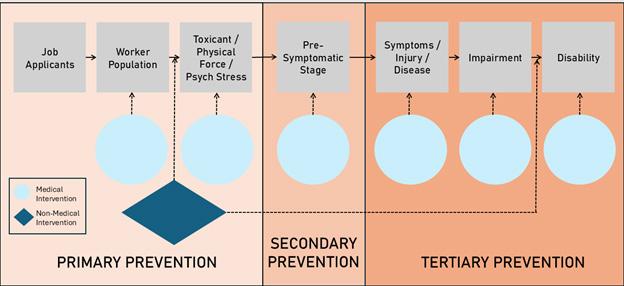
An employer may conduct certain “nonmedical” assessments of job applicants before offering employment. Examples of this type of assessment might include a drug test, a functional capacity evaluation, or a typing test. The Americans with Disabilities Act prohibits employers from requiring a medical examination until after a job offer, but they may make employment contingent upon the recommendations of a medical evaluation. Employers are responsible for providing a safe workplace for contracted and temporary workers, but the contractor or temporary worker agency commonly manages the medical interventions identified in the figures. The pre-placement exam may include a comprehensive history, examination, and testing (except for genetic assessments, including family history). The goal of the exam is to perform a medical assessment of the examinee’s medical fitness for performing the offered job without imminent, significant harm to themselves, their co-workers, or the public, with or without accommodations. Without releasing any protected health information, the examiner informs the employer whether, in their judgment, the individual can work without restrictions, should have accommodations to enable the person to perform the job safely, or cannot perform the proposed work even with accommodations. The examiner does not make an employment decision or determine whether to grant accommodations; by law, that responsibility rests with the employer.
The pre-placement exam provides an opportunity to identify and inform the employee of medical and lifestyle issues that could benefit them through medical and behavioral interventions. Employer benefits and programs may facilitate (though they cannot mandate) workers' pursuit of these interventions.
At the primary prevention stage (see Figure 7), non-medical interventions may include measures to prepare the worker to safely manage job demands, such as ergonomic and safety training, physical conditioning, acclimatization to temperature extremes, and the design of accommodations. Safety, IH, and HR professionals can collaborate to create a safe and supportive work environment that protects and, if possible, advances workers' health, safety, and well-being. Medical biomonitoring can help identify whether the IH and safety controls are effective in preventing hazardous occupational exposures.
OEM physicians bring specialized expertise in identifying, evaluating, and preventing illness caused by toxic exposures across the full spectrum of a worker’s daily life. Their training spans clinical medicine, epidemiology, toxicology, exposure science, and ergonomics, enabling them to determine whether a specific risky substance, occupational or nonoccupational, has contributed to disease or injury. This includes well-established workplace hazards such as asbestos, silica, lead, solvents, pesticides, and irritant or allergenic dusts, as well as emerging public health concerns like PFAS and microplastics. By applying the emerging concept of the “exposome”—the cumulative 24-hour exposure profile across work, home, transit, and community settings—OEM physicians can recommend targeted preventive strategies to reduce the onset, progression, or recurrence of diseases such as asthma, COPD, cancers, heavy metal toxicity, and solventinduced neurotoxicity. When prevention fails and causation is established, they also play a key role in facilitating appropriate workers’ compensation support.
Lifestyle medicine physicians, whose “Reduce / Avoid Risky Substances” pillar has traditionally emphasized addictive drugs, can be strengthened through collaboration with OEM by also considering occupational and environmental toxicants into prevention strategies. Many chronic diseases central to lifestyle medicine, including cardiovascular disease, diabetes, metabolic syndrome, respiratory illness, and some cancers, are influenced not only by
personal behaviors but also by cumulative toxic exposures. Similarly, while reducing harmful exposures remains the primary prevention strategy, adherence to evidence-based lifestyle behaviors may help mitigate some of the adverse health effects associated with cumulative lowgrade toxic exposures. Assessing and minimizing both workplace and non-workplace sources enhances the rigor of prevention efforts and supports comprehensive, evidence-based strategies to protect and improve worker health.
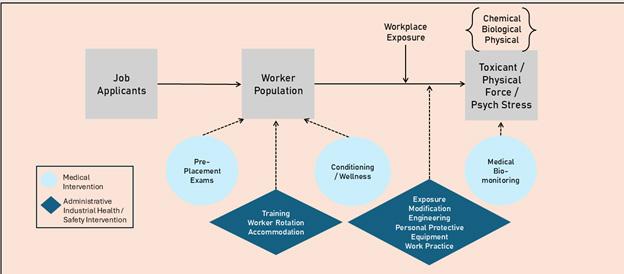
Lifestyle medicine physicians, whose “Reduce / Avoid Risky Substances” pillar has traditionally emphasized addictive drugs, can be strengthened through collaboration with occupational and environmental medicine by also considering occupational and environmental toxicants into prevention strategies. Many chronic diseases central to lifestyle medicine, including cardiovascular disease, diabetes, metabolic syndrome, respiratory illness, and
some cancers, are influenced not only by personal behaviors but also by cumulative toxic exposures. Likewise, potentially adverse health effects from cumulative low-grade toxic exposures, can be mediated by adhering to health lifestyle behaviors as promoted by lifestyle medicine experts. Assessing and minimizing both workplace and non-workplace sources enhances the rigor of prevention efforts and supports comprehensive, evidence-based strategies to protect and improve employee health.
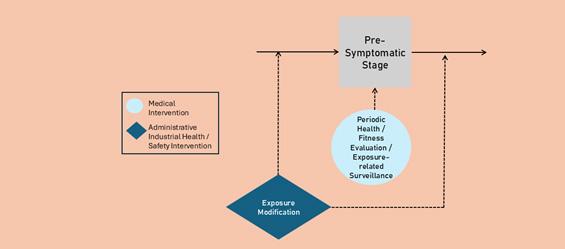
When primary and secondary prevention fail to prevent illness or injury, the OEM clinician evaluates the worker and recommends a treatment plan that may include referrals to other specialists and rehabilitation professionals, as well as lifestyle recommendations. ACOEM has published evidence-based guidelines to optimize medical management. Some states use these or
other organizations’ guidelines to support insurer decisions for approving treatment plans. Even when states have not adopted guidelines as the standard of care, insurers may use them or their own internal guidelines for case management. Figure 8 displays these tertiary prevention strategies used by OEM practitioners.
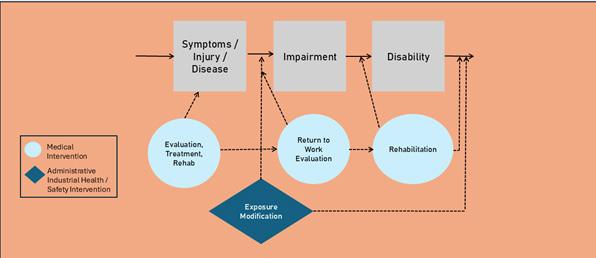
The OEM professional also has the responsibility to assess and communicate their opinion about “causation,” i.e., whether the individual’s work caused the injury or illness. This causation opinion must be based on epidemiologic as well as individual clinical history that supports a causal link. However, whether an insurer accepts a claim as work-related is also shaped by state and federal law. Individual states can establish different standards for accepted causal links. For some occupations, such as firefighting, causation may be legally assumed for specific medical conditions. The clinician’s causation opinion provides the foundation for worker’s compensation benefits provided by an insurer. The insurer may accept the clinician’s causation decision or contest it by referring the matter to an “independent” examiner. Administrative courts serve to adjudicate contested claims. The OEM professional has a responsibility to document their rationale for their causation opinion to facilitate an informed, fair, and prompt decision
by the insurance adjuster, and may be called to testify under oath.
The OEM clinician is also responsible for writing a “return to work prescription” after every work-related visit. Robust evidence supports the therapeutic value of staying at work with accommodations as needed or of an early return to work. The management of this aspect of a work-related condition is a key factor in whether an individual’s injury or illness ultimately resolves and whether they successfully return to work. When work status is correctly managed, permanent disability is usually a preventable condition, even after serious injury or illness. The critical nature of this aspect of occupational healthcare usually demands much more frequent follow-up than is typical for non-occupational conditions.
As with other stages of prevention, non-medical interventions can play a prominent role in supporting recovery and return to work. These
interventions can include ergonomic changes, modifications to safety and IH controls, personal accommodations, or changes in job tasks. When no appropriate worksite changes allow a worker to return to work, vocational rehabilitation may enable work in other employment settings to avoid disability. As an additional example of the benefit of integration of OEM and lifestyle medicine, both OEM practitioners and lifestyle medicine practitioners can play an important role in nutrition support simply by helping workers remain gainfully employed. Helping injured and ill workers recover more completely and more quickly can help them extend their ability to continue working and to work safely. This is easier said than done but certainly can be accomplished to a useful degree for many workers. Optimizing the ability to work and support themselves and their families can make purchasing healthy food easier and make lifestyle medicine recommendations more feasible for many workers of all income levels. This could be done by strengthening options for lifestyle medicine practitioners to refer patients to OEM practitioners, by providing relevant OEM training to lifestyle medicine practitioners, or both.
In alignment with the Total Worker Health® (TWH) approach, OEM recognizes social determinants of health which may influence worker health, safety, and well-being.17 These include a myriad of factors including control of hazards and exposures, organization of work, built environment supports, leadership, community supports, compensation and benefits , and internal and federal policies. Evidence has accumulated to demonstrate how working conditions such as these influence the likelihood that workers will embrace employer-
sponsored health promotion. In addition, OEM recognizes the interaction of occupational risk factors with personal risk factors and how this interrelationship is associated with health outcomes.8 In addition, lifestyle medicine and OEM practitioners can participate in addressing disparities in lifestyle health risk factors for chronic diseases across many categories including, but not limited to, socioeconomic status, income, race, ethnicity, sex, migration status, housing insecurity, stress, and occupation.
A guide to implementing TWH has been described by Rathke at the National Oceanic and Atmospheric Administration (NOAA) National Environmental Satellite, Data, and Information Service (NESDIS). It describes how NESDIS promotes workplace health and productivity through the TWH Program, which integrates science-based system designs to strengthen mission capacity and foster a healthier workforce. Grounded in OEM and work design research, NESDIS has translated evidence into practical, immediately applicable insights that promote healthier, more sustainable performance.
Much has been written about the Culture of Health and how companies with a strong culture of health outperform the market.115 The Robert Wood Johnson Foundation considers a culture of health to be one in which: “good health and wellbeing flourish across geographic, demographic, and social sectors; fostering healthy equitable communities guides public and private decision making; and everyone has the opportunity to make choices that lead to healthy lifestyles.”122 This definition is not just applicable to the U.S., but equally to any organization intent on creating a culture of health. The Global Reporting Institute (GRI) has collaborated with the Robert Wood Johnson Foundation to define a Culture of Health for Business (COH4B) Framework, on “the role of business in impacting the health and well-being of its stakeholders, linked to a curated set of principles and business practices. It is a multi-stakeholder-developed, evidence-based public tool which companies can use to take comprehensive action on the health and wellbeing of workers, families, and communities.”123
The 16 business practices across 4 pillars help global corporations align their GRI reporting to the framework.
Organizations that are not required to adhere to GRI reporting standards, may consider reviewing Professor Quelch’s Culture of Health “fourpillar framework,” co-developed by Harvard T.H. Chan School of Public Health and Harvard Business School.124 It offers a way for businesses to evaluate their actions to maximize the wellbeing of workers, consumers, the community, and the environment, ultimately contributing to a healthier population and economy.
The four priority areas of the Culture of Health framework are:
9 Worker Health: consideration of worker well-being, including a strong culture of safety
9 Consumer Health: healthfulness and safety of products and services
9 Community Health: health and safety efforts in the location of doing business
9 Environmental Health: impact of operations on the environment
Improving an organization’s culture is a journey. It requires knowing the current status, the target, and the available resources. Progress is what matters. While each company starts at a different baseline, with intervention and effort, each company can improve its culture of health. Examples of successful culture change can be found in Fabius, et al.115
A healthy culture allows its workforce to thrive by addressing well-being and prevention while enabling all workers to perform at their best. A culture of health is more specific to workforce health and promoting healthy lifestyle behaviors at work and is often defined as “wellness.” It is a priority in organizational culture.
Developing a sustainable culture of health and well-being “requires a systematic approach addressing transformational drivers of culture change, as well as comprehensive efforts to improve health and well-being to reduce costs and illness burdens.”115 TWH emphasizes the importance of management’s commitment to health and well-being. Managers can leverage
existing organizational elements such as workforce development (health literacy), servant leadership (removing barriers to healthy lifestyle and role-modeling healthy lifestyle behaviors), and continuous improvement at the grassroots level. From the behavior change model called social cognitive therapy, we know that a strong environment (peers, credible role models, workplace cues) and creating selfefficacy through capacity building, will nudge people to behavior change. It is about creating a culture where both the environment and peers encourage each other to adopt healthy lifestyle behaviors, not just at home but also in the workplace.
• AHA wellbeing scorecard: https://www. heart.org/en/healthy-living/companycollaboration/well-being-works-better/ workforce-well-being-scorecard
• CDC Worksite Health Scorecard: https:// www.cdc.gov/workplace-health-promotion/ php/scorecard/index.html
• Healthy Work Survey: https://www. healthywork.org/employers/healthy-worksurvey-employers/
• HERO scorecard: https://hero-health.org/ hero-scorecard/
• Mayo Clinic Wellbeing Index: https://www. mywellbeingindex.org/
• NIOSH Well BQ: https://www.cdc.gov/niosh/ twh/wellbq/
PHYSICAL ACTIVITY
• International Physical Activity Questionnaire (IPAQ)
• Global Physical Activity Questionnaire (GPAQ)
• Godin-Shephard Leisure-Time Physical Activity Questionnaire (GLTEQ)
• Baecke Physical Activity Questionnaire
• Accelerometers (e.g., ActiGraph)
• Wearables (Fitbit, Garmin, Apple Watch)
• Pedometers
• VO₂ max testing
• Resting heart rate
• Heart rate variability
NUTRITION
• Dietary Screener Questionnaire (DSQ –NHANES)
• Rapid Eating Assessment for Participants (REAP-S)
• Starting the Conversation (STC)
• Block Food Frequency Questionnaire
• Harvard/Willett Food Frequency Questionnaire
• Food Choice Questionnaire (FCQ)
• Dutch Eating Behavior Questionnaire (DEBQ)
• Mediterranean Diet Adherence Screener (MEDAS)
• Beverage Intake Questionnaire (BEVQ-15)
RESTORATIVE SLEEP
• Pittsburgh Sleep Quality Index (PSQI)
• Epworth Sleepiness Scale (ESS)
• Insomnia Severity Index (ISI)
• Sleep Hygiene Index (SHI)
• Occupational Fatigue Exhaustion Recovery (OFER) Scale
• Chalder Fatigue Questionnaire
• Actigraphy (Wearable Sleep Monitoring)
• Consumer Wearables (Fitbit, Oura, Garmin)
• STOP-BANG (sleep apnea risk)
• Berlin Questionnaire (sleep apnea screening)
SOCIAL CONNECTIVITY
• UCLA Loneliness Scale
• De Jong Gierveld Loneliness Scale
• Job Content Questionnaire (JCQ – Social Support Subscale)
• Lubben Social Network Scale (LSNS-6)
REDUCE / AVOID RISKY SUBSTANCES
• Alcohol Use Disorders Identification Test (AUDIT)
• AUDIT-C (Short Version)
• Fagerström Test for Nicotine Dependence (FTND)
• Global Adult Tobacco Survey (GATS) Core Items
• Drug Abuse Screening Test (DAST-10)
• ASSIST (Alcohol, Smoking and Substance Involvement Screening Test)
• Opioid Risk Tool (ORT)
MANAGE STRESS
• Perceived Stress Scale (PSS-10)
• Job Content Questionnaire (JCQ)
• Effort–Reward Imbalance (ERI) Questionnaire
• Copenhagen Psychosocial Questionnaire (COPSOQ)
• Maslach Burnout Inventory (MBI)
• Brief COPE Inventory
• Coping Self-Efficacy Scale (CSES)
ALSO, ATTITUDE AND MINDSET
• General Health Questionnaire (GHQ-12)
• Patient Health Questionnaire (PHQ-9)
• WHO-5 Well-Being Index
• Psychological Capital Questionnaire (PCQ)
• Growth Mindset Scale (Dweck)
• Connor-Davidson Resilience Scale (CD-RISC)
• Utrecht Work Engagement Scale (UWES)
*Disclaimer: Some resources shared may require purchase, subscription, or thirdparty registration. Inclusion does not imply endorsement.
Optional version to utilize for design: https:// docs.google.com/spreadsheets/d/1XLP4ntsM PXllNRSh0TlmMCDsl4iu9agslGOsOpcfqUM/ edit?usp=sharing
Centers for Disease Control and Prevention –National Center for Chronic Disease Prevention and Health Promotion
• Physical Activity Breaks for the Workplace Resource Guide.
• https://www.cdc.gov/workplace-healthpromotion/media/pdfs/2024/06/WorkplacePhysical-Activity-Break-Guide-508.pdf
Physical Activity Guidelines for Americans, 2nd Edition (PDF)
• Comprehensive science-based guideline from the U.S. Department of Health and Human Services (HHS). Covers recommendations across age groups, intensity, dose, and special populations.
• https://health.gov/sites/default/ files/2019-09/Physical_Activity_ Guidelines_2nd_edition.pdf
WHO Physical Activity Facts & Global Guidelines Overview
• World Health Organization fact sheet summarizing why physical activity matters globally and linking to WHO Global Guidelines on Physical Activity and Sedentary Behaviour.
• https://www.who.int/news-room/factsheets/detail/physical-activity
American College of Lifestyle Medicine — Recommendations & Standards
• Lifestyle medicine clinical positions on the role of physical activity within therapeutic lifestyle interventions. Includes guideline context for chronic disease management.
• https://lifestylemedicine.org/ recommendations-standards
American College of Lifestyle Medicine
First Clinical Practice Guideline on Lifestyle Interventions for Type 2 Diabetes
• Latest lifestyle medicine clinical guideline highlighting evidence-based physical activity as a pillar in T2D prevention and remission strategies.
• https://lifestylemedicine.org/lifestylemedicine-and-the-path-to-type-2-diabetesremission/
AHA (American Heart Association) Physical Activity Recommendations Overview
• Patient-friendly summary of Physical Activity Guidelines for heart health professionals and the general public.
• https://www.heart.org/en/healthy-living/ fitness/fitness-basics/aha-recs-for-physicalactivity-in-adults
Centers for Disease Control and Prevention — Active People, Healthy Nation Initiative
• National public health initiative aiming to increase physical activity levels across communities. Includes implementation toolkits.
• https://www.cdc.gov/physicalactivity/ activepeoplehealthynation/index.html
Community Preventive Services Task Force
— The Community Guide: Physical Activity Interventions
• Systematic reviews of community and workplace strategies (e.g., point-of-decision prompts, built environment approaches).
• https://www.thecommunityguide.org/topic/ physical-activity
World Health Organization — Global Action Plan on Physical Activity
• Population-level strategy promoting activity through policy, transportation, and workplace design.
• https://www.who.int/publications/i/ item/9789241514187
American College of Sports Medicine (ACSM)
Physical Activity Guideline Resources
• ACSM provides evidence-based recommendations, scientific reviews, and practice tools used widely by clinicians, researchers, and exercise professionals.
• https://acsm.org/education-resources/ trending-topics-resources/physical-activityguidelines
CDC Physical Activity Guidelines & Recommended Strategies (CDC)
• Centers for Disease Control and Prevention guidance on amounts/types of activity and community-level, evidence-based strategies for implementation.
• https://www.cdc.gov/physical-activity/php/ guidelines-recommendations/index.html
Strong People Strong Bodies
• Community health evidence-based strength training, wellness education, and related programs for midlife and older adults.
• www.strongpeopleprogram.org
Walking spree Activity Challenges (not affiliated)
• Corporate health and wellness platform designed to help employers motivate their workers to live healthier, more active lifestyles through fun, engaging digital programs and challenges.
• https://walkingspree.com/ Wellable
• All-in-one employee wellness, rewards, and recognition platform that helps organizations run customizable programs to engage workers in holistic health challenges.
• https://www.wellable.co/ Wellhub
• Subscription to fitness, mindfulness, nutrition, sleep, and other well-being services to boost engagement and health outcomes.
• https://wellhub.com/
Centers for Disease Control and Prevention — Nutrition Guidelines & Recommendations
• Evidence-based dietary guidance and population health implementation strategies.
• https://www.cdc.gov/nutrition/php/ guidelines-recommendations/index.html
Community Preventive Services Task Force — The Community Guide: Nutrition & Obesity Prevention
• Systematic evidence on worksite food policies, pricing strategies, and environmental interventions.
• https://www.thecommunityguide.org/topic/ nutrition
National Academies of Sciences, Engineering, and Medicine — Dietary Reference Intakes (DRIs)
• Scientific nutrient intake standards informing clinical and public health nutrition practice.
• https://ods.od.nih.gov/HealthInformation/ nutrientrecommendations.aspx
U.S. Department of Health and Human Services & U.S. Department of Agriculture — Dietary Guidelines for Americans (2020–2025)
• Foundational, science-based national nutrition guidance for disease prevention and health promotion across the lifespan.
• https://www.dietaryguidelines.gov/
World Health Organization — Healthy Diet Fact Sheet & Global Recommendations
• Global evidence-based dietary guidance focused on chronic disease prevention and nutrient adequacy.
• https://www.who.int/news-room/factsheets/detail/healthy-diet
Academy of Nutrition and Dietetics — EvidenceBased Nutrition Practice Guidelines
• Condition-specific clinical nutrition recommendations supported by systematic review.
• https://www.eatrightpro.org/practice/ guidelines-and-positions/evidence-basednutrition-practice-guidelines
American College of Lifestyle Medicine — Clinical Practice Guidelines (Type 2 Diabetes & Lifestyle Intervention)
• Evidence-based guidance incorporating therapeutic nutrition into chronic disease management.
• https://lifestylemedicine.org/ recommendations-standards/
American College of Lifestyle Medicine — Food as Medicine Position Statement
• ACLM’s evidence-based dietary position recommending a whole-food, plantpredominant eating pattern for prevention, treatment, and potential reversal of lifestylerelated chronic disease.
• https://lifestylemedicine.org/aclm-releasesupdated-dietary-position-statement/
American College of Lifestyle Medicine — Six Pillars of Lifestyle Medicine (Nutrition Component)
• Defines whole, minimally processed plantpredominant nutrition as a core therapeutic pillar.
Harvard T.H. Chan School of Public Health — Healthy Eating Plate
• Evidence-informed dietary pattern emphasizing vegetables, fruits, whole grains, and healthy proteins.
• https://nutritionsource.hsph.harvard.edu/ healthy-eating-plate/
American Heart Association — Workplace Health Solutions: Nutrition
• Employer guidance on improving food environments and worker dietary behaviors.
• https://www.wellbeingworksbetter.org/-/ media/Healthy-Living-Files/Foodscape/ Healthy_Workplace_Food_and_Beverage_ Guide.pdf?sc_lang=en
Healthy Eating Research — Policy & Environmental Strategies
• Evidence summaries supporting institutional and workplace nutrition policy change.
• https://healthyeatingresearch.org/
World Health Organization — Healthy Diet & Food Policy Guidance
• Global public health guidance on population nutrition strategies and workplace relevance.
• https://www.who.int/health-topics/healthydiet
American College of Lifestyle Medicine — ACLM Learning Center (Nutrition Courses & Tools)
• Clinical education modules and implementation resources for “Food as Medicine” integration into practice.
• https://learning.lifestylemedicine.org/
American Heart Association — Healthy Eating Recommendations
• Evidence-based heart-healthy dietary guidance aligned with chronic disease prevention.
• https://www.heart.org/en/healthy-living/ healthy-eating
Centers for Disease Control and Prevention — Healthy Eating for Healthy Weight
• Practical dietary strategies linked to weight management and metabolic health.
• https://www.cdc.gov/healthy-weightgrowth/healthy-eating/index.html
Nutrition.gov — Healthy Eating Tools & Tips
• Consumer-friendly tools, meal planning resources, and dietary education materials.
• https://www.nutrition.gov/topics/basicnutrition/healthy-eating
15-Day Whole Food Plant-Based Jumpstart Program
• ACLM Certified Program. Physicianguided, evidence-based lifestyle nutrition intervention to prevent or reverse chronic disease.
• https://rochesterlifestylemedicine.org/aboutjumpstart/
Adopt a Lifestyle
• Self Guided or 3, 6, 9, 12-month Partner with a Coach Programs.
• https://adoptalifestyle.com/programs Esselstyn Foundation (not affiliated)
• Free or low-cost experiential programs and partnerships focused on spreading wholefood, plant-based nutrition education, disease prevention, and lifestyle change.
• https://esselstynfamilyfoundation.org/thefoundation-in-action/
Food For Life (Physicians Committee for Responsible Medicine - PCRM)
• Nutrition education about plant-based eating for chronic health conditions through handson classes and practical skills.
Full Plate Living
• No cost ACLM Certified Program with options including online self-paced 7 sessions, 7 session facilitated groups, 8 sessions, or shared medical appointments.
CORE GUIDELINE DOCUMENTS
American Academy of Sleep Medicine — Recommended Amount of Sleep for Pediatric Populations
• Consensus recommendations for infants, children, and adolescents.
• https://aasm.org/resources/pdf/ pediatricsleepdurationconsensus.pdf
American Academy of Sleep Medicine & Sleep Research Society — Adult Sleep Duration Consensus Statement
• Evidence-based recommendation that adults should sleep 7 or more hours per night on a regular basis to promote optimal health.
• https://aasm.org/resources/pdf/pressroom/ adult-sleep-duration-consensus.pdf
Centers for Disease Control and Prevention — Sleep and Sleep Disorders Guidelines
• Public health guidance on recommended sleep duration and sleep health promotion.
• https://www.cdc.gov/sleep/index.html
World Health Organization — WHO Guidelines on Physical Activity and Sedentary Behavior (Sleep Integration)
• Includes 24-hour movement guidelines integrating sleep, sedentary behavior, and activity.
• https://www.who.int/publications/i/ item/9789240015128
American Academy of Sleep Medicine — Clinical Practice Guideline for the Treatment of Chronic Insomnia in Adults
• Evidence-based recommendations for behavioral and pharmacologic management of insomnia (CBT-I as first-line therapy).
• https://jcsm.aasm.org/doi/10.5664/ jcsm.6470
American College of Physicians — Management of Chronic Insomnia Disorder in Adults
• Guideline recommending cognitive behavioral therapy for insomnia (CBT-I) as initial treatment.
• https://www.acpjournals.org/doi/10.7326/ M15-2175
National Heart, Lung, and Blood Institute — Sleep Health & Disorders Evidence Resources
• Clinical information on sleep apnea, insomnia, and cardiometabolic risks.
• https://www.nhlbi.nih.gov/science/sleepscience-and-sleep-disorders
National Institute for Occupational Safety and Health — Workplace Fatigue & Shift Work Resources
• Guidance on fatigue risk management, shift work disorder, and workplace safety.
• https://www.cdc.gov/niosh/topics/ workschedules/ National Safety Council
• Fatigue Cost Calculator & Employer Toolkit Tools for quantifying productivity and safety risks associated with sleep deprivation.
• https://www.nsc.org/workplace/safetytopics/fatigue/what-is-fatigue-costing-yourcompany
American Academy of Sleep Medicine — Sleep Education (Patient Resources)
• Clinician-validated educational tools and sleep disorder screening information.
• https://sleepeducation.org/
Centers for Disease Control and Prevention — Sleep Hygiene & Tips for Better Sleep
• Practical behavioral guidance aligned with evidence-based sleep health recommendations.
• https://www.cdc.gov/sleep/about_sleep/ sleep_hygiene.html
National Sleep Foundation — Sleep Health Recommendations
• Evidence-informed sleep duration and quality guidance for the public and employers.
• https://www.sleepfoundation.org/
Circadian Care
• Integrated, coordinated care teams, athome diagnostics, remote monitoring, and treatment to help patients manage complex chronic conditions like heart, metabolic, pulmonary, endocrine, and sleep disorders more quickly and effectively.
• https://www.circadiancare.com/
Centers for Disease Control and Prevention — Loneliness and Social Isolation Resources
• Public health overview linking social connection to cardiometabolic and mental health outcomes.
• https://www.cdc.gov/social-connectedness/ risk-factors/
National Academies of Sciences, Engineering, and Medicine — Social Isolation and Loneliness in Older Adults (Consensus Report)
• Comprehensive evidence review on health impacts and intervention strategies.
• https://nap.nationalacademies.org/ catalog/25663/social-isolation-andloneliness-in-older-adults
U.S. Department of Health and Human Services — Our Epidemic of Loneliness and Isolation (Surgeon General’s Advisory)
• Landmark public health advisory outlining health risks of social disconnection and national strategies to strengthen social bonds.
• https://www.hhs.gov/sites/default/files/ surgeon-general-social-connection-advisory. pdf
World Health Organization — Social Determinants of Health Framework
• Global framework recognizing social connectedness as a determinant of physical and mental health outcomes.
• https://www.who.int/health-topics/socialdeterminants-of-health
American Psychological Association — Evidence on Social Support & Health
• Scientific summaries demonstrating reduced mortality and improved resilience with strong social ties.
• https://www.apa.org/monitor/2019/05/cecorner-relationships
Harvard T.H. Chan School of Public Health — Human Flourishing Program
• Research linking relationships to longevity and cardiometabolic health.
• https://hfh.fas.harvard.edu/
National Institute on Aging — Social Isolation, Loneliness & Health
• Clinical evidence linking social disconnection to dementia, heart disease, and depression.
• https://www.nia.nih.gov/health/lonelinessand-social-isolation
American Heart Association — Workplace WellBeing & Belonging
• Guidance on fostering social support and psychological safety in organizations.
• https://www.heart.org/en/professional/ workplace-health
National Institute for Occupational Safety and Health — Total Worker Health®: Social & Organizational Factors
• Framework integrating psychosocial safety, belonging, and supportive work culture.
• https://www.cdc.gov/niosh/twh/
U.S. Surgeon General — Framework for Workplace Connection
• Practical employer guidance to build cultures of belonging and reduce workplace isolation.
• https://www.hhs.gov/surgeongeneral/ priorities/workplace-well-being/index.html
World Health Organization — Mental Health at Work Policy Brief
• Evidence linking supportive workplace relationships with reduced burnout and improved productivity.
• https://www.who.int/publications/i/ item/9789240053052
Campaign to End Loneliness — Loneliness Measurement Guidance
• Validated tools for measuring loneliness in population and organizational settings.
• https://www.cdc.gov/social-connectedness/ about/
Campaign to End Loneliness — Loneliness Measurement Guidance*
• Validated tools for measuring loneliness in population and organizational settings.
• https://www.campaigntoendloneliness.org/
Greater Good Science Center — EvidenceBased Practices for Building Connection*
• Research-informed interventions such as gratitude, compassion training, and structured peer engagement.
• https://greatergood.berkeley.edu/
University of California, Los Angeles — UCLA Loneliness Scale
• Validated psychometric tool to assess perceived loneliness.
• https://sparqtools.org/mobility-measure/ ucla-loneliness-scale-version-3/
Harvard Medical School — Health Benefits of Strong Relationships
• Evidence summaries linking connection to immune function and longevity.
• https://www.health.harvard.edu/mindand-mood/the-health-benefits-of-strongrelationships
National Alliance on Mental Illness — Building Social Support
• Practical guides for strengthening community and peer support.
• https://www.nami.org/Your-Journey/ Individuals-with-Mental-Illness
Stanford Center for Compassion and Altruism Research and Education — Compassion Training Programs
• Evidence-based programs supporting empathy and pro-social behavior development.
• https://ccare.stanford.edu/
National Academies of Sciences, Engineering, and Medicine — Fostering Healthy Mental, Emotional, and Behavioral Development
• Evidence review on protective cognitive and emotional factors across the lifespan.
• https://nap.nationalacademies.org/ catalog/25201
U.S. Department of Health and Human Services — Surgeon General’s Advisory on Mental Health & Well-Being
• Identifies optimism, belonging, meaning, and emotional health as foundational public health priorities.
• https://www.hhs.gov/surgeongeneral/ priorities/mental-health/index.html
World Health Organization — Mental Health Action Plan 2013–2030
• Framework promoting mental well-being, prevention, and strengthening protective psychological factors across populations.
• https://www.who.int/publications/i/ item/9789240031029
MEDICINE & CLINICAL CONTEXT
American Psychological Association — Clinical Practice Guideline for Depression (CBT & Behavioral Activation)
• Evidence supports cognitive restructuring and behavioral activation for improving maladaptive thought patterns and outlook.
• https://www.apa.org/depression-guideline
National Institute on Aging — Positive Affect & Aging Research
• Evidence linking optimism and purpose in life to reduced mortality and improved cardiovascular outcomes.
• https://www.nia.nih.gov/research
WORKPLACE RESOURCES
Gallup Organization — Workplace Engagement & Well-Being Research
• Evidence linking growth mindset, recognition, and purpose to performance and retention.
• https://www.gallup.com/workplace
U.S. Surgeon General — Framework for Workplace Mental Health & Well-Being
• Promotes meaning, recognition, autonomy, and belonging to strengthen workplace mindset and engagement.
• https://www.hhs.gov/surgeongeneral/ priorities/workplace-well-being/index.html
IMPLEMENTATION RESOURCES
American Psychological Association — Building Resilience Roadmap
• Evidence-informed steps to strengthen adaptive thinking and cognitive flexibility.
• https://www.apa.org/topics/resilience
University of Pennsylvania Positive Psychology Center — PERMA Model & Evidence-Based Interventions
• Framework for cultivating Positive emotion, Engagement, Relationships, Meaning, and Accomplishment.
• https://ppc.sas.upenn.edu/
SUPPLEMENTARY RESOURCES
American Psychological Association — Growth Mindset Research Overview
• Evidence supporting adaptive cognitive framing in performance and resilience outcomes.
• https://www.apa.org/monitor
Mayo Clinic — Positive Thinking & Health Outcomes
• Evidence linking optimistic explanatory style with improved immune and cardiovascular health.
• https://www.mayoclinic.org/healthy-lifestyle/ stress-management/in-depth/positivethinking/art-20043950
National Institutes of Health — Purpose in Life & Health Research
• Research summaries connecting meaning and psychological well-being to reduced chronic disease risk.
• https://www.nih.gov/news-events
Centers for Disease Control and Prevention — Alcohol & Public Health Guidelines
• National recommendations on alcohol consumption limits and prevention strategies.
• https://www.cdc.gov/alcohol/index.htm
U.S. Department of Health and Human Services
Office of the Surgeon General – Alcohol and Cancer Risk
• Scientific evidence for causal link between alcohol consumption and risk for at least seven types of cancer, including breast (in women), colorectum, esophagus, voice box, liver, mouth, and throat.
• https://www.hhs.gov/surgeongeneral/ reports-and-publications/alcohol-cancer/ index.html
U.S. Preventive Services Task Force — Screening & Behavioral Counseling for Unhealthy Drug Use
• Evidence-based recommendations for screening adults and adolescents in primary care and providing brief behavioral interventions.
• https://www.uspreventiveservicestaskforce. org/uspstf/recommendation/drug-use-illicitscreening
U.S. Preventive Services Task Force — Tobacco Smoking Cessation in Adults & Pregnant Persons
• Evidence-based guidance on behavioral and pharmacotherapy interventions.
• https://www.uspreventiveservicestaskforce. org/uspstf/recommendation/tobacco-usein-adults-and-pregnant-women-counselingand-interventions
U.S. Preventive Services Task Force — Unhealthy Alcohol Use: Screening & Behavioral Counseling
• Grade B recommendation for screening and
brief counseling interventions in primary care.
• https://www.uspreventiveservicestaskforce. org/uspstf/recommendation/unhealthyalcohol-use-in-adolescents-and-adultsscreening-and-behavioral-counselinginterventions
World Health Organization — Global Strategy to Reduce the Harmful Use of Alcohol
• Population-level policy framework and intervention guidance.
• https://www.who.int/publications/i/ item/9789241599931
World Health Organization — WHO Framework Convention on Tobacco Control (FCTC)
• International treaty guiding tobacco control policies and cessation strategies.
• https://www.who.int/news-room/factsheets/detail/tobacco
American Society of Addiction Medicine — National Practice Guideline for the Treatment of Opioid Use Disorder
• Evidence-based clinical recommendations for pharmacologic and behavioral treatments.
• https://www.asam.org/quality-care/clinicalguidelines/national-practice-guideline
National Institute on Drug Abuse — Principles of Drug Addiction Treatment
• Research-based guide to effective treatment approaches.
• https://nida.nih.gov/research-topics/ treatment
Substance Abuse and Mental Health Services
Administration — TIP 63: Medications for Opioid Use Disorder
• Comprehensive evidence-based clinical guideline for treatment of opioid use disorder
(MOUD).
• https://www.samhsa.gov/blog/substanceuse-disorders-treatment-options
National Institute for Occupational Safety and Health — Workplace Supported Recovery
• Guidance for employers on substance use prevention, stigma reduction, and recoveryfriendly policies.
• https://www.cdc.gov/niosh/topics/opioids/ workplace-supported-recovery.html
Substance Abuse and Mental Health Services
Administration — Drug-Free Workplace Toolkit
• Employer guidance for prevention programs and supportive policies.
• https://www.samhsa.gov/workplace
U.S. Department of Labor — Recovery-Ready Workplace Toolkit
• Resources for building recovery-supportive workplace cultures.
• https://www.dol.gov/agencies/eta/RRWhub/Toolkit
World Health Organization — Healthy Workplace Framework
• Guidance integrating substance use prevention into occupational health systems.
• https://www.who.int/publications/i/ item/9789241599313
Centers for Disease Control and Prevention — Tobacco Cessation Resources
• Evidence-based cessation strategies and quitline access.
• https://www.cdc.gov/tobacco/hcp/patientcare/quitlines-and-other-resources.html
Smokefree.gov — National Smoking Cessation Tools
• Free apps, text-based programs, and quitline resources.
• https://smokefree.gov/
Substance Abuse and Mental Health Services Administration — National Helpline (1-800-662HELP)
• Confidential referral and treatment resource for substance use disorders.
• https://www.samhsa.gov/find-help/nationalhelpline
American Heart Association — Alcohol & Cardiovascular Health Guidance
• Evidence summaries linking substance use to cardiometabolic outcomes.
• https://www.heart.org/en/healthy-living/ healthy-eating/eat-smart/nutrition-basics/ alcohol-and-heart-health
Centers for Disease Control and Prevention — Cannabis & Health Effects
• Evidence summaries on cannabis-related health risks.
• https://www.cdc.gov/cannabis/healtheffects/
National Cancer Institute — Tobacco & Cancer Evidence
• Research linking tobacco use to cancer and prevention strategies.
• https://www.cancer.gov/about-cancer/ causes-prevention/risk/tobacco
QuitAssist (not affiliated)
• Free online resource to help adult tobacco users quit smoking, vaping, or dipping by connecting them with expert information, tools, stories, and links to resources like quitlines and support programs.
• www.Quitassist.com
American Psychological Association — Clinical Practice Guideline for the Treatment of PTSD
• Evidence-based recommendations supporting cognitive behavioral therapy (CBT) and related interventions for stressrelated disorders.
• https://www.apa.org/ptsd-guideline
National Institute for Occupational Safety and Health — Stress at Work Framework
• Public health guidance outlining organizational and individual strategies to reduce workplace stressors.
• https://www.cdc.gov/niosh/stress/about/ index.html
National Institute of Mental Health — Stress and Coping Resources
• Scientific overview of stress physiology and validated coping interventions.
• https://www.nimh.nih.gov/health/ publications/so-stressed-out-fact-sheet
World Health Organization — Guidelines on Mental Health at Work (2022)
• Evidence-based recommendations for preventing work-related stress, burnout, and promoting mental well-being in occupational settings.
• https://www.who.int/publications/i/ item/9789240053052
LIFESTYLE MEDICINE & CLINICAL CONTEXT
American College of Physicians — Nonpharmacologic Treatment of Chronic Pain
• Guideline supporting stress-reducing therapies such as mindfulness, CBT, and exercise.
• https://www.acpjournals.org/doi/10.7326/ M16-2367
National Center for Complementary and Integrative Health — Mindfulness & Stress Reduction Evidence
• Research summaries on mindfulness-based stress reduction (MBSR), meditation, yoga, and relaxation therapies.
• https://www.nccih.nih.gov/health/providers/ digest/mind-and-body-approaches-forstress
Substance Abuse and Mental Health Services Administration — Evidence-Based Behavioral Health Interventions
• Repository of validated stress management and resilience programs.
• https://www.samhsa.gov/resource-search/ ebp
U.S. Surgeon General — Framework for Workplace Mental Health & Well-Being
• Evidence-informed guidance to reduce burnout and improve psychological safety at work.
• https://www.hhs.gov/surgeongeneral/ priorities/workplace-well-being/index.html
World Health Organization — WHO Self-Help Plus (SH+) Stress Management Program
• Evidence-based scalable stress management intervention for community and workplace use.
• https://www.who.int/publications/i/ item/9789240035119
Centers for Disease Control and Prevention — Coping with Stress
• Practical public health strategies for recognizing and managing stress.
• https://www.cdc.gov/mental-health/
Mayo Clinic — Stress Management Toolkit
• Evidence-informed guidance on relaxation techniques, cognitive reframing, and behavioral strategies.
• https://www.mayoclinic.org/healthy-lifestyle/ stress-management/basics/stress-basics/ hlv-20049495
American Psychological Association — Stress in America Report
• Annual survey data informing policy and workplace strategy.
• https://www.apa.org/news/press/releases/ stress
Curalinc
• Employee assistance and workforce mental health and well-being programs that offer clinically oriented, accessible behavioral health support, advocacy, and related services to help organizations support workers’ mental health and productivity.
• https://curalinc.com/
Harvard Medical School — Relaxation Response Research
• Evidence linking stress reduction practices to improved cardiometabolic markers.
• https://www.health.harvard.edu/mind-andmood/relaxation-techniques-breath-controlhelps-quell-errant-stress-response
The LIFT Project
• ACLM Certified Program. 10-week evidencebased well-being and resilience lifestyle medicine program to help workers improve mental wellbeing, reduce stress, and boost resilience while enhancing workplace culture and performance.
• https://www.theliftproject.global/ corporateedition/
Lyra Health
• Digital mental health benefits platform connecting workers to evidence-based therapy, coaching, and mental health support through an AI-enhanced, technology-driven care system designed to improve wellbeing and outcomes while reducing healthcare costs.
• https://www.lyrahealth.com/
National Alliance on Mental Illness — Managing Stress & Mental Health
• Community-based resources for coping and resilience building.
• https://www.nami.org/living-with-a-mentalhealth-condition/managing-stress/
Springheath
• Digital mental health platform with assessments, coaching, therapy, medication support, and wellness tools and tailored mental health support through a connected virtual system.
• https://try.springhealth.com/
Wellcoaches
• Certification program to support sustainable behavior change and well-being in clients.
• https://www.wellcoachesschool.com/
RESOURCES
American Institute for Cancer Research (AICR) Healthy 10 Challenge
• Free 10-week interactive online program to build healthier eating and activity habits based on evidence-based cancer prevention recommendations.
• https://healthy10challenge.org/
Building Resilient and Healthy Workplaces (not affiliated)
• Executive-level framing and case examples that connect workforce health to organizational performance.
• https://www3.weforum.org/docs/ WEF_Building_Resilient_and_Healthy_ Workplaces_2024.pdf
CDC NIOSH’s Fundamentals of Total Worker Health Approaches
• Essential Elements for Advancing Worker Safety, Health, and Well-Being
• https://www.cdc.gov/niosh/docs/2017-112/ default.html
Center for the Promotion of Health in the New England Workplace (CPH-NEW)
• Supports employers in assessing and building organizational readiness and management support to successfully start Total Worker Health® or Healthy Workplace Participatory Program with tools, surveys, and consultative guidance to evaluate resources, leadership commitment, and preparation before implementation.
• https://www.uml.edu/research/cph-new/ worker/organizational-readiness.aspx
Centers for Disease Control and Prevention’s National Diabetes Prevention Program (NDPP)
• Evidence-based initiative helping people at risk for type 2 diabetes make sustainable lifestyle changes through a year-long lifestyle change program.
• https://www.cdc.gov/diabetes-prevention/
The Chanwuyi Lifestyle Medicine Program (ACLM Certified Treatment Program)
• Diet, physical activity, stress management, and emotional well-being. ACLM Certified Program.
• https://www.chanwuyilifestyle.psy.cuhk.edu. hk/
Chronic Disease Self-Management Program (CDSMP) (not affiliated)
• Evidence-based workshop designed to help adults with chronic conditions develop skills, confidence, and strategies to better manage
symptoms and improve health and quality of life.
• https://selfmanagementresource.com/ programs/small-group/workplace-chronicdisease-self-management-small-group/
Paving the Path to Wellness
• https://www.pavingwellness.org/pavingprogram
Freedom from Diabetes (ACLM Certified Treatment Program)
• Improved health through holistic lifestyle changes involving personalized medical support, diet, exercise, and behavioral transformation
• freedomfromdiabetes.org
Full Plate Living (ACLM Certified Education Program)
• No cost ACLM Certified Shared Medical Appointment program. Can be run in the workplace as 8 session program w/o medical billing.
• https://www.fullplateliving.org/
Fuel-Restore-Invigorate-Connect-Protect 90/10 Principle of Energy Management
• Renewing and managing personal energy across physical, emotional, mental, and spiritual dimensions rather than just trying to manage time.
• https://hbr.org/2007/10/manage-yourenergy-not-your-time
Harvard Online course “Improving Your Business Through a Culture of Health”
• Online course for business leaders on implementing a “Culture of Health” to enhance organizational performance, reduce costs, boost revenue, and strengthen reputation.
• https://www.harvardonline.harvard.edu/ course/improving-your-business-throughculture-health
Harvard T.H. Chan Center for Work, Health, & Well-Being
• Implementing an Integrated Approach: Weaving Worker Health, Safety, and Wellbeing into the Fabric of Your Organization
• https://dash.harvard.edu/entities/ publication/2ad61d5d-5753-4bc5-a6fa01f3d237d79a
Healthy Workforces Initiative
• Establishes the workplace as a primary setting for prevention and holistic workforce health, with a strong global employer lens.
• https://initiatives.weforum.org/healthyworkforces/home
The LIFT Project (ACLM Certified Education Program)
• ACLM Certified Program 10 session program
• https://www.theliftproject.global/ corporateedition/
Massachusetts General Healthy Lifestyle Program
• Virtual group visits, health and wellness coaching, and education to help patients adopt healthy behaviors to prevent and treat chronic diseases and improve overall health.
• https://www.massgeneral.org/medicine/ internal-medicine/healthy-lifestyle-program
McKinsey Workplace Intervention Tool (not affiliated)
• Results of analysis of 115 evidence-based workplace interventions across four dimensions of health: physical, mental, social, and spiritual.
• https://www.mckinsey.com/mhi/ourinsights/from-potential-to-practical-fuelingperformance-with-proven-workplace-healthinterventions
Measuring What Matters: Assessing Workplace Mental Health and Well-being
• Focused on mental health but useful for governance, metrics, and accountability frameworks.
• https://www3.weforum.org/docs/WEF_ Assessing_Workplace_Mental_Health_and_ Well_being_2024.pdf
My Viva Inc. (ACLM Certified Education Program)
• Digital tools, expert coaching, and clinical integration to prevent and manage chronic disease, improve resilience, and drive meaningful change.
• https://discover.myvivaplan.com/
Nudj Health (ACLM Certified Treatment Program)
• Nutrition, physical activity, stress management and sleep
• https://www.nudjhealth.com/
OHS Vulnerability Measure, Institute for Work & Health (IWH)
• Measures the extent to which a worker may be vulnerable to occupational health and safety risks at work, associated with elevated rates of self-reported work injury and illness.
• https://www.iwh.on.ca/tools-and-guides/ ohs-vulnerability-measure
Ornish Program
• Nutrition, Exercise, Stress Management, Relationships
• https://www.ornish.com/
Pivio (formerly CHIP Program) (ACLM Certified Education Program)
• Evidence-based LM program by the Lifestyle Medicine Institute helping prevent, treat, and reverse chronic disease through sustainable behavior change while also reducing healthcare costs.
• https://piviohealth.com/
Thriving Workplaces: How Employers Can Improve Productivity and Change Lives (2025)
• Provides a clear business case (productivity, resilience, value creation) along with practical employer actions.
• https://reports.weforum.org/docs/WEF_ Thriving_Workplaces_How_Employers_ can_Improve_Productivity_and_Change_ Lives_2025.pdf
TrueNorth Health Center (ACLM Certified Treatment Program)
• To address chronic conditions, educational programs, lifestyle counseling, and evidencebased therapies to promote sustainable health improvements.
• https://www.healthpromoting.com/
WELL-LEADER MINDSET™ Masterclass
• 12-week wellness program for executives and other organization leaders.
• https://www.well-leadermindset.com
World Economic Forum: Employer Strategies for Encouraging Healthy Weight and Metabolic Wellness
• Particularly aligned with lifestyle medicine pillars (nutrition, physical activity, metabolic risk management) and offers concrete employer approaches.
• https://www.weforum.org/publications/ promoting-health-and-well-being-employerstrategies-for-encouraging-healthy-weightand-metabolic-wellness/
World Economic Forum: Workforce Health Across the Value Chain
• Speaks to coordinated, scaled approach across many stakeholders.
• https://www.weforum.org/publications/ workforce-health-across-the-value-chainorganizational-insights-to-mitigate-risk-andcreate-sustainable-growth/
1. Centers for Disease Control and Prevention. CDC Workplace Health Model. Available from: https://www. cdc.gov/workplace-health-promotion/php/model/index.html. Accessed February 19, 2026.
2. Boersma P, Black LI, Ward BW. Prevalence of multiple chronic conditions among US adults, 2018. Prev Chronic Dis. 2020; 17:200130. DOI: http://dx.doi.org/10.5888/pcd17.200130.
3. Centers for Disease Control and Prevention. Fast facts: Health and economic costs of chronic conditions. Available from: https://www.cdc.gov/chronic-disease/data-research/facts-stats/index.html. Accessed February 19, 2026.
4. Punnett L, Cavallari JM, Henning RA, Nobrega S, Dugan AG, Cherniack MG. Defining 'integration' for Total Worker Health®: A new proposal. Ann Work Expo Health. 2020 Mar 10;64(3):223-235. doi: 10.1093/ annweh/wxaa003. PMID: 32003780; PMCID: PMC7064271.
5. Poscia A, Moscato U, La Milia DI, Milovanovic S, Stojanovic J, Borghini A, Collamati A, Ricciardi W, Magnavita N. Workplace health promotion for older workers: A systematic literature review. BMC Health Serv Res. 2016 Sep 5;16 Suppl 5(Suppl 5):329. doi: 10.1186/s12913-016-1518-z. PMID: 27609070; PMCID: PMC5016729.
6. Song Z, Baicker K. Effect of a workplace wellness program on employee health and economic outcomes: A randomized clinical trial. JAMA. 2019;321(15):1491–1501. doi:10.1001/jama.2019.3307
7. Driscoll T, Turner MC, Villeneuve PJ, et al. The WHO/ILO joint estimates approach to occupational risk factor and burden of disease estimation: Providing actionable evidence with impact across sectors in countries. Ann Work Expo Health. 2025;69(3): 337–343. https://doi.org/10.1093/annweh/wxae107
8. Schulte PA, Pandalai S, Wulsin W, Chun H. Interaction of occupational and personal risk factors in workforce health and safety. Am J Public Health. 2012;102(3): 434-48. doi: 10.2105/AJPH.2011.300249. Epub 2011 Nov 28. PMID: 22021293; PMCID: PMC3487655.
9. Geller ES. The psychology of safety handbook. Lewis Publishers. 2001.
10. McKinsey Health Institute. Thriving workplaces: How employers can improve productivity and change lives. January 16, 2025. Available from: https://www.mckinsey.com/mhi/our-insights/thriving-workplaceshow-employers-can-improve-productivity-and-change-lives. Accessed February 19, 2026.
11. McLellan RK. Total Worker Health: A promising approach to a safer and healthier workforce. Ann Intern Med.2016;165:294-295. doi:10.7326/M16-0965.
12. Virtanen M, Lallukka T, Elovainio M, Steptoe A, Kivimäki M. Effectiveness of workplace interventions for health promotion. Lancet Public Health. 2025;10(6):e512-e530. doi: 10.1016/S2468-2667(25)00095-7.
13. Javanmardi S, Rappelt L, Zangenberg S, Heinke L, Baumgart C, Niederer D, Freiwald J. Effectiveness of workplace health promotion programs for industrial workers: A systematic review. BMC Public Health. 2025;25(1):168. doi: 10.1186/s12889-025-21365-8.
14. Goetzel RZ, Henke RM, Tabrizi M, et al. Do workplace health promotion (wellness) programs work? J Occup Environ Med. 2014;56(9):927-934.
15. Hymel PA, Stave GM, Burton WN, et al.; ACOEM Presidential Task Force on Lifestyle Medicine and OEM Practice. Incorporating Lifestyle Medicine Into Occupational Medicine Practice: ACOEM Guidance Statement. J Occup Environ Med. 2025;67(1):e72-e84. doi: 10.1097/JOM.0000000000003268. Epub 2024 Nov 8. PMID: 39511831.
16. Zamani M, Nosraty N, Soroori Sarabi A. Towards a business healthy lifestyle: Reducing risks while increasing efficiency?" Code, Cognition & Society. 2025;1(1):29-58. doi: 10.22034/ccsr.2025.526977.1001 https://www.ccsreview.com/article_224063.html
17. Lee MP, Hudson H, Richards R, Chang CC, Chosewood LC, Schill AL, on behalf of the NIOSH Office for Total Worker Health®. Fundamentals of total worker health approaches: Essential elements for advancing
worker safety, health, and well-being. Cincinnati, OH: U.S. Department of Health and Human Services, Centers for Disease Control and Prevention, National Institute for Occupational Safety and Health. DHHS (NIOSH) Publication No. 2017-112. Available from: https://www.cdc.gov/niosh/docs/2017-112/ pdfs/2017_112.pdf?id=10.26616/NIOSHPUB2017112&id=10.26616/NIOSHPUB2017112. Accessed February 23, 2026.
18. Centers for Disease Control and Prevention. Total Worker Health®. National Institute for Occupational Safety and Health. Available from: https://www.cdc.gov/niosh/twh/index.html. Accessed February 22, 2026.
19. McLellan D, Moore W, Nagler E, Sorensen, G. Implementing an integrated approach: Weaving worker health, safety, and well-being into the fabric of your organization. 2017;8(1) Available from: https://stacks. cdc.gov/view/cdc/225003. Accessed February 25, 2026.
20. McLellan RK. Creating and sustaining integrated prevention approaches in a large health care organization. In: Hudson HL, Nigam JS, Sauter SL, Chosewood LC, Schill AL, Howard J. (Eds.).Total Worker Health®: Integrative approaches to safety, health, and well-being. Washington, DC: American Psychological Association. 2019.
21. U.S. Department of Health and Human Services, Office of the Surgeon General. Workplace mental health & well-being. Available from: https://www.hhs.gov/surgeongeneral/reports-and-publications/workplacewell-being/index.html. Accessed February 22, 2026.
22. University of Massachusetts Lowell, Center for the Promotion of Health in the New England Workplace (CPH-NEW). Healthy workplace participatory program. Available from: https://www.uml.edu/research/ cph-new/healthy-work-participatory-program/. Accessed February 23, 2026.
23. University of Massachusetts Lowell, Center for the Promotion of Health in the New England Workplace (CPH-NEW). Center for the Promotion of Health in the New England Workplace (CPH-NEW). Available from: https://www.uml.edu/research/cph-new/. Accessed February 23, 2026.
24. Nielsen K, Sorensen G, El-Salanti N, Munch-Hansen M. Designing, Implementing, and Evaluating Sustainable Interventions in Organizations. Society of Occupational Health Psychology. Oxford University Press; 2025.
25. Johns Hopkins Medicine. Office of well-being: Ten-minute well-being tips for managers. Available from: https://www.hopkinsmedicine.org/office-of-well-being/leadership/manager-tips. Accessed February 23, 2026.
26. Centers for Disease Control and Prevention. CDC Worksite Health ScoreCard. Available from: https:// www.cdc.gov/workplace-health-promotion/php/scorecard/index.html. Accessed February 23, 2026.
27. Orlandi MA. The diffusion and adoption of worksite health promotion innovations: An analysis of barriers. Prev Med. 1986;15(5):522-536.
28. Ernawati E, Mawardi F, Roswiyani R, et al. Workplace wellness programs for working mothers: A systematic review. J Occup Health. 2022;64(1):e12379. doi:10.1002/1348-9585.12379
29. Reed JL, Prince SA, Elliott CG, et al. Impact of workplace physical activity interventions on physical activity and cardiometabolic health among working-age women: A systematic review and meta-analysis. Circ Cardiovasc Qual Outcomes. 2017;10(2):e003516. doi:10.1161/CIRCOUTCOMES.116.003516. Accessed February 23, 2026.
30. Bischoff LL, Otto AK, Hold C, Wollesen B. The effect of physical activity interventions on occupational stress for health personnel: A systematic review. Int J Nurs Stud. 2019;97:94-104. doi:10.1016/j. ijnurstu.2019.06.002. Accessed February 23, 2026.
31. Di Mario S, Cocchiara RA, La Torre G. The use of yoga and mindfulness-based interventions to reduce stress and burnout in healthcare workers: an umbrella review. Altern Ther Health Med. 2023;29(1):29-35.
32. Upadhyaya M, Sharma S, Pompeii LA, Sianez M, Morgan RO. Obesity prevention worksite wellness interventions for health care workers: A narrative review. Workplace Health Saf. 2020;68(1):32-49.
doi:10.1177/2165079919863082.
33. Worley V, Fraser P, Allender S, Bolton KA. Describing workplace interventions aimed to improve health of staff in hospital settings: A systematic review. BMC Health Serv Res. 2022;22(1):459. doi:10.1186/s12913021-07418-9.
34. Plotnikoff R, Collins CE, Williams R, Germov J, Callister R. Effectiveness of interventions targeting health behaviors in university and college staff: A systematic review. Am J Health Promot. 2015;29(5):e169-e187. doi:10.4278/ajhp.130619-LIT-313.
35. Crane M, Cobbold A, Beck M, et al. Interventions designed to support physical activity and disease prevention for working from home: A scoping review. Int J Environ Res Public Health. 2023; 20(1):73. https://doi.org/10.3390/ijerph20010073.
36. Bezzina A, Ashton L, Watson T, James CL. Workplace wellness programs targeting weight outcomes in men: A scoping review. Obes Rev. 2022;23(4):e13410. doi:10.1111/obr.13410.
37. Baygi F, Djalalinia S, Qorbani M, Dejman M, Nielsen JB. Lifestyle interventions in the maritime settings: A systematic review. Environ Health Prev Med. 2020;25(1):10. doi:10.1186/s12199-020-00848-7.
38. Choi Wan Chan C, Perry L. Lifestyle health promotion interventions for the nursing workforce: a systematic review. J Clin Nurs. 2012;21(15-16):2247-2261. doi:10.1111/j.1365-2702.2012.04213.x.
39. Chappel SE, Verswijveren SJJM, Aisbett B, Considine J, Ridgers ND. Nurses’ occupational physical activity levels: A systematic review. Int J Nurs Stud. 2017;73:52-62. doi:10.1016/j.ijnurstu.2017.05.006.
40. Chong KE, Shorey S. Barriers in adopting health-promoting behaviours among nurses: A qualitative systematic review and meta-synthesis. Int J Nurs Pract. 2022;28(1):e13030. doi:10.1111/ijn.13030.
41. Kelly M, Wills J. Systematic review: What works to address obesity in nurses? Occup Med (Lond). 2018;68(4):228-238. doi:10.1093/occmed/kqy038.
42. Power BT, Kiezebrink K, Allan JL, et al. Development of a behaviour change workplace-based intervention to improve nurses’ eating and physical activity. Pilot Feasibility Stud. 2021; 7: 53. https://doi.org/10.1186/ s40814-021-00789-0.
43. Stanulewicz N, Knox E, Narayanasamy M, Shivji N, Khunti K, Blake H. Effectiveness of lifestyle health promotion interventions for nurses: A systematic review. Int J Environ Res Public Health. 2020; 17(1):17. https://doi.org/10.3390/ijerph17010017.
44. MacMillan F, Karamacoska D, El Masri A, et al. A systematic review of health promotion intervention studies in the police force: Study characteristics, intervention design and impacts on health. J Occup Environ Med. 2017;0:1–11. doi:10.1136/oemed-2017-104430.
45. MacMillan F, Kolt GS, Le A, George ES. Systematic review of randomised control trial health promotion intervention studies in the fire services: Study characteristics, intervention design and impacts on health. Occup Environ Med. 2021;78(6):454–63. https://www.jstor.org/stable/27361314.
46. Hill A, Alston L, Needham C, Peeters A, LaMontagne AD, Nichols M. Systematic review of the effectiveness of health promotion interventions targeting obesity prevention in school-based staff. Health Promot Int. 2022;37(3):daac061. doi:10.1093/heapro/daac061.
47. Nathan N, Murawski B, Hope K, et al. The efficacy of workplace interventions on improving the dietary, physical activity and sleep behaviours of school and childcare staff: A systematic review. Int J Environ Res Public Health. 2020;17(14):4998. doi:10.3390/ijerph17144998.
48. Flahr H, Brown WJ, Kolbe-Alexander TL. A systematic review of physical activity-based interventions in shift workers. Prev Med Rep. 2018 Apr 5;10:323-331. doi: 10.1016/j.pmedr.2018.04.004. PMID: 29868387; PMCID: PMC5984233.
49. Monnaatsie M, Biddle SJH, Khan S, Kolbe-Alexander T. Physical activity and sedentary behaviour in shift and non-shift workers: A systematic review and meta-analysis. Prev Med Rep. 2021;12(24):101597. doi: 10.1016/j.pmedr.2021.101597.
50. Lassen AD, Fagt S, Lennernäs M, et al. The impact of worksite interventions promoting healthier food and/
or physical activity habits among employees working 'around the clock' hours: A systematic review. Food Nutr Res. 2018;62. doi: 10.29219/fnr.v62.1115.
51. Lalla-Edward ST, Fobosi SC, Hankins C, Case K, Venter WDF, Gomez G. Healthcare programmes for truck drivers in sub-Saharan Africa: A systematic review and meta-analysis. PLoS One. 2016;11(6):e0156975. doi:10.1371/journal.pone.0156975.
52. Virraga R, Singh B, O’Connor E, et al. Keep on truckin’: How effective are health behaviour interventions on truck drivers’ health? A systematic review and meta-analysis. BMC Public Health. 2024;24(1):2623. doi:10.1186/s12889-024-19929-1.
53. Nielsen K, Noblet A. Organizational interventions for health and well-being: Handbook for evidence-based practice. Available from: https://library.oapen.org/ bitstream/handle/20.500.12657/54684/9781315410494_10.4324_9781315410494-1. pdf;jsessionid=E77965F050FA93ADA7E766C748AEEFC1?sequence=1. Accessed February 23, 2026.
54. Jirathananuwat A, Pongpirul K. Promoting physical activity in the workplace: A systematic meta-review. J Occup Health. 2017;59(5):385-393. doi: 10.1539/joh.16-0245-RA. E.
55. Robertson MM, Tubbs D, Henning RA, Nobrega S, Calvo A, Murphy LA. Assessment of organizational readiness for participatory occupational safety, health and well-being programs. Work. 2021;69(4):1317-42.
56. University of Massachusetts Lowell, Center for the Promotion of Health in the New England Workplace (CPH-NEW). Step 1: Assess organizational readiness. Healthy workplace participatory program. Available from: https://www.uml.edu/research/cph-new/healthy-work-participatory-program/get-ready/assessreadiness/readiness.aspx. Accessed February 23, 2026.
57. Johnson SS. A rationale and framework for activating employers as agents of change in the implementation of lifestyle as medicine. Am J Health Promot. 2023;37(7):997-1013. doi:10.1177/08901171231184527a
58. Herrera-Sánchez IM, León-Pérez JM, León-Rubio JM. Steps to ensure a successful implementation of occupational health and safety interventions at an organizational level. Front Psychol. 2017;8:2135. doi: 10.3389/fpsyg.2017.02135.
59. Council on Quality and Leadership. 12 reasons why data is important. Available from: https://www.c-q-l. org/resources/guides/12-reasons-why-data-is-important/. Accessed February 23, 2026.
60. Payne J, DePriest K, Daniel C, et al. Measures and measurement tools for studying Total Worker Health®. J Occup Environ Med. 2025;67(6):404-413. doi: 10.1097/JOM.0000000000003348.
61. Dobson M, Schnall P, Faghri P, Landsbergis P. The Healthy Work Survey: A standardized questionnaire for the assessment of workplace psychosocial hazards and work organization in the United States. J Occup Environ Med. 2023;65(5):e330-e345. doi: 10.1097/JOM.0000000000002820.
62. Centers for Disease Control and Prevention. NIOSH Worker Well-Being Questionnaire (WellBQ). Available from: https://www.cdc.gov/niosh/twh/php/wellbq/index.html. Accessed February 23, 2026.
63. Health Enhancement Research Organization. HERO Scorecard. Available from: https://hero-health.org/ hero-scorecard/. Accessed February 23, 2026.
64. Mayo Clinic. Well-Being Index Demo. Available from: https://www.mywellbeingindex.org/demo-account/. Accessed February 23, 2026.
65. American Heart Association. Well-being Works Better™ Scorecard insights into workforce well-being. Available from: https://www.wellbeingworksbetter.org/en/scorecard. Accessed February 23, 2026.
66. Levy BS, Wegman DH, Baron SL, Sokas RK, eds. Occupational and Environmental Health: Recognizing and Preventing Disease and Injury. 7th ed. Oxford, UK: Oxford University Press; 2017.
67. Demerouti E, Bakker AB, Nachreiner F, Schaufeli WB. The job demands-resources model of burnout. J Appl Psychol. 2001;86(3):499-512. PMID: 11419809.
68. Health and Safety Executive. Stress Indicator Tool (SIT). Available from: https://books.hse.gov.uk/stressindicator-tool-sit. Accessed February 26, 2026.
69. Hall GB, Dollard MF, Coward J. Psychosocial safety climate: Development of the PSC-12. Int J Stress Manag. 2010;17(4): 353–383. https://doi.org/10.1037/a0021320
70. Haraldsson P, Nylander E, Jonker D, Ros A, Josefsson KA. Workplace interventions focusing on how to plan, organize and design the work environment in hospital settings: A systematic review. Work. 2024;78(2):331-348. doi: 10.3233/WOR-230205.
71. Tenney L, Huebschmann AG, Brown CE, Schwatka NV, Newman LS. Leveraging an implementation science framework to measure the impact of efforts to scale out a Total Worker Health® intervention to employers. Int J Environ Res Public Health. 2022; 19(3):1372. https://doi.org/10.3390/ijerph19031372.
72. Aust B, Møller JL, Nordentoft M, et al. How effective are organizational-level interventions in improving the psychosocial work environment, health, and retention of workers? A systematic overview of systematic reviews. Scand J Work Environ Health. 2023;49(5):315-329. doi: 10.5271/sjweh.4097.
73. Montano D, Hoven H, Siegrist J. Effects of organisational-level interventions at work on employees' health: A systematic review. BMC Public Health. 2014;14:135. doi: 10.1186/1471-2458-14-135.
74. von Thiele Schwarz U, Nielsen K, Edwards K, et al. How to design, implement and evaluate organizational interventions for maximum impact: The Sigtuna Principles. Eur J Work Organ Psychol. 2021;30(3): 415–427. https://doi.org/10.1080/1359432X.2020.1803960
75. Gurubhagavatula I, Barger LK, Barnes CM, et al. Guiding principles for determining work shift duration and addressing the effects of work shift duration on performance, safety, and health: guidance from the American Academy of Sleep Medicine and the Sleep Research Society. J Clin Sleep Med. 2021;17(11):2283-2306. doi: 10.5664/jcsm.9512.
76. Berglund RT, Kombeiz O, Dollard M. Manager-driven intervention for improved psychosocial safety climate and psychosocial work environment. Saf Sci. 2024;176:106552. doi:10.1016/j.ssci.2024.106552.
77. Shee PY, Dollard MF, Idris MA. How psychosocial safety climate affects employee well-being via basic psychological needs: A longitudinal multilevel moderated mediation study. J Appl Psychol. 2026;111(1):6890. doi:10.1037/apl0001304.
78. National Alliance of Healthcare Purchaser Coalitions. Using evidence to inform health strategy and valuebased benefit design. Available from: https://www.nationalalliancehealth.org/wp-content/uploads/ NationalAlliance_AB_PCORIRoadmap_-FINAL.pdf. Accessed February 24, 2026.
79. Celis M, Dirix N, Bassleer M, Duyck W. Defaults at work: A field experiment on the effect of nudges on stand-Up working. Int J Environ Res Public Health. 2025;22(7):994. doi: 10.3390/ijerph22070994.
80. Volpp KG, John LK, Troxel AB, Norton L, Fassbender J, Loewenstein G. Financial incentive-based approaches for weight loss: A randomized trial. JAMA. 2008;300(22):2631-7. doi: 10.1001/jama.2008.804.
81. Giles EL, Robalino S, McColl E, Sniehotta FF, Adams J. The effectiveness of financial incentives for health behaviour change: Systematic review and meta-analysis. PLoS One. 2014;9(3):e90347. doi: 10.1371/journal. pone.0090347.
82. Chen HYJ, Fang CYF. Sustainable workplaces and employee well-being: A Systematic review of ESGlinked physical activity programs. Healthcare (Basel). 2025;13(23):3146. doi: 10.3390/healthcare13233146.
83. Leonard TC. Book Review: Richard H. Thaler, Cass R. Sunstein, Nudge: Improving Decisions about Health, Wealth, and Happiness. Const Polit Econ. 2008;19:356-360. https://doi.org/10.1007/s10602-008-9056-2.
84. Thaler R. H., Sunstein C. R. Nudge: Improving Decisions about Health, Wealth, and Happiness. New Haven: Yale University Press; 2008.
85. Kremers SP, Eves FF, Andersen RE. Environmental changes to promote physical activity and healthy dietary behavior. J Environ Public Health. 2012;470858. doi: 10.1155/2012/470858.
86. van Roekel H, Giurge LM, Schott C, Tummers L. Nudges can be both autonomy-preserving and effective: Evidence from a survey and quasi-field experiment. Behav Public Policy. 2026;10(1):127-150. doi:10.1017/ bpp.2023.18
87. De Paolis G, Tiberio L, Caffaro F. More sustainable choices in the workplace: a systematic review of nudge theory applications. Front Psychol. 2025;16:1556796. doi: 10.3389/fpsyg.2025.1556796
88. Nielsen K, Miraglia M. What works for whom in which circumstances? On the need to move beyond the ‘what works?’ question in organizational intervention research. Hum Relat. 2016;70(1):40-62. https://doi. org/10.1177/0018726716670226.
89. Kompier MAJ, Cooper CL, Geurts SAE. A multiple case study approach to work stress prevention in Europe. Eur J Work Organ Psychol. 2000;9(3):371–400. https://doi.org/10.1080/135943200417975.
90. Taylor SP, Kowalkowski MA. Using implementation science-guided pilot studies to assess and improve the informativeness of clinical trials. J Gen Intern Med. 2021;36(2):533-536. doi: 10.1007/s11606-020-06220-3.
91. Conn VS, Hafdahl AR, Cooper PS, Brown LM, Lusk SL. Meta-analysis of workplace physical activity interventions. Am J Prev Med. 2009;37(4):330-9. doi: 10.1016/j.amepre.2009.06.008.
92. Lin YP, McCullagh MC, Kao TS, Larson JL. An integrative review: work environment factors associated with physical activity among white-collar workers. West J Nurs Res. 2014;36(2):262-83.
93. Mitchell MS, Goodman JM, Alter DA, et al. Financial incentives for exercise adherence in adults: Systematic review and meta-analysis. Am J Prev Med. 2013;45(5):658-67. doi: 10.1016/j.amepre.2013.06.017.
94. Shurney DW. Cummins’ vision: Improved health through lifestyle medicine innovation. Am J Lifestyle Med. 2017;12(1):46-48. doi:10.1177/1559827617726506.
95. Armitage NH, Kramer MK, Nelson MS, Hopkins D, Langeslay R, Thornton JA. Effectiveness of lifestyle interventions in an active duty Air Force population. Am J Health Promot. 2021;35(6):784-793. doi: 10.1177/0890117121997308.
96. Krist AH, Gaudet T. Whole health implementation lessons from the Veterans Health Administration, United States of America. Bull World Health Organ. 2025;103(11):750-752. doi: 10.2471/BLT.25.293503.
97. Nielsen K, Randall R. Opening the black box: Presenting a model for evaluating organizational-level interventions. Eur J Work Organ Psychol, 2013;22(5), 601–617. https://doi.org/10.1080/135943
2X.2012.690556
98. Nielsen K, Abildgaard JS. Organizational interventions: A research-based framework for the evaluation of both process and effects. Work & Stress. 2013;27(3):278-297. doi:10.1080/02678373.2013.812358.
99. Abildgaard JS, Saksvik PØ, Nielsen K. How to measure the intervention process? An assessment of qualitative and quantitative approaches to data collection in the process evaluation of organizational interventions. Front Psychol. 2016;22(7):1380. doi: 10.3389/fpsyg.2016.01380.
100. Craig P, Dieppe P, Macintyre S, Michie S, Nazareth I, Petticrew M. Developing and evaluating complex interventions: The new Medical Research Council guidance. BMJ. 2008;337:a1655. doi: 10.1136/bmj.a1655.
101. Wierenga D, Engbers LH, Van Empelen P, Duijts S, Hildebrandt VH, Van Mechelen W. What is actually measured in process evaluations for worksite health promotion programs: A systematic review. BMC Public Health. 2013;13:1190. doi: 10.1186/1471-2458-13-1190.
102. Kaplan RS, Norton DP. The Balanced Scorecard: Translating strategy into action. Harvard Business School Press. 1996. Available from: https://www.hbs.edu/faculty/Pages/item.aspx?num=8831. Accessed February 23, 2026.
103. Institute for Work & Health. What gets measured gets done: The Healthy Workplace Balanced Scorecard. Available from: https://www.iwh.on.ca/sites/iwh/files/iwh/reports/iwh_special_report_balanced_scorecard_ report_2000.pdf. Accessed February 24, 2026.
104. Ozminkowski RJ, Serxner S, Marlo K, Kichlu R, Ratelis E, Van de Meulebroecke J. Beyond ROI: Using value of investment to measure employee health and wellness. Popul Health Manag. 2016;19(4):227-9. doi: 10.1089/ pop.2015.0160.
105. Horstman CM, Ryan DH, Aronne LJ, et al. Return on investment: Medical savings of an employer-sponsored digital intensive lifestyle intervention, weight loss. Obesity (Silver Spring). 2021;29(4):654-661. doi: 10.1002/ oby.23117.
106. Kim Y. The effects of smoking, alcohol consumption, obesity, and physical inactivity on healthcare costs: S longitudinal cohort study. BMC Public Health. 2025;25:873. https://doi.org/10.1186/s12889-025-22133-4
107. Johns Hopkins Bloomberg School of Public Health. Institute for Health & Productivity Studies. Available from: https://publichealth.jhu.edu/institute-for-health-and-productivity-studies. Accessed February 24, 2026.
108. WellSteps. ROI Calculator. Available from: https://www.wellsteps.com/explore/roi-calculator/. Accessed February 24, 2026.
109. Meharry School of Global Health. Mental health ROI calculator. Available from: https://meharryglobal.org/ healthinvest/. Accessed February 24, 2026.
110. Meharry School of Global Health. Cost of mental health inequities. Available from: https://meharryglobal. org/wp-content/uploads/2024/05/DI_CHS_Cost-of-MH-inequities.pdf. Accessed February 24, 2026.
111. Grossmeier J, Serxner SA, Montalvo T, et al. Guidance on development of employer value dashboards. Am J Health Promot. 2020;34(4): 448–451. https://doi.org/10.1177/0890117120915113b.
112. Schwatka NV, Atherly A, Dally MJ, et al. Health risk factors as predictors of workers' compensation claim occurrence and cost. Occup Environ Med. 2017;74(1):14-23. doi: 10.1136/oemed-2015-103334.
113. Novita W, Edriani D. Measuring employee performance in the age of remote work: Key metrics and challenges. Escalate Econ and Bus J. 2024;2(2):54-65.
114. The American College of Occupational and Environmental Medicine. OEM Competencies. 2021. Available at https://acoem.org/learning/oemcompetencies. Accessed February 26, 2026.
115. Fabius R, Phares S. Companies that promote a culture of health, safety, and wellbeing outperform in the marketplace. J Occup Environ Med. 2021;63(6):456-461. DOI: 10.1097/JOM.0000000000002153.
116. ACOEM. Practice guidelines. Available from: https://acoem.org/Practice-Resources/Practice-GuidelinesCenter. Accessed February 24, 2026.
117. Pronk NP. Workforce health and well-being. In Schneiderman N, Revenson TA, Abraído-Lanza AF, et al. (Eds.) APA Handbook of Health Psychology, Vol. 3. Health Psychology and Public Health. American Psychological Association. 2025;105–125. https://doi.org/10.1037/0000396-007.
118. McLellan RK, MacKenzie T, Tilton P, Dietrich A, Comi RJ, Feng Y. Impact of workplace sociocultural attributes on participation in health assessments. J Occup and Environ Med. 2009; 51(7):797-803.
119. Sorensen G, McLellan DL, Sabbath EL, et al. Integrating worksite health protection and health promotion: A conceptual model for intervention and research. Prev Med. 2016;91:188-196. doi: 10.1016/j. ypmed.2016.08.005.
120. NIOSH. National occupational research agenda (NORA)/national Total Worker Health® agenda (2016–2026): A national agenda to advance Total Worker Health® research, practice, policy, and capacity. Cincinnati, OH: U.S. Department of Health and Human Services, Centers for Disease Control and Prevention, National Institute for Occupational Safety and Health, DHHS (NIOSH) Publication 2016–119. DHHS (NIOSH) Publication No. 2016–114. 2016
121. Rathke CB. NESDIS TWH program overview 2026. Available from: https://www.youtube.com/ watch?v=3SZqbBTkzow. Accessed February 24, 2026.
122. Robert Wood Johnson Foundation. What is a culture of health? Evidence for action. Available from: https://evidenceforaction.org/about-us/what-culture-health. Accessed February 24, 2026.
123. Global Reporting Initiative. Linking the GRI standards and the Culture of Health for Business (COH4B) framework. Global Reporting Initiative. Available from: https://www.globalreporting.org/media/lhwnf2dc/ gri-coh4b_linkage.pdf. Accessed February 24, 2026
124. Quelch JA. Build a culture of health. Huffington Post: What’s Working: Purpose + Profit. May 24, 2016. Available from: https://www.hbs.edu/faculty/Pages/item.aspx?num=51299. Accessed February 24, 2026.