[ CREDITS AND COPYRIGHT ]
The Atlantic Council for International Cooperation (ACIC) is a coalition of individuals, organizations, and institutions across Atlantic Canada working toward a more just, equitable, and sustainable world. Through public engagement, youth programming, and partnerships with members locally and globally, ACIC connects people across generations and communities to explore global issues and foster meaningful action. Grounded in values of equity, inclusion, and dignified storytelling, ACIC supports spaces where diverse perspectives are shared and lived experiences are centered. Initiatives like PhotoVoices reflect this approach by creating opportunities for participants to tell their own stories, build connections, and engage more deeply as global citizens. © 2026 Atlantic Council for International Cooperation (ACIC) and contributing photographers Photographs in this publication were taken between 2019 and 2026. All photographs and written reflections are the work of PhotoVoices participants and are shared with permission. We ask that this work be respected and not reproduced or shared beyond its intended use without permission. Brief excerpts may be used for educational or non-commercial purposes with appropriate credit. Published April 2026 by the Atlantic Council for International Cooperation (ACIC) Halifax, Nova Scotia, Canada www.acic-caci.org ACIC gratefully acknowledges the financial support of Global Affairs Canada for this project. The views and perspectives expressed in this publication are those of the contributors and do not necessarily reflect those of ACIC or its partners, including Global Affairs Canada.
We extend our sincere thanks to Tedi Buffett and Carmahn McCalla for their thoughtful support in compiling this book, and for helping bring these stories and images together with care and intention. We are equally grateful to Jackie Dowling for their leadership in creating and guiding the PhotoVoices program, and for fostering a space where participants could share their perspectives with honesty and creativity. Their collective contributions have been essential in shaping this publication.
[ LAND ACKNOWLEDGMENT ]
We acknowledge that we work and live in Miʼkmaʼki, the traditional and unceded territory of the Miʼkmaq People. This territory is covered by the “Treaties of Peace and Friendshipˮ which Mi'kmaq and Wolastoqiyik people first signed with the British Crown in 1725, making us all Treaty People, committed to the ongoing relationship between nations, and to reconciliation. We also recognize that Nova Scotia is home to more than 50 African Nova Scotian communities, whose cultures, histories, and contributions have shaped this province for over 400 years and continue to do so today. We further acknowledge the lands, territories, and communities beyond Canada where our partners live and work, including in Ghana, Nigeria, Malawi, The Gambia, Cameroon, Guyana, and the Democratic Republic of the Congo. We recognize that each of these places holds its own histories, cultures, and relationships to land, shaped by both resilience and the ongoing impacts of colonialism. We also recognize the importance of centering local knowledge, leadership, and lived experience within these contexts. As an organization working toward just, equitable, and sustainable communities, rooted in global solidarity, ACIC acknowledges that this work is connected to communities and partners around the world. We recognize the shared and distinct histories that shape these experiences, and the importance of approaching this work with humility, care, and accountability.
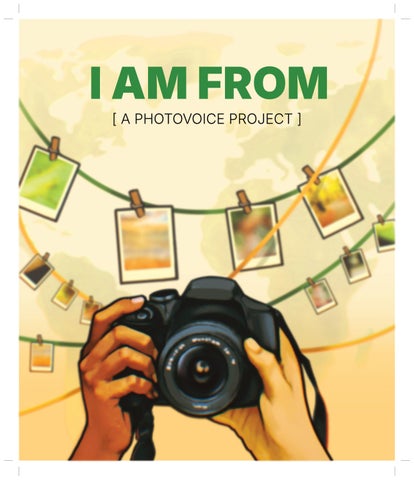
A PHOTOVOICE PROJECT
I AM FROM
TABLE OF CONTENTS
1.
2.
INTRODUCTION
1
SECTION ONE:
PARTICIPANT MAP
2
GENDER
3.
4.
SECTION TWO:
SECTION THREE:
HISTORY & IDENTITY
10
ENVIRONMENT
5.
6.
SECTION FOUR:
SECTION FIVE:
HEALTH & WELL-BEING
22
7. MEET THE PARTNERS
36
PARTICIPANT CREDITS 41
SOCIAL ADVOCACY
4
16
28
INTRODUCTION TO [ PHOTOVOICE ] Stories are powerful: they weave people and experiences together and shape how we see the world. Each year ACIC has partnered with an international organization for PhotoVoices. For 6 years, the program has empowered youth to share their stories through photos. Photovoice is an action-based research, facilitation and evaluation tool developed in 1996 by Caroline Wang and Mary Ann Burris. PhotoVoices engages participants in critical dialogue through photography and aims to mobilize change related to shared community concerns. During the 10-week program, youth produce photography and art guided by a series of themes. Over 130 youth from Atlantic Canada, Africa and South America have participated in PhotoVoices, building skills, exploring the Sustainable Development Goals, learning from experts in the field, and so much more. This book highlights some of the recurring themes participants have explored throughout the program's lifespan — gender, history & identity, environment, health & well-being and social advocacy.
1
| Anane Michael, 2025 (Ghana) “The Echoes of Colonialism: A Haunting Refrainˮ
[GENDER] Gender inequality is deeply rooted in many societies. Women and girls are under-represented in leadership positions, targeted victims of violence and discrimination, and refused access to education, economic empowerment, and essential health services. While all women face inequality, the consequences can be harsher for those coping with intersectional factors. Not all women share the same experiences, therefore strategies for change must also be intersectional. Solutions to address these issues must be led by self-determining people in collaboration with their Communities and Nations. Participants have shown great interest in themes relating to gender. Throughout the program, youth have produced photography and artwork that explores the intersections of gender, race, class, age, sexuality, ability, and nationality. The photographs and artwork in this section were produced during themed weeks focused on SDG 5: Gender Equality, women and agriculture, women in leadership and more. 4
| Beauty Haruna, 2023 (Nigeria) "Women's education is crucial to the development of society."
| Ayoola Timileyin, 2022 (Nigeria) “My personal experience with gender.ˮ
| Beri Cooper, 2024 (Canada)
| Fawoh Nancy Tomoh, 2024 (Cameroon)
“May 5th marks Red Dress Day, or National Day of Awareness for Missing and Murdered Indigenous Women and Girls and Two-Spirit People.ˮ
“A challenge to including women in agriculture is the limited access to land and resources. In this photo taken at Bomaka, Buea, Cameroon we have Christina, a farmer and her daughter.ˮ
1
| Janice Osenkor Anum, 2026 (Ghana) “When women are in leadership, most people throw opinions at them in a way to lower their self-esteem.ˮ
| Thandie Chisi, 2023 (Malawi) "Empowered Women Empower Communities"
1
| Shorinola Anuoluwapo Anik, 2022 (Nigeria) 6
“Education is a gendered issue.ˮ
| Noella Ngunyam, 2024 (Cameroon) “Gender inequality showing a women-only group practicing agriculture, a gender-biased stereotype based on the notion that activities like farming are meant for women.ˮ
| Yanche Mary-Joyce Awahsiri, 2024 (Cameroon) “This is Madam Hannah, a nursery School teacher in Yaoundé. She is one of the many women who teach and cater for children as young as 3 years old.ˮ
| Salah Kimberly, 2024 (Cameroon) “Depicts how women are silenced by marriage.ˮ
| Kate McSweeney, 2023 (Canada) "While it is important to have women on staff, they mostly hold lower-ranking positions of power, aside from professors." 7
| Janice Osenkor Anum, 2026 (Ghana) “I am convinced that mentorship is also key in achieving gender equality. If women who have walked the path could share their stories and opportunities in their fields, we will be a step in the right direction in achieving gender equality.ˮ
| Stanley Afful, 2025 (Ghana) “The Forgotten Boy: The need for male-inclusive reproductive health education in Ghanaˮ
| Shamila Pokharel, 2026 (Canada) “The book symbolizes education and awareness, which can help people recognize ideological, institutional, interpersonal, and internalized forms of oppression.ˮ
| Thandie Chisi, 2023 (Malawi) 9 "Educating the girl child leads to many perspectives on education."
[HISTORY & IDENTITY] PhotoVoices is a tool for self-empowerment. Each week participants reflect on their personal histories, identities and lived experience through photography and art. In addition to photography and artwork, this section includes ‘I am from…ʼ poetry. Adapted from George Ella Lyonʼs “Where Iʼm Fromˮ poem, this guided exercise asks participants to write about their homes, histories, communities and identity.
| Favour Tolulope Mustapha, 2022 (Nigeria) “This shows a tradition in my community. Each family has a designated mini gate as the main entrance to their compound coupled with a fence.ˮ
10
| Stanley Afful, 2025 (Ghana) “Beholding Legaciesˮ
11
I am Ama I am the oceanʼs whisper and the sunʼs embrace, A daughter of Cape Coast, bold in my grace. I hear the echoes of Sankofaʼs song, A past reclaimed, where I belong. I am the rhythm of the loomʼs soft thread, Weaving stories in blue, gold, and red. I see beauty in whatʼs cast away, Breathing new life, remaking the fray.
| Chi On, 2021 (Canada) "Everyone over the world understands a red heart means love. Photovoice itself is the answer, a solution in enhancing partnership, redefining “communityˮ and making sustainable development one step closer!"
I am silk touched by the artistʼs hand, Tie-dyed dreams stitched into land. I feel the weight of Yaa Asantewaaʼs fight, Strength unshaken, fierce in my light. I am Francisca, Adadzewa Dadzie by name, Rooted in culture, destined for fame. The taste of fufu, rich and true, Goat meat soup, a love I pursue. I dream of legacies, bold and free, A future of fashion, led by me. I am ambition wrapped in traditionʼs thread, A story untold, yet fully ahead. — Francisca, Adadzewa Dadzie (Ghana)
| Ruvimbo Chipazi, 2025 (Canada) 14
“Capturedˮ
| Fikayo Kayode, 2025 (Canada) 15
[ENVIRONMENT] Due to the interconnected nature of our planet's environment, any environmental degradation that occurs in one region or country can have far-reaching consequences on ecosystems and populations across the globe. Addressing environmental injustice requires international collaboration and collective action. Through photography participants have documented the impacts of climate change on a range of communities. The photos communicate both challenges and progress towards sustainability and environmental restoration.
| Ashu Martha, 2024 (Cameroon) “The most effective way is to be conscious of the times we are in. Climate change is evident and WE ALL have to take proper care of our environment.ˮ
16
| Adama Dampha, 2022 (The Gambia) “Tree planting is one way to reduce erosion.ˮ
| Kate McSweeney, 2023 (Canada) | Irene Nhi Phuong Tran, 2023 (Vietnam) “Knowing that with our culture of using incense, our community have handcrafted the incense made of Agarwood. It does not contain VOCs, and therefore, they have a more positive impact to the environment.ˮ
“This photo represents a solution to the issue of reliance on fossil fuels. While it is not present in this picture, a waterfall somewhat like this but typically larger can be used to generate hydropower. Many homes in Canada run on hydropower, and it is a great step towards using renewable sources for energy.ˮ 17
| Towera Mughogho, 2023 (Malawi) “The burden of having a low and unreliable water source is particularly heavy on women and girls.ˮ
| Noella Ngunyam, 2024 (Cameroon) “Climate change is environmental racism, with continents like Africa having to pay for the gross carbon damages caused by the big industrious regions.ˮ 18
| Ivy Abbott-Charles, 2024 (Canada) | Tadala Banda, 2023 (Malawi) “The dumping of waste on land causes land degradation, making it infertile and leading to low crop yields and famineˮ
“A lot of the work around environmental justice comes from young folks, who see these injustices and have the energy, hope, and compassion to do something about them.ˮ
| Nicholas Hillier, 2020 (Canada) “An iceberg, where 80% of its mass is underwater, unseen to the human eye.ˮ
19
| Miriam Gejebo Bulus, 2023 (Nigeria)“ Nigeria currently has the largest number of people hit by flooding among 19 African countries.ˮ
| Pechuqui Laurata, 2024 (Cameroon) “The photo shows what environmental racism looks like in my community.ˮ 20
| Maya Bergeron, 2026 (Canada)
| Tristan Giddens, 2020 (Canada)
“‘As you enjoy the soft light and silent majesty of this forest, you must stay on the boardwalk,ʼ a sign implores. ‘It has been built to protect the roots of these trees.ʼˮ
“This picture of an overflowing trash can at a local community park is to represent how different communities treat things differently.ˮ
| Adeola Oluwaseyi Oke, 2022 (Nigeria) “Growing trees helps prevent air pollution by absorbing pollutant gases.ˮ
| Beri Cooper, 2024 (Canada) | Lopha Mtambo, 2023 (Malawi) “There are no parties holding community members accountable for properly disposing waste. It has become a norm to just throw garbage anywhereˮ
“The contribution of women in agriculture is vital for achieving sustainable development and food security, despite facing economic, social and cultural barriers.ˮ 21
[HEALTH & WELL-BEING] ACIC first ran PhotoVoices in 2020. The program coincided with the COVID-19 pandemic and as such, health and well-being was top of mind for many. Throughout the years, youth have produced photos that reflect on the underlying social, economic and environmental conditions that impact individual and community health and well-being. The photographs and artwork in this section were produced during themed weeks focused on SDG 3: Good Health and Well-being, lived experience of the pandemic, mental health awareness and more.
| Ashu Martha Agbornyenty, 2024 (Cameroon) “These kits are donated to women in rural and vulnerable communities [and] helps reduce complications during childbirth due to its sterile components.ˮ
22
| Asoh Etheldreda, 2024 (Cameroon) “Usually when I am down mentally, I listen to music or read novels and it gives me hope.ˮ
23
| Yanche Mary-Joyce Awahsiri, 2024 (Cameroon)
| Jessi Humphreys, 2024 (Canada)
“This water point is a borehole built by a quarter church and supplies water all round, free of charge for the local community and anyone in need.ˮ
“Nova Scotians pay some of the highest taxes in the country yet our healthcare system is deeply flawed.ˮ
| Fawoh Nancy Tomoh (Cameroon) “The health impact of unsafe water and the associated risk of contamination from unmanaged sewage are visible in the rapid transmission of diseases such as cholera, diarrhoea, typhoid and
| Grace Gilliss, 2020 (Canada) “I still fear the unknown in all this.ˮ
| Shyann Griffiths, 2024 (Canada) “I took this photo of a clothing drive that the college I attend is holding for individuals who need warm clothes during the winter season. This is one way that good health and well being is being supported and flourishing in my community.ˮ
| Adebayo Samuel Kehinde, 2022 (Nigeria)
| Benita Davis, 2021 (Guyana) "Not only are these persons supplying their family with one of their basic needs, food. They are also ensuring that these vegetables are organically grown resulting in improved health."
| Harry Gillis, 2020 (Canada) “I canʼt imagine being in school and wearing a mask and gloves.ˮ 1 25
| Yanche Mary-Joyce Awahsiri, 2024 (Cameroon) “This is "Village de L'amour", a safe heaven for the mentally ill. It is located in the Jamot Hospital in Yaoundé and takes care of people suffering from mental illness.ˮ
| Adeola Oluwaseyi, 2022 (Nigeria) “There no doubt that yoga's incorporation of breathing and meditation can improve one's mental health and well-beingˮ
| Victoria Fianyeku Aseye Aku, 2026 (Ghana) “Choosing stillness and solitude becomes an act of self-care and resistance, allowing the individual to rest, reflect, and rechargeˮ
| Ivy Oye Amponsah, 2026 (Ghana) “Self-care, when practiced in community, interrupts cycles of burnout and isolation. It becomes a source of renewal, ensuring that people can continue to thrive and support one another.ˮ
| Tadala Banda, 2023 (Malawi) “Discrimination is a major issue when it comes to achieving health equity, and it can take different forms such as racism or prejudice based on origin.ˮ
| Adama Dampha, 2022 (The Gambia) “A solution is to train, mentor, and nurture staff on how to relate with their patients because these people need all the necessary care from the doctors.ˮ
27
| Akalambi Clare Enjoh, 2024 (Cameroon) “In my life, social advocacy means getting the work done no matter how difficult it may seem.ˮ
[SOCIAL ADVOCACY] Art can be a vehicle for action. Photovoice, as a practice, aims to mobilize change by sharing community concerns, hopes and actions. In every assignment, regardless of theme, participants look in-depth at social issues to guide dialogue on action-oriented solutions.
The photographs and artwork in this section were produced during themed weeks focused on social advocacy, justice and cultural resilience. Some of the photographs depict protest and social movements that coincide with the years the program took place.
28
| David Saah, 2025 (Ghana) “Flow of the Universeˮ
29
| Ngueubou Njantio Merveille, 2024 (Cameroon) “I believe recording audios, editing and sharing it with targeted audiences can cause social justice.ˮ | Tsetse Confidence Anita, 2026 (Ghana) “The church also creates inclusive programs where every child is supported and given equal opportunity to grow spiritually.ˮ
| Samia Abadou, 2025 (Canada)
| Michael Anane, 2025 (Ghana) “Seeds of Liberationˮ
“This piece represents Black women and their ability to express themselves after decolonizationˮ
| Devine Levine-Kpai, 2025 (Canada) “This powerful collage focuses on not only celebrating Black resistance across generations, but blends historical and contemporary figures, highlighting the continuous fight for justice, decolonization, and self-determination.ˮ
| Beri Cooper, 2024 (Canada) “Social advocacy is coming together to promote change for a greater equitable future for everyone.ˮ
| Gavin Snow, 2026 (Canada) “People and organizations with a platform need to use their platform in a way that matters for the right reasons.ˮ
31
| Asoh Etheldreda Ambe, 2024 (Cameroon) “Social advocacy to me is all about promoting inclusion, the act of supporting a particular cause that is aimed at improving the well-being of a specific group of people or individuals.ˮ
| Kekiba Maame Patience, 2026 (Ghana) “The act of educating others represents a form of resilience that pushes communities toward awareness, prevention, and positive social change.ˮ
| Akalambi Clare Enjoh, 2024 (Cameroon) “Change the behaviour that needs to be changed now. Those little steps will one day sum up and be regarded as a great impact.ˮ
33
| Tamana Abdulhamid, 2024 (Canada) “This photo was taken October 12, 2022, when I organized a protest for women's rights and education rights in Afghanistan.ˮ
Muzzammil Mohabir, 2021 (Guyana) 34
"Powerful data can change perspectives."
| Ivy Abbott-Charles, 2024 (Canada) “I love protesting as a form of social advocacy because it promotes a sense of community.ˮ
| Joanne Hart, 2020 (Canada) “Will money really fix all of the problems we face in Newfoundland and Labrador, or is it just a band-aid, a temporary fix?ˮ
35
MEET THE PARTNERS
ACIC has partnered with 12 organizations over the project's 6 years. The program provides opportunities for collaboration and sharing between ACIC and partnering organizations.
2020 Partners WeavEast, Atlantic Canada WeavEast is a regional platform supported by Inspiring Communities, and aims to develop shared learning, pool resources and offer a collective voice from Atlantic Canada.
Inspiring Communities, Atlantic Canada Inspiring Communities is a nonprofit intermediary organization that uses systems change, social innovation and collaboration tools to create equitable, thriving communities. We partner with communities and organizations that share our values, to address longstanding challenges with equity-centred solutions.
36
2021 Partners WWF, Guiana Our mission in the Guianas is to work together with the people of Suriname and Guyana to conserve their natural heritage for human well-being for now and for generations to come. From our humble beginnings with just 5 staff members in 1999, we grew into one of the most recognized and influential environmental NGOs in the Guianas. We strive to build a future in which humans can live in harmony with nature.
East and Central African Association for Indigenous Rights (ECAAIR), Democratic Republic of Congo (based in Fredericton, Canada) East and Central African Association for Indigenous Rights (ECAAIR) is a Non-Governmental, Non Political, Non-Religious and Non-Profit organization working with communities around the globe and in particular Canada, the Democratic Republic of Congo and Uganda since 2003 to advance health-wellbeing, peace and human rights through education, activities to alleviate poverty and to empower the most vulnerable.
37
2022 Partners Nova Scotia Gambia Association, The Gambia The NSGA is an international Canadian charity and a Banjul registered NGO development organisation that has been actively operating in The Gambia since 1985. Since its inception it has been working in various social advancement programmes in education and health targeted, at local communities and schools.
Connecting the Dots, Nigeria A community of selfless people who strive to improve by using their talents or skills to build solid connections and remarkable experiences with other people. We partner with young people, families and communities in building resilience for a better & brighter future.
2023 Partners The Girls Empowerment Network (GENET), Malawi GENET is a feminist and local women-led organization working with girls and young women, their networks and communities to advance their rights to autonomy, choice, empowerment and meaningful engagement. GENET was founded in 2008 and is committed towards elimination of gender inequalities, promoting economic and climate change justice for girls and women in Malawi. We work under 5 key thematic areas: Education, Sexual and Reproductive Health and Rights (SRHR), Gender Based Violence (GBV), Economic Empowerment and Climate change. 38
Mcrissar Foundation, Nigeria A nonprofit, nonpartisan, non governmental organization founded in 2020. Our primary focus is on education, leadership development, health & menstrual hygiene, women empowerment, the creation of safe spaces for victims of gender based violence and sexual assault and legal aid. We believe that women should have equal socio-economic, cultural, and political opportunities as men. With this ideology in mind, we are trying to achieve an equal ratio for both genders in our communities. Our goal is not to change cultural or religious beliefs but to eliminate all barriers militating against the rights of women and girls. Our Strategy is to create awareness, engage and influence the adolescent girl before they hit the age of 18-years-old through programs, boot camps, workshops, guidance and counseling and professional development training.
2024 Partners Local Youth Corner (LOYOC), Cameroon LOYOC is a leading youth-led, non-profit, and nongovernmental organization created in 2002 to respond to the increase in the socio-political and economic challenges facing young people such as; unemployment, bad governance, gender-based violence, and lack of quality education, poverty, and corruption, the poor social justice system, and exclusion in the decision-making processes which serves as push and pull factors to youth radicalization, involvement in crime, violence and in conflict with the law.
39
2025 Partners Connecting to Africa, Nova Scotia Connecting to Africa aims to facilitate opportunities for Nova Scotian groups and organizations of African descent to engage in partnerships with groups and organizations in Africa. The organization aims to engage in Africaʼs development means to assist in the transformation and expansion of capacities for Nova Scotians of African descent, as well as Africans on the continent.
Algo Peers, Ghana Algo Peers designs STEAM tools and programs to reach every child— and equip a new generation ready to solve Africaʼs biggest challenges. Rooted in how they live, learn, and lead.
2026 Partners The West Africa Centre for Peace Foundation (WACPF), Ghana WACPF is a non-governmental organization that serves young people in schools and communities through education on human rights, leadership training, and peace building. The West Africa Centre for Peace Foundation is the official affiliate of the PeaceJam Foundation – USA. For over fourteen years, WACPF has worked at the forefront of youth empowerment, peacebuilding, and civic education in Ghana and across Africa. As the national implementing partner of PeaceJam Ghana, WACPF has equipped thousands of young people with the skills of nonviolence, ethical leadership, and social responsibility.
40
STORIES ARE POWERFUL. They weave people and experiences together and shape how we see the world.
acic-caci.org | communications@acic-caci.org