7 things to know about quality K–12 science education in June 2026
1
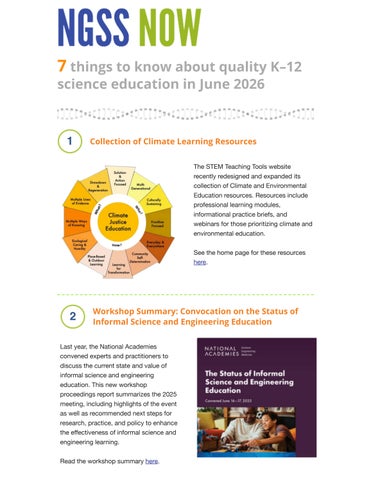
Collection of Climate Learning Resources The STEM Teaching Tools website recently redesigned and expanded its collection of Climate and Environmental Education resources. Resources include professional learning modules, informational practice briefs, and webinars for those prioritizing climate and environmental education. See the home page for these resources here.
2
Workshop Summary: Convocation on the Status of Informal Science and Engineering Education
Last year, the National Academies convened experts and practitioners to discuss the current state and value of informal science and engineering education. This new workshop proceedings report summarizes the 2025 meeting, including highlights of the event as well as recommended next steps for research, practice, and policy to enhance the effectiveness of informal science and engineering learning. Read the workshop summary here.
3
Phenomena Lab: Board of Curiosities This free resource provides a structure to pique students' curiosity in science and engage in informal investigations over the summer. While not formally aligned to standards, this resource can strengthen at-home sense-making. See the Board of Curiosities here.
4
American Institutes for Research and the U.S. National Science Foundation Launch a New Center Supporting STEM Education Research and Practice
A new Center for STEM Education Research and Translation has been launched to support the development and use of research funded by the National Science Foundation (NSF) among PreK–12 STEM education communities. One of its major goals is sharing important research findings that inform the field about making progress toward effective science practice. Learn more about the Center here.
5
The Principal Effect: How Investing in School Leaders Is Key to Solving Education's Challenges
“Principals are the single most influential factor shaping student learning, teacher retention, and school climate — making leadership investment one of the highestleverage strategies available to policymakers seeking to improve education.” See the Learning Policy Institute post here.
6
Report: Does Providing Educators Choice over Feedback Improve the Effectiveness of Self-Directed Professional Learning? “These analyses suggest that providing instructors with choice over feedback was most effective when instructors were also intrinsically motivated to engage in other forms of professional learning. The combination of choice and engagement with supporting resources appears to have created a conducive environment for instructional improvement, leading to measurable benefits for students.” See the rppl report here.
7
ICYMI: Student Work is Gold
“We all want to construct challenging, meaningful assessments that provide the support students need to show what they know and can do. So, when we initially draft assessments, we use our best professional judgment to meet that goal. But how do we actually know if it does? This is where the power of student work again comes into play. Students will ultimately tell us what the strengths and weaknesses are and how to See the blog post here.
Visit OfficialNGSS on Bluesky
Copyright © 2026 NextGenScience, All rights reserved.