5 things to know about quality K–12 science education in March 2026 1
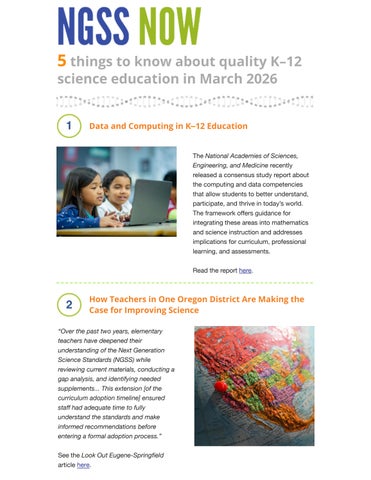
Data and Computing in K–12 Education The National Academies of Sciences, Engineering, and Medicine recently released a consensus study report about the computing and data competencies that allow students to better understand, participate, and thrive in today’s world. The framework offers guidance for integrating these areas into mathematics and science instruction and addresses implications for curriculum, professional learning, and assessments. Read the report here.
2
How Teachers in One Oregon District Are Making the Case for Improving Science
“Over the past two years, elementary teachers have deepened their understanding of the Next Generation Science Standards (NGSS) while reviewing current materials, conducting a gap analysis, and identifying needed supplements... This extension [of the curriculum adoption timeline] ensured staff had adequate time to fully understand the standards and make informed recommendations before entering a formal adoption process.” See the Look Out Eugene-Springfield article here.
3
Tools for Measuring Students’ Interests, Identities, and Connections to Real-World Science
As science classrooms shift toward three-dimensional learning, leaders and educators need reliable ways to see that shift in action. Annenberg EdExchange’s recently published Science Instruction and Identity collection brings together instruments for measuring instructional practice, teacher knowledge, and student experience and identity in science. These tools can support leaders with evaluating professional learning, monitoring the implementation of standards, and piloting instructional materials. See the resource here.
4
What if AI Gets it Wrong? Teaching Students to Detect Errors and Misleading Models “AI models often reflect dominant scientific narratives and datasets, which can marginalize local knowledge, community-based science, or emerging research. Teaching students to detect AI errors also means teaching them to ask whose data and whose assumptions shape AI outputs. In this way, error detection becomes both a scientific and ethical practice that supports more inclusive and critically conscious science learning.” See the NSTA blog post here.
5
ICYMI: Five Design Principles for Supporting Student Motivation and Engagement in Science Classrooms
How can we support teachers in sparking and sustaining motivation and engagement in a manner that will enable all students to feel included, empowered, and interested to learn science? This blog post shares five motivation design principles and sample planning questions to guide planning and instruction for science. See the NextGenScience blog post here.
Visit OfficialNGSS on Bluesky