5 things to know about quality K–12 science education in January 2026
1
Science Classroom Implementation Descriptors
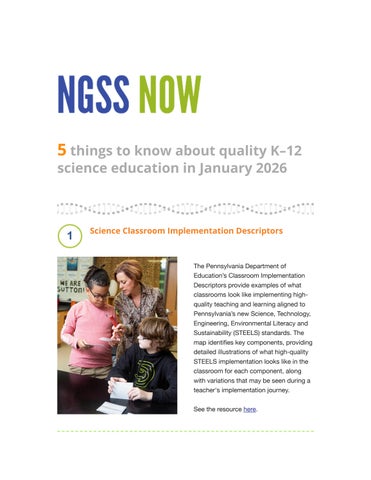
The Pennsylvania Department of Education’s Classroom Implementation Descriptors provide examples of what classrooms look like implementing highquality teaching and learning aligned to Pennsylvania’s new Science, Technology, Engineering, Environmental Literacy and Sustainability (STEELS) standards. The map identifies key components, providing detailed illustrations of what high-quality STEELS implementation looks like in the classroom for each component, along with variations that may be seen during a teacher's implementation journey. See the resource here.
2
Using Performance Tasks to Support Instruction
California educators developed guidance for using performance tasks to support science instruction on the Authentic Tasks for Learning and Assessment in Science (ATLAS) website. The guidance focuses on using student work as a tool to drive learning forward throughout instruction rather than just a measurement of learning. See the guidance on the ATLAS website here.
3
New STEM Teaching Tool: Defending and Leveraging Public Climate & Environmental Justice Data Real-world data plays an important part in high-quality science education. This STEM Teaching Tool outlines where databases, tools, and guides can be found, helping instructional designers support the important practice of using authentic scientific data in the classroom. See the tool here.
4
Teachers' Customizations of Storyline Science Curricula: Adapting for Their Students and Instructional Contexts
In order to be more responsive to students and school system constraints, teachers make small changes daily to curricula and throughout instruction. A recent study investigated the level and frequency of changes to storyline science curricula, finding that some changes supported the vision and instructional model of the curriculum, while others did not. This research highlights the need for more tools, models, and professional learning focused on the common and necessary practice of curriculum adaptation. See the Science Education research article here.
5
ICYMI: Task Annotation Project in Science (TAPS) Science and Engineering Practices
“Assessing the SEPs is different from assessing skills because of an emphasis on purpose — assessing the SEPs requires that students purposefully use the SEPs to make sense of phenomena or solve problems, rather than just demonstrating the necessary, purely procedural aspects of scientific endeavors. Skills are isolated pieces of the SEPs that are disconnected from sensemaking, while SEPs are meaningful tools to deepen students’ science exploration and sense-making connected to phenomena and problems.” See the TAPS SEP resource here.
Visit OfficialNGSS on Bluesky
Copyright © 2026 NextGenScience, All rights reserved