Tracking Changes The Journal of ACES: The Society for Editing aceseditors.org
SUMMER-FALL 2026
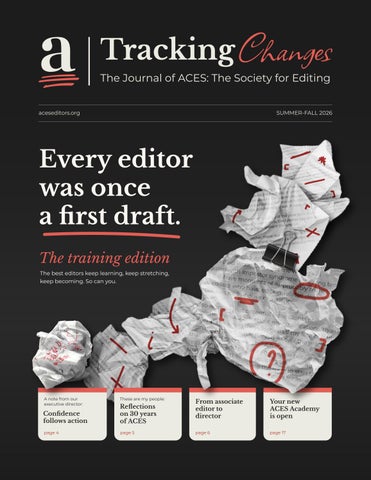
Every editor was once a first draft. The training edition The best editors keep learning, keep stretching, keep becoming. So can you.
A note from our executive director:
These are my people:
Confidence follows action
Reflections on 30 years of ACES
From associate editor to director
Your new ACES Academy is open
page 4
page 5
page 6
page 17
SUMMER-FALL 2026
Letter from the editor By Christine Steele
EDITOR Christine Steele COPY EDITORS Holly Akins Anne Checkosky Catalina Sofia Dansberger Duque
ACES’ MISSION ACES: The Society for Editing, the nation’s leading organization of editing professionals, educators, and students, is dedicated to improving the quality of communication and the working lives of editors. We set standards of excellence and give a voice to editors in journalism, government, business, and beyond through top-notch training, networking, and career opportunities.
FEEDBACK christinesteele @aceseditors.org
Copyright © 2026 ACES: The Society for Editing 180 S. Western Ave., #132 Carpentersville, IL 60110
Cover artwork created by Pilar Gutierrez
A
s artificial intelligence (AI) continues to change our profession, we’ve dedicated this issue to the training, resources, and community available through ACES to help you build new skills, connect with fellow editors, and continue investing in your professional development. Gigi Sutton, executive director, inspires us to invest in our professional development now and not wait till we think we are ready. Mark Allen, president, reflects on the culture and belonging at ACES as the society approaches its 30th anniversary. On LinkedIn, we asked how do you keep your knowledge fresh, and you'll find a few member responses in the “Faces of ACES.” Other highlights in this issue include hearing from three editors who share their experiences taking the Poynter ACES Certificates in Editing, learning some dos and don’ts of organizing a successful in-person training session, and reflections from two attendees at the ACES Atlanta conference. They both share about making meaningful connections and finding a sense of belonging. Some of you have asked what ACES’ stance is on AI. ACES’ intention is to bring educational webcasts and articles to members featuring experts in our industry, not as an endorsement, but as an opportunity to better understand AI as a tool so that you are able to make more informed decisions about using AI or not. From the archived Spotlight Series on AI to “The Carbon Cost of a Comma” webcast (available in ACES Academy), we brought you and will continue to bring you what’s relevant about both sides of AI. If you have any webcast ideas, we welcome your proposals. And lastly, we hope you are enjoying the new website, the member Info Hub, and the improved ACES Academy. We continue to improve the platforms. You can easily register for events now through the Info Hub or the main calendar on the website. We don’t want you to miss any training opportunities. Professional development isn't just about keeping up — it’s about leading the way.
Christine Steele Editor/Membership Coordinator ACES: The Society for Editing
INSIDE THIS EDITION
2
Letter from the editor
4
A note from our executive director: Confidence follows action
5
These are my people: Reflections on 30 years of ACES
6
From associate editor to director: Poynter ACES Introductory Certificate
8
Putting training into action: Poynter ACES Intermediate Certificate
9
Reflect, revise, rediscover: Poynter ACES Advanced Certificate
11
Switching to a career in editing
14
Faces of ACES
16
What membership makes possible
17
Your new ACES Academy is open
18
Showing up, finding my people
19
A first-timer’s lessons from ACES 2026: Atlanta
21
The dos and don’ts of organizing a training session
24
Doodles in the margins
A note from our executive director
By Jehan “Gigi” Sutton, MBA
Confidence follows action The longer I have been in this work, the more my perspective has changed. Professional development is not a box to check or a milestone to reach. It is an ongoing commitment to learning, growing, and becoming better at what we do.
This is also why ACES continues to invest in training, even when its greatest value may not be realized until years later. One course helps you communicate better with an author. Another introduces you to a new tool or an AI workflow. An impromptu conversation leads to your next client or your next job three years down the road. We are building a foundation, and we build on that.
The strongest professionals I know are the ones who never stop learning. Every conference, every conversation, and every training session offers an idea, sometimes a small one, that can change the way we approach our work. That has been true for me through my involvement with organizations like BoardSource, Association Forum, ASAE, and ACES. What I learn in those rooms about governance, strategic planning, and association management is what I take back to ACES every day, in how I support the board, the staff, the organization, and the members.
The profession is changing quickly. Technology is changing, AI is changing, publishing is changing. I believe editing is becoming more valuable, not less. The tools will keep shifting, but not the need for human judgment, critical thinking, ethics, and common sense. AI can help with efficiency, but it cannot replace the experience, the empathy, and the context that you bring to the work. That creates an opportunity for editors to expand what they offer, and ACES’ role is to help you meet it with confidence so you can feel prepared to be part of the conversation.
If you are reading this and feel behind, self-taught, or unsure whether you are qualified to keep growing, I want you to know you are far from alone. You are in good company. Many of our members come from journalism, from academia, from communications, and from careers that had nothing to do with editing. There is no single right path. Comparing yourself to everyone else and assuming they have it figured out does no good, because most of us are still learning every day. Being self-taught does not make you less qualified. It means you were curious enough to invest in yourself.
That is also why I care so deeply about ensuring that ACES remains a place where everyone feels a strong sense of belonging. Professional development is not only about courses and certificates, but also it is about finding the people who understand your work, who push you to grow, and who remind you that you are not alone.
E
arly in my career, I thought of professional development as a way to gain a skill or earn another certificate.
A mentor once told me that confidence usually follows action, not the other way around. I have never let that go. You do not need to wait until you feel ready. Keep learning, keep showing up, and over time you realize you have become the professional you hoped to be.
Jehan “Gigi” Sutton, MBA Executive Director ACES: The Society for Editing
4
Tracking Changes | Summer-Fall 2026
Here is what I hope you take away from this issue. Read the stories from members who put their training to work, and then find one opportunity to do the same. It might be a webcast, a certificate, a conversation with a colleague, or simply a new skill you want to strengthen. Whatever you choose, just start there. Whether you are just getting started or have been editing for 30 years, there is always something new to learn. That commitment to growth is what keeps us moving forward and what makes this profession and this community so worth showing up for.
These are my people: Reflections on 30 years of ACES By Mark Allen, President, ACES Board of Directors
CES had been around for nine years when I first attended a national conference, in Cleveland. What I knew right away (and this has been said many times before) was that these are my people: people who care about the written word, people who care about getting it right for their readers, people who care about their craft and care about how their colleagues are contributing to the common goal of clarity.
A
What strikes me as we approach our 30th year is how much we have grown in terms of the breadth and diversity of our membership, training, voice, and resources while still maintaining that sense that we all belong to a community. We share a common language, common goals, common outlook. ACES has always been focused on cultivating a sense of belonging for its members. I feel very confident following Heather E. Saunders into the presidency because I know our members share that understanding and common sense of purpose. I have trust and admiration for Executive Director Gigi Sutton, her staff, the 13-member ACES board, and the dozens of volunteers on committees and task forces who help ACES maintain a special relationship with each member. And I know I am among my people — a diverse group of thousands of professionals, any one of whom I could sit down with for a coffee and feel I am chatting with a friend.
Our 30th anniversary offers a great chance to look to our legacy to inform our future. My second conference was in 2009 in Minneapolis. Since then, ACES has continually been an important part of my professional life. After the Minneapolis conference, ACES expanded beyond newspapers — as did I — embracing the idea that all editors are fighting a good fight for clarity and truth in communication. As we look ahead with some trepidation about perceptions of the relevancy of editing, we do so knowing there are thousands of us who get it, who have our backs. If I have one goal for the next two years, it’s to elevate the field in the public’s eye. I’m confident we can all accomplish that together.
www.aceseditors.org
5
Introductory certificate
From associate editor to director: How the Poynter ACES Certificate changed my career
By Rachel Fowler
I
’ve always believed that good editing is invisible. When it works, readers never notice what the editor has worked on or
fixed. As a shy introvert, being an editor always made sense to me; it’s a career that allows you to stay behind the scenes. But for editors, that invisibility can cause some issues professionally. How do you demonstrate a skill that succeeds by going unnoticed? In 2018, I found one answer: the Poynter ACES Introductory Certificate in Editing. At the time, I was a managing editor (moved up from associate editor) and a few years into my role at my organization. I was gaining confidence and experience in the work, but I was looking for a way to ground my editorial judgment in something formal and recognized. The Poynter ACES Certificate offered exactly that. The program is designed for working professionals, which was immediately appealing. There’s no fixed schedule and no classroom to commute to. You complete the coursework on your own time, fitting it around your existing responsibilities. The full program took me about 10-12 hours to complete, which was meaningful and manageable enough to actually finish.
The curriculum covers the core competencies of editing: fundamentals, art and science of editing, getting it right, writing online headlines, clarity is key, and language primer. Even for experienced editors, the program is a great refresher and gives you the practice you need. For ACES members, a discount on enrollment makes the program even more accessible, which is one more reason to be a member. Completing the certificate was, in a word, validating. It gave me a recognized credential from two institutions with real weight in the communications world. But more than the credential itself, the process of completing the program sharpened my thinking. It pushed me to articulate why certain editorial choices work, not just that they do.
In the years following my completion of the certificate, I received several promotions, eventually reaching my current position as director of external communications.
Worth a listen
“The Carbon Cost of a Comma” The environmental impact of generative AI, one of many timely conversations in the ACES Academy catalog. Members watch free. Log in to stream.
Having a formal, external validation of my editorial skills made it easier to advocate for myself in professional conversations. It gave my supervisors, and me, a shared vocabulary for the value I was bringing to the organization. If you’re an editor at any stage of your career looking to demonstrate your expertise, pursue a promotion, or simply invest in your own professional development, I’d recommend the Poynter ACES Introductory Certificate without hesitation. The time commitment is realistic, the content is rigorous, and the credential carries genuine professional credibility. Editing is often thankless work. This is one way to make sure it doesn’t go unrecognized.
Rachel Fowler is the director of external communications for the Society of Tribologists and Lubrication Engineers (STLE) and is publisher of its monthly magazine. She has more than 18 years of experience in the field. She has been a member of ACES since 2018 and is on the Communications and Publications Committee.
www.aceseditors.org
7
Intermediate certificate
Putting training into action I
had no formal editing training when I became an editor. My English literature undergraduate program was more focused on preparing students for MFAs than careers, so I learned on the job as copy chief for my college newspaper and later in my first post-grad job as a technical writer. But I always knew I wanted to be an editor, and my curiosity and love of learning kept me building my skills. When I landed my first job with the title of “editor,” I was given a small professional development budget to grow my skills. That budget brought me to my first ACES conference, and later it paid for my Poynter and ACES editing certificates. The introductory training was a good reinforcement of the skills I had developed on my own, and I liked seeing it listed on my LinkedIn and resume, showing I was invested in my growth as an editor. When it came time for the intermediate training, I figured it would be more of the same. At that point, I had several years of professional editing experience, and I didn’t expect more than another item on my resume. I was, happily, proven wrong. The Intermediate Certificate training had just been refreshed, and I was excited to see on the curriculum some of the editors I admired and had the pleasure to volunteer with. As I jumped into the first lesson, I found myself typing more and more notes into a file, not simply to make sure I was prepared for the final evaluation at the end of the course, but also to refer back to when I put the training into action in my job.
I did that quickly, almost comically so. I finished up with “Editing Data: Training Your Word Brain to Embrace Math” with Mark Allen one afternoon, and as I still had about an hour left in my workday, I opened up a file sent to me by a colleague to do what I thought would be a quick editing pass. In just the second paragraph, I saw a percentage and wondered if it was correct. Previously, I might have skimmed over this, assuming that the writer used a formula in the spreadsheet her team kept. But one of Mark’s lessons was about percent increases and how these are often not calculated correctly. I opened up the spreadsheet and realized there wasn’t a formula; it was the exact error Mark pointed out, of not using the percent increase calculation when writing that something “increased by X%.” I flagged the math for the writer, wrote down the formula and explained why the number was off. The writer thanked me for the explanation and made the correction in that file and several other iterations. And when I saw a similar file later in the year, the math was always accurate.
Training keeps us sharp as editors. It teaches us concepts and practices that we may use immediately or we may pocket and pull out years later. Curiosity is an important quality for an editor, and training of any kind keeps our minds expanding and attuned to our ever-evolving world and the words we use to describe it.
Lauren Filippini is the marketing and communications manager for Alpha Chi Omega, a women's fraternity with more than 325,000 members. She edits all communications and manages the quarterly membership magazine. For ACES, Lauren serves as the vice president for finance.
8
Tracking Changes | Summer-Fall 2026
By Lauren Filippini
Advanced certificate
Reflect, revise, rediscover: Poynter ACES Advanced Certificate
By Catalina Sofia Dansberger Duque
I
joined ACES to attend VCON 2025, and it expanded my world as an editor beyond my laptop and office. Through that experience, I connected with editors in the Baltimore area and helped organize local meetups. These connections introduced me to a welcoming community of editors and word aficionados who generously shared their expertise and ideas and encouraged me to invest in my professional development, leading me to enroll in the introductory, intermediate, and advanced Poynter ACES Certificates in Editing. When the cold spring finally eased into a warm summer, I celebrated by helping plan an ACES Baltimore-area gathering and completing the Poynter ACES Advanced Certificate in Editing. One of my favorite sections in the six-course series was "Become a Trusted Editor: How to Build Credibility and Strengthen Relationships." It was led by Chris Clermont, vice president and head of DEI+ at Vox Media, and Lissa Soep, senior editor for audio at Vox Media, cofounders of Language Please, a free style guide covering many facets of identity, such as race and ethnicity, religion and spirituality, and more. Drawing on decades of editing experience, Clermont and Soep shared tips and strategies through pre-recorded videos, self-guided lessons, activities, and assessments. I knew the technical lessons would be super useful, but I was not
expecting to reflect on myself and my editing practice. It's easy to fall into production mode without being aware of your editor persona. It was like a fun mindfulness exercise that brought back the human behind the edits.
The “What Kind of Editor Are You?” section took a deep dive into the six editor personas — mentor, standards-bearer, researcher, craftsperson, triangulator, and antagonist — using test cases and sample scenarios to show how each persona can help or inhibit good editing.
I found that I'm a researcher, always wanting to collect as many details as possible; a triangulator, ensuring everyone who needs to be involved in the process is included; and a mentor, always looking for ways to share any skills while continuing to learn from others. As a communications manager at the University of Maryland Baltimore County, I rely on all of these skills year-round to help produce UMBC news stories and the fall and spring UMBC Magazine. These opportunities allow me to apply and hone these skills every day. I'm now equally aware of my editing persona as I am of the production cycle.
Four ways to grow. One catalog. Whatever you want to work on next, there is a webcast for it. Business of Editing
Soft Skills for Editors
Core Editing Skills Words and Language
What I'm thrilled about is that this is not a one-and-done training. One of the benefits of the Poynter ACES certificates is continued access to all the lessons and resources after completing the program. I use it as a trusted resource. Whenever I have questions about developmental editing, in the advanced certificate, I go back to “Connecting the Dots: Developmental Editing for Structure, Character and Flow,” led by author, editor, and ACES member Tiffany Vakilian. With language constantly changing, I double-check the approaches taught in the “Inclusive Editing: How Sensitivity Reads and Thoughtful Queries Can Improve Copy” course led by Tanya Pai, director of standards and quality at Yahoo News, and the founder of Language, Please.
At UMBC, I have applied these sharpened skills to strengthen the editing process for faculty, staff, and students across more than 25 departments in the College of Arts, Humanities, and Social Sciences (UMBC's largest college). By having intentional conversations during the developmental editing process and explaining editorial decisions from draft to publication, I have built stronger relationships with the faculty, staff, and students. The long-term impact of the skills I gained through the Poynter ACES Advanced Certificate in Editing has been crafting more engaging stories for the UMBC News and UMBC Magazine, reaching a readership of over 100,000.
The experience inspired me to pursue other professional development opportunities, including a women's leadership program, where I connected with other editors and communications professionals, and joined the ACES Communications and Publications Committee.
Catalina Sofia Dansberger Duque is a writer, editor, and communications professional with extensive experience translating academic research into engaging multimedia content for a general audience. She is passionate about helping writers strengthen their work through thoughtful editing, clear communication, and collaborative learning. As a multilingual professional, she brings an international and cross-cultural perspective to storytelling, education, and editorial practice.
10
Tracking Changes | Summer-Fall 2026
Photo credit: Brad Ziegler
Switching to a career in editing
By Crystal Yang
M
y path to becoming an editor was not what you’d call traditional. For the first seven years of my professional career, I practiced as a social worker after receiving a bachelor’s in psychology and a master’s in social work. In 2018 I began exploring the idea of editing as a possible career pivot, but without any real effort or enthusiasm. A major change at my job in 2019 led to uncertainty about my future there, motivating me to file for an editing business license within that same week. There were only a handful of obstacles in my way: I had no background or training in editing, I had no idea where to get clients, and I didn’t know the first thing about running a business. One of the beautiful things about being completely out of touch with the editing world was that I had no preconceived notions about how to break in. I didn’t truly worry that I had no related degree or that I had never worked in publishing. All I knew was that I wanted to become an editor, so that’s what would happen. I just needed to put my mind to it. What I didn’t know at the time, though, was that I needed some type of training. I thought that because I had always been good at grammar, spelling, and punctuation, I was qualified to call myself an editor and get paid for my work. (Yes, I was that person.) Once I actually looked into what editors did — and found out there were different types of editing, and even something called “The Chicago Manual of Style” — I quickly realized I was in over my head. After allowing myself to panic for a bit, I sat down and researched what I had gotten myself into. What would allow me to truly be able to do the job and do it well? How the heck did I run an editing business? Over the next eight months, I spent countless hours engaging in online training and self-study, researching freelance editing, and working on my business processes. I turned to a variety of training resources, which were a mix of paid and free ones, listed here in no particular order:
Editor’s starter kit Webcast recordings on various topics through ACES, the Editorial Freelancers Association (EFA), and Editors Canada Poynter ACES Certificate in Editing (which has since been revamped and is now divided into a three-level curriculum: introductory, intermediate, and advanced) Sessions at the 2020 ACES virtual conference The EFA’s Advanced Copyediting course (no longer available) The Publishing Training Centre’s Essential Proofreading course (UK-based) Louise Harnby’s resources on editing fiction and the business of being an editor (free blog posts and paid e-books and templates) “The Copyeditor’s Handbook” and its accompanying workbook, by Amy Einsohn and Marilyn Schwartz “Dreyer’s English,” by Benjamin Dreyer “The Chicago Manual of Style” and its online Q&A
www.aceseditors.org
11
While this collection of resources may seem eclectic, they gave me enough confidence to feel like I could take on paid work. Don’t get me wrong — I struggled with impostor syndrome for a long time (and still have moments of it), probably more so than editors who have editing-related degrees, certificates, or in-house experience. I also worried that potential indie clients or publishers would ask about my qualifications, then laugh at me when they discovered my lack of formal training. Instead, what I’ve found over the years is that indie clients care about my portfolio, testimonials, and sample edits, while publishers care that I can pass their copyediting and proofreading Credit: fizkes, iStock tests. My training gave me the tools to start taking on work, and now that work speaks for itself.
Plus, I still engage in continuing education through ACES conferences and monthly webcasts, as well as offerings from other organizations. Over the years, I’ve heard many stories like mine from editors who pivoted from other careers, and they all reinforce the idea that there’s no single path or “correct way” to becoming an editor — and it is lifelong learning. Ultimately, it doesn’t matter what your background or previous career was, you can transition into editing with the right training and support.
Crystal Yang (she/her), owner of Rabbit with a Red Pen, is a fiction editor and authenticity reader who's worked on best-selling novels and award-winning video games. Drawing on her background as a social worker, she unites her love of language and passion for social justice by pushing for writing and representation that’s more dignified, intentional, and just. She’s the creator of the Conscious Language Toolkits for Editors and for Writers, teaches for the Editorial Freelancers Association, and is a past ACES Board member. When she's not working with words, she's probably swearing at a video game.
12
Tracking Changes | Summer-Fall 2026
Order your ACES merch today. Some items are limited.
Editors are always learning and finding new ways to stay current. For this issue of Tracking Changes, we asked ACES members on LinkedIn: How do you keep your knowledge fresh? Here’s what they shared.
Frances Cross There are several seasoned editors I admire, and I pop into their websites periodically to read their blogs and check out any new publications they may have written. I’m also subscribed to email updates from CMOS, Merriam-Webster, Grammar Girl, Louise Harnby, Catherine Turner, Victory Editing, and of course ACES. Attending conferences is also valuable, and fun, too! Continuing education is a must to stay on top of changing standards, or to just reacquaint myself with what I previously learned.
Holly Akins I attend monthly professional development webinars through editing organizations, plus I take a course or two each year to keep my skills sharp. Writing and editing conferences are good resources, if they’re in the budget. Volunteering and teaching are great ways to stay connected in the community and learn from others.
Suzanne Arnold I particularly appreciate ACES’ webinars for ongoing learning — getting into detail on topics that matter.
14
Tracking Changes | Summer-Fall 2026
Cara Catalano I directly engage with style authorities, structured coursework, and hands-on work improving the AI tools I edit with. I follow CMOS Q&A emails and forums, asking and answering questions to see how linguists handle real edge cases. I take Coursera courses, including grammar training from UC Irvine, and use OED Premium, free through most university libraries. Which words gain or lose acceptance is a clearer signal of direction than any style guide alone. When sources disagree, I compare specialized guides against recent institutional work, checking NASA’s guide for space terms or Purdue and Chicago for MLA and CMOS questions.
Danielle Gudakunst I subscribe to CMOS and read its monthly Q&As, paying attention to what other style guides are doing, and delving into guides I find on current topics like race, gender, Indigenous peoples, sexual orientation, and so forth to read and incorporate in our publication. Even if it doesn’t seem directly relevant, it might be.
Alicia Chantal I pursue interests outside of editing: How can my favorite shows inform me of hot or trending topics? How can a social media chat reveal language that is being used in different communities? How is information for a dance class communicated? All of these things contribute to a breadth of knowledge and world experience that can be brought to client work!
Famin Ahmed Staying on top of the latest trends and updates is important, especially if you’re looking for a new position or client. I follow editing organizations on social media and regularly take some time to read through their newsletters. I also take short courses and webinars — ACES has some great ones! — to keep my own skills sharp and to explore new trends and tools. In the office, I created an editors workgroup and led discussions of how to incorporate new trends in our work. The group was a great way to promote professional development across the organization and build camaraderie and collaboration. Plus, it gave our organization a great return on investing in professional development!
ACES 2026: Atlanta
What membership makes possible By ACES staff
hen you join ACES, you’re investing in something much bigger than an annual membership. You’re investing in your career, your growth as an editor, and a community of professionals who understand the work you do every day.
W
That’s the true value of membership. Editing is a profession that never stands still. Language evolves. Technology changes. Client expectations shift. New challenges and opportunities emerge every year. Staying current takes more than individual effort. It takes a community committed to learning, sharing knowledge, and supporting one another. That’s what ACES exists to provide. An ACES membership is a commitment to your professional future and in a community dedicated to helping editors succeed. Whether you’re refining your craft, expanding your business, navigating changes in the industry, or simply looking for colleagues who speak your language, ACES is here to support you throughout your career. A professional association is a two-way investment. The more you engage, the greater the return on your investment. Attend a webcast. Explore ACES Academy. Read our publications. Volunteer for a committee. Connect with fellow editors. Participate in conversations with peers. Share your expertise. Learn something new. Many members tell us that the relationships they’ve built through ACES have been just as valuable as the educational opportunities. They’ve found mentors, collaborators, clients, lifelong friends, and a network they can rely on throughout their careers. That sense of belonging
16
Tracking Changes | Summer-Fall 2026
is hard to measure, but it’s one of the reasons so many members say ACES feels like home. We recently announced an increase in membership dues. We understand that any increase affects our members, and we appreciate the trust you place in ACES. This investment helps us continue building and improving the programs, resources, and experiences that serve editors today while preparing our organization for the future. Our members are the heart of this organization. Every conversation, every volunteer, every presenter, every attendee, and every new connection strengthens our community and helps shape the future of editing. Thank you for being part of ACES. We hope you’ll continue to explore everything your membership has to offer, connect with fellow editors, and make this community your professional home. Because the more you invest in ACES, the more ACES can invest in you.
Your new ACES Academy is open! You can also filter by year and search by keyword, so finding the right webcast takes seconds instead of scrolling.
By Maria Coxwell, CMP
I
f you have logged in to the ACES website recently, you have probably noticed that things look a little different. As part of our website transition, ACES Academy has a new home and an improved learning experience that makes it easier to discover, browse, and access the content you need. You can now search the catalog by the skills you want to develop, not just by the webcast title. To find the learning that's most relevant to you, we have organized everything into four categories.
1
2
3
4
Business of Editing covers running your own business: project management, client management, fiscal management, marketing, setting boundaries, and networking. Core Editing Skills covers the craft itself: grammar, syntax, tools, fact-checking and research, and techniques like big-picture and sentence-level editing. Soft Skills for Editors covers everything around the work: time management, critical thinking, attention to detail, professionalism, collaboration, relationship building, leadership, empathy, adaptability, and communication. Words and Language covers language trends, plain language, lexicography, inclusiveness, bias and sensitivity, jargon, cross-cultural language use, voice and tone preservation, and style.
Whether you’re building foundational skills or expanding your expertise, there is something here for you. Explore a new topic, expand your knowledge in an area you love, or fill a specific gap you’ve been meaning to close. From broad industry topics to specialized niche subjects, you'll find learning opportunities to support your professional growth. A few recent popular webcasts give you a sense of the range: “Do Readers Care About Editing?” which shares recommendations from the ACES Value of Editing research study, and “The Carbon Cost of a Comma,” on the environmental impact of generative AI. For the word and language nerds out there, “Timeless Basic Math: Lessons from Old Math Books" and "Strange and Unusual: A Deeper Dive into English's Oddball Reputation.” Attending live webcasts and exploring the on-demand catalog is one of the many benefits of your ACES membership, and it is now easier than ever to find the learning that’s right for you. Access the Academy in two ways: Log in to the Info Hub from the member login and find the shortcut in the left menu or click “Learn & Grow” on our homepage, select ACES Academy, and click “Access the ACES Academy.” I think you are going to like what you find.
Maria Coxwell, CMP Professional Development Manager, ACES: The Society for Editing
New look. Same expertise. Webcasts on demand. Your ACES Academy just got easier to use. Search by category, filter by year, find your next lesson by keyword.
Log in and start exploring.
Showing up, finding my people
By Scott Hinderer
or the 2026 ACES conference, some 500-plus first-time and returning attendees alike traveled to Atlanta, a city known for crossroads. Speaking from experience, it was a fitting destination for those in the editorial profession finding themselves caught at a disquieting juncture from the rapid scaling of artificial intelligence this year.
F
Prior to a looming layoff near the end of 2025, I reupped my ACES membership, knowing I would need to feel tethered to something in what would be a lonesome, stormy period. Being counted among the ACES membership gives me confidence and a sense of belonging even in the most abundant of times. Somewhat local, I commuted to the conference in hopes to make new contacts and learn ways to improve and diversify my craft, and after nearly a week of social and instructive sessions, I did just that. I eased into the conference with the first-timers’ reception, where other newcomers like me mingled informally before the next day’s opening ceremonies. Out of the four flexible learning tracks, I began the conference’s instructional component with the session, “Advocating Editing: How You Can Raise Awareness and Appreciation for What We Do.” After writing cover letter after cover letter and rewriting résumés, I was ready for some answers to my existential questions. The give-and-take between the speakers and audience generated some good ideas and good feelings for these turbulent times.
Credit: Scott Hi
The rest of the week we filled out our schedules with sessions on creating efficiencies and communications strategies as well as craft talks — all important skills in building our reputation and community. All in all, it was a great week of learning and bonding for the future of editing in a town once called Terminus.
Scott Hinderer has a bachelor’s degree in English-Creative Writing from Salisbury University. He has been a professional copy editor for several metro daily newspapers, magazines, and websites across two decades. Since being “pivoted to video” (i.e., the Phantom Zone), he’s pursuing opportunities to fulfill a lifelong dream of working in book publishing. He can be found online at LinkedIn.com/in/scotthinderer.
18
Tracking Changes | Summer-Fall 2026
nderer
A first-timer’s lessons from ACES 2026: Atlanta was an editor for five years before I worked up the courage (and budget) to attend an in-person ACES conference. Before that, I’d lurked in the chat at virtual conferences and attended Zoom networking sessions, but in-person events felt too intimidating. I wasn’t sure they’d be a good fit for me, a new(ish) freelance editor and caregiver with two jobs who’d transitioned from another career. Then I joined the ACES Communications and Publications Committee in 2025, and attending the upcoming conference in Atlanta became a priority.
By Holly Akins
I
I’m a planner, so I started my conference prep about six months ahead of time. Along the way, I took notes. What helped make my conference experience meaningful and less intimidating? And what would I do differently next time?
L to R: Barbie Halaby, Holly Akins, Nicole Wayland, Heather E. Saunders
That’s right; I said “next time.” ACES 2026: Atlanta may have been my first in-person editing conference, but it certainly won’t be my last. The session presenters taught me things that I’ll use to improve my business: how to give better notes to my authors, how to plan for communications during a crisis, and how to better edit AI-assisted text. The most meaningful part, though, was what happened between the sessions, the conversations and connections with fellow attendees. When I arrived, I felt nervous, alone, and outnumbered. But by the end, I felt like I was part of a community. No virtual conference chat or Zoom networking session has ever given me that feeling. So yes, I’ll go again. And I’ll use these notes to make ACES 2027: Puerto Rico even better:
CONFERENCE DOS Start prepping early. Having friendly faces and prior relationships established helped lessen the intimidation factor for me. I reached out to board members, presenters, and fellow attendees months before the event to make connections. Use the conference app. The Whova app has the agenda, list of conference attendees with profiles, meetup information, and more. Getting familiar with Whova helped me plan my schedule, then kept me on track with updates and announcements during the conference. Set aside time to volunteer. This is a low-stakes way to make sure you’re not a wallflower, and you’ll help keep the event running smoothly. If budget is an issue and a ticketed event isn’t an option for you, be a greeter for a networking session or reception; you’ll get to talk to people on their way in. Just remember to set an alarm or reminder so you don’t miss a shift.
CONFERENCE DON’TS Skip the bee. The spelling bee is an annual fundraiser for the ACES Education Fund — and it puts the “fun” in “fund.” This isn’t your middle school bee, and the format is different from a usual spelling bee. If contestants stumble on a word, they can buy a letter from an audience member who agrees to donate five dollars to the cause. The bee was my favorite event! Try to do everything. The agenda is packed. Prevent overwhelm by setting a goal for the conference, then choosing the sessions and events that support your goal. Stack your schedule. Sessions can run long, and you may want to chat with the presenter afterward. The elevators may be overrun. I didn’t account for that, and I deeply regretted scheduling a client meeting immediately after a session ended. Remember to build in some buffering time.
www.aceseditors.org
19
CONFERENCE DOS Wear comfortable shoes. Even if you stay at the conference hotel, sometimes the event spaces may be spread out. One day, I walked over two miles without getting more than half a block from the hotel. Deal with your receipts daily. I’m a former bookkeeper; it would be irresponsible of me not to mention this. Conference days run at a fast pace, and losing receipts is easy. Take pictures of your receipts and submit expenses promptly so you keep up with reimbursements and deductions.
CONFERENCE DON’TS Be afraid to approach someone. It’s okay to talk to new people and edibuddies here. Conference attendees have name badges, so we’re easy to spot. If you notice someone hanging out in the common areas, say hi. I made new friends just by talking to people in the lobby between sessions.
Stay flexible. Sessions fill up, speakers get sick, and opportunities pop up. Someone may invite you to lunch or you could volunteer to monitor tables at the silent auction. Be familiar with the schedule so you can adjust your plans and have alternate session choices.
In short, attending the annual conference is worth it. Go for the sessions, then stay for the spelling bee and community. I’ll see you there!
L to R: Conference spelling bee contestants, Maxine Mulvey, Kate Karp, Cathleen Small, Emma Olen
Holly Akins has been an ACES member since 2023 and volunteers on the Communications and Publications Committee. She is the co-coordinator for the EFA’s Virginia chapter and owns BulletProof Writing Services, focusing on content writing, copyediting, and proofreading for nonfiction indie authors and small businesses.
The dos and don’ts of organizing a training session
By Milly Vega, M.A.
’m the daughter of two retired schoolteachers. For almost 30 years, my father taught English and my mother taught Spanish in Puerto Rico’s public school system. And even though my career path has been different than theirs — I chose the communications field — I’ve always been involved in training.
I
So, maybe, I have the teaching bug after all. Last May, I closed at work “The Communications Partners Academy,” an inaugural three-workshop series with college continuing education units (CEUs) that I conceived for our internal writers. As preparations unfolded, I realized that organizing an in-person training session requires more than lesson planning. Making correct budgetary and logistics decisions is key to organizing successful training sessions.
Other considerations Promote the session on social media if possible. Keep a printed or an electronic list of attendees for your records. Send an evaluation survey to gather attendees’ feedback. Write an evaluation report that contains key findings and lessons learned. If you’re a company employee, use it for your annual performance evaluation. If you’re a freelancer, use it to show your work to potential clients.
Based on this experience, I compiled a list of dos and don’ts for organizing an in-person training session. Let’s review them:
DOS
DON’TS
Think about how expenses will be covered If you organize training sessions for company employees, ask the Human Resources Department to cover expenses. Often, they fund training sessions for employees. Make sure to complete all the paperwork you must submit.
Don’t organize a training session without researching first I often ask my parents, the retired schoolteachers, for advice. Likewise, consult experienced professionals. If possible, survey potential attendees in advance to understand their needs and preferences. You can also review trends in continuing education on the web.
On the other hand, if you organize training sessions hosted by a professional association, consider charging a registration fee to cover expenses. Also, look for sponsors to allocate extra funds. Regardless of who the organizer is, contemplate the following items when you plan your budget: speaker compensation, venue, food and beverage, audiovisual equipment, and parking.
Don’t set unrealistic expectations Set a reasonable number of attendees that’s neither too low nor too high. Be wise with your spending so you can adhere to the estimated budget. Be realistic with time too. Give the speaker enough time to cover the chosen topic — thus giving attendees the chance to stay throughout the entire session.
www.aceseditors.org
21
DOS
DON’TS
Consider logistics Find out if other events are already scheduled on your intended date; this can affect registration for your session. Also, consider major and religious holidays when picking the session date because people might be out of the office.
Don’t trust technology entirely I reaffirm what I said during my session at ACES 2026: Atlanta, “Don’t Panic: How to Edit Corporate Communications During External Crises.” We can’t trust technology entirely. One day, the audiovisual equipment works; the next day, it doesn’t. Test it the day before the session. On session day, arrive early and have an audiovisual technician in the room. Prepare a troubleshooting sheet in case you need it.
Choose the delivery format considering both attendees and the organizer’s needs. In-person, online, and hybrid sessions are some of the most frequent learning modalities. If concurrent sessions are presented, give attendees and speakers enough time to go from one session to another.
Share supporting materials with attendees, like ACES does Attendees like receiving session slide decks and handouts they can share with coworkers and peers. ACES calls this “taking it back to the office.” For that reason, the organization shares materials with attendees before webcasts, virtual, and in-person conferences.
Another tip? Print a copy of the slide deck. If the equipment doesn’t work, the speaker can use the printed copy and present the session. Taken together, these dos and don’ts will help us to organize a training session in a smoother and more timely way, avoiding delays and setbacks that may affect the desired outcomes. We’ll make my parents proud. Credit: Milly Vega
Another reason is to allow them to focus on the presentation without worrying about quickly taking notes. Paying more attention to the presentation can help them with comprehension. You can deliver materials in print, electronic or both formats.
Milly Vega is a Puerto Rico-based corporate communications supervisor with 20 years of editing, writing, and public relations experience. She is a former journalist and media officer. A member of ACES since 2022, she chairs the Communications and Publications Committee and speaks regularly at ACES conferences. Milly holds a B.B.A. in International Public Relations and an M.A. in Media Writing.
22
Tracking Changes | Summer-Fall 2026
ACES ANNUAL CONFERENCE Join editors from acro
ss industries for practical learning, fresh ideas, meaningful connectio ns, and a celebration of 30 years of ACES, all in Puerto Rico.
April 26-29, 2027
Registration opening fall 2026
s e l d o o D
24
Tracking Changes | Summer-Fall 2026
in the margins
contact
We invite you to contribute to Tracking Changes. Submit your ideas and help shape the conversations featured in each issue. Write to Christine Steele at christinesteele@aceseditors.org.
www.aceseditors.org
25
TRACKING CHANGES SUMMER-FALL 2026
www.aceseditors.org
ACES: The Society for Editing 180 S. Western Ave., #132, Carpentersville, IL 60110