
Extended Essay
By Stephanie Doddridge & Danni Zuvela
Stephanie Doddridge: Tools for Quiet Acitivism Extended Essay
Tools, Broken and Unbroken: Tool-Being and Tool-kits in Ecological Restoration
Tools are things used to achieve tasks by humans and non-humans (crows, dolphins, monkeys, and probably others we don’t know about yet). In order for something to be a tool, it must be functional; it must be unbroken, held, and used.
When a tool is functioning perfectly, it silently recedes into the background of our consciousness. This is what (notorious) German philosopher Martin Heidegger 1 termed the ready-to-hand (Zuhanden). When an ecologist uses a mechanical auger, a spade, or a rake, they’re not consciously looking at the tool; they’re looking through it, focused entirely on the soil and the seedling. The tool is simply an implement helping to achieve a task; its existence, its “thingness” isn’t important. In other words, we could say that the tool’s autonomous reality (what philosophers would term its “tool-being”) withdraws, essentially sacrificing its individual visibility to serve a larger project.
It is only when a tool breaks, fails, is rendered unfunctional, or is deliberately stripped of its immediate (or ‘normal’) utility that its hidden essence is suddenly thrust into the light. It (the tool) becomes present-at-hand (Vorhanden), demanding our direct attention.
However, when we in contemporary art deploy philosophy, we often need to rethink the classics, and this is no exception, as this classical framework around tools and tool-being often (even if implicitly) privileges tools of force, extraction, and “utility”. Feminist thinker Ursula K. Le Guin, drawing on anthropologist Elizabeth Fisher, offers a radically different genealogy of tools in her legendary work, Carrier Bag Theory of Fiction2. Le Guin upends the dominant narrative that the foundational human tool was the spear (a weapon used for dominance and killing). Instead, she argues the first crucial device was the receptacle: a basket, a sling, a carrier bag used for gathering, holding, and sharing sustenance.
In the context of ecological restoration, the tools deployed on these sites are overwhelmingly “carrier bags.” Over the course of the last year, artist Stephanie Doddridge, working with the not-for-profit ecological restoration outfit Bio·R, observed the implements that ecologists and volunteers use in their daily business of repairing damaged landscapes at Frahns Farm and the native seed orchard, both at Monarto, Ngarrindjeri Country. The tools of this trade are not weapons of conquest, dominating and taming the soil, but vessels of care and cultivation.
1 Heidegger is notoriously difficult to navigate in emancipatory, decolonial, and intersectional spaces because his undeniable foundational impact on philosophy, particularly the object theory we are referring to here, is inextricably linked to his Nazism, as the man was an actual Nazi. Please trust us, please stay with us as we get to the brilliant subsequent theorists who have reimagined what “tools” and “use” might actually mean, as we seek to move away from these Western, extractive models of utility and toward relational, feminist, and Indigenous frameworks of thought - we will get there.
2 Le Guin, Ursula 1986, ‘The Carrier Bag Theory of Fiction’, in Women of Vision: Essays by Women Writing Science Fiction, Denise Du Pont (ed.), St Martin’s Press, New York. See also the 2024 version published by Cosmogenesis UK, with introduction by Donna Haraway and illustrations by Lee Bul.
By translating the physical implements of ecological restoration into speculative, non-functional art objects, as she has in Tools for Quiet Activism, Doddridge performs a philosophical interruption for us. She “breaks” the functional identity of these tools, dragging their withdrawn tool-being out of the background, and into the gallery’s space for contemplation. Some of these tools are familiar household objects used in novel ways - the brush-head from a long-handled broom used to gently dislodge pebble-sized, seed-filled berries from plants in the seed orchard; or tiny hand-vacuums used to harvest their lighter, fluffier wind-borne cousins.
The feminist philosopher Sara Ahmed3 might describe this phenomenon as “queer use” - when an object is used for a purpose, or by a body, in a way that it was not originally designed for. By queerly redirecting domestic tools toward ecological repair, Doddridge observed these ecologists subverting the rigid, “normal” intended utility of mass-produced objects, and learned how adaptation can translate into powerful forms of care.
As Doddridge discovered through her interactions with the ecologists and their work, some other restoration “tools” were less objects than they were processes. Take the distinctive “frypans” planting technique, where round, flat-bottomed depressions are dug by hand from starter holes bored by mechanical augers.
Here, Le Guin’s theory is physically manifested in the landscape: these “frypans” are quite literally carrier bags carved out of soil. The Bio·R frypans (one of many innovations developed through close scientific observation of earlier planting iterations) are earthen receptacles designed specifically to capture, concentrate, and hold water for the growing plants. Their fortified walls provide some protection also from the raking rains that can accompany the planting season.
In the case of the grading process, by which scientists deal with the weed seed biomass and overrich fertiliser residue4 left post-farming by scraping back the top 5–10 cm of topsoil and pushing it into mounds across the site, both the grader and the technique are tools in the regenerators’ arsenal. The grading, and the frypans, are physical acts of shaping the earth to hold – rather than to yield (profit, produce, “natural resources”, etc).
3 See Ahmed, Sara 2019, What’s the Use? On the Uses of Use, Duke University Press.
4
Materials, Materiality, Materialism – and Good Relations with the Earth
Fascinated by these tools and the years of painstaking, empirical, site-based research that led to their development, Doddridge embarked on a creative process responding to the ecological restoration work undertaken by Bio·R. Drawing on her paper-making practice, Doddridge used plant matter discarded after on-site seed harvesting and from Adelaide Botanic Garden’s pruning practices - gathered, chopped, boiled, cooled, blended, pestled, mixed, and formed - to create a series of sculptural tool-forms which echo and reference, in a poetic way, some of these remedial implements.5
The Bio·R seed orchard at Monarto, where the ecologists cultivate and harvest locally-adapted seeds for direct sowing along with purchased seedlings in their annual plant-out, led Doddridge to want to exhibit the locally-adapted seeds themselves. Experimenting over many months in her sometimes-whiffy studio at Adelaide Contemporary Experimental, she created a custom bio(degradable)plastic in which to encase the seeds. Returning to Le Guin, these bioplastic “plantables” could be considered to be the ultimate carrier bags: delicate, provisional vessels designed to hold and protect life until the time is right to release it.
It’s here that the materials themselves become a critique, especially when we turn to Indigenous thinkers for insight. In Pollution Is Colonialism, Métis scholar Max Liboiron6 argues that traditional plastics are inherently colonial because they operate on the assumption that the earth is an infinite sink for permanent human waste. Things that take millennia to biodegrade aren’t a problem as long as they continue to generate profits.
When we think with Liboiron’s powerful ideas, we realise that extractive science creates tools designed to outlast us, dominating and ruining the landscape with toxic microplastics long after their utility ends. (Think about how much plastic shit ends up unnecessarily in the earth from gardens, let alone extractive mass agricultureweed-matting, we’re looking at you). Doddridge’s bioplastics and paper-pulp tools actively resist this colonial permanence. By rendering these paper-(bio-)plastic tools non-functional for traditional labour, she brings them into the gallery as “present-athand” objects for contemplation - temporarily.
5
6
Doddridge hand-made the wall labels describing each individual work in Tools for Quiet Activism by incorporating materials, chiefly dead iris leaves, from another group of quiet activists in South Australia, the crew at Garden Demolition Rescue who salvage domestic gardens before they are destroyed for redevelopment.
Liboiron, Max 2021, Pollution is Colonialism, Duke University Press, Durham, NC.
The resulting sculptural works – Tools for Quiet Activism, Ready-To-Hand, and Transparent Utility - along with her seed-embedded bioplastic “plantables,” assemble a series of these speculative tools for our consideration. Unlike traditional sculptures designed to endure indefinitely, Doddridge’s bio-based tools and transparent, circular seed-traps are fully compostable, designed with an ethic of material reciprocity. Their three-dimensional tool-forms are temporary vessels in a living process. Post-exhibition, as water, wind, worms, and microbes disintegrate their forms, their utility will be redefined. The tools will negotiate and work with the soil rather than dominating it, perhaps echoing Liboiron’s call for scientific and material practices that make “good relations” with the land.
Here, we get a chance to consider the concept of tool-being from an ecological, more-than-human dimension. By designing these sculptures to decompose, Doddridge is ensuring that their gallery-bound state of “present-at-hand” contemplation is short-lived. After de-install, these objects will transition back into a state of “ready-to-hand” utility, not for us humans to use, but for the many nonhuman communities in the soil matrix to work with and grow from. Their tool-being reimagined, Doddridge’s experimental tools become food, structure, and catalyst for the earth they were used to repair. This ephemerality is a highly deliberate choice by the artist to foreground non-traditional, sustainable, practical alternatives, and to champion the use of innovative, non-precious materials as a critical practice in contemporary art.
Stephanie Doddridge: Tools for Quiet Acitivism Extended Essay
Activism, Quietly
The intentional, organic instability of Doddridge’s imaginary, recombinant tools and circular seed traps is a radical gesture. A similarly humble but subversive act is found in her elevation of basic, unornamented plant matter into objects for our attention, as seen on the back wall of the gallery in Field Notes for a Seed Sampler. There, she presents seeds, dried plants, and planting notes in a manner that echoes the pedagogical, scientific context of the Museum of Economic Botany in which this work is exhibited.
This context is historically weighty, and conceptually rich for contemporary experimental art. As a nineteenth century institution, “economic botany” was historically and then-unproblematically founded on an extractive, colonial drive to classify, categorise, commodify, and profit from the natural world. “Economic botany” has given us the outdated worldview that positions plants as chiefly a socalled “resource”.
With Tools for Quiet Activism, Doddridge seeks to address and subvert this legacy, and leverage the highly resonant MEB exhibition space for the purposes of contemporary art. In utilising the authoritative visual language of the colonial archive to showcase localised, non-commercial acts of ecological care, her exhibition performs a soft critique-by-comparison for us to recognise and comprehend at our own pace, as specimens and labels are offered in a subtly new sensory tone. Her exhibition operates as something of a healing counter-gesture that uses the museum’s own modus operandi to propose the opposite of its original intent. Doddridge – inveterate gardener, contemporary experimental artist, quiet activist –asserts, with kindness, that our relationship with plants can, and needs to, evolve. She is asking: What if we were to prioritise relational reciprocity over economic yield? What might our relationship with plants be like then?
The intentional instability of Doddridge’s dreamlike, recombinant tools and seed mats - fortified with bioplastic, they will last for the exhibition, but not for a lifetime - is a radical gesture. More subversion is found in her elevation of basic, unornamented plant matter into objects for our attention, as seen on the back wall of the gallery. There, she presents seeds, dried plants, and planting notes in a manner that both echoes the museological context of the Museum of Economic Botany, and quietly asserts that contemporary art can consist of “readymades” found anywhere of interest. At the centre of this display wall is a plant with which Doddridge formed a special connection: the relatively little-known Native Flax, or
Linum marginale, which flowers a beautiful periwinkle blue that is echoed as a key colour motif throughout the exhibition.7
Similarly, Doddridge’s embroidered seed lists and pinboard collection of images, notes, and documents from her year of engaging with the scientists and the sites are another form of quiet activism. This work pushes back against the notion of art as only a marketplace for the trading of fixed commodities, suggesting instead that art can be a social process of action, co-production, reflection, and connection. Value can be non-monetary, she is suggesting, just as “resources” don’t have to be plundered to be valuable.
The work of the independent ecologists is, of course, itself a form of vital quiet activism – relentlessly seeking to intervene in a repeatedly-traumatised land with patience, attention, mapping, trialling, adjusting, cultivating, and remediating. Their work takes a place, scarred by cultural and ecological violence, and attempts to heal it, building concentrated habitat for declining bird species. Each year, they iterate their practice, observing results, learning from past experiences, refining processes, improving maps and planting plans8, and growing, like the acres upon acres of emergent biodiversity they have collectively brought into being.
At their annual Bio·R planting festivals, in which hundreds of community members volunteer to plant thousands and thousands of seedlings and young plants in the direst months of the South Australian year, chilly temperatures and manual labour are offset by the rewarding feeling of giving back, working together, and leaving a landscape better than they found it.
To return to Sara Ahmed, use is not just what we do to objects; it is how we shape our worlds and our bodies through repeated action. When this community of the willing gathers year after year, bending their heads and hands to the earth, retooling household brooms and vacuums, and hand-digging frypans in the soil, they are engaged in a massive, collective “queer use” of the landscape itself. They are taking land that was (mis-)shaped by extractive, colonial farming and deliberately (queerly) re-using it for remedy and repair.
Doddridge has observed their work, their research, their tools, and their activism. Her exhibition is as much about documenting and knowledge-sharing as it is about celebrating the most powerful, relational ecological restoration tool of all: community.
8
7 The muted eggplant colour featured on the exhibition’s entry wall reflects yarned hand-dyed to a similar colour by Doddridge using eucalyptus from her garden. The yarn also appears in the embroidered seed list.
Maps and planting plans, like those shown in Doddridge’s artworks, Witnessing Humble Iteration and Sow Native Seeds, Cultivate Future Habitat, are updated and improved constantly/each year.
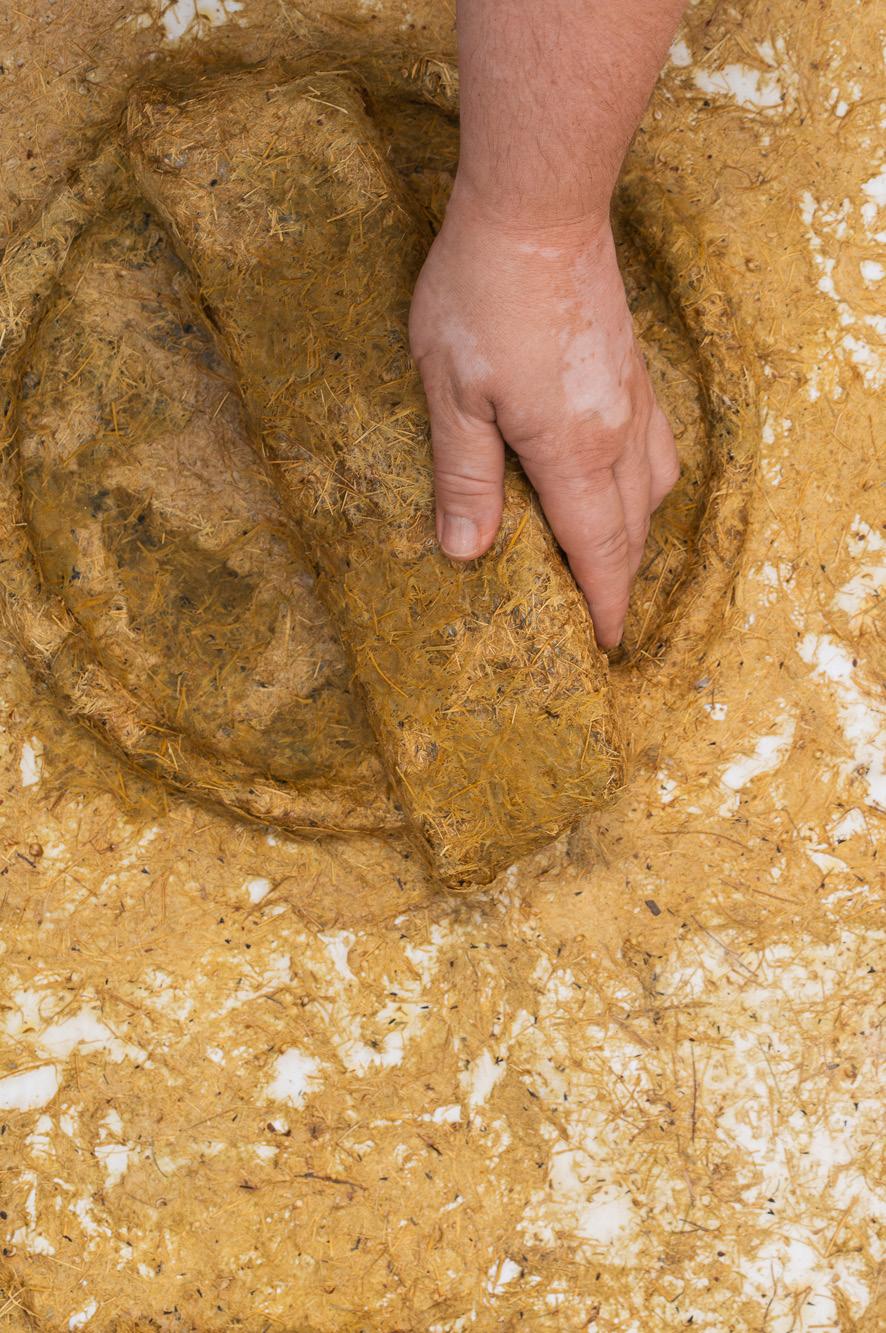

Stephanie Doddridge’s studio (2026). Photography by Lana Adams.