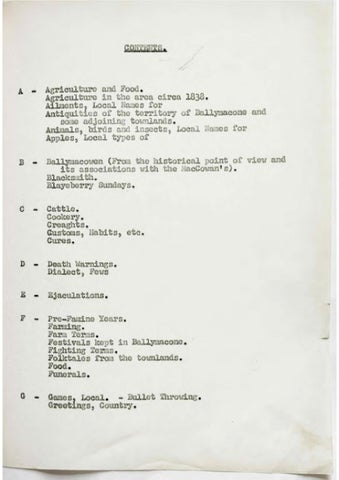
COMTESERS
A
-
Agriculture
and
Agriculture Ailments,
B
-
of
kinds
Local
circa
1838.
Names
for
terrioritry of Ballymacone and
ter
townlands.
and
insects,
types
Ballymacowen its
circa
the
adjoining
Animals,
Apples,
food.
the
Local
Antiquities some
in
Names
the
with
historical
the
Sundays.
Cattle. Cookery
Creaghts. Customs,
Habits,
etc.
Cures.
death
Warnings
dialect,
E
-
—
Fews
Ejaculations.
Pre-Famine
Years.
Farming Farm
Terns.
Festivals
kept
in
Ballymacone.
Fighting Terms. Folktales
from
the
townlands.
Food. Funerals.
Games,
Local.
Greetings,
-
Bullet
Country.
point
of
MacCowan's).
Blacksmith. Blayberry
for
of
(From
asociations
Local
Throwing.
view
and
H
-
Harvesting. Harvesting
Custons
-
the
cutting
of
the
Calliagh.
Highwaymen. Horse, The Houses;
Tho
Brague
Cottage
House Customs. Housing and House Types.
Housing, Comparative notes on
Implements,
Agricultural.
Implements,
houschold
houses
K
-
L
in
the
utensils,
etc.
noted
in
district.
Keening.
-
Irish
language
Lands.
in
Upper
Descriptions
Fews.
of
Lime Burning.
M
-
Map
Sheets
Marilage
P
-
Pedlar,
of
the
District.
Custons.
The
Place Names. Plants
in
Potato,
the
area.
The
Potatoes
in
Proverbs
or
Proverbs
-
Proverbs
1838. Savings
Good
-
Ill
Marriage.
Proverbs
-
Local
Riddles.
S
-
School Sliabh
Fuaid,
Animals
and
Bids.
Luck.
-
-
to
luck.
Proverbs
R
relating
Sayings.
References
in
Annals
of
the
Four
Masters.
Tailors
and
Shoomakers.
Travelling Tea-Men.
Townland names, Variations of Spelling Tinkers and Gypsies. Tongue Twisters.
Trees
of
the
area.
Trees and Plants, Local names for. Turf
-
Cutting.
Valentines,
W —
Rhymes,
etc.
Wakes.
Wake Games. Wakes and Funeral Customs. Weather Lore and Sayings.
"The Big Wind of 1839". Wood Turner.
1
The Fews in 1651.
Commissioners of the Parliament of the Commonwealth of England.
Letter
to
the
Council
of
State.
This last Thursday a party of the enemy met with a small convoy of 20 horse and 40 foot and cut them off who we conveying 1200 loaves to Col. Venables party at Armagh. The loss
his
to
the
orders
Moyry,
convey
of
was
eight
where
they
occasioned
by
the
miles
about
being
were
fallen
upon
Captain
not
observing
a
secure
way
through
by
Tories
that
keep
in
the
those
montains who are reported to be in number 200 horse and 300
foot.
Dunlop,
Letter
A
to
Sir
party
Charles
of
20
Vol.I,
p.17.
Coote.
horse
and
40
foot
going
from
Dundalk
to
the
army about Armagh to convey bread to them was lately cut off in
the
field
by
the
unadvisedness
Col.
Venables
party
of
Belfast
8
the
of
is
enemy, the
now
enemy
Aug.
reached
and
1651.
and
officer
clear
the
in
bread
not
towards
those
Dunlop
lost
through
observed
the
his
Fews
parts.
Vol.
I,
D.
25.
to
the
directions.
fall
on
that
Chapter
Though the
lands
heads
die
Headings
lands
die
not
–
the
coarbs
die,
live.
Brehon Laws, Vol. IV, p. 267.
Coarb
-
heir
or
keeper
of
Ibid,
And
with
a
sleep, and
sure
a
mystic and
never
figures
beauty
open
a
has
post
hearts
over
the
lain
strange
classes eyes
on
shining
radiant
p.103.
and
which
which
with
dreams,
beautiful
land.
our
like
grasses
of
in
the
an
this
eyes
the
hill
the
land
sides
sun
of
spirit
Ireland
the
as
but
move
enchanted
is,
body
in
gentle
in
stately
through
world
as
dreams:
of
his their
own, and it has become alive through every haunted rath and wood and mountain and like, so that we can hardly think of it
otherwise
than
as
the
shadow
of
the
thought
of
God.
A.E.
Agriculture
and
Food.
1559-1603.
The burn
foresaid
them
seldom
for
eat
willingly
Our
the
this
eat
straw,
herb
and
horses
carts
or
leather
to
the
or
tails
pulled
iron
of
so
not
Irish
and
being
like but
horses
of
a
to
they
They
laste.
Moryson.
with
fasten
the
but
yet
kind.
sharp
p.229.
they
oats,
thereof,
better
things
and
their
cakes
any
history
chains,
their
thresh
make less
shamrock,
of
draw
do
much
Illustrations
ropes
be
Irish
bread,
the
withe tails
wild
traces them
rumps
of
by
when
the
off.
Ibid. p.263. The Commonwealth of Ireland Moryson.
They
and
most
gladly
roosted
or
holding
him
save
that
whereof which
eat
commonly sodd, a
they
they
churl
they
take
is
the
best
any
claret
oatmeal,
congealed
milk
aqua
eat
hath
most
of
bread
corn
in
often
let
They the
their and
left for
drink
world
swallow
love
no
shamrocks
and
it
or
much
and
it
be meat,
Christians, horses,
usquebagh
much of
blood, meat
if
any
after
their
lumps
cows
and
raw;
with
bread
They
butter
times
any
wine.
with
watereress
their
care.
vitae
as
many
seldom
special
and
blood
herbs,
flesh
who
keep
seisdom
with
raw
eat
sack
butter
eating
more
but
mixed
the
than
sour
curdled.
Ibid
The
p.321.
food
Mangers
of
the
and
Justons
of
the
Irish.
people.
Potatoes from August to May. Fuel
-
Eggs
and
turf
Tobacco
their
in
most
butter taken
places.
made in
rancid
short
by
pipes
keeping
seems
the
in
bogs.
pleasure
of
lives.
Petty's
"Political.
-Econemy
of
Ireland",
Vol.
II,
p.
59.
Agriculture
The
absence
of
fences
and
and
Food
(Cont'd).
encloses
before
the
17th
century which resulted in the employment of many handsmen, the
chief
As system
wealth
personal of
being
tenure
creaghting
to
execution
Hay
or
fodder
wintered
Tillage short the
of
the
In
winter
intended
for
of
there
Seed
sown
by
the into
the
chitle.
land
decay.
in
enough
seale.
was
became
in
for
general practice
and
dire
local did
was also.
steers
and
results.
needs
not
was
then
very
involve
corps.
work
around
have
to
be
the
houses
fenced
from
a
sack
or
and
against
tail.
hand
the
population
quantity with
Methods
for
The
increase
limited
would
by
in
sometimes
ground
corn
Ploughing
-
ample
present
manuring
by
was
out
though
of
fell
hastened
heifers
then
apron.
land –cattle
Auriculture
Bog
and
turf
then on
the
spare,
they
inprove
within
part
ashes
repeat it
down
of
set
owing
topsoil, laid
to
burn
the
aren
circa
them
on
a
spading
their
the
several
with
few
quantity
times
found grass
of
surface
potatoes,
to
then
upon
to
the
of
At
above
of
of
ditsches,
the
whole
date
their
good
the
employed.
with
and
other
ferment
and
rot
of
than
the
good
farmers
dunghills
weeds
corps
day
if
the
ground
having
clay
is
meadow
mingled when
and
manure
unlands;
off
They
deepest
other
the
is
cutting
practicable.
bog
for
by
to
this
with
the
levelled
and
seed.
Ibid as
low
required
until
give
the
where
Donaldson's
quantity
1838.
moorlands.
Farmers
the
in
of
the
bog
or
vegetable
of
Fews",
district moory
p.37.
increased
earth,
substanties,
the
scouring
and
letting
together.
p.37.
potatoes,
"History
above
acts,
etc.
compost as
when
said
dung
to
produce
alone
was
Local names for common ailments.
Measles
-
Nettle
rash.
Whooping Cough - Chin cough
Croup - The choking.
Thrush.
Diarrhoea - The looseness.
Stomach-ache - Sore belly.
Erysipelas
-
Epilepsy
Falling
-
Rose.
Wild
fire.
Sikness.
Consumption - Decline.
Asthma - The smothering.
Heart-trouble
-
Goitre
big
-
The
Torment
throat.
of
the
heart.
Notes
on
the
Antiquities
of
the
territory
of
Ballymacone and some adjoining townland
Territory of Ballymacone.
Armaghbrague.
Carrigatuke,
highest
point.
Reputed
sit
of
an
ancient
cairn associated with the Red Branch Saga and St. Patrick's church
Rude
building
stone
location district
of
adventure
seat
an
south
on
sumit
annual of
with
the
known
blayeberry
Carrickatuke
bull.
as
St.
Patrick's
pilgrimage.
and
from
Old
Cairn
chair. name
Hill
of
to
Newtownhamilton was Moin Fuad - authority Mr. Arthur McParland whose informant was an old man born about 1830.
Corran
The Grey Stone of Corran. A pillar-shaped stone making the
burial-place
of
the
bull
whose
destructive
activities
prevented the erection of a church on Carrigatuke. Carrickatuke Remains of an old "green road" which tradition states once ran from Emain Macha to Tara, part of which was in use in the 17th and 18th centuries as highway from Armagh to
Dublin. Sngle-ringed
fort
A
case
cylindrical
on
farm
of
gold
of
Peter
was
Kernan.
found
in
this
townland
in
1833. See Topographical Dictionary of Ireland (Lewis) under Lisnadill,
and
Wilde's
Catalogue
of
Antiquities
in
the
Royal
Irish Academy, p. 89.
Farranmamucklagh
Locallycalled
"Farlagh".
The Fairy Glen on the farm of Arthur Boyle contains a Mass
Altar on which tradition says Mass was celebrated in Penal Days.
The
alter
was
rudly
shaped
of
earthen
sods
and
is
now much defaced and overhung by three large thorns. The last McCone of Farlagh died in October 1942 aged 85 years. His name was James.
IV.
Lislea.
Fort shown in this townland on Maps of 1835 and then evidently farm the
of
in
Mr.
fort's
fairly
perfect
Samuel
removal.
condition.
Craig.
tradition
Now
says
a
site
ill-luck
only
on
followed
-2-
V.
Lisnadill
Contains the remains of two earthen-ringed forts (on the Menary and Moor forms) and a hoof-indented boulder linked
with
stores
of
St.
Patrick
and
the
Bull,
as
well
as
a
travelling earthwork, commonly called “the Cast”. Linked by tradition with Navan Rath near Armagh and Locally believed
to
have
been
a
boundary
of
the
old
district
of
Emain Macha. Cast traceable but very inperfect on Moor and Williamson farms.
VI. Tanderagee
Ballymacone Mill in this townland was formerly for the
grinding of grain but is now converted into a scutch-mill. In
old
days
miller
as
part
his
of
the
corn
or
wheat
was
retained
by
the
for grinding. The custon was known
fee
locally as "Mutter" which may be a corrupt form of "Multure".
VII. Tullybrone.
Booley
Hill
before
the
on
hill
James was
Gillespie's
divided
up
farm.
into
A
relief
enclosed
of
the
days
fields.
Was shown in the Johnston farmhouse a christening robe of linen, made from flax grown and woven in the house over a century ago.
The Johnston's have been in occupation of their farm from before
the
battle
of
the
Boyne
and
the
present
house
is
said
to have been built 150 years ago. Some old glass remains in the
windows
"Bulls' hearth
-
eyes". but
greenish-tinged,
House
this
was
had
a
not
canopy
removed
in
quite
type
recent
clear
brace
times
and
over
and
a
with an
open
kitchen
range inserted. Windows in gable-end light two attic rooms up upstairs. Centre-room upstairs known as the “Black Loft because been
it
has
no
house.
III.
Tullynagin.
No
widow.
discontinued
antiquities
on
The
this
Cutting
farm.
of
Quilting
the
Calliagh
frame
at
has
this
Adioining Tounlands.
I. Aughnagurgan.
A
group
of
"Prelimary
three
prehistoric
Survey
of
burial
Northern
places
for
which
see
the
Ireland".
Old road passing through this townland by Tullynawood Lake associated St.
with
pre-christian
tales
and
also
linked
with
Patrick.
The "Calendar of State Papers of Ireland" 1592-1596, p.246, show the name as Aughe Magoregan and record that Conor Oge McCardill
rescued
certain
kine
there.
II. Ballymacnab.
Earthen-ringed
but
partly
fort
on
destroyed.
farm
of
Known
James
as
Mcllroy.
"Devlin's
Single-ringed
forth"
and
so
called in commemoration of a previous owner of the farm. A
second
situnte
is
on
fairy
The
single-ringed farm
Thorn
Bull's
fort
belonging
that
track
-
figures
a
locally
to
called
Bernard
in
many
hoof-indented
"O'Neill's
Curran.
local
boulder
near
it
Fort" there
tales. associated
with St. Patrick's encounter with the Bull from Arnaghbrague. Mass Garden in sub-denoination of townland called Carrickclay and on farm of Arthur (Joe) O'Toole.
III.
Ballintemple
In
the
cutting
of
turf
in
this
townland
some
habitation
sites were discovered, in one of which "a coat or jacket of a very
peculiar
cloth,
like
sacking
or
bits
and
pieces
the
brown
canvas
was
were
in
color
and
discovered.
eventually
of
It
lost.
a
course
was
dug
With
it
texture
out
was
in found
some leather footwear of a shoe or slipper shape". The coat had buttons and according to Mr. Wm. Isaac Johnston they were "wood or horn
IV.
Ballynoran.
Reputed
church
side
on
hill
known
as
Kirk
Hill.
Greatly
destroyed earthen ringed fort on the farm of the Cunningham family,
V.
also
a
fort
site
on
farm
of
John
Hughes.
Cashel.
Stone-walled enclosure or cashel, totally known as "The Relig"
because
for
still-born
and
with
by
of
its
use
children.
the
taking
in
former
Wall
of
times
greatly
stones
for
as
a
buried-place
reduced
building
in
height
purposes.
Largest amber head over found in Ireland discovered within the
ring.
—.—
There
was
once
completly known
a
cairn
removed.
locally
as
on
It
same
was
"Carn"
or
hill
but
probably
in
the
it
has
situate
adjoining
been in
the
field
field
named
Carnaeggit“
VI. Cladybeg
Contains line of an old trackway linked with Emain Macha and Tara, that later become a well-known highway continuing in
use
in
parts.
In
the
17th
and
18th
century
was
the
recognized route from Armagh to Dublin and much infested by
highwaymen. Passed through the Dorsey entrenchments, and tradition affirms that Brian Boru's funeral came to Armagh from
Clontarf
by
this
route,
and
that
James
II
traversed
it on his way to and from Derry in the days immediately preceding
the
battle
of
the
Boyne.
A Barracks was erected here in 1700 in which a small party of
troops
way
to
were
and
fro
quartered
through
to
the
safeguard
hills
of
the
travellers
on
Fews
to
and
their
protect them from the attention of highwaymen for whom the district
was
somewhat
notorious.
At
that
time
there
was
an Inn near to the Barracks known as the "Black Ditch" which probably took its name from the peak spoken of locally
as
the
Cairn
site
on
"Black
Dead
Bank".
Man's
Hill,
alias
Cairn
Hill.
tradition
says that the cairu was removed by the Synott family when building Ballymoyer House and that they had the then Lord
Charlemont's
permission
to
dismantle
it.
Bonfires
were lighted on the cairn in the old days on Mid-Surner Eve and there was music and dancing. This continued until about
50
years
ago
and
the
games,
etc.
were
very
similar
to those taking place on Bilberry Sundays at Armaghbrague. The side of the cairn is now a circular green match ver free
of
heather.
VII. Cavenakill.
Cairn sito on Cairn Mill in which, when the graves were being broken up some potery was found and removed to Ballymoyer House.
Habitation
sites
found
in
the
cutting
of
peat
in
this
townland. Informant Mr. Anthony O’Hare. In 1930 when cutting turf a bronze spear-head was found by Mr. Hugh O'Hare and at the same time a bronze palstave was discovered by his brother John. The two brother's were sons of the above Anthony O'Hare. The spear-head and
palstave were found within a few yards of each other.
-5-
Cladymore.
This
townland
of
St.
of
a
Peter
who
a
and
grange
Granted
to
site
of
Civil
a
St.
Sir
Paul
Toby a
of
part
of
the
Armagh
of
Caulfeild
village
market
small
War
formerly
lands
and
of
the
contains
Abbey the
site
chapel.
formed
Saturday
was
and
friary
1641,
in
therein
two
the
and
fairs
probably
possibly
in
early
was
in
17th
given
a
century patent
for
1612.
established
1644
or
during
1645
-
see
the
Friar
O'Mellan's Journal under May 1644 and January 1645 Fort and
sides
on
Patrick
ringed
fort
farms
of
Vallely, on
the
Joseph
and
a
McCullagh,
perfect
Raftery
James
miniature
Boulter,
earthen¬
farm.
Drumconwell
A
very
perfect
earthen-ringed
fort
on
farm
of
Peter
Donnelly and and greatly destroyed fort known as "Rainey's Fort"
nearby.
discovered
In this townland was discovered the only Ogham Stone so far found
in
Co.
Armagh.
Dundrum
Double-ringed little.
Two
earthen-ringes
other
fort
double-ringed
on
farm
forts
in
of
Mr.
John
immediate
vicinity, one in the adjoining townland of Tullyglush the other in Ballinagalliagh. Killyfaddy.
Contains Cast" site
on
on
Pond
a
very
the
of
Henry
and
probably
relies
Peter
St.
and
section
Cunningham
farm
Field,
fine
of
a
and
Price.
another
Paul
the
Gray
the
a
“Dane's
Reputed
known
as
the
"Graveyard
chapel
Armagh,
so-called
farus.
Field
called
grange
of
of
of
the
building
castle Fish
Field"
Abbey
shown
of
on
are
St.
the
Escheated Counties Mep of 1609.
Latmacollum.
lof
the
Danes
Cast
on
farm
of
Mr
John
Hughes
In
this townland the Cast is commonly known as the "Rampar"
Tullyvallen.
Shee
Fina
King
Lir.
Donnelly's ring
of
Bloody
or
the
Hill.
Once
boulders Bog
Fairy
said
or to
White
Hill,
surmouted
standing
take
its
the
by
a
reputed
cairn
abode
of
enclosed
by
a
atones.
name
from
a
battle
fought
there
-6-
in
1650-51
under
between
O'Neill's
troops
and
Cromwellian's
Ireton.
Souterrain
on
Warnington
farm.
Harrymount. Cairn from which a Bronze Age Food Vessel was
obtained.
Cross of
inscribed
Peter
stones
Donnolly
and
in
Tullyvallen
Henry
–
Tipping,
on
farms
Savage.
Newtownhamlton village founded about 1770 by the Hamilton by
family
purchase
who
earlier
acquired
in
that
3,275
century.
acres
in
the
Hamilton's
district
of
Hampton Hall, Balbriggan and Hamwood, Co. Meath, present
representatives. Corp
of
Irish
Volunteers
raised
by
Edward
Tipping
circa
Yeomarry Corps in 1798. Copper June
halberd
1930.
found
in
Tullyvallen
Bog
-
Sec
J.R.S.A.I.
L
names
for
birds.
animals
and
insects.
Mankcepor - a small lizard or newt.
Stirk
-
a
Whatrit
young
-
Stripper
cow.
woesel.
-
for
not
in
call
but
giving
with
Moilay - eov without horns.
Springer - I cov near her calving.
Grue - Freyhound.
Bulle-stirk
-
young
Reill.
Screw house - Shrew House.
Linty
-
linnot.
Gold Pink - Gold Finch.
Corbie - Grey-backed crow.
Pee-weet - Lapwing.
Jinny wran - common wren.
Clagg
-
the
Pismire
-
horse-fly.
tho
Devil'sselle
-
ant.
tho
Dragon
fly.
Coffin-cutter - the Devil's Coachman (Locally
way
that
a
story
Christ
is
told
had
of
gone
this
Barywig - the carwig.
Heather-bloot
-
snipe.
Felt - Redwing.
Blue-bonnet - Bluo Titmouse.
Hern Cran - Herron.
Yoltio
Sealdie
-“Y-
-
a
Hammer.
nowly
hatched
insect
through
bind.
having
the
shown
harvest
the
fields).
Theoudy
cuckoo,
An'
she
The
jinty
An'
brings
Another
brings wran
she
them
version
she
them
says
lays
out
lays
out
but
with
two
a
deal
to
do,
ninctoen.
both
next
an'
elean.
-
The wren has ten and brings them up like gentlemen.
Lacal
This
is
farus there apples.
not
a
were
The
types
fruit
a
of
apples.
district
few
following
fruit
but
trees,
kinds
still
on
some
old
service
in
Widow's Whelpe
Barn
For's
Black Annet
Mhelps
LauGerry Cheeks
of
mostly
Hill
White Annet
Canes
Honoy Combs
Half-plums
Sogar Sweets
Red Strokes
Dockeneys
Russetts
Lily
Finger.
the
older
varieties
the
of
district.
The
Torritory
of
Mallvincone
and
its
asseciations
dth.
###
Intreductory
Some
Sunday"
rising
to
explore
years
getting
a
health
much
ago
-
the
whenbringing
on
Carrigatuke,
of
1,02¼
of
Ballymune
the
feet,
a
hill
my
Abreunding
the
annual
in
quest
River.
"Milbury
Armaghbrague
compelled
countryside
on
me
to
foot.
In
doing so Iher; l'acumulated a pass of material relating to folk
custon
and
tradition
-
matter
that
must
be
shelved
for
the
present.
In
my
journeys
through
the
district
I
was
continually
finding myself on the banks of the Ballymneone river, and
being
of
reason
upon
a
for
somewhat
inquisitive
the
Its
which
was
left
town
or
to
name.
local
knowledge
wonder
lands
of
origin
the
why
was,
failed
the
HeCon's.
nature
tried
to
find
however,
a
toern
light
any
subject
shouldFisquerade
Hy
curiosity
was
a
so
as
even
I
the
more
whetted when I found that an old corn—will in Tanderagoe
townland was still known as Ballymscome Mill“. It then became
1.0.S.
Street
2.The
corn
early
as
erected. ctorage
25.
hill
1703. Loth
is
of
Sco
some
antiquity,
Appendix
buildings
accomodation.
IV.
service Local
A
but
being
sculch
are
tradition
now
in
use
mill
at
tus
chiefy
aseribes
least
as
later
farm
the
creation
of the will to a mythical "Bella McCono" from whom the river is
also
said
to
take
its
hand!
-4-
necessary
of
the
to
river
Further
the
try
and
with
lands
in
the
as
a
the
laps
hope
and
that
widden
through
other
church
the
connection
surcene.
consideration
Inquisitions,
period
selve
of
the
other
they
problem
induced
documents
night
produce
sub-denouination
of
the
the
or
me
to
Plantation
missing
alias
story
for
town
aand
or
in
the aren. My rescarchesdu[n]lckly solsclosed the fact that the Sept
Sept
once
formed
the
a
hold
a
tract
definito
territory
of
of
region
over
6,000
described
acres
by
and
various
that
the
lands
Oathorities
as
Ballymcono.
The McCone's and their lands.
I first examined an Inquisition taken at Armagh on August 12,
1609, and therein learned that the Sept of ClanjeCono had been
time out of mind possessed of the eight Soans of -
Tullbrouwe
Licnechll
Toynrosy
Lisleagh
Fornaghleshalge
Tullynen
Arnaghbreg
Corvan
In
Fues
having
barony
proceeded
Plantation
index
at
for
sups
the
of
a
rent
so
far
that
northern
to
I
the
Archbishop
thought
year
as
they
courties.
it
El
Odvisable
form
The
of
our
I
General
per
to
crum.
consult
amilest
Imp
of
the
tonnland
Ulster
proved unproduceive but the County Enrenial Sheets under Facs
3.
Cal.
Pnt.
Holls
7.
James
I.
-3-
portrayed
the
above
eight
townlands
as
a
separate
unit
within
that barony under the title of Balle McOmon. A presentment
made byhaltson native jurymen in the preceding year noued
the lands as BallymacOwen and gave the additional information
that
the
Archbishop.j.i.nged
certainty
of
which
the
Jury
certain
knew
chief
not“,
rents
whilet
"the
another
record of the same date designated the group of townlands
as Ballymackowen
The
townlands
of
Upper
Feus,
of
Sliabb
Fund,
through
the
which
ancient
exact
a
position
question
district
one
ran
road
in
of
one
from
in
the
noted
the
of
are
in
three
the
all
situate
early
great
three
Tara
to
Feus
there
is
times
the
as
familiar
great
Enania.
in
the
little
to
location
places,
highways
As
barony
of
Sliah
Ireland,
Fuaid's
infinite
information, but Carrigatuke seems the most probable
identification.
detail
of
Space
reference.
nanuscripts
as
will
not
They
marrations
of
permit
first
an
appear
Gegendary
emonination
in
our
events
in
oldest
that
even
then
4.Vol. E.3.13 and No.582 Trinity College Library, Dublin. Survoy of the County of Arnagh taken at the Moyrey Castle August 2, 1608. A note dated August 3, 1605, in the writing
of Archbrchop Henry Uscher and preserved in Old Rent Exlls, Archbishop's the
division
Registry,
of
the
Public
county
Library,
into
Arnagh,
baronies
took
aspects
place
in
that that
year. Patrick McCalo McArdell was then Conitable of the
Fews and BallymacOwen appears as eight ummemed towns.
5. Rawlison I.S. No.237. Bodleian Libruary, Onford - ses
Annalecta Hibernica, No.3, September, 1931, p. 216.
—.—
were
long
past.
They
continue
down
theernieries
to
the
present
and show that it was a most important spot - favour as a place of
battles, assemblies and conferences. Such meetinge occur in the
Annals and cumpel one to suppose that there was some specific
reason
of
apart
past
from
tradition
its
that
situation
made
it
for
its
more
choice,
or
less
some
sacred
voneration
ground.
We have no data, however, as to when the above eight terms
became
the
property
of
the
Hccone's.
The
first
notice
I
have
found of the name loeally refers to a Patricio Macuymn and
Gillachended Macongan. It is shown in a document perfected by
Archbishop Ccannel on February 5, 1264, who erected the Franciscan
Abbey of Arnagh in that year. In 1367 a Macongan charges as a
principal
citizen
and
one
of
the
chief
tenants
of
Archbishop
Suoteman, and in an undated rent list of about the some year
there is a reference to the "land of O’Co[m]gern - rent 10/-, "that found
being
the
earlier
account
I
have
of
the
territory
or
lands
of
Ballynacone.
The
tract
of
land
compiring
the
territory
was
a
long
Grip contching from Lisnadill, about 2½ miles south of Arnagh,
to within about the same distance of the modern village of
Newtownhamlton, and up to the late eighteenth century formed
part of the old and very large parish of Armagh. Tenants on the
southern
part
attend
their
to
separated
of
them
theyorschlaged
the
territory
religious
from
in
a
the
must
devitions
ancient
church
on
have
owing
city
one
found
of
to
the
and
its
the
nearly
it
difficult
distance
churches.
to
that
Probably
Granges
of
the
-5-
Abbey
of
The
in
St.
Peter
following
Elizabeth's
and
St.
Paul.
members
reign,
but
of
made
the
Sept
supission
were
and
involved
were
in
rebellion
pardoned
by
nurrant from the Lord Deputy, dated June 24, 1602.
Morris OcComane, Ycoman James Ogo, McCovano, Yecman)
All
of
Fewes
Rorie HeCoven, Husbandman
Barony Torligh McCovane, Yconan Schöne HeCothane, Johann
Torlight
rentals
later
as
settled
tenant
Innodiately
and
Seotch
of
in
a
Armagh
house
afterwards
Eottlers
took
in
and
the
the
place.
appears
city
in
the
Archbishop's
1615-1624.
Plantation
The
in
of
Ulster
Commissioners
with
English
appointed
to
enim
on
July
31,
1600,
and
raised
there
two
days.
From
Dunhalk
they
set forth for Armagh on the morning of August 3. The day was
sterry
and
decided
passed
four
to
territory
there
of
of
it
was
rest
a
a
back
outside
of
the
of
not
the
the
and
4)
the
city
to
begin
city
they
heard
surveyors
and
obtained
the
many
from
their
for
morning
the
August
claius
facts
Feus"
they
and
rents
south
of
within
the
underbtedly
place
to
the
they
was
4
until
the
probably
one
resting
completed
of
pitched
was
second
August
midst
(August
camp
notable
into
"the
Feus
first
but
rather
passed
reached
morning
The
evening
they
interviewed
West
Arnagh.
the
Commission,
encorped
the
they
Eallemacone
and
day
when
encamp.
from
which
so
through
miles
within
yet
they
of
August
work
13.
of
of
6,
on
the
Whilst
the
from
remained
Archbishop,
the
-6-
inhabitants
days
that
The
August
of
the
county,
that
were
of
help
during
the
busy
followed.
most
12.
consequontial
It
was
held
to
meeting
decide
of
the
the
week
took
contrary
place
between
on
the
Crown and the Church as to terman and herenagh lands and the
findings
as
invaliable
and
as
a
to
as
septs
a
guide
and
clue
to
to
the
sept
the
lands
old
make
Irish
location
of
that
families
their
Inquisition
of
lands.
the
county
The
Commissioners present were: -
Sir
Arthur
Sir
Chichester
Oliver
St.
John
The Archbishop of Armagh
Sir Garrett Moore
The
Sir
archbishop
of
Dublin
John
Davies
William Parsons (Surveyor-
Sir Thomas Ridgeway
General)
Sir Humphrey Winche
The Jury appointed to assist the Commissioners was ablected
(with
the
two
exceptions)
county.
The
Jury
from
was
the
as
Marmaduke Whitechurch, Esq. Sir
Tirlagh
O
Neale,
Knt.
septs
or
families
of
follows:-
Calvagh Mc Donnell Redmond O Hanlon Owen Boy Moliurcho
Carberie McCann
Neale O Calligan
Donagh Morchie Tirlagh
chief
Hugh MeHenry O Neale
Meiteggart
Patrick Oge 0 Conrie
Christopher Fleminge
Cormack McTirlagh Braslowe
Con 0 Neale
0 Hugh McBrion McCan
Neale
Bartholomew Owen
Donell McHenry O Neale
Hugh Meiteggart
Neale McCoddane
Tirlagh O Cassaye
Donnell McCann
Vice 0 Quin
Unfortunately
findings
and
revealed
gave
cepts
the
jurors
the
detailed
were
the
did
names
not
of
particulars
include
a
most
of
as
their
to
McCone,
the
septs
of
lands.
but
their
the
county
The
then
-8-
All
theüenants
bondes
rents
then
were
held
direct
liable
for
from
the
herriotts
Archbishop
of
oxen,
and
mutton,
hogs, hens, and so many days work each year "with man and
garran"
-
The
July
3,
see
Appendix
Archbishop
1620.
It
I.
had
contains
a
further
a[s]light
grant
of
the
wordations
in
territory
the
la
on
spolling
of the names of the townlands but otherwise revealed no new
features.
A
Chancery
Inquisition
relating
to
the
lands
of
James
Archbishop of Armagh and taken in the city on September 9,
1633, is, however, much more informative - see Appendix II -
for
besides
giving
three
separate
acts
ofbringing
for
the
Ballymacone townlands
final
list
of
the
the/territory
of
Dullomaccunn
sub-denemination
of
each
of
it
the
gives
eight
in
the
townlands,
one of which was Menemacowan in Armaghbrague.
In
the
"Distration
of
Forfeited
Lands
returned
by
the
Down Survey, (chewing whose they were in Anno 1641 and to whom
now
set
out"
there
is
the
followingnenary
of
the
lands
Armaghbrog
Fernanucklagh
Tonrogee
Coramoro
Tollebrone
Tullynegonie
Lossleagh
Lisnadoll
and the Commons of Ballymacowen.
The
haps
of
the
-
above
survey nade in 1655, depict the Commons as 481 acres of course
nenntain pasture and render the place-name as Ballymacowane.
In
people
the
in
mistrate
16th
the
to
and
17th
lowlands
the
uplands
conturies
after
sowing
with
their
it
was
their
usual
corps
families
and
for
in
the
spring
besitle,
to
living
-9-
there
in
to
their
in
the
not
temporary
hemes
corps.
fenced
at
the
The
in.
sentiments
beginning
criminal
Each
during
head
of
the
the
pasturage
of
a
summer
autuam
was
family
and
in
returning
time
grazed
belonging
to
by
all
to
the
rather
and
sept
place had
the
right
entitled
his
to
farm.
were
the
ennables
total
send
grace
In
his
being
a
man
in
did
cattle
on
usually
in
regulating
classification,
equivalent
the
to
to
turn
other
not
out
c-or
the
animals
the
on
being
exact
in
the
any
number
proportion
thebringing
the
exceed
it,
such
taken
number
way
amount
he
of
to
was
the
size
lands
as
of
he
one
cows
pleased
his
animals
unit
or
so
of
which
the
long
privilege.
as
The
Kustom was known as bookoying and was probably ancient as it is
noticed
for
in
the
Senchus
Tho
Poll
Tax
of
four
townlands
Mor.
1666
unfortunately
within
only
gives
particulars
thebringing:-
Ardmaghbeg, inhabited by 16 Irish.
Tonrige,
inhabited
Tollenagin, Lisnadell,
by
inhabited
inhabited
10 by
by
Irish. 5
10
Irish.
Irish
and
10
English.
Just why the other four townlands should have been cmitted is
souewhat
have
puzzling.
been
without
It
does
not
seem
inhabitants.
A
possible
survey
of
that
the
they
could
principal
Irish names and their number is given under each barony and
there were then 10 0 Counos in Upper Fows.
6.
Royal
Irish
Academy
Conmus of 1659.
Library.
known
also
as
-10-
The Henrth Money Rolls for the year 1664 give the names
of
the
they
The
people
also
then
Road
of
lack
in
the
relevant
compleeness
inhabitants
Lisnndill.
were
No
townlands?
who
there
mention
-
all
Irish
McCone's
is
no
excepting
are
paid
the
of
Ralph
mentioned
tax
–
but
Tullybrone.
and
though
Clement
there
is
clan proof
that
members
of
the
Cæn
were
still
resident
within
the
HeCone territory. About that time McKeone became a normal
spelling
due
rendering
no
of
doubt
the
to
a
surname.
Haarth
By
Collector's
then
they
had
phonetic
speed
into
many
townlands in the Upper Fows and indeed into lower Fows also
as
the
following
list
indicates
-
Cavankill
Corharmock
Owen McKoone
Shane HcKeone
Rory McKoone
Cormick MeKeone
Patt. McKhone Darmahuschin Dellek Phelim Boy McKeone Donagh McKeone
Sorley McKoone
HcKeone Carricksalloely
Ontlecken Phelim McKeone Art McKoone
Dunasmullan
Domolly
John McKoone
Rory 0 Cowan
Carronmannan
Ballylana
Patt. Roe MeKoone
Patt McKeon
Patt.
7.
Soo
HooIo McKeone
Mckcone
Appendix
III.
-11—
In
a
the
days
favourite
many
in
before
haunt
stores
evading
of
are
and
His
is,
indeed,
and
Rapparoes
the
still
the
revolutionary
celebrated
told
of
his
Rappareo,
and
were
in
those
the
remembered
that
ever
graces
the
sent
nxse
the
district
Redmond
audacity
foaling
best
who
wars
of
his
O’Hanlon.
cleverness
pursuit
any
was
of
of
the
him.
Tories
Fous.
The old road from Armagh to the south had a great charm
for
as
such
the
gentry,
sometimes
following
letter
indeed
shows
it
was
a
fatal
attraction
-
Armagh. July 17, 1697. „Sir Versterdam this
town
that
Captain
infested this
a
road
and
that
six
o'clock
fellow
Nachally
this
place
about
country
and
were they
stript
the
in
in
the
afternoon,
to
his
achirt,
rest
of
the
came
with
an
Raunaroes
a
little
house
within
were
there
asleep.
upon
into
account
that
four
so
long
miles
which
of
Captain
Macklin and about twelve men of his company and townmen went out
with
had
a
they
our
all
say
got
expedition
at
to
party
some their
so
and
distance,
horses
cagerly
designed
who
ran
to
and
and
made
away
purcued
them,
that
surprise gave as
them
fast
they
them,
as
soon
but
notice, they
they
and
could,
overtook
so but
them.
They fired many []chots and would not take quarter, but after an bour's chose they killed MacNally and one Macihane and brought in
their
hands
These
two
which
were
wereickeicly
the
chiefest
of
dined
these
upon
the
Sessions
regues
that
robbed
House.
fourteen
or fifteen persons on Wednesday last, and murdered Captain
Groves one
till
that
8.
of
he
after
their
his
bayonets
10xpired.
was
They
coming
Situate
in
being
their
into
market
his
drank
hither
to
Street.
prisoner heart
most
treat
of
his
for
and
Dr.
a
long
rouling
on
it
in
Drelincourt's
friends."
Replaced
time,
Hall
putting
his
body
winc
11.
by
present
Court
House in 1809. William Groves of Castle Shannaghan, Co. Donegal. 10. The Vory Nov. Peter Drelincourt, D.D. Dean of Armagh 1691-1722.
11.
Printed letter
Dresden
from
giving
an
Groves of
the
a
Kowsletter.
gentleman
account
and
of
robbed
chief
of
the
in
Armagh
Rapharees
several
then.
Thorpe
other
Monday,
collection to
his
that
19,
friend
killed
persons,
July
Vol.
with
1097.
in
XI.
"A
Dublin,
Captain
the
behoading
-12-
In
in
1703
Ashe's
we
get
Survey
another
of
the
glimpse
lands
of
the
of
the
ancient
territory
Archbishopric.
The
eight
townlands were then held by named principalütenants who had
built
small
many
of
fara
then
houses
had
with
cottier
barnes,
tenants
stables
under
and
them,
cou-houses.
living
in
"cabins" or small tenements with cow-houses and potato gardens
attached.
Amongst
the
latter
class
of
tenants,
in
all
cept proburality, were soude nenbers of the old sikn that gave name
to
the
area,
they
do
not
at
anyrate
figure
amongst
the
enumerated. tenants
in
the
Eleven
survey
years
-
soo
later
a
Appendix
most
IV.
deprehensive
census
of
the
population of the eight Towns was compiled giving the names
and
religions
of
all
theüenants
thereon.
Compared
with
the Henrth Money Rollsof 1664 already mentioned it shows an
astonishing
further
increase
in
members.
reclamation
of
waste
importance
of
the
as
district
an
early
and
18th
This,
lands.
The
century
interesting
as
no
doubt,
was
document
census
revealed
of
the
two
is
due
to
of
inhabitants
members
of
clan the old Olæn, Teige and Hugh McCoen resident in Parnemuckly.
It
also
shows
a
certain
Torlagh
Bronty
in
Armagh-brege
who
nay have been the clussive ancoster of Hugh Brohte, the grand¬
father
of
The
the
district
unsettled
was
fomous
in
so
concerned.
novelists
would
far
In
as
seen
the
August
-
to
soe
have
soudhern
1703
Appendix
the
been
still
portion
V.
somewhat
of
well-knoun
the
Dr.
territory
Thomas
-13-
Molyncux12
came
north
from
Dublin
on
a
visit
to
his
estate
at Castledillon near Armagh, from which he continued his
journey
to
many
other
places
in
the
north.
On
leaving
Dundalk
with his friend and kompanlon, Counsellor Dopping, they
"be signed for Ardmagh and went sixteen miles towards it,
mostly on the very wild mountains on the Fews. These mountains
are
of
aieggy
gravel,
corn
all
this
meadow
house
Fort
in
heothy
which
or
is
evil,
way
met
called
Black
but
without
entertainment
not
so
them.
From
there
through
house
baited
Ditch,
as
or
one
He
any
much
two
road
but
enclosures.
Barracks
of
the
on
where
soldiers.
tolerable
three
them
and
miles
at
there
grass
a
rocky
nothing
them
Here
of
the
is
was
second
also
a
small
miserable
within
brings
like
you
two
to
miles
the
end
of the mountains and you enter into a pleasant enclosed country
which in five or six miles brings you through new made roads
to Ardmagh". 13.
Donaldson writing of the state of the Barony of Upper
Fess
as
it
familles
a
was,
circa
settled
picture
of
in
the
1733,
some
district
when
a
number
townlands
in
the
of
thereof,
second
Presbyterian
provide
quarter
of
us
with
the
12. Son of Samuel Holyneun of Castledillon, Co. Armagh, and
brother of William Holyneux, the author of "The Case of
Ireland
Stated".
Born
1661;
created
a
baronet
died 1733. 13. "Journey to ye North 1708", Young's "Old Belfast", pago
153.
1730;
-14—
eighteenth
thicket
with
in
century.
different
health,
several
He
places
boggale,
portions
of
states
and
ruhbes,
the
that
lands
wet
and
on
"extensive
lands
other
the
shrubberies
and
bogs
acquatic
summits
and
covered
production
being
under
tillage from whence the inhabitants whose members were very
iented
derived
custon
of
the
straw
their
ploughing
to
scenty
with
separate
it
subsistance.
horse
from
yoked
the
by
corn
The
the
was
old
tails
not
barbarous
and
burning
entirely
abolished notwithstanding the Legislature had mado laws
upwards
upon
of
a
century
delinquents.
interior
The
to
houses
that
were
period
imposing
generally
built
fines
in
"clachons" or clusters and had two doors or entrances which
were
closed
or
it
as
by
cattle
infested
operations
at
More
last
a
to
bundles
keep
bawn,
and
the
About
Carl
with
answered
enclosed
their
up
or
out
kind
property
of
sticks
the
of
from
wind
pound,
thieves
or
hundred
and
to
rain.
The
protect
and
alternately,
whole
themselves,
robbers
which
then
country."
that
period
the
of
certain
Charley
or
caught
a
Big
Charley,
(with
some
district
who
of
was
Carragher,
killed
his
"the
and
scene
known
robbed
associates)
and
of
lacally
until
he
as
was
hanged,
following which he was beheaded and quartered, the head and
quarters
was
being
gibbeted
at
had
committed
"murders
and
are
to
credit
Thomas
places
in
other
Wright,
the
the
district
atrocious
where
crimes".
antiquarian,
it
If
was
he
we
-15-
dismal
country
with
scarce
a
house
to
be
seen"
14
when
he
set
out from Dundalk acompanied by the Bishop of Raphoe on
March 31st, 1747, on his way from that town to Armagh.
Had
he
made
the
journey
later
in
the
year
he
would,
no
doubt,
have had some comments to make upon the magnficent views
for
which
An
1750
the
love
he
of
was
It
then
gain
so
states
that
received
of
his
known.
will
of
the
travel
any
on
the
man
in
journey
"almost
Xenophon
collected
their
well
account
stimulated
made
having
under
is
interesting
descent
first
then
area
bringing.
Dublin
as
the
as
famed
so
district
from
perilous
far
to
the
Armagh
an
march.
desperate
a
commended
his
his
around
he
protection,
on
him,
horseback,
to
achievement
andidously
friends
in
When
venture,
soul
to
God,
proceeded
through
the
defiles of Armagh Breagh and Black Bank. Even then he was
alarmed at every breath of wind which which thistled through the
heath
and
whirring
started
of
the
terror
grouse's
snipe,
lest
the
In
this
state
of
at
the
of
robbers
merciless
of
when
things
trepitation
residence
and
with
safeguard
of
the
Tories
he
Johnston
or
he
easily
bleating
should
prosseded
of
the
Fews
travellers.
The
of
be
until
who
heard
a
the
vagrant
upon
he
was
him
arrived
the
terror
Johnston's,
who
14. Journal of Thomas Knight, Louth Archacological Journal,
Vol.
II,
p182
-16-
vere
conservators
country
from
were
honourable
half
an
a
century
Fews
they
name
of
may
the
preserved
be
incursion
and
were
were
said
Sovereigns.
worth
man
a
Johnston's
accidentally
On
and
valiant
family
whose
The
O’Lavery,
overthrown.
of
Tories
On
other
exertions
country.
possessed
the
power
a
dark
and
ancedote
night
talent,
against
the
Priest
the
and
each
of
In
the
though
famous
not
perceiving
and
the
the
them
Priest
chief
other
They
during
concerning
the
the
robbers.
the
rode
up
district
to
following
humor
rising
useful
have
relating.
mountain
of
highly
to
the
of
the
were
both
gentleman
with whom he had so unpleasant and unexpected a rencontre
exclained
-
"Jesus
of
Protect
That
Nazareth,
us
courage
comes
where
courage
dreary
wastes
his
heart
smoke
usual
eyes
and
of
for
and
from
had
of
King
Johnston,
and
goes
oozed
out
Armagh
new
of
strength
Johnston's
the
King
of
the
is
assured,
at
his
Breagh
his
curling
the
escort
to
tenderly
take
leave
of
their
many
ends
a
traveller
armidst
the
now
spirit
invigerating
arm
when
he
in
the
embrace
friend
Fews.
and
finger
felt
nerving
house
Jews.
who
saw
air.
Here
it
with
tears
in
in
the
course
the
was
their
of
two
days made good his journey to Dublin." 15
Despite
well-to-do
robbers
local
and
other
families
of
such
those
discomforts,
days
15. Newry Telegraph, November 24, 1820.
made
a
the
more
trip
to
-17-
Dublin
fairly
months
there
journey's
early
frequently
each
provide
19th
and
year,
a
The
void
century.
It
some
following
picture
was
indeed
of
written
the
winter
description
the
by
spent
of
discomforts
the
Honble.
such
of
the
Mrs.
Henry Caulfeild 16 who spent her girlhood days at Castledillon,
Co. Arnagh, with her material aunt, Lady Molyneux, who was
accustoned to very the route and sometimes made the trip via
Newry or Castleblayney instead of through the Fews.
"Yearly we went to Dublin in November and returned in
June.
Plate,
family
linen,
were
household
sent
up
by
a
goods
and
tenant
the
who
tranks
acted
of
as
the
carrier
When the move was from Castle Dillon, salted beef, butter, and
every
four
transportable
cart
lands,
nor
servants
travelled
a
general
sort
of
Nor
did
halts
at
morals
this
plan
carman's
and
that
thing
did
with
girl
the
the
it
-
until
were
board
added
to
caravan
the
extent
sometimes
end
there,
for
kitchenmaid,
seated
cease
inns
was
solder
Lady
not
and
second
fashion
Molyneux
very
on
until
the
to
the
under
housemaid,
and
baggage.
discovered
improving
lodging
the
of
that
manners
fourth
the
or
evening
cost nearly as much as the stagecoach, now that there were
rivels
upon
the
road.
16. Widow of the Honble, H. Caulfeild, M.P. Hockley Lodge Armagh, and mother of James Molyneux Caulfeild, third and
last
Earl
of
Charlenont.
She
died
in
1878.
-18-
Sir
Capel
travelling,
chariot,
books,
his
at
thing
to
on
and
never
the
had
by
box
sorts
and
and
the
peculiar
in
his
that
like
placed
he
at
M.
and
in
all
the
It
the
was
particular
as
with
went
where
he
direct,
set
up
vigorously
family
domestic
large
of
packed
never
Handel
and
mode
own
interior
He
Lady
horses.......
own
things.
away
travelled
four
and
of
scraped
his
himself,
inns
joined
unpacked
own
went
all
and
Molyneux
her
course,
villages
He
was
Lady
by
valet
music-stand
home.
of
always
violin
diverged
his
he
17
until
work
barouche
followed
by
as
every-
in
gear
drawn
another
carriage with the upper servants. The time consumed was two
days
and
Dundalk
a
half,
and
involving
Drogheda
.....
two
In
nights
those
at
days
inns,
the
generally
stoppage
at
of
carraiges and even of stage-coaches by highwaynen was by no
means
rare.
to
Dublin
of
a
as
robber
I
cannot
we
forget
apprehend
named
Collier
our
terror
Dunleer,
were
well
on
that
winter
whereabouts
known,
and
the
again
journey
exploits
as
we
passed the ivied wall of Santry within whichie desperadoes were
reported
17.
fourth 1792
to
baronct.
but
secret
the
the
Dorn
withdrew
society.
Britain
of
themselves.”
he
1750.
Joined
the
United
after
the
formation
following
the
Union
dressed
family
18
his
levery,
dissolution
of
servants
an
the
in
of
that
Ireland
green
expression
Irish
of
Irishmen
of
and
his
Parliament.
in
body
into
with
Great
white
instead
disapproval
He
died
18. Monthly Revlew, Vol. XI, June 1893, p.140-141.
a
1832.
of
-19-
Dut
to
and
early
18th
return
to
19th
the
McCone's.
century
to
to
documents
play
a
new
of
the
version
of
late
the
surname in the neighbourhood of the old patrimony and one
must
assume
Bridge
still
that
families
services)
McGoane's
were,
in
and
appears
in
in
Cashel
Ballymacnab
reality,
McCone's
as
(where
McCone's
McCoan's
especially
as
in
and
the
same authorities 19 we find McCoane's and McCona's in Foley!
20 Our
next
manuscript
lands
of
guide
by
that
is
which
parish
a
a
Tythe
census
becomes
Payer's
of
the
List
for
inhabitants
available
for
the
Lisnadill,
of
the
year
a
town-
1835.
In
the eight townlands of Ballymacone the undernoted members of
the
sept
are
tables
-
- Michael McCone.
Annaghbrague
Alexander McGone, Charles
Farnamucklagh
McCoane, Anthony, John and Bernard McCone
a
summary
showing
a
then
concentration
of
the
clan
in
Farnanucklagh, a matter of some interest as James McCone
who
the
died
in
October
name
to
reside
In
my
searches
verlants
ranging
present
McCone.
from
the
in
that
against
from
original
1942,
the
The
aged
the
13th
surname
century
difference
form
previous
19.
Frecholders'
Liste,
Archbishops.
Registrer.
Appendix,
years,
was
the
last
of
townland.
20.
see
85
vi.
go
to
found
many
Macongam
to
the
Rentals,
I
show
end
a
of
to
the
transition
the
16th
etc.
Public
Library.
Armagh
-20-
century, from which time omards the generally accepted
renderings have been McCowan, McCowane (1602), McOven, MacOwen,
McCone, Mackowen (1605), McCone, McOmem, McGoane, McOwen (1609),
McCoan (1615), O Conne (1659), Mckeon, Mekeone, O Cown (1664),
McGoan, McGone, McCeane, McCone, McGoan, McKeone, Mckeon (last
half
of
18th
and
first
quarter
of
19th
century),
McCone,
McCoane, Cowan (1835), and indeed McKeown. To illustrate the
last
change
Voters'
in
List.
the
For
orthography
instance
in
of
the
1851
name
the
evidence
McCone's
remains
in
of
Farranmucklagh are entered as McKeon's and in 1863 as McKeone's,
but
shortly
afterwards
figure
as
McKeown's.
An
example
best
proves that point. In 1852 John McCone of the above townland
was enrolled as John Mckeone, in 1854 become John McKeown, in
1860 reversed to Mckeone and by 1872 was again John McCone.
other
members
negligence
unfamilar
in
of
the
clan
spelling
with
the
McCone's.
for
Armagh,
As
equally
more
surname
individual
County
was
were
a
than
likely
in
due
to
indifference
matter
published
careless,
of
1864,
fact
but
the
officitals
on
the
part
Griffith's
gives
yet
of
Valuation
another
modification. There Catherine McCone of Armaghbrague, John
and Owen McCono of Farnamucklagh are enrolled as Macoun's.
—21—
Epilogue
sept
material
for
the
history
of
the
kept
is
very
scenty.
They are said to have been of Meath. exrtaction 20 but were
certainly
existed
settled
as
Armagh
here
early
and
in
"time
lands
been
considerably
occupation
position
territories
Fairfax
years,
the
city
out
of
least
to
the
to
of
Majesty's
two
town
pay
a
Armagh,
service
By
of
"lands
part
they
1615,
of
in
a
the
part
in
1620,
then
a
the
Armagh
find
rent
a
build
light
of
a
of
fair
horse
1 XIII.6s.8d.
of
the
the
in
sound
leased
stone
and
by
the
were
liberties
held
of
rents
were
presumably
later,
Manor
been
however,
and
McComgan"
the
had
McCone's
and
of
Ballemacowan
herriott,
a
that
the
years
and
and
at
formed
portion
within
£5
the
MacMurphy's
Six
Some
and
found
mind".
Balemoire
a
1264
They
was
major
finally.
of
it
increased.
of
with
he
1367.
1609
McCons's
had
as
before
to
for
60
house
man
for
Fairtax
George
within
His
died
about 1634 whereupon the lease was renewed to his widow Mrs.
Mary Fairfax, and by 1660 had been acquired by Thomas Fairfax
but by 1711 had passed to the Graham's of Ballyheriden.
Archiopiscopal
during
that
Manor
for
rentals
long
1714,
20.
Woulfe,
21.
Rental
give
period
a
Irish
1620,
no
with
document
names
information
the
exception
already
and
to
of
referred
Surnames.
Archbishop's
as
Registry.
a
the
McCone's
census
to.
They
of
no
the
-22-
longer
hold
directly
under
the
Archbishop
and
it
is
clear
that the new method of farming out the See Lands brought
much
the
hardchip
omission
We
are
Civil
War
Friar
O
of
in
of
to
the
the
tenants
surname
complete
1641
Mellan's
and
and,
from
ignorance
during
Journal
we
the
incidentally,
later
of
how
that
in
rentals.
they
Cromwellian
know
resulted
there
fared
in
period.
was
a
the
From
skirmish
in the Fews on May 21, 1642, and on May 8, 1644, the Friars
of
Armagh
went
to
went
Farney
to
and
the
Fews,
that
Armaghbrague.
six
days
The
later
latter
the
creaghts
townland
is
mentioned again on May 30, and under date September 1 of same
year
the
we
learn
Fews
January
have
where
1645
fled
by
1664
years
of
they
seven
but
is
that
of
of
the
if
the
so
enemy"
some
may
from
plunder.
people
we
went
of
the
assume
A
later
Fews
that
Armagh
to
in
then
they
returned
still
tenanted
Benburb.
eight
that
date
onuards
there
settlers
into
the
especially
following
pleasant,
entry
may
the
from
Scotch
of
acquired
but
battle
imediately
It
party
suggests
the
natives,
influx
"a
westward
following
In
that
townlands
the
however,
area
battle
to
be
of
able
were
the
to
was
a
ready
in
the
Boyne.
record
that
there
are still McCone's in Arnaghbragne. There Michael McCone
(aged
of
about
the
sons,
77
Tythe
years),
Payer:
Francis,
John
son
Lists
and
of
of
Francis
1835,
James,
and
and
grandson
dwolls
with
Bridget
his
his
of
Michael
three
daughter.
-23.
The McCone's are now widely scattered but they were
people
of
some
standing
in
the
Feus
before
the
O
Neill's
overran that slice of County Arnagh, and though modern
maps
no
longer
mark
the
ancient/territory
we
still
have
the
mallymacone River and the hamlet of Mowhan to remind us of
the
sept's
Armagh.
links
with
the
past
history
of
the
See
Lands
of
Annendix
Rental
of
Tenants
the
on
Archbishop
the
Territory
I.
of
of
Armuch
1615.
Ballemacoan.
The
Owen McMurphy und Patrick McMurphy.
three
balliboes or Tullybrone, Lisadell [Lisnadill] and Corran at£21 per an; three
oxen
three
fat
days
of
two
hogs;
work
by
years
three
man
old;
six
barrels
and
muttons;
of
garran.
barley
Duties
is
twelve
or
oats;
be
for
hens;
this
corn
this
year.
Maurice McCone und Patrick, McCone, Two balliboes of Lisleagh
and
two
years
two
barrels
and garran
Tullanecran
old; of
four
fatt
barley
or
at
£3.10s.3d.
muttons; oats;
per
eight
thirty
an;
two
oxen
hens;
two
fat
days
work
with
of
hogs;
man
an.
James McCoan and Shane McCoan. One balliboe called
Aghernamuckla [Farranamuckla] years or
old;
oats;
two
ten
fat
days
and Cavenacrowe [Cavanagrow] at £5o.130. Ad; one or of two
muttons;
work
with
four
a
man
hens; and
one
barrel
of
barley
garran.
Patrick HcCoan and Maha McCoan. Two balliboes called Armaghbreag and Tanderagee at 215 per an; two oxen of two
years
old;
four
fat
muttons;
two
fat
hens;
two
barrels
of
barley or oats; twenty days work with man and garran.
(Archbishop's Registry, Public Library, Armagh).
Note
as
to
above.
Sir
Toly
collection
of
Tyrone's
November
1,
1610,
of
such
herriotts
Caulfeild's
rents
provide
besides
from
a
basis
much
Account
his
flight
for
the
additional
in
of
his
1607
values
in
to
each
information
as
to [p]rices of other commodities - for instance, cows were worth
15/-
calves
4/-
8d.
per
each,
each,
barrell.
steers
sheep
13/4
1/6
each,
each,
heifers
hogs
2/6
10/-
each.
cach,
and
oats
Annendix
II.
September 9, 1633, James, Archbishop of Armagh, and his tenants
in
possession
Ballymacowan
of
-
consisting
of
Lisnedull [Lisnadill]
-
Toynregy
Lisleagh [Lislea]
Fernaghneshallye
Tollyvegynn
Corran
Tullybrone
mentioned
in
the
Armaghbreague
Patent
as
-
Lislea
Armaghbregg [Armaghbreague]
Lisnedoth
Tullybrone
Ballycorran
Beg
Tonregie
and More
10
Tullynegan.
Ferneshalg
All
the
his
tenants
aforesaid in
lands
in
possession
of
the
Archbishop
and
Ballymcowan
Lissnedell,
one
balliboe
containing
part
of
Knocktantie,
part of Creenkill, Lurgaboye, Lissdrumgawnagh, and Coolekill. Lislea, one ballyboe containing Drumgarve and Tullawoskie. Tullyneecan, one townland containing Druoell and Carneveeagh vecagh.
Carrenbeg
als
Cavanteeragh,
one
balliboe
containing
Fernaghmmucklagh Faranamucklagh and Liscormully.
Corremore, one balliboe, contalning Fernaghneeshaly, Mullaghmoy, Feavegore and Attycorbe. Archaghbreghie, [Armaghbreague] one balliboe, containing Bealstallon
Annagh, Knockbracke and Menemacowan. Tanneraghie,
one
ballihoe
containing
Tearwullin,
Corbeachen and Dartanffrye. Tullybrone, Oughtnygrowre
1.
Chancery
one
balliboe
containing
Clontiegorog
wo
Inquisition,
No.20,
Charles
I.
and
Annendie
Hearth
Money
III.
Rolle
of
1661.
Tollonegin Tullyneggin
Armaghbreague Art O Hugh Shane Kreaghan Owen O Hugh Patt McEnally Patte
O
Hugh Hugh O Cunnagh Patt McGrane
Lislea Patt McMurphy Cavan Bryan O Gormly
(Corran).
Patt O Haggan Teage O Kelly
Lisnadill
Patte McEngald
Ralph Read
Neale McGugin
Clemenne Road
Farnamucklagh Bryan O Tonner
Tandragee Bryan O Haggan
Hugh O Donnelly
Neale O Kanevran Shana McGuvhale
Tullybrone No hearths shown.
(Original
the
Public
perished
Four
rolls
formerly
accord
office,umblom,
in
burning
Courts
the
in
1922)
of
the
a
Annendix IV.
Ashe's
This
Survey.
contains
493
acres
profitable
land
and
74
Corren. acres
unprofitable,
lesses
has
I
of
it
in
all
Irish
his
Plantation
own
hands,
The
measure.
all
under
stock.
Gaven McMurde, Saunders McMurde and Samuel McClealan who
have
each
houses, is
course
and
a
small
garden,
farnhouse etc.
grazing
are
farm
with
barns
tenants
and
on
it
to
and
the
some
stables,
other
small
f
parts
cow
This
of
rye
oats.
This
Farranamuklagh measure.
It
is
contains
coarse
arable
335
and
acres
Irish
pasture
Plantation
land,
better
than above. James Chambers, John Duncan, Pat Tonor, and Gilduff
McArdell
a
farm
small
with lie
cabins
together
under and
who have each
and
house
with
them
are
barns,
are
bounded
etc.
and
several
cottiers
tenants.
The
last
towns
by
the
two
Ballemowen
Water
west,
Claudemore and Claudebegg, [Clady] south and cast and Folea [Foley] north.
Lisnadill.
This
contains
191
acres
Irish
Plantation
Measure. John Read, John May, near to whose house is a large and
fort
with
some
few
a
small
fruit
grove
trees
or
upon
thrump
of
thorn
trees
William Murdagh and
it.
William Read are tenants and have each a small farmhouse with
barns,
cabins,
stables,
etc.
It
lies
etc.
and
about
2
under
miles
them
from
cottiers
Armagh,
with
and
is
bounded with Ballymarron north, Latmacullan east, Killyfaddy very
good
meadows dry
west,
Lislea
arable
upon
it
and
and
nature
and
it
is
Ballymacnabb
north.
land
are
well
and
there
enclosed
with
This
is
good
quicks
and
dirches.
Lislea.
This
contains
151
acres
Irish
Plantation
measure.
William Campbell, Thomas and Hugh Miller, Adam Dinsmore and
John
Simpson
farm-house cottiers
with
with
are
barn
cabins.
tenants. stables, It
is
They
ete.
have
and
bounded
each
have
with
a
small
under
them
Killefaddie
and
Tullenegin west, Ballymacnab cast and south and Lisnadill worth. large
A
good
fort.
turf
This
bog
lies
and
about
some
three
meadow, miles
and
from
on
it
a
Armagh.
Appendix
Tullybrone. lease,
the
res than
other
Irish
80
There
acres
pasture
land. a
are
like
Tanderagee
It
is
Armaghbreague
a
small
is
a
The
grazing vallen
south,
water
east.
Note:
there
belonging
Tandreagee
Wallise,
are
120
this
John
with
stones
and
who
have
each
small
and
pasture
it
a
land.
Note:
glen
by
half
Walter barns
is
small
together
Ballybrolly
Water
east.
one
the
potato some
north,
have
Water
each
them
and
west,
cast.
James who
McDonnel
have
garden,
with
of
land
measure
each
etc.
parts
chiefly
and
Common
and
under
small
rents
bounded
and
who
173
to
This
under
by
Tullyvallan
Ballymcowen
Ballymcowen
it
of
Irish
arable
west,
held
then
with
stock
by
this
barn
them
land
than
and
and
has
upon
Water
across
a
served small
No.
north
34.
land.
These
and
John
and
farmhouse
cottiers
pasture it.
and The
stone
some
to
lease
measure.
Armaghbreage
Killyfaddy
under
better
carried
in
small
and
a
yards.
it
a
and
Ballemcowen is
with
arable
Plantation
belonging
bounded
is
and
mill
30
house
This
It
Plantation
and
etc.
Graham
each
under
farm
barns
and
this
half
Irish
with
corn
about
have
is
good
mountain.
Arthur
and
a
acres
McKernan
under
acres
by
This
are
are
is
has
holds
meadows
and
cottiers,
their
cabins,
the
now
80
stables
tenants.
sone
have
under
held
24
farmhouse
troughs
But
Johnson
and
is
The
and
This
who
Lucas
containing
other
and
It
Read
Constant
under
wooden
Tullybrone. that
are
who
corn-mill.
it.
Lucas
lies
Capt.
There
contains
built
cottiers
like
160
more
unprofitable
acres
make
of
or
this
farm.
This
a
acres
no
south
361
west,
acres
River
to
whole
is
who
cottiers
Graymore
are
the
arable
Johnston,
343
belong
there
course,
cowhouse,
etc.
Graynore
to
2.
above
a
farm.
Measure.
sone
them
with
cattle,
that
some
with
and
under-cottiers
young
is
John
and
farm
contains
so
It
contains
under
graring
It
this
Ballmacowen
measure
tenement
course
onts.
and
Leard
and
35.
Fulton,
This
Plantation
tenants
No.
of
measure,
beunded
north,
profitable.
half
farm-house
35.
are
is
(cont’d)
measure.
James
shall
tenants.
Irish
half
but
Plantation
of
them
is
IV
with
cabins
There
last
south,
with
two
are
lie
Graymore
Ballemeowen
Annendix
This
Tullynagin.
Mensure.
It
is
some riendoii. Dixon
who
barns,
IV.
contains
arable
and
(cont'd).
110
acres
pasture
Irish
land
and
Plantation
has
upon
it
James Morrison, Jeremy Frame and David
have
stables,
each etc.
a
shall
This
is
farmhouse but
with
hungry
oat-kilns,
dry
land
and
it is bounded with the Ballemowen Water and Tandragee west,
Lislea
south.
This
east, lies
Killyfaddy
about
three
north miles
and
Farranamuckagh
from
Armagh.
(Archbishop's dendenden,ss[e]denstrye, Public Libruary, Armagh).
Annendix
Rental
of
the Manor of Armagh - 1714.
Chief
Armaghbreague
V.
tenant
-
Hector
Graham,
Armagh.
R Callow McCann
Phelomy McGurgan
James McDonnell
gent.,
Owen O'Neill
Morris McGuire
Cormick McAnally
James McDonnell
Bryan McGuire
Neil
Coll
Phel Neile
John McGuire
John
O
Edmond O Kelly
Patrick
Torlagh Bronty
Bryan O Kelly
Hugh Branogan [Brannigan]
Horgan
Hugh Lappan
John O Haggan
Bryan McAnally
Pat McGuire
Ffeighan
Turlagh O Hugh
R
Neil
Halgon
Knocher McAnally
Ballycorran Corran
na
Chief
tenant
Gaun McMurdy
-
Arthur
Graham,
gent.
Neal Maghingall R
Lyan Donoly [Donnelly] R
Alex. McMurdy
Pat Morgan
Owen O Donely [Donnelly]
Samuel McClelland
Hugh Morgan I
Pat McGirr
Farnamuckly.
tenant
Chief
-
Arthur
Graham,
gent.
James Chambers
Neece Toner
Hugh McCoen
David McClure
Gilduffe McArdle
Cormack Lappan
Cullo McArdle
Jas.
Pat Toner Hugh Toner
Lislea,
Chief
tenant
Wm. Gamble
-
Arthur
John
Graham,
George Ffoard
Jas. McNare
John Simpson
Chief
tenant
Walter Johnston Jas.
Ireland
Tur.
O
Neile
Tullybrone.
Chief
John Johnston John
Jefferys
Wm. Johnston
-
Arthur
gent.
John Mullen
Miller
Thos. Gamble
Lisnadill.
Raverty
Teige McCoen
Wm. O Germill
Graham, gent.
Wm. Johnston
Pat.
John
Thos.
Reid
Curry Curry
R
Wm. Reid
tenants
-
Arthur
Owen McShane Pat
Lurkan
Owen Carvan
and
Hector
Graham.
Thos.
Loghread P
Appendix
Chief
Tanderagee
tenant
V.
-
(cont’d).
Hector
Graham,
gent.
Constant Mckernan R Pat. McParlon [McParland] R Samuel Derry Jas. McTeigue R. Gain McCavill
Samuel McKernan Thur. Currie O
10
Jas.
Brien
Tullynagin,
Stoop
P
John
Chief
tenant
-
Hector
Graham,
Jas. Morrison P
James Morrison P
Mm. Morrison
Thos.
Jerome Frame P
Hugh Smilley
P
=
R
=
(Archbishop's
Gillpatrick
John Lucas
gent.
Jas.
Frame
Preston
Presbyterian. Roman
registry
Public
Library,
Armagh).
P
P
Appendix
Tythe
Payer
VI.
Lists
183!
Armaghbreague.
Edward Allen
Andrew Jenkin
Michael McGurgan
Charles O Brien
John Gordon
Gec
David Clarke
William weight
John Fee
george Anderson
Daniel Holland
Hobert Hogg
James Kernaghan
Catherine Donelly
Margaret Wright
Widow Harvey
Owen Donnelly
David Jenkins
Widow Castles
Patrick Donnelly
John Clarke, Sen.
William Coleman
Patrick Doyle
Janes Ringham
James Totten
John Doyle
Jacob
James Thompson
Widow Watson
Robert Colman
Henry O’Brien
James Clarke
William Coleman
Archibald Colman
David MeKee
William Henry
Mary McKeown
James Galbraith
Arthur Donnelly
Widow Callaghan
Widow Baille
John Donnelly
Hugh Lennon
William McBride
Robert
Francis Campbell
Henderson Watson
Michael McCoy
Bernard Keenan
John
Robert Lowry
Richard McKeown
Einard Diviney
Patrick Powell
Arthur Murphy
William English
Mr. McCleave
John Haughey
Hugh Garmoney
James Rainey
Charles O Brien
John MeClean
Charles Cavanagh
Widow Neill
Alexander Porter
Michael McCone
Widow Graham
James Paxton
Thomas Conlan
William Papper
William Smith
William Campbell
William Herren
Andrew Steen
Patrick Cavanagh
James McKeown
James Simonton
Alexander Jeffery
Edward Doyle
Charles Doyle
Patrick McKeown
Henry Murray
Clark
Bailie
Thomas Totten
Miller
William Harkness
Bernard Hughes
Samuel Seceveral
Pat.
Michael Murray
William Hanly
William Moore
William Tedford
Francis McVeagh
Francis Harvey
James Murray William Henry
Doyle
James Donnelly
William Castles
Joseph Porter
Terence McCardle
John Kelly
Alex. Porter
Peter Campbell
Robert O Brien
John McClelland
J. Donaghy
Samua
William Moody
William Warnock
James
Thomas Glover Samuel Warnock Charles O Brien
John Neill Patrick McGrath William Campbell
Samuel Warnock Harvey
Arthur Adams
Isaac Smith
Alexander McClean
James Castles
John O Brien
William Leeman
Edward McVeigh
Owen McVeigh
Pat.
Widow Collins
Doyle,
Sen.
Catherine Conlon
Annondix
VI.
(cont'd).
Corran.
Michael Doran
Patrick Toner
James Harvey
Owen Morgan
John Harvey
John
Neill
Hugh Finn
Bartholomew Vallely
Michael McArdle
Bernard Hughes
Patrick McNally
John Hughes
Edward Rogan
Alex.
Widow McGiveran [McGivern]
Michael Cole
Sandy McKeown
Alex. Allen, Jun.
Patrick Sharkey
Terence McArdle
William Mills
Thomas Collins
Widow Trodden
Neill Molloy
Terence Connolly
Bernard
James Murphy
Patrick Grimes
Widow Grimes
Terence McParland
Samuel Fulton
Allen,
Sen.
Vallely
Terence Kelly
Patrick
Bernard Feighan
Widow Kelly
John Kerr
Henry Steinson [Stinson]
James McCann
John McCardle
Henry Pinkerton
John Mckenna
Samuel Price
James Dogherty
Arthur
Brian McParland
Robert Feighan
Charles Cavanagh
Corrigan
Kerr
Peter Callaghan
Hugh Maguire
Terence McArdle
Owen Donaghy
Patrick Gribben
Terence Toner
Patrick Donaghy
Patrick Cowan
Hans
Patrick McNally
Owen Magee
Owen McParland
Dennis Short
Roger Magee
John McCardle
Bridget McParland
John Toner
Rippett
Patrick McNally
Arthur Kerr
Patrick Donnelly
Widow McNally
### William
Widow John Donnelly
Patrick Morgan
Robert Rainey
Bridget McCartney
John Dogherty
James Dogherty
John Short
Mills
Michael Cole
Farnanamucklach.
John McCardle
George Rutledge
John McCone
Bernard
Anthony McCone
Arthur Toner
Widow Murphy
James Murphy Robert Fegan Patrick McKee
Bernard Carbery Arthur McKee Felix McKee Alexander McGone Owen McKenna Widow Devlin
Roger Toner Denis Toner
Charles McCoane
Quin
John McCone
Owen Toner
James Kelly
Patrick
John Kelly Michael Toner
Toner
Francis Toner
Hugh Toner
Terence Toner
Michael Toner
Dennis
Peter Toner
Peter
Sport
Lappin
Patrick McCrystal
Michael Lappin
Michael Boyle
Owen Lappin
Arthur Boyle
Thomas Corr
Terence Rafferty
Patrick Monaghan
Peter MeDermott
— K
Robert Kearney
Bernard McCoane
Patrick Lappan
Francis
O’Neill
John Dowris
Bernard
Megan
Hugh McCall
Peter Toner, Jun.
Annaille
V.
—
(Cont'd).
Lisnadill.
Joseph Henry David
Ireland
John Marshall Mary Morrow James morrow Thomas Marks
David Williamson,
Son.
William Reed
David Williamson, Jun.
Widow Reed
John Donaldson
James Hanlon
Widow Atkinson
Joseph Devlin
John Donaldson
Thomas McKenna
James Donaldson
James Marks
Lislea
Roger McCann Thomas McCann
Richard Kane James Houston William Girvan James Magurk Richard Gray
Charles Keating
John Houston
Robert McCann, Jr.
Robert Houston
John McCann
Constant Donnelly
Henry Moffett
Thomas McKinstry Arthur
Vallely
Francis Kerr Andrew Gamble Robert McCann, Sen.
Janes Rocks Henry Rocks Bernard Rocks
Francis
Kelter
Charles Keating
Archibald Glenny
Tullybrone John
Michael McGiveran [McGivern] Philip
Feighan
Thomas McDowell
Patrick Patrick
Clark
Toner Duffy
John Books Arthur Johnston
Hans Johnston George Hall
George Hall
John Clarke William Moore
Hugh Jeffry
Robert Donnolly John Rocks
Patrick Duffy Hans Johnston John Murphy
Richard Donnelly James Donnelly
Alexander Jeffry Edward Conry
Watthew Johnston John Johnston Clement Courtney Thomas McTeague William Moore Janes
Jeffery
Jelm Robson Terence McCardle Peter Rocks William Jeffry
David Brin
Jeffry
4 Hugh Jeffry
Toner
Tanderagee. John Lawson Francis Mclaughlin
Francis Wilson Peter Nugent
James Catenay John Hanlon James Catenny
Peter Cassedy
Dornard Donnelly John Cassedy Laughlin Donnelly
Michael Gormal, Sr.
James Cashedy Hichsel Gormal, Jr. Peter Kernan
Alexander Gormal
Francis Campbell Widow Francis Kearney
Samuel Dickson Elizabeth
Reid
Lawrence Kearney David Duncan
Janes McCreish [McCreesh] Owon Devlin
Hugh McCall
Bernard Lindsay Patrick
Lindsay
Widow Lindsay
Torence Trodden
John Trodden Peter Catenay
John Catenay James Donnelly Thomas Mckee Terence Donnelly
John McIlkerian James Morrison James Mckee
Annendix
Tanderngee
VI.
-
(cont'd).
(cont'd).
Francis
Francis Toner
James Devlin
Wilson
Laurence Kelly
Hugh Harrison John Devlin James Terry
Hugh McCall
Tullynagin
Janes
Hugh Morrison
Patrick
William Freme
Cornelius
Morrison Hanlon
Peter Nugent
Ardle Hanlon
Jeremiah Morris
James
Widow Hanlon
Noble Frema
Donnelly
Owen McKenna
Taylor
Thomas McCristal [McCrystal]
Samuel Craig
(Archbishop'sden, Registry, Public Libruary, Armagh).
(Note: The Surname O Coune appears in the Poll Tax of 1660 but
the
Hearth
Money
Rolls
of
four
years
later
give
it
as
McKeon and McKeone. The prevalence of McKeown in Armaghbrague in
1835
raiseg
Ballymacnab
a
query
should
whether
not
be
the
registers
examined
to
of
Granenore
discover
if
by
any
»chance the McKeown's of that townland appear in Baptisms, Marrieges and Burials as Mckeon's or McCone's.)
and
Stray
notes
relating
to
the
Pardons
For
murder
committed
Sept
in
of
Clan
McCoane.
1602.
before
their
rebellion.
Intrusion
on Crown lands and debts to the Crown excepted. Lord Deputy's warrant
for
same
dated
June
24,
1602.
Morris McCowane, Yeoman. James Oge McCouane, Yeoman. Rorie McCowane, Husbandman.
All
of
the
Fewes.
Torligh McCowane, Yeoman. Shane McCowane, Yeoman.
2An Inquisition taken at Armagh 12th August 7 James I, 1609
states
that
The Sept of ClanneCoane was possessed time out of mind of
the
eight
Towns
of
Lisnedull
Lisleagh
(Lisnadill). (Lislea).
Tollynegynn (Tullynagin).
Corran
(Corran).
Tullibroane
(Tullybrone).
Toynregy
(Tanderagee).
Fernaghleshalge
(Fa Faranamucklagh).
Armaghbrogagh
(Armaghbrague).
in Fuighes Fews Barony, at a rent to the Archbishop (of Armagh) of fl,
but
that
those
L.
2.
Towns
Fiants
were
of
Calendar
never
in
his
Elizabeth.
Patent
Rolls.
hands.
-2-
Grant
1614/15,
of
containing
and
all
to
Christopher
the
the
territory
Towns
and
Archbishop of Armagh, Feb.25,
of Ballyncowen in Fews Barony lands
of
-
Lisloa
Armaghbregre
Lisnedolly
Tulbrone
Ballycorran
Tonregie
Fernashalge
Tullinegan
other
lands
in
said
kerrtory.4
Grant to Christopher, Archbishop of Armagh, July 3, 1620, of Ballymcoven country consisting of -
Lislell
Armaghbregie
Lisnedolshe
Tullbrone
Ballycorran
Tonregle
Fernashalge
Tullynegan 5
Turlo McCowan resident in Armagh City in 1615. Turlough McCone
Ballemcoan
for
60
for
His
of
years,
14th
Territory
in
herriott.
To
£5
Majesty's
1624,
1628,
July,
1624.
Service.
and
1634,
to
1631. Mary
possession
provide
See
Same
a
Rental lands
Fairfax,
of
George
light of
least
widow.
Fairfax,
horse
1620, for
Mrs.
and
also
same
Esq.
man
rentals
term
Fairfax
-
widow,
shown in 1660 and Thos. Fairfax in 1663. Arthur Graham lesseo in
1711,
and
townlands
Lisica
given
as
-
Tullybrone
Lisnedullye
Farneshalye aldas Farnamucklagh
Armaghbrege
Ballycorran
Tanre
muckley als Cavanagrough Tullanagin
3. Christopher Hamilton, D.D., Archbishop of Armagh 1613-1625.
4.
Calendar
Patent
Rolls
12
James
I.
5.
Calendar
Patent
Rolls
18
James
I.
3
A
distribution
of
forfeited
lands
returned
by
the
Down Survey
showing whose they were in Anno Domini 1641
and
they
to
whom
are
now
set
out.
Fews Barony, Co. Armagh
Armaghbreg
223
acres.
The Commons of Ballymacowen. 567
acres
Tollebrone
160
acres
Tonregee
173
acres
Coranmore
481
acres.
Fernanucklagh
In
Tullynegonie
110 acres.
Lessleoagh
151
acres
Lisnadell
191
acres
possession
of
the
heirs
of
George
Fairtax.
Book of Survey and Distribution 1654-1703.
Fewes Barony, Co. Armagh
Ardmaghbregg
223
acres
Commons of Ballymacowen 120 acres.
Coranmore Fernamucklagh
35 acres
Tollibrone
160 acres
Tonregee
173
Tullyenegeinc
110
Lesseleagh Lesnadill
acres acres
acres 191
acres
6. Volume 1-5-2, Stowe M.SS. Royal Irish Academy.
7.
###
Poll
Tax
Abstract
of
1660.
Ardmaghbeg
16
Irish.
Tonrige
10
Irish.
Tollenagin
ish.
Lisnadell
No
8.
particulars
10
for
English.
townlands
of
-
Tullybrone
Farnaghmucklagh
Lislea
Corran.
sometimes
called
the
Census
of
Royal Irish Academy Libruary.
1659.
Copy
in
The
Poll
Tax
of
1660.
Shows:
16 Irish inhabitants in Armaghbrague " Ballymacnab. 18
"
Cladybeg.
21
"
Cladymore
10
English
10
Irish
tenants
tenants
in "
in
Lisnadill
Tandragee. Tullynagin.
Lands
of
Ballynacone
in
1655.
As shown by the Down Survey Maps 1655 - Barony of Fews.
1. Ballymacownne Commons. Coarse mountain pasture 481 acres. 2. Armaghbreg - arable 60; pasture 163.
3. Tollebrone — arable 100; pasture 60. 4. Fernaghmuckly - arable 77; pasture 100; mountain and boggy pasture 5.
Corran
-
arable
100;
158.
pasture
369;
coarse
mountain
pasture
98.
b, Tonregee - arable 100; pasture 73. 7.
Lissaleagh
-
arable
75;
pasture
Tullynegen
-
arable
55;
pasture
100;
pasture
9.
Lisnadoll
-
arable
76.
91.
(Note: Ballymacowane Commons comprised the southern part of the townland of Armaghbrague). Ruined Church in Killyfaddy.
10 ß Ardmaghbreg.
223
acres
profitable.
111
The Commons of Ballymacownane. 120 profitable; furzy beg 361.
12 1
Corramore 493 profitable; course nourtain 74.
13 14
Ffearnaghmuklagh. 335 profitable. Tollybrone Tonregee
100
173
Tullynegeine
Lissaleagh
profitable.
hrofitable. 110
151
profitable.
profitable.
18 B Lisnadell 191 proffitable.
The
The most
soyle
part
yields
is
a
little
heath.
The
Fews
cold
in
low
corroghs
1655.
part
is
is
course
arable
without
land so
in
mountain
course
graine
mountain
shakeing
of
pastureable,
very
The
and
Barony
store
pasture
very
and
as
of
for
red
manure
mixt
much
intermixt
sand
much
and
but
it
labour.
ffurze, fearne
with
mixt
the
bog,
with
bogs
and
undistinguishable.
There
are many small rivers running through it which come from the Mountains the
hath
turned
corroghs the
a
that
whose
land
hath
channells
yeden
bogs
where
been
thereon,
woody
of
which
shaking
hills
There
been
Oryer
thickness
and
small
hedging
the
of
extreme
the
noe
only
country
and
assom
was
formerly
and
these
nations
but
castle
nowe
stopt
by
into
incompassing
live.
of
either
unroofed.
all
being
grasse that
meadow-land
corrogh
improvement
one
course
heatny
decayed
It
building
hath
and
or
formerly
destroyed
by
war.
Observations on Map of the Fews.
In
the
Barony
improvement inhabitants
place
to
tillage".
always
place In
of
made
to
in
Orier the
lived
in
inrich
Loghgilly
-
"there
forfeited
creaghts
the
small
parish
hath
here
been
which
spots
"there
no
manner
menconed
is
they
of
for
removed
arable
little
of
the
from
for
building,
hedging or any other improvement".
Down Survey Maps. Public Record Office, Belfast.
Irish
Ballymacoren
Sale
17
April,
1729.
1729-1749.
Hector
Graham
of
Co.
Monaghan
to Arthur Graham or Ballyheridan.
three in
the
ballieboes
eight
or
townlands
townlands of
the
and
one
Territory
half-townland
or
Precinct
of
land
called BallyMcOwen - ArmaghBrage, Tullybrone, Tandragye and
Tullynagin.
Deed
of
Assignment
22
March,
1749.
Registered
20
March,
1750. William Stewart of Killymoon, Co. Tyrone, William Agnew
and
of
Kilaughter,
Co.
of
Stewart
exor.
These in
the
Patrick
three
eight
Antrim,
ballyboes
townlands
of
or
of
and
the
Mary
city
townlands
the
Stewart,
of
and
Territory
or
widow
Dublin.
half-a-townland Precinct
of
land
called Bally McOwen.
Armagh-Brego otherwise called Annaghbrame. Tandragye
Tauraghie
Tallagan
Tullmagin
Tullybrone.
Note:
The be
Registry
examined
for
aliases
of
of
Deeds,
for
Henrietta
reference
townlands
to
Street,
Dublin,
above/territory
therein.
to
and
Charlemont Estate Rental 1752-1764.
Granemore.
James McGoan 1752-1764. Name spelt McGonan in 1759.
Cashel.
Peter HcKeom 1752-1764.
Lisarau.
Cormick. Francis and Patrick McKeown.
Freeholders Lists
1813-1820.
Michael McGoan, Cashel. Janes McCoane, Foley.
John Mccone, Foley. James McGoan, Cashel. Michael McGoan,
Cashel.
Bernard McGoan, Francis McGoan,
Cashel. Ballymanab. [Ballymacnab]
All of whom had leases in
the
received period
Henry McGoan, Cashel. 1815-1819. Phelimy McGoan, Cashel.
1825. Michael McGoan, Cashel. Bernard McGoan Thomas McGoan,
Arthur McGoan,
Cashel. Cashel.
Cashel.
1851-1852.
John McKoone, Fernamuckla. Laurence MeKoone Farnanuckla.
Bernard McKeone, Umerinvore. Charles McKeone Ballintate.
1852-53 As above.
1853-1854. Hernard McRcono,
Farnamuckla. Charles McMeone, Ballintate. Bernard Bickeone
Im¬
Thomas lickcono. Lisraw.
John McKoown, Farnamuckla. Poter McKeown, Ballintemple
1855-1856 Charles
HcKeene,
Ballintate.
Bernard MeKoone, Farnamuckla. Peter Hekoown, Ballintemple
John IleKeown, Farnamuckla.
Rentals
1859-1860.
and
Freeholders
Charles McKeone.
Ballintate.
Bernard McKeone, Thomas McKeone.
Lists.
Farnamuckla.
Lisraw.
John McKeone, FernamuckIa. Peter Mckeone, Ballintemple.
1860-1861.
Charles McKeone,
Ballintate.
Bernard McKeone.
Farnamuckla.
John McKeown, Farnamuckla. Peter McKeown,
Ballintemple.
Thomas McKeown, Fernomuckla.
1863-1864
Charles Mckeon,
Ballintate.
Bernard McKeon,
Farnamuckla.
Thomas Mckeon
Lisraw.
John McKoon, Farnamuckla. Peter Mckeon, Ballintemple.
1864-1865.
Charles McKeown,
Ballintate.
Bernard McKeown
Farnamuckla.
Thbmas McKeown.
Lisraw.
John McKeown, Fernamuckla. Peter MöKeown, Ballintemple.
1871-1872.
Bernard McKeown, Farnemuckla. Thomas McKeown, Lisraw.
1872-73
Some and vpelled same. Charles
Kckoon
of
Ballintate
Von:
Tythe
Payer
Lists
1835.
Amachbrague.
Andrew Jenkin
Michael McGurgan
John Gorden
George Anderson
William Wright
John Fee
Robert Hogg
James Kernaghan
Margaret Waight
Widow Harvey
Edward Allen Charles O’Brien David Clarke Daniel Holland
Catherine Donelly Owen Donnelly Patrick Donnelly Patrick Doyle John Doyle James Thompson
Henry O’Brien Archibald Coleman
David Jenkins
Widow Castles
John
William Coleman
Clarke,
Sen.
James Bingham
James Totten
Jacob Clarke
Thomas Totten
Widow Watson
Robert Coleman
James
Clark
William Coleman
William Henry
David McKee James Galbraith
Arthur Donnelly
Widow Callaghan
Widow Bailie
John Donnelly
Hugh Lennon
William McBride
Robert Miller
Francis Campbell
Henderson Wilson
Michael McCoy
Bernard Keenan
John
Richard McKeown
Edward Diviney
Patrick
Mary McKeon
Robert Lowry
Bailie
Powell
William English
Mr. McCleave.
John Haughey
Hugh Garmoney
James Rainey
Charles O’Brien
John McClean
Charles Cavanagh
Arthur Murphy
Widow Neill
Alexander Porter
Michael McCone
Widow Graham
James Paxton
Thomas Conlan
William Pepper
William Smith
William Campbell
William Herron
Andrew Steen
Par
James McKeown
James
Edward Doyle
Charles Doyle
Patrick McKeown
Henry Murray
William Hartness
Bernard
Samuol Seceveral
Pat. Doyle
William Hanly
William Moore
William Teoford
James Murray
Francis McVeagh
Francis
Willian Henry
James Donnelly
William Castles
Terence McCardle
John Kelly
Joseph
Porter
Simon
rick Cavanagh
Alexander
Jeffery
Hughes
Michael Murray
Harvey
Peter Campbell
Robert O'Brien
John McClelland
J. Donaghy
Samuel Warnock
William Moody
William Warnock
James Harvey voy.
Thomas Glover
Alex.
Porter
Arthur Adams
Isaac
Samuel Warnock
Alexander McClean
James
Charles O’Brien
John
John
Neill
O’Brien
Smith Castles
William Leeman
Edward McVeigh
Owen McVeigh
Patrick HeGrath
Pat.
Widow Collins
William Campbell
Catherine Conlon
Doyle,
Sen.
Tythe Payer’s Liste 1835.
Corran.
James Harvey Michael Doran John Harvey Patrick Toner Hugh Finn Samuel Fullton Bernard Hughes
Owan Morgan
John
Neill
Bartholomew Vallely Pat
Patrick McNally
Michael McArdle Edward Rogan John Hughes
Widow McGiveran [McGivern]
Michael Cole Patrick Sharkey
Alex.
Allen,
Sen.
Sandy McKeown Terence McArdle
Alex. Allen. Jun. Thomas Collins
William Mills
Terence Connolly Neill Molloy Pat
James Murphy Terence McParland Bernard Feighan Henry Steinson Henry
Pinkerton
ick Grimes
Terence Kelly
Widow Kelly James McCann
John
mcKenna
Arthur Corrigan
James Dogher Robert Feighan
Charles Cavanagh Terence McArdle
Hugh Maguire
Patrick Gribben
Owen Donaghy
ick
Cowan
Widow Trodden
Bernard Vallely Widow Grimes Patrick
Kerr
John Kerr John McCardle
Samuel Prince ian McParland Peter
Callaghan
John Toner Terence Toner
Hans Rippett
Patrick Donaghy Patrick McNally
Roger Magee
Dennis Short Bridget McParland
Patrick Donnelly Widow John Donnelly Bridget McCartney John
Owen Magee
Patrick McNally Widow HeNally Patrick Morgan John Dogherty
Owen McParland John McCardle (24.3-2) V
Ker
William Mills Robert Rainey
James Dogherty
Michael Cole
short
Farnanamucklagh.
Bernard
Quin
John McCone
John McCardle
Amer George Rutledge
Anthony McCone
Widow Murphy
John McCone
James Murphy
James Kelly
Robert Fegan
John Kelly
Patrick McKee
Michael Toner
Bernard Carbory
Terence Toner
Arthur McKee
Dennis
Owen Tone
short
Patrick Toner Francis Toner Hugh Toner Michael Toner Peter Toner
Patrick McQ
Alexander McGone
Michael Lappin
Oven Mckenna
Oven Lappin Thomas Corr
Widow Devlin Roger Toner
Patrick Monaghan
Denis Toner
Bernard McCoane
Charles McCoane
nugh Mccall Poter
Toner,
istal
Peter Lappin
Felix McKee
Patrick
Lappan
John Dowris Jun.
Michael Boyle Arthur Boyle Terence
Rafferty
Peter McDermott Robert Kearney Francis O’Neill
Bernard Megain
Tythe
Payer’s
Lists
1835.
Asnadill.
David Williamson, Sen. Joseph Henry
David Williamson, Jun. David Ireland
John Donaldson ohn Marshall Widow Atkinson
William Reed
Widow Reed James Hanlon Joseph
Devlin
y Morrow, John Donaldson
Thomas Mckenna
lanes Morrow
James Donaldson
James Marks
Thomas Works
Mea.
loger McCann Thomas McCann
lichard Kane James Houston William Girvan James Magurk
Richard Gray Charles Keating
John Houston
Robert Houston
Robert McCann, Jun. John McCann Henry Moffett
Constant Donnelly
Thomas Mckinstry Arthur
Vallely
Francis Kerr Andrew Gamble Robert McCann, Sen.
James Rooks
Henry Rocks Bernard Rocks Francis Kelter Charles Keating
Irchibald Glenny
Tullybrone.
John Michael McGiveran [McGivern]
Patrick
Philip Feighan
Patrick Duffy
Thomas HcDowe 11
Hans Johnston
George Hall
John Clarke
Euch Jeffry
Robert Donnelly
Patrick Duffy
Matthew Johnston
Clark
Toner
John Rocks Arthur Johnston George Hall William Moore John Rocks
Hans Johnston
Clement Courtney
John Murphy
William Moore
Richard Donnelly
John Robson
James Donnelly
Peter Rocks
Alexander Jeffry
David Jeffry
Edward Conry
Brian Toner
John Johnston Thomas McTeague James Jeffery
Terence McCardle William Jeffry Hugh Jeffry
Tanderagee
Francis Wilson
Francis McLaughlin
Peter Nugent
Bernard Donnelly
James Catenay
Laughlin Donnolly
John Lawson Peter Cassedy [Cassidy] John Cassedy
Tythe
Tanderagee
Payer
Lists
1835.
(cont'd)
James Cashedy [Cassidy]
Michael Gormal
Sen.
Peter
Michael Gormal,
Jun.
John Hanlon James Catenay Widow Kearney
Francis Kearney Samuel Dickson
Elizabeth Reed Lawrence Kearney
David Duhcan James McCreish [McCreesh]
Kernan
Francis
Campbell
Bernard Lindsay Patrick Lindsay
Terence Trodden
Widow Lindsay
John Trodden
John Catenay
Peter Catenay
Thomas Mckee
James Donnelly
ence
John McIlkerian
ancis
tandis Toner
James Devlin
John Devlin
Hugh Morison
Hugh McCall
James Terry
Donnelly
James Morrison
James McKee
Owen Devlin
Alexander Gormal.
Hugh McCall
Wilson
Laurence
Kelly
Tullynagin.
Hugh Morrison rison
James Morrison
Cornelius
William Freme
Patrick
Owen McKenna
Jeremich Morris
Ardle Hanlon
Peter
Noble Freme
Widow Hanlon
James Taylor
Samuel Craig
Thomas McCrystal
Abtract
from
Archbishop's
the
Tythe
Hanlon
Payer's
Stück Registiv,
Liste,
Donnelly
Nugent
Lisnadill
Parish
1835.
Armach
Mais
le
Comte
de
l'éviter
des
The
In most
a
state
noble
of
of
Blacksmith.
society
all
when
professions
war
was
(and,
of
regarded
course,
as
the
before
the
invention of gunpower) those who Manufactured swords and spears were naturally looked upon as important people.
Forges
were
communal
indeed
centre
of
in
their
the
not
so
particular
distant
past
district
with
the
smiths
then occupying a much higher rank in the community than
they
do
extent, they of
to-day.
clearly
serve,
an
Forges
houses
old
were
for
factor
then,
the
now
and
are
gossip
or
rivalled
by
still
news
to
of
radio
some
the
and
areas
ease
transport.
Equipment remains very much as it was certuries ago. The
anvil,
quite
a
bellows,
respective
activities
are
now
tongs,
sledges,
antiquity
mostly
etc.
behind
confined
survive
them.
to
the
and
The
have
smith's
showing
of
horses.
Gone are the days when they forged the weapons of war for
the
great
the
days
of
the
figures
are
old
art
not -
that
so
still
live
in
our
folk-tales,
distant
when
there
was
blacksmiths
made
pikes
by
a
short
the
but
arrival
thousand
in the troubles of 1798 and 1840.
Local
sticks
or
smiths
toasters
well-designed
of
their
has
of
been
such
In the
work
local
king
of
but
longer
they
garden
that
utterly
dates
no
is
gate¬
passing
still
folklore
all
do
destroyed
may
make
by
be
the
craftamen,
the
old
rustlight
from
time
That,
however,
-
to
time
individually
mass
in
production
seen
in
country
smith
is
said
a
is
judgment
to
candle¬
produce a
feature
iron
but
work
example
garden.
have
once
attributed
to
been
King
Solomon, who conferred that honour hpon him in recognition
of
the
fact
that
the
workmen
engaged
in
the
building
of
the
Temple were dependent upon him for took
Blacksmith's
Toast
-
Frost
and
rain
and
frost
again.
Horse shoeing - Annals of the Four Masters A.D.1348.
Tomaltagh McDorey, chief of Kinel Duachain, was killed by
his
own
knife
while
he
was
shoeing
a
horse,
Blayeberry
At
present
is
only
one
authorings
take
place,
which
such
some
seven
of
1,204
land
in
towns
of
The
miles
foot
the
the
suggested
as
Guard".
the
local
was
the
the
Barony
some
Red
it
was
tradition
of
but
Armagh
hill
known
as
of
note
in
It
Carrigatuke
rises
to
a
height
Amaghbrague,
Fews,
one
at
of
the
and
as
a
town-
eight
Ballencoan
in
Pagan
days
cycle
location
one
City.
point
Branch
at
County
upper
territory
of
a
in
Armagh
highest
probable
That
time
importance.
of
time
practically
immorial
In
Fairy
White
and
Rock
and
the
river.
What
which
also
only
be
is
Hill,
within
the
it
up
0.###.
O.
south
the
of
folk
famous
nothing
the
district
tales
"White
carn-crouned
of
the
S.
with
of
is
Carn
evident
remains
it
in
totally
been
the
as
tradition
stream
like
another
Tracks
have
of
in
to
show
some
Street
25.
Street
24.
the
the
called
must
have
great
townland
the
or
the
abode
of
White
White
legendary
king
kind
as
of
Finn”
was
itself
known
famous
place
adjoining
says,
those
a
“Shee
Armghbrague
little
was
to
of
known
summit,
district
speculation.
2.
seems
confines
source
the
bill
whose
the
link
1.
it
immediatly
Tullyvallen2
Lir
the
of
spot
sito.
Fron
of
in
ancient
speak
in
from
and
south
historic
figures
of
there
Sundays.
days,
Fuat
con
passed
now
—2—
through
it
even
through
the
Iron
cumulcations
elovated
were
in
he
his
favour
of
the
he
must
glory
in
early
played
live
on
an
it
Christian
the
and
on
and
his
it,
the
chariot-horses,
the
Grey
he
went
travelled
by
the
have
that
gel
great
its
forth
same
slopes
final
to
or
right
such
so
no
doubt
part
in
the
of
its
story
it,
fro
between
the
spot
Lake
Macha
from
from
and
Emain
-
before
in
and
on
magic
route
combat
probably
times
ridges,
way
near
and
of
its
history.
and
When
Age
important
beyond
Delgan;
Bronze
stags
Glen.
Emer,
he
the
the
Mainly
traversed
Dun
captured
in
into
County
Cuchulain
and
for
age
situation
preminence
Macha
then
many
he
the
to
whercon
which
the
the
Black
time
covered
adjoining
arose
Steed
wooing
another
fell
Emain
of
as
well
with
county
of
Louth.
other
favour
figures
in
the
Red
Branch
Saga
might
be
mentioned in connection with the Neighbourhood, but the greatest
personage
only
a
of
all
humble
uns
of
later
Christian
date.
He
missionary,
was
yet
not
his
is
a
warrior
the
name
but
with
which Armaghbrague and Carrigatuke are now most clearly
ass
Iated.
days
but
saint
with
county
Almost
not
so
St.
having
with
ghostly
Bull
erected
by
bailt
Ardmacha
at
that
Patrick.
attempted
atones
day,
forgotten
from
the
pushed
so
tant
to
on
each
end
The
horses
tradition
build
cairn
the
instond.
the
Local
over
in
are
his
that
deserted
maint
is
earlier
church
Carrigatuke
all
the
credits
first
night
he
of
still
and
the
in
the
tells
of
a
Patrick
the
spot
very
and
real
to
the
inhabitants
spectally
is
a
was
in
so
have
fair
in
the
a
four
huge
attached
Satanic
the
till
local
of
his
early
sparsely
importance
therefore
the
the
in
no
with
a
fifth
a
not
quartz
stones,
north-east,
few
miles
in
The
like
the
often
Why
It
in
it
may
great
cairn
on
Carrigatuke,
of
a
told
way,
the
is
former,
equdpped
sort
heavy
been
was
the
some
spilling
It
by
district,
was
eventually
have
clear.
south-west
burden
Guard"
place.
calrn
from
of
century.
which,
the
assurance
Carn
now
vanished
are
away".
buried
is
"suspended
I
"White
they
that
him
Carn"
townland
of
but
that
us.
pay
as
It
privitive
the
sequence
to
is
I
the
we
it.
have
because
attention
It's
County's
of
Armghbrague
Re’desive
times
regarding
of
the
not
the
that
of
with
yoke
and
his
creel
on
"gettin'
each
safe
other".
the
must
one
as
bate
and
weary,
but
guide
bringing
fews,
cide
grew
bull
penance
sHoulders".
days
to
doing
stones
populated,
avelable
that
of
a
feel
andorlying
early
miles
with
when
the
white
some
devil
hills,
with
in
Mullyash,
Majesty
hell
In
on
creels
three
of
but
that
"White
tradition
the'
to
suppose
the
of
oul'
signal-cairn
covering
cairn
tales
to
"the
preservation
designated
a
most
protection,
that
Carnavanaghan,
and
of
his
reasonable
had
linked
by
brague,
regret
probably
was
on
is
the
under
wistful
It
all
of
stories
to
of
that
little
that
its
it
is
was
suggest
so
material
highest
district,
a
been
of
position,
the
famous
have
information
traditionary
anadit
most
must
Bronze
a
peak
in
country-
Age
back
—.—
ground
the
as
days
of
zouthern
the
of
Emain
Christian
with
the
ball
and
the
so
peak
but
if
so,
passed
some
Patrick
in
nearby.
"the
its
of
the
defeat
destruction,
affiriming
many
of
that
centuries
of
regard
to
have
of
bull"
was
told
came
fields
Armagh
where
may
he
the
new
made
the
and
though
the
"brought
in
the
local
of
elsewhere
by
who
on
found
does
well
for
hunt
not
of
be
so,
the
Corran
of
district
the
with
County
being
that
dead
the
for
saint
might learn so nothing of the past deeds of that famous warrior
and
his
xxxnlons.
fow
local
various
It
may
of
the
be
worth
stories.
while
to
put
of
that
accounts
so
the
activities
there
the
after
Patrick,
my
in
at
operation
the
buried
natives
Ossian
back"
That
fore
and
from
What
the
converts
his
all
traditions
by
faith.
some
to
bull
discuise
of
the
probably
disaproved.
not
drye
adventures
the
to
in
the
because
his
in
am,
the
church-destroying
the
credit
killed
In
would
and
in
to
the
are
line
he
were
enough,
a
and
which
story
district
was
still
district
there
it
Patrick
is
Age
capital.
It
the
the
the
ancient
through
slaughter
of
was
saint
must
Strangely
it
the
hostile
the
Iron
that
with
people
in
ourung.
tale
custom
whether
inhabitants
ended
The
to
know
is
of
mission
We
the
band
Ulster's
Carrigature
clearly
a
of
Lator
greatness,
on
emerge
bull
alleidig.
Macha
started.
firecides.
south
on
possible
defences
further
the
a
on
record
a
-5-
1.
The
as
be
an'
an
The
bull
day.
it
tore
pushed
An'
went
ltories
over
Patrick
mad.
for
may
The
miles
not
during
was
very
whole
roun'
be
but
of
true.
the
night
ennoyed
Armagh
whether
it
all
an'
was
was
that
Patrick
cursed
the
set
bull
after
it.
It
raged
killed
he
Patrick's
curses or died of a temper I don’t remember.
It
was
wunderful
days.
The
same
ring
too
his
if
every
her
he
Patrick
on
tuk
ye
the
an'
she
riz
again.
She
soon
him
God
should
true.
for
capors
raised
have
The
he
the
oul'
died
that
a
people
toul'
at
for
killed
it.
But
the
till
He
cud
be
his
But
An'
drew
it
did
the
the
He'd
way.
a
ye
An'
chariot
on
over
pleased
man
damage.
stories
oul'
over
always
once
no
the
ride
that
wasn’t
tried
in
accounts.
sister
an
wheels
curse
all
little.
God
him.
then
it
horses
sort.
on'
lesson
ye
the
of
saints
good
He
turned
of
the
curse
ground
been
way
wus
notion.
time
with
but
bell
the
too
That
may
not
doing
so
be
anyhow!
Arnaghbrague.
3.
Patrick's
successors
provocation. 1461,
lying,
the
fish,
"cursed
and
at
the
from
same
Candle.
the
time
Register
sole
being
under
of
foot
obe. to
excomunicated
March
5,
the
riding,
bread,
garlic, the
date
on
wherein
walking,
drinking,
onions,
of
example
sitting,
eating,
leeks,
capable
vinditive
standing,
waking,
butter,
were
Prene's
particularly
occupations
head,
bell,
a
sleeping,
flesh, other
were
Armagh
Archbishop
contains
parties
at
liquor,
and
in
all
the
crown
by
Book,
of
-6-
II.
then
I
Kleiderin erhängen. Imeuble
I
was
a
boy
it
was
Patrick. —
often
I'd
he
on
the
mountains
above with old Sammy Morrison the was herd blal the Moore's of
Lisnadill.
An
it’s
bull
oul'
days,
of
the
Patrick
of
its
he's
foot
That
it
that
settle
the
be
be
of
on
there's
Carrick
buried
stones
the
eul'
track
said
it
God
in
night
the
in
bull
an'
and,
lit
at
in
clane
An'
be
Grey
very
the
mad
the
ano
oul
when
all
Ah!
only
if
the
stories
or
completely
Ballymacnab,
an'
that
a
chased
ande
The
marks
adimys
had
1x
very
Patrick
in
that
no
tried
that
is
true.
An'
noise
built
Armagh
kind
total.
he
was
put
for
En'
be
to
it
had
bull
imnre
crazy.
of
wonder
Patrick
for
they
that
roarin'
story
the
me
Stone”.
an'
countryside,
That's
that
people
wus
dancin'
sure
an’
day.
wreckin
oul'
ay,
on'
she
the
this
brother
Ballymacnab
site!
something
under
whole
and
me
indeed
till
beyunt.
fine
toul
days
went
the
it
Carrick
on
The
in
he
hebbe
Carrigutuke.
every
day
and
ye
on
is
ou
bull’s
They
fear
sure
are
was
the
minal.
self,
often
riz
awful.
at
It
frightened even Patrick an' he authorized the country from far an'
near,
they
an'
they
fetched
k.
A
slew
the
standins
the
beast
biggest
stone
an'
stone
that
dragged
they
iteures
and
In
him
till
find.
local
Corran..
In
they
day
folklore
2. One of 3. three hoof-indented houlders linked by tradition
with
Carrickatuke
the
Bull
that
drove
Patrick
from
An'
the
-7-
the deepest hole that over was an' they dumped him in. An' they
put
the
stone
on
top
they
were
so
affeuren
he’d
rise
anmin.
An
then to wur children we wur so afeared of him rising; we niver
went
near
the
stone
at
all.
Corran.
III.
The
boul'
Patrick bate the —.—
Patrick
bate
the
ball
bull
at
at
long last. —
long
last.
It
give
him
bother on Carrick dancin' roin' him, but when the bugger followed
him
till
Armagh
he
was
fair
angered.
They's
he
till
himself
"I must show the baste who's the master here" and with that he
grabbed
it
to
its
four
pins
an'
swirled
it
into
the
sky.
When
it come down again it bounced leck an ingy-rubber ball from onc
hill
till
another
left
its
marks.
There's
marks
the
to
as
way
come
all
roun
They're
at
the
But
would
town
plain
Navan
Newtown.
people
the
itself
the
have
till
he
for
everywhere
seen
and
bull
it,
an'
in
a
in
many
couple
couldn’t
have
feth
oul'
the
of
it
a
fell
place
places
been
boy's
the
here
it
still.
on
divil
yet!
Ballyheridan.
—
3.
Navan
Math.
7. Linnadill und Hallparkenab.
—.—
Imeuble
-8-
IV.
It
And
was
in
Patrick
the
was
days
of
rea —
Ushen
an'
Patrick
was
am
torented
for everything that ho'd be building on the Brague wud be down
the
next
morning.
niver
die,
liked
Ireland
Sure
where
it
happened.
An'
he
ushen
might
better.
was
on
Ushen
on
have
An'
the
wus
been
that's
other
he's
just
big
back
from
living
still
the
lan'
only
of
that
he
that!
side
white
of
Carrickbroad
horse
was
it
carreerin
all
up
the
mountain when a woman with a bag of turf - bad luck to her
anyhow
for
be
filled
after
self
with
Ireland
of
the
it
a
sure
Ushen
didn’t
he
hopped
och
him
anoo,
an'
what
be
so
an'
iver,
down
he
was
he
till
was
her
the
lay
be
sure
ye
on
ho's
Why
euch’t
burdenin'
the
ne
some
a
he's
legs
with
the
Ushon
the
be
all
are
it.
of
hor¬
sorrows
they're
them
of
the
cause
are
long
horse
on
the
turf
soon
hill-side.
story
only
short,
so
groun’
long
an'
as
down
on
her
back.
An'
felt
the
death
upon
An'
the
woman
who
was hebbe the Cally Berry? or sone like her, went away.
3. A townland many miles away, on the Armagh-Louth Lorder.
9.
One
of
the
around
chief
figures
Sileve
she
not.
slicing
safe
harm.
if
not
hebbe
are
up
upon
an'
caused
an'
But
An'
some
droppin'
helped
that
load?
still.
her
carry
weerin'
like
after
of
cud
man's
forget
be
good
she
the
more
an'
ho
the
heart-burn
an'
How
was
lazy
come
many
worth
it
in
Gullion.
theener-tales
contred
-9—
An'
it,
I
an'
am
up
to
wich
Patrick
he
see
wus
gees.
you
three
so
times
passin'
An'
says
weak
on
along
he
Patrick
now.
befere
an'
Sure
fehle
hourerd
till
it's
Ushen
yourself
von".
mil
An'
abant
"It's
can
sorry
have
Patrick
the
tilhos
to him of heaven but Ushen man't in much of a bother.
Says
he,
"The
divil
Well,
Patrick
"Are
a
I'm
was
there
che"
not
sure
houn's
says
goin'
put
and
Beagels
there".
Patrick.
there
about
at
for
all"
he
says
was
Ushen
taking
a
an'
liking'
till
Min.
Says
he
'between
you
an'
that
brute
of
a
bull
on
the
Breague I’m like to be breakin’ me heart”.
An
Ushen
Gullion,
two
an
had
will
a
ye
wish:
bury
says
me
he
"elei
high
on'
ye
Jury
dry
an'
to
be
clap
Slieve
a
stone
or
above
"Deed
Then
again
till
strength
In'
an’
says
I
I
Ushen
take
a.
will”,
I'll
Patrick
a
"For
look
rid
ye
says
says
Patrick.
the
last
at
you
of
him"
"rise
me
wish
bull.
"Give
says
boul'
I'll
have
me
me
back
strength
my
he.
boy
an'
be
after
the
bull
an'
when
doin'
you best."
An'
It
he
stiff
Ushen
struck
as
you
went
it
a
like
an'
searched
mortal
box
and
buried
its
In
for
the
on
face
a
that
he
knocked
mountain
foun'
it
somewhere
-10
near
till
himself.
the
Brague
An'
when
as
like
as
in
the
skin
But
sure
Slew
not
he
of
he
a
stone
above
Patrick
come
till
wud
the
wake
Gullion
with
totally
baste.
no
an'
be
buried
An'
him
look
it
for
they
a
like
for
destroyed,
Usin'
more.
it,
An'
Christian
him,
there
thinkin'
he
blanket
brought
there.
a
him
Patrick
wus
he
asleep
tus.
back
was
till
oul'
real
serry.
V.
It's
till
on
touch
meself
was
I
as
tell
they
Ay,
till
whole
until
me
an'
plain
of
as
ye
the
the
bastes
when
gone
many
by,
a
I
saw
nloots
none
I
over.
it
are
heard
then
the
as
ye
it
touched
earth
till
he
lit
then
riz
again
an'
down
on
the
side
he
back
wont
they
an'
he
Leps
clane
mad.
buried
him
stone.
An'
came
An'
on
some
on
another
the
country
Corran,
say
he
an'
was
in
of
up
an'
bull
at
riz
lies
all
many
on
the
under
but
divil devil himself - an' mebbo he was. Who knows?
the
a
An'
Rath.
after
slaughtered
he
as
tell.
Navan
An'
it
the
day
so
it
an!
Ballymacnab.
Lisnadill.
there
no
at
Sum
can
bull
there
eyes
that's
the
niver
An'
blessed
larnin'
an'
believed
two
saw.
An'
Brague
he
niver
own
how
nothing
down.
this
the
of
I
Iver
here.
has
story
me
plain
was
there's
Sum
with
as
an'
footed
scenery
himself
but
like,
others
grandest
Patrick
time
world
some
like.
it's
track.
Armagh
the
wur
years
way
Bull's
it
you
marks
the
The
that
him.
he
An
lump
very
An'
of
oul'
a
-11-
VI.
It's
often
I
heard
Carrick
above.
Amagh
in
be
by
a
built
guard
from
knowed
it
tarrable.
gathered
them
was
sorts
vus
very
day
be
bull
its
is
that
an'
in
seen.
wus
it
day.
in
So
it
country
in
baste
near.
near
Ireland
bull
torment
the
the
An'
the
wus
at
above
mountain
the
drawn
all,
for
it
but
he's
it,
all
a
vur
an'
till
of
wud
At
last
lepped
it
the
but
it
something
An'
ones
they
among
An
top,
the
for
spirit
An.
there
see.
it
again
wicked
self.
that
over
above.
the
all
temper
roun'.
till
off
building
sure
right
strong
a
the
mornin'.
such
Corran
Patrick
stone
of
the
back
the
an
jumped
night
But
went
frightened
far
that
after
undone
was
Bull.
stopped
Night
anger
the
Bull
end
to
on
one
the
the
the
on'
wud
in
the
above.
the
bate.
ordinary
sent
the
and
An'
stone
laid
An'
was
It
of
Ballymacnab
from
no
an'
Armagh
killed
largest
it
till
wus
saint
set
again.
where
It
Patrick
tell
Brague
the
was
there
lepped
hill
the
St.
it
sure
of
there
is
till
it
this
-12-
VII.
The
top
mebbe
that
it.
he
An'
druids
wud
the
mornin'.
the
done
it
Not
in
St.
hev
That
heart
people
an'
riz
so
ago
There'd
went
an
Day
a
saint
for
on
a
to
saint
for
bull
gentle
place.
he
been
wus
wud
no
be
an'
an'
It
ball.
hev
build
the
the
the
walls
to
in
end
nebbe
Better
on
oul'
forward
in
wus
was
they
then
hed
stayed.
there
dances
gored
It
to
that
farther
time
the
be
but
that
Armagh.
might
place.
there
long
thousands
games
a
wus
destroyed
the
gentle
church
raised
on
a
always
wee
the
went
then
August.
a
that
earlier,
long
was
They
so
always
Patrick's
hed
it.
night,
lost
was
Carrick
disliked
every
that
of
before
bits
Patrick
Carrick
on
an'
the
lots
first
of
Sunday
harmless
fun, though to be sure there might be too much drink be times,
strong
wus
hev
stuff
mebbe
been
too,
on
that
that
they
their
sweethearts,
were
on
The
oul'
Sunday
something
Now
say
the
it's
hill
people
when
he
come
trees
an
full
till
blaye
but
used
wild
that
start
the
the
berries
say
the
pigs
bull
they
it
an'
of
might
day
the
even
the
was
But
come
Carrick
rest
till
thing!
Patrick's
till
that
nothing
indeed
before
an'
of
paid
be
an'
was
killed.
who
for
hev
a
worse,
man.
There
knows
an'
that
till
sich
now?
iver
since.
place
scrub
things
must
gatherin's
lasted
was
It
meet
cultivated
country
nothin's knowed of now, God be thankit!
Excise
and
that
-13-
The
above
stores
are,
I
think,
of
some
significance.
estable vols) They
the
do
days
not
prove
a
of
Ossian
blayeberry
for
pilgrimage
instance,
nor
do
to
they
Carrigatuke
prove
that
in
such
pilgrimages have continued from Patrick's days to the present,
They
are,
have
its
reason
it
in
root
have
that
that
in
a
advanced
might
bull
however,
forgotten
for
the
begun
spoiled
we
suggestive
the
cannot
as
some
Pagan
custom
a
is
cult
the
church".
say.
It
is
that
custom.
for
How
quite
may
actually
Locally
tentative
thanksgiving
wee
now
of
only
suppression
"the
much
the
defeat
truth
possible
of
the
there
that
that
is
Patrick
found aieus as a festival there and had some trouble in convertng it to
Christian
usage
or
it
may
herald
the
harvest.
It is very difficult to induce the inhabitants of Armaghbrague
brague to reason why the pilgrimage should continue, or
consider
how
accept
it
as
other
festivals,
younger
it
an
began.
Most
established
people
and
are
to
of
them
fact,
leave
concerned
like
it
at
they
are
St.
quite
content
Patrick's
that.
show
As
little
far
Day
as
to
and
the
interest
in
the
twys and wherefores of Blayeberry Sundays - to them they are
merely "good crack".
Carrigatuke is somewhat unusual in having two Blayecherry
Festivals
other
on
journey
have
each
the
to
been
proceduro
year
first
the
told
to
-
one
Sunday
mountain
that
go
in
on
in
to
last
August.
begins
past
direct
the
days
the
early
it
hill,
Sunday
On
in
was
in
those
the
July,
two
days
afternoon
considered
from
the
morning
the
the
but
I
proper
chapel,
taking
-14
suffcient
the
it
food
for
the
day.
pilgrimage,
but
it
the
pilgrimate
is
Young
mostly
the
and
old
younger
it
seems
people
made
who
attempt
now.
I
first
saw
over
a
quarter
of
a
century
ago and on that particular Sunday most of the "company" on the
montain consisted of men and women under and up to about
thirty
years
of
age.
Some
were
evidently
sweethearts,
but
there were a number of husband and wives, besides a few
unattached
elderly
persons
of
both
sexes.
I
conversed
with
many of the pilgrims on that occasion, but none of them were
able
it
to
was
give
an
any
oul'
reason
custom
blayeberries".
Some
at
the
the
base
of
for
to
old
hill,
being
go
to
Carrick
people
and
there
with
whom
beyond
on
I
whom
that
met
I
the
day
later
also
had
fact
an'
in
a
"that
etc
the
day,
talk,
had
heard in their younger days that the pilgrrnage was in some
way connected with St. Patrick, but they did not remember any
religious
ceremony
ever
held
in
connection
with
the
festival.
They mentioned that the clergy as a rule disapproved of the
pilgrimage and did not attend the "Blayeberryings". One old
man,
had
however,
heard
"of
asserted
a
priest
that
it
having
had
not
blessed
always
the
been
people
so
from
for
he
Patrick's
Chair one Sunday
I was present a second time in 1932 with Mr. H.G. Tempest,
but
on
that
afternoon
I
had
no
opportunity
of
conversing
with
the pilgrims as Tempest was engaged on a survey of the places
are visible from the summit, a task requiring a telescope,
-15-
theodolite, and other heavy apparatus, which we had to carry up
the
hill
in
broiling
sunshine.
We
were
early
so
the
place
was
less crowded than it would have been later. We soon, however,
became
the
centre
of
attraction
to
those
present.
It
was
a
somewhat embarrasing position and made worse by the persistent
attacks of wood-wasps which were new to the pilgrins as well as
ourselves.
that
I
mention
Tempest
was
that
trying
to
visit
especially
identify
because
Carrigatuke
as
of
the
the
fact
view-
point of an old poem in the Book of Leinster, and his subsequent
paper in the Louth Archaeological Journal10 provide an
accurate
picture
of
the
huge
extent
of
country
visible
from
the
peak - for so moderate a height it commands an exceptionally
wide view, mountains like Slemish (50 miles away), Cuilcagh
(43 miles), Bessy Bell (45 miles) and Sawel (40 miles) being
clearly
visible
sumnits.
a
great
distant
It
is
to
the
naked
certainly
expanse
of
mountains
eye,
one
highlands
-
but
there
of
the
and
is
besides
a
finest
host
views
lowlands,
more
than
of
a
other
in
rolling
Ulster
plans
beautiful
-
and
view
at Carrigatuke, there is a definite atmosphere of past days and
a feeling of communion with those days and on the right Sunday
blayeberries
I
in
append
a
plenty.
few
accounts
of
the
custom.
The
first
was
taken down in turf-cutting time in May 1941, from an old man
10.
Vol.
VII,
pp.455-471.
Sliabh".
"An
ancient
Poet's
view
from
-26-
then aged 85, and the other in June—July 1942. The first
suggests a considered story of the problem, an account that
me been handred down, but there is, of course, the possibility
that
the
ancient
bull-slaying
hill-festival
story
and
has
so
accidentally
become
a
intruded
reason
for
the
into
an
origin
of the pilgramage.
I.
On
see
to
I
They
the
last
swarms
pick
niver
of
go
pick
Sunday
boys
bilberries
heard
to
how
an'
an'
it
in
bilberries.
July
girls
for
a
begun,
and
the
footin'
whiles
but
the
first
it
to
in
the
dancin'
August
top.
an'
countryside
ye'd
They
carryin'
always
go
on.
know¬
of it as the "Bilberry Sundays" an many a body met his wife
for
the
first
time
on
that
same
hill
on
sich
a
day.
The
sweethearts wud all be there an' them that had none and bo
11 lookin
for
that
sit
go
them
in
that
wur
"Patrick's
fixt
seat"
like
and
themselves.
hev
a
wish
but
Then
the
crowds
are not what they were.
Armaghbrague.
11. This fact was commented upon by Donaldson in 1818
who states - "The acquentance and courtship of the parties
often
patrons
and
commence
other
and
public
are
places
carried
on
of
sports
rural
at
fairs
amusements. See Account of the Barony of Apper Fews.
Tempest,
Dundalk,
1923.
and
-17-
II.
On
the
August
people,
sit
in
I
don't
last
there's
boys
know
Sunday
always
and
"Patrick's
a
girls,
why
in
the
July
and
gathering
go
chair".
I
to
do
don't
the
on
gather
1t.
first
Sunday
Carrick.
The
blayeberries
know
why
in
young
and
they
do
to
it.
Somebody on the Brague may know. My people only came here
about
a
quarter
of
a
century
ago.
There's
an
even
bigger
was
boy.
12 blayeberrying on Carn Hill.
Granemore.
III.
I
mind
them
on
Carrick since
I
a
The Blayebury Sunday's were always the last in July
an'
the
first
in
August. I
mind
then
on
Carrick
since
was a boy - they're not so crowded now.
Armaghbrague
12.
Carn
Hill.
near
Local
name
for
Mullyash
mountain
I
-18-
IV.
Blayeberry
Sundays
alwa
s
bring
the
crowd.
Blayebury Sundays always bring the crowd to Carrick but
years
In
ago
the
oul'
heared
the
the
days
the
heel
getting
they
fiddle
of
the
wud
hev
used
goin'
till
for
evening.
been
lump
dance
most
An'
a
at
of
one
on
the
it
bigger
an'
day
time
-
than
ye'd
ayt
there
now.
hev
right
was
into
race
an
games like Mullyash, but now they just Knock about an' pluck
blayeberries.
The
people
are
getting
duller
these
days.
They
don't know how till enjoy themselves anymore.
Armaghbrague
V. I niver went blayeberrying in
I
niver
went
blayeberring.
It's
a
long
way
up
from
here an' when I wus a wee one I got enough of that mountain.
All the farms here had half-an-acre or an acre or more up
there an' we we ones wur tormented with turf-cutting an'
grazing.
a
big
late
But
day's
years
not
crack.
an'
Blayeberry
It's
in
for
But
no
blayeberries
sure
time
it's
fallen
there'll
be
no
they
out
of
sim
Sunday
Tanderagee
go.
It's
for
fashion
things
as
of
-19-
The next account, though noted down in County Armagh,
deals
almost
exclusively
with
playoberry
Iestivities
on
Mullyash Mountain on the Monaghan-Armagh border. It was
recorded in Cullyhanna, County Armagh, a village less than
two miles from Mullyash, and about four miles south-west of
Carrigatuke
many a change the world takes.
VI.
Och!
many
years
since
then
I
I'll
as
be
89
I
am
a
change
wus
the
come
first
day
the
at
an'
a
world
'Tis
blayeberrying.
that
November
takes.
the
wus
not
big
I
was
at
twenty-seventh
sixty
all,
an'
long
as
big
but
sure
nebbe
I'll
clear the hundred yet.
I
blayeberried
coortin'
it
was
over
dances
split
all
wee
girl
Mullyash
there,
but
a
yor
the
an'
Mullybawn
over
nearly
hill
fun.
sides
covered
at
with
that
an'
-
wus
roun'
The
with
there
laughin'.
soap
an'
a
he
the
an'
hill
There'd
hole
full
a
of
fella
her
Scores
carn
on
with
married
best.
the
capers
once
after
of
be
a
all
hev
pole
water
-
people
damn
wud
that
was
but
wud
there'd
nade
be
ye
stannin'
around'
be
it
-
up
an'
the water wud be eighteenteen inches deep or more. An' the head
of
the
for
the
them
An'
pole
and
one
drop
be
flat
an'
there'd
who
cud
speel
back
into
the
there'd
be
Irish
it.
Great
water.
reels
an'
be
two
God,
Sights
the
half-crowns
best
for
but
it
sore
dance
was
eyes
of
all
upon
fun
they
wud
to
it,
see
wur!
be
a
-20—
three
two
part
girls
then
time
another
be
great
of
race
sticks
not
real.
in
sister,
an'
money.
left
on
met
him
after
that
time
do
I
his
I'd
ye
said
he,
me
boy.
I
the
fire".
God
that
for
Sunday
like
"I
fell
made
matched them!
man
Newtown
it
of
now
declare
right
the
out
two
a
to
of
But
didn’t
you
me
the
them
of
all
the
that
be
runnin
atween
had
an'
long.
to
I
At
him
caught
in
but
tell
ye
the
into
the
middle
trying
I'll
pan
sure
it
wus
the
said
the
a
he
together.
I
two
were
He
man
way
An'
an'
There'd
there.
a
with
way
prizes
drink
myself.
God
high
hooked
a
one
them.
wife
stay
dance
There'd
hung
his
an’
them
ye.
we'd
are
but
out
ball
she
an'
birl
tell
met
Marryin'
that
of
He'd
it.
but
fair
middle
eight
be
that
he
the
can
hittin'
But
thoughts
I
there'd
a
in
of
scouldin',
own.
at
out
together.
for
mind
go
figures
an'
price
divil
vus
"How
on
a
and
make
jumpin'
with
the
boy'd
about
sport
an'
A
clift?"
divil
truth
of
C
Cattle
1559-1603.
Plenty of
cattle,
vagabond
of
grass
and
in
rebels
makes
the
had
heat
great
the of
Irish
the
have
last
infinite
rebellion
multitudes
of
cows
multitudes
the
ver
which
they
still
drove with them withersoever themselves were driven and fought for
them
as
for
their
Illustrations quoting
Fynes
Ulster, woody, but
in
the
parts
with
fifth
in
green
The
England,
so
wise
gardens
the
harvest
as
the
p.222. of
Ireland,
fertile,
C.
Litton
Falkiner,
Ireland.
in
is
a
large
other
province,
parts
barren,
to
behold
and
history,
p.219.
Moyson.
only
cold
Irish
all
power
much
Irish
not
winter's
such
is
of
pleasant
increase
the
not
History,
parts
and
of
are
great
oberved
hath
families.
accordingly
cattle.
fields
also
and
Description
part
some
Illustrations
yield
Irish
Moyson's
fenny,
all
stored
of
altars
later
Illustrations
of
to
feed
I
to
be
more
far
pastures
time
ripen
than
apt
corn.
winter to
most
of
in
Irish
are
will
mild
more
v....
corn
but
and
cattle,
freely
than
green
the
fruits
as
that
it
and
heat so
but
say
of
so
p.221.
Moryson.
I
in
like
the
their
England.
history,
is
sun
Cookery.
& Local Dishes:
Oatmeal dumbling.
made of oaten meal and flour and looked in
Apple-cake.
both.
Make pastry of flour and potatoes. Peel apples
and
between
on
a
area
Apple-dumplings.
two
sheets
griddle. because
them
A
of
of
finally. pastry
great
the
Enclose
and
delicacy
uscarcity
of
cook
in
this
apples.
Enclose apply in pastry ball andhehe boil
in
Sowans.
slice
broth
or
water.
made from small seeds of corn and weeds which become separated from the good corn
at
the
mill.
Ground
seperately
and when brought home put into crocks and
of
Champ.
"soured".
Later
boiled
into
a
kind
porridge.
Finely mashed potatoes often flavoured with
vegetables
like
leeks,
parsely,
etc.
"There was an old lady who lived in a lamp, who had no room to beette her champ;
She up with her beetle and smashed the lamp. And then she had room to beette her champ
Creschts.
Note
from
Vol.III,
I.
For
p.
"Tho
greater
and
country plan
Creaghts",
J.P.
Prendergast,
J.R.S.A.I.,
221.
their
ness
Ulster
of
security,
policy
forbade
any
rendering
for
want
and
kept
of
to
their
cover
their
the
instead be
built.
And,
a
much
to
to
an
discouraged
wandering
shewd¬
strength
carrying
untenable
supplies,
to
with
attempting
country
and
people
O'Nial's
of
out
this
invader
bringing
pastoral
life.
II. Con O'Nial (temp. Henry VIII) caused his posterity who should
learn
the
houses
At
III.
the
English
language,
sow
wheat
or
build
Speed's Chronicles, Chapt. 24, p.837.
Plantation
one
of
the
difficulties
was
how
to
fix
and render amagenable to law and order the pastoral population which from early ages had been accustomed to wander without fixed
habitations
after
their
herds
of
cattle.
Ther
dwellings are described as made of wattles and boughs of trees
covered
with
long
turves
or
sods
of
grass
which
they
could easily remove and put up as they wandered from place to
place
in
Spenser's to
have
wattled
their
IV.
lived and
herds
This
search
"State
of
of
this
life.
covered
before
freedom
pasture.
Ireland",
Fynes
p.35.
Moyson
with
turf
Moryson
Most
speaks
(p.74).
of of
In
p.164,
Ulster
and
seems
cabbins
war
they
drove
them.
had
charms
-
so
they
still
subsisted
at
the
period of the Commonwealth. In 1650 near Augh Lieut. Gen. O’Neal
built they
a
stay
station.
VI.
and
his
house
wife
which
till
they want
Ludlow's
Creaght,
a
in
the
which
lived
they
term
in
do
grass
Memoirs“,
used
lower
to
a
creaght
and
Vol.
describe
classes
Some
call
them
creaghts
which
they
build
so
-
completely then
I,
p.
the
"there
in
an
having
hour
distedge
or
to
two
another
365.
little
huts
and
cabins
lived.
from
the
conveniently
little
with
huts
hurdles
they and
live
long
turf, that they can remove them in summer towards the montains
and
bring
them
down
to
the
valleys
Story'n "Wars" 1698, p.16. (Hear Newry).
in
winter.
in,
Custons,
Habits
Hay Insoles".
Wisps Said for
to
the
be
of
an
feet
fresh
hay
ancient
besides
worn
custom
being
in
the
and
shoes
that
conduieve
instead
fresh
to
sweet
warm
of
insoles.
hay
is
good
feet.
The Whin.
Tradition whins
were
in
first
the
territory
planted
of
because
Ballymacone of
their
says
that
convenience
as
bushes whereon to dry the family washing - but we find reference different
Co.
in
Antrim,
planted
rentals
story.
in
For
made
in
other
instance
in
diteses
1739,
counties
in
it
a
that
Survey
isparosted
would
form
of
suggest
Mount
that
"whins
excellent
a
Hamilton,
sown
or
Cures
Procure a nail from blacksmith in God's name and Toothache. bury
it
under
a
hawthorn
tree.
Procure a Hairy Mary and busy it.
stye.
Can be eured by a person whose mother's maiden name
She
is
the
made
same
the
as
cure
that
by
born
by
"sticking
her
the
husband.
stye
with
a
thorn from a gooseberry bush".
Chin-cough
Find a man and his wife who had the one sumame
before marriage. Procure some bread from them with
Dog-bites
their
blessing.
No cure. Dog must be destroyed otherwise the person bitten may become affected if the dog goes mad.
Warts.
Rub
with
and
the
Warts
freshly
warts
can
killed
will
also
be
meat.
Then bury the meat
pass.
given
away.
Touch
the
wart
with
paper or wood, then wrap the object up and leave somewhere for somebody to lift. Fluid
from
Wash Snail
nettle stings.
Charms.
Sprains.
in
dandelion.
smith's
rubbed
on
Rub
with
a
Rub
with
"dockan"
Pass
from
An
rag
water wart
and
father
eel-skin
(water
and
used
to
then
stuck
it
be
leave
to
cool
on
a
picked
irons).
bush.
up.
leaves.
to
daughter
bracelet
the
prevents
mother
sprains.
to
son.
Some
people have charms for them.
Pains A
raw
potato
carried
in
the
pocket.
(Rheumatism)
To stop blood.
cobwob will stop blood flowing from a cut finger.
Whooping enough. Go to a house where husband and wife have the same
surname
must
and
always
ask
ask
for
for
bread,
three
butter
and
sugar.
You
things.
Mrs. Cassidy, Tanderagee. Put on horse's "winkers" and be driven into pig sty nty.
Cures.
Kind
a
(cont'd)
manKeeper
and
link
its
belly
three
times
in
Burns. the
name
that, by
the
of
the
Father,
person
licking
doing
Son,
so
and
will
Holy
be
able
Ghost.
to
After
cure
it. Cassidy, Tanderagee.
Cough.
Boiled
Flaxseed.
Boiled
docken
seeds.
Bog Beans boiled make an excellent tonic.
Dog's tongue cures burns and cleans Wounds.
Flaxseed.
Boiled Fed
to
cure
a
horses
cough, gives
and
glossy
coats.
For whooping enough - pass the sufferer under a donkey.
a
burn
D
death
Dog
crying
Bees
swerning
Crickets
leave
A
magpie
A
person will
A
bind
Missed death
A
rigs
corpse
in
grave
a
it
the
house
is
in
ill
the
that
at
the
and
house
before
door
a
a
sign
of
a
death.
death.
foretells
keeps
widow
potatoes a
does
picking
or
sinks
a
bad
at
news.
the
not
night
corn
brings
considered
member
stiffen
is
within
a
a
of
bed-clothes
sure
homested
foretells
death.
death
in
wall the
a
death.
omen,
of
another
year.
the
a
bad
of
family.
sign
foretells
from
news
a
the
rapidly
falls a
at
second
household
leaving
foretells
a
takes
that
picture
to
a
recover.
usually
Rooks
If
not
death.
leaving
coming
who
a
and
tapping
death
A
means
Warnings.
without
family.
same.
the
string
breaking
Fows
A.
A
-
I.
"A
A-back.
Abodes
wudn't
-
Afore
-
-
to
Agee
-
open.
All
-
tried
frolic
or
last
night
grow
to
come
the
door
agee."
What would all me?
annoy.
various
Airing
uses.
taking
-
eased.
He
aised
Allow
-
agree.
I'll
allow
Allowance
sorts
-
-
permission.
heavy,
"I
scold,
ails
yo
herself
Aised
the
the
bag
that
can't
there
Anenst
-
-
sensible,
opposite
Antic
-
Ar
scar.
-
a
funny.
or
He's
Arn
-
errand.
Art
-
direction.
the
on
my
may
ye
cute.
fire."
back.
be
any
Raining
etc.
it?
air.
it
give
at
by
She
All
ill.
near.
Out
All
abodes
old.
'Leave
prevent,
-
it
play.
What
air
-
before.
-
-
-
dog
afraid.
Age
Anear
Heavy-a-back.
foretells.
carry-on.
Afeared
bothered.
Light-a-back."
The
A
be
Dalect.
such
all
gave
so.
sorts.
him
He's
all
ye'd
split
allowance."
all
sorts."
there.
against.
that
What The
antic
is
he
from?
wind's
art
in
the
wrong
yor
art
sides
for
at
him.
dry
weather