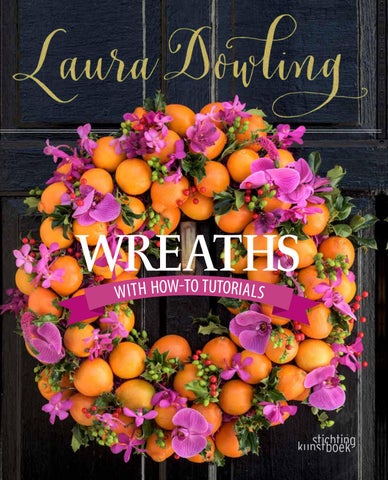
LAURA DOWLING
WITH HOW-TO TUTORIALS
L
aura Dowling creates beauty and poetry with her signature wreaths, weaving an enticing floral fairy tale of color and inspiration, timeless style and fanciful details that are evocative of secret, wild gardens, meadows and forests brimming with enchantment and delight. With layer upon layer of lush blooms and fruits, entwining vines, and surprising combinations of colors, textures and both every day and extraordinary materials, her wreaths make unique design statements that inspire the imagination with a forward-looking, trend-setting approach. Here in this lavishly illustrated book, Laura shares her inspiration, creative process, and step-by-step tips and techniques for creating 78 beautiful and innovative seasonal wreaths for all occasions. From simple and elegant evergreen wreaths to intricate and elaborate fruit and vegetable designs, Laura provides expert insights and detailed guidelines for replicating her fabulously festive wreaths at home.
A
s Chief Floral Designer at the White House from 2009 - 2015, Laura was responsible for the dazzling floral pieces that stunned visitors, welcomed politicians and diplomats and were the shining stars of many White House holiday seasons and official events. With Wreaths, she launches a new series of floral art design how-to books that are enriched with her unique flair for story-telling and mastery of a broad range of floristry techniques. Laura Dowling -- TED talk speaker, floral designer and flower ambassador -- is the author of the best-selling Floral Diplomacy at the White House (2016) and A White House Christmas (2017) and currently travels the world presenting design workshops and organizing inspirational floral installations and special events.
ISBN 978-90-5856-603-4
9 7 8 9 0 5 8 5 6 6 0 3 4
$35
WREATHS
WREATHS
A WHITE HOUSE CHRISTMAS FLORAL DESIGN TUTORIA G N I D U L LS INC
WREATHS WITH HOW-TO TUTORIALS
CONTENTS
T
his book is dedicated to B., connoisseur, raconteur and Renaissance man...
W
ho makes me smile every day.
4
7 Introduction 10 Basics 10 Getting Started 13 Techniques 26 26 28 29 30 31 32 33 34 35 36 37 38 38 40 41 42 42 44 45 46 48 49 50 51 52 54 56 57 58 59 60 61 62 64 65 66 67
FROM THE WOODS Swan Lake Evergreen Fir Pinecones, Wool & Crabapples Gilded Pinecones White Pinecones & Snowberries Classic Magnolia Silver Reindeer Ivy & Berry Berry Spice Pinecones & Sugar Snap Peas Pinecones & Red Berries FROM THE MEADOWS Wildflower Plum Meadow Daisies Sunflowers under the Tuscan sun FROM THE GARDEN Strawberry Blossom Spring Green Salad Lettuce & Ferns Winter Peppers & Berries Green Pepper Diamond Green Peppers & Blue Bells Ribbon Leaf Pleated Green Leaf Primrose Potato & Sweet Peas Yellow Peppers & Apricots Purple Cabbage & Turnips Cabbages, Heather & Camellia Pears & Apples Golden Apples, Potatoes & Daffodils Green Apples & Wild Sweet Peas Green Apples & Hellebores Pink Rose & Peony Heart Bluebirds & Butterflies Lilac Rhododendron Run for the Roses Coral Charm
68 FROM THE MARKET 68 Ruby Fruit
70 71 72 74 76 77 78 79 80 82 83 84 86 87 88 90 92 93 94 96 97 98 100 101 102 103 104
Sugar Plums & Hellebores Purple Potatoes & Cherry Blossoms Purple Potatoes, Crabapples & Nandina Apple Azalea Purple Eggplants Brussels Sprouts & Holly Fruitcake & Cranberry Lace Strawberry Candy Heart Spicy Lime Cranberry & Ivy Heart Golden Apple Pink Apples & Berries Carrots & Peppers Yellow Tomato & Ivy Peaches, Apricots & Bittersweet Oranges, Apricots & Potatoes Oranges, Cherries & Geranium Orange Pepper Lemon Mint Oranges, Rosehips & Yellow Orchids Orange Peel Limes, Berries & Holly Queen Bee Sweet Violets Red Tomato & Fuschia Orchid Pumpkin Patch Green Squash, Dogwood & Zucchini
106 106 108 109 110 112 113
FROM THE ISLANDS Coral Reef Blue Hydrangea Seychelles Mango Lime Sicilian Oranges & Orchids Northern Lights Nantucket Rose
114 114 116 117 118 120 122 123 124 125
FROM DREAMS Easter Bunny Plumberry Zinnia Midsummer’s Night Dream Vintage Carousel Springtime in Paris Polka Dot Apples Sweet Dreams Serengeti Sunrise Le Ballon Rouge
127
Acknowledgements
5
BASICS TOOLS
A
few thoughts. Making a wreath is a lot like telling a story with a beginning, a middle and an end. It requires a compelling plot (theme), a mix of interesting characters (design elements) and a strong narrative (technique) that builds up with a crescendo and flourish to a dramatic ending (finishing touches). In musical parlance, wreath-making is comparable to playing a jazz riff with an improvised melody and syncopated rhythms, harmonies and grace notes. Architects and engineers can relate to the process of drawing building plans, constructing a foundation, and designing a structure completed with beautiful materials. From an artistic angle, wreath design is like creating a masterpiece: mapping out lines and shapes, mixing colors, and then painting an inspiring design. In sum, making a wreath is similar to crafting every other art form – it requires a methodical thought process, technical skills and a large dose of creative inspiration.
A basic wreath tool kit is comprised of a few simple tools: clippers, wire cutters, scissors and various wires: paddle wire, straight wire, bark wire, and bullion wire. Over time, as you gain experience and momentum, expand your tool kit to include a variety of additional tools and elements -- wood picks, pins, water tubes, hot glue, pipe cleaners, ribbons, raffia, wool, etc. – a variety of crafting implements for creating unique and original pieces.
GETTING STARTED Although it might seem counterintuitive for a creative project, the starting point for wreaths is actually technical and logistical – just like a pilot going over a pre-flight checklist. First, determine the purpose and occasion for the wreath (e.g., a holiday design, a spring fete, a wedding, birthday celebration, etc.), including how long the wreath needs to last. Next, identify the context or setting – e.g., the size and mechanics required, whether it is an indoor or outdoor wreath and if it’s to be placed in a formal or informal setting. Finally, think about how much time and effort is required to make the wreath, including what happens to the wreath afterwards (e.g., whether fresh elements are composted or thrown away, dry elements preserved, or the wreath form saved to be used again). These considerations will determine the level of difficulty and complexity of the wreath – as well as guide overall design and style parameters.
DESIGN PROCESS
THE FORM
MATERIALS
The secret of wreath-making is to create the design in levels and layers to achieve an intricate, polished and professional look. Start with a base layer to provide structure and color, followed by a layer of fruit, flowers or vegetables, and then add another level of smaller, accent pieces completed with final, finishing touches. In general, wreath-making follows the principles of design with the goal of achieving balance and harmony by utilizing color, proportion and line. When it comes to color, I tend to gravitate towards monochromatic schemes, working in a tight palette and building up textures in a focused range of a similar hue. This creates the most impact as well as a more refined and cohesive look. I think it’s important to incorporate depth in the design, layering in dimension with flowing lines and escaping elements. A border of ivy (or berries, ribbon or branches woven into garlands) always adds definition to the wreath. Finally, think of where you’ll be displaying your wreath and coordinate the colors, size and style to complement this backdrop.
In its most basic iteration, a wreath can be hand-made from rambling branches and tumbling vines bound together to form a circle – a simple ring that is naturally elegant. For more elaborate designs requiring strength and support, choose wreath forms with a stronger, wider girth – e.g., grapevine, straw, or wire--ready-made frames you can find at the craft store. For fresh flower designs, use a floral foam wreath or foam garlands wired to a straw or grapevine frame so that the blooms have a water source. In addition to the classic circular, round form, wreath frames come in square, oval and diamond shapes, allowing for maximum flexibility in achieving your creative vision.
Once you select a theme, choose design elements that will convey the story from start to finish. For a fresh look, think outside the typical, traditional wreath recipe and expand the boundaries to blend fresh and faux, dried and non-floral materials, with an unexpected mix of fruit, flowers and vegetables leading the way. I like to use new combinations such as potatoes and orchids in surprising color combinations. In general, use a variety of elements focusing on color and texture: dried grasses, gathered pinecones, collected shells, fabricated ribbons and on and on – mixing and matching these materials to achieve the desired effect and overall vision. The key is to incorporate multiple sizes, shapes and forms (e.g., round, pointy, and delicate fruits or flowers) that have different finishes (e.g., shiny, matte or natural) and bold color combinations (purple and red, plum and lime green, etc.). By expanding the range of elements used in these designs, it’s possible to create completely new concepts – a new art form: wreaths that make a statement and can be used for many occasions throughout the year. Although I often start with a concept and outline of a plan, I leave room to improvise as I go along – this is the space where creativity ensues.
10
11
FROM THE WOODS
FROM THE WOODS
W
N
hen working with pinecones and other woodsy elements that are characterized by subtle, muted hues, it’s often important to incorporate a colorful accent touch. For this version of the pinecone wreath, I used a mix of natural and gilded pinecones, accented with sugar snap peas and variegated holly. The green peas add a note of whimsy and freshness, while the holly exudes an appropriate seasonal sensibility.
atural and striking in color and form, pinecones can be painted colors, gilded or dipped in white paint to resemble snow. Try bleaching them for a trendy neutral effect or embellish with brightly hued berries and ribbons for more colorful and traditional designs. Here, I’ve used cranberries and magnolia pods to create a cozy wreath that reminds me of kitchen pomanders of cranberry spice and sweet cinnamon-infused mulled cider – a perfect way to spread indoor (and outdoor) holiday cheer.
PINECONES & SUGAR SNAP PEAS HOW-TO instructions
WHAT you’ll need TOOLS: Bark wire Paddle wire Straight wire Clippers Wire cutters 6-inch wired wood picks MATERIALS: 1 18-inch grape vine wreath frame 10 bags of cinnamon scented pinecones from the craft store (or an equivalent amount from the woods) 24 karat gold craft spray paint 1 ½ pounds of sugar snap peas 1 bunch of variegated holly
1 2 3
2
Medium
2W+
Wrap the bark wire around the frame to create a loop for hanging. Spray 3 bags of pinecones with a light layer of gold paint. Using the paddle wire, create garlands of 5 pinecones (mixing gold and natural together) by wrapping individual pine cones and twisting the wire, adding a pine cone, leaving a 2-inch interval of wire in between pinecones and about 6 – 8-inches on each end. Working in rows, wrap the pinecone garlands across the frame, tying the ends securely in the back. Cut the excess wire. Continue adding strings of pinecones until the entire wreath is covered. Create small bundles of sugar snap peas using the wired wood picks, piercing 3 – 4 together and tying them so that the snap peas are about 2-inches above the wood base. Insert the wired sugar snap peas into the grapevine frame so that they float above the wreath in various directions. Bundle small pieces of variegated holly together and wire them to the wood picks. Insert the variegated holly in and around the wreath as a finishing touch.
4 5 6 7 8 9
36
PINECONES & RED BERRIES WHAT you’ll need TOOLS: Green paddle wire Bullion wire Clippers Wire cutters Scissors Floral cold glue MATERIALS: 1 18-inch pinecone wreath 1 roll of copper/brown 1 ½-inch ribbon 3 bags of cinnamon scented pinecones (or an equivalent amount from the woods) 3 pounds of cranberries 16 magnolia pods Holly leaves
HOW-TO instructions
1 2 3
2
Medium
2W+
Wrap the burgundy ribbon around the wreath to create a loop for hanging. Craft a ribbon base layer using the ruched ribbon technique. Using the paddle wire, make garlands of pinecones by twisting the wire around the center, wiring 4 together, leaving 2-inches in between. Lay the pinecone garland across the wreath, wrapping the ends around and securing in the back. Cut the excess wire. Working in rows around the wreath, continue adding pinecones in this manner to cover the entire form. Create 8 garlands of magnolia pods, wiring 2 together. Place the magnolia pod garlands over the top of the wreath, positioning the pods to fit in and around the pinecones. Twist the wire ends together in back. Using the bullion wire, create cranberry garlands (about 8 – 10-inches in length), leaving 6 – 8-inches of wire on each end. Wrap the cranberry garlands around the wreath like ribbons, creating a variety of patterns and lines. Secure the ends in back, cut the excess wire. Using the cold glue, attach individual holly leaves to create a touch of green throughout the wreath.
4 5 6 7 8 9
10
37
FROM THE WOODS
FROM THE WOODS
W
N
hen working with pinecones and other woodsy elements that are characterized by subtle, muted hues, it’s often important to incorporate a colorful accent touch. For this version of the pinecone wreath, I used a mix of natural and gilded pinecones, accented with sugar snap peas and variegated holly. The green peas add a note of whimsy and freshness, while the holly exudes an appropriate seasonal sensibility.
atural and striking in color and form, pinecones can be painted colors, gilded or dipped in white paint to resemble snow. Try bleaching them for a trendy neutral effect or embellish with brightly hued berries and ribbons for more colorful and traditional designs. Here, I’ve used cranberries and magnolia pods to create a cozy wreath that reminds me of kitchen pomanders of cranberry spice and sweet cinnamon-infused mulled cider – a perfect way to spread indoor (and outdoor) holiday cheer.
PINECONES & SUGAR SNAP PEAS HOW-TO instructions
WHAT you’ll need TOOLS: Bark wire Paddle wire Straight wire Clippers Wire cutters 6-inch wired wood picks MATERIALS: 1 18-inch grape vine wreath frame 10 bags of cinnamon scented pinecones from the craft store (or an equivalent amount from the woods) 24 karat gold craft spray paint 1 ½ pounds of sugar snap peas 1 bunch of variegated holly
1 2 3
2
Medium
2W+
Wrap the bark wire around the frame to create a loop for hanging. Spray 3 bags of pinecones with a light layer of gold paint. Using the paddle wire, create garlands of 5 pinecones (mixing gold and natural together) by wrapping individual pine cones and twisting the wire, adding a pine cone, leaving a 2-inch interval of wire in between pinecones and about 6 – 8-inches on each end. Working in rows, wrap the pinecone garlands across the frame, tying the ends securely in the back. Cut the excess wire. Continue adding strings of pinecones until the entire wreath is covered. Create small bundles of sugar snap peas using the wired wood picks, piercing 3 – 4 together and tying them so that the snap peas are about 2-inches above the wood base. Insert the wired sugar snap peas into the grapevine frame so that they float above the wreath in various directions. Bundle small pieces of variegated holly together and wire them to the wood picks. Insert the variegated holly in and around the wreath as a finishing touch.
4 5 6 7 8 9
36
PINECONES & RED BERRIES WHAT you’ll need TOOLS: Green paddle wire Bullion wire Clippers Wire cutters Scissors Floral cold glue MATERIALS: 1 18-inch pinecone wreath 1 roll of copper/brown 1 ½-inch ribbon 3 bags of cinnamon scented pinecones (or an equivalent amount from the woods) 3 pounds of cranberries 16 magnolia pods Holly leaves
HOW-TO instructions
1 2 3
2
Medium
2W+
Wrap the burgundy ribbon around the wreath to create a loop for hanging. Craft a ribbon base layer using the ruched ribbon technique. Using the paddle wire, make garlands of pinecones by twisting the wire around the center, wiring 4 together, leaving 2-inches in between. Lay the pinecone garland across the wreath, wrapping the ends around and securing in the back. Cut the excess wire. Working in rows around the wreath, continue adding pinecones in this manner to cover the entire form. Create 8 garlands of magnolia pods, wiring 2 together. Place the magnolia pod garlands over the top of the wreath, positioning the pods to fit in and around the pinecones. Twist the wire ends together in back. Using the bullion wire, create cranberry garlands (about 8 – 10-inches in length), leaving 6 – 8-inches of wire on each end. Wrap the cranberry garlands around the wreath like ribbons, creating a variety of patterns and lines. Secure the ends in back, cut the excess wire. Using the cold glue, attach individual holly leaves to create a touch of green throughout the wreath.
4 5 6 7 8 9
10
37
FROM THE GARDEN
T
WHAT you’ll need TOOLS: Barked wire Bullion wire Paddle wire Straight wire (thinner gauge) Wire cutters Clippers Scissors 6-inch wired wood picks 4-inch water picks MATERIALS: 1 18-inch grapevine wreath 1 roll of 1 ½-inch purple ribbon 100 mini red/purple potatoes = 8 – 12 bags 15 stems of pink wild sweet pea vine (substitute dendrobium orchids or jasmine vine) 12 stems fuchsia wild roses (or spray roses) 1 pint black cherries
here are many places of beauty throughout the world, but the dawning of spring in the Pacific Northwest surely must rank among the top for its distinctive, breathtaking splendor of flowering branches, daffodils, tulips, azaleas and giant rhododendrons that emerge from the gray fog and mist. In early May, one of my favorite sights is the carpet of violas that blanket the aptly named Violet Prairie near my family home in Southwest Washington State. By the height of summer, the landscape is covered with a riotous tangle of wild sweet pea and blackberry vines, characterized by bright pink flowers, ripe fruit and sage green vines. This “primrose potato” wreath is inspired by the beauty and bounty of a Seattle spring with purple potatoes from the market and sweet peas, blackberry vines and roses from the garden.
PRIMROSE POTATO & SWEET PEAS HOW-TO instructions
1 2 3 4 5 6 7 8 9 10
2
Medium
5-7 D
Wrap bark wire around the wreath to create a loop for hanging. Create a ribbon base layer using the ruched ribbon technique. Attach the ribbon garland to the front of the grape vine form, tying it to the edges with the paddle wire. Using the straight wire, pierce the potatoes, stringing 3 together. Wrap the string of wired potatoes across the front of the wreath form, twisting and securing the wire tightly in back. Cut the excess wire. Add the potato strings in rows, working around the frame until the entire wreath form is covered. Using the bullion wire and wired wood picks, wire 2 – 3 cherries together by piercing the center and/or tying the stems together, creating small bundles. Attach the cherry bundles to the frame in a natural pattern, inserting the wood picks both inside and outside across the wreath. Cut the wild sweet pea vines into 10 – 12-inch lengths, inserting them in the water picks. As a finishing touch, add the sweet pea vines, inserting the water picks into the frame, weaving them around the wreath.
52
53
FROM THE MARKET
WHAT you’ll need TOOLS: Bark wire 1 roll of 1 ½-inch purple ribbon Straight wire (thinner gauge) Bullion wire Clippers Scissors Wire cutters 4-inch water picks 6-inch wired wood picks MATERIALS: 1 21-inch grapevine wreath 100 small purple potatoes 1 pound crabapples 2 bunches heather 1 bunch nandina foliage with berries
A
cross the mouth of Galway Bay, off the western coast of Ireland in the waters of North Atlantic sea, lies the rugged, windswept Aran Islands, a place that time has seemingly forgotten. Hauntingly beautiful, incredibly remote – accessible only by air or ferry – it’s a landscape of jagged rocks, thatched roof houses, ancient forts and pastoral fields -- a place of raw, untamed natural splendor. Battered by storms and high winds, the islands’ harsh weather sometimes lifts long enough to reveal glimpses of botanical life; the colors and forms make a strong impact set against the stark background of grey stone, sea and sky. Throughout the ages, rugged islanders have sought creative ways to defy nature’s wrath, employing seaweed and sand to grow various crops and building low-slung stone walls in the fields for protection against the elements. This wreath of potatoes and heather with touches of nandina is inspired by the rocky landscape, colors and textures of the Aran Islands – a unique place of bleak beauty in the middle of the Wild Atlantic Way.
PURPLE POTATOES, CRABAPPLES & NANDINA HOW-TO instructions
3
Expert
2W+
1 2 3
Wrap the bark wire around the wreath form to create a loop for hanging. Create a purple ribbon base layer using the ruched ribbon technique. Working side to side across the top of the wreath, attach the ruched ribbon garland to cover the top and sides of the wreath. Using the straight wire, pierce the purple potatoes, stringing 5 together. Lay the potato garland across the wreath, covering the sides and top, leaving some space in between each potato to let the ribbon show through. Wrap the ends of the wire around the wreath, tying them securely in back. Working in rows, continue adding individual strings of potatoes in this manner until the entire wreath is covered. Using the straight wire, string 4 – 5 crabapples together, adding a bit extra wire to create longer garlands. Lay the wire crabapple garlands over the top of the potatoes so that they float a bit above the surface, wrapping and tying the ends securely in back. Add sprigs of heather using the wired wood picks. Cut the nandina foliage into 6 – 8-inch pieces and wire them to the wood picks, inserting the foliage in and around the wreath, focusing on the inner and outer edges.
4 5 6 7 8 9
DESIGN note Use faux crabapples from the craft store and substitute Italian ruscus for the nandina.
10 11
72
73
FROM THE MARKET
WHAT you’ll need TOOLS: Bark wire Straight wire (thinner gauge) Bullion wire 6-inch wired wood picks 4-inch water picks MATERIALS: 1 18-inch grapevine wreath 1 roll of 2-inch wired edge gold ribbon 20 peaches 40 apricots 2 pints of yellow cherry tomatoes 1 bunch of bittersweet vines Sprigs of yellow lantana blossoms
A
s a child, I remember spending long hours in my grandfather’s library, a cozy and welcoming space with book-lined walls and a blazing hearth. While he read sophisticated historical novels and biographies, I perused a children’s section that included a fairly sizable collection of literary classics and Dr. Seuss, as well as mysteries, fairy tales and quirky vintage books. One of my favorite corners contained the flower and gardening books, including several Victorian tomes on the symbolic meaning of flowers. I still remember one particular book of rhyming verse that issued dire warnings about plants with scary names – deadly nightshade, devil’s claw, witch hazel, ghost plants – cautioning that their alluring beauty disguises horrible deadly consequences if ingested. The compelling prose definitely made an impression on me. Although it looks good enough to eat, this wreath of tangled brambles and bittersweet vine (also known as deadly nightshade or poisonberry) mixed with peaches and apricots in golden hues is designed only for visual enjoyment and delight.
PEACHES, APRICOTS & BITTERSWEET HOW-TO instructions
1 2 3 4 5 6 7 8 9 10 11 12
3
Expert
5-7 D
Craft a ribbon base layer with the ruched ribbon technique. Wrap the bark wire around the wreath to create a loop for hanging. Using the straight wire, pierce the peaches close to the center, stringing 2 together. Lay the peach garland across the top of the wreath, wrap the wire ends around, and secure together in back. Cut the excess wire. Working in rows around the wreath, add peach garlands until the entire form is evenly covered. Create garlands of apricots in the same manner, stringing 3 together. Working in rows around the wreath, add garlands of apricots, placing them in between the peaches, covering the top and sides of the wreath. Using the straight wire, create garlands of yellow tomatoes, stringing 4 together. Add the tomato garlands, wrapping them evenly across the wreath in rows, filling in gaps, creating additional texture. Cut the bittersweet vine into various lengths and wire the ends using wood picks. Tuck the berries in and around, placing longer vines on the outside edges. Add sprigs of lantana by placing water-filled picks at intervals around the form so that the flowers float above the fruit.
DESIGN note Use firm, unripened peaches and apricots for the best result.
88
89
ACKNOWLEDGEMENTS
“A Gift of Gratitude” T
his book on wreaths was pure joy to conceptualize, create and produce -- the natural progression of my first two books on “Floral Diplomacy” and “A White House Christmas” that focused on my White House experience as the venue for my floral work. In the Christmas book, I share some of my favorite White House projects and how to create them, including a few wreaths – a precursor of this book and the launch of my new floral design series. As I’ve travelled around the country over the past two years, leading floral design workshops and conducting book signings, the experience has left a strong impression. Without a doubt, engaging in conversation with like-minded people who are passionate about flowers and design is absolutely the best part of my job. While audiences are naturally interested in White House anecdotes and behind-the-scenes stories, I’ve noticed that the conversation quickly turns to “how-to” topics – specific questions about floral techniques, inspiration and design. For many years, my dream has been to write a floral design book – a technical handbook with tips and tricks interspersed with inspirational images and text about the creative process, the kind of book that I would include in my own reference library. Inspired by feedback from my book tour audiences and social media followers – who seem especially intrigued by my wreath designs – my new series of floral art books launches with wreaths, to be followed by a full range of floral art themes and ideas. Once again, I am grateful for my brilliant team at Stichting Kunstboek – Publisher Karel Puype, Editor Katrien Van Moerbeke and designer Jan de Coster for their talent and expertise. Each time we work together, they help me visualize an exciting concept woven together by text and images, presented in engaging, elegant formats with sophisticated graphic design. I am also impressed by their professionalism and efficiency; they’ve made the process of writing 3 books in 2 ½ years such a (relatively) easy, breezy pursuit that is always a pleasure! Photography is the essential element for any design book and is even more important when it comes to “how-to” manuals. For the
126
12 years, I’ve been fortunate to work with Kevin Allen, who always portrays my flowers and wreaths with such precision and sensitivity – perfectly capturing my vision and intent. He took the bulk of the wreath photos in this book. In addition, it’s been a pleasure working with Sunni Kim Cook on this project, who has a fantastic eye for composition and detail – and the ability to create images with a uniquely fresh, modern feeling. Sunni is responsible for the “how-to” photos as well as a few wreath shots, too. I am also grateful for the artistry of Georgianna Lane, whose evocative and ethereal shots are always swoon-worthy. I appreciate the contributions of the brilliant Erik Kvalsik and talented Dominik Ketz as well as the photography of Louise Krafft, who took the orange peel wreath image – a sentimental favorite. I am so appreciative of the generosity of my friends and neighbors in Old Town Alexandria, who graciously lend me their doors throughout the year as a backdrop for my creations. I’ve surprised more than a few of their family members who are always startled to see me standing right outside their door, clippers and wires in hand. With its historic architecture and quaint traditions, Old Town is the perfect setting for portraying the possibilities of wreaths. Writing a book can be an all-consuming project that requires a village of support. A big bouquet of gratitude is therefore in order for all of my friends and family members who enthusiastically helped with every phase of the project from brain-storming wreath concepts and photo-styling to copy edits, publicity and recipe reviews, especially Lola Honeybone, Gudrun Cottenier, Ashley Greer and Evelyn Alemanni. As always, my husband, Bob Weinhagen, is a patient and supportive presence behind-the-scenes; I appreciate his witty repartee, encouragement and love. Finally, I am grateful to you, the reader, for joining me on this creative journey with wreaths. My sincere wish is that you find inspiration in this art of creative expression that leads to beauty – in your home, in your community and, thanks to social media, can float like the red balloon to reach a broad, international audience, inspiring others along the way.
127
LAURA DOWLING
WITH HOW-TO TUTORIALS
L
aura Dowling creates beauty and poetry with her signature wreaths, weaving an enticing floral fairy tale of color and inspiration, timeless style and fanciful details that are evocative of secret, wild gardens, meadows and forests brimming with enchantment and delight. With layer upon layer of lush blooms and fruits, entwining vines, and surprising combinations of colors, textures and both every day and extraordinary materials, her wreaths make unique design statements that inspire the imagination with a forward-looking, trend-setting approach. Here in this lavishly illustrated book, Laura shares her inspiration, creative process, and step-by-step tips and techniques for creating 78 beautiful and innovative seasonal wreaths for all occasions. From simple and elegant evergreen wreaths to intricate and elaborate fruit and vegetable designs, Laura provides expert insights and detailed guidelines for replicating her fabulously festive wreaths at home.
A
s Chief Floral Designer at the White House from 2009 - 2015, Laura was responsible for the dazzling floral pieces that stunned visitors, welcomed politicians and diplomats and were the shining stars of many White House holiday seasons and official events. With Wreaths, she launches a new series of floral art design how-to books that are enriched with her unique flair for story-telling and mastery of a broad range of floristry techniques. Laura Dowling -- TED talk speaker, floral designer and flower ambassador -- is the author of the best-selling Floral Diplomacy at the White House (2016) and A White House Christmas (2017) and currently travels the world presenting design workshops and organizing inspirational floral installations and special events.
ISBN 978-90-5856-603-4
9 7 8 9 0 5 8 5 6 6 0 3 4
$35
WREATHS
WREATHS
A WHITE HOUSE CHRISTMAS FLORAL DESIGN TUTORIA G N I D U L LS INC
WREATHS WITH HOW-TO TUTORIALS