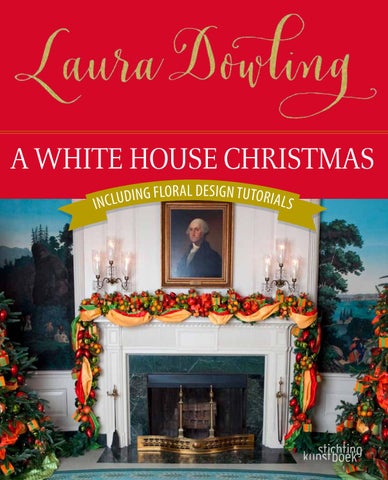
LAURA DOWLING
INCLUD
ING FLORAL DESIGN TUTORIALS
C
hristmas at the White House is the most beautiful and grand celebration of the year, the ultimate display of nostalgic traditions and romanticized ideals. Part extravaganza, part historical tradition – the White House Christmas is always characterized by an inspiring theme, exquisite decorations and unifying messages of hope and goodwill towards all. As Chief Floral Designer during her six years in the White House, Laura Dowling was responsible for the dazzling floral pieces that made the season so memorable. Working with the First Lady and a talented team of volunteers, she designed amazing decorations for every White House room that enhanced architectural details and historical collections, carried out the First Lady’s vision, showcased American artists and hand-crafted designs, and celebrated beloved Christmas traditions and cherished American ideals. Here, Laura invites readers behind the scenes of this complex year-long planning process where some of the most innovative and ambitious handmade craft displays were created. From architectural details to sugar paste floral vases and robotic versions of the first family dogs, the decor inspired and delighted visitors and guests from all around the world. In addition to her White House experiences, Laura shares advice and ideas, amusing anecdotes, tips and techniques for planning holiday displays, including step-by-step instructions for recreating some of the most popular and original White House holiday designs at home. Laura is the author of Floral Diplomacy at the White House and currently travels throughout the world leading floristry workshops, designing events and speaking to groups about the role of flowers as important diplomatic tools.
$45
A WHITE HOUSE CHRISTMAS
A WHITE HOUSE CHRISTMAS
A WHITE HOUSE CHRISTMAS AL DESIGN TUTORIA R O L F G N I D U LS INCL
A WHITE HOUSE CHRISTMAS FLORAL DESIGN TUTORIA G N I D U L LS INC
2
A WHITE HOUSE CHRISTMAS FLORAL DESIGN TUTORIA G N I D U L LS INC
2
INTRODUC TION
T
he Christmas season is by far the largest and most important White House event that occurs each year, the ultimate display of nostalgic traditions and romanticized ideals that are often evoked in literature and film and embedded in our hearts and minds. We can envision an idyllic wintry scene, beautiful decorations, glistening snow and sleigh bells in the moonlight illuminating the metaphorical path home to loved ones who have gathered from near and far. In a spectacular setting of sparkly and sentimental decorations, lavishly wrapped gifts, a cozy gathering around the hearth, decorated tables and endless delectable feasts, we conjure images of Christmas celebrations long past: memories that always shine bright no matter how much time goes by. Christmas is a time for reveling in beloved childhood memories and sentimental family traditions as well as expressing hope for the future. At the White House, the holiday season resonates with all Americans on both a collective and profoundly personal level, full of history, traditions, symbolism and patriotic meaning. At Christmas, the White House is truly America’s holiday home, bringing people together from across the country in celebration of our most deeply held values and cherished beliefs.
we sought to capture the intangible magic of the White House Christmas.
D
uring the holidays the best gifts are often the ones that are personal and meaningful and don’t cost anything at all. These simple gifts – the gifts of nature and the winter garden, going home for the holidays, celebrating with friends and family, honoring the people who serve our country, a child’s sense of wonder, family traditions, the Christmas feast and the joy of music – represent core holiday ideals that are timeless and universal. At the White House, we celebrated all of these unifying themes with the goal of spreading a spirit of generosity and goodwill towards others. In the Christmas season, the majestic grandeur of the White House is the ultimate expression of holiday splendor, symbolizing iconic American ideals, honoring cherished traditions and creating opportunities for celebration and joy for all.
A
s Chief Floral Designer at the White House, it was my privilege and honor to create the White House Christmas for six years, working with the First Lady and an extraordinary group of volunteers to create holiday magic. Together, we created Christmas celebrations that surprised and delighted visitors and viewers with inspiring décor projects that carried out the First Lady’s vision of highlighting key priorities, showcasing American artists and handcrafted designs, and inviting all Americans to participate in the celebration of the White House Christmas. From architectural details including intricate hydrangea-covered archways, illusion cube-patterned column covers and gilded maple leaf rosette panels to sugar paste floral vases and looped ribbon and robotic versions of the First Family dogs, the décor we created was ambitious and detailed. Our goal was to open doors and opportunities for volunteer collaboration, inviting people from across the country to work behind the scenes on an array of creative projects and original décor. In addition to the artistic endeavors, it was the overarching symbolism, behind-the-scenes stories, heartwarming anecdotes, and creative process that provided the most memorable moments. Working together throughout the years to create imaginative decorations and beautiful décor for the holiday displays forged something larger than the individual tasks and projects to showcase our passion for art and dedication to excellence. Each year
In 2014, the Red Room glistened in a wintry palette of cream and emerald green with accents of red birds and berries. Bountiful displays of hydrangeas and lilies in hand-made sugar paste urns served as striking focal point displays, while the lush trees and evergreen wreaths created a serene and traditional ambi-
6
7
THE VOLUNTEERS
E
ach year, 100 volunteers from across the country forego Thanksgiving with their families for the opportunity to travel to Washington to join in the annual White House decorating project. Most have gone through a competitive selection process, sending passionate, compelling – and even heartwrenching letters to me and a variety of White House officials. Some persistent volunteers apply year after year with the hope of being selected, undeterred by a growing pile of rejection letters, often making the cut through sheer willpower and perseverance. With hundreds of people applying each year, only a relatively small number can become ‘official’ White House holiday decorators for the 5 days after Thanksgiving. Although there was always a seemingly endless supply of talented and enthusiastic volunteer support – and so much work to do to achieve our creative vision -- only a few people were actually ever lucky enough to be chosen via this official volunteer channel. I saw an opportunity to boost the holiday decorating process – not only to include more people – but to expand our ability to create more detailed and intricate hand-made projects as well, increasing participation and overall capacity. If we made the flower shop more open and accessible to volunteers from across the country – people who wanted to work on holiday projects and contribute their time and talents – we could highlight the White House as open and accessible and create innovative and inspiring holiday décor. That’s how the White House Christmas became a year-round activity, divided into three main phases: design and development, creation and implementation, and project installation.
V
olunteers are the magic behind the White House Christmas and they took on an even greater role during my tenure, working with me on Christmas projects throughout the year. Early in the New Year, volunteer designers and architects joined me in the flower shop to help brainstorm and sketch ideas for various White House spaces. Their task was to create a supply of drawings that represented each White House interior and exterior space. During the winter months, we developed new ideas – trees and topiaries, wreaths and garlands, motifs and details, using colored pencils to illustrate a range of color possibilities and experimenting with new techniques and materials. We collected these drawings in notebooks that became a reference guide we used throughout the year. By spring, these sketches, architectural renderings and design ideas became fully developed room-by-room concepts, featuring color
palettes, specific elements and narrative themes. Volunteers created prototypes and mock-ups of key designs as well as digital inspiration boards, helping me prepare themes and presentations for the First Lady to review. After the overall theme, room-by-room subthemes, ideas and designs were selected and approved, my volunteer teams launched into action.
A
mong the inspiring and innovative designs we created with volunteers over the years are a ribbon and pipe cleaner archway featuring thousands of pieces of pipe cleaner arranged in a complex latticework motif; the illusion cube column covers made from tens of thousands of berries, folded leaves and individual gold leaf pine cone scales; the doorway frame made of 1,000 gilded oak leaf rosettes; the Red Room sugar-flower vases; oversized wreaths made out of lacquered fruits and vegetables; and the ever-popular replicas of the Presidential dogs Bo and Sunny made out of 40,000 pipe cleaners, miles of looped ribbon, pompoms, licorice and marshmallows, buttons, and even trash bags. All of these projects required detailed plans, budgets and timelines to determine important milestones and calculate the amount of time (volunteer work hours) and resources that each project required.
W
e made small patterns of motifs – tracking the amount of time required and then multiplying it according to the size of the piece. Each project had its own detailed plan that rolled up into the overall holiday planning process. In any given year, we took ambitious and detailed holiday projects – column covers, hand-made vases, ribbon work details, and custom wreath designs – that we worked on well before the installation period commenced. A highly structured and organized process was key to finishing these projects that eventually merged with the holiday installation process and timeline in late November.
My holiday design process always involved creating patterns and motifs out of simple materials including leaves, berries, pinecones, cinnamon sticks, pipe cleaners and ribbons that volunteers fashioned into column covers, door surrounds, and flower vessels. These geometric designs provided an elegant backdrop to the Christmas decorations.
20
21
RUCHED RIBBON WREATHS STEP-BY-STEP TECHNIQUES
O
ne of the great hallmarks of White House holiday design is the concerted use of recycled and repurposed material to create something new and inspirational. A great pleasure of serving as Chief Floral Designer was the ability to gain access to the vast collection of elements and décor, the beautiful cache of vintage and historical materials from White House Christmases past. My favorite hunting grounds were the giant rolling bins in the back of the warehouse where a colorful collection of holiday ribbons in every hue were stored away, waiting to be rediscovered. Here is an idea for using extra rolls of ribbon to create festive holiday wreath designs with texture and impact. You can add touches of sparkle and natural greens to complete the display. WHAT YOU’LL NEED � � � � � � �
1
Create a single-sided looped ribbon garland using thin
2
paddle wire to make 1 inch loops that are even and close together.
Working side to side across the front of
3
the wreath frame, apply the ruched ribbon garland to the frame, tying the ribbon on each side with the wire.
Once the wreath is completely covered with the ribbon, add small shiny ornaments to the design, wiring them to the wood picks and inserting them in a balanced pattern on the wreath.
4 5
Add trailing ivy on the inner and outer surfaces
A 16 – 18 inch grapevine wreath form Thin paddle or wrapping wire 4 inch wired wood picks 5 – 6 rolls of 3 inch wire edge ribbon 1 roll of accent ribbon 1 box of small shiny ornaments Green trailing ivy
of the wreath to create definition.
Finish the bouquet with a jaunty
48
coordinating bow.
49
GREEN ROOM BACKGROUND. One of the most elegant parlors in the White House is the Green Room, famous for its deep emerald silk moire-covered walls, richly upholstered Duncan Phyfe furniture, and French-inspired floor-covering woven in the Savonnerie style. Notable features include the portrait of Benjamin Franklin over the mantel, carved marble mantel piece, coral silk wing chairs, ecru-and-green striped sofa, and an inspiring collection of landscape designs and modern art. James Hoban, architect of the White House, originally intended the room to be used as a ‘common dining room’ in recognition of its intimate proportions and spectacular garden view. Legend has it that Thomas Jefferson, who used the room as intended as a dining space, launched the color tradition by putting a green-painted canvas cloth down to protect the floors. Subsequent Presidents continued the green theme in the room, but not all shades of green were met with approval. When President Andrew Jackson re-decorated the room in a yellowy grass green, critics scoffed at the color choice, chiding that it is ‘odious from the sallow look it imparts’. Although the shade of green evolved and changed over time, the Green Room has always retained its namesake color.
96
97
CUSTOM RIBBON DESIGNS STEP-BY-STEP TECHNIQUES
L
arge, focal point décor elements (like the Blue Room tree) require large-scale decorations to achieve aesthetic balance, especially when they are used in expansive rooms. Too-skimpy ribbons or too-tiny ornaments can distract the eye and detract from the overall presentation. Because high-quality extra-wide ribbon is such an expensive proposition, I sought ways to create custom ribbon designs that could be placed on large trees (as well as on garlands and wreaths) using materials we already had on hand. We went to the White House warehouse where decades of holiday ribbons and ephemera are stored away, waiting to be rediscovered and put on display. I especially enjoyed delving into the large rolling bins of ribbon that were lined up in the back of the warehouse. There, the unique ribbons in every holiday hue were an endless source of inspiration and creative opportunity. Year after year, we re-fashioned the ribbon in geometric-patterned motifs – a new detail that could be used to decorate trees, vases, wreaths and garlands. The custom ribbon work is a great way to use leftover ribbons and to add a new layer of detail and craft-work to holiday displays.
1 2 3 4
Identify a geometric pattern and copy it to tracing paper.
TIP: Xerox the pattern to achieve the desired size and scale.
Trace the design on your base ribbon. Measure the decorative ribbon and cut out the pattern pieces, taking care to keep them uniform in size.
Using the spray adhesive on the base layer, apply the
5
individual ribbon pieces. Add hot glue if necessary on the edges to secure the ribbon.
Continue adding pieces of ribbon to complete the pattern
and create the desired length of custom ribbon.
WHAT YOU’LL NEED �
Wide wire-edged ribbon or fabric (10 – 18 inches across) for the base layer � Ribbons in various colors and widths (for the decorative pattern) � Marking pen and ruler � Tracing paper � Hot glue gun (and glue sticks) � Spray adhesive
T
ip: Peruse a variety of pattern books for design inspiration. Geometric patterns (stripes, polka dots, triangles, etc.) are particularly effective.
T
ip: Use a spare amount of hot glue, only what is minimally needed to secure the motif to the base ribbon to avoid leaving marks..
116
117
HOLIDAY ENTERTAINING AT THE WHITE HOUSE
142
143
HOLIDAY ENTERTAINING AT THE WHITE HOUSE
142
143
LAURA DOWLING
INCLUD
ING FLORAL DESIGN TUTORIALS
C
hristmas at the White House is the most beautiful and grand celebration of the year, the ultimate display of nostalgic traditions and romanticized ideals. Part extravaganza, part historical tradition – the White House Christmas is always characterized by an inspiring theme, exquisite decorations and unifying messages of hope and goodwill towards all. As Chief Floral Designer during her six years in the White House, Laura Dowling was responsible for the dazzling floral pieces that made the season so memorable. Working with the First Lady and a talented team of volunteers, she designed amazing decorations for every White House room that enhanced architectural details and historical collections, carried out the First Lady’s vision, showcased American artists and hand-crafted designs, and celebrated beloved Christmas traditions and cherished American ideals. Here, Laura invites readers behind the scenes of this complex year-long planning process where some of the most innovative and ambitious handmade craft displays were created. From architectural details to sugar paste floral vases and robotic versions of the first family dogs, the decor inspired and delighted visitors and guests from all around the world. In addition to her White House experiences, Laura shares advice and ideas, amusing anecdotes, tips and techniques for planning holiday displays, including step-by-step instructions for recreating some of the most popular and original White House holiday designs at home. Laura is the author of Floral Diplomacy at the White House and currently travels throughout the world leading floristry workshops, designing events and speaking to groups about the role of flowers as important diplomatic tools.
$45
A WHITE HOUSE CHRISTMAS
A WHITE HOUSE CHRISTMAS
A WHITE HOUSE CHRISTMAS AL DESIGN TUTORIA R O L F G N I D U LS INCL