Contents Foreword Peter Eisenman
Introduction Caroline O’Donnell José Ibarra
From Caged Human to Cageless Monster Caroline O’Donnell José Ibarra
From Strategy to Tactic Caroline O’Donnell José Ibarra
Perceptual Metamorphoses: Lunar (Re)Turns: Becoming With Cosmology, Ecology, and Extraterrestrial Influence Kari Weil Spyros Papapetros
······ · 12 ··· · · · · · 6 ·····
Awry of the Plan Jesse Reiser
········ 44 ········ 52 ·············· 68 ······· ········ 18 ········· 38
Crossing 198
Tripe 118
Charolina House in collaboration with Dillon Pranger 164
Melt 188
Bloodline 130
Primitive Hut 208
Evitim
Combust Party Wall
232
144
94
Salt Inc. 176
·········
Afterword Survey
Cynthia Davidson One or Several Wolves
Recalculating: A Conversation
Architecture on Money: Notes for a New Currency
Diagram as Remedy: Caroline O’Donnell Decoding Freud’s Diagrams
Hair Dos and Don’ts: Caroline O’Donnell Caroline O’Donnell José Ibarra Shape Shifting: A Brick Problem Martin Miller Intelligent Animism Jimenez Lai
Greg Lynn
····· 7 4 ···· ··
·· 82 ····· ···· · 34 2 ·· ···· ···· · 38 Goosebumps 8 270
···
···
···
···
·4 0
4·
Wonderful 284
Janus House
Urchin
···
···
··
41
2·
···
···
308
248
42
6
··
· ·
Ci-ça
Confluence
326
in collaboration with LMNOP 298
Art Dock an OMG project, in collaboration with Martin Miller
Zimmer 320
334
Foreword Peter Eisenman
6
“Werewolf. Where wolf ? Wear wolf. Beware, wolf. There were so many possibilities that, in the end, I did not know if I were man or I were wolf.”1 In the 1960s, Jacques Derrida introduced one of the most important concepts for architecture, film, painting, and literature: undecidability. The philosopher described it as a moment in which meaning, wholeness, and presence were uncertain. Inevitably, in any text, there are points of ambiguity and complexity that disrupt any thought-tobe-stable meaning that an author might intend. The more abstraction and complexity, the more space for undecidability, and the more room for the meaning to be a mental construct. In this sense, architecture is about the invisible. It is about clues that only architects can see. As such, we can read compression, tension, movement, and even implied planes continuing beyond corners. We can experience the stressed space between what we expect to be there and what is there. In the physical world, things are hidden in plain sight. In Michael Haneke’s Funny Games (2007 and 1997), there is a tension which comes from what we do not see. Everything on the surface looks fine; a soft-spoken young man dressed in white comes to the door and asks a woman if he can borrow some eggs. He is given the eggs and says his goodbyes. In the next scene, the eggs have fallen to the ground, but we do not see the eggs dropping. Instead, we see an apologetic, clumsy man with cracked eggs at his feet. This methodology of offscreen action repeats consistently throughout the film. In fact, very little happens on the screen, at least when compared to what happens in the mind of the viewer; a projected reality based on experience and speculation. It is the tension between what is expected and what is shown that produces an anxiety in the spectator. For Jasper Johns, such undecidability manifests differently. In his piece Flag (1954–1955), we encounter a familiar object that has been strangely altered and defamiliarized—the viewer can sense that something is wrong. The canvas is not the same proportion as the American flag’s familiar ratio. From experience, we know that the flag has been trimmed. There is a tension between the physical and the virtual, an incredible edge stress that is produced between our knowledge of what the painting should be and what the painting is.
7
Architecture is about signs, not things. It is language. And consequently, the possibility of any reading implies abstraction. This book’s three guiding terms— lunacy, shapeshifting, and material metamorphosis—are all misnomers and misunderstandings. Lupacy, perhaps. Or form-shifting.2 These might be better terms. What is interesting for me about the book’s concept, “werewolf,” is its embedded possibility to appropriate multiple meanings, its ability to be set up as a critical discourse, inscribed within Derrida’s idea of undecidability. When we read a text, the images are as problematic as our minds can conjure. In a movie, the transformation from man to wolf is rather banal—even comical, at times. The image that we can generate in our minds is much more unsettling, and consequently, it can become much more problematic.
8
Charles Sanders Peirce described the difference between the linguistic signs: symbol, icon, and index. For him, the symbol is an arbitrary referent requiring cultural agreement, while the icon is visually similar to the object. An index, on the other hand, is the only sign that has a physical and temporal relationship with the object. A footprint in the sand, a scratch, a drop of blood … these are traces, marks, imprints, and clues to a former presence (and current absence) of the referent. Haneke’s Code Unknown (2000) is an interesting model for this because we cannot deduce who the killer is in the plotline. We follow leads but each one invalidates the other, which destabilizes the expectation of a typical “whodunit” plot. The premise becomes undecidable. In other words, legibility is frustrated, and linear narrative is gone. The murder mystery is the most modern form of literary discourse because the clues are indices. Clues depend on traces or marks of a presence that is no longer. A crime scene is a series of abstract marks that requires the mind of the detective—and that of the reader—for deducing the meaning. The solution involves a tracing back in time to the moment of the event. In O’Donnell’s practice, CODA, several projects suggest an architectural equivalent. The 2013 MoMA PS1 winning entry, Party Wall, is not interesting because of its environmental or material qualities. It is interesting because there are clues at work that also play with the project’s own notions of being. Party Wall spells out “wall” in its own shadow in a way that provokes the questions: is it a wall? And, what is the constitution of a wall, anyway? This play between a word and a physical object is
the beginning of undecidability in three-dimensional form. In this case, the form of the object has nothing to do with aesthetics. The project is shaped in a specific way only to give formal meaning. In doing so, it avoids the possibility of someone saying, “I like it,” because the project has no option but to look the way it does. Thus, the material and color are irrelevant. CODA took a basic shape, eroded it, and produced meaning that was both the object itself, and the sign of the object. I argue that in architecture, ducks are the product of modernism, and decorated sheds are the product of postmodernism. Party Wall reinvigorates this Venturi Scott Brown proposition, producing a type that is a third condition, somewhere in between, or even beyond a duck and a decorated shed. The project is not quite a decorated shed, even though it is all sign, and it is not quite a duck, as it lacks a formally symbolic meaning. Typologically, it falls outside of these two seemingly dialectical terms. CODA, in this project, is on to something that is both conceptual and phenomenological. For example, James Joyce deals with language in a supposedly phenomenological way, but it is actually abstract. The sounds (and thus, the meanings) are garbled. The question in architecture has been how to problematize meaning by the language of disturbance, erosion, or transfiguration. Similar to Joyce’s spaces of literature, experience is not just physical, it is conceptual. The column is not simply the thing itself, it is also the sign of the column. It is simultaneously the phenomenon and its abstraction as a sign function. Against this background, the difference between semantics and syntax is relevant. While semantics is about the meaning of words, syntax is about the relationship between words: that is, the context of a word in regard to the other words around it. The latter term literally means “composition” in Greek. Ferdinand de Saussure, Derrida’s mentor, wrote regarding syntax that: “The idea or phonic substance that a sign contains is of less importance than the other signs that surround it.”3 And Derrida, himself, believed that the omnipresence of context was fundamental to undecidability: “One can perhaps come to recognize other possibilities in it by inscribing it or grafting it onto other chains. No context can entirely enclose it.”4 Since every utterance is repeated in a different context, each reading and writing is evolved because of its changed context.
9
In the same way, context is important for architecture. There are different approaches to contextual projects: Leon Krier’s New Urbanism, Colin Rowe’s Contextualism, O.M. Ungers’s Green Archipelago, Aldo Rossi’s Analogous City. The question today is how to make context thematic and abstract, or how to make it operate in an undecidable or disturbing way within an architecture. The possible readings of Party Wall only occur because the context of the museum courtyard forces the possibility of multiple readings. Context is a serious contingency in any architecture.
10
Between the 1960s and 1980s, a transition occurred from a strictly formal reading of context to one with semiotic possibilities. Relationships between pure geometries were no longer sufficient to explain the complexities of the world and of architecture. The epistemology that related some stable state of form to some progressive mode of an ideal universe, seen as an absolute condition, was questioned. Pure geometry was disrupted and dislocated through the introduction of fractal mathematics and topology. Opposite to the prescriptive codes of classical architecture and the Cartesian geometry of modernism, the generative use of geometries today has emerged from new relationships with nature, biology, and ecology. D’Arcy Thompson’s On Growth and Form influenced generations of architects, from Le Corbusier onwards, but our understanding of nature today is far more complex than demonstrated in Thompson’s transformations. Avalanches, tectonic movement, clouds … we have begun to think about global systems, dynamic organizations that involve form in a space-time continuum. These new natures have restructured our thinking about architecture today. In this new ecological world, undecidability performs differently. Undecidability is still possible today through dismantlement, deterioration, and materiality. The object is not only a being in the Hegelian sense, but a being in the process of becoming other through such disturbances. John Hejduk, for example, invented a whole series of student exercises with fruit and vegetables that deteriorated over the course of the semester: the mold was about an intellectual and conceptual exercise, not a phenomenological one. Undecidability’s disruption allows for misreading. Aside from the slew of doubleentendre project titles in the book, from Tripe to Zimmer, the name CODA is also intentionally misreadable. It suggests a code yet to be deciphered. Or a manuscript
as in the codex, which in some cases, notably in Leonardo da Vinci’s, was written backwards, from right to left, such that it could only be read using a mirror, which prompted a different kind of reading. This produces strangeness and the possibility of new effects. A coda is also the end of a piece of music coming from cauda, which is Latin for tail. Does the werewolf have a tail? Or a tale to tell?
11
Introduction
Caroline O’Donnell and José Ibarra
12
It was fascinating to watch her skull change shape—as though the hands of an invisible sculptor were kneading and molding the living clay, squeezing the very bony structure into new conformations. The elongated head seemed miraculously shorn of curls for the moment, and then the fine fur sprang up, the ears flared outward, the pinkish tips twitched along a thickened neck. Her eyes slitted upward, while the features of the face convulsed, then converged into a protuberant muzzle. The grimace of involuntary rictus became a snarl, and fangs jutted forth.1 The werewolf is defined by her2 liminality, her existence in a state of becoming. While the vicious actions under the power of the moon—the biting and eating of human flesh, the howling, the baring of teeth—are startling, it is perhaps the creature’s transformation that is most fundamental. This metamorphosis rocks our image of an ordered, cultured world, and of our place in it as stable and fixed. The werewolf blurs the boundaries of human, animal, and monster in a way that seems to leave the doors tantalizingly open to the wilderness and to the wild. As early humans co-evolved alongside wolves, oftentimes in fear of the furry marauders, they recognized parallels between the two species. Inevitably, they began to venerate the speed and ruthlessness of the wolf and, in many ways, “to desire some appropriation of its power for themselves.”3 In Native American culture, entering a lupine trance could yield a “wolf trot,” allowing the tribesmen to cover hundreds of miles without interruption.4 And in Norse mythology, the transformation into a wolf-like state was desirable for battle. A poem by Snorri Sturluson recalls Þorbjörn Hornklofi’s account (ca. 872) and describes a combat in which the heroes are becoming lupine: Savage berserker roaring mad, And champions fierce in wolf-skins clad, Howling like wolves; and clanking jar Of many a mail-clad man of war.5 Indeed, the revered shapeshifter, preying at the boundary of civilization, appears in the folklore of countless cultures. In Europe, the wolf-human existed in innumerable variations: lupo mannaro (Italy), hombre lobo (Spain), vrykolakas (Greece), varulf (Sweden), faoladh (Ireland), and so on. In Ancient Egypt, Anubis, the god who ushered souls
13
into the afterlife, was himself half-man and half-wolf. And in other cultures where the wolf is not a common predator, other animals replaced it: werejaguars (preColumbian Mesoamerica), weretigers (India), and wereleopards and werelions (Africa). These mythical creatures emerged from very real beasts; the relentless predators who lurked in the shadows at the edge of early settlements. Between the late sixteenth century and early nineteenth century in France, over 1,600 death certificates note the wolf as the cause of death, though the real number is likely higher.6 Of these, half are estimated to have been rabid wolves infected with “canine madness.”7 Rabid wolves tend to develop extraordinary strength and violent behavior, and these transformed creatures were regarded, at the time, not as the result of a disease but as “monstrous creatures endowed with supernatural powers.”8 The wolf, already wild, was even wilder as it crossed the boundary from animal to monster.
14
Throughout the nineteenth century, myriad gothic horror novels told tales of the human-become-wolf, endowed, in the process, with all the traits of the beast: “a shaggy covering of fur, glowing eyes, long canine teeth, and razor-sharp claws … cunning, craftiness, swiftness of movement, bestial ferocity, and unbridled cruelty.”9 One century later, the dawn of cinema brought with it a new popularized werewolf whose diverse origins in pulp fiction converged into a more homogeneous character with, at times, somewhat comic or kitsch connotations. In these more recent times, the full Moon has become the accepted trigger for the transformation, a relationship not essential in earlier fiction. Common to all definitions, however, is the werewolf as an ambivalent creature, unsatisfied with being. The werewolf is, whether voluntarily or otherwise, always driven toward becoming. While humans compared themselves to wolves and dreamt of an ability to devolve wolfward, architecture fantasized about achieving the order and perfection displayed by man. Architecture has long favored being over becoming, thing over event, such that any association of architecture with impermanence is thought to challenge its longstanding affiliation with a universal perfection—especially the perfection embodied by the static human figure encased within platonic shapes. What new architectures might arise if that alignment with man-in-geometry were to be exchanged for werewolf-in-the-wild?
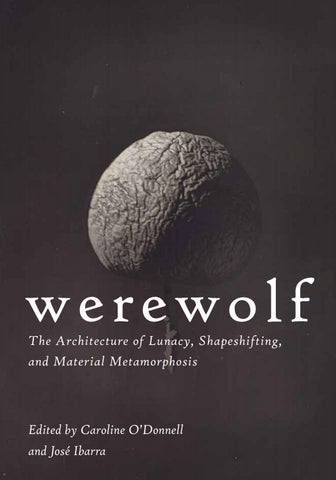
Werewolf: The Architecture of Lunacy, Shapeshifting, and Material Metamorphosis is a monographic manifesto10 that departs from the prevalent architectural models of inert objectness and proposes a shift toward working with today’s dynamic political and ecological climates, morphing and adjusting in response to shifting scenarios and surroundings. The first part of this book begins with architecture’s pervasive lineage of man as ruler—both master and measure—of space. Chapter 1 moves from human to animal to monster and arrives at a new model for architecture in which fluctuation and indeterminacy are fundamental. As the animal becomes monster, three characteristics that define the werewolf are translated into analogous conceptual frameworks and architectural propositions: lunacy considers natural triggers for transformational events, shapeshifting explores formal variation—whether literally, in physical space, or metaphorically, through perceptual means—and material metamorphosis investigates physical and chemical changes to matter. Finally, this chapter juxtaposes lupine tales of trickery and deception with architecture’s linguistic trajectory. This unpacking of the book’s conceptual framework is followed by chapter 2, which studies the arc of dynamic architecture through twentieth- and twenty-first-century case studies. These building precedents support an argument for transformation and responsiveness as an imperative for architecture today. Following these chapters, a series of contributor essays explore contextual responsiveness, materiality, form, and perception in the blurry zone between architecture and werewolves. Kari Weil addresses literary transformation through Kafka’s The Metamorphosis, Spyros Papapetros investigates the lunar affect upon architecture from Renaissance cosmology through modern ecology, Jesse Reiser delves into primordial instincts and their risks and rewards, Greg Lynn discusses mechanically dynamic architecture, and Jimenez Lai explores the material and perceptual logics of furriness. The second part of this book presents a series of experiments and forays into the world of transformation that look directly at werewolf theory in practice. These are selected built and unbuilt works of CODA (and its sister practice, OMG) ranging from objects to pavilions to buildings, all using lunacy, shapeshifting, and material metamorphosis as design principles.
15
The third and final part of this book collects various insights on the origins of these lycanthropic notions, as well as the architectural associations to werewolves. This section starts with an interview with O’Donnell that traces her own transformation from wain to woman to wolf, and features an appearance by her OMG partner, Martin Miller. Then, a survey asks historians, theorists, designers, and building users about the role of werewolves and other monsters in architecture. Finally, these transcripts are followed by two additional essays by O’Donnell. These texts were written and published years before Werewolf: The Architecture of Lunacy, Shapeshifting, and Material Metamorphosis was conceived, but they serve to reveal underlying relationship between the shapeshifting monster and the theories presented in this book by looking at architecture through economy, ecology, and psychoanalysis. This festigraph is bookended with essays by Peter Eisenman and Cynthia Davidson, whose contributions to architecture have given shape to many of the ideas here, either by direct correspondence or by opposition.
16
Ultimately, all these words and projects respond to one fundamental prompt: what would it mean for architecture to be, sometimes, lycanthrope? The human fascination with the monster comes not so much from her beastliness but from her transformability, indefinability, and behavior outside the norm. The werewolf encounter is exhilarating not so much due to the contact with a wild animal but rather, as Herbert de Vries has noted, “with one that has transgressed a boundary between nature and culture.”11 What is architecture when it exists in a state of becoming, between nature and culture?