W
M
aster of Kashmiri cuisine, Khan Mohammed Sharief Waza belongs to the Waza family, who introduced wazwaan to Kashmir. Always interested in his family tradition, he joined his father, the legendary Abdul Ahad Waza, at a very young age. He says, ‘My father used to say that wazwaan is a feast for kings. All I know about the intricacies of the art of wazwaan, I learnt from him.’ Khan Mohammed Sharief Waza and his brothers, Shafi and Rafiq, have popularised wazwaan in India and abroad. Wherever there is a Kashmiri food festival anywhere, the catering is invariably done by their Delhi-based company, Ahad Sons. The brothers’ passionate devotion to the cause of promoting wazwaan far and near has resulted in their carving a prominent niche for gourmet Kashmiri food.
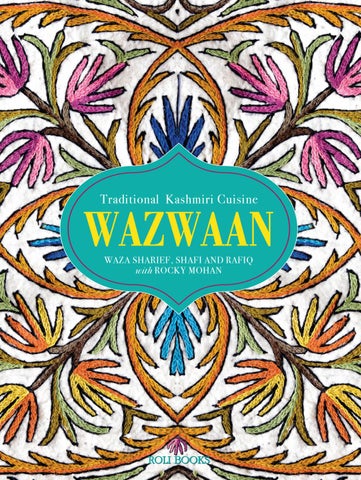
Traditional Kashmiri Cuisine
Wazwaan Waza Sharief, Shafi and Rafiq with Rocky Mohan
hen Timur invaded India in the fifteenth century, he unknowingly introduced to the country a cuisine that is perhaps unrivalled in the world – wazwaan. The elaborate preparation and ceremonial presentation of lavish meals, often comprising 36 courses, makes wazwaan a sumptuous and royal repast. Seven dishes typically form an indispensable part of the feast – tabakh maaz, rista, rogan josh, dhaniwal korma, aab gosh, marchwagan korma and ghustaba. Firin and kahwah (green tea) round off a never-to-be-forgotten culinary experience. For the first time ever, the exotic treasury of secret recipes from the renowned family of Waza – the master chefs of Kashmir – are made available to all those who love the cuisine of the beautiful valley.
Bestselling book by the Waza Brothers of Ahad Sons Left to right: Khan Mohammed Sharief, Khan Mohammed Shafi and Khan Mohammed Rafiq Waza
ISBN: 978-81-941109-3-4
www.rolibooks.com
Cover-Wazwaan 21 6 2019.indd 1
28/06/19 11:30 AM
Contents
9
Introduction 13
Special Kashmiri Culinary Ingredients 16
Kashmiri Spices and Condiments 17
Basic Recipes 18
Lamb 49
Fish 56
Chicken 60
Vegetarian 86
Rice 89
Chutneys 92
Desserts 96
Index
the demon by dropping a mountain on him. This legendary mountain is believed to be Takht-iSulaiman or Shankaracharya, which forms the famous backdrop to the city of Srinagar. History and myth, language and literature, art and architecture, culture and tradition are distinctive features emphasising the individuality of the people of Kashmir, but they are also closely intertwined with and are an integral part of the Indian subcontinent. It was in this valley that Buddhism reached the zenith of its glory, Hinduism extended its frontiers into Shaivism and Shaktism, and Islam acquired a new meaning in the practice of Sufism. Kashmir can claim the distinction of being the melting pot of a multifaceted, unique and harmonious cultural blend. Its versatile cultural forms, fairs and festivals, rites and rituals, seers and sagas, cuisine and language, with its roots embedded in antiquity, speak of unity in diversity and unparalleled cultural cohesion – called kashmiriyat. The scenic beauty of Kashmir is only rivalled by its cuisine, which offers an infinite and sumptuous variety of both vegetarian and non-vegetarian delicacies – perhaps nowhere else in India can one find food as unique and elaborate, which pampers the taste buds of the most fastidious of gourmets. It is born of the marriage of the rich, cultural heritage of the land and diverse influences – Hindu, Buddhist, Afghan, Mughal, Sikh and British. Kashmiri cuisine is of two distinct types – wazwaan is the food of the Muslims, and the Pandits have their traditional butta. They share a love for lamb; wood fire to cook their mouth-watering delicacies, of which many are common to both. What is very evident is that both have been greatly influenced by the Mughlai style of cooking. The main difference is that the Pandits do not use onions and garlic, while Muslims utilise these in good measure. According to local belief, when Timur invaded India in the 15th century, in his wake came 1700 skilled woodcarvers, weavers, calligraphers, architects and cooks from Samarkand, who settled in the valley of Kashmir. The descendants of these cooks, the wazas, are the master chefs of Kashmir. Waan in Kashmiri means ‘shop’. A wazwaan is literally, therefore, a cook shop or restaurant. 10
In practice, however, the wazwaan is an elaborate and sumptuous ritual; a feast served to an honoured guest. This lavish hospitality must in turn be fully appreciated by the guest, for it is not just a meal but a ceremony. Hours of cooking and days of planning go into the preparation and serving of a wazwaan. Normally restricted to special occasions and celebrations at home, the wazwaan experience begins with table settings laid out for groups of four, who are seated on the floor and share the meal served on a large metal plate called a trami. First there is the ritual washing of hands in a basin called a tash-t-nari, which is taken around by attendants, and the diners wash their hands with warm water. Then the tramis arrive, each heaped with rice, accompanied by four seekh kababs, four pieces of methi maaz, one tabakh maaz, one safed murg, one zafrani murg – this is the first course. Yoghurt and chutney are served separately in small earthen pots. Choice dishes are served, fragrant with herbs, one after the other, each made with fresh, local produce. The animals are slaughtered ceremonially and expertly according to Muslim custom, and the waza (chief cook) personally supervises the preparation of each dish that emerges from his kitchen – every ingredient for the meal is handpicked, and much toil and effort ensures that each dish is a culinary masterpiece. The wazas’ recipes are secret, locked away in their heads, passed on from generation to generation. The ultimate formal grand banquet in Kashmir is the royal wazwaan. Of its 36 courses, between 15 and 30 are meat preparations, cooked all night by the vasta waza (master chef) and his retinue of wazas. Seven dishes must be a part of the meal on these occasions – tabakh maaz, rista, rogan josh, dhaniwal korma, aab gosh, marchwagan korma and ghushtaba. A variety of kebabs and vegetable preparations are also served. This veritable feast is rounded off with ghushtaba, a delicious wazwaan speciality made of pounded mutton balls in a yoghurt-based gravy. Firin (saffron-flavoured semolina garnished with dry fruits) is the dessert, followed by kahwah, the green tea flavoured with saffron, cardamoms and almonds, and the wazwaan is over – a repast fit for a king and a never-to-be-forgotten experience of royal Kashmiri hospitality. 11
Aa b Gosh Meat in a thick milk gravy
6 8
1 kg
meat, cut into pieces from the shoulder and putt 18 cups / 3600 ml water 2 tsp / 12 gm garlic (lasan), ground 2 tbsp / 8 gm aniseed (moti saunf) powder Salt to taste ½ cup / 95 gm pure (desi) ghee
1 tsp / 6 gm 10 cups / 2 lt
cloves (laung) green cardamoms (choti elaichi) onion paste, fried milk, boiled until it is reduced to 500 ml or 2 cups
Method 1. Boil the meat in the water. Remove the scum with a ladle until the water is clear. Add the garlic, fennel powder and salt. Cook until the meat is half done. 2. Remove the pan from the heat and keep aside to cool. Strain the stock and collect it in another pan. Wash the meat in cold water and keep aside. 3. Heat the ghee in a small pan; add the cloves. Sautè them until they crackle. Sprinkle 1 tbsp water carefully, and cover the pan with a lid. 4. Add the meat to the strained stock with the green cardamoms, clove-flavoured ghee and onion paste. Bring the mixture to the boil. Reduce heat and cook covered until the meat is tender and very little water remains. 5. Add the reduced milk and mix well. Heat through.
(See picture on page 2)
45
Lamb
Ingredients
Me th i M aaz A Kashmiri delicacy
2 2 ½ cup / 100 ml Salt to taste 8
stomachs intestines of a goat garlic (lasan), ground
1 tsp / 2 gm
Kashmiri red chilli powder, dissolved in ½ cup water ½ cup / 100 ml dry cockscomb (mawal) flowers, heated with 1 cup water, extract (see p. 17) 20 tsp / 10 gm dry fenugreek leaves (kasoori methi) 1 cup / 190 gm pure (desi) ghee 1 tsp / 2 gm black cardamom (bari elaichi) powder ¼ tsp black pepper (kali mirch) powder
green cardamoms (choti elaichi) 6 black cardamoms (bari elaichi) 4 tsp / 8 gm turmeric (haldi) powder 2 tsp / 4 gm dry ginger powder (sonth) 4 cinnamon (dalchini) sticks, 1" each 1 tbsp / 18 gm garlic (lasan) paste
Method 1. Cut open the stomachs and intestines and wash under running water at least 5-6 times. 2. Boil the stomachs for 2-3 minutes and then drain the water. Remove the outer rough membrane with your hands until the surface is smooth. 3. Boil 20 cups water in a deep pan; add the stomachs and intestines. Remove the scum that rises. When the water is clear, add the garlic and salt. Boil until half done. Remove from heat and keep aside to cool. Reserve the stock. When cool, chop the stomachs and intestines coarsely into small rectangular pieces and strips. 4. In a deep pan, heat 15 cups of the reserved stock. Add the chopped meat, cardamoms, turmeric and dry ginger powders, cinnamon sticks and garlic paste. Boil for 25 minutes. 5. Mix in the red chilli water and boil for 20 minutes more. Reduce heat to low and simmer for 25 minutes or until the meat is tender. Add a little water, if required. 6. Meanwhile, boil the dry fenugreek leaves in 1 cup water and drain. Heat the ghee; fry the drained fenugreek leaves. To the meat mixture, add the cockscomb flower extract, fried fenugreek leaves, black cardamom and pepper powders. Mix well. 47
Lamb
Ingredients
W
M
aster of Kashmiri cuisine, Khan Mohammed Sharief Waza belongs to the Waza family, who introduced wazwaan to Kashmir. Always interested in his family tradition, he joined his father, the legendary Abdul Ahad Waza, at a very young age. He says, ‘My father used to say that wazwaan is a feast for kings. All I know about the intricacies of the art of wazwaan, I learnt from him.’ Khan Mohammed Sharief Waza and his brothers, Shafi and Rafiq, have popularised wazwaan in India and abroad. Wherever there is a Kashmiri food festival anywhere, the catering is invariably done by their Delhi-based company, Ahad Sons. The brothers’ passionate devotion to the cause of promoting wazwaan far and near has resulted in their carving a prominent niche for gourmet Kashmiri food.
Traditional Kashmiri Cuisine
Wazwaan Waza Sharief, Shafi and Rafiq with Rocky Mohan
hen Timur invaded India in the fifteenth century, he unknowingly introduced to the country a cuisine that is perhaps unrivalled in the world – wazwaan. The elaborate preparation and ceremonial presentation of lavish meals, often comprising 36 courses, makes wazwaan a sumptuous and royal repast. Seven dishes typically form an indispensable part of the feast – tabakh maaz, rista, rogan josh, dhaniwal korma, aab gosh, marchwagan korma and ghustaba. Firin and kahwah (green tea) round off a never-to-be-forgotten culinary experience. For the first time ever, the exotic treasury of secret recipes from the renowned family of Waza – the master chefs of Kashmir – are made available to all those who love the cuisine of the beautiful valley.
Bestselling book by the Waza Brothers of Ahad Sons Left to right: Khan Mohammed Sharief, Khan Mohammed Shafi and Khan Mohammed Rafiq Waza
ISBN: 978-81-941109-3-4
www.rolibooks.com
Cover-Wazwaan 21 6 2019.indd 1
28/06/19 11:30 AM