In den Bildunterschriften werden für Maßangaben folgende Abkürzungen verwendet / The following abbreviations are used to indicate object dimensions: H für Höhe / H for Height B für Breite / W for Width T für Tiefe / B for Breadth L für Länge / L for Length D für Durchmesser / D for Diameter
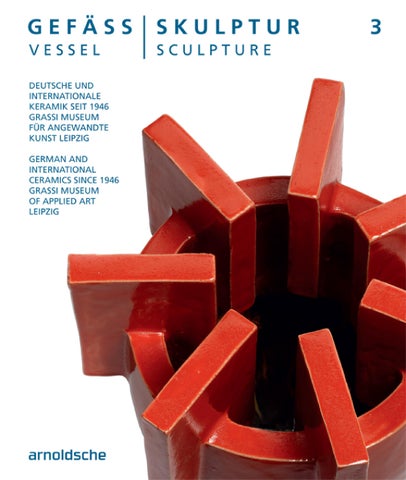
Frontispizabbildung / Frontispiece illustration: MICHAEL CLEFF Aus der Serie „Über Addition“ Hattingen an der Ruhr/Nordrhein-Westfalen, 2005 Schamottiertes Steinzeug, gebaut, montiert, perforiert, engobiert, partiell geschliffen und poliert H 27 cm, B 27,5, T 23 cm Schenkung aus der Sammlung I. und Dr. G. Lailach, 2015 Inv.Nr. 2015.1447 From the “About Addition” series Hattingen an der Ruhr, North Rhine-Westphalia, 2005 Grogged stoneware, hand-built, assembled, perforated, slipped, partly ground and burnished H 27 cm, W 27.5, B 23 cm Donated by the I. and Dr. G. Lailach Collection, 2015
4
VORWORT P R E FA C E
Als wir im Herbst 2008 mit Eröffnung der Ausstellung „GEFÄSS | SKULPTUR. Deutsche und internationale Keramik seit 1946“ auch ein gleichnamiges Katalogbuch vorlegten, ahnten wir nicht, dass der große Zuspruch, den Ausstellung und Publikation finden sollten, einer Fortsetzung des Projektes den Weg ebnen würde. Im Winter 2013/14 folgte eine zweite Ausstellung, wiederum von einer umfänglichen Publikation begleitet. Nun, fünf Jahre später, legen wir hiermit den dritten Band in dieser Reihe vor, der ebenfalls von einer Ausstellung flankiert wird. Es geht darum, Wege der modernen Studiokeramik von der Mitte des 20. Jahrhunderts bis zur Gegenwart anhand von guten Abbildungen ausgesuchter Objekte aus dem Bestand unseres Museums zu skizzieren. Die Arbeiten treten dabei miteinander in ästhetische Zwiesprache und Interaktion. Durch die weitgehend chronologische Abfolge wird deutlich, dass sie sich immer konsequenter aus einer dienstbar funktionalen Attitüde heraus zu autonomen, skulptural wahrzunehmenden Kunstwerken entwickeln, ohne dabei zwingend das Thema des Gefäßes aufgeben zu müssen. Für die Autorinnen und Autoren der Stücke wie für die daran Interessierten und die Sammler liegen zuweilen Welten zwischen jenen Objekten, die eine meisterliche Beherrschung handwerklicher Fertigkeiten der Töpferei voraussetzen, und solchen, für die das Material Ton vorrangig aus der Perspektive der bildenden Kunst heraus genutzt wird. Doch sind die Übergänge zwischen den verschiedenen Positionen
5
In autumn 2008, when, with the opening of the exhibition “VESSEL | SCULPTURE. German and International Ceramics since 1946” we also presented a catalogue with the same title, we did not anticipate that the great popularity with which exhibition and publication were to be met would pave the way for a continuation of the project. In winter 2013/14, a second exhibition followed, again accompanied by a comprehensive publication. Now, five years later, we herewith present the third volume in this series, likewise alongside an exhibition. The publication outlines pathways of modern studio ceramics from the middle of the 20th century until the present day based on high-quality reproductions of selected objects from our museum’s collection. In doing so, the works enter into aesthetic dialogue and interaction. Thanks to the largely chronological order, it becomes clear that they are developing ever more consistently from a subserviently functional stance towards autonomous, sculpturally perceivable pieces of art, without necessarily having to W A L T E R G E B A U E R relinquish their motif as vessels. For the authors of the pieces, as for enthusiasts and collectors, the objects that require a masterly command of craftsmanship in pottery are sometimes worlds apart from those in which clay is primarily used from a fine arts perspective. Still, the transitions between the different positions remain in flux. Whether a piece is still a vessel or already a sculpture lies in the eye of the beholder and can ultimately be proven in its application and exhibition.
Walzenformvase Bürgel/Thüringen, um 1947 Pyrithaltiges Steinzeug, gedreht, engobiert, matt glasiert, im Standbereich den Scherben freilassend H 11,6 cm, D 8,4 cm Schenkung aus der Sammlung A. und H. P. Binroth, 2011 Inv.Nr. 2011.299 Cylindrical vase Bürgel, Thuringia, c. 1947 Stoneware with pyrite, thrown, slipped, matt glaze, revealing the body in the base area H 11.6 cm, D 8.4 cm Donated by the A. and H. P. Binroth Collection, 2011
B E AT E K U H N „Stachelgruppe” Düdelsheim, Stadt Büdingen/Oberhessen, 1965 Steinzeug, gedreht, modelliert, montiert, mehrschichtig matt glasiert H 42 cm, B 53 cm, T 16 cm Schenkung aus der Sammlung Hg. und E. Gareis, 2014 Inv.Nr. 2014.585 “Group of prickly creatures” Düdelsheim, City of Büdingen, Upper Hesse, 1965 Stoneware, thrown, modelled, assembled, multiple layers of matt glaze H 42 cm, W 53 cm, B 16 cm Donated by the Hg. and E. Gareis Collection, 2014
86
87
112
HEIDI KIPPENBERG Zwei walzenförmige Vasen Buch bei Weisendorf/Mittelfranken, 1972 (links) und 1970 (rechts) Steinzeug, gedreht, mattglasiert, mit Beguss überglasiert, bei der rechten Vase Fußzone unglasiert links: H 17,5 cm, D 12,1 cm Schenkung von Ch. Dywicki, 2014 Inv.Nr. 2014.895 rechts: H 14 cm, D 9,5 cm Schenkung aus der Sammlung Dr. H. Meurer, 2016 Inv.Nr. 2016.1457 Two cylindrical vases Buch near Weisendorf, Central Franconia, 1972 (left) and 1970 (right) Stoneware, thrown, matt glaze, overglazed with overlay, on the right-hand vase foot zone unglazed left: H 17.5 cm, D 12.1 cm Donated by Ch. Dywicki, 2014 right: H 14 cm, D 9.5 cm Donated by the Dr. H. Meurer Collection, 2016 DIETER CRUMBIEGEL Vase mit abgesetztem Fuß Fulda/Hessen, 2. Hälfte 1960er Jahre Schamottiertes Steinzeug, gebaut, montiert, zweischichtig glasiert, mit Beguss akzentuiert H 15,9 cm, D 8,4 cm Schenkung aus der Sammlung A. und H. Nelius, 2014 Inv.Nr. 2014.665 Vase with stepped foot Fulda, Hesse, 2nd half 1960s Grogged stoneware, hand-built, assembled, two layers of glaze, highlighted with poured glaze H 15.9 cm, D 8.4 cm Donated by the A. and H. Nelius Collection, 2014
113
148
RUTH DUCKWORTH Fußschale Chicago (USA), 1970er Jahre Porzellan, gebaut, modelliert, glasiert, Fußzone unglasiert H 12 cm, D 17 cm Schenkung aus der Sammlung Hg. und E. Gareis, 2014 Inv.Nr. 2014.592 Footed bowl Chicago (USA), 1970s Porcelain, hand-built, modelled, glazed, foot zone unglazed H 12 cm, D 17 cm Donated by the Hg. and E. Gareis Collection, 2014 „Aufrechte Form, durchbrochen“ Chicago (USA), 1975/76 Porzellan, gewalzt, geschnitten, montiert, verformt, innen glasiert H 20,5 cm, B 14 cm, T 6 cm Schenkung aus der Sammlung Dr. H. Meurer, 2016 Inv.Nr. 2016.1442 “Upright form, perforated” Chicago (USA), 1975/76 Porcelain, rolled out, cut, assembled, altered, glazed inside H 20.5 cm, W 14 cm, B 6 cm Donated by the Dr. H. Meurer Collection, 2016
149
178
ULLA VIOTTI Wandrelief Hammenhög bei Simrishamn/Schonen (Schweden), um 1980 Schamottiertes Steinzeug, gewalzt, verformt, modelliert, geritzt, mit Oxiden eingefärbt, auf Aluminiumträgerplatte H 53 cm, B 43 cm, T 7 cm Schenkung aus der Sammlung N. Ludwig, 2018 Inv.Nr. 2018.160 Mural relief Hammenhög near Simrishamn, Schonen (Sweden), c. 1980 Grogged stoneware, rolled out, altered, modelled, incised, coloured with oxides, on an aluminium support plate H 53 cm, W 43 cm, B 7 cm Donated by the N. Ludwig Collection, 2018 HILDEGUND SCHLICHENMAIER UND / A N D RÉMI BONHERT Vasenobjekt Redan/Aubinges bei Les Aix-d’Angillon (Frankreich), 1972/73 Schamottiertes Steinzeug, gedreht, verformt, die Oberfläche mit einem in Engobe getränkten Textilnetz strukturiert, innen glasiert, Holzofenbrand H 15,2 cm, D 12,2 cm Schenkung aus der Sammlung H. und H. Koch, 2009 Inv.Nr. 2009.367 Vase object Redan, Aubinges near Les Aix-d’Angillon (France), 1972/73 Grogged stoneware, thrown, altered, the surface textured with a textile net soaked in slip, glazed inside, fired in a woodburning kiln H 15.2 cm, D 12.2 cm Donated by the H. and H. Koch Collection, 2009 RÉMI BONHERT Vasenobjekt Redan/Aubinges bei Les Aix-d’Angillon (Frankreich), 1979 Schamottiertes Steinzeug, gedreht, verformt, modelliert, Oberflächenstruktur durch engobengetränktes Textilnetz, Ammonit-Abdruck, im Bereich der Öffnung glasiert, Holzofenbrand H 20,6 cm, D 10,8 cm Schenkung aus der Sammlung H. und H. Koch, 2009 Inv.Nr. 2009.366 Vase object Redan, Aubinges near Les Aix-d’Angillon (France), 1979 Grogged stoneware, thrown, altered, modelled, surface texturing with textile net soaked in slip, ammonite imprint, glazed in the area of the opening, fired in a wood-burning kiln H 20.6 cm, D 10.8 cm Donated by the H. and H. Koch Collection, 2009
179
204
BARBARA STEHR Wandteller (Detail) Tornesch-Ahrenlohe/Holstein, um 1980 Steinzeug, gedreht, mehrschichtig glasiert, Craquelé D 26,3 cm, H 5,6 cm Schenkung aus der Sammlung Ch. Dywicki, 2014 Inv.Nr. 2014.881 Wall plate (detail) Tornesch-Ahrenlohe, Holstein, c. 1980 Stoneware, thrown, multiple layers of glaze, craquelure D 26.3 cm, H 5.6 cm Donated by the Ch. Dywicki Collection, 2014 W E N D E L I N S TA H L Deckelvase Klotten/Mosel/Rheinland-Pfalz, Mitte 1980er Jahre Steinzeug, gedreht, engobiert, Kristallglasur auf Zink-Barium-Basis H 24 cm, D 21 cm Schenkung aus der Sammlung Neumann-Ogando, 2010 Inv.Nr. 2010.908 a / b Lidded vase Klotten, Moselle, Rhineland-Palatinate, mid-1980s Stoneware, thrown, slipped, zinc-bariumbased crystal glaze H 24 cm, D 21 cm Donated by the Neumann-Ogando Collection, 2010
205
220
HILDEGUND SCHLICHENMAIER Objekt (Detail) Redan/Aubinges bei Les Aix-d’Angillon (Frankreich), um 1980 Steinzeug, gedreht, gebaut, modelliert, Ascheanflugglasur, Holzofenbrand H 19,5 cm, B 21 cm, T 18 cm Schenkung aus der Sammlung Dr. H. Meurer, 2014 Inv.Nr. 2014.566 Object (detail) Redan, Aubinges near Les Aix-d’Angillon (France), c. 1980 Stoneware, thrown, hand-built, modelled, fly-ash glaze, fired in a wood-burning kiln H 19.5 cm, W 21 cm, B 18 cm Donated by the Dr. H. Meurer Collection, 2014 GERHARD LUTZ Mohnkapsel Niederalteich/Niederbayern, 1982 Steinzeug, gebaut, modelliert, montiert, matt glasiert H 13,9 cm, D 15,4 cm Schenkung aus der Sammlung A. und G. Schütte, 2009 Inv.Nr. 2009.307 Poppy-seed capsule Niederalteich, Lower Bavaria, 1982 Stoneware, hand-built, modelled, assembled, matt glaze H 13.9 cm, D 15.4 cm Donated by the A. and G. Schütte Collection, 2009
Nachfolgende Doppelseite / Double page overleaf: F R A N K S T E YA E RT Boot (Wrack) Denderbelle bei Aalst (Belgien), um 1982/83 Hochgebrannte Irdenware, gewalzt, geschnitten, modelliert, montiert, mit polychromen Engoben bemalt H 17 cm, B 60,6 cm, T 33,5 cm Schenkung aus der Sammlung N. Ludwig, 2018 Inv.Nr. 2018.136 Boat (Wreck) Denderbelle near Aalst (Belgium), c. 1982/83 High-fired earthenware, rolled out, cut, modelled, assembled, painted with polychrome slips H 17 cm, W 60.6 cm, B 33.5 cm Donated by the N. Ludwig Collection, 2018
221
276
WA LT H E R Z A N D E R Große Schildformvase („Windkanter“) (Detail) Fahrenholz bei Drage an der Elbe/ Niedersachsen, 1985 Schamottiertes Steinzeug, gebaut, modelliert, montiert, matte Eichenascheglasur H 40 cm, B 45 cm, T 16 cm Schenkung aus der Sammlung A. und H. Nelius, 2014 Inv.Nr. 2014.680 Large shield form vase (“Ventifact”) (detail) Fahrenholz near Drage, Elbe, Lower Saxony, 1985 Grogged stoneware, hand-built, modelled, assembled, matt oak ash glaze H 40 cm, W 45 cm, B 16 cm Donated by the A. and H. Nelius Collection, 2014 INKE LERCH-BRODERSEN Eiform-Kumme mit geometrischem Dekor Bünsdorf bei Rendsburg/SchleswigHolstein, um 1991 Porzellan, gedreht, Dekor aus eingefärbten Porzellanengoben und Feldspatglasur H 18 cm, D 16 cm Schenkung aus der Sammlung G. und K. Bruch, 2014 Inv.Nr. 2014.767 Ovoid bowl with geometric decoration Bünsdorf near Rendsburg, SchleswigHolstein, c. 1991 Porcelain, thrown, decoration of coloured porcelain slips and feldspathic glaze H 18 cm, D 16 cm Donated by the G. and K. Bruch Collection, 2014
277
ARCADIO BLASCO Wandrelief Mutxamel, Alicante (Spanien), 1988 Hart gebrannter schamottierter Ton, modelliert, reliefiert, partiell engobiert, eingelegte Perlen, geritzt D 24 cm, H 3,5 cm Trägerplatte H 30 cm, B 30 cm Schenkung aus der Sammlung Neumann-Ogando, 2010 Inv.Nr. 2010.860 Mural relief Mutxamel, Alicante (Spain), 1988 Hard-fired grogged clay, modelled, with relief, partly slipped, inlaid beads, incised D 24 cm, H 3.5 cm Support panel H 30 cm, W 30 cm Donated by the Neumann-Ogando Collection, 2010 HERMAN MUYS Mann im Sessel Haaltert (Belgien), wohl 1989 Hart gebrannter Ton, aus Platten geschnitten, gebaut, modelliert, montiert, polychrome Engobenund Glasurbemalung H 51 cm, B 23 cm, T 29 cm Schenkung aus der Sammlung N. Ludwig, 2018 Inv.Nr. 2018.153 Man in armchair Haaltert (Belgium), probably 1989 Hard-fired clay, cut from slabs, hand-built, modelled, assembled, polychrome slip and glaze painting H 51 cm, W 23 cm, B 29 cm Donated by the N. Ludwig Collection, 2018
302
303
THOMAS NAETHE Gefäß Utzerath/Eifel, um 2003 Steinzeug, gedreht, engobiert, Porzellanengobenüberzug H 15,4 cm, D 17 cm Schenkung aus der Sammlung G. und K. Bruch, 2014 Inv.Nr. 2014.793 Vessel Utzerath, Eifel, c. 2003 Stoneware, thrown, slipped, coat of porcelain slip H 15.4 cm, D 17 cm Donated by the G. and K. Bruch Collection, 2014 Gefäß Utzerath/Eifel, um 2003 Steinzeug, gedreht, montiert, engobiert, Porzellanengobenüberzug H 22,5 cm, D 28,6 cm Schenkung von L. Reimers, 2004 Inv.Nr. 2004.135 Vessel Utzerath, Eifel, c. 2003 Stoneware, thrown, assembled, slipped, coat of porcelain slip H 22.5 cm, D 28.6 cm Donated by L. Reimers, 2004
388
389
436
437
464
KYUNGMIN LEE Gefäß aus der „Matrix“-Serie Berlin, 2015 Porzellan, gegossen, linearer Farbdekor, innen transparent glasiert H 19 cm, B 17,5 cm, T 17 cm Erworben mit Unterstützung des Freundeskreises des Museums, 2015 Inv.Nr. 2015.410 Vessel from the “Matrix” series Berlin, 2015 Porcelain, cast, linear colour decoration, transparent glaze on the inside H 19 cm, W 17.5 cm, B 17 cm Purchased with funding from the Circle of Friends of the Museum, 2015 MARTIN MÖHWALD Hohe Vase Halle/Saale, 2012 Steinzeug, gedreht, engobiert, Umdruckdekor von Papiervorlage, transparent glasiert H 35 cm, D 14 cm Schenkung des Freundeskreises des Museums, 2012 Inv.Nr. 2012.405 Tall vase Halle, Saale, 2012 Stoneware, thrown, slipped, slip-transfer decoration from paper template, transparent glaze H 35 cm, D 14 cm Donated by the Circle of Friends of the Museum, 2012
465
JANTJE ALMSTEDT *1988 Marburg-Dagobertshausen/Hessen · 2009–2014 Studium Kommunikationsdesign an der Burg Giebichenstein Kunsthochschule Halle, B.A., 2015–2018 Kunststudium ebenda, Fachrichtung Keramik bei Martin Neubert, Diplom · Frei aufgebaute und modellierte keramische Objekte und Wandarbeiten, teils mit Gefäß- und/oder Figur-Anklang, von stark assemblage-artigem Charakter, polychrom engobiert und bemalt, oft in Verbindung mit anderen Materialien und in Gruppen oder Konstruktionen als raumgreifende Installation präsentiert; umfangreiches zeichnerisches und grafisches Œuvre Abb. siehe S. 472, 473
ticeship with Helma Klett in Fredelsloh/Solling · From 1947 own workshop in Bochum-Querenburg (formerly Mansfeld Mine) with his wife ➞ Ingeborg Asshoff · 1949 Journeyman’s certificate in Münster · 1965 Member of IAC Geneva, founder-member of Gruppe 83 · 1967–1998 New workshop in Bochum-Querenburg · Ceramic vessels, vase sculpture and combinations, at first wheel thrown, later also hand-built and assembled; stoneware, then also porcelain, often narrow-mouthed and surfaces decorated with stamped or incised relief; wide variety of glazes, most of them matt; also small-scale figurative sculptures For ill., see pp. 96, 106, 107, 140, 141, 146, 226, 227
INGEBORG ASSHOFF *1988 Marburg-Dagobertshausen/Hesse · 2009–2014 Studied communication design at Burg Giebichenstein Kunsthochschule Halle, B.A., 2015–2018 studied art there, specialising in ceramics with Martin Neubert, graduate degree · Free-form hand-built and modelled ceramic objects and mural works, some reminiscent of vessels and/or figures, of strongly assemblage-like character, polychrome slipped and painted, often combined with other materials and in groups or constructions presented as expansive spatial installations; comprehensive œuvre of drawings and graphic art For ill., see pp. 472, 473
BRUNO ASSHOFF
Inv.Nr. 2014.660
Inv.Nr. 2009.211
(Gemeinsame Marke mit Ingeborg Asshoff) / (Ingeborg and Bruno Asshoff used the same mark) *1914 Essen †2003 Bochum · 1933–1935 kaufmännische Lehre, 1935–1945 Berufssoldat · 1945/46 Töpferlehre bei Helma Klett in Fredelsloh/Solling · Seit 1948 eigene Werkstatt in Bochum-Querenburg (ehemalige Zeche Mansfeld) mit seiner Frau ➞ Ingeborg Asshoff · 1949 Gesellenprüfung in Münster · 1965 Mitglied der AIC Genf, Gründungsmitglied der Gruppe 83 · 1967– 1998 neue Werkstatt in Bochum-Querenburg (auf dem Frielinghof) · Gefäße, Vasenplastiken und -kombinationen, zunächst ausschließlich gedreht, später auch gebaut und montiert; Steinzeug, dann auch Porzellan, oft mit kleinen Öffnungen und mit durch Stempeln oder Ritzen reliefierten Oberflächen; vielfältigste, meist matte Glasuren; auch figürliche Kleinplastik Abb. siehe S. 96, 106, 107, 140, 141, 146, 226, 227 *1914 Essen †2003 Bochum · 1933–1935 Business apprenticeship, then eleven years as a professional soldier · 1945/46 Potter’s appren-
481
Inv.Nr. 2014.660
Inv.Nr. 2009.211
(Gemeinsame Marke mit Bruno Asshoff) / (Ingeborg and Bruno Asshoff used the same mark) *1919 Bochum †1998 ebenda · 1938–1940 Studium an der Kunstakademie Düsseldorf, Bildhauerklasse Sepp Mages · 1945–1947 Töpferlehre bei Helma Klett in Fredelsloh/ Solling · 1947 Meisterprüfung in Hannover · Ab 1948 eigene Werkstatt mit ihrem Mann ➞ Bruno Asshoff in Bochum-Querenburg (ehemalige Zeche Mansfeld) · 1965 Mitglied der AIC Genf, Gründungsmitglied der Gruppe 83 · 1967–1998 neue Werkstatt in Bochum-Querenburg (auf dem Frielinghof) · Gefäße, Vasenplastiken und -kombinationen, zunächst ausschließlich gedreht, später auch gebaut und montiert; Steinzeug, dann auch Porzellan, oft mit kleinen Öffnungen und mit durch Stempeln oder Ritzen reliefierten Oberflächen; vielfältigste, meist matte Glasuren; auch figürliche Kleinplastik Abb. siehe S. 96, 106, 107, 140, 141, 146, 227 *1919 Bochum †1998 ibidem · 1938–1940 Studied at Kunstakademie Düsseldorf in Sepp Mages’ sculpture class · 1945–1947 Potter’s apprenticeship with Helma Klett in Fredelsloh/ Solling · 1947 Master craftsman’s certificate in Hanover · From 1947 own workshop with her husband ➞ Bruno Asshoff in Bochum-Querenburg (formerly Mansfeld Mine) · 1965 Member of IAC Geneva, founder-member of Gruppe 83 · 1967–1998 New workshop in BochumQuerenburg · Ceramic vessels, vase sculptures and combinations, at first wheel thrown, later also hand-built and assembled; stoneware, then also porcelain, often narrow-mouthed and surfaces decorated with stamped or incised relief; wide variety of glazes, most of them matt; also small-scale figurative sculptures For ill., see pp. 96, 106, 107, 140, 141, 146, 227
CHRISTINE ATMER DE REIG
FELICITY AYLIEFF
Inv.Nr. 2010.40
Inv.Nr. 2018.148
Inv.Nr. 2009.630
Inv.Nr. 2005.87
Inv.Nr. 2015.903
*1935 Hamburg · 1955/56 Sprachenstudium · 1956–1959 Fremdsprachenkorrespondentin in Hamburg, 1958 Töpferkurs bei Otto Lindig an der Landeskunstschule Hamburg · 1959–1962 Töpferlehre bei Janne ReckertCordua in Wenningstedt/Sylt, 1962/63 dort Gesellin · 1963/64 Studium an der Hochschule für Bildende Künste Hamburg bei ➞ Jan Bontjes van Beek · 1964–1966 gemeinsame Werkstatt mit Till Sudeck in Aumühle bei Hamburg · 1966–1977 eigenes Atelier in Hasselbeck-Schwarzbach/Hubbelrath (ab 1975 Ratingen) bei Düsseldorf, ab 1977 in Mettmann · Gefäße und Gebrauchskeramik, gedreht, zunächst aus Steinzeug, von 1969 bis gegen die Mitte der 1980er Jahre ausschließlich aus Porzellan mit farbigen Glasuren, hier oft mit geschnittenen, durchscheinenden Reliefdekoren mit zarten Glasuren aus dem E-Ofen, danach auch wieder kräftige Steinzeugarbeiten, Vasen, Schalen und große Teller aus dem Reduktionsbrand mit asiatisch orientierten Glasuren und freien Pinselzeichnungen, gegossene Kleinserien in Porzellan, seit einigen Jahren auch montierte Kastengefäße Abb. siehe S. 132, 133, 134, 236
*1954 Edlesborough/Bedfordshire (Großbritannien) · 1972–1978 Keramik- und Textilstudium an der Bath Academy of Art, Bath · 1978/79 Post-Graduate-Studium am Goldsmiths College, University of London · 1978–1982 Lehrtätigkeit an der Bedales School, Hampshire · Seit 1981 eigene Werkstatt in Bath, später auch an anderen Orten · 1981–1993 Lehrtätigkeit am Goldsmiths College, University of London, 1982–1989 am Bath College of Higher Education, 1989–2001 am Bath Spa University College, Professur 2000 · 1993–1996 Forschungstudium am Royal College of Art, London, seit 2001 Lehrtätigkeit ebenda · 1995 Gründung einer Gemeinschaftswerkstatt für Nachwuchskeramiker in Bath · Ab 2000 gemeinsame Werkstatt mit Takeshi Yasuda in Bath, seit 2006 auch Tätigkeit in dem von beiden gegründeten „Red House Design Studio“ in Jingdezhen (China), hier Zusammenarbeit mit ansässigen Porzellan-Manufakturen · 2010 Artist in Residence in der Royal Delft Fabrik (Niederlande) · Gefäße und Plastiken, gebaut oder abgeformt, zunächst nur aus Irdenware, heute auch aus Porzellan; reiche Oberflächenwirkung durch Sgrafitto und Inlaytechnik („keramisches Terrazzo“), weich gebeulte Kugel- oder Organformen aus Irdenware mit Zusätzen von Glas- und Porzellangranulat und monochromen, matten Oberflächen; seit 2006, angeregt durch die chinesische Porzellantradition, überdimensionale Porzellangefäße mit polychromer und Blau-Weiß-Bemalung in moderner Interpretation Abb. siehe S. 280, 281, 430, 431
*1935 Hamburg · 1955/56 Studied languages · 1956–1959 Foreign language correspondent in Hamburg, 1958 course in pottery-making with Otto Lindig at Landeskunstschule Hamburg · 1959–1962 Potter’s apprenticeship with Janne Reckert-Cordua in Wenningstedt/Sylt, journeyman there in1962/63 · 1963/64 Studied at Hochschule für Bildende Künste Hamburg with ➞ Jan Bontjes van Beek · 1964–1966 Workshop jointly with Till Sudeck in Aumühle near Hamburg · 1966–1977 Own studio in HasselbeckSchwarzbach, Hubbelrath (from 1975 Ratingen) near Düsseldorf, from 1977 in Mettmann · Vessels and utilitarian ceramics, thrown, first stoneware, 1969–mid-1980s porcelain only, with coloured glazes, often with cut, translucent relief decoration with delicate glazes from the electric kiln, later again sturdy work in stoneware, vases, bowls and large plates fired in a reducing atmosphere with Asian-orientated glazes and free brush drawings, small series in cast porcelain, for some years now also assembled box-shaped pieces For ill., see pp. 132, 133, 134, 236
*1954 Edlesborough/Bedfordshire (Great Britain) · 1972–1978 Studied ceramics and textiles at Bath Academy of Art, Bath · 1978/79 Postgraduate studies at Goldsmiths College, University of London · 1978–1982 Taught at Bedales School/Hampshire · From 1981 own workshop in Bath, later also elsewhere · 1981–1993 Taught at Goldsmiths College, University of London, 1982–1989 at Bath College of Higher Education, 1989–2001 at Bath Spa University College, professorship 2000 · 1993–1996 Studies at the Royal College of Art, London, from 2001 taught there · 1995 Founded a communal workshop for young ceramicists in Bath · Since 2000 workshop jointly with Takeshi Yasuda in Bath, since 2006 both have also worked at the Red House Design
Studio they founded in Jingdezhen (China), where they collaborate with local porcelain factories · 2010 Artist in residence at the Royal Delft Factory (the Netherlands) · Vessels and sculpture, hand-built or press-moulded, initially only earthenware, now also in porcelain; richly decorated surfaces featuring sgraffito and inlay technique (“ceramic terrazzo”), softly indented spherical or organic earthenware shapes with the addition of granulated glass and porcelain and monochrome matt surfaces; since 2006, inspired by the Chinese porcelain tradition, outsized porcelain vessels with polychrome and blue-and-white painting in a modern interpretation For ill., see pp. 280, 281, 430, 431
GORDON BALDWIN
Inv.Nr. 2018.149
Inv.Nr. 2009.246
Inv.Nr. 2009.244 *1932 Lincoln/Lincolnshire (Großbritannien) · 1949–1951 Studium der Malerei und Keramik an der Lincoln School of Art and Design, Lincoln, Keramik bei Robert Blatherwick · 1951–1953 Studium der Keramik und Malerei an der Central School of Art and Design London, u.a. bei Eduardo Paolozzi und William Turnbull (Skulptur), bei Dora Billington (Keramik) · 1953–1963 Lehrauftrag am Goldsmiths College of Art London · 1956/57 technischer Assistent an der Central School of Art in London · 1957–1996 Lehrauftrag für Keramik und Skulptur am Eton College, Windsor · 1957–1983 Lehrauftrag an der Camberwell School of Art and Crafts in London, 1957– 1987 auch an der Central School of Art and Design sowie gelegentlich am Bristol Polytechnic, Department of Art and Design, und am South Glamorgan Institute of Higher Education in Cardiff/Wales · 1957–1996 Atelier in Eton/Windsor/Berkshire, seit 1996 in Market Drayton/Shropshire · 2000 Ehrendoktorwürde des Royal College of Art in London · Anfänglich Gebrauchskeramik, dann unter dem Eindruck der Arbeiten ➞ Lucie Ries und vor allem ➞ Hans Copers Gefäßobjekte aus Steinzeug, später aus hartgebranntem Ton; seit Ende der 1950er ausschließlich gebaute Arbeiten, zunächst wie Synthesen zeitgenössischer Skulptur und Malerei mit der Idee des Gefäßes; über stelenförmige Gefäße und Schalenformen und angeregt durch Naturformen dann Entwicklung zu geschlossenen Formen mit kleinen, oft zeichenartigen Öffnungen; zunehmende Reduktion der Farbskala der
Oberflächen auf mattes Weiß oder Schwarz der Engoben und Glasuren mit zeichenhafter Malerei, rhythmischen Ritzungen und Markierungen; auch Malerei, Zeichnung, Collage und Metallskulptur Abb. siehe S. 154, 155, 252, 253 *1932 Lincoln/Lincolnshire (Great Britain) · 1949–1951 Studied painting and ceramics, with Robert Blatherwick, at the Lincoln School of Art and Design in Lincoln · 1951–1954 Studied ceramics and painting at the Central Saint Martins College of Art and Design in London, with, among others, Eduardo Paolozzi and William Turnbull (sculpture) and Dora Billington (ceramics) · 1953–1963 Taught at Goldsmiths College of Art London · 1956/57 Technical Assistant at the Central School of Art in London · 1957–1996 Taught ceramics and sculpture at Eton College, Windsor/Berkshire · 1957–1983 Taught at the Camberwell School of Art and Crafts in London, 1957–1987 also at the Central School of Art and Design and occasionally at Bristol Polytechnic in the Department of Art and Design, and at the South Glamorgan Institute of Higher Education in Cardiff/Wales · 1957– 1996 Studio at Eton, Windsor/Berkshire, from 1996 in Market Drayton/Shropshire · 2000 Honorary doctorate from the Royal College of Art in London · Initially utilitarian ceramics, later, influenced by the work of ➞ Lucie Rie and especially ➞ Hans Coper, vessel objects in stoneware, later in hard-fired clay; since the late 1950s only hand-built work, at first like syntheses of contemporary sculpture and painting with the vessel idea; via stele-shaped vessels and bowl forms and inspired by natural forms then developed closed forms with small sign-like openings; increasingly reduced colour palette of surfaces to matt white or black slip and glazes with sign-like painting, rhythmic incisions and markings; also painting, drawing, collage and metal sculpture For ill., see pp. 154, 155, 252, 253
HEINER BALZAR
Inv.Nr. 2014.662
Porzellan; nach einfachen, oft zylinderoder kugelförmigen, mitunter sogar dekorierten Gefäßen Entwicklung immer kräftig gedrehten, dickwandigen, oft stark gegliederten Formen, Stangenvasen, Zylinderformen und Schalen, eigene farbige Feldspatglasuren für den Salzbrand; auch Reliefs und skulpturale Arbeiten; später hauptsächlich Baukeramik Abb. siehe S. 270, 271
stoneware, vessels inspired by tradition, modernised in moderation, in series and one-offs in kölschbraun (Cologne brown) or painted with cobalt and manganese smalt, in part with incised Red and Knibis decorations; also figurative small-scale sculptures, figures and above all slightly stylised animals, free-formed or manufactured from models, in salt-glazed stoneware For ill., see p. 75
*1937 Höhr-Grenzhausen · 1952–1954 Potter’s apprenticeship with certificate at the workshop (specialised in salt-firing) of his mother, ➞ Elfriede Balzar-Kopp, in Höhr-Grenzhausen · 1955 Journeyman’s year in the Netherlands and Sweden · 1956–1958 Graduated from master class taught by ➞ Hubert Griemert at the Staatl. Werkschule für Keramik Höhr-Grenzhausen · 1958 Master craftsman’s certificate · 1958– 1966 Worked in the family business · 1966/67 Freelanced in the ceramics industry, including a research assignment from the Deutsche Keramische Gesellschaft for developing a prototype gas-fired kiln for salt-firing · Since 1967 own studio in Höhr-Grenzhausen · Vessels, salt-fired stoneware, later also porcelain; after simple, often cylindrical or spherical, occasionally also decorated vessels, development towards increasingly more powerful wheel thrown, thickwalled, often strongly structured forms, stalk vases, cylindrical forms and bowls, own coloured feldspathic glazes for salt-firing; also reliefs and sculptural pieces; later mainly architectural ceramics For ill., see pp. 270, 271
RICHARD BAMPI
ELFRIEDE BALZAR-KOPP
Inv.Nr. 1963.108
Inv.Nr. 2014.770
*1937 Höhr-Grenzhausen · 1952–1954 Töpferlehre mit Gesellenprüfung in der auf Salzbrand spezialisierten Werkstatt der Mutter ➞ Elfriede Balzar-Kopp in HöhrGrenzhausen · 1955 Gesellenjahr in Holland und Schweden · 1956–1958 Studium an der Staatl. Werkschule für Keramik HöhrGrenzhausen bei ➞ Hubert Griemert · 1958 Meisterprüfung · 1958–1966 Tätigkeit im elterlichen Betrieb · 1966/67 freiberufliche Tätigkeit in der keramischen Industrie, u.a. ein Forschungsauftrag der Deutschen Keramischen Gesellschaft zur Entwicklung des Prototyps eines gasbeheizten Ofens für Salzbrandverfahren · Seit 1967 eigenes Atelier in Höhr-Grenzhausen · Gefäße, Steinzeug aus dem Salzbrand, später auch
*1904 Bendorf bei Koblenz †1983 HöhrGrenzhausen · 1924–1926 Studium an der Keramischen Fachschule Höhr bei Alfred Berdel und Alfred Kamp · 1926/27 weitere Ausbildung an der Staatl. Majolika Manufaktur Karlsruhe bei Ludwig König · Seit 1927 eigene Werkstatt in Höhr · 1937 Meisterprüfung · Salzglasiertes Steinzeug, aus der Tradition in Maßen modernisierte Gefäße in Serie und Unikate in Kölschbraun oder bemalt mit Kobalt- und Mangansmalte, teils mit Red- und Knibisdekor; auch freigebildete oder aus Modeln gefertigte figürliche Kleinplastik, Figuren und vor allem leicht stilisierte Tiere in salzglasiertem Steinzeug Abb. siehe S. 75 *1904 Bendorf near Koblenz †1983 HöhrGrenzhausen · 1924–1926 Studied at Keramische Fachschule Höhr with Alfred Berdel and Alfred Kamp · 1926/27 Further training at Staatl. Majolika Manufaktur Karlsruhe with Ludwig König · From 1927 own workshop in Höhr · 1937 Master craftsman’s certificate · Salt-glazed
Inv.Nr. 2012.429
Inv.Nr. 2010.57
Inv.Nr. 2008.262
Inv.Nr. 1964.54
*1896 Amparo/São Paulo (Brasilien) †1965 Kandern/Südbaden · Um 1900 Übersiedlung der Familie nach Rheinfelden/Oberrhein · 1915–1918 Soldat · 1918/19 Architekturstudium an der Technischen Hochschule München und am Bauhaus Weimar · 1920/21 Studienreisen in die Schweiz und nach Florenz · 1922 Gold- und Silberschmiedearbeiten in Wien · 1923 Auswanderung nach Rio de Janeiro (Brasilien), Gründung der Kunstwerkstätten Rio, erste Keramiken · 1925 Rückkehr nach Deutschland, Übernahme des väterlichen Architekturbüros · 1927 Gründung der Fayence-Manufaktur Kandern · 1934 Beginn keramisch-technischer Studien, Experimente mit Brenntemperaturen und Glasuren · 1937 Umfirmierung in Fayence-Manufaktur Richard G. Bampi, Kandern · Ab 1942 Zusammenarbeit mit dem Maler Julius Bissier · 1944/45 Kriegsdienst, danach Weiterführung der Werkstatt bis zu seinem Tod · 1967 Nachlassversteigerung im Badischen Landesmuseum Karlsruhe, deren Erlös testamentarisch als Grundlage für den Richard-Bampi-Preis zur Förderung junger Keramiker bestimmt wurde · Gefäßkeramik und Plastik · 1929 Beschäftigung mit fernöstlicher Keramik, ab 1937 Entwicklung von Reduktionsglasuren, ab 1941 Steinzeug mit Feldspatglasuren, nach 1945 mehrschichtig, pastos laufende Glasuren mit fellartigen Strukturen oder malerische Akzente auf Irdenware; seit 1951 Einfluss skandinavischer Keramik und abstrakter Kunst, angeregt von Naturerscheinungen neue organoide Formen; nach 1956 Verfeinerung übereinander gespritzter Glasuren auf Feinsteinzeug, besonders auf dem Gebiet der Kristallglasuren; auch plastische Arbeiten, Baukeramik und Wandmosaiken Abb. siehe S. 9, 48, 72, 73
482