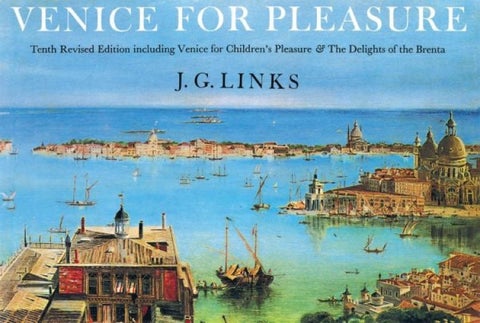
VENICE FOR PLEASURE WALK 1 p. 77 The Accademia, the Zattere, the Frari, the Rialto Bridge
WALK 2 p. 123 The Riva degli Schiavoni, SS. Giovanni e Paolo, the Rialto Bridge
WALK 3 p. 165 The Sestiere di S. Marco
WALK 4 p. 181 The Grand Canal and the Canareggio Area
AROUND VENICE p. 209 and the Islands of the Lagoon
VENICE FOR PLEASURE WALK 1 p. 77 The Accademia, the Zattere, the Frari, the Rialto Bridge
WALK 2 p. 123 The Riva degli Schiavoni, SS. Giovanni e Paolo, the Rialto Bridge
WALK 3 p. 165 The Sestiere di S. Marco
WALK 4 p. 181 The Grand Canal and the Canareggio Area
AROUND VENICE p. 209 and the Islands of the Lagoon
This is the tenth revised edition of a guide book that has become a classic, remaining in print for sixty years. Its simple object, in the author’s own words, is to guide reader to places they might otherwise miss and, having reached them, to explain what they might wish to know and then leave them, preferably at a café, to admire, to enjoy, and perhaps be disappointed. The illustrations, now for the first time in full colour, show visitors, as they confrons a view, what their predecessors of a hundred, two hundred or five hundred years ago saw from the same point. The main part of the book describes four walks, each of which can be completed in one day, although there are points in each at which one can break off and return another day. Maps, old and new, are provided for each walk. The introduction deals with the Piazza S. Marco and its neighbourhood, and appendices are devoted to the public boat services, food and drink and books about Venice. One chapter is entitled ‘Venice for Children’s Pleasure’.
One of the most delightful and original guides ever written about the city – any city, for that matter Jan Morris Not only the best guide book to that city ever written, but the best guide book to any city ever written Bernard Levin in The Times A trusty companion Ned Sherrin in the Mail on Sunday An absolute must for anyone going to Venice Evening Standard The most readable guide to Venice John Diamond in The Sunday Times The little classic Good Book Guide The essential and much loved companion Anderson's Travel Companion Deliciously readable Saga Magazine Classic Country Life
J. G. Links’ little charmer The Lady
A friend The Daily Mirror
It doesn’t tell you about all the Tintorettos and Veroneses and Titians you must look at. It just tells you how to enjoy yourself Ham and High
Essential on any Venetian outing The Sunday Telegraph
A world authority on Venice Jeffrey Bernard in The Spectator Thanks J. G. Let's do it again Sue Lawley in The Sunday Telegraph A quite brilliant oddity Country Living
Mr. Links leads the visitor on a number of walks through the labyrinthine ways of the most beautiful of cities, walks filled with history, art, observation, curiosities, exotica, and sophistication. It’s a guide which like no other I know, leads, by gloriously digressive routes, straight into the heart of a city’s genius A Common Reader
Funny and fascinating, it is invaluable on the ground but also a beautiful piece of descriptive reading Eothen
A minor classic The Sunday Times
One of the great travel books The Art Newspaper
Essential reading Condé Nast Online
My all time favourite guidebook James Daunt of Daunt’s Travel Books
J. G. Links’ magic guidebook The Times
The grand old man of Venice Brian Sewell in the Evening Standard
The best guide to Venice The Daily Telegraph Venice with passion The Guardian One of those miraculous books that gets passed by hand, pressed urgently on friends Sean French in the New Statesman
This is the tenth revised edition of a guide book that has become a classic, remaining in print for sixty years. Its simple object, in the author’s own words, is to guide reader to places they might otherwise miss and, having reached them, to explain what they might wish to know and then leave them, preferably at a café, to admire, to enjoy, and perhaps be disappointed. The illustrations, now for the first time in full colour, show visitors, as they confrons a view, what their predecessors of a hundred, two hundred or five hundred years ago saw from the same point. The main part of the book describes four walks, each of which can be completed in one day, although there are points in each at which one can break off and return another day. Maps, old and new, are provided for each walk. The introduction deals with the Piazza S. Marco and its neighbourhood, and appendices are devoted to the public boat services, food and drink and books about Venice. One chapter is entitled ‘Venice for Children’s Pleasure’.
One of the most delightful and original guides ever written about the city – any city, for that matter Jan Morris Not only the best guide book to that city ever written, but the best guide book to any city ever written Bernard Levin in The Times A trusty companion Ned Sherrin in the Mail on Sunday An absolute must for anyone going to Venice Evening Standard The most readable guide to Venice John Diamond in The Sunday Times The little classic Good Book Guide The essential and much loved companion Anderson's Travel Companion Deliciously readable Saga Magazine Classic Country Life
J. G. Links’ little charmer The Lady
A friend The Daily Mirror
It doesn’t tell you about all the Tintorettos and Veroneses and Titians you must look at. It just tells you how to enjoy yourself Ham and High
Essential on any Venetian outing The Sunday Telegraph
A world authority on Venice Jeffrey Bernard in The Spectator Thanks J. G. Let's do it again Sue Lawley in The Sunday Telegraph A quite brilliant oddity Country Living
Mr. Links leads the visitor on a number of walks through the labyrinthine ways of the most beautiful of cities, walks filled with history, art, observation, curiosities, exotica, and sophistication. It’s a guide which like no other I know, leads, by gloriously digressive routes, straight into the heart of a city’s genius A Common Reader
Funny and fascinating, it is invaluable on the ground but also a beautiful piece of descriptive reading Eothen
A minor classic The Sunday Times
One of the great travel books The Art Newspaper
Essential reading Condé Nast Online
My all time favourite guidebook James Daunt of Daunt’s Travel Books
J. G. Links’ magic guidebook The Times
The grand old man of Venice Brian Sewell in the Evening Standard
The best guide to Venice The Daily Telegraph Venice with passion The Guardian One of those miraculous books that gets passed by hand, pressed urgently on friends Sean French in the New Statesman
PALLAS ATHENE
VENICE FOR PLEASURE J. G.Links
PALLAS ATHENE
VENICE FOR PLEASURE J. G.Links
CONTENTS Foreword by Jan Morris p. 11 Preface to the Seventh Edition p. 15 Preface to the Tenth Edition p. 17
Introduction p. 20 1. Author to reader 20 1I. Approaching Venice 24 1II. View from the Molo 31 1V. The Doge’s Palace and the Basilica 40 V. St Mark’s: The Piazza 51 VI. A little Venetian history 62 VII. View from the Campanile 73
Walk 1: The Accademia, the Zattere, the Frari, the Rialto Bridge p. 77 1. Preface 79 1I. Piazza S. Marco to the Accademia 80 1II. The Accademia 91 1V. The Grand Canal seen from the Accademia 99
V. Between the Accademia and the Zattere 100 VI. The Frari and its neighbourhood 107 VII. The Rialto Bridge to Piazza S. Marco 117
Walk 2: The Riva degli Schiavoni, SS. Giovanni e Paolo, the Rialto Bridge p. 123 1. The Scuola di S. Giorgio degli Schiavoni and the Arsenal 125 1I. View from the Public Gardens 138 1II. The Riva degli Schiavoni to SS. Giovanni e Paolo 144 IV. View from the Fondamente Nuove 153 V. Between the Fondamente Nuove and the Rialto Bridge 158
Walk 3: The Sestiere di S. Marco p. 165 1. The Sestiere di S. Marco 167 1I. The Correr Museum 177
CONTENTS Foreword by Jan Morris p. 11 Preface to the Seventh Edition p. 15 Preface to the Tenth Edition p. 17
Introduction p. 20 1. Author to reader 20 1I. Approaching Venice 24 1II. View from the Molo 31 1V. The Doge’s Palace and the Basilica 40 V. St Mark’s: The Piazza 51 VI. A little Venetian history 62 VII. View from the Campanile 73
Walk 1: The Accademia, the Zattere, the Frari, the Rialto Bridge p. 77 1. Preface 79 1I. Piazza S. Marco to the Accademia 80 1II. The Accademia 91 1V. The Grand Canal seen from the Accademia 99
V. Between the Accademia and the Zattere 100 VI. The Frari and its neighbourhood 107 VII. The Rialto Bridge to Piazza S. Marco 117
Walk 2: The Riva degli Schiavoni, SS. Giovanni e Paolo, the Rialto Bridge p. 123 1. The Scuola di S. Giorgio degli Schiavoni and the Arsenal 125 1I. View from the Public Gardens 138 1II. The Riva degli Schiavoni to SS. Giovanni e Paolo 144 IV. View from the Fondamente Nuove 153 V. Between the Fondamente Nuove and the Rialto Bridge 158
Walk 3: The Sestiere di S. Marco p. 165 1. The Sestiere di S. Marco 167 1I. The Correr Museum 177
Walk 4: The Grand Canal and the Canareggio Area p. 181 1. The Ca’ d’Oro 183 1I. Northern Venice 187 1II. The Canareggio 194 1V. The Fondaco dei Turchi 200 V. From the Pescheria 205
Around Venice and the Islands of the Lagoon p. 209 1. The Ancient Settlements 211 1I. Around Venice 213 1II. Murano 221 1V. Burano and Torcello 224
Venice for Children’s Pleasure and The Delights of the Brenta p. 227 1. Children in Venice 229 1I. Exploring the Waterways 238 1II. The Delights of the Brenta 239 1V. Solutions 246
Appendices A. The Services provided by ACTV, p. 247 B. Books about Venice, p. 255 1. General 255 1I. Guidebooks 258 1II. Art and Topography 262 1V. Photographs 267
C. The Street Signs of Venice, p. 266 D. Food and Drink, p. 270
About J. G. Links p. 274 List of Illustrations p. 277 Index p. 279 Maps, drawn by M. A. Verity VENICE – Key Map, inside front cover WALK 1 – Southern Venice 78 WALK 2 – Eastern Venice 124 WALK 3 – The Sestiere di S. Marco 166 AROUND VENICE – 210
Walk 4: The Grand Canal and the Canareggio Area p. 181 1. The Ca’ d’Oro 183 1I. Northern Venice 187 1II. The Canareggio 194 1V. The Fondaco dei Turchi 200 V. From the Pescheria 205
Around Venice and the Islands of the Lagoon p. 209 1. The Ancient Settlements 211 1I. Around Venice 213 1II. Murano 221 1V. Burano and Torcello 224
Venice for Children’s Pleasure and The Delights of the Brenta p. 227 1. Children in Venice 229 1I. Exploring the Waterways 238 1II. The Delights of the Brenta 239 1V. Solutions 246
Appendices A. The Services provided by ACTV, p. 247 B. Books about Venice, p. 255 1. General 255 1I. Guidebooks 258 1II. Art and Topography 262 1V. Photographs 267
C. The Street Signs of Venice, p. 266 D. Food and Drink, p. 270
About J. G. Links p. 274 List of Illustrations p. 277 Index p. 279 Maps, drawn by M. A. Verity VENICE – Key Map, inside front cover WALK 1 – Southern Venice 78 WALK 2 – Eastern Venice 124 WALK 3 – The Sestiere di S. Marco 166 AROUND VENICE – 210
Foreword Jan Morris Innumerable foreigners have been associated with Venice down the generations, but I venture to say that none have been more affectionately related than J. G. Links – on the one side because his was a profound and guileless love of the city, on the other because none of Venice’s innumerable chroniclers have portrayed the Serenissima’s character with quite such a combination of the scholarly, the informal and the intimate. I was almost tempted to call his attitude innocent, and in a way it was, because his book is not only called Venice for Pleasure, it really is a sort of pleasure-manual, too. Its author describes himself as ‘the perennial tourist’, travelling purely for enjoyment, but it would be misleading to think of it as a work of hedonism, for Joe Links was a man of deceptive sophistication, the kind of urbanity that
is masked in simplicity. Over the years thousands of readers, starting to reading this book, have been relieved to encounter its famously undemanding approach to the city – ‘Generally the first thing to do in Venice is to sit down and have some coffee’: but by the time they get to the end of it, all the same, they will have learnt virtually everything that an educated stranger needs to know about the place, its art and its history, besides being subtly entertained throughout. *
*
*
This has happened almost without their realizing it, for the Links literary style is at once deceptive and essentially kind. He is the very opposite of those noisy tour guides we are sure to pass, brandishing their placards, as we follow his easy prose through 11
Foreword Jan Morris Innumerable foreigners have been associated with Venice down the generations, but I venture to say that none have been more affectionately related than J. G. Links – on the one side because his was a profound and guileless love of the city, on the other because none of Venice’s innumerable chroniclers have portrayed the Serenissima’s character with quite such a combination of the scholarly, the informal and the intimate. I was almost tempted to call his attitude innocent, and in a way it was, because his book is not only called Venice for Pleasure, it really is a sort of pleasure-manual, too. Its author describes himself as ‘the perennial tourist’, travelling purely for enjoyment, but it would be misleading to think of it as a work of hedonism, for Joe Links was a man of deceptive sophistication, the kind of urbanity that
is masked in simplicity. Over the years thousands of readers, starting to reading this book, have been relieved to encounter its famously undemanding approach to the city – ‘Generally the first thing to do in Venice is to sit down and have some coffee’: but by the time they get to the end of it, all the same, they will have learnt virtually everything that an educated stranger needs to know about the place, its art and its history, besides being subtly entertained throughout. *
*
*
This has happened almost without their realizing it, for the Links literary style is at once deceptive and essentially kind. He is the very opposite of those noisy tour guides we are sure to pass, brandishing their placards, as we follow his easy prose through 11
VENICE FOR PLEASURE the streets. He never pushes us, never bullies, never shows off, never condescends. We don’t have to be interested in 14th century mosaics, and Venice for Pleasure is surely the only guide-book – if a guidebook is the word for it – that occasionally confesses itself surfeited with wonders, or bored in a gallery of art. Style, as de Buffon said, is the man himself. I know of no writer whose work seems more organic, as if it has never been worked out in study and draft, but has flowed straight from his mind, like conversation. That mind, though, is marvellously well-stocked. Links’ learned devotion to this particular city is supported by astonishingly wideranging resources of learning and experience. He was, it is true, one of the world’s great authorities on Canaletto, that quintessentially Venetian painter, but as he leads you so engagingly from Rialto to the Piazza, or scoffs at some art historian’s unwelcome theory concerning Carpaccio – as he mellifluously rambles on, you would hardly guess that he was also the Queen’s Furrier, that he was a familiar competitor on the Cresta Run, that he collaborated on best-selling detective stories, that he wrote a 12
FOREWORD seminal book about urban landscape painting, that he knew a great deal about German wines and was a Governor of the Hudson’s Bay Company and loved fast cars and was, altogether, a genuine 20thcentury polymath. ‘If all the circumstances are propitious,’ he says almost at the end of his book, ‘I can promise you the most delightful experience that even Venice has to offer.’ He is talking about an out-of-season dinner at the Locanda Cipriani on the island of Torcello, and we can sure that his own pleasure is tinged by the memory of some lovely evening of his own, long ago perhaps: but it is enriched too by all the ravishing delights of Venice through which he has been guiding us since the first page – delights sensual very often, but delights of the intellect too, enhanced by humour and by the deep knowledge of history and art that he has been so entertainingly sharing with us. For by now, as we reach the end of the book, too, we feel we know him well. It has been a walking-tour of Venice, but not exactly a guided tour. He carries no placard, and he has never told us what we ought to do, what we ought to feel. Like an unassuming
friend he has shown us the way, helped us to understand, opened our eyes to unexpected beauties and assured us that just to sit at a café and look at the passing scene is as essential to the experience of Venice as a visit to the Doge’s Palace. His book is properly titled. It really is a handbook to pleasure in Venice. *
*
*
So far as I know Joe Links, who died in 1997, never complained about what has happened to Venice – its debilitating flooding, its ghastly overcrowding, the vulgarities of its tourist industry and its gradual decline from civic grandeur into the condition of a museum. He loved it, I would assume, for what it was, pathos and all, and like me he relished not only its ancient serenity, but also its gaudy ostentation – which is, after all, as old as the Republic itself. Anyway, physically little has changed in the city since the first edition of Venice for Pleasure was published in 1966 – by the nature of things the structure of Venice remains inviolate, give or take a conversion here, a rebuilding there, or the insidious effects of high water. ‘Once again,’ Links wrote
in the fifth edition, ‘I have resisted the temptation to make changes,’ and he was right to do so. It is not just that the Venice he takes us through is his Venice, illuminated by his unique personality: it is eternal Venice, Venice in the ideal, almost in the abstract, itself essentially impervious to tourism (if not to tides). In fact, I think, Venice for Pleasure is one of those very few guide-books in the English language which can stand permanently on their own as literature, like Richard Ford’s Handbook to Spain or E. M. Forster’s Guide to Alexandria. By the nature of things not much of importance in this book can really be out-dated: but even if, one dread day, the loveliest of all cities is swallowed finally into the Adriatic, a world then bereft can still be lovingly guided around the memory of Venice, stopping for refreshments now and then (‘Choose one of the cafés on the Riva del Vin, and settle down. We can now do some sightseeing in comfort’) in the incomparable company of Joseph Gluckstein Links. Trefanmarys, 2008 13
VENICE FOR PLEASURE the streets. He never pushes us, never bullies, never shows off, never condescends. We don’t have to be interested in 14th century mosaics, and Venice for Pleasure is surely the only guide-book – if a guidebook is the word for it – that occasionally confesses itself surfeited with wonders, or bored in a gallery of art. Style, as de Buffon said, is the man himself. I know of no writer whose work seems more organic, as if it has never been worked out in study and draft, but has flowed straight from his mind, like conversation. That mind, though, is marvellously well-stocked. Links’ learned devotion to this particular city is supported by astonishingly wideranging resources of learning and experience. He was, it is true, one of the world’s great authorities on Canaletto, that quintessentially Venetian painter, but as he leads you so engagingly from Rialto to the Piazza, or scoffs at some art historian’s unwelcome theory concerning Carpaccio – as he mellifluously rambles on, you would hardly guess that he was also the Queen’s Furrier, that he was a familiar competitor on the Cresta Run, that he collaborated on best-selling detective stories, that he wrote a 12
FOREWORD seminal book about urban landscape painting, that he knew a great deal about German wines and was a Governor of the Hudson’s Bay Company and loved fast cars and was, altogether, a genuine 20thcentury polymath. ‘If all the circumstances are propitious,’ he says almost at the end of his book, ‘I can promise you the most delightful experience that even Venice has to offer.’ He is talking about an out-of-season dinner at the Locanda Cipriani on the island of Torcello, and we can sure that his own pleasure is tinged by the memory of some lovely evening of his own, long ago perhaps: but it is enriched too by all the ravishing delights of Venice through which he has been guiding us since the first page – delights sensual very often, but delights of the intellect too, enhanced by humour and by the deep knowledge of history and art that he has been so entertainingly sharing with us. For by now, as we reach the end of the book, too, we feel we know him well. It has been a walking-tour of Venice, but not exactly a guided tour. He carries no placard, and he has never told us what we ought to do, what we ought to feel. Like an unassuming
friend he has shown us the way, helped us to understand, opened our eyes to unexpected beauties and assured us that just to sit at a café and look at the passing scene is as essential to the experience of Venice as a visit to the Doge’s Palace. His book is properly titled. It really is a handbook to pleasure in Venice. *
*
*
So far as I know Joe Links, who died in 1997, never complained about what has happened to Venice – its debilitating flooding, its ghastly overcrowding, the vulgarities of its tourist industry and its gradual decline from civic grandeur into the condition of a museum. He loved it, I would assume, for what it was, pathos and all, and like me he relished not only its ancient serenity, but also its gaudy ostentation – which is, after all, as old as the Republic itself. Anyway, physically little has changed in the city since the first edition of Venice for Pleasure was published in 1966 – by the nature of things the structure of Venice remains inviolate, give or take a conversion here, a rebuilding there, or the insidious effects of high water. ‘Once again,’ Links wrote
in the fifth edition, ‘I have resisted the temptation to make changes,’ and he was right to do so. It is not just that the Venice he takes us through is his Venice, illuminated by his unique personality: it is eternal Venice, Venice in the ideal, almost in the abstract, itself essentially impervious to tourism (if not to tides). In fact, I think, Venice for Pleasure is one of those very few guide-books in the English language which can stand permanently on their own as literature, like Richard Ford’s Handbook to Spain or E. M. Forster’s Guide to Alexandria. By the nature of things not much of importance in this book can really be out-dated: but even if, one dread day, the loveliest of all cities is swallowed finally into the Adriatic, a world then bereft can still be lovingly guided around the memory of Venice, stopping for refreshments now and then (‘Choose one of the cafés on the Riva del Vin, and settle down. We can now do some sightseeing in comfort’) in the incomparable company of Joseph Gluckstein Links. Trefanmarys, 2008 13
Preface to the Seventh Edition No reference has been made to restorations which are taking place throughout Venice and will doubtless continue in the foreseeable future. The reader must not therefore expect to find everything as described in the guide or, in many cases, to be able to see the monument at all. The journey will rarely be wasted, though: a part of Venice that might otherwise have been missed will be seen and the object of this guide is to introduce Venice to its readers rather than her monuments. The waterbus services will appear very different from those described in earlier editions, apart from the substitution of the name ACTV for the long familiar ACNIL. Within a short period after the publication of this edition they must be expected to change again so that anything said about them here should be checked (except, I feel confident, the venerable No. 1). Yet again I have resisted the temptation to make changes which a maturer mind would write differently, if at all. Yet again I must rejoice in the miracle that has enabled Venice to survive for thirteen hundred years and this modest guide for over thirty. This edition is dedicated to Alexander Fyjis-Walker, the perfect publisher – at last. J. G. Links London, Autumn 1997
Preface to the Seventh Edition No reference has been made to restorations which are taking place throughout Venice and will doubtless continue in the foreseeable future. The reader must not therefore expect to find everything as described in the guide or, in many cases, to be able to see the monument at all. The journey will rarely be wasted, though: a part of Venice that might otherwise have been missed will be seen and the object of this guide is to introduce Venice to its readers rather than her monuments. The waterbus services will appear very different from those described in earlier editions, apart from the substitution of the name ACTV for the long familiar ACNIL. Within a short period after the publication of this edition they must be expected to change again so that anything said about them here should be checked (except, I feel confident, the venerable No. 1). Yet again I have resisted the temptation to make changes which a maturer mind would write differently, if at all. Yet again I must rejoice in the miracle that has enabled Venice to survive for thirteen hundred years and this modest guide for over thirty. This edition is dedicated to Alexander Fyjis-Walker, the perfect publisher – at last. J. G. Links London, Autumn 1997
Preface to the Tenth Edition Though there have indeed been changes in Venice since J. G. Links last wrote, not least to his beloved water-bus services, it is a source of continuous wonder, as he would have put it, that this guidebook can remain essentially unchanged. Sixty years after its original publication, Venice for Pleasure is still adding to the gaiety of nations. For this edition all the walks have been carefully checked afresh. Revisions have been kept to a minimum so as to preserve the essence of the book as untouched as possible. Change does take place, however, and the reader is advised in particular to consult the vaporetti timetables. There will always be a café table at which such pleasurable work can be undertaken. Just before his death, J. G. Links was very involved in the restoration of one of the greatest views ever painted of Venice, Canaletto’s The Riva degli Schiavoni in the Sir John Soane Museum in London. Details have been reproduced in the preceding pages, and it is seen in its entirety opposite This edition is dedicated to the memory of J. G. Links, the best friend a reader – or publisher – could have. AF-W, London 2026
Preface to the Tenth Edition Though there have indeed been changes in Venice since J. G. Links last wrote, not least to his beloved water-bus services, it is a source of continuous wonder, as he would have put it, that this guidebook can remain essentially unchanged. Sixty years after its original publication, Venice for Pleasure is still adding to the gaiety of nations. For this edition all the walks have been carefully checked afresh. Revisions have been kept to a minimum so as to preserve the essence of the book as untouched as possible. Change does take place, however, and the reader is advised in particular to consult the vaporetti timetables. There will always be a café table at which such pleasurable work can be undertaken. Just before his death, J. G. Links was very involved in the restoration of one of the greatest views ever painted of Venice, Canaletto’s The Riva degli Schiavoni in the Sir John Soane Museum in London. Details have been reproduced in the preceding pages, and it is seen in its entirety opposite This edition is dedicated to the memory of J. G. Links, the best friend a reader – or publisher – could have. AF-W, London 2026
Venice in 1500. Bird’s-eye view by Jacopo de’ Barbari. From the wood engraving in the Correr Museum, Venice.
19
Venice in 1500. Bird’s-eye view by Jacopo de’ Barbari. From the wood engraving in the Correr Museum, Venice.
19
INTRODUCTION
Introduction
I. Author to reader. If I start with the timehonoured words, ‘This is not a guidebook,’ the reader will inevitably expect a series of personal reflections and anecdotes inspired by a stay in Venice, and he would be badly misled. Nor would the denial be quite justified, for this is, in a sense, a guidebook. The trouble is that it is only half what a reader expects of a guidebook: it is a guide to the pleasures of Venice without its pains. Its simple object is to guide readers to places they might otherwise miss and, having reached them, to tell them what they might wish to know and then leave them there to admire, to enjoy or, perhaps, to be disappointed. For let it be said at once, many people are disappointed in Venice. ‘Do you know what he said to 20
me when he came back from Venice?’ a distinguished old gentleman asked me once; ‘he said he was disappointed ! I must say I envied him his power of imagination.’ That seemed to me to sum it up until I cross-examined a very old aunt who also confessed to disappointment with her first visit. In this case the explanation was simple. An exhibition called ‘Venice in London’ had opened at Olympia in December 1891, and here was Venice as it should have been. It was ‘beautifully illuminated and perfectly warmed so that on a winter’s day in London a Venetian summer’s day could be enjoyed.’ The Rialto, the canals, the palaces, the shops, the market places, the very atmosphere and climate were reproduced. There were thousands of lights and dazzling splendour, battalions of grace-
ful and refined danseuses, and lovely Italian music written especially (I am quoting from The Times, so it must be true). On the canal in front of the stage you could float down the silent waters in a Venetian gondola steered by a Venetian gondolier, accompanied by the music of mandolins and songs of serenaders with their never ending FuniculiFunicula. AND, The Times fails to point out, although my aunt remembered, the gondolas were WHITE. Later on, in February, she went to Venice, in Italy, for her honeymoon. There were no lights, no warmth, no ‘dancers attired in gorgeous costumes’ as there had been in London. The canals smelt and, worst of all, the gondolas were black. She returned to Olympia but never to Venice. But the readers of this guide will probably not be disappointed in Venice. It is, on the whole, not a disappointing city, even to those with enviable powers of imagination. Before forecasting my readers’ reactions, though, it might be best to describe them, if only to ensure that those who fail to answer the description refrain from buying this book.
First of all, they are the possessors of at least one other guide to Venice, one that will tell them of the painters and sculptors and architects of Venice and of their marvellous works which fill the treasure houses of the city to overflowing – that is, of course, provided they want to read about these things as well as to look at them. Be that as it may, this is for the most part a book about the outsides of buildings, seldom about their contents. It is about Venice, the city, not about its possessions, and very little about its people. Next, they are walkers, or, at least, dawdlers. Earlier writers on Venice seem never to have taken a step through its streets; on arrival they hired a gondola, preferably with two gondoliers, for the period of their stay, and in it they sat, with Ruskin or Baedeker or E. V. Lucas on their lap, occasionally raising their eyes to see what they were gliding past It was a luxurious and enchanting way to see Venice. It still is, in spite of the motor traffic, but you should bear in mind Hugh Honour’s warning that in a gondola three is a crowd. This makes it rather expensive. 21
INTRODUCTION
Introduction
I. Author to reader. If I start with the timehonoured words, ‘This is not a guidebook,’ the reader will inevitably expect a series of personal reflections and anecdotes inspired by a stay in Venice, and he would be badly misled. Nor would the denial be quite justified, for this is, in a sense, a guidebook. The trouble is that it is only half what a reader expects of a guidebook: it is a guide to the pleasures of Venice without its pains. Its simple object is to guide readers to places they might otherwise miss and, having reached them, to tell them what they might wish to know and then leave them there to admire, to enjoy or, perhaps, to be disappointed. For let it be said at once, many people are disappointed in Venice. ‘Do you know what he said to 20
me when he came back from Venice?’ a distinguished old gentleman asked me once; ‘he said he was disappointed ! I must say I envied him his power of imagination.’ That seemed to me to sum it up until I cross-examined a very old aunt who also confessed to disappointment with her first visit. In this case the explanation was simple. An exhibition called ‘Venice in London’ had opened at Olympia in December 1891, and here was Venice as it should have been. It was ‘beautifully illuminated and perfectly warmed so that on a winter’s day in London a Venetian summer’s day could be enjoyed.’ The Rialto, the canals, the palaces, the shops, the market places, the very atmosphere and climate were reproduced. There were thousands of lights and dazzling splendour, battalions of grace-
ful and refined danseuses, and lovely Italian music written especially (I am quoting from The Times, so it must be true). On the canal in front of the stage you could float down the silent waters in a Venetian gondola steered by a Venetian gondolier, accompanied by the music of mandolins and songs of serenaders with their never ending FuniculiFunicula. AND, The Times fails to point out, although my aunt remembered, the gondolas were WHITE. Later on, in February, she went to Venice, in Italy, for her honeymoon. There were no lights, no warmth, no ‘dancers attired in gorgeous costumes’ as there had been in London. The canals smelt and, worst of all, the gondolas were black. She returned to Olympia but never to Venice. But the readers of this guide will probably not be disappointed in Venice. It is, on the whole, not a disappointing city, even to those with enviable powers of imagination. Before forecasting my readers’ reactions, though, it might be best to describe them, if only to ensure that those who fail to answer the description refrain from buying this book.
First of all, they are the possessors of at least one other guide to Venice, one that will tell them of the painters and sculptors and architects of Venice and of their marvellous works which fill the treasure houses of the city to overflowing – that is, of course, provided they want to read about these things as well as to look at them. Be that as it may, this is for the most part a book about the outsides of buildings, seldom about their contents. It is about Venice, the city, not about its possessions, and very little about its people. Next, they are walkers, or, at least, dawdlers. Earlier writers on Venice seem never to have taken a step through its streets; on arrival they hired a gondola, preferably with two gondoliers, for the period of their stay, and in it they sat, with Ruskin or Baedeker or E. V. Lucas on their lap, occasionally raising their eyes to see what they were gliding past It was a luxurious and enchanting way to see Venice. It still is, in spite of the motor traffic, but you should bear in mind Hugh Honour’s warning that in a gondola three is a crowd. This makes it rather expensive. 21
VENICE FOR PLEASURE Nevertheless, contrary to the idea held by many before their first visit to Venice, there is not a building in the city proper that cannot be reached on foot and the spread of cafés on land has done much to compensate for the loss of amenities on the water. This being the case, it seems only sensible to walk in Venice; nowhere else will the walker be so well rewarded, and the streets, hard though their surfaces appear, have a miraculous spring in the paving which makes fatigue almost impossible. As to the readers’ other attributes, or defects, well, they are not sightseers in the true sense; they are, for example, prepared to sacrifice the famous and illustrious for the little known and charming if there is not time for both. They are in Venice to enjoy themselves, nothing more, and in this, curiously enough, they are in a minority. Very few travellers seem to enjoy their first visit to Venice. They are awed, dazzled, overwhelmed by its appearance. Its sights arouse their admiration, or, sometimes, their disgust. They marvel at its art, grow incredulous as they learn its history and thank heaven fasting for its existence. Above 22
INTRODUCTION all, they are exhausted by it; physically, mentally and emotionally, its assault is too much for ordinary human beings to withstand in the few days usually at their disposal. They flee to Florence, where everything has its feet firmly on the ground. The pure indulgence in pleasure is something denied to all but a handful of travellers willing to devote themselves to seeking nothing else. Their gondola photographs will be inferior to those of their friends; they will know little more of Titian than they knew before leaving home (and much less than if they had stayed at home and read a good book about him); they might not even have entered the Doge’s Palace, preferring to leave it until next time, or next time but one. But they will have enjoyed themselves; Venice will have woven its spell around them and they will be captives for life. There will always be time to go into the Doge’s Palace later. It is for them that this book is written. Now that we know the readers, perhaps we should say something of the writer. Let us exchange references, so to speak. I must start, then, by warning
you against me. I am too apt to see Venice through the eyes of John Ruskin because it was he who introduced me to the city through his writings many decades ago. Inevitably, therefore, it is the Byzantine traces or the Gothic building that catch my eye and I accept too readily Ruskin’s derision of the High Renaissance and of what we now call the Baroque. Yet, with an inconsistency worthy of the great man himself, I am attracted by the painters who chose to explore the visible world rather than by those Ruskin himself admired for their preoccupation with the sublime and the mystical. Giovanni Bellini, Carpaccio or Canaletto will draw me into a church or gallery while Titian, Tintoretto or Tiepolo find me still at my coffee when it is closing time. Nor can I tell you much about the Venetian people for I have never lived among them, preferring the comforts of the Hotel Danieli for short periods two or three times a year over a period of half a lifetime. Enough of me. It is already apparent that this book is being written by a man with the mind of the perennial tourist. And so it is. My defence is
that it is being written for the perennial tourist – the tourist, as I see it, being one who travels for pleasure and nothing else whatever. Moreover, the true sightseer is already well served in Venice. He or she has for long had at his disposal Giulio Lorenzetti’s Venice and its Lagoon with its 1,000 pages of mostly accurate information, and, since this book was first written, Hugh Honour’s Companion Guide to Venice has been published. This is the best guide to any city that I happen to have come across, written as it is by a sensitive art historian nevertheless capable of being witty and even descending to gossip. The plan of this book is simple. It follows the method first laid down by a Major Douglas in 1907 in a now almost unobtainable book called Venice on Foot consisting of a series of walks covering most parts of the city. This method was followed by Lorenzetti and Honour but, whereas they take you to places so that you may go inside, Major Douglas and I take you more for the pleasure of the journey. They stop at a church or gallery. We stop at a café – and, in the case of 23
VENICE FOR PLEASURE Nevertheless, contrary to the idea held by many before their first visit to Venice, there is not a building in the city proper that cannot be reached on foot and the spread of cafés on land has done much to compensate for the loss of amenities on the water. This being the case, it seems only sensible to walk in Venice; nowhere else will the walker be so well rewarded, and the streets, hard though their surfaces appear, have a miraculous spring in the paving which makes fatigue almost impossible. As to the readers’ other attributes, or defects, well, they are not sightseers in the true sense; they are, for example, prepared to sacrifice the famous and illustrious for the little known and charming if there is not time for both. They are in Venice to enjoy themselves, nothing more, and in this, curiously enough, they are in a minority. Very few travellers seem to enjoy their first visit to Venice. They are awed, dazzled, overwhelmed by its appearance. Its sights arouse their admiration, or, sometimes, their disgust. They marvel at its art, grow incredulous as they learn its history and thank heaven fasting for its existence. Above 22
INTRODUCTION all, they are exhausted by it; physically, mentally and emotionally, its assault is too much for ordinary human beings to withstand in the few days usually at their disposal. They flee to Florence, where everything has its feet firmly on the ground. The pure indulgence in pleasure is something denied to all but a handful of travellers willing to devote themselves to seeking nothing else. Their gondola photographs will be inferior to those of their friends; they will know little more of Titian than they knew before leaving home (and much less than if they had stayed at home and read a good book about him); they might not even have entered the Doge’s Palace, preferring to leave it until next time, or next time but one. But they will have enjoyed themselves; Venice will have woven its spell around them and they will be captives for life. There will always be time to go into the Doge’s Palace later. It is for them that this book is written. Now that we know the readers, perhaps we should say something of the writer. Let us exchange references, so to speak. I must start, then, by warning
you against me. I am too apt to see Venice through the eyes of John Ruskin because it was he who introduced me to the city through his writings many decades ago. Inevitably, therefore, it is the Byzantine traces or the Gothic building that catch my eye and I accept too readily Ruskin’s derision of the High Renaissance and of what we now call the Baroque. Yet, with an inconsistency worthy of the great man himself, I am attracted by the painters who chose to explore the visible world rather than by those Ruskin himself admired for their preoccupation with the sublime and the mystical. Giovanni Bellini, Carpaccio or Canaletto will draw me into a church or gallery while Titian, Tintoretto or Tiepolo find me still at my coffee when it is closing time. Nor can I tell you much about the Venetian people for I have never lived among them, preferring the comforts of the Hotel Danieli for short periods two or three times a year over a period of half a lifetime. Enough of me. It is already apparent that this book is being written by a man with the mind of the perennial tourist. And so it is. My defence is
that it is being written for the perennial tourist – the tourist, as I see it, being one who travels for pleasure and nothing else whatever. Moreover, the true sightseer is already well served in Venice. He or she has for long had at his disposal Giulio Lorenzetti’s Venice and its Lagoon with its 1,000 pages of mostly accurate information, and, since this book was first written, Hugh Honour’s Companion Guide to Venice has been published. This is the best guide to any city that I happen to have come across, written as it is by a sensitive art historian nevertheless capable of being witty and even descending to gossip. The plan of this book is simple. It follows the method first laid down by a Major Douglas in 1907 in a now almost unobtainable book called Venice on Foot consisting of a series of walks covering most parts of the city. This method was followed by Lorenzetti and Honour but, whereas they take you to places so that you may go inside, Major Douglas and I take you more for the pleasure of the journey. They stop at a church or gallery. We stop at a café – and, in the case of 23
VENICE FOR PLEASURE mine, at any rate (there were fewer cafés in Major Douglas’s time), are designed to include as many cafés as possible which are suitable resting places where this book may, without self-consciousness, be taken out and read while the objects it describes are ranged around the reader’s coffee or apéritif table. Venice is a city of churches and palaces and, inevitably, since this is both a pleasure guide and a street guide, its emphasis is on palaces rather than churches. A word must be said about Venetian ‘streets’. The main streets are, of course, the canals (or rii, singular rio). It was always to the water that the buildings put their best face forward, if there was water to be seen. All secular buildings were approached, by the owners and their guests anyway, from the water. Churches, being patronised more by non-gondola owners, were generally approached by foot. As time has passed, moreover, the demand for foot passage way in certain places became greater than for waterway and many canals were filled in and became dry-land streets. (Where the name is Rio Terrà this has invariably occurred.) A ‘street’, therefore, may be either a canal or a 24
INTRODUCTION more conventional roadway (generally Calle). (See p. 268 for definitions of all these names.) Very seldom will the front of a palace be on the side away from the water but there is almost always a place from which it can be seen from dry land. One of the objects of this book is to find those places. II. Approaching Venice. There are many ways of beginning a guide book. You could start with something of the history of the people who inhabit the place. Ruskin (although The Stones of Venice is not a guide book and not very much about Venice) did so, and did so in noble words: ‘Since the dominion of men was asserted over the ocean, three thrones, of mark beyond all others, have been set upon its sands: the thrones of Tyre, Venice and England.’ The history of the people of Venice is, however, so startlingly unlike that of any other people, and its span so much longer, that to do so would delay the reader’s arrival too long. Ruskin’s reader, indeed, was delayed by a whole volume and this was because the history led to the architecture and Ruskin felt that to understand the architecture
of Venice it was necessary to understand Architecture. This took 140,000 words, most of them well worth reading today, although Venice is scarcely mentioned. Nevertheless, visitors must know just a little about Venetian history and, as soon as we find somewhere comfortable to sit and spend ten minutes on its study, I propose to provide them with the barest outline of it. They will learn soon enough that this city is unlike any other in the world: a brief look at its history will tell them why. Another way is to start with a description of the geographical features which made Venice what it is (and what it is gradually becoming). Here again, something of Venice’s strange situation in its lagoon, of that eggshell which protects it from the sea and of the reason why its streets are ‘full of water’ (in Robert Benchley’s words) must be known by the traveller who is to enjoy it to the full. The knowledge must wait, though. I must not fall into the trap that ensnared Ruskin. I will start by going to Venice and considering the rest when we get there. The aerial photograph overleaf will give readers the necessary sense of their bearings.
It has often been said that the only proper way of arriving in Venice is by the sea, that is to say through the northernmost of the two openings in the eggshell to Venice’s east (A), and so along the Riva degli Schiavoni (B), perhaps to stop short of everything worth seeing and moor alongside one of the few uninteresting parts of the city (C) (as many of the cruising ships do), or perhaps to continue past all the wonders of the Piazzetta to the Marittima (D), which has nothing to offer but views of dockyards and a brewery. Those who enter from the airport who do not have a pre-arranged boat to meet them, and cannot afford to hire one, will probably take the Alilaguna service to S. Marco; they will have all the advantages of the arrival by sea and, after what most will find a thrilling voyage, their boat will land them in the heart of the greatest constellation of beauty in all Europe. It is true that they do not enter the sea itself. Their boat leaves the airport on the mainland (E), follows a channel in the lagoon to the island of Murano (F) (p. 221), and there enters the main canal of that island. After a stop there it proceeds, passing 25
VENICE FOR PLEASURE mine, at any rate (there were fewer cafés in Major Douglas’s time), are designed to include as many cafés as possible which are suitable resting places where this book may, without self-consciousness, be taken out and read while the objects it describes are ranged around the reader’s coffee or apéritif table. Venice is a city of churches and palaces and, inevitably, since this is both a pleasure guide and a street guide, its emphasis is on palaces rather than churches. A word must be said about Venetian ‘streets’. The main streets are, of course, the canals (or rii, singular rio). It was always to the water that the buildings put their best face forward, if there was water to be seen. All secular buildings were approached, by the owners and their guests anyway, from the water. Churches, being patronised more by non-gondola owners, were generally approached by foot. As time has passed, moreover, the demand for foot passage way in certain places became greater than for waterway and many canals were filled in and became dry-land streets. (Where the name is Rio Terrà this has invariably occurred.) A ‘street’, therefore, may be either a canal or a 24
INTRODUCTION more conventional roadway (generally Calle). (See p. 268 for definitions of all these names.) Very seldom will the front of a palace be on the side away from the water but there is almost always a place from which it can be seen from dry land. One of the objects of this book is to find those places. II. Approaching Venice. There are many ways of beginning a guide book. You could start with something of the history of the people who inhabit the place. Ruskin (although The Stones of Venice is not a guide book and not very much about Venice) did so, and did so in noble words: ‘Since the dominion of men was asserted over the ocean, three thrones, of mark beyond all others, have been set upon its sands: the thrones of Tyre, Venice and England.’ The history of the people of Venice is, however, so startlingly unlike that of any other people, and its span so much longer, that to do so would delay the reader’s arrival too long. Ruskin’s reader, indeed, was delayed by a whole volume and this was because the history led to the architecture and Ruskin felt that to understand the architecture
of Venice it was necessary to understand Architecture. This took 140,000 words, most of them well worth reading today, although Venice is scarcely mentioned. Nevertheless, visitors must know just a little about Venetian history and, as soon as we find somewhere comfortable to sit and spend ten minutes on its study, I propose to provide them with the barest outline of it. They will learn soon enough that this city is unlike any other in the world: a brief look at its history will tell them why. Another way is to start with a description of the geographical features which made Venice what it is (and what it is gradually becoming). Here again, something of Venice’s strange situation in its lagoon, of that eggshell which protects it from the sea and of the reason why its streets are ‘full of water’ (in Robert Benchley’s words) must be known by the traveller who is to enjoy it to the full. The knowledge must wait, though. I must not fall into the trap that ensnared Ruskin. I will start by going to Venice and considering the rest when we get there. The aerial photograph overleaf will give readers the necessary sense of their bearings.
It has often been said that the only proper way of arriving in Venice is by the sea, that is to say through the northernmost of the two openings in the eggshell to Venice’s east (A), and so along the Riva degli Schiavoni (B), perhaps to stop short of everything worth seeing and moor alongside one of the few uninteresting parts of the city (C) (as many of the cruising ships do), or perhaps to continue past all the wonders of the Piazzetta to the Marittima (D), which has nothing to offer but views of dockyards and a brewery. Those who enter from the airport who do not have a pre-arranged boat to meet them, and cannot afford to hire one, will probably take the Alilaguna service to S. Marco; they will have all the advantages of the arrival by sea and, after what most will find a thrilling voyage, their boat will land them in the heart of the greatest constellation of beauty in all Europe. It is true that they do not enter the sea itself. Their boat leaves the airport on the mainland (E), follows a channel in the lagoon to the island of Murano (F) (p. 221), and there enters the main canal of that island. After a stop there it proceeds, passing 25
INTRODUCTION between the eastern tip of Venice and the island of Certosa, to the Lido for another stop. It continues past the southern bank of Venice, for the most part called the Riva degli Schiavoni, may stop at the Arsenal and so to a mooring point (G) on the Molo, outside the public gardens. We will leave them there to recover their breath until they are rejoined by those who have taken the only slightly more prosaic route from the other direction. They may be interested to know that if they continue on foot for a few yards in the direction their boat was going, they will find themselves outside Harry’s Bar. Meanwhile they may even take their first coffee at a delightful little white marble gazebo which after many years is once again a café. It was built in 1812 and has ever since been a significant little landmark in innumerable drawings, paintings and photographs of the entrance to the Grand Canal, looking west. It was Napoleon who had it built. He liked to take his coffee there and, when told it was a poison, replied that it was a very slow and very delicious one, so we have a good precedent. (It should be noted that most stories told of Napoleon refer in
fact to his stepson, Eugène de Beauharnais, who was left in the city as viceroy. There is no evidence that Napoleon himself ever had a day of leisure in Venice.) Those interested in the strange, malevolent, pathetic work of Fr. Rolfe, Baron Corvo, will be moved to know that they are on the spot where he endured such harrowing and well-deserved suffering. Most foreign travellers who do not fly into Venice arrive by car or bus (some do so coming from the airport). Probably none come by horse or by carriage, the method used to transport Venice’s visitors for the first thousand years of its existence, but quite a number, particularly Italians, continue to use the railway, almost as outdated though it be. The train traveller has his first glimpse of the lagoon soon after the train leaves Mestre and crosses the two-mile-long bridge begun in 1841. It was built by the Austrians, who were then ruling Venice, but paid for by the Venetians, much to their disgust. They never really wanted a railway bridge and even less did they want a road bridge. They managed to do without the road bridge for 27
INTRODUCTION between the eastern tip of Venice and the island of Certosa, to the Lido for another stop. It continues past the southern bank of Venice, for the most part called the Riva degli Schiavoni, may stop at the Arsenal and so to a mooring point (G) on the Molo, outside the public gardens. We will leave them there to recover their breath until they are rejoined by those who have taken the only slightly more prosaic route from the other direction. They may be interested to know that if they continue on foot for a few yards in the direction their boat was going, they will find themselves outside Harry’s Bar. Meanwhile they may even take their first coffee at a delightful little white marble gazebo which after many years is once again a café. It was built in 1812 and has ever since been a significant little landmark in innumerable drawings, paintings and photographs of the entrance to the Grand Canal, looking west. It was Napoleon who had it built. He liked to take his coffee there and, when told it was a poison, replied that it was a very slow and very delicious one, so we have a good precedent. (It should be noted that most stories told of Napoleon refer in
fact to his stepson, Eugène de Beauharnais, who was left in the city as viceroy. There is no evidence that Napoleon himself ever had a day of leisure in Venice.) Those interested in the strange, malevolent, pathetic work of Fr. Rolfe, Baron Corvo, will be moved to know that they are on the spot where he endured such harrowing and well-deserved suffering. Most foreign travellers who do not fly into Venice arrive by car or bus (some do so coming from the airport). Probably none come by horse or by carriage, the method used to transport Venice’s visitors for the first thousand years of its existence, but quite a number, particularly Italians, continue to use the railway, almost as outdated though it be. The train traveller has his first glimpse of the lagoon soon after the train leaves Mestre and crosses the two-mile-long bridge begun in 1841. It was built by the Austrians, who were then ruling Venice, but paid for by the Venetians, much to their disgust. They never really wanted a railway bridge and even less did they want a road bridge. They managed to do without the road bridge for 27
VENICE FOR PLEASURE another ninety years and had Mussolini on their side – he never believed in the railway bridge either and said he would like to see it pulled down. Before the railway bridge was built, the traveller entered his gondola or the post boat at Mestre or at Fusina, leaving his carriage, if he had one, at the inn before embarking. (It was possible to take one’s carriage by boat into the city itself and many did so, although it is hard to see why; when the bridge was finished and the trains started, one often saw carriages hitched on to the back of the train.) Murray’s Hand-Book advised travellers to go by way of the village of Fusina rather than the town of Mestre, partly because it had a decent inn where they took care of your carriage and partly because the road to Fusina, by the banks of the Brenta, abounded with neat villas, many of them Palladian (which did not mean that Palladio had built them all). ‘The traveller may,’ continued Murray, ‘if he chooses, proceed by the barca, with a very miscellaneous assortment of passengers; and those who do not mind roughing it speak of the voyage as affording much pleasure.’ We shall later discuss the 28
INTRODUCTION pleasures of this voyage (see p. 239); meanwhile we are on the bridge, which had opened to trains just in time for the 1846 edition of Murray’s HandBook. As the train (or the airport bus) passes over the bridge it is worth casting an eye over the marshes and islands to the north; there is not much to be seen of Venice yet, anyway. This was the scene of the bitter fighting following the rising under Daniele Manin against the Austrians in 1848-49. The bridge had been opened only two years and it became a strategic point in the battles, losing forty of its arches. It was not reopened until 1851. Halfway across there is a monument to the men who rose under Manin against the occupiers. The scene should be borne in mind: moving illustrations of incidents which took place in this neighbourhood will be seen when we visit the Risorgimento section in the Correr Museum later on. The train arrives at Venice’s sleek railway station (H), which was Venice’s pride and joy when it opened in 1955. It replaced the first station for which, in 1846, two churches, two convents, a palace and a scuola
were demolished. For over a thousand years the Grand Canal has flowed past this spot. Travellers by car are in a rather unenviable position. Until 1933 they were not suffered to enter Venice at all with their vehicle. Since then a bridge alongside the railway bridge has admitted them as far as a pair of garages on a site known as the Piazzale Roma. However, these are always full and they may be directed to a vast car park on an adjoining artificial island called the Tronchetto. If this also is full they will have been directed to a car park on the mainland either at S. Giuliano or Fusina whence they will enter Venice by water, as did all their predecessors for a thousand years until 1846. We will assume that they have had the doubtful privilege of parking on the Tronchetto and have thus reached the Piazzale Roma. Their dismay may be tempered by the knowledge that they are not yet in Venice at all. The land they stand on and the water beside it were put there for their convenience. Both the railway traveller and the driver now face the problem of getting themselves, their fami-
lies and their possessions to their hotel. They (our two travellers) are, moreover, very near each other. The Ferrovia, or railway station, is the water bus’s last stop on the Grand Canal proper; the Piazzale Roma is on a modern extension of the Grand Canal and is its final stop. This water bus is the vaporetto, the normal means of transport of all Venetians. A profound knowledge of the internal transport system of Venice may be acquired with comparatively little effort over a number of coffees or apéritifs by means of the ACTV timetable. (This was called the ACNIL timetable in earlier editions of this guide and, since the company changed its name to Azienda Consorzio Transporti Veneziano, Venetians still often try to make a word out of the acronym, with varying results mostly sounding like a sneeze.) The timetable itself is hard to obtain, but a summary, some may call it a eulogy, will be found in Appendix A (p. 247). It should be run through at the first convenient opportunity. The effort will be found highly rewarding, but at this point, unless transport has already been arranged, rich travellers visiting Venice for the first time may indulge in the extravagance of a water 29
VENICE FOR PLEASURE another ninety years and had Mussolini on their side – he never believed in the railway bridge either and said he would like to see it pulled down. Before the railway bridge was built, the traveller entered his gondola or the post boat at Mestre or at Fusina, leaving his carriage, if he had one, at the inn before embarking. (It was possible to take one’s carriage by boat into the city itself and many did so, although it is hard to see why; when the bridge was finished and the trains started, one often saw carriages hitched on to the back of the train.) Murray’s Hand-Book advised travellers to go by way of the village of Fusina rather than the town of Mestre, partly because it had a decent inn where they took care of your carriage and partly because the road to Fusina, by the banks of the Brenta, abounded with neat villas, many of them Palladian (which did not mean that Palladio had built them all). ‘The traveller may,’ continued Murray, ‘if he chooses, proceed by the barca, with a very miscellaneous assortment of passengers; and those who do not mind roughing it speak of the voyage as affording much pleasure.’ We shall later discuss the 28
INTRODUCTION pleasures of this voyage (see p. 239); meanwhile we are on the bridge, which had opened to trains just in time for the 1846 edition of Murray’s HandBook. As the train (or the airport bus) passes over the bridge it is worth casting an eye over the marshes and islands to the north; there is not much to be seen of Venice yet, anyway. This was the scene of the bitter fighting following the rising under Daniele Manin against the Austrians in 1848-49. The bridge had been opened only two years and it became a strategic point in the battles, losing forty of its arches. It was not reopened until 1851. Halfway across there is a monument to the men who rose under Manin against the occupiers. The scene should be borne in mind: moving illustrations of incidents which took place in this neighbourhood will be seen when we visit the Risorgimento section in the Correr Museum later on. The train arrives at Venice’s sleek railway station (H), which was Venice’s pride and joy when it opened in 1955. It replaced the first station for which, in 1846, two churches, two convents, a palace and a scuola
were demolished. For over a thousand years the Grand Canal has flowed past this spot. Travellers by car are in a rather unenviable position. Until 1933 they were not suffered to enter Venice at all with their vehicle. Since then a bridge alongside the railway bridge has admitted them as far as a pair of garages on a site known as the Piazzale Roma. However, these are always full and they may be directed to a vast car park on an adjoining artificial island called the Tronchetto. If this also is full they will have been directed to a car park on the mainland either at S. Giuliano or Fusina whence they will enter Venice by water, as did all their predecessors for a thousand years until 1846. We will assume that they have had the doubtful privilege of parking on the Tronchetto and have thus reached the Piazzale Roma. Their dismay may be tempered by the knowledge that they are not yet in Venice at all. The land they stand on and the water beside it were put there for their convenience. Both the railway traveller and the driver now face the problem of getting themselves, their fami-
lies and their possessions to their hotel. They (our two travellers) are, moreover, very near each other. The Ferrovia, or railway station, is the water bus’s last stop on the Grand Canal proper; the Piazzale Roma is on a modern extension of the Grand Canal and is its final stop. This water bus is the vaporetto, the normal means of transport of all Venetians. A profound knowledge of the internal transport system of Venice may be acquired with comparatively little effort over a number of coffees or apéritifs by means of the ACTV timetable. (This was called the ACNIL timetable in earlier editions of this guide and, since the company changed its name to Azienda Consorzio Transporti Veneziano, Venetians still often try to make a word out of the acronym, with varying results mostly sounding like a sneeze.) The timetable itself is hard to obtain, but a summary, some may call it a eulogy, will be found in Appendix A (p. 247). It should be run through at the first convenient opportunity. The effort will be found highly rewarding, but at this point, unless transport has already been arranged, rich travellers visiting Venice for the first time may indulge in the extravagance of a water 29
VENICE FOR PLEASURE taxi. If the weather is fine, and the travellers’ anxiety to reach their destination can be contained, the gondola is probably preferable, and, of course, cheaper (but by no means cheap). The porters will require to be tipped according to what will seem an excessive scale, but one which is legally laid down. A small tip will also be required for the man who holds the boat alongside during embarkation. He is called a ganzier and is probably a retired gondolier: his predecessors have been tipped for just this service for a great many centuries and it is not for a stranger to break the tradition. (On the whole, there is not a great deal of tipping or alms-giving to be expected in Venice. Beggars are comparatively few, although it is painful to see the occasional child playing happily until he catches sight of a tourist and then adopting an expression of misery to gain sympathy and money. It is true that visitors cannot be unconscious of the general intention to make them pay to the full for the privilege of being in Venice. The charges are nearly all prescribed by law, though, and the privilege is one worth paying for. Always remember that whatever the Municipality extracts from today’s tourists will not be 30
INTRODUCTION enough to preserve Venice from extinction for much more than another hundred years.) Many of us will, however, happily turn to the vaporetto, and board a No. 1, or possibly, in the summer, the faster No. 2. (ACTV in its wisdom changes its routes from year to year but it is safe to assume that No. 1 is sacrosanct.) As no one in their senses will proceed on the magical journey now about to start with a guide book on their lap, no detailed description of the buildings need be given here. Like all the best journeys, it is not the most direct way to reach our destination. The Grand Canal follows the shape of an inverted letter S and if the top loop were cut off two miles of what would otherwise be a three-mile journey could be avoided. Mussolini made this possible by having a new canal (called, indeed, the Rio Nuovo) cut to join an old canal which enters the Grand Canal at a point near the curve of the bottom loop (thus, for once, reversing the process of closing long-standing canals and replacing them by streets, a process which has done much to upset the precarious balance between water and land and
tide on which Venice’s existence depends). But the boat that used to take this route, the diretto, is no more, and today’s traveller will have to imagine the pleasures of sailing past the Venice Fire Station and Venetian traffic lights. Our destination is the S. Marco stop. We are approaching the Piazzetta down the Grand Canal (K) from the opposite direction to that taken by the travellers who came by the airport boat and whom we now join on the Molo. (In fact, of course, we shall probably first go to our hotel but I omit that part, so anxious are we to join our fellow travellers and get started. In a way this is a pity since the arrival at one’s hotel by boat is the first of the many supreme pleasures which Venice, and Venice alone, offers. Its nature varies with each hotel, and some of the smaller ones have, indeed, to be approached on foot just as if one were anywhere else. Most hotels, though, are converted palaces, or at any rate on the sites of palaces, and it is worth remembering that only when we arrive, or leave, by boat shall we in all probability be using the front door. If we happen to be staying at the
Danieli, this will no longer be the case, but in Ruskin’s day ‘the beginning of everything was in seeing the Gondola-beak come actually inside the door at Danieli’s, when the tide was up, and the water two feet deep at the foot of the stairs.’) III. View from the Molo. But we are on the Molo and perhaps the first thing to do, as is generally the first thing to do in Venice, is to sit down and have some coffee. We can take it at ‘Napoleon’s’ coffee house, but the view there is interrupted now, so we may instead find ourselves drinking expensively at a table facing the Lagoon belonging to one of the Piazzetta cafés with a band. (Those arriving from the Grand Canal may not yet have seen the Piazzetta – but be patient.) We may prefer, though, to save our euros for a few moments by finding a free marble seat and doing without coffee just yet. We look around us. Across the water, and slightly to our left is the church of S. Giorgio Maggiore on its own island. Overleaf Canaletto shows it presiding over the boat-filled Basin of St Mark’s. We shall 31
VENICE FOR PLEASURE taxi. If the weather is fine, and the travellers’ anxiety to reach their destination can be contained, the gondola is probably preferable, and, of course, cheaper (but by no means cheap). The porters will require to be tipped according to what will seem an excessive scale, but one which is legally laid down. A small tip will also be required for the man who holds the boat alongside during embarkation. He is called a ganzier and is probably a retired gondolier: his predecessors have been tipped for just this service for a great many centuries and it is not for a stranger to break the tradition. (On the whole, there is not a great deal of tipping or alms-giving to be expected in Venice. Beggars are comparatively few, although it is painful to see the occasional child playing happily until he catches sight of a tourist and then adopting an expression of misery to gain sympathy and money. It is true that visitors cannot be unconscious of the general intention to make them pay to the full for the privilege of being in Venice. The charges are nearly all prescribed by law, though, and the privilege is one worth paying for. Always remember that whatever the Municipality extracts from today’s tourists will not be 30
INTRODUCTION enough to preserve Venice from extinction for much more than another hundred years.) Many of us will, however, happily turn to the vaporetto, and board a No. 1, or possibly, in the summer, the faster No. 2. (ACTV in its wisdom changes its routes from year to year but it is safe to assume that No. 1 is sacrosanct.) As no one in their senses will proceed on the magical journey now about to start with a guide book on their lap, no detailed description of the buildings need be given here. Like all the best journeys, it is not the most direct way to reach our destination. The Grand Canal follows the shape of an inverted letter S and if the top loop were cut off two miles of what would otherwise be a three-mile journey could be avoided. Mussolini made this possible by having a new canal (called, indeed, the Rio Nuovo) cut to join an old canal which enters the Grand Canal at a point near the curve of the bottom loop (thus, for once, reversing the process of closing long-standing canals and replacing them by streets, a process which has done much to upset the precarious balance between water and land and
tide on which Venice’s existence depends). But the boat that used to take this route, the diretto, is no more, and today’s traveller will have to imagine the pleasures of sailing past the Venice Fire Station and Venetian traffic lights. Our destination is the S. Marco stop. We are approaching the Piazzetta down the Grand Canal (K) from the opposite direction to that taken by the travellers who came by the airport boat and whom we now join on the Molo. (In fact, of course, we shall probably first go to our hotel but I omit that part, so anxious are we to join our fellow travellers and get started. In a way this is a pity since the arrival at one’s hotel by boat is the first of the many supreme pleasures which Venice, and Venice alone, offers. Its nature varies with each hotel, and some of the smaller ones have, indeed, to be approached on foot just as if one were anywhere else. Most hotels, though, are converted palaces, or at any rate on the sites of palaces, and it is worth remembering that only when we arrive, or leave, by boat shall we in all probability be using the front door. If we happen to be staying at the
Danieli, this will no longer be the case, but in Ruskin’s day ‘the beginning of everything was in seeing the Gondola-beak come actually inside the door at Danieli’s, when the tide was up, and the water two feet deep at the foot of the stairs.’) III. View from the Molo. But we are on the Molo and perhaps the first thing to do, as is generally the first thing to do in Venice, is to sit down and have some coffee. We can take it at ‘Napoleon’s’ coffee house, but the view there is interrupted now, so we may instead find ourselves drinking expensively at a table facing the Lagoon belonging to one of the Piazzetta cafés with a band. (Those arriving from the Grand Canal may not yet have seen the Piazzetta – but be patient.) We may prefer, though, to save our euros for a few moments by finding a free marble seat and doing without coffee just yet. We look around us. Across the water, and slightly to our left is the church of S. Giorgio Maggiore on its own island. Overleaf Canaletto shows it presiding over the boat-filled Basin of St Mark’s. We shall 31
VENICE FOR PLEASURE visit S. Giorgio, if only to climb its campanile and see the best view of all of Venice. Palladio designed the church and its adjoining buildings which were not finished until 1614, more than thirty years after his death. To many of us, Palladio’s pure lines stand for Renaissance architecture at its noblest, although it is not to Venice but to Vicenza we must go to see his work in its full flower. Ruskin considered S. Giorgio barbarous, childish and contemptible. Palladio’s was the infidel art that Ruskin hated. Indeed, Ruskin had chosen Venice because it was ‘in Venice only that effectual blows can be struck at this pestilent art of the Renaissance. Destroy its claims to admiration there,’ he wrote, ‘and it can assert them nowhere else.’ For Goethe, on the other hand, Palladio ‘opened the way to all art and life as well’. How different was his work from ‘our saints, squatting on their stone brackets and piled one above the other in the Gothic style, or our pillars which look like tobacco pipes, our spiky little towers and our cast-iron flowers. Thank God, I am done with all that junk for good and all.’ We may choose between them. 34
Opposite is a drawing showing the scene where we are sitting as it was in Canaletto’s day. The little building in the foreground was behind the café – in fact it is behind, since you can still see the remains of the arch and window if you cross the bridge. It was called the Fondeghetto della Farina, a small wheat warehouse, but later on it had become the headquarters of the Minister of Wheat Supply for the city. The public granaries are on the right of the drawing and they occupied that site until demolished in 1808. Soon after that, the gardens were laid out and the little café structure was built in front of the Fondeghetto della Farina. The Fondeghetto itself, which had by that time become the Academy of Fine Arts, was given to the port authorities and it still houses the Captain of the Port. We have now met both Ruskin and Canaletto and their names will appear often in this book. This is simply because they, more perhaps than any other two people, left a record of what Venice looked like in their day, Ruskin in words (but in a good many accomplished drawings, too), Canaletto
VENICE FOR PLEASURE visit S. Giorgio, if only to climb its campanile and see the best view of all of Venice. Palladio designed the church and its adjoining buildings which were not finished until 1614, more than thirty years after his death. To many of us, Palladio’s pure lines stand for Renaissance architecture at its noblest, although it is not to Venice but to Vicenza we must go to see his work in its full flower. Ruskin considered S. Giorgio barbarous, childish and contemptible. Palladio’s was the infidel art that Ruskin hated. Indeed, Ruskin had chosen Venice because it was ‘in Venice only that effectual blows can be struck at this pestilent art of the Renaissance. Destroy its claims to admiration there,’ he wrote, ‘and it can assert them nowhere else.’ For Goethe, on the other hand, Palladio ‘opened the way to all art and life as well’. How different was his work from ‘our saints, squatting on their stone brackets and piled one above the other in the Gothic style, or our pillars which look like tobacco pipes, our spiky little towers and our cast-iron flowers. Thank God, I am done with all that junk for good and all.’ We may choose between them. 34
Opposite is a drawing showing the scene where we are sitting as it was in Canaletto’s day. The little building in the foreground was behind the café – in fact it is behind, since you can still see the remains of the arch and window if you cross the bridge. It was called the Fondeghetto della Farina, a small wheat warehouse, but later on it had become the headquarters of the Minister of Wheat Supply for the city. The public granaries are on the right of the drawing and they occupied that site until demolished in 1808. Soon after that, the gardens were laid out and the little café structure was built in front of the Fondeghetto della Farina. The Fondeghetto itself, which had by that time become the Academy of Fine Arts, was given to the port authorities and it still houses the Captain of the Port. We have now met both Ruskin and Canaletto and their names will appear often in this book. This is simply because they, more perhaps than any other two people, left a record of what Venice looked like in their day, Ruskin in words (but in a good many accomplished drawings, too), Canaletto
WALK 1
The Accademia, The Zattere, the Frari, the Rialto Bridge I. Now that we have looked at something of the centre of the city, let us explore the city itself. We shall be surprised to find how quickly we may be able to disengage ourselves from our fellow tourists. Small though Venice is and inexhaustible as the pleasures it offers are, we shall see mostly Venetians once we leave the Piazza, the Mercerie, the Rialto Bridge and the Riva degli Schiavoni – particularly if we visit off season. I will describe but four walks and this will suffice to include almost everything most desirable that the city itself offers – of course, within the limitations already laid down. Three of the walks are long, the remaining one, number 3, quite short. Naturally, it is not intended that the long ones should be completed in a day. There are several points at
which one can break off and return another day. Nevertheless, each can quite easily be done in a day by those who have a limited time in Venice and want to see as much as possible. I may say that I have myself completed each of them in time for a lateish lunch, but this I cannot advise. Timing is important. Many churches still close at midday, the big ones to open again at two-thirty or three, some not until four. Ask the concierge of your hotel who may well have to telephone the church for advice. If you start at nine in the morning, a good time to start, the walks will sort themselves out as far as timing is concerned. Venice in a week? Yes, exactly. One day for the Piazza and surroundings; three for my three long walks; one for walk number 3 with an afternoon to spare; one for a boat trip around the 79
WALK 1
The Accademia, The Zattere, the Frari, the Rialto Bridge I. Now that we have looked at something of the centre of the city, let us explore the city itself. We shall be surprised to find how quickly we may be able to disengage ourselves from our fellow tourists. Small though Venice is and inexhaustible as the pleasures it offers are, we shall see mostly Venetians once we leave the Piazza, the Mercerie, the Rialto Bridge and the Riva degli Schiavoni – particularly if we visit off season. I will describe but four walks and this will suffice to include almost everything most desirable that the city itself offers – of course, within the limitations already laid down. Three of the walks are long, the remaining one, number 3, quite short. Naturally, it is not intended that the long ones should be completed in a day. There are several points at
which one can break off and return another day. Nevertheless, each can quite easily be done in a day by those who have a limited time in Venice and want to see as much as possible. I may say that I have myself completed each of them in time for a lateish lunch, but this I cannot advise. Timing is important. Many churches still close at midday, the big ones to open again at two-thirty or three, some not until four. Ask the concierge of your hotel who may well have to telephone the church for advice. If you start at nine in the morning, a good time to start, the walks will sort themselves out as far as timing is concerned. Venice in a week? Yes, exactly. One day for the Piazza and surroundings; three for my three long walks; one for walk number 3 with an afternoon to spare; one for a boat trip around the 79
VENICE FOR PLEASURE island and to Torcello; one for re-visiting favourites or finding delectabilities I have missed. Venice has always been at her best when taken in fairly small doses – and, of course, you can always come back. And so to walk number 1. II. Piazza S. Marco to the Accademia. No traveller will wish to leave Venice without having visited the Accademia. Some will enjoy Venice more after having completed this task than having it ahead of them, so for their benefit we will make it the object of our first expedition beyond the Piazza. One of the most interesting things about the Accademia is that just outside it lies the only café on the lower reaches of the Grand Canal. A visit would therefore be essential even if the Accademia were not there. And once the contents of the Accademia have been examined, meticulously or perfunctorily according to the visitor’s taste, there is an enchanting area of Venice to be seen in its neighbourhood. Let us therefore resist the temptation to say we did not come to Venice to look at pictures and be off to the Accademia. 80
WA L K 1 We leave the Piazza by the south-west corner. Looking right along the Calle de l’Ascensione, we see a thirteenth-century building which was (and once again is) the Hotel Selvadego. On our left was (and more or less always has been) another hotel called the Luna. Both were for crusaders, some of whom were said to have met no infidels farther south than the Luna, for that, by implication, was as far as they got. Who shall blame them? If we leave this busy corner and turn left down the Calle Vallaresso we shall reach Harry’s Bar and the S. Marco vaporetto station. If instead of turning left down the Calle Vallaresso we turn right just a bit further, down the Frezzeria we shall be in an old and important shopping street (named after the arrows which were sold there). Byron took lodgings here on his first arrival in Venice in 1816 and promptly cuckolded his host, a draper named Segati; he was still far from the depths of caddishness, though, that he was later to reach in Venice. Off this street, to the left, a small calle leads to the Piscina de Frezzaria and the Colomba restaurant, of considerable merit. We are going to the Accademia, though, not to
Harry’s Bar or the Colomba restaurant, so we follow the crowd straight along the Calle Seconda de l’Ascensione, which soon becomes the Salizzada S. Moisè, to the Campo S. Moisè. On our left is ‘the frightful façade of S. Moisè’, as Ruskin described it, ‘one of the basest examples of the basest school of the Renaissance’, and, while baseness is being considered, the façade of the Bauer Grünwald Hotel across the way may be worth a glance. We may wonder how Moses came to be canonised but my book of saints is silent on the subject. He is by no means the only Jewish saint with a church in Venice, though; he has Jeremiah, Job, Zachariah and Samuel to keep him company. From now on, we are not in Ruskin’s ‘paved alley, some seven feet wide where it is widest’ but in the Calle Via Larga 22 Marzo, a wide street (for Venice) of modern buildings, built in 1880 and named in commemoration of the noble and tragic resistance to the Austrian occupiers under Daniele Manin. On 22 March 1848, the Venetian Republic was proclaimed but seventeen months later the Austrians were back in full control and then they remained until 1866. Calli to the left off the 22
March lead to the great hotels on the Grand Canal, such as the Europa-Regina and the former Grand. At the end, the street swings left, but before following it we glance into the courtyard reached by the calle leading off to the right, the Corte de Ca’ Michiel. We return to the main street which we follow as it turns right and we reach a bridge across a canal called ‘delle Ostreghe’ (oysters) with a restaurant and the Bar Ducale, with quite excellent sandwiches. Pauses should always be made on the bridges, particularly those with cafés beside them, for it is from bridges that Venice’s true streets, the canals, can be seen. As of time of writing this is now a café with no seating, so a pause is no longer indicated; but no matter, more rewarding views from bridges, and indeed more intriguing canals will be found than this one. It offers one tiny ‘sight’ – a view of the window of Ruskin’s bedroom at the corner of the building on the other side of the little canal where it joins the Grand Canal. He stayed at what was then the Casa Wetzlar in 185152; it is now the Gritti Hotel. That digression into the Corte de Ca’ Michiel was to see where Isabella Teotochi Albrizzi lived 81
VENICE FOR PLEASURE island and to Torcello; one for re-visiting favourites or finding delectabilities I have missed. Venice has always been at her best when taken in fairly small doses – and, of course, you can always come back. And so to walk number 1. II. Piazza S. Marco to the Accademia. No traveller will wish to leave Venice without having visited the Accademia. Some will enjoy Venice more after having completed this task than having it ahead of them, so for their benefit we will make it the object of our first expedition beyond the Piazza. One of the most interesting things about the Accademia is that just outside it lies the only café on the lower reaches of the Grand Canal. A visit would therefore be essential even if the Accademia were not there. And once the contents of the Accademia have been examined, meticulously or perfunctorily according to the visitor’s taste, there is an enchanting area of Venice to be seen in its neighbourhood. Let us therefore resist the temptation to say we did not come to Venice to look at pictures and be off to the Accademia. 80
WA L K 1 We leave the Piazza by the south-west corner. Looking right along the Calle de l’Ascensione, we see a thirteenth-century building which was (and once again is) the Hotel Selvadego. On our left was (and more or less always has been) another hotel called the Luna. Both were for crusaders, some of whom were said to have met no infidels farther south than the Luna, for that, by implication, was as far as they got. Who shall blame them? If we leave this busy corner and turn left down the Calle Vallaresso we shall reach Harry’s Bar and the S. Marco vaporetto station. If instead of turning left down the Calle Vallaresso we turn right just a bit further, down the Frezzeria we shall be in an old and important shopping street (named after the arrows which were sold there). Byron took lodgings here on his first arrival in Venice in 1816 and promptly cuckolded his host, a draper named Segati; he was still far from the depths of caddishness, though, that he was later to reach in Venice. Off this street, to the left, a small calle leads to the Piscina de Frezzaria and the Colomba restaurant, of considerable merit. We are going to the Accademia, though, not to
Harry’s Bar or the Colomba restaurant, so we follow the crowd straight along the Calle Seconda de l’Ascensione, which soon becomes the Salizzada S. Moisè, to the Campo S. Moisè. On our left is ‘the frightful façade of S. Moisè’, as Ruskin described it, ‘one of the basest examples of the basest school of the Renaissance’, and, while baseness is being considered, the façade of the Bauer Grünwald Hotel across the way may be worth a glance. We may wonder how Moses came to be canonised but my book of saints is silent on the subject. He is by no means the only Jewish saint with a church in Venice, though; he has Jeremiah, Job, Zachariah and Samuel to keep him company. From now on, we are not in Ruskin’s ‘paved alley, some seven feet wide where it is widest’ but in the Calle Via Larga 22 Marzo, a wide street (for Venice) of modern buildings, built in 1880 and named in commemoration of the noble and tragic resistance to the Austrian occupiers under Daniele Manin. On 22 March 1848, the Venetian Republic was proclaimed but seventeen months later the Austrians were back in full control and then they remained until 1866. Calli to the left off the 22
March lead to the great hotels on the Grand Canal, such as the Europa-Regina and the former Grand. At the end, the street swings left, but before following it we glance into the courtyard reached by the calle leading off to the right, the Corte de Ca’ Michiel. We return to the main street which we follow as it turns right and we reach a bridge across a canal called ‘delle Ostreghe’ (oysters) with a restaurant and the Bar Ducale, with quite excellent sandwiches. Pauses should always be made on the bridges, particularly those with cafés beside them, for it is from bridges that Venice’s true streets, the canals, can be seen. As of time of writing this is now a café with no seating, so a pause is no longer indicated; but no matter, more rewarding views from bridges, and indeed more intriguing canals will be found than this one. It offers one tiny ‘sight’ – a view of the window of Ruskin’s bedroom at the corner of the building on the other side of the little canal where it joins the Grand Canal. He stayed at what was then the Casa Wetzlar in 185152; it is now the Gritti Hotel. That digression into the Corte de Ca’ Michiel was to see where Isabella Teotochi Albrizzi lived 81
VENICE FOR PLEASURE and, now that we are comfortably installed, we may consider that remarkable woman for a moment (her own name, Teotochi, betrays her Greek origin). Before Napoleon’s arrival in 1797 she conducted one of Venice’s two grandest ‘salons’ at which literary, musical and political lions received the final mark of acceptance. As her ‘salon’ was her career, she was disinclined to abandon it when her first husband was sent abroad so she arranged for her marriage to be annulled and acquired a new husband, Count Albrizzi. His presence was required only during the marriage ceremony itself, the honeymoon being spent with Isabella’s cicisbeo or cavaliere servente, a peculiarly Italian institution. The cicisbeo was a combination of secretary, footman, lady’s-maid, protector and sometimes, though by no means always, lover. He also provided his mistress’s husband with freedom to pursue his own inclinations, the husband, as it was said, being the master appointed by the lady’s father whereas her cicisbeo was the friend of her own choice. Isabella, like her friendly rival for the leadership of Venetian society, Giustina Michiel, seemed indestructible. We read of her in 1795 taking up a 82
WA L K 1 young poet, Ugo Foscolo, who was to become famous. In 1819 she had the privilege of introducing Byron to his last, greatest (and, some think, only) love, Countess Guiccioli. Byron called Isabella the De Staël of Venice (‘not at all dissolute as most of the women are’) and later in the year reported sadly that she was dying. It was to be another thirteen years, though, before the lights were to be turned out in Venice’s two great drawing rooms, both ladies dying in the same year in their late seventies. Let us finish our coffee and proceed along the short calle which leads to the first of three campi between the Accademia Bridge and the Piazza, the Campo S. Maria Zobenigo (‘o del giglio’, of the lily, as it is called). To the left, at the end of the campo, are the entrance to the Gritti Palace hotel and the vaporetto stop. To the right, the church of S. Maria Zobenigo, bracketed with S. Moisè by Ruskin as ‘the most remarkable in Venice for their manifestation of insolent atheism’. He must have suffered deeply from its impieties for he saw it every day when staying at the Casa Wetzlar. We may or may not agree about the insolence of the
façade but we cannot fail to be fascinated by the relief plans of Zara (which the Venetians had sent the crusaders to capture for them when they failed to pay up during the Fourth Crusade), Candia (Crete), Padua, Rome (had they hoped to add this to their Empire?), Corfu and Spalato (Split) which are carved on it. A few yards away on the left is a brick building which is all that is left of the campanile; it was pulled down in 1774 just before life became insupportable to it; Barbari (p. 103) shows us that its predecessor had met the same fate by 1500. We cross the campo and, taking the bridge on the right pass into a tiny campo, the Campiello della Feltrina, with its celebrated paper shop, the Legatoria Piazzesi, then over another bridge and into the Campo S. Maurizio. Before leaving it let us walk down the Calle del Dose (Doge) to the left. At the end is a tiny fondamenta (a walk beside the banks of a canal, so called because it serves as a foundation to the houses). This (the Fondamenta S. Maurizio) is the only one of its kind on the Grand Canal and offers us a convenient vantage point from which we can contemplate the life of the Canal in
solitude. It will always be our object to contemplate the palaces of the Grand Canal from dry land where possible rather than from the water. It is easier to read our guide book under such conditions, if that is what we want to do; it is easier to take our photographs. Above all, we can keep our heads in one position and not have to turn from side to side as do our fellow tourists on their vaporetto, for all the world as if they were at Wimbledon. We can see nothing of our own side of the Canal from our little fondamenta but opposite us we can see the whole range from the Salute to the Accademia Bridge which we shall soon be crossing. Opposite us is the ground floor of what was to have been the huge house of the Veniers, but this was as high as they got and the unfinished palace was abandoned for two hundred years. Peggy Guggenheim then bought it and since her death it has become a museum for her collection of modern pictures. Next to it (towards the Salute) was another Venier palace, replaced by a modern house, and next to that the Palazzo Dario which seems about to disintegrate and fall into the canal. It was built about 1450 and is a typical example of the Venetians’ love 83
VENICE FOR PLEASURE and, now that we are comfortably installed, we may consider that remarkable woman for a moment (her own name, Teotochi, betrays her Greek origin). Before Napoleon’s arrival in 1797 she conducted one of Venice’s two grandest ‘salons’ at which literary, musical and political lions received the final mark of acceptance. As her ‘salon’ was her career, she was disinclined to abandon it when her first husband was sent abroad so she arranged for her marriage to be annulled and acquired a new husband, Count Albrizzi. His presence was required only during the marriage ceremony itself, the honeymoon being spent with Isabella’s cicisbeo or cavaliere servente, a peculiarly Italian institution. The cicisbeo was a combination of secretary, footman, lady’s-maid, protector and sometimes, though by no means always, lover. He also provided his mistress’s husband with freedom to pursue his own inclinations, the husband, as it was said, being the master appointed by the lady’s father whereas her cicisbeo was the friend of her own choice. Isabella, like her friendly rival for the leadership of Venetian society, Giustina Michiel, seemed indestructible. We read of her in 1795 taking up a 82
WA L K 1 young poet, Ugo Foscolo, who was to become famous. In 1819 she had the privilege of introducing Byron to his last, greatest (and, some think, only) love, Countess Guiccioli. Byron called Isabella the De Staël of Venice (‘not at all dissolute as most of the women are’) and later in the year reported sadly that she was dying. It was to be another thirteen years, though, before the lights were to be turned out in Venice’s two great drawing rooms, both ladies dying in the same year in their late seventies. Let us finish our coffee and proceed along the short calle which leads to the first of three campi between the Accademia Bridge and the Piazza, the Campo S. Maria Zobenigo (‘o del giglio’, of the lily, as it is called). To the left, at the end of the campo, are the entrance to the Gritti Palace hotel and the vaporetto stop. To the right, the church of S. Maria Zobenigo, bracketed with S. Moisè by Ruskin as ‘the most remarkable in Venice for their manifestation of insolent atheism’. He must have suffered deeply from its impieties for he saw it every day when staying at the Casa Wetzlar. We may or may not agree about the insolence of the
façade but we cannot fail to be fascinated by the relief plans of Zara (which the Venetians had sent the crusaders to capture for them when they failed to pay up during the Fourth Crusade), Candia (Crete), Padua, Rome (had they hoped to add this to their Empire?), Corfu and Spalato (Split) which are carved on it. A few yards away on the left is a brick building which is all that is left of the campanile; it was pulled down in 1774 just before life became insupportable to it; Barbari (p. 103) shows us that its predecessor had met the same fate by 1500. We cross the campo and, taking the bridge on the right pass into a tiny campo, the Campiello della Feltrina, with its celebrated paper shop, the Legatoria Piazzesi, then over another bridge and into the Campo S. Maurizio. Before leaving it let us walk down the Calle del Dose (Doge) to the left. At the end is a tiny fondamenta (a walk beside the banks of a canal, so called because it serves as a foundation to the houses). This (the Fondamenta S. Maurizio) is the only one of its kind on the Grand Canal and offers us a convenient vantage point from which we can contemplate the life of the Canal in
solitude. It will always be our object to contemplate the palaces of the Grand Canal from dry land where possible rather than from the water. It is easier to read our guide book under such conditions, if that is what we want to do; it is easier to take our photographs. Above all, we can keep our heads in one position and not have to turn from side to side as do our fellow tourists on their vaporetto, for all the world as if they were at Wimbledon. We can see nothing of our own side of the Canal from our little fondamenta but opposite us we can see the whole range from the Salute to the Accademia Bridge which we shall soon be crossing. Opposite us is the ground floor of what was to have been the huge house of the Veniers, but this was as high as they got and the unfinished palace was abandoned for two hundred years. Peggy Guggenheim then bought it and since her death it has become a museum for her collection of modern pictures. Next to it (towards the Salute) was another Venier palace, replaced by a modern house, and next to that the Palazzo Dario which seems about to disintegrate and fall into the canal. It was built about 1450 and is a typical example of the Venetians’ love 83
VENICE FOR PLEASURE of bright coloured marble. The Dario is one of the best beloved of all the Grand Canal palaces. Looking towards the right, we see the little Campo S. Vio on the corner of which is the Palazzo Barbarigo, once occupied by the Venezia Murano Glass Company. They had those mosaics put there in 1883, not, as one might have thought, as a warning but as an advertisement of their wares. It had been an ancient palace and Canaletto’s picture opposite shows its side façade. He painted it often, though not always with the man on the roof cleaning the chimney – an excessively difficult operation with Venetian chimneys. The tiny chapel that gives the campo its names is, from our fondamenta, scarcely visible behind a tree: it was built in 1864 and replaced a fourteenth-century church which achieved importance because a rebellion happened to be put down on the name day of its saint. Consequently, the Doge visited it annually in state to give thanks – and went on doing so until the fall of the Republic four hundred years later. On the far side of the canal (the Rio S. Vio) are two seventeenth-century palaces, the Loredan and the Balbi-Valier, then a garden and then the Palazzo 84
Contarini dal Zaffo (one of twenty-two palaces called ‘Contarini’ but the Contarinis were quite a family. One of them was there when the first Doge was elected in 697 and the family provided eight Doges themselves.) Restored though it be, this is a palace worth looking at and, perhaps, it is worth comparing its façade with that of the Dario palace lower down the Grand Canal. We now leave our private little fondamenta and return to the top of the Campo S. Maurizio. The leaning campanile we see ahead is that of S. Stefano, although it is much nearer the church of S. Maurizio. We shall see a lot of this landmark. We follow the calle to the left, over a bridge to the right of which we can see how the canal goes under the church of S. Stefano, and so reach the Campo S. Stefano. This huge campo was a great place for bull-fights and carnivals and we may well take coffee at the café at its entrance and contemplate the palaces which surround it. Three of them are called, respectively, Palazzo Barbaro, Loredan and Morosini but here one is confronted with a recurring difficulty in following the names of Venetian
VENICE FOR PLEASURE of bright coloured marble. The Dario is one of the best beloved of all the Grand Canal palaces. Looking towards the right, we see the little Campo S. Vio on the corner of which is the Palazzo Barbarigo, once occupied by the Venezia Murano Glass Company. They had those mosaics put there in 1883, not, as one might have thought, as a warning but as an advertisement of their wares. It had been an ancient palace and Canaletto’s picture opposite shows its side façade. He painted it often, though not always with the man on the roof cleaning the chimney – an excessively difficult operation with Venetian chimneys. The tiny chapel that gives the campo its names is, from our fondamenta, scarcely visible behind a tree: it was built in 1864 and replaced a fourteenth-century church which achieved importance because a rebellion happened to be put down on the name day of its saint. Consequently, the Doge visited it annually in state to give thanks – and went on doing so until the fall of the Republic four hundred years later. On the far side of the canal (the Rio S. Vio) are two seventeenth-century palaces, the Loredan and the Balbi-Valier, then a garden and then the Palazzo 84
Contarini dal Zaffo (one of twenty-two palaces called ‘Contarini’ but the Contarinis were quite a family. One of them was there when the first Doge was elected in 697 and the family provided eight Doges themselves.) Restored though it be, this is a palace worth looking at and, perhaps, it is worth comparing its façade with that of the Dario palace lower down the Grand Canal. We now leave our private little fondamenta and return to the top of the Campo S. Maurizio. The leaning campanile we see ahead is that of S. Stefano, although it is much nearer the church of S. Maurizio. We shall see a lot of this landmark. We follow the calle to the left, over a bridge to the right of which we can see how the canal goes under the church of S. Stefano, and so reach the Campo S. Stefano. This huge campo was a great place for bull-fights and carnivals and we may well take coffee at the café at its entrance and contemplate the palaces which surround it. Three of them are called, respectively, Palazzo Barbaro, Loredan and Morosini but here one is confronted with a recurring difficulty in following the names of Venetian
VENICE FOR PLEASURE palaces for there are three other Barbaros, eight other Loredans and twelve other Morosinis amongst them. The pure pleasure lover in Venice, therefore, may well ignore the names of all but the best-known palaces and, of course, those which particularly take his fancy. The Pisani Palace, though, off a little campo named after it on the left, at the canal end of the Campo S. Stefano, is worth walking to. It is the Conservatory of Music (not one of the original four) and hideous sounds emanate from it, but its inner courtyards with their pillars of Istrian stone which were the status symbol of its ancient owner are strangely impressive – if you can get inside to see them. Returning to the Campo S. Stefano we turn left and go round the church of S. Vidal to the Campo S. Vidal. On our left, then, are the gardens of the Cavalli or Franchetti Palace, a monster of unsympathetic restoration, named after its perpetrator, Baron Franchetti. In front of us is the Accademia Bridge and, before we examine it, we may care to pop into the Art Gallery which S. Vidal has become, where we might if we are very deserving, be allowed to see the Carpaccio of S. Vitale (the 86
same saint, of course) on horseback. This diversion, though, is strictly for Carpaccio lovers. Let us now turn our eyes to the Grand Canal and manoeuvre ourselves into the position from which Canaletto’s Stonemason’s Yard (opposite) was painted – we do so by studying the angle of the church of the Carità, now the Accademia, on the far side of the Grand Canal and getting as far away from it as possible against the wall of the church of S. Vidal. The first thing we notice is that there is no longer a campanile to the Carità. It fell down in 1744 destroying the houses in front of it and, unlike a number of fallen Venetian campanili, it has never been replaced. Next we notice that the house on the right of the picture is still there. We are, indeed, standing beside it. Looking across the Grand Canal, again, we may spot that the campanile of S. Trovaso (for that is the name of the church) has lost its dome but is otherwise unaltered. The house immediately to the right of the campanile is also unchanged; it was for many years the British Consulate and the Queen looked out of that window when she visited Venice in 1962.
VENICE FOR PLEASURE palaces for there are three other Barbaros, eight other Loredans and twelve other Morosinis amongst them. The pure pleasure lover in Venice, therefore, may well ignore the names of all but the best-known palaces and, of course, those which particularly take his fancy. The Pisani Palace, though, off a little campo named after it on the left, at the canal end of the Campo S. Stefano, is worth walking to. It is the Conservatory of Music (not one of the original four) and hideous sounds emanate from it, but its inner courtyards with their pillars of Istrian stone which were the status symbol of its ancient owner are strangely impressive – if you can get inside to see them. Returning to the Campo S. Stefano we turn left and go round the church of S. Vidal to the Campo S. Vidal. On our left, then, are the gardens of the Cavalli or Franchetti Palace, a monster of unsympathetic restoration, named after its perpetrator, Baron Franchetti. In front of us is the Accademia Bridge and, before we examine it, we may care to pop into the Art Gallery which S. Vidal has become, where we might if we are very deserving, be allowed to see the Carpaccio of S. Vitale (the 86
same saint, of course) on horseback. This diversion, though, is strictly for Carpaccio lovers. Let us now turn our eyes to the Grand Canal and manoeuvre ourselves into the position from which Canaletto’s Stonemason’s Yard (opposite) was painted – we do so by studying the angle of the church of the Carità, now the Accademia, on the far side of the Grand Canal and getting as far away from it as possible against the wall of the church of S. Vidal. The first thing we notice is that there is no longer a campanile to the Carità. It fell down in 1744 destroying the houses in front of it and, unlike a number of fallen Venetian campanili, it has never been replaced. Next we notice that the house on the right of the picture is still there. We are, indeed, standing beside it. Looking across the Grand Canal, again, we may spot that the campanile of S. Trovaso (for that is the name of the church) has lost its dome but is otherwise unaltered. The house immediately to the right of the campanile is also unchanged; it was for many years the British Consulate and the Queen looked out of that window when she visited Venice in 1962.
VENICE FOR PLEASURE This great picture shows Canaletto at the top of his form and painting as if every shaft of light on each brick was a new discovery. He painted many fine pictures but few undoubted masterpieces and those of us who live in London are fortunate indeed that our National Gallery owns three of these (see p. 110 for another). Until a few years ago there was, amazingly, no Canaletto view on exhibition in all Venice, only the capriccio he gave the Accademia when ultimately elected. This has now been rectified by the city having acquired two of his finest and earliest paintings which are on exhibition at the Ca’ Rezzonico (see p. 107). We may now turn our attention to the great wooden structure of the Accademia Bridge, unknown to both Canaletto and Ruskin. It is a temporary one only. It will be replaced by a stone bridge as soon as the Municipality can afford it, so they say. It has been there for nearly a hundred years, though, and itself replaced an extremely ugly iron bridge which was built in 1854. That in turn was the result of good intentions coming to nothing. A single-arch stone bridge had been contemplated in 1838 to commemorate the acces88
WA L K 1 sion of Ferdinand I of Austria, and a writer of the day wrote that it was doubtful whether the loss in point of scenic effect or the gain to the city would preponderate. In any case nothing happened until 1854 and then it was that truly dreadful iron affair. Ruskin found it there when he returned in 1876 and thought it ‘ghastly’. He particularly resented the toll which was used to pay the English builders of the bridge and thought the money would have been better spent, as in his day, on the gondoliers operating the ferry service. They, as a result of the bridge, had had to take to begging, drinking and bellowing – but everything was going to pieces since the introduction of steam. If the iron bridge had not been too low for the new type of vaporetto to sail under, it would no doubt still be there, but by 1933 a new bridge was essential, both here and at the station, where a similar iron bridge had been built at the same time. Both the new bridges were designed by the same architect and both, indeed, follow the same design. The station bridge, however, was built in stone since the Canal is far narrower there and stone could be afforded, whereas here the builders had to make do with
wood. It is surprising what a difference the two materials make to the appearance. As for the displaced gondoliers, they still have a hard time. Gondolas are expensive to maintain and few tourists can afford to hire them for their sightseeing. There are only seven traghetti (gondola ferries) left so the gondoliers have to rely largely on the nightly serenade. Let us ascend the bridge and stop soon after its highest point. It is a commanding scene, indeed. Looking down the Grand Canal, towards the Salute but on the left, next to the Palazzo Cavalli, we see a pair of palaces built by the Barbaro family – the family who paid for the façade of S. Maria Zobenigo which so disgusted Ruskin and who had it devoted entirely to the glorification of their somewhat bloodthirsty exploits. ‘So they have been brought to their garrets justly,’ commented Ruskin to his father after he and Effie had dined with tenants in the palace’s state rooms while two old brothers, the last of the Barbaros, were living in one of the garrets on the fourth floor. In the last century it was bought by a family named Curtis who used to place its ‘large, cool upper floor’ at the disposal
of Henry James (‘£40 a year to anyone but me,’ he wrote to a friend). He loved Venice (‘I don’t care if I never see Rome or Florence again,’ he added) and he loved the Barbaro so much that he resisted the temptation of buying a little house of his own, complete with garden, higher up the Grand Canal, which was offered at an absurdly cheap price. He repaid the Curtises’ hospitality by placing the climax of The Wings of the Dove in the Palazzo Barbaro and perhaps exorcising the memories of the Barbaro family. At the end we see the side of the huge stone Palazzo Corner della Ca’ Grande (‘one of the worst and coldest buildings of the Central Renaissance’ was, of course, Ruskin’s comment); it is a landmark which can be seen from the extreme east of the city. Then the grand hotels begin just as the Canal bends round. On the right, we see the Venier and Dario palaces which we saw from the Fondamenta S. Maurizio. Looking up the canal, we can see only as far as the Palazzo Rezzonico on the left. A tablet records that Robert Browning died there, which is true, and every gondolier and most guide books will tell 89
VENICE FOR PLEASURE This great picture shows Canaletto at the top of his form and painting as if every shaft of light on each brick was a new discovery. He painted many fine pictures but few undoubted masterpieces and those of us who live in London are fortunate indeed that our National Gallery owns three of these (see p. 110 for another). Until a few years ago there was, amazingly, no Canaletto view on exhibition in all Venice, only the capriccio he gave the Accademia when ultimately elected. This has now been rectified by the city having acquired two of his finest and earliest paintings which are on exhibition at the Ca’ Rezzonico (see p. 107). We may now turn our attention to the great wooden structure of the Accademia Bridge, unknown to both Canaletto and Ruskin. It is a temporary one only. It will be replaced by a stone bridge as soon as the Municipality can afford it, so they say. It has been there for nearly a hundred years, though, and itself replaced an extremely ugly iron bridge which was built in 1854. That in turn was the result of good intentions coming to nothing. A single-arch stone bridge had been contemplated in 1838 to commemorate the acces88
WA L K 1 sion of Ferdinand I of Austria, and a writer of the day wrote that it was doubtful whether the loss in point of scenic effect or the gain to the city would preponderate. In any case nothing happened until 1854 and then it was that truly dreadful iron affair. Ruskin found it there when he returned in 1876 and thought it ‘ghastly’. He particularly resented the toll which was used to pay the English builders of the bridge and thought the money would have been better spent, as in his day, on the gondoliers operating the ferry service. They, as a result of the bridge, had had to take to begging, drinking and bellowing – but everything was going to pieces since the introduction of steam. If the iron bridge had not been too low for the new type of vaporetto to sail under, it would no doubt still be there, but by 1933 a new bridge was essential, both here and at the station, where a similar iron bridge had been built at the same time. Both the new bridges were designed by the same architect and both, indeed, follow the same design. The station bridge, however, was built in stone since the Canal is far narrower there and stone could be afforded, whereas here the builders had to make do with
wood. It is surprising what a difference the two materials make to the appearance. As for the displaced gondoliers, they still have a hard time. Gondolas are expensive to maintain and few tourists can afford to hire them for their sightseeing. There are only seven traghetti (gondola ferries) left so the gondoliers have to rely largely on the nightly serenade. Let us ascend the bridge and stop soon after its highest point. It is a commanding scene, indeed. Looking down the Grand Canal, towards the Salute but on the left, next to the Palazzo Cavalli, we see a pair of palaces built by the Barbaro family – the family who paid for the façade of S. Maria Zobenigo which so disgusted Ruskin and who had it devoted entirely to the glorification of their somewhat bloodthirsty exploits. ‘So they have been brought to their garrets justly,’ commented Ruskin to his father after he and Effie had dined with tenants in the palace’s state rooms while two old brothers, the last of the Barbaros, were living in one of the garrets on the fourth floor. In the last century it was bought by a family named Curtis who used to place its ‘large, cool upper floor’ at the disposal
of Henry James (‘£40 a year to anyone but me,’ he wrote to a friend). He loved Venice (‘I don’t care if I never see Rome or Florence again,’ he added) and he loved the Barbaro so much that he resisted the temptation of buying a little house of his own, complete with garden, higher up the Grand Canal, which was offered at an absurdly cheap price. He repaid the Curtises’ hospitality by placing the climax of The Wings of the Dove in the Palazzo Barbaro and perhaps exorcising the memories of the Barbaro family. At the end we see the side of the huge stone Palazzo Corner della Ca’ Grande (‘one of the worst and coldest buildings of the Central Renaissance’ was, of course, Ruskin’s comment); it is a landmark which can be seen from the extreme east of the city. Then the grand hotels begin just as the Canal bends round. On the right, we see the Venier and Dario palaces which we saw from the Fondamenta S. Maurizio. Looking up the canal, we can see only as far as the Palazzo Rezzonico on the left. A tablet records that Robert Browning died there, which is true, and every gondolier and most guide books will tell 89
VENICE FOR PLEASURE
WA L K 1 you that he owned it, which is not. In fact, it had been bought in 1887 by his unpromising son, Pen, who had just married an American heiress, to Browning’s delight. Pen immediately set about restoring and redecorating the gigantic building with such success that Henry James wrote home ‘what he has done here with the splendid Palazzo Rezzonico transcends description for beauty’. Two years later, Browning caught cold on a visit to Pen and died; soon afterwards the American heiress could bear neither the ‘stately temple of the rococo’ nor Pen any longer and left, determined to become an Anglican nun. The palace had one more private owner and then, in 1935, it was sold to the Municipality who furnished it from the many eighteenth-century possessions of the Correr Museum (see p. 107). Fortunately for us, the amateurs’ cameras were already clicking in Venice and the Brownings posed for their friend Miss Barclay outside the palace with the result shown here. There are two Gothic palaces between the Rezzonico and the Accademia, the Loredan and the Contarini dagli Scrigni, and then comes the
90
British Consul’s house. On the right there are no palaces of particular note. (I should mention here that Ca’ is short for Casa, or house, and that there is no significance between its use and that of the grander Palazzo as a prefix. Some very grand palaces, such as the Ca’ d’Oro, are never called Palazzo; some very modest houses seem always to enjoy the name. Most of them are called by either name, just as the speaker chooses.) It is time to descend the bridge. On our right stands the Accademia. On our left the café. We resolutely turn right. III. The Accademia. The first nineteen rooms of the Accademia can be done in half an hour by any traveller with sound limbs and a willingness to postpone the delights of such heavyweights as Titian, Tintoretto and Veronese (those who came to Venice expressly to see the work of these masters will need several visits to the Accademia; they will also need to enter many dark churches in pursuit of their goal). Room I can be walked through quickly with an
admiring glance at the floor and ceiling. Room II has two Giovanni Bellinis, one painful and one with a lovely background, two Carpaccios, including a famous Presentation, and three Cimas: Doubting Thomas, a familiar-looking Madonna of the Oranges and a third to be avoided at all costs. Room III need not detain us but in Rooms IV and V (really one room) we are held up badly, first by a stunning St. George by Mantegna, then by some glorious small Giovanni Bellinis and a Piero della Francesca St. Jerome (all St. Jeromes seem to be enchanting but wait till you see Carpaccio’s another day). It also contains that mysterious and irresistible Tempest by Giorgione, one of the few Giorgiones never to have had its attribution assailed. Room VI leads straight to Room X without having to pass through Rooms VII, VIII and IX, and advantage should be taken of this fact except for a peep into Room VIII for Bonifacio de’ Pitati’s Eternity (number 917) which gives us a little view of the Piazza as it was in 1533. On arriving at Room X we find ourselves before Veronese’s Feast at the House of Levi, about which a book could be written. Ruskin said you must not 91
VENICE FOR PLEASURE
WA L K 1 you that he owned it, which is not. In fact, it had been bought in 1887 by his unpromising son, Pen, who had just married an American heiress, to Browning’s delight. Pen immediately set about restoring and redecorating the gigantic building with such success that Henry James wrote home ‘what he has done here with the splendid Palazzo Rezzonico transcends description for beauty’. Two years later, Browning caught cold on a visit to Pen and died; soon afterwards the American heiress could bear neither the ‘stately temple of the rococo’ nor Pen any longer and left, determined to become an Anglican nun. The palace had one more private owner and then, in 1935, it was sold to the Municipality who furnished it from the many eighteenth-century possessions of the Correr Museum (see p. 107). Fortunately for us, the amateurs’ cameras were already clicking in Venice and the Brownings posed for their friend Miss Barclay outside the palace with the result shown here. There are two Gothic palaces between the Rezzonico and the Accademia, the Loredan and the Contarini dagli Scrigni, and then comes the
90
British Consul’s house. On the right there are no palaces of particular note. (I should mention here that Ca’ is short for Casa, or house, and that there is no significance between its use and that of the grander Palazzo as a prefix. Some very grand palaces, such as the Ca’ d’Oro, are never called Palazzo; some very modest houses seem always to enjoy the name. Most of them are called by either name, just as the speaker chooses.) It is time to descend the bridge. On our right stands the Accademia. On our left the café. We resolutely turn right. III. The Accademia. The first nineteen rooms of the Accademia can be done in half an hour by any traveller with sound limbs and a willingness to postpone the delights of such heavyweights as Titian, Tintoretto and Veronese (those who came to Venice expressly to see the work of these masters will need several visits to the Accademia; they will also need to enter many dark churches in pursuit of their goal). Room I can be walked through quickly with an
admiring glance at the floor and ceiling. Room II has two Giovanni Bellinis, one painful and one with a lovely background, two Carpaccios, including a famous Presentation, and three Cimas: Doubting Thomas, a familiar-looking Madonna of the Oranges and a third to be avoided at all costs. Room III need not detain us but in Rooms IV and V (really one room) we are held up badly, first by a stunning St. George by Mantegna, then by some glorious small Giovanni Bellinis and a Piero della Francesca St. Jerome (all St. Jeromes seem to be enchanting but wait till you see Carpaccio’s another day). It also contains that mysterious and irresistible Tempest by Giorgione, one of the few Giorgiones never to have had its attribution assailed. Room VI leads straight to Room X without having to pass through Rooms VII, VIII and IX, and advantage should be taken of this fact except for a peep into Room VIII for Bonifacio de’ Pitati’s Eternity (number 917) which gives us a little view of the Piazza as it was in 1533. On arriving at Room X we find ourselves before Veronese’s Feast at the House of Levi, about which a book could be written. Ruskin said you must not 91
VENICE FOR PLEASURE his wife founded a nunnery, leaving the children to propagate – which they did effectively, for by the sixteenth century there were fifty different branches of the family and there are today twelve Giustinian palaces in Venice, one of them being the Europa Hotel (now part of the St Regis). The next palace is also really a Giustinian; at any rate they built it, but it was bought by the Foscaris whose name it has borne ever since the fifteenth century. It has been mightily restored but is nevertheless the most important Gothic palace on this reach of the Grand Canal. When Ruskin first went to Venice it was a foul ruin, its hall a sea of mud (but the ‘noblest example of the Gothic’ all the same). On his last visit, it had been restored by the Venetians and given to the Austrians for use as a barracks (at least, Ruskin said it was ‘given’; one wonders). Now it is part of the University. Between the Ca’ Foscari and the Renaissance Palazzo Balbi (the one with obelisks) farther up the Canal runs the Rio Nuovo, the ‘new’ canal leading to the station. The Palazzo Balbi’s claim to distinction, apart from its unique position in volta del canal (at the canal’s turn), is that the Balbi who 100
built it adopted an unusual method of making the builders hurry: he swore that he would sleep under no roof until it was finished and moored a boat outside. He kept his word but caught cold and died before the work was done. Napoleon saw the regatta from this palace and the judges’ stand has always been erected outside it. Its obelisks make it easily recognisable in pictures, such as the one opposite. Next door to it in the Rio Nuovo is an undistinguished house with probably the best view in all Venice, a site ripe for development indeed. Already sixty years ago, E. V. Lucas was remarking that ‘it might be made so desirable’. The problem is, what can one build on it? Frank Lloyd Wright was quite uninhibited by the neighbourhood and produced what some thought an admirable solution in the fifties. It caused such a sense of shock, however, among the Venetian traditionalists that permission to rebuild was refused and the site remains as it was. V. Between the Accademia and the Zattere. Now we really can take our coffee, and after it we can start our walk. I promise to write as little as
VENICE FOR PLEASURE his wife founded a nunnery, leaving the children to propagate – which they did effectively, for by the sixteenth century there were fifty different branches of the family and there are today twelve Giustinian palaces in Venice, one of them being the Europa Hotel (now part of the St Regis). The next palace is also really a Giustinian; at any rate they built it, but it was bought by the Foscaris whose name it has borne ever since the fifteenth century. It has been mightily restored but is nevertheless the most important Gothic palace on this reach of the Grand Canal. When Ruskin first went to Venice it was a foul ruin, its hall a sea of mud (but the ‘noblest example of the Gothic’ all the same). On his last visit, it had been restored by the Venetians and given to the Austrians for use as a barracks (at least, Ruskin said it was ‘given’; one wonders). Now it is part of the University. Between the Ca’ Foscari and the Renaissance Palazzo Balbi (the one with obelisks) farther up the Canal runs the Rio Nuovo, the ‘new’ canal leading to the station. The Palazzo Balbi’s claim to distinction, apart from its unique position in volta del canal (at the canal’s turn), is that the Balbi who 100
built it adopted an unusual method of making the builders hurry: he swore that he would sleep under no roof until it was finished and moored a boat outside. He kept his word but caught cold and died before the work was done. Napoleon saw the regatta from this palace and the judges’ stand has always been erected outside it. Its obelisks make it easily recognisable in pictures, such as the one opposite. Next door to it in the Rio Nuovo is an undistinguished house with probably the best view in all Venice, a site ripe for development indeed. Already sixty years ago, E. V. Lucas was remarking that ‘it might be made so desirable’. The problem is, what can one build on it? Frank Lloyd Wright was quite uninhibited by the neighbourhood and produced what some thought an admirable solution in the fifties. It caused such a sense of shock, however, among the Venetian traditionalists that permission to rebuild was refused and the site remains as it was. V. Between the Accademia and the Zattere. Now we really can take our coffee, and after it we can start our walk. I promise to write as little as
VENICE FOR PLEASURE possible while we are walking; nothing is worse than having to read a guide book while walking and looking round, all at the same time. Comments will therefore be reserved for when we are sitting down and, so far as possible, only the minimum of directions for when we need to get from one place to another. They may even be too minimal and we may get lost. No matter. Accost the first passer-by not taking a photograph, smile and say, for example, ‘Zattere?’ His answer will be ‘sempre dritto’ (straight on), which will not help much as nothing is straight on in Venice. He will, however, add gestures to his answer which will, at any rate, set us off in the right direction. In all probability, he will insist on personally escorting us, whether he happened to be going in our direction or not. If he does not answer ‘sempre dritto’, he is not a Venetian and his directions must be treated with caution; he may be just another foreigner showing off by walking about Venice without taking pictures. Venetians always answer ‘sempre dritto’. Jan Morris, by far the city’s best twentieth-century chronicler, tells us (in Venice, 1960) how Pepin attempted to take Venice in 809 and reached Malamocco, which the Venetians 102
WA L K 1 had abandoned in favour of the group of islands called Rivo Alto – Rialto. ‘Only one old woman had stayed behind in Malamocco, determined to do or die, and this patriotic crone was summoned to the royal presence. “Which is the way to Rivo Alto?” demanded Pepin, and the old woman knew her moment had come. Quavering was her finger as she pointed across the treacherous flats ... tremulous was her voice as she answered the prince. “Sempre dritto,” she said: and Pepin’s fleet, instantly running aground, was ambushed by the Venetians and utterly humiliated.’ So it has been ever since. Now that we have confidence, we can finish our coffee and then we turn our backs on the Grand Canal and walk a few yards down the calle in which the café stands, the Rio Terrà Foscarini, and immediately turn left along the Calle Nova S. Agnese (signpost: English Church). We cross a canal and are in the Campo S. Vio. Where the men are standing in deep conversation in the picture on p. 85 there was for many years a petrol pump. The men resting on the ground may well still be there, though, or at any rate their descendants. We promise ourselves to return to the little Protestant
church next Sunday and proceed along the Calle de la Chiesa to the Fondamenta Venier dai Leoni. We pass the back door of Mrs Guggenheim’s palace and reach the Campiello Barbaro with its four acacia trees and its invitation to artists to reach for the drawing board. The palace whose back stands on the north side of the campiello is the Palazzo Dario, surprisingly different in period and type from the Grand Canal façade. We continue in the direction we were following turning left, then right down Ramo Barbaro, across a canal with two fondamente, and after a few yards we can turn left (towards the traghetto) for another view of the Grand Canal. We can now see all the great hotels proclaiming their names, with the Gritti Palace immediately opposite and the wellkept traghetto station of S. Maria Zobenigo o del Giglio alongside. The vast stone palace to their left is the Palazzo Corner della Ca’ Grande, now the Prefecture. Its owner was so intent that it should remain the biggest on the Grand Canal that it was he who stopped Peggy Guggenheim’s predecessors from completing the Palazzo Venier dai Leoni in the eighteenth century. The palace with
the exquisite balconies, three palaces to the right of the Gritti Hotel, is called the Contarini-Fasan (Fasan = pheasant: the owner liked shooting them. A more far-fetched legend calls it Desdemona’s house, no one knows why.) Ruskin called it ‘one of the principal ornaments of the very noblest reach of the Grand Canal’ and drew it lovingly. It is worth comparing this section of the Grand Canal with the detail from the Barbari view overleaf. Now we go back to the rio with two fondamente and turn left down one of them, the Ca’ Bala. This brings us out on the Fondamenta delle Zattere, Venice’s sunny, sheltered southern promenade (zattere are rafts: timber rafts used to be floated over here from the mainland and moored here). We are on the Giudecca Canal and across the water is the Giudecca Island: the church opposite is Palladio’s Redentore. Every July they build a bridge of boats across the Giudecca Canal to the Redentore to commemorate deliverance from a plague. If we are exhausted we can now turn left and follow the fondamenta to the Punta della Dogana (the Custom House Point, ‘Duana’ on de’ Barbari’s view overleaf), with probably the most spectacular 103
VENICE FOR PLEASURE possible while we are walking; nothing is worse than having to read a guide book while walking and looking round, all at the same time. Comments will therefore be reserved for when we are sitting down and, so far as possible, only the minimum of directions for when we need to get from one place to another. They may even be too minimal and we may get lost. No matter. Accost the first passer-by not taking a photograph, smile and say, for example, ‘Zattere?’ His answer will be ‘sempre dritto’ (straight on), which will not help much as nothing is straight on in Venice. He will, however, add gestures to his answer which will, at any rate, set us off in the right direction. In all probability, he will insist on personally escorting us, whether he happened to be going in our direction or not. If he does not answer ‘sempre dritto’, he is not a Venetian and his directions must be treated with caution; he may be just another foreigner showing off by walking about Venice without taking pictures. Venetians always answer ‘sempre dritto’. Jan Morris, by far the city’s best twentieth-century chronicler, tells us (in Venice, 1960) how Pepin attempted to take Venice in 809 and reached Malamocco, which the Venetians 102
WA L K 1 had abandoned in favour of the group of islands called Rivo Alto – Rialto. ‘Only one old woman had stayed behind in Malamocco, determined to do or die, and this patriotic crone was summoned to the royal presence. “Which is the way to Rivo Alto?” demanded Pepin, and the old woman knew her moment had come. Quavering was her finger as she pointed across the treacherous flats ... tremulous was her voice as she answered the prince. “Sempre dritto,” she said: and Pepin’s fleet, instantly running aground, was ambushed by the Venetians and utterly humiliated.’ So it has been ever since. Now that we have confidence, we can finish our coffee and then we turn our backs on the Grand Canal and walk a few yards down the calle in which the café stands, the Rio Terrà Foscarini, and immediately turn left along the Calle Nova S. Agnese (signpost: English Church). We cross a canal and are in the Campo S. Vio. Where the men are standing in deep conversation in the picture on p. 85 there was for many years a petrol pump. The men resting on the ground may well still be there, though, or at any rate their descendants. We promise ourselves to return to the little Protestant
church next Sunday and proceed along the Calle de la Chiesa to the Fondamenta Venier dai Leoni. We pass the back door of Mrs Guggenheim’s palace and reach the Campiello Barbaro with its four acacia trees and its invitation to artists to reach for the drawing board. The palace whose back stands on the north side of the campiello is the Palazzo Dario, surprisingly different in period and type from the Grand Canal façade. We continue in the direction we were following turning left, then right down Ramo Barbaro, across a canal with two fondamente, and after a few yards we can turn left (towards the traghetto) for another view of the Grand Canal. We can now see all the great hotels proclaiming their names, with the Gritti Palace immediately opposite and the wellkept traghetto station of S. Maria Zobenigo o del Giglio alongside. The vast stone palace to their left is the Palazzo Corner della Ca’ Grande, now the Prefecture. Its owner was so intent that it should remain the biggest on the Grand Canal that it was he who stopped Peggy Guggenheim’s predecessors from completing the Palazzo Venier dai Leoni in the eighteenth century. The palace with
the exquisite balconies, three palaces to the right of the Gritti Hotel, is called the Contarini-Fasan (Fasan = pheasant: the owner liked shooting them. A more far-fetched legend calls it Desdemona’s house, no one knows why.) Ruskin called it ‘one of the principal ornaments of the very noblest reach of the Grand Canal’ and drew it lovingly. It is worth comparing this section of the Grand Canal with the detail from the Barbari view overleaf. Now we go back to the rio with two fondamente and turn left down one of them, the Ca’ Bala. This brings us out on the Fondamenta delle Zattere, Venice’s sunny, sheltered southern promenade (zattere are rafts: timber rafts used to be floated over here from the mainland and moored here). We are on the Giudecca Canal and across the water is the Giudecca Island: the church opposite is Palladio’s Redentore. Every July they build a bridge of boats across the Giudecca Canal to the Redentore to commemorate deliverance from a plague. If we are exhausted we can now turn left and follow the fondamenta to the Punta della Dogana (the Custom House Point, ‘Duana’ on de’ Barbari’s view overleaf), with probably the most spectacular 103
VENICE FOR PLEASURE view in Venice, and from there to the vaporetto or traghetto stop from the Salute to S. Marco. Better perhaps, though, to reserve this for an evening excursion and, if we are feeling strong, turn right. The first church we pass is Spirito Santo with its scuola next to it (this is where the bridge of boats starts) and next to that is a new block of flats of interest to those who wonder whether it really is possible to build well in Venice in the language of today; many will feel this is successful. Soon comes the Pensione Calcina, the only spot in Venice with a memorial to Ruskin, although by the time he stayed there he was already suffering from intermittent madness and did no work worth while. Neither the Danieli nor the Gritti Hotels, in which he wrote respectively the first and second volumes of The Stones of Venice, pay him any acknowledgment. If it is nearly lunch-time do not pause at any of the inviting cafés on the Zattere: there will be a good place to lunch in about ten minutes. Otherwise, the cafés may well be patronized. There are few in Venice better sited climatically and I have drunk Campari outside one of them on Christmas morning. 106
WA L K 1 We next pass the church of the Gesuati, not to be confused with the Gesuiti (Jesuits) in the north of the city, and at the next bridge, the Ponte Longo, we turn right along the Fondamenta Nani by the side of the Rio di S. Trovaso with its much painted and photographed squero (boat-building yard). We turn left over the first bridge and then left again and so back along the other side of the Rio to the Campo S. Trovaso (shortened, inexplicably, from SS. Gervasio e Protasio) with its fine old wellhead. After crossing the campo, we turn right along the Fondamenta Bonlini and right again along the Fondamenta di Borgo by the side of the Rio de le Romite. The promised luncheon place appears at last; it is the Locanda Montin on the right and I can only hope it is fine enough to lunch in the garden. After lunch, we emerge and turn right, continuing along the Fondamenta del Borgo, over a bridge and so to the Calle Lunga S. Barnaba where we turn right into the Campo S. Barnaba. Cinema-goers may recall this as the spot where Katharine Hepburn fell into the canal in a film called Midsummer Madness – and a passer-by,
describing the incident to his friends with true Venetian attention to detail, followed suit. We may now pass on the right of the church of S. Barnaba (there is no need whatever to enter it) and get a new view of the Grand Canal from the S. Samuele traghetto stop. There is not very much of interest on the opposite side of the Grand Canal. We see the church and campo of S. Samuele and on their left the Palazzo Grassi, once a famous hotel called the Emperor of Austria and now (like the Dogana) a vast gallery of modern art. Next on the left is the Palazzo Moro-Lin. If we are tired we can go home from here. If it is raining and we feel like a museum, we can do the Ca’ Rezzonico (but we must go back and pass round the other side of the church to reach it). It contains a museum of eighteenth-century Venice and gives some impression of what it meant to live in one of the very grandest of the Grand Canal palaces. There are a few fine and interesting pictures, a lot of dull ones, and wonderful views from the windows. The third floor should not be missed, for there the marionettes and apothecary’s room are to be seen. Above all, the Ca’ Rezzonico is now the home
of the only two view paintings on public exhibition in his native city by Canaletto. One of them shows the same view up the Grand Canal from the Palazzo Balbi as appears on p. 101, but with no Regatta. The other is the view down the Rio dei Mendicanti which we shall come to when we reach Part IV of our second walk on p. 153. Both were painted at the very beginning of Canaletto’s career, before he was diverted from large, freely-painted theatrical pictures to the small, sunny topographical views painted to please the English tourist. Venice did well to wait for these magical pictures. VI. The Frari and its neighbourhood. Whether we continue from our excursion to the Accademia and Zattere or return another day, we are now on the way to the Frari and, finally, to the Rialto Bridge. We start at the Campo S. Barnaba and take the bridge farthest from the Grand Canal of the two crossing the Rio di S. Barnaba. This is the Ponte dei Pugni, one of several bridges used between the thirteenth and seventeenth centuries for fist fights between rival factions of particular pugnacity. They were probably encouraged by the 107
VENICE FOR PLEASURE view in Venice, and from there to the vaporetto or traghetto stop from the Salute to S. Marco. Better perhaps, though, to reserve this for an evening excursion and, if we are feeling strong, turn right. The first church we pass is Spirito Santo with its scuola next to it (this is where the bridge of boats starts) and next to that is a new block of flats of interest to those who wonder whether it really is possible to build well in Venice in the language of today; many will feel this is successful. Soon comes the Pensione Calcina, the only spot in Venice with a memorial to Ruskin, although by the time he stayed there he was already suffering from intermittent madness and did no work worth while. Neither the Danieli nor the Gritti Hotels, in which he wrote respectively the first and second volumes of The Stones of Venice, pay him any acknowledgment. If it is nearly lunch-time do not pause at any of the inviting cafés on the Zattere: there will be a good place to lunch in about ten minutes. Otherwise, the cafés may well be patronized. There are few in Venice better sited climatically and I have drunk Campari outside one of them on Christmas morning. 106
WA L K 1 We next pass the church of the Gesuati, not to be confused with the Gesuiti (Jesuits) in the north of the city, and at the next bridge, the Ponte Longo, we turn right along the Fondamenta Nani by the side of the Rio di S. Trovaso with its much painted and photographed squero (boat-building yard). We turn left over the first bridge and then left again and so back along the other side of the Rio to the Campo S. Trovaso (shortened, inexplicably, from SS. Gervasio e Protasio) with its fine old wellhead. After crossing the campo, we turn right along the Fondamenta Bonlini and right again along the Fondamenta di Borgo by the side of the Rio de le Romite. The promised luncheon place appears at last; it is the Locanda Montin on the right and I can only hope it is fine enough to lunch in the garden. After lunch, we emerge and turn right, continuing along the Fondamenta del Borgo, over a bridge and so to the Calle Lunga S. Barnaba where we turn right into the Campo S. Barnaba. Cinema-goers may recall this as the spot where Katharine Hepburn fell into the canal in a film called Midsummer Madness – and a passer-by,
describing the incident to his friends with true Venetian attention to detail, followed suit. We may now pass on the right of the church of S. Barnaba (there is no need whatever to enter it) and get a new view of the Grand Canal from the S. Samuele traghetto stop. There is not very much of interest on the opposite side of the Grand Canal. We see the church and campo of S. Samuele and on their left the Palazzo Grassi, once a famous hotel called the Emperor of Austria and now (like the Dogana) a vast gallery of modern art. Next on the left is the Palazzo Moro-Lin. If we are tired we can go home from here. If it is raining and we feel like a museum, we can do the Ca’ Rezzonico (but we must go back and pass round the other side of the church to reach it). It contains a museum of eighteenth-century Venice and gives some impression of what it meant to live in one of the very grandest of the Grand Canal palaces. There are a few fine and interesting pictures, a lot of dull ones, and wonderful views from the windows. The third floor should not be missed, for there the marionettes and apothecary’s room are to be seen. Above all, the Ca’ Rezzonico is now the home
of the only two view paintings on public exhibition in his native city by Canaletto. One of them shows the same view up the Grand Canal from the Palazzo Balbi as appears on p. 101, but with no Regatta. The other is the view down the Rio dei Mendicanti which we shall come to when we reach Part IV of our second walk on p. 153. Both were painted at the very beginning of Canaletto’s career, before he was diverted from large, freely-painted theatrical pictures to the small, sunny topographical views painted to please the English tourist. Venice did well to wait for these magical pictures. VI. The Frari and its neighbourhood. Whether we continue from our excursion to the Accademia and Zattere or return another day, we are now on the way to the Frari and, finally, to the Rialto Bridge. We start at the Campo S. Barnaba and take the bridge farthest from the Grand Canal of the two crossing the Rio di S. Barnaba. This is the Ponte dei Pugni, one of several bridges used between the thirteenth and seventeenth centuries for fist fights between rival factions of particular pugnacity. They were probably encouraged by the 107
Index Minor palaces, street, campi etc. and ACTV stations are omitted. Places and buildings generally appear under the name of the saint or person after whom they are named. Hotels and restaurants are grouped. ch = church pal = palazzo or palace isl = island Numbers in italics refer to illustrations.
INDEX Accademia (Academy of Fine Arts), 60, 80, 86, 87, 91-99 Bridge, 58, 83, 86‒9 ACTV (Azienda Consorzio Trasporti Veneziani), 29, 30, 247-54 Albrizzi, Countess Isabella Teotochi, 81‒2 Alvise, S. ch, 192 Anafesto, Paolucci (Doge, 705-725), 68 Andrea della Zirada, S. ch, 216 Angelo Raffaele ch, 216 Angelo, S. district and campo, 56, 174 Aponal, S. (S. Apollinare) campo, 115, 205 Apostoli, SS. ch, 161 Apostoli, SS. campo, 162, 187 Aquileia, 211 Arsenal, 58, 60, 73, 134‒6, 137, 153, 154, 155, 223, 250 Aseo, Corte dell’, 108, 109 Assicurazioni Generale, 52 Axel, Van pal, 149 Bacino Orseolo, 58, 168 Baedeker, 21, 51, 259 Balbi pal, 100, 101, 107, 172, 174, 183 Bandiera e Moro campo, 133 Bando, Colonna del, 208 Bando, Pietro del, 47, 49, 94, 208
Barbari, Jacopo de’ (c. 1440‒1515), 37, 142, 179 drawings of: Canareggio, 198 Chiara, S., 213 Eastern Venice, 141 Fondamente Nuove, 159 Giovanni e Paolo, SS., 159 Grand Canal, 104-5, 170‒1 Molo, 38 Rialto Bridge, 117 Riva degli Schiavoni, 215 St Mark’s Square and Doge’s Palace 38-9 Venice in 1500, 18-19 Barbarigo pal, 84, 85 --- della Terrazza pal, 173 Barbaro pal, 84‒6, 89 Barnaba, S. campo and ch, 106, 107 Bartolomeo, S. campo and ch, 59, 122, 161, 163 Barzizza pal, 172 Basso, S. former ch, 59, 125, 126, 127 Bellini, Gentile (1429‒1507), 54, 62, 71, 93, 94, 96, 126, 127, 127 ---, Giovanni (1430‒1516), 56, 71, 95, 108, 114, 128, 152, 162 Bellotto, Bernardo (1720‒80), 93, 137, 150, 264 Benedetto, S. campo and ch, 169, 173 Bernardo pal, 99, 173 Biagio, S. ch, 136
Bibbione, 211 Biennale Exhibition, 58, 136, 138, 155 Bocca di Piazza, 56, 57, 177 Bonifacio de’ Pitati (1487‒1553), 91 Brenta Canal, 28, 75, 239 et seq. Bridge of Sighs, 43, 44, 59 Bronze Horses of St. Marks, 60‒61, 60, 66, 94 Brown, Horatio (1854‒1926), 256‒7 Brown, Rawdon (1806‒83), 113, 163, 172, 191, 256 Browning, Robert (1812‒89), 89‒90, 90 Bucintoro barge, 63‒66, 64‒5, 66, 72, 223 Burano isl, 76, 155, 212, 222 Burchiello, 239 et seq., 241 Businello pal, 120, 172 Byron, George Gordon, Lord (1788‒1824), 80, 82, 138‒9, 144, 184‒5, 243, 253, 254 Ca’ d’Oro, 71, 185-7 Ca’ Rezzonico see Rezzonico Calcina, Pensione, 106 Camello pal, see Mastelli Camerlenghi pal, 118, 162, 208 Campanile (St Mark’s); collapse of, 48, 49-50, 49, 56, 57 view from, 73-76, cover view of, 38, 54, 94
281
Index Minor palaces, street, campi etc. and ACTV stations are omitted. Places and buildings generally appear under the name of the saint or person after whom they are named. Hotels and restaurants are grouped. ch = church pal = palazzo or palace isl = island Numbers in italics refer to illustrations.
INDEX Accademia (Academy of Fine Arts), 60, 80, 86, 87, 91-99 Bridge, 58, 83, 86‒9 ACTV (Azienda Consorzio Trasporti Veneziani), 29, 30, 247-54 Albrizzi, Countess Isabella Teotochi, 81‒2 Alvise, S. ch, 192 Anafesto, Paolucci (Doge, 705-725), 68 Andrea della Zirada, S. ch, 216 Angelo Raffaele ch, 216 Angelo, S. district and campo, 56, 174 Aponal, S. (S. Apollinare) campo, 115, 205 Apostoli, SS. ch, 161 Apostoli, SS. campo, 162, 187 Aquileia, 211 Arsenal, 58, 60, 73, 134‒6, 137, 153, 154, 155, 223, 250 Aseo, Corte dell’, 108, 109 Assicurazioni Generale, 52 Axel, Van pal, 149 Bacino Orseolo, 58, 168 Baedeker, 21, 51, 259 Balbi pal, 100, 101, 107, 172, 174, 183 Bandiera e Moro campo, 133 Bando, Colonna del, 208 Bando, Pietro del, 47, 49, 94, 208
Barbari, Jacopo de’ (c. 1440‒1515), 37, 142, 179 drawings of: Canareggio, 198 Chiara, S., 213 Eastern Venice, 141 Fondamente Nuove, 159 Giovanni e Paolo, SS., 159 Grand Canal, 104-5, 170‒1 Molo, 38 Rialto Bridge, 117 Riva degli Schiavoni, 215 St Mark’s Square and Doge’s Palace 38-9 Venice in 1500, 18-19 Barbarigo pal, 84, 85 --- della Terrazza pal, 173 Barbaro pal, 84‒6, 89 Barnaba, S. campo and ch, 106, 107 Bartolomeo, S. campo and ch, 59, 122, 161, 163 Barzizza pal, 172 Basso, S. former ch, 59, 125, 126, 127 Bellini, Gentile (1429‒1507), 54, 62, 71, 93, 94, 96, 126, 127, 127 ---, Giovanni (1430‒1516), 56, 71, 95, 108, 114, 128, 152, 162 Bellotto, Bernardo (1720‒80), 93, 137, 150, 264 Benedetto, S. campo and ch, 169, 173 Bernardo pal, 99, 173 Biagio, S. ch, 136
Bibbione, 211 Biennale Exhibition, 58, 136, 138, 155 Bocca di Piazza, 56, 57, 177 Bonifacio de’ Pitati (1487‒1553), 91 Brenta Canal, 28, 75, 239 et seq. Bridge of Sighs, 43, 44, 59 Bronze Horses of St. Marks, 60‒61, 60, 66, 94 Brown, Horatio (1854‒1926), 256‒7 Brown, Rawdon (1806‒83), 113, 163, 172, 191, 256 Browning, Robert (1812‒89), 89‒90, 90 Bucintoro barge, 63‒66, 64‒5, 66, 72, 223 Burano isl, 76, 155, 212, 222 Burchiello, 239 et seq., 241 Businello pal, 120, 172 Byron, George Gordon, Lord (1788‒1824), 80, 82, 138‒9, 144, 184‒5, 243, 253, 254 Ca’ d’Oro, 71, 185-7 Ca’ Rezzonico see Rezzonico Calcina, Pensione, 106 Camello pal, see Mastelli Camerlenghi pal, 118, 162, 208 Campanile (St Mark’s); collapse of, 48, 49-50, 49, 56, 57 view from, 73-76, cover view of, 38, 54, 94
281
VENICE FOR PLEASURE Canaletto, Il, Giovanni Antonio Canal, called (1697‒1768), 34‒6, 55, 93, 107, 263‒4 and the Accademia, 92 and Consul Smith, 197, 206 home of, 164 paintings, drawings or prints: Bacino di S. Marco 32‒3 Barbarigo pal, 85 Basso, S., 127 Biagio, S. (view from), 124 and see Riva Brenta, 244 Bucintoro, 64‒5 Burchiello, 241 Campo S. Polo, 175 Dolo, 244 Fondamente Nuove, 154 Geminiano, S., 53 Geremia, S., 196 Grand Canal from Rialto Bridge, 121 Marco, Scuola di S., 89, 149 Molo, 35 Piazzetta, 231 Prison, 147 Regatta on Grand Canal, 101 Riva degli Schiavoni, 4‒5 et seq, 16, 124 Rocco, S., 36, 109‒11, 110 Stonemason’s Yard, 36, 86, 87, 228 Vio, S., 84, 85, 99 Canareggio, 168, 194-4, 196, 198, 199, 220 Canova, Antonio (1757‒1822), 113
282
INDEX Caorle, 211 Carità, S. Maria della former ch, 86, 87 Carpaccio, Vittore (1486‒1525), 71, 94‒5, 95‒8, 179, 192, 190, 260, 262 paintings: in S. Giorgio degli Schiavoni, 129-33 of Holy Cross, 94‒5, 116, 117 The Presentation, 91 St. Ursula, 95-8 S. Vitale, 86 Casanova, Giovanni Jacopo (1720‒98), 115, 144, 153 Casola, Canon Pietro, 43, 74, 223, 267, 270 Cassiano, S. ch, 71, 205 Cavalli pal, 86, 89, 186 Certosa, La isl, 27, 75 Chiara, S. former ch, 216, 217 Chioggia, 68, 75, 138, 139, 212, 240, 251 Cima da Conegliano, Giambattista (1459‒ 1518), 91, 134, 191 Cini Foundation, 213 Cipriani, Arrigo, 273 Clemente, S. isl, 75, 140 Clock Tower (Orologio), 59, 71, 94, 122, 127 Coccina Tiepolo pal, 120, 172 Colleoni, Bartolomeo (1400‒75), 71, 150‒2, 192 Constable, W. G., 263 Contarini del Bovolo pal, 168‒9, 177 --- delle Figure pal, 185 --- Fasan pal, 103 --- family, 84
Corner della Ca’ Grande pal, 89, 103, 140 --- della Regina pal, 161, 205 --- Spinelli pal, 1851 Correr Museum, 35, 52, 56, 90, 177-80, 261 --- family, 178, 179 Corvo, ‘Baron’ (‘Fr’ Rolfe), 27, 203, 260 Coryat, Thomas (1577‒1617), 41, 257 on Venetian courtesans, 177‒8 on the Campanile, 73 on Campo S. Polo, 115 on Venetian food, 267-8 on Fusina, 242 on the Piazza, 51 on Venetian scuole, 129 on the Tetrarchs, 47 on S. Todaro, 41 Cristoforo, S. isl, 156, 156 Croce, S. former ch, 167 Crociferi, oratorio, 160 Crusaders, 60, 63, 66, 80, 83, 187 Dandolo, Enrico (Doge, 1191‒1205), 66, 69 --- pal, see Hotels, modern: Danieli Dante Alighieri (1265‒1321), 223 Dario pal, 71, 83‒4, 89, 103 Dogana da Mar (di Mare), 37, 103, 105, 107, 162 Doge’s palace, 22, 42‒46, 65, 63, 67, 128 Dolo, 244, 244 Dona pal, 120, 172, 173 Donato, S. (Murano), 158, 222
Elena, S. isl, 142, 143 Elisabetta, S. Maria (Lido), 138, 239 Erasmo, S. isl, 75, 252 Ermagora e Fortunato, SS. (Marcuola, S.) ch, 200 Evelyn, John (1620-1706), 122, 189, 242
Francesco del Deserto, S. isl, 253 --- della Vigna, S. ch, 153 Franchetti, Baron Raimondo, 86, 186 ---, Baron Giorgio, 186 --- pal, 86, 186 Frari, S. Maria dei campo and ch, 59, 111-114, 112 Frezzeria, 80, 177 Fusina, 28, 29, 75, 155, 242, 252
Fabbriche Nuove e Vecchie, 207 Fabri, Brother Felix, 70, 118‒9, 150, 156, 257 Falier, Marin (Doge, 1354-5), 67, 69, 162 Fantin, S. ch, 177 Farsetti pal, 118, 172 Felice, S. ch, 187, 205 Fenice Theatre, 58, 176-7 Florian’s Café, 51, 272 Fondaco dei Tedeschi, 95, 98, 118, 119‒20, 187, 207 Fondaco dei Turchi, 173, 178, 200‒3, 201, 202, 204 Fondamente Nuove, 59, 153‒8, 154, 221, 222 Fondeghetto (Fonteghetto) della Farina, 34, 35 Formosa, S. Maria campo, 59, 148‒9 Fosca, S. campo, 189 --- (Torcello) ch, 224, 226 Foscari, Francesco (Doge, 1423‒57), 71, 114 --- pal, 71, 100 Foscolo, Ugo (1778‒1827), 82
Gallo, S. campo, 58 Garibaldi, Via (Rio Terrà), 136 Geminiano, S. former ch, 38, 52, 53, 55, 56 Geremia, S. ch, 195, 196, 197, 198, 203 Gervasio e Protasio, SS., see Trovaso, S. Gesuati, S. Maria dei ch, 106 Gesuiti ch, 160 Ghetto, 194 Giacomo dell’ Orio, S. ch, 205 --- di Rialto, S. ch, 115, 208 Giants’ Staircase (Doge’s Palace), 43, 56 Giardini Pubblici (Public Gardens), 136 Giglio, S. Maria del (Zobenigo) ch, 82 Giobbe, S. ch and campo, 220 Giorgio in Alga, S. isl, 240 --- dei Greci, S. ch, 129 --- Maggiore, S. ch and isl, 31‒4, 33, 36‒7, 75, 140, 213‒14 --- degli Schiavoni, S. scuola, 96, 129‒33 Giorgione da Castelfranco (c. 1478–c. 1510), 71, 91, 98, 119, 187, 207
Douglas, Hugh A., 23, 145, 259 Ducale, Palazzo, see Doge’s Palace
Giovanni in Bragora, S. ch, 134 --- Crisostomo (Grisostomo) S. ch, 95, 162 --- Evangelista, S. scuola, 93, 94, 114 --- e Paolo, SS. (S. Zanipolo) ch, 59, 71, 76, 113, 152-3, 159, 221 Giudecca isl, 37, 75, 103, 138, 140, 167, 194, 214, 215, 232, 242 --- Canale di, 37, 103, 234 Giuliano, S. (S. Zulian) ch, 122, 164 Giustinian pal, 99 Giustinian family 99, 173 Goethe, Johann Wolfgang (1749‒1832), 34, 74, 139, 223 Goldoni, Carlo (1707‒93), 122, 163, 178, 240 Grado, 211 Grand Canal, views of between Salute and Accademia, 83‒4, 89‒91 from Accademia Bridge, 89‒91 from Accademia, 99‒100 from Ca’ Rezzonico, 107 from Rialto Bridge, 118 from S. Tomà, 183-85 from Calle del Traghetto, 169-73, 170-1 illustrated: southern reach, 85, 87, 101, 104‒5 middle reach, 116, 117, 121, 170‒1 northern reach, 188, 194, 198, 199, 201 Grassi pal, 107 Grazia, La isl, 75, 140, 253 Grimani pal, 118, 120, 172
283
VENICE FOR PLEASURE Canaletto, Il, Giovanni Antonio Canal, called (1697‒1768), 34‒6, 55, 93, 107, 263‒4 and the Accademia, 92 and Consul Smith, 197, 206 home of, 164 paintings, drawings or prints: Bacino di S. Marco 32‒3 Barbarigo pal, 85 Basso, S., 127 Biagio, S. (view from), 124 and see Riva Brenta, 244 Bucintoro, 64‒5 Burchiello, 241 Campo S. Polo, 175 Dolo, 244 Fondamente Nuove, 154 Geminiano, S., 53 Geremia, S., 196 Grand Canal from Rialto Bridge, 121 Marco, Scuola di S., 89, 149 Molo, 35 Piazzetta, 231 Prison, 147 Regatta on Grand Canal, 101 Riva degli Schiavoni, 4‒5 et seq, 16, 124 Rocco, S., 36, 109‒11, 110 Stonemason’s Yard, 36, 86, 87, 228 Vio, S., 84, 85, 99 Canareggio, 168, 194-4, 196, 198, 199, 220 Canova, Antonio (1757‒1822), 113
282
INDEX Caorle, 211 Carità, S. Maria della former ch, 86, 87 Carpaccio, Vittore (1486‒1525), 71, 94‒5, 95‒8, 179, 192, 190, 260, 262 paintings: in S. Giorgio degli Schiavoni, 129-33 of Holy Cross, 94‒5, 116, 117 The Presentation, 91 St. Ursula, 95-8 S. Vitale, 86 Casanova, Giovanni Jacopo (1720‒98), 115, 144, 153 Casola, Canon Pietro, 43, 74, 223, 267, 270 Cassiano, S. ch, 71, 205 Cavalli pal, 86, 89, 186 Certosa, La isl, 27, 75 Chiara, S. former ch, 216, 217 Chioggia, 68, 75, 138, 139, 212, 240, 251 Cima da Conegliano, Giambattista (1459‒ 1518), 91, 134, 191 Cini Foundation, 213 Cipriani, Arrigo, 273 Clemente, S. isl, 75, 140 Clock Tower (Orologio), 59, 71, 94, 122, 127 Coccina Tiepolo pal, 120, 172 Colleoni, Bartolomeo (1400‒75), 71, 150‒2, 192 Constable, W. G., 263 Contarini del Bovolo pal, 168‒9, 177 --- delle Figure pal, 185 --- Fasan pal, 103 --- family, 84
Corner della Ca’ Grande pal, 89, 103, 140 --- della Regina pal, 161, 205 --- Spinelli pal, 1851 Correr Museum, 35, 52, 56, 90, 177-80, 261 --- family, 178, 179 Corvo, ‘Baron’ (‘Fr’ Rolfe), 27, 203, 260 Coryat, Thomas (1577‒1617), 41, 257 on Venetian courtesans, 177‒8 on the Campanile, 73 on Campo S. Polo, 115 on Venetian food, 267-8 on Fusina, 242 on the Piazza, 51 on Venetian scuole, 129 on the Tetrarchs, 47 on S. Todaro, 41 Cristoforo, S. isl, 156, 156 Croce, S. former ch, 167 Crociferi, oratorio, 160 Crusaders, 60, 63, 66, 80, 83, 187 Dandolo, Enrico (Doge, 1191‒1205), 66, 69 --- pal, see Hotels, modern: Danieli Dante Alighieri (1265‒1321), 223 Dario pal, 71, 83‒4, 89, 103 Dogana da Mar (di Mare), 37, 103, 105, 107, 162 Doge’s palace, 22, 42‒46, 65, 63, 67, 128 Dolo, 244, 244 Dona pal, 120, 172, 173 Donato, S. (Murano), 158, 222
Elena, S. isl, 142, 143 Elisabetta, S. Maria (Lido), 138, 239 Erasmo, S. isl, 75, 252 Ermagora e Fortunato, SS. (Marcuola, S.) ch, 200 Evelyn, John (1620-1706), 122, 189, 242
Francesco del Deserto, S. isl, 253 --- della Vigna, S. ch, 153 Franchetti, Baron Raimondo, 86, 186 ---, Baron Giorgio, 186 --- pal, 86, 186 Frari, S. Maria dei campo and ch, 59, 111-114, 112 Frezzeria, 80, 177 Fusina, 28, 29, 75, 155, 242, 252
Fabbriche Nuove e Vecchie, 207 Fabri, Brother Felix, 70, 118‒9, 150, 156, 257 Falier, Marin (Doge, 1354-5), 67, 69, 162 Fantin, S. ch, 177 Farsetti pal, 118, 172 Felice, S. ch, 187, 205 Fenice Theatre, 58, 176-7 Florian’s Café, 51, 272 Fondaco dei Tedeschi, 95, 98, 118, 119‒20, 187, 207 Fondaco dei Turchi, 173, 178, 200‒3, 201, 202, 204 Fondamente Nuove, 59, 153‒8, 154, 221, 222 Fondeghetto (Fonteghetto) della Farina, 34, 35 Formosa, S. Maria campo, 59, 148‒9 Fosca, S. campo, 189 --- (Torcello) ch, 224, 226 Foscari, Francesco (Doge, 1423‒57), 71, 114 --- pal, 71, 100 Foscolo, Ugo (1778‒1827), 82
Gallo, S. campo, 58 Garibaldi, Via (Rio Terrà), 136 Geminiano, S. former ch, 38, 52, 53, 55, 56 Geremia, S. ch, 195, 196, 197, 198, 203 Gervasio e Protasio, SS., see Trovaso, S. Gesuati, S. Maria dei ch, 106 Gesuiti ch, 160 Ghetto, 194 Giacomo dell’ Orio, S. ch, 205 --- di Rialto, S. ch, 115, 208 Giants’ Staircase (Doge’s Palace), 43, 56 Giardini Pubblici (Public Gardens), 136 Giglio, S. Maria del (Zobenigo) ch, 82 Giobbe, S. ch and campo, 220 Giorgio in Alga, S. isl, 240 --- dei Greci, S. ch, 129 --- Maggiore, S. ch and isl, 31‒4, 33, 36‒7, 75, 140, 213‒14 --- degli Schiavoni, S. scuola, 96, 129‒33 Giorgione da Castelfranco (c. 1478–c. 1510), 71, 91, 98, 119, 187, 207
Douglas, Hugh A., 23, 145, 259 Ducale, Palazzo, see Doge’s Palace
Giovanni in Bragora, S. ch, 134 --- Crisostomo (Grisostomo) S. ch, 95, 162 --- Evangelista, S. scuola, 93, 94, 114 --- e Paolo, SS. (S. Zanipolo) ch, 59, 71, 76, 113, 152-3, 159, 221 Giudecca isl, 37, 75, 103, 138, 140, 167, 194, 214, 215, 232, 242 --- Canale di, 37, 103, 234 Giuliano, S. (S. Zulian) ch, 122, 164 Giustinian pal, 99 Giustinian family 99, 173 Goethe, Johann Wolfgang (1749‒1832), 34, 74, 139, 223 Goldoni, Carlo (1707‒93), 122, 163, 178, 240 Grado, 211 Grand Canal, views of between Salute and Accademia, 83‒4, 89‒91 from Accademia Bridge, 89‒91 from Accademia, 99‒100 from Ca’ Rezzonico, 107 from Rialto Bridge, 118 from S. Tomà, 183-85 from Calle del Traghetto, 169-73, 170-1 illustrated: southern reach, 85, 87, 101, 104‒5 middle reach, 116, 117, 121, 170‒1 northern reach, 188, 194, 198, 199, 201 Grassi pal, 107 Grazia, La isl, 75, 140, 253 Grimani pal, 118, 120, 172
283
VENICE FOR PLEASURE Grimani, Fondamenta da 189 Gritti Badoer pal, 134 Guardi, Francesco (1712‒93), 89, 156, 156‒7, 186, 216, 217, 218, 264 ---, Gianantonio (1698‒1760), 216 Guggenheim, Mrs Peggy, 83, 103 Guiccioli, Countess, 82, 184 Harry’s Bar, 27, 80, 164, 273 Holland, James (1800‒70), 75, cover Honour, Hugh, 21, 23, 261 Hotels, modern: Bauer Grünwald, 81 Cavaletto, 58 Cipriani, 37, 140, 214, 269 Danieli, 23, 31, 43, 99, 144-8, 146, 147, 214, 215, 273 Gritti, 81, 103, 106, 176, 233 Locanda Cipriani, 224, 226, 273 Luna, 80 Marte, 194, 220 Principe, 198, 220 St Regis (formerly Europa-Regina) 81, 100 Hotels, former: Flute, 118, 207 Leon Bianco, 116, 206‒7 St. George, 118 Selvadego, 76 Sturgeon, 95, 116, 118 Howard, Deborah, 262
284
INDEX James, Henry (1843‒1916), 89‒90 Jesolo, 211, 252 Labia pal, 195‒7, 196, 220 Lazaretto Vecchio isl, 139‒40 Lázzaro, S. isl, 139, 253 Le Corbusier, 111 Leoncini, Piazzetta dei, 60, 94, 125, 126, 127, 168 Leopardi, Alessandro de’ (d. 1522), 150, 192 Lido isl, 42, 74, 138-39, 155, 185, 212, 238‒9, 250 Lido, Porto di, 63, 76, 139, 211 Lio, S. campo, 164 Loggetta, 49‒50 Lombardi, Solari family, known as (working in Venice c. 1467‒1560), 114, 149, 152 Longhena, Baldassare (1604‒82), 51, 214 Longhi, Pietro (1702‒85), 92, 148, 231‒2, 232 Loredan pal, 84, 86, 90, 118, 172 Lorenzetti, Giulio, 23, 45, 260 Lorenzo, S. rio, 94, 128‒9 ---, S. bridge, 130 Lotto, Lorenzo (c. 1480‒1555), 153 Luca, S. district, 58, 168 Lucas, E. V. (1868‒1938), 21, 100, 257 Madonetta pal, 120 Malamocco, 62, 74, 102, 138, 139, 212 Malcontenta, villa, 242‒3 Mangilli-Valmarana pal, 206
Manin, Daniele (1804‒57), 28, 73, 81, 168, 176, 180 ---, Ludovico (Doge, 1788-97), 68, 69, 160 Mantegna, Andrea (1431‒1506), 91, 186 Marciana (Sansovino) Library, 40, 50, 51, 55 Marco, Piazza S., see Piazza ---, S. scuola, 150, 151, 159, 221 Marco, S. sestiere, 167 et seq. Marcuola, S. (SS. Ermagora e Fortunato) ch, 200 Margherita, S. campo, 108 Maria, S. della Carità, Formosa, dei Frari, dei Gesuati, del Giglio, Mater Domini, dei Miracoli, della Pietà, della Salute, dei Servi, see under second name Marittima, 25, 215 Mark’s St (S. Marco), Basilica of, 48 49, 50, 57, 59-61, 93‒4, 126, 127 Floor of, 235 ---, St, Square, see Piazza S. Marco Marziale, S. ch, 189 Mastelli (Camello) pal, 190, 191 Mater Domini, S. Maria ch, 205 Maurizio, S. campo and fondamenta, 83‒4 Mazzorbo isl, 224 Mercerie, 58, 59, 122, 125, 163 Mestre, 27, 28, 195, 220, 229, 230, 242 Michele, S. isl, 76, 155‒6, 156‒7, 215 Michiel, Giustina, 82 --- (or Michele), Vitale (Doge, 1096‒1102), 145
Milion, Corte del, 162‒3 Miracoli, S. Maria dei ch, 71, 149 Mocenigo, Tommaso (Doge, 1413‒23), 71 --- pal, 72, 183-84 Moisè, S. ch, 81, 82 Molo, 27, 31, 35, 38, 39, 62, 75 view from, 31 et seq. Monteverdi, Claudio (1567‒1643), 71, 114 Moro-Lin pal, 107 Morris, Jan (James), 102, 172, 211, 226, 232, 262 Morton, H. V., 187 Mosto, Ca’ da pal, 95, 116, 206‒7 Mozart, W. A. (1756‒91), 177 Murano isl, 25, 76, 153, 155, 158, 212, 221‒2 Murazzi, the, 238, 251 Murray’s Handbook, 28, 144, 252, 259 Musset, Alfred de (1810-57), 145 Napoleon and Venice, 27, 46, 72, 97, 100, 140, 160, 178, 223 his improvements: Bucintoro Pavilion, 27, 31 Michele, S., 155 Piazza S. Marco, 55, 56 Public Gardens, 40 Royal Gardens, 40 his thefts: 60, 128, 214 Naval Museum, 136 Nicolò, S. (Lido) ch, 138, 139, 238, 250 ---, da Tolentino ch, 205 ---, dei Mendicoli ch, 216
Norwich, John Julius, 257, 258 Oro, Ca’ d’, 71, 91, 185-7 Orologio, see Clock Tower Orto, Madonna dell’ ch, 190‒1, 215
Priuli pal, 128 Procuratie Nuove, 51‒52, 53 --- Vecchie, 38, 52, 53 Pugni, Ponte dei, 107‒8
Palladio, Andrea (1508‒80), 28, 34, 44, 103, 155, 214, 215, 243 Pantalon, S. (Pantaleone) ch and campo, 109, 172 Papadopoli pal, 120, 169 --- Gardens, 172, 205 Pellestrina isl, 138, 139, 155, 212, 251 Pesaro pal (Grand Canal), 161, 178, 187, 205 --- pal (S. Benedetto), 169 Pescheria (fishmarket), 201 Piazza S. Marco, 38, 46, 49‒59, 53, 54, 57, 70, 74, 93‒4, 126, 127, 133‒4, 150, 180, 208 Piazzale Roma, 29, 143, 155, 169, 205, 217, 245 Piazzetta, 29, 31, 38‒9, 40-8, 48, 71, 231 Piero della Francesca (c. 1410‒92), 91 Pietà, S. Maria della ch, 72, 140, 223‒4 Pietra del Bando, 47, 49, 94 Pietro di Castello, S. ch, 46, 143 Pisani pal, 86 ---, Moretta pal, 173 Pitati, see Bonifacio Polo, Marco (1254-1323), 163, 260 Polo, S. campo, 115 Porta della Carta (Doge’s Palace), 46, 54, 55, 56, 57, 94 Poveglia isl, 212 Prison, 43, 144‒5, 146, 147
Quadri(’s) Café, 51 Querini Stampalia Gallery, 148 Ragg, Mrs Laura, 260 Railway Station, 28, 217 --- Bridge, 88, 198 Redentore ch, 37, 103, 215 Remer, Campiello del, 162, 207 Restaurants: Anice Stellato, 273 Antica Trattoria (Murano), 222 Antico Martini, 176 Cipriani, Locanda (Torcello), 224, 226, 273 Bacco, 194 Cipriani (Giudecca), see Hotels Colomba, La, 80, 177 Conte Pescaor, al, 164 Do Forni, 164 Harry’s Bar, 27, 164, 273 Madonna, 115 Malamocco, 144 Memo, da, 251 Montin, Locanda, 106 Paradiso, 138 Povoledo, 198 Vecia Cavana, 160
285
VENICE FOR PLEASURE Grimani, Fondamenta da 189 Gritti Badoer pal, 134 Guardi, Francesco (1712‒93), 89, 156, 156‒7, 186, 216, 217, 218, 264 ---, Gianantonio (1698‒1760), 216 Guggenheim, Mrs Peggy, 83, 103 Guiccioli, Countess, 82, 184 Harry’s Bar, 27, 80, 164, 273 Holland, James (1800‒70), 75, cover Honour, Hugh, 21, 23, 261 Hotels, modern: Bauer Grünwald, 81 Cavaletto, 58 Cipriani, 37, 140, 214, 269 Danieli, 23, 31, 43, 99, 144-8, 146, 147, 214, 215, 273 Gritti, 81, 103, 106, 176, 233 Locanda Cipriani, 224, 226, 273 Luna, 80 Marte, 194, 220 Principe, 198, 220 St Regis (formerly Europa-Regina) 81, 100 Hotels, former: Flute, 118, 207 Leon Bianco, 116, 206‒7 St. George, 118 Selvadego, 76 Sturgeon, 95, 116, 118 Howard, Deborah, 262
284
INDEX James, Henry (1843‒1916), 89‒90 Jesolo, 211, 252 Labia pal, 195‒7, 196, 220 Lazaretto Vecchio isl, 139‒40 Lázzaro, S. isl, 139, 253 Le Corbusier, 111 Leoncini, Piazzetta dei, 60, 94, 125, 126, 127, 168 Leopardi, Alessandro de’ (d. 1522), 150, 192 Lido isl, 42, 74, 138-39, 155, 185, 212, 238‒9, 250 Lido, Porto di, 63, 76, 139, 211 Lio, S. campo, 164 Loggetta, 49‒50 Lombardi, Solari family, known as (working in Venice c. 1467‒1560), 114, 149, 152 Longhena, Baldassare (1604‒82), 51, 214 Longhi, Pietro (1702‒85), 92, 148, 231‒2, 232 Loredan pal, 84, 86, 90, 118, 172 Lorenzetti, Giulio, 23, 45, 260 Lorenzo, S. rio, 94, 128‒9 ---, S. bridge, 130 Lotto, Lorenzo (c. 1480‒1555), 153 Luca, S. district, 58, 168 Lucas, E. V. (1868‒1938), 21, 100, 257 Madonetta pal, 120 Malamocco, 62, 74, 102, 138, 139, 212 Malcontenta, villa, 242‒3 Mangilli-Valmarana pal, 206
Manin, Daniele (1804‒57), 28, 73, 81, 168, 176, 180 ---, Ludovico (Doge, 1788-97), 68, 69, 160 Mantegna, Andrea (1431‒1506), 91, 186 Marciana (Sansovino) Library, 40, 50, 51, 55 Marco, Piazza S., see Piazza ---, S. scuola, 150, 151, 159, 221 Marco, S. sestiere, 167 et seq. Marcuola, S. (SS. Ermagora e Fortunato) ch, 200 Margherita, S. campo, 108 Maria, S. della Carità, Formosa, dei Frari, dei Gesuati, del Giglio, Mater Domini, dei Miracoli, della Pietà, della Salute, dei Servi, see under second name Marittima, 25, 215 Mark’s St (S. Marco), Basilica of, 48 49, 50, 57, 59-61, 93‒4, 126, 127 Floor of, 235 ---, St, Square, see Piazza S. Marco Marziale, S. ch, 189 Mastelli (Camello) pal, 190, 191 Mater Domini, S. Maria ch, 205 Maurizio, S. campo and fondamenta, 83‒4 Mazzorbo isl, 224 Mercerie, 58, 59, 122, 125, 163 Mestre, 27, 28, 195, 220, 229, 230, 242 Michele, S. isl, 76, 155‒6, 156‒7, 215 Michiel, Giustina, 82 --- (or Michele), Vitale (Doge, 1096‒1102), 145
Milion, Corte del, 162‒3 Miracoli, S. Maria dei ch, 71, 149 Mocenigo, Tommaso (Doge, 1413‒23), 71 --- pal, 72, 183-84 Moisè, S. ch, 81, 82 Molo, 27, 31, 35, 38, 39, 62, 75 view from, 31 et seq. Monteverdi, Claudio (1567‒1643), 71, 114 Moro-Lin pal, 107 Morris, Jan (James), 102, 172, 211, 226, 232, 262 Morton, H. V., 187 Mosto, Ca’ da pal, 95, 116, 206‒7 Mozart, W. A. (1756‒91), 177 Murano isl, 25, 76, 153, 155, 158, 212, 221‒2 Murazzi, the, 238, 251 Murray’s Handbook, 28, 144, 252, 259 Musset, Alfred de (1810-57), 145 Napoleon and Venice, 27, 46, 72, 97, 100, 140, 160, 178, 223 his improvements: Bucintoro Pavilion, 27, 31 Michele, S., 155 Piazza S. Marco, 55, 56 Public Gardens, 40 Royal Gardens, 40 his thefts: 60, 128, 214 Naval Museum, 136 Nicolò, S. (Lido) ch, 138, 139, 238, 250 ---, da Tolentino ch, 205 ---, dei Mendicoli ch, 216
Norwich, John Julius, 257, 258 Oro, Ca’ d’, 71, 91, 185-7 Orologio, see Clock Tower Orto, Madonna dell’ ch, 190‒1, 215
Priuli pal, 128 Procuratie Nuove, 51‒52, 53 --- Vecchie, 38, 52, 53 Pugni, Ponte dei, 107‒8
Palladio, Andrea (1508‒80), 28, 34, 44, 103, 155, 214, 215, 243 Pantalon, S. (Pantaleone) ch and campo, 109, 172 Papadopoli pal, 120, 169 --- Gardens, 172, 205 Pellestrina isl, 138, 139, 155, 212, 251 Pesaro pal (Grand Canal), 161, 178, 187, 205 --- pal (S. Benedetto), 169 Pescheria (fishmarket), 201 Piazza S. Marco, 38, 46, 49‒59, 53, 54, 57, 70, 74, 93‒4, 126, 127, 133‒4, 150, 180, 208 Piazzale Roma, 29, 143, 155, 169, 205, 217, 245 Piazzetta, 29, 31, 38‒9, 40-8, 48, 71, 231 Piero della Francesca (c. 1410‒92), 91 Pietà, S. Maria della ch, 72, 140, 223‒4 Pietra del Bando, 47, 49, 94 Pietro di Castello, S. ch, 46, 143 Pisani pal, 86 ---, Moretta pal, 173 Pitati, see Bonifacio Polo, Marco (1254-1323), 163, 260 Polo, S. campo, 115 Porta della Carta (Doge’s Palace), 46, 54, 55, 56, 57, 94 Poveglia isl, 212 Prison, 43, 144‒5, 146, 147
Quadri(’s) Café, 51 Querini Stampalia Gallery, 148 Ragg, Mrs Laura, 260 Railway Station, 28, 217 --- Bridge, 88, 198 Redentore ch, 37, 103, 215 Remer, Campiello del, 162, 207 Restaurants: Anice Stellato, 273 Antica Trattoria (Murano), 222 Antico Martini, 176 Cipriani, Locanda (Torcello), 224, 226, 273 Bacco, 194 Cipriani (Giudecca), see Hotels Colomba, La, 80, 177 Conte Pescaor, al, 164 Do Forni, 164 Harry’s Bar, 27, 164, 273 Madonna, 115 Malamocco, 144 Memo, da, 251 Montin, Locanda, 106 Paradiso, 138 Povoledo, 198 Vecia Cavana, 160
285
VENICE FOR PLEASURE Rezzonico pal, 89‒90, 90, 107, 178 Rialto Bridge, 56-7, 95, 115-8, 116, 117, 120, 121, 139, 144, 161‒3, 206‒8 Rio Nuovo, 30, 100, 109, 120, 216, 248 Rocco, S. ch, 109, 110 ---, S. Scuola di, 109-11, 110 Rolfe, see Corvo Rossi, Domenico (1678-1742), 160 Rousseau, Jean-Jacques (1712-78), 220 Ruskin, John (1819-1900), 21, 23, 24‒5, 31, 36, 255-6, 263 references to: Accademia Bridge, 88 Arsenal lions, 136 Bellini’s S. Giovanni Crisostomo, 162 Ca’ d’Oro, 185‒6 Calcina, Pensione, 106 Campiello della Chiesa, 168 Canaletto, 36, 93 Carpaccio, 98, 179, 192 Corte de l’Aseo (house in), 109 Convent of the Servi, 189 Corte del Milion, 163 Campiello del Remer, 162 Danieli Hotel, 31, 144 Doge’s (Ducal) Palace, 42, 44, 45 Fondaco dei Tedeschi, 119 Fondaco dei Turchi, 200‒3, 204 Fondamente Nuove, 158 Frari, 113‒4 Gritti Hotel, 81, 176
286
INDEX Ruskin, John, references to cont. the Lido, 138 Madonna dell’ Orto, 191 Palazzo Barzizza, 172 Palazzo Businello, 172 Palazzo Camello, 187 Palazzo Contarini-Fasan, 103 Palazzo Corner della Ca’ Grande, 89 Palazzo Corner Spinelli, 185 Palazzo Dona, 169 Palazzo Foscari, 100 Palazzo Gritti Badoer, 134 Palazzo Mastelli, 191 Porta della Carta, 46 S. Alvise, 192 S. Andrea, 216 S. Donato, 158, 222 S. Giorgio Maggiore, 34, 214 S. Giorgio degli Schiavoni, Scuola di, 131 S. Giorgio in Alga, 240, 236 S. Giovanni Evangelista, Scuola di, 114 S. Marco, Scuola di, 152 S. Maria Formosa, 149 S. Maria dei Miracoli, 149 S. Maria Zobenigo, 82 St Mark’s, 58-60 S. Moisè, 81, 82 S. Rocco, Scuola di 111 St Ursula, 97‒8 Stones of Venice, 24, 44, 58, 98, 106, 134, 144, 149, 242, 255
Ruskin, John, references to cont. Titian’s Presentation, 99; Madonna di Ca’ Pesaro, 114 Torcello, 224‒6, 225 Venice, Fall of, 71 ---, Byzantine, 109, 162, 170, 109, 162, 172‒3 Veronese’s Marriage at Cana, 92 Ruskin, Mrs John (Euphemia ‘Effie’ Chalmers Gray, 1829‒97), 36, 74, 89, 176, 186, 191,226, 256 Sacca Sessola isl, 75, 140, 253 Salute, S. Maria della ch, 37, 75 Salvatore, S. ch, 122 Samuele, S. ch, 107 Sand, George (1804‒76), 145 Sansovino, Jacopo Tatti, called il (1486‒1570), 50, 51, 55, 114, 140, 189 --- Library, 50‒1, 55 Savorgnan pal, 220 Scalzi ch, 203, 217, 219 Scamozzi, Vincenzo (1552‒1616), 50, 51, 55 Schiavoni, Riva degli, 4-5, 6, 9, 10, 14, 16, 25, 27, 58, 75, 134, 135, 134, 140, 145, 146, 147, 146 Sebastiano, S. ch, 216 Secondo, S. isl, 220 Seminario Patriarcale, 37 Servi, S. Maria dei ch, 189 Servolo, S. isl, 139, 253
Shelley, Percy Bysshe (1792‒1822), 184‒5, 238 Simeone Piccolo (e Giuda) S. ch, 217, 218 Smith, Consul Joseph (1675‒1770), 197, 206, 263 Sofia, S. ch, 161, 187 Soranzo (S. Polo) pal, 115 Soranzo (Van Axel) pal, 149 Spirito Santo ch, 106 Stefano, S. ch, 84, 174 Strada Nova, 160, 162, 187, 194, 203, 205 Surian pal, 220
Tomà, S. ch, 183 Torcello isl, 59, 62, 76, 80, 155, 212, 224‒6, 225 Treporti, 155 Triaca (teriaca), 187‒9 Tronchetto isl, 29, 155, 252 Troubetzkoi, Prince, 185 Trovaso, S. (SS. Gervasio e Protasio) ch, 86, 87, 106 Ursula, St, 95-8
Tafur, Pero, 223, 257 Taglioni, Marie (1804‒84), 172, 185 Tiepolo, Giovanni Battista (1697‒1770), 92, 192 Tintoretto, Jacopo Robusti, called (1518‒94), 71, 94, 111, 160, 190‒1, 197, 214, 216 Titian, Tiziano Vecellio, called (1477‒1576), 71, 94, 99, 113, 119, 158, 173, 207, 216, 221 Tolentino, S. Nicoló da ch, 205
Van Axel pal, 149 Vendramin Calergi pal, 42, 197, 198, 203, 248 Venier dai Leoni pal, 83, 89, 103, 162 Verdi, Giuseppe (1813‒1901), 176 Veronese, Paolo Caliari called, il (1530‒88), 71, 91-2, 94, 214, 216 Verrochio, Andrea del Cione, called (1436‒ 88), 150, 192, 221
Vidal, S. (S. Vitale) ch, 86 Vignole, Le isl, 75, 252 Vio, S. (SS. Vito e Modesto) ch, 84, 85, 102 Visentini, Antonio (1688‒1782), 197, 206, 264 Vitale, S., see Vidal Vittoria, S. Maria della temple, 138 Vivaldi, Antonio (1675‒1741), 72 Wagner, Richard (1813‒83), 99, 203 Whistler, James McNeil (1834‒1903), 134, 135 Wright, Frank Lloyd (1867‒1959), 100 Zaccaria, S. ch, 128, 214, 215 Zattere, 58, 103‒6, 215, 232 Zecca, 40 Zen pal, 160 Zitelle, 214 Zobenigo, S. Maria (del Giglio) ch, 82, 89 Zulian, S. (S. Giuliano), 122
287
VENICE FOR PLEASURE Rezzonico pal, 89‒90, 90, 107, 178 Rialto Bridge, 56-7, 95, 115-8, 116, 117, 120, 121, 139, 144, 161‒3, 206‒8 Rio Nuovo, 30, 100, 109, 120, 216, 248 Rocco, S. ch, 109, 110 ---, S. Scuola di, 109-11, 110 Rolfe, see Corvo Rossi, Domenico (1678-1742), 160 Rousseau, Jean-Jacques (1712-78), 220 Ruskin, John (1819-1900), 21, 23, 24‒5, 31, 36, 255-6, 263 references to: Accademia Bridge, 88 Arsenal lions, 136 Bellini’s S. Giovanni Crisostomo, 162 Ca’ d’Oro, 185‒6 Calcina, Pensione, 106 Campiello della Chiesa, 168 Canaletto, 36, 93 Carpaccio, 98, 179, 192 Corte de l’Aseo (house in), 109 Convent of the Servi, 189 Corte del Milion, 163 Campiello del Remer, 162 Danieli Hotel, 31, 144 Doge’s (Ducal) Palace, 42, 44, 45 Fondaco dei Tedeschi, 119 Fondaco dei Turchi, 200‒3, 204 Fondamente Nuove, 158 Frari, 113‒4 Gritti Hotel, 81, 176
286
INDEX Ruskin, John, references to cont. the Lido, 138 Madonna dell’ Orto, 191 Palazzo Barzizza, 172 Palazzo Businello, 172 Palazzo Camello, 187 Palazzo Contarini-Fasan, 103 Palazzo Corner della Ca’ Grande, 89 Palazzo Corner Spinelli, 185 Palazzo Dona, 169 Palazzo Foscari, 100 Palazzo Gritti Badoer, 134 Palazzo Mastelli, 191 Porta della Carta, 46 S. Alvise, 192 S. Andrea, 216 S. Donato, 158, 222 S. Giorgio Maggiore, 34, 214 S. Giorgio degli Schiavoni, Scuola di, 131 S. Giorgio in Alga, 240, 236 S. Giovanni Evangelista, Scuola di, 114 S. Marco, Scuola di, 152 S. Maria Formosa, 149 S. Maria dei Miracoli, 149 S. Maria Zobenigo, 82 St Mark’s, 58-60 S. Moisè, 81, 82 S. Rocco, Scuola di 111 St Ursula, 97‒8 Stones of Venice, 24, 44, 58, 98, 106, 134, 144, 149, 242, 255
Ruskin, John, references to cont. Titian’s Presentation, 99; Madonna di Ca’ Pesaro, 114 Torcello, 224‒6, 225 Venice, Fall of, 71 ---, Byzantine, 109, 162, 170, 109, 162, 172‒3 Veronese’s Marriage at Cana, 92 Ruskin, Mrs John (Euphemia ‘Effie’ Chalmers Gray, 1829‒97), 36, 74, 89, 176, 186, 191,226, 256 Sacca Sessola isl, 75, 140, 253 Salute, S. Maria della ch, 37, 75 Salvatore, S. ch, 122 Samuele, S. ch, 107 Sand, George (1804‒76), 145 Sansovino, Jacopo Tatti, called il (1486‒1570), 50, 51, 55, 114, 140, 189 --- Library, 50‒1, 55 Savorgnan pal, 220 Scalzi ch, 203, 217, 219 Scamozzi, Vincenzo (1552‒1616), 50, 51, 55 Schiavoni, Riva degli, 4-5, 6, 9, 10, 14, 16, 25, 27, 58, 75, 134, 135, 134, 140, 145, 146, 147, 146 Sebastiano, S. ch, 216 Secondo, S. isl, 220 Seminario Patriarcale, 37 Servi, S. Maria dei ch, 189 Servolo, S. isl, 139, 253
Shelley, Percy Bysshe (1792‒1822), 184‒5, 238 Simeone Piccolo (e Giuda) S. ch, 217, 218 Smith, Consul Joseph (1675‒1770), 197, 206, 263 Sofia, S. ch, 161, 187 Soranzo (S. Polo) pal, 115 Soranzo (Van Axel) pal, 149 Spirito Santo ch, 106 Stefano, S. ch, 84, 174 Strada Nova, 160, 162, 187, 194, 203, 205 Surian pal, 220
Tomà, S. ch, 183 Torcello isl, 59, 62, 76, 80, 155, 212, 224‒6, 225 Treporti, 155 Triaca (teriaca), 187‒9 Tronchetto isl, 29, 155, 252 Troubetzkoi, Prince, 185 Trovaso, S. (SS. Gervasio e Protasio) ch, 86, 87, 106 Ursula, St, 95-8
Tafur, Pero, 223, 257 Taglioni, Marie (1804‒84), 172, 185 Tiepolo, Giovanni Battista (1697‒1770), 92, 192 Tintoretto, Jacopo Robusti, called (1518‒94), 71, 94, 111, 160, 190‒1, 197, 214, 216 Titian, Tiziano Vecellio, called (1477‒1576), 71, 94, 99, 113, 119, 158, 173, 207, 216, 221 Tolentino, S. Nicoló da ch, 205
Van Axel pal, 149 Vendramin Calergi pal, 42, 197, 198, 203, 248 Venier dai Leoni pal, 83, 89, 103, 162 Verdi, Giuseppe (1813‒1901), 176 Veronese, Paolo Caliari called, il (1530‒88), 71, 91-2, 94, 214, 216 Verrochio, Andrea del Cione, called (1436‒ 88), 150, 192, 221
Vidal, S. (S. Vitale) ch, 86 Vignole, Le isl, 75, 252 Vio, S. (SS. Vito e Modesto) ch, 84, 85, 102 Visentini, Antonio (1688‒1782), 197, 206, 264 Vitale, S., see Vidal Vittoria, S. Maria della temple, 138 Vivaldi, Antonio (1675‒1741), 72 Wagner, Richard (1813‒83), 99, 203 Whistler, James McNeil (1834‒1903), 134, 135 Wright, Frank Lloyd (1867‒1959), 100 Zaccaria, S. ch, 128, 214, 215 Zattere, 58, 103‒6, 215, 232 Zecca, 40 Zen pal, 160 Zitelle, 214 Zobenigo, S. Maria (del Giglio) ch, 82, 89 Zulian, S. (S. Giuliano), 122
287