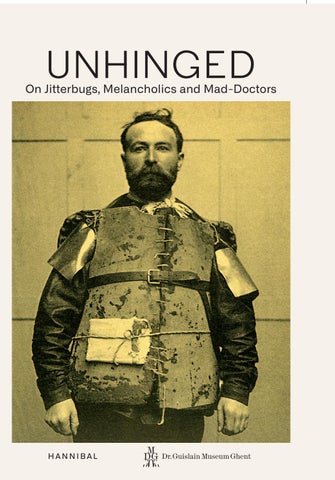
Madness is what disturbs us, throws us off balance and leads us to the edge of normality. But where does the norm end and chaos begin? And who decides where that boundary lies?
On Jitterbugs, Melancholics and Mad-Doctors
On Jitterbugs, Melancholics and Mad-Doctors
Unhinged tells the story of fools, madmen and the insane, but it also emphasises the importance of psychological well-being in an increasingly complex society. In five themes, the Dr. Guislain Museum dissects that ‘other’ that both disturbs and fascinates us. For a long time, ‘abnormal’ behaviour was locked up in imposing institutions, but today psychological care reaches far beyond those walls. This publication draws attention to the evolution and influence of power relations in psychiatry, and seeks to get a grip on the many labels that are both a help and a hindrance. It questions the di chotomy between body and mind, and shows how imagination brings insight and makes the unspeakable visible. Instead of burying psychiatry in history, the Dr. Guislain Museum renders mental health pressingly topical.
Unhinged is brave, open, rigorous, and beautiful. This exhibition of diverse images and the illuminating essays in its catalogue take on the urgent questions in psychiatry’s past that remain urgent questions in psychiatry’s present. What does it mean to be mentally ill? How is it different from being physically ill? How do the spaces of a building serve or hinder the needs of patients? How can art penetrate the mysteries of psychiatric suffering and offer therapeutic benefits? And how can we understand the continually shifting categories of diagnosis that have framed our understanding of madness then and now? See it. Read about it. It will make you think, feel, and wonder. Siri Hustvedt
www.hannibalpublishing.com
9 789463 8 87229
On Jitterbugs, Melancholics and Mad-Doctors
In five essays, this richly illustrated book, based on the collection presentation of the same name, explores the boundaries of the traditional and looks for the sense in madness. Andrew Scull wrote the foreword.
Andrew Scull
THE D R. GUISLAIN MUSEUM: AN APPRECIATION Foreword
The asylum once seemed to be one of the most enduring symbols of civilisation’s determination to isolate and hide away the men tally ill. Though it proclaimed itself a therapeutic institution, its public image was more as the Bluebeard’s cupboard of the neigh bourhood, a Gothic castle behind whose high walls and barred windows, a nameless horror lurked. Its inmates were shut up in every sense of the term, lost from public view, their utterances dis missed as the ravings of Unreason, their lives at the mercy of those who presumed to act in their name. Stigma, shame and scandal have persistently shadowed madness, and our struggles to under stand alienation, to deal compassionately with those who suffer from it, and to conjure up effective responses to its ravages and depredations, continue unabated in the present. We now live in the twilight of the asylum age. The once-familiar ‘museums’ of madness that haunted the imagination of our forebears are fast-fading from our collective consciousness. A few have been repurposed, albeit with strenuous efforts to mask their past history — as housing for the nouveaux riches, for example, London’s Colney Hatch Asylum transformed into the Princess Park Manor development; or as va cation spots for the moneyed classes, doubtless blissfully unaware that they are occupying what was once Venice’s madhouse for women now repurposed as a luxury hotel on San Clemente Island, whose owners boast with no sense of irony that it is ‘the perfect destination to unwind in total relaxation’. Most mental hospitals, however, have fallen into disrepair, a sad collection of neglected hulks slowly suffering the fate that awaits us all: ‘dust thou art, and unto dust thou shall return’, as the Book of Genesis would have it. It is thus singularly appropriate that what I regard as the world’s leading psychiatry museum, the Dr. Guislain Museum, should be housed in the walls of a nineteenth-century asylum. Museums of psychiatry, rather like medical museums, are a rare species these days. Medical museums were once very common.
A N A P P R E C I AT I O N — 7
They existed in the first instance, not so much to entertain and educate hoi polloi, but rather as collections of clinical curiosities that illustrated the prominence and success of their owners, and that were useful in instructing neophyte physicians. They were a fundamental part of the nineteenth-century medical student’s education, allowing the comparison of healthy and diseased anatomical specimens. Medicine moved on from the anatomicalpathological era, and only a handful of such establishments now survive, such as the Mutter Museum in Philadelphia and the Hunterian Museum housed by the Royal College of Surgeons in London. By contrast, remarkably few museums of psychiatry have ever existed. And oddly, one of the most famous such establishments is an anti-psychiatry museum, set up in Hollywood by the cult of Scientology, its message captured in its very name: Psychiatry — An Industry of Death Museum. Colonial Williamsburg in Virginia, that Disneyfied recreation of early American history, contains a recreation of the Bedlam that opened its doors there in 1773, and the original Bedlam, Bethlem Hospital in London, recently opened a small museum curating artefacts from its long history. The Freud Museums in London and Vienna are, as their name implies, pri marily of interest to those focused on the history of psychoanalysis. In another more specialised vein, the Prinzhorn Collection in Heidelberg, Germany, houses a remarkable collection of artwork created by the mentally ill and assembled by Hans Prinzhorn (a collection that was somehow preserved from the Nazis who sought to destroy it); and Jean Dubuffet’s later compendium of art brut (a term he coined) is now on exhibit in Lausanne, Switzerland. None of these establishments compare, however, in ambition, in size, in range, or in importance to the Dr. Guislain Museum, the most comprehensive establishment of its type known to me. The museum is housed in Belgium’s oldest asylum, planned as early as 1824, but not opening its doors until 1857. Those who built the nineteenth-century asylum system initially conceived of these institutions as curative spaces, a new social geography of madness quite literally providing asylum or respite from the bewildering pressures of the world outside. On entering the museum, one is therefore at once made aware of how, even a few generations ago, Western societies opted to respond to mental disturbance. To enter the grounds and the wards of one of these establishments is to walk into a now-forgotten world. To imagine oneself confined in
8 — FOREWORD
Illustrations from: Friedrich Anton Mesmer, Mesmerismus, oder, System der Wechselwirkungen: Theorie und Anwendung des thierischen Magnetismus als die allgemeine Heilkunde zur Erhaltung des Menschen, 1814, Berlin. Dr. Guislain Museum, Ghent
72 — B O D Y A N D M I N D
Phrenological organs, from: M’Phun’s Catechism of Phrenology, 1852, Glasgow. Dr. Guislain Museum, Ghent
According to Viennese doctor Franz Joseph Gall (1758–1828), the inner person could be read from the ‘bumps’ on their head. Gall made a chart of the brain localising these bumps in order to ascertain a person’s characteristics. A strongly developed trait was thought to be expressed as a bulge in the skull, whereas less developed traits could not be felt. Gall considered the skulls of geniuses and the mentally ill interesting study material because he thought that they presented the most pronounced characteristics. Phrenology became highly influential in the Western world and employers even used phrenologists to vet candidates for jobs.
H U M O U R S , M A G N E T I S M A N D P E R C E P T R O N I U M — 73
neurology. Despite the fact that phrenology is a pseudoscience, the popular and accessible translation of the much older physiognomy has left its mark. The names Paul Broca and Carl Wernicke are still connected to two areas of the brain that are linked to speech and language understanding, respectively. T H E S TA R T O F P S Y C H I AT R Y
Before he was appointed chief physician of the Hôpital de la Salpêtrière in 1795, Philippe Pinel believed in mesmerism and animal magnetism, and he was also no stranger to phrenology. It was only later that his personal mission changed. Whereas some of Pinel’s earliest articles described case histories in terms of temper aments and humours, his interest would slowly shift to the English ‘moral treatment’, and he applied himself to the passions. In con trast to his earlier physiological approach, he began to approach madness in moral terms. Pinel’s translation of William Cullen’s work was of great im portance to the development of his own theories. Cullen was a doctor from Edinburgh who undertook the first serious attempt to classify syndromes. He is still known today for his categorisation of neurosis, a group of complaints that can be distinguished from what was known as ‘delirium’. Cullen placed all sorts of illnesses in the group which we would not want to lump together today (such as tetanus, epilepsy, apoplexy, diabetes and hysteria). Delirium was, for Cullen, a ‘false judgement (...) commonly producing disproportionate emotions’. Madness was a sort of delirium, an ‘impairment of the mind’, which, given the connection between mind and body, must be traceable to a ‘state of the bodily part’. We see a return to old ideas. Even with Cullen there is something intangible in the mind-body problem. He talked of ‘nervous power’, a very fine, subtle and active fluid that was present in people ‘in a way that we do not clearly understand’. A lack of clarity remains, and it seems that scientists dare not make statements about what has been known for centuries as spiritual, religious or even divine: the soul or the mind. But what is the difference between the soul and the mind? Was there a difference? And can that ‘discovered’ mind also be responsible for what Pinel attempted with his moral treatment? These questions remain as yet unanswered. People did not give up their centu ries-old proclivity for spirituality just like that, but looked for a new soul and spiritual nature in, for example, romanticism.
74 — B O D Y A N D M I N D
G U I S L A I N A S D I P L O M AT
The early days of institutional psychiatry were saturated with humourism. The treatments advised by doctors remained very traditional: ‘The brain was always affected, sometimes by an infec tion or by the pressure of blood, so bloodletting, cold compresses and causing blisters were always necessary. Hot baths were recom mended for nerves and an eye had to be kept on various organs such as the stomach, the bowels and, don’t forget, the sexual organs’ (van den Bosch, 2018). The great about-turn came with the moral treatment. As well as physical causes, the mental aspect began to gain ground and in this historical period, nationality began to play a great role. English classical physiognomic psychia try was not based on the same characteristics as the French, where observation and descriptions in fine detail occurred. German psy chiatry was also completely different, with so-called ‘Somatiker’ and ‘Psychiker’ directly opposing each other. Those two approaches to psychiatry would only unite in a sense in the idea of the unitary psychosis. Because it had not been possible to get a grip on every manifestation of psychiatric syndromes, the idea arose that although there were various symptoms, it was still one illness. This is where Joseph Guislain enters the story. If we consider psychiatry from the perspective of nationalities as stated above, we recognise a typically Belgian compromise in Guislain’s approach. Guislain probably does not need much introduction in a book like this for a museum like ours, but he is more than the architect of a building, the name of a museum or a historical figure who became famous as the Belgian Pinel. Guislain’s life and work developed in various ways. First of all, there is, of course, the building; secondly, his importance in the introduction of legislation; and thirdly, his role as a thinker and academic. The latter is often neglected because of theoretical difficulties, but the fact that he introduced the moral treatment is not unimportant. Guislain was a master in combining theory and practice. Together with Canon Peter Joseph Triest, he drew up internal rules, a tool in the application of the moral treatment that should not be underestimated. Triest had great faith in the chief physician. The rules left nothing to chance: the doctor was of prime importance in the recovery of the patient, and the success or failure of the moral treatment depended on his authority. In order to make the ap proach possible, Guislain developed an ingenious theory that combined the most important European psychiatric schools: the
H U M O U R S , M A G N E T I S M A N D P E R C E P T R O N I U M — 75
Surprise bath as shock therapy, engraving from: Joseph Guislain, Traité sur l’aliénation mentale et sur les hospices des aliénés, 1876, Amsterdam. Dr. Guislain Museum, Ghent According to Joseph Guislain (1797–1860), causing sudden anxiety could have a positive therapeutic effect. Shock therapies usually involved water: cold showers, a ‘shower bath’ or
76 — B O D Y A N D M I N D
a ‘surprise bath’. ‘The device consists of a small Chinese temple’, wrote Guislain, ‘in which the interior contains a moveable iron cage whose own weight causes it to sink in water. One leads the mad person into this house: a helper closes the door on the outside while another operates a lever so that the sick person is immersed in the water. Once the treatment has been carried out, the contraption is lifted up again.’
French clinical approach of Pinel and Esquirol, with the radical organisational approach of the German ‘Somatiker’. ‘Wise is the doctor who knows the passions.’ It was with this maxim that Guislain embraced Pinel and Esquirol’s approach. Moral causes were more important than physical ones, and, of the moral causes, the passions were the most important. In a subtle way, Guislain connected the moral issue with the organisational approach of phrenology. In contrast to Gall’s theory, mental illness, according to the psychiatrist from Ghent, could not necessarily be blamed on an injury to the brain, but could just as well be caused by moral problems. The brain was the seat of mental illness, but not necessarily the cause. Guislain did not deny Gall’s biological view, but allowed space for the moral causes which were currently dominant in French psychiatry. According to Guislain, a strong stimulus could lead to the experience of pain. Stimuli were the moral cause of pain. In a certain sense we can read this as a ‘traumatic experience’, a way of thinking heavily reminiscent of Freud. The consequence of that pain experience was an excessive sensibility of the nervous system, so that all subsequent stimuli could be experienced as equally painful. The pain of the mind was central to Guislain because the reaction was of a psychological nature. The term he coined was phrenopathy, which literally means: the suffering of the mind. Guislain is often considered an important forerunner of the psy chological approach in psychiatry because of this given: mental illness as a psychological reaction. FROM NEURONS TO PERCEPTRONIUM
When psychiatry started, theories took off. In less than two centuries, a great deal of work was done at an increased pace to unravel the mysteries of the human body. It is telling that the most famous doctor and psychologist of the twentieth century, Sigmund Freud, evolved in his own career from physiologist to psycho analyst. Freud wrote in his early days about psychic energy and traumas in a way that was heavily influenced by his biological introduction to his career. All sorts of insights followed in relation to the way that the nervous system, neurotransmitters and hormo nal regulation worked. It is almost impossible to keep track of the evolution. Belgian research at the Psychiatrisch Ziekenhuis Duffel (Duffel Psychiatric Hospital) has very recently shown that certain bacteria play a role in depression. It seems like history is repeating
H U M O U R S , M A G N E T I S M A N D P E R C E P T R O N I U M — 77
Mathew Kneebone, Curse of the Walking Techbane, from the series Mechanical Systems Drawing, 2016, IBM Electrographic and graphite pencil on paper. Dr. Guislain Museum, Ghent
In the nineteenth century, spiritualists believed in the link between magnetic fields and the ‘life force’. According to them, the human body generated an invisible magnetic field, also known as an aura, which had an effect on the emotional and spiritual state of a person. The Techbanes of today believe that an overactive power in their body causes interference to the magnetic field. A walk outside can make a street light fail or cause a car radio to tune to another frequency. The work of Mathew Kneebone (b. 1982) investigates how we relate to technological innovation.
78 — B O D Y A N D M I N D
itself because, according to Pinel and Esquirol, the digestive sys tem holds the cause of psychiatric syndromes. The influence of contemporary physics appeals even more to the imagination. That the human brain is as great a mystery as the universe is a witticism, but research projects like BRAIN are attempting to map every neural network in the brain, just as tele scopes from NASA are searching for unknown terrain in the darker reaches of space — and since quantum mechanics, nothing sur prises us any more. It has not only taught us that the very smallest subatomic particle has an effect on huge heavenly bodies, but that humankind floats around between them somewhere as well. In the same way, astrophysicist Max Tegmark is also trying his luck at deciphering that extraordinary characteristic which we ascribe to our mind. He argues that there may be a substance like perceptronium, the material missing link in order to understand our con sciousness. That dark matter, the homunculus of astrophysics, has been proven to really exist means that it is not implausible that the human mind and consciousness can be found in a small substance. For the time being, however, no sufferer of depression has bene fited from someone looking at the bacteria in his or her intestines, and the existence of perceptronium can probably offer more solace to someone in the middle of a psychotic episode as a delusion than as a reality. Since the advent of modern times, the concept of madness has changed completely. The indivisibility of the mind has been ban ished to the realm of fiction for good. The mind can fragment, disintegrate and dissociate, and within that context the concept of schizophrenia arose. The mind can suddenly break open, so that mental products can exist independently of each other and become realities in themselves. They are gaining more and more interest in hallucinations and delusions, and the search for an explanation soon leads the patient to external influences. This looks very much like how psychiatry has occupied itself with the causes of madness through the centuries. Someone who is struggling with a psychosis uses delusion to transform thoughts into voices. Or the influence of ideas via television and computers into objective rays against which he or she must protect him- or herself. The subjective changes into what is objectively perceptible, the mental seems too unfathomable and changes again into something physical. Psychiatry also tries to find the causes of psychological realities in something biological, and vice versa.
H U M O U R S , M A G N E T I S M A N D P E R C E P T R O N I U M — 79
Abb. 145. Gruppe von schizophrenen Endzuständen (Group in end-stage schizophrenia), from: Oswald Bumke, Lehrbuch der Geisteskrankheiten, 1929, Munich. Dr. Guislain Museum, Ghent 192 — C L A S S I F I C AT I O N
The caption with this group portrait — Abb. 145. Gruppe von schizofrenen Endzuständen — from the textbook by German psychiatrist Oswald Bumke (1877–1950) demonstrates objectification: he describes his subjects not as women but as ‘stages of schizophrenia’, and not as patients but
as a disease profile. There are 11 women sitting and standing in a line, centred in the image. The natural light falling into the room casts shadows on their faces and sober clothing. The harmonic composition suggests that it has been staged, testifying to a strong photographic and aesthetic quality.
Ten women are looking away, gazing at the floor or their hands, or have their eyes closed. One woman refuses to avert her gaze, looking straight into the lens. The focus is on the gaze, uneasy rather than scientific or classifying, both for the women in the portrait and the viewer today. C L A S S I F I C AT I O N — 193
This book has been published to accompany the exhibition Unhinged. On Jitterbugs, Melancholics and Mad-Doctors at the Dr. Guislain Museum in Ghent from 12 October 2019 onwards. Foreword: Andrew Scull Texts: Patrick Allegaert, Arnout De Cleene, Yoon Hee Lamot, Bart Marius, Sarah Van Bouchaute, Eline Van de Voorde Translations: Lode Demetter (Ape-Translations.be) Text and image editing: Patrick Allegaert, Annemie Cailliau, Alexander Couckhuyt, Arnout De Cleene, Yoon Hee Lamot, Bart Marius, Sarah Van Bouchaute, Eline Van de Voorde Photography: Marcel Köppen (pp. 150, 155, 238) Guido Suykens (pp. 26, 34, 51, 52–53, 69, 88, 89, 90, 91, 97, 131, 135, 137, 140–141, 151, 168, 171, 178, 186–187, 210, 213, 250) Cover: Cuirasse protectrice en cauotchouc portée par un aliéné persécuté, from: Nouvelle Iconographie de la Salpêtrière, volume 8, 1895, Paris. Dr. Guislain Museum, Ghent Backcover: Paul Regnard, Attitudes passionnelles, photograph of Augustine Gleizes, from: Iconographie photographique de la Salpêtrière, volume 2, 1877–1878, Paris. Dr. Guislain Museum, Ghent Study of the brain by Professor André Dewulf, twentieth century, brain slices. Dr. Guislain Museum, Ghent
Design: Dooreman
Exhibition concept and composition: Patrick Allegaert, Arnout De Cleene, Yoon Hee Lamot, Bart Marius, Sarah Van Bouchaute Exhibition design: Johan De Wit Exhibition collaborators: Patrick Allegaert, Annemie Cailliau, Alexander Couckhuyt, Arnout De Cleene, Nico Deuninck, Henk Dewaele, Yoon Hee Lamot, Lieven Leurs, Bart Marius, Annemie Sneijers, Kristine Timperman, Sarah Van Bouchaute, Eline Van de Voorde, Saïdya Vanhooren, Luckas Vervaeke The staff of the Dr. Guislain Museum: Isay Aldinov, Fatima Ammi, Linda Arts, Fatiha Asghir, Rachid Azdoud, Kristof Baetens, Patrick Bertrand, Wim Blancquaert, Frederik Bourguillioen, Lidwine De Buck, Rudi De Graaf, Jeannine D’Hondt, Erwina D’Hoore, Karina De Weirdt, Serkan Eryuce, Wim Herregodts, Arzu Karaca, Boris Kotiev, Martin Lauwers, Ilkay Mektepli, Maurice Michiels, Ilse Milants, Kristine Praet, Marcel Roos, Frank Snoeck, Anne-Marie Spanoghe, Caroline Speeckaert, Geoffrey Staelens, Sybille Van den Berghe, Dieter Vanden Bossche, Geert Van Pol, Hendrik Van Wordragen, Guido Verschaeren, Judith Verween, Hatice Yagmur ISBN 978 94 6388 722 9 D/2019/11922/29 NUR 895 © Hannibal Publishing, 2019 www.hannibalpublishing.be Hannibal Publishing is part of Cannibal Publishing
All rights reserved. No part of this publication may be reproduced or transmitted in any form or by any means, electronic or mechanical, including photocopy, recording or any other information storage and retrieval system, without prior permission in writing from the publisher.
Copy-editing: Patrick Lennon Project coordination for Hannibal: Pascale Goossens
With the support of the Flemish Government
Structural sponsors
Printing: die Keure, Bruges, Belgium Binding: Abbringh, Groningen, the Netherlands
256