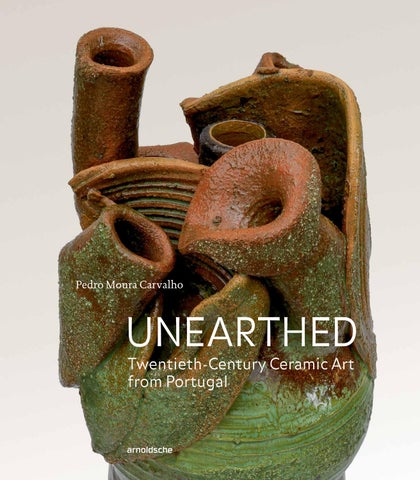
Pedro Moura Carvalho
UNEARTHED
978 -3 - 8979 0 - 636 -5
9 783897 906365
Twentieth-Century Ceramic Art from Portugal
In a country known for its lively azulejos (tiles) and clay crafts, local studio pottery in Portugal has remained practically unknown, yet throughout the last century, a considerable number of potters and visual artists—from Portugal as well as Germany, Hungary, Brazil, and Mozambique, among other countries—have created an original corpus of work. Based on what is probably the most comprehensive collection of local ceramic art, this publication discusses with greater detail thirty potters’ work and is illustrated with almost 300 ceramics. It covers the entire twentieth century, but gives particular emphasis to the 1950s and 1960s, when there was a boom in interest for the discipline and when both state and private patrons commissioned significant artworks. This is the first seminal study of such an eclectic production, aiming to become a standard reference for the general public, collectors and museum curators.
Pedro Moura Carvalho
UNEARTHED Twentieth-Century Ceramic Art from Portugal
CONTENTS
AC K N O W L E D G EM EN T S Such a comprehensive survey was only possible thanks to the time and generosity of many friends, colleagues, artists and a number of institutions. Special thanks go to ceramicists Martins Alves, Armando Dinis, Natália Frias, Marcelino Gordillo, Maria M anuela Madureira, Júlio Pomar, Pedro Cabrita Reis, José Santa-Bárbara, Bela Silva and Mário Ferreira da Silva for sharing their views in stimulating discussions. I am also indebted to Margarida Araújo, Teresa Balté, Ana Maria Bica (CENCAL), João Alpuim Botelho and Pedro Bebiano Braga (Museu Bordalo Pinheiro), Nuno Cardoso, Bárbara Coutinho (MUDE – Museu do Design e da Moda – Francisco Capelo Collection), Pedro Cunha, José Costa Duarte, Pedro Faro, João Maria Ferreira, Jorge Figueiredo F erreira, Luísa Ferreira, João Figueiredo, Joaquim Guardão, Suzana Barros Lapa (Centro de Estudos Querubim Lapa), António Afonso Lima, Francisco Marcos Manzano, Sílvia Massa, Sara Antónia Matos (Atelier-Museu Júlio Pomar), Jorge Mealha, Duarte M. E. S. Melo (Museu Carlos Machado), António Miranda, Filipe de Meirelles Moita (Ritz Hotel), Miguel Cabral de Moncada (Cabral Moncada Leilões), Beatrice Müller, Alexandre Nobre Pais (Museu N acional do Azulejo), Maria José Palla, Ana P içarra, Martinho Almada Pimentel, Tiago Pinto, Alberto Possiedi, Joana Beato Ribeiro, João Pinto Ribeiro and Sebastião Pinto Ribeiro (Palácio do Correio Velho), Richard Riss (Fonds Delaunay), Mário Roque, Alexandre Sargento (Museu do Neo-Realismo), Conceição Serôdio (Museu de Cerâmica de Sacavém), Jorge Silva, António Jorge Silva, Alice Stilwell, João Malhadas Teixeira, José Madeira Ventura, and Isabel Xavier (Centro de Estudos e Documentação de Cerâmica Contemporânea Caldense Ferreira da S ilva), as well as Biblioteca de Arte e Arquivos – F.C.G., Fundação Júlio Pomar and private collectors who wish to remain anonymous. I would like to thank the enthusiastic arnoldsche team, namely Greta Garle, Silke Nalbach, Wendy Brouwer and Dirk Allgaier – who from the very first moment realised the potential of my proposal – for their enormous patience and creative collaboration. I am deeply grateful to Victor dos Reis for graciously accepting the challenge to write about this “discreet” field, to my parents, to João Lucena e Vale for all the encouragement and to Hugo Pinheiro da Silva and Rita Gomes Ferrão for the many passionate conversations about yet another discovery. Finally, a very special word of gratitude goes to Ceramica-Stiftung (Basel) and to Jorge Welsh and Luísa Vinhais of Jorge Welsh Research & Publishing (Lisbon/London), whose vision and generosity allowed the publication of this book.
Acknowledgements Foreword Introduction
4 9 16
CHAPTER ONE
FROM NATURALISM TO THE ASCENDENCY OF ART DECO (1895–1932) Caldas da Rainha: the leading ceramic centre in Portugal Manuel Cipriano Gomes, known as Mafra: the original innovator Rafael Bordalo Pinheiro: from brilliant artist to “simply a labourer” The 2nd Viscount of Sacavém and the Austrian Joseph Füller Gustavo Bordalo Pinheiro: a more than capable “follower” Costa Mota Sobrinho: the cosmopolitan sculptor
All efforts were made to ascertain each ceramic manufacturer, though some remain unidentified. Height precedes length (or diameter), which precedes depth. All measurements are in centimetres. On the cover: Bottle by Luís Ferreira da Silva, c. 1968, SECLA, Caldas da Rainha, 40 × 14, PMCC, inv. no. A481, see p. 269, cat. 159 On the backcover: Vase by Jorge Vieira, 1952, Joaquim Duarte & Filhos, Lda., Lisbon (?), 29 × 19 × 30, A209, see p. 200, cat. 43; Knot vase by Costa Mota Sobrinho, 1912, Fábrica de Faianças das Caldas da Rainha, 20.5 × 34 × 16.5, A521, see p. 173, cat. 6; Sculpture by Mário Ferreira da Silva, 2000, 29.5 × 15.5 × 10, A349, see p. 307, cat. 210
This English and the also published Portuguese edition (À Roda: Cerâmica de Autor em Portugal no Século XX) have been produced with the generous support of the CERAMICA-Stiftung Basel and Jorge Welsh, Research & Publishing, London / Lisbon.
23 24 25 26 30 31 33
Art Nouveau in Portugal: a tiled affair
35
Raul Lino and the (almost) total work of art
37
Neo-Manueline and other revivalisms
40
Art Deco triumphs; the example of Vista Alegre
41
Foreign docents in Portugal: Leopoldo Battistini and the smaller potteries
44
Three international sculptors and ceramic designers
46 47 49 50
Canto da Maya at Boulogne-sur-Seine Donald Gilbert: an Englishman at Sacavém João da Silva at Vista Alegre and Rosenthal
CHAPTER T WO
STUDIO POTTERY REVIVAL (1933–1949)
53
António Ferro and the secretariat for propaganda and culture of Estado Novo
54 57 59
The Política do Espírito, or Politics of the Soul Italy as a source of inspiration
The rebirth of studio pottery and its two pioneers Jorge Barradas: baroque and decorative Hein Semke: “too modern and too austere”
From small potteries to ceramic schools Clay handicrafts and figurado from Barcelos: their impact The whimsical world of Rosa Ramalho, Ana Baraça and Mistério Visual artists and traditional potteries
60 61 65 69 69 70 73
14
2 __ António Pedro, Amazon-acrobat (rear view), c. 1952 (cat. 37)
among many other things. Some of his pieces in the collection, dating from 1952 (or close to this date), are some of the few testimonies in Portugal to what we could call “three-dimensional Surrealism” or, at least, a possible path towards it. In the case of Amazon- acrobat, the relationship with his pictorial work is evident and unavoidable (fig. 2). Albeit with a very different personality and work, the other revelation is the already mentioned Victor Palla, author with Costa Martins (1922–1996) of the extraordinary photography book Lisboa, Cidade Triste e Alegre (Lisbon, sad and happy city), first published in Lisbon in 1959. For Palla, ceramics seems to have constituted a place of experimentation, as irresistible as all the others through which his imagination and creativity led him. The “discovery” of these fired clay creations of his provides a broader understanding not only of the varied creative path of the author but also of how, in 1950s and 1960s Portugal, this cult of creative freedom meant an obvious conflict, intellectually at least, with the political, social and cultural dictatorship which had been ruling the country since the early 1930s. Finally, there is no doubt that the Pedro Moura Carvalho Collection allows for the inclusion in the broader history of Portuguese artistic creation of an 4
I would like to thank Pedro Moura Carvalho for the full access to his collection as well as for sharing information which proved to be fundamental for the present text.
15
author whose career is almost entirely built on ceramics – and not on painting, sculpture, architecture or photography, although at the beginning of his career he also devoted himself to iron sculpture, hammered copper and engraving. This artist is Luís Ferreira da Silva (1928–2016). His work – which is almost totally unknown outside the specific field of ceramics and the region of Caldas da Rainha – reveals plastic qualities which make it as central to ceramics as, in general, to artistic creation in Portugal in the second half of the twentieth century (fig. 3). In their formally telluric and chromatically refined nature, his pieces from the 1960s, which we are now getting to know better, live in that field of fertile ambiguity between form and function, representation and abstraction, monochrome and polychrome, two and three-dimensional, small and large, and sometimes take on an unexpected monumentality. This is one of those rare cases in which the author, being only a ceramicist, is above all a complete artist. Someone whose exceptional creativity is revealed in earthenware and stoneware and, in this way, produces in us a double awareness: the awareness that we are seeing and touching pieces made of ceramic and, at the same time, that we are discovering something which is, after all, much more than fired and glazed clay. Isn’t this, after all, one of the happiest experiences of a collector? 4
3 __ Luís Ferreira da Silva, Sculptural form, 1964 (cat. 136), in the exhibition Design at São Bento: Traits of Portuguese Culture, at the Prime Minister’s Official Residence, Lisbon, 2021.Courtesy: © MUDE 2020 / Luísa Ferreira
16
IN T RODUC T ION
With a few exceptions, twentieth-century applied arts are traditionally neglected in Portugal. Interestingly enough, three of such exceptions are in the field of ceramics: glazed tiles, clay crafts and wares from Caldas da Rainha, a city located about a hundred kilometres north of Lisbon, are subjects that are well studied and published. The opposite is true on what concerns studio pottery, yet from the mid-1940s, the field attracted a growing number of gifted ceramicists and many of the most important Portuguese visual artists. Still, it remained practically unstudied. A number of reasons explain the interest in the three noted exceptions, elucidating, at least partially, the disregard for the subject of this book. Among these is the fact that, in Portugal, tiles are considered to be a national art. This justifies the existence of the Museu Nacional do Azulejo (national tile museum), though a long overdue national ceramics museum has yet to be established. Such attention to tiles is entirely justifiable, for these square pieces of flat cer amic are ubiquitous in the country. Decorated manu ally or industrially, tiles animate the façades of unpretentious buildings while reflecting sunlight and thus conferring movement and colour to local streets. They have become part of the Portuguese landscape, lending character to the exterior but also to the interiors of secular and religious buildings since the Renaissance. Tiles were also employed by artists, mainly painters, as a form of inexpensive and lasting canvas, and they continue to be, though some other artists also understand the full potential of such a field to continuously push established boundaries. These boundaries in turn have attracted scholars’ attention to this particular art form. Since a number of books on twentieth-century tiles have been published, they are only discussed here when highly pertinent. Portuguese exceptionalism in the field of ceramics is also revealed by the deep enthusiasm that locals,
1 __ King Consort (Ferdinand II of Portugal showing his own ceramics) by Rafael Bordalo Pinheiro, in Álbum das Glórias (Lisbon, vol. I, no. 12, November 1880).
Ferdinand II (1816–1885), who, in 1870, made him Supplier of the Royal Household. This German prince of the Houses of Saxe-Coburg-Gotha married Queen Maria II of Portugal (r. 1826–1828 and 1834– 1853) and became a major arts patron, known as the Artist King (fig. 1). The Pena Palace, in Sintra, the earliest royal palace planned under the influence of Romanticism, was the grandest of his many artistic projects and where many of his rather accomplished drawings and ceramics are kept. The latter were fired at Mafra’s pottery at Caldas, small factories such as Constância and the industrial manufacturer Fábrica de Loiça de Sacavém (F.L. Sacavém), near Lisbon. The king’s interest in ceramics is further witnessed in his sponsoring of studio pottery by the Bohemian Wenceslau Cifka (1811–1883), his “art adviser” and one of the many foreigners who contributed to the development of the field in Portugal. Ferdinand II’s keen eye for pottery was well known, for in 1880 he was portrayed by one of the greatest Portuguese cer amicists, Rafael Bordalo Pinheiro (1846–1905), holding a dish and seated next to a pot almost certainly painted by himself.
Bordalo Pinheiro is a unique case, since well over a century after his death, his models are still being reproduced and exported. Moreover, his name overlays all other ceramicists of the so-called Caldas school. A number of factors contributed to this, including his larger-than-life personality. Trying to classify his ceramic production is complex, since Bordalo Pinheiro was unusually eclectic, irreverent and bold, both in technical and aesthetic terms. Most of all, he was daring, creating highly original work in a variety of styles, from Renaissance, Baroque, Naturalism, Art Nouveau, Japonisme and Neo-Mudéjar, among others. As early as 1916, a small museum dedicated to his work opened in Lisbon, where, to this day, many of his ceramics and other works are displayed, including those by his son, Gustavo (1867–1920), who adopted, albeit in a rather subtle fashion, some artistic conventions of Art Nouveau and Art Deco. Despite the difficult political and financial situation in the period that followed the establishment in Portugal of the Republican regime, in 1910, Gustavo and the family’s factory managed to survive. One of the characteristics of local studio pottery is that more often than not it is difficult to date with precision. The proverbial conservatism of the Portuguese is partially responsible but does not fully explain it. As one would expect, throughout the twentieth century, many ceramicists were influenced by a number of artistic movements, yet styles and fashions pass and only on very few occasions were they adopted with vehemence. Costa Mota Sobrinho (1877–1956), a sculptor who, after studying in Paris, worked at Caldas in a different factory, was one of the few who created, albeit during a brief period, a more consistent corpus of Art Nouveau ceramics. Among these is the highly original Knot vase, from 1912, of which only six are known, including two in this collection (cats 5, 6). Thrown with two triangular handles ending in simple knots, the vase is both complex and simple, capturing the fluidity of lines that characterizes such artistic movement. Their glazes, however, reveal influences of various regions. One, in electric iridescent blue, reflects contempor ary trends in countries such as Austria and Hungary, but the other, in green, seems to be a rare attempt to reproduce in the country some of extraordinary
17
Introduction
Context and background
including authors and art historians, devote to clay crafts. The most notable creations fall within figurado, a category that includes small clay figurines reproducing both human and animal shapes, which originally were humble toys intended for less privileged children. Modelled and painted by hand, in modest potteries across the country, such figurines were initially made with leftover clay and fired in the little spaces left vacant when firing utilitarian wares. Such toys were sold at fairs, along with glazed and unglazed terracotta bowls, jars and related crockery, to bring some extra income into what were destitute households in small and isolated villages. Because of their intrinsic quality, originality and humour, by the 1950s they caught the attention of cultured artists and art galleries and eventually acquired urban admirers. Doe (cat. 158) by Rosa Ramalho (1888– 1977), for instance, became a classic. Rendered as pregnant, it also serves as a toothpick holder and has a striking resemblance to its counterpart by Pablo Picasso (1881–1973), made at Vallauris in 1950. By then, Ramalho was 62 years old and had been making such figures for decades. Of note is the fact that figurado has also influenced local artists and ceramicists, who often worked in traditional potteries. Other than tiles and clay crafts, the third category of ceramics that deserves considerable attention are wares from Caldas, as the city is often abbreviated. It was there that in the late nineteenth century and the early decades of the last century, a number of potteries and small factories transformed what was then a quiet village into the most important centre for cer amic art in the country. Many such wares were exhibited in world fairs and are part of the collections of major museums, including The Metropolitan Museum of Art, New York, and the Victoria and Albert Museum, London. The earliest innovator there was a potter who would become known simply as Mafra (1929–2005), the name of the village where he was born. Originally, he took inspiration from local, British and French wares, notably those made after models by Bernard Palissy (1510–1589), the Renaissance French master, yet he also designed novel and more attractive forms adding new glaze colours and, for the first time in the region, marked his wares with his own name. Mafra’s work captured the attention of King Consort
24
2 3
For more about its origins, see Dias and Machado, A Cerâmica, pp. 13–35. Queirós, Cerâmica Portuguesa, p. 141. Ibid., p. 143. This and other quotes in Portuguese have been translated by the author unless otherwise stated.
At the end of the nineteenth century, a series of ama teurs moved to what was then the small town of C aldas da Rainha. With considerable imagination and some financial resources, but also thanks to the local potters’ know-how and excellence in and with materials, they became renowned ceramicists in just a few years. Although the so-called louça das Caldas, or wares from Caldas, from earlier periods had deserved specialists’ attention, much ambiguity persists on their origins and various developmental stages. Archaeological evidence revealed that fine utilitarian crockery, of varied types, was being made there from at least the sixteenth century. 1 The earlier productions, however, are beyond the scope of this book. Many uncertainties remain, including about the role that the somehow perplexing figure of Maria dos Cacos, active from c. 1820 to 1853, played on its later development, since almost nothing is known about this pioneering woman. 2 As one would expect, long before the arrival of such amateurs, local potters had been making qual ity wares characterized by their fine forms and proportions, and glazed mostly in green and honey colours, which by then were already being sold across the country. As in many other ceramic centres in this period, much of this production, namely of ewers, bowls, bottles, vases and suchlike, was essentially anonymous and utilitarian. For better or for worse, louça das Caldas is at present synonymous with Rafael Bordalo Pinheiro, the artist who brought them greater fame. In Portugal, this carries so much weight that some of the most extraordinary work made by the first great renovator of Caldas wares, the above-mentioned Mafra, is often believed to be by Bordalo Pinheiro himself. Moreover, the latter’s name almost erased other praiseworthy names. Some were included by José Queirós (1856–1920) in his reference work Cerâmica Portuguesa (Portu-
guese ceramic), first published in 1907, assessing that at that time “fourteen factories were active in that village [Caldas da Rainha], employing a staff of three hundred workers, including men, women and children”.3 Among these was one founded by José Francisco de Sousa (1835–1907), in 1860, and a further was established by Avelino António Soares Belo (1872–1927), in 1899. Others would follow, some of which were more specialized. Among the various ceramicists working at Caldas who created a more consistent corpus of original work was Francisco Elias (1869–1937). He first worked under Rafael but from 1916 established his own pottery. He and some of his family members cultivated mainly the mini ature genre and made, mostly, religious images, both regional and historical types. One of them, Eduardo Mafra Elias (1880–1949), was also interested in literary personalities, such as Ramalho Ortigão (1836– 1915), a writer and art historian who wrote about local ceramics. His full-length portrait (fig. 1.1) is only 7.5 centimetres tall, enough to fully capture the writer’s pose and personality. Thanks to the efforts of the local Museu da Cerâmica (museum of ceramics) and some authors, the work
1.1 __ Eduardo Mafra Elias, Miniature of Ramalho Ortigão, 1920–1940, Caldas da Rainha, clay, moulded and modelled, 7.5 × 1.8 × 1.7, inv. no. A296
25
From Naturalism to the Ascendency of Art Deco
1
Caldas da Rainha: the leading ceramic centre in Portugal
1.2 __ Mafra, Fish with reptiles and butterfly, 1853–1870, Caldas da Rainha, earthenware, moulded and modelled, 15.5 × 60 × 22, João Maria Ferreira Collection, inv. no. CJMF_506, Caldas da Rainha. Courtesy: Margarida Araújo; João Maria Ferreira Collection
of some of these factories has been reasonably studied and published in catalogues that accompany exhibitions organized by that same museum. Other than the aforementioned work, that of Rafael’s son, of the 2nd Viscount of Sacavém (1863–1928) and of Costa Mota Sobrinho are just some that deserve particular attention.
Manuel Cipriano Gomes, known as Mafra (1829–1905): the original innovator Manuel Cipriano became known as “Mafra”, for this was the name of the village, not far from Lisbon, where he was born. The location is celebrated mostly for its vast eighteenth-century royal palace and convent, but also for the utilitarian crockery still being made in its neighbourhoods, namely at Sobreiro. Following Mafra’s arrival in Caldas da Rainha, in 1853, the process of transforming a production eminently utilitarian into something that incorporated artistic trends began soon after. After taking over Maria dos Cacos’s pottery, he accelerated its modernization process. The production of typical vessels was never interrupted, yet new utilitarian wares were introduced, the palette of colours was expanded and greater emphasis was put
on their decoration, which often included elements in relief. Some of the inspiration came from the English company Minton, Hollins & Co., one of the most renowned British factories during the Victorian period, but also from France, where wares by the Renaissance potter Bernard Palissy were fashionable at the time and imitated across the country. CharlesJean Avisseau (1796–1861) and Joseph Landais (1800– 1883), who became established in the city of Tours, and Victor Barbizet (c. 1805–c. 1870), who was working in Paris, are among the ceramicists who designed wares inspired by Palissy’s. It was their work, more common and widespread than the original sixteenth-century wares, that inspired Mafra, yet he did not simply copy foreign models but rather introduced many innovations. His animals, for example, are more realistic when compared to their French counterparts. They often rest in so-called musgado grounds, reminiscent of real moss (musgo in Portuguese), obtained through the passage of fresh and therefore more malleable clay through a sieve. 4 Such highly textured effects were mainly employed on trays and plates. Quite extraordinary is a further category of rather surreal ceramics indebted to the compositions of Giuseppe Arcimboldo (1527–1593), the Italian painter known for his human-inspired portraits composed exclusively with fruits, vegetables, flowers, fish or other animals. From these, Mafra reproduced in three-dimensions and in real-life size, reptiles and insects, which were applied to emphasize the forms of, mainly, fish, creating compositions
4
For more information on this technique see Fernandes and Rebelo, “Modos de fazer”, p. 143.
62
63
Studio Pottery Revival
2.5 __ Two views of Jorge Barradas’s second exhibition of his ceramic work, held in 1948 at S.N.I., Lisbon, where the Old shepherd (cat. 22) is on display in the more prominent area. Photograph: Col. Estúdio Mário Novais, FCG – Biblioteca de Arte e Arquivos
ornaments and of clear Surrealist flavour appears in profile. That same year, 1950, Barradas admitted that he liked to “work smiling”, 42 which explains, at least partially, why his ceramic production is, in general terms, characterized by graceful and decorative solutions. Among the many artworks which bear witness to such a predisposition are several heads of women, some of which have fruits and flowers semi-hidden in their hair, and two tall figures of women. The latter (fig. 2.6) were made in 1959 for the Estufa Fria Garden in Lisbon and now stand at the entrance of Pimenta Palace, the main branch of the Museu de Lisboa. 43 Both are almost two metres high, which is per se an achievement anywhere, something that Barradas acknowledged in his inscriptions on both sculptures stating that he “invented” them. He also collaborated in many important projects promoted by the regime, including in the above-men tioned international exhibitions and a number of prominent buildings of the period. In the capital, he authored ceramic panels in the Humanities Faculty (1957) of the University of Lisbon, the Institute for Hygiene and Tropical Medicine (1958) and the National Library (1963). A large ceramic panel for the main library (1955) of the University of Coimbra, the façade (1956, destroyed) of the Portuguese tourism office in Paris, a fountain and panels of tiles (1959) at the former Portuguese embassy in Rio de Janeiro, and tile panels (1967) for the house of the governor of the Bank of Angola, Luanda, are some of his many works. He also collaborated with architects in the development of numerous projects for both private institutions and clients, many of which have large dimensions. 44 The Catholic Church was among his main clients, as works still in situ indicate. Among these are panels in Sant’Eugenio Basilica (1950), Rome, the Chapel of Our Lady of Piedade (1950) in Cova da Piedade, the Seminary of Olivais (1950) in Lisbon, the Church of Our Lady of Fatima (1952) in Parede, and the Church of São João de Deus (1952) in Lisbon. Although his illustrations, paintings, ceramics and glass are frequently selected to be part of temporary exhibitions in public museums and private institutions, Barradas has yet to have a much-deserved retrospective exhibition. This is probably due to two
2.6 __ Jorge Barradas, Autumn, 1959, Viúva Lamego, ceramic, modelled, 285 × 94 (with base), Museu de Lisboa (Pimenta Palace), inv. no. MC.CER.0335, Lisbon
factors: his close connection to the previous regime, and also the “whims” that Macedo alluded to. He was a fruitful artist. This is seen not only in his capacity for work but also in his compositions, which from the mid-century became crowded. As highlighted on several occasions, his painting style influenced his ceramic work, with the excesses and superfluous elements of the former having been transmitted to the latter. 45 The horror vacui that characterizes much of his painting in the 1950s and 1960s is also seen in his ceramics, including in a reference work, such as the extensive panel (1950) for the lobby of a bank headquarters in Porto. 46 There, to the excesses of the narrative he added an excessive number of details, volumes and decorative fantasies in three dimensions. The same is true for the nine tile panels that he created for the ceiling of the open gallery of the same building. He was, above all, a decorator and colourist who ignored artistic trends and movements, insisting on formulas linked to the picturesque and favouring regional themes.
42 See Rodrigues, Jorge Barradas, p. 11. 43 Identified as allegories of Autumn and Summer; Museu de Lisboa, inv. nos MC.CER.0335, MC. CER.0336, Lisbon. 44 For the corpus of his ceramic work, see Rodrigues, Jorge Barradas, pp. 205–214. 45 Meco, “Jorge Barradas”, p. 12. 46 The Banco Português do Atlântico, which has been absorbed by Banco Comercial Português, another bank. For illustrations, see Rodrigues, Jorge Barradas, pp. 88–89.
126
attractive unsigned ceramics (figs 3.31, 3.32), including a Bird jug, the author of which also remains un identified; its form, however, suggests that it was designed by someone with experience, possibly Araújo Soares, who is the probable author of some of the larger pieces such as a thrown and engraved cachepot also made in stoneware (cat. 42). Studio pottery from Campos & Filhos is not that common, yet an excellent selection is on permanent display in the former Meadela factory, acquired in 1999 by the Fábrica da Louça Regional de Viana do Castelo, where a small and informal museum is open to the public.
196 See Pedro, “Autobiografia”.
António Pedro (1909–1966): Surrealist ceramics and the “conquest of the impossible” Experimentalist, pioneer, entrepreneur and multifaceted are some of the terms that define the short but rather prolific life of António Pedro. To these one could add a permanent restlessness that led him to evolve among his many literary, commercial and art istic endeavours. The “conquest of the impossible”, as he himself stated, in a revealing autobiographical text dated 1955, was a further goal of his. 196 He was a poet, writer, journalist, critic, magazine director, owner of an art gallery, translator, essayist, theatre director, and a broadcaster at the B.B.C. He made “decorations, illustrations, lithographic prints, scen
3.28 __ António Araújo Soares’s sketches of ceramics, 1955 (on display in Museu da Fábrica da Louça Regional de Viana do Castelo). Lamp base, c. 1955, Campos & Filhos, Aveiro, stoneware, moulded, 27 × 11, inv. no. A581
3.29 __ António Pedro, Modern cockerels, early 1950s, Campos & Filhos, Meadela, ceramic, moulded, 15 × 10 × 9.5, inv. nos A189A, A189B
ography, costumes and advertising” as well as “painting, sculpture, drawings and ceramics”. Although in the recent past many facets of his work received a great deal of attention, the ceramics to which he dedicated no more than half a dozen years continues to be neglected by both researchers and museums. This is not completely surprising since, in terms of numbers, his production was rather limited and many items are extremely fragile, which also contributed to their vanishing. Pedro was born in Cabo Verde, then under Portuguese rule, in an environment “of bourgeois and well-thinking people” who were never very pleased by his professional choices. These would take him to attend courses in law and literature, classes at the University of Sorbonne, Paris, and to live in Lisbon, Coimbra, London, Brazil, Moledo, Porto and, of course, in his West African country of birth and the French capital. As a child, he studied at the Jesuit Institute Nun’Alvres, in La Guardia, in the Spanish region of Galicia. By 1930, already married and following an initial phase focusing on writing poetry, he developed interest in the world of visual arts. In that same year, he organized with Diogo de Macedo the first salon of the so-called Independentes, and two years later he founded the UP Gallery, in Chiado. This was a small but multifaceted space, designed by architect Jorge Segurado (1898–1990), the façade of which announced, in elegant lettering, that it was also a
127
Unprecedented Flair
3.27 __ António Araújo Soares, Giraffe jug, 1957, Campos & Filhos, Meadela, ceramic, moulded, 40 × 14, Hugo Pinheiro da Silva collection, Porto. The same jug on the cover of a catalogue of an exhibition of Fernanda and Araújo Soares’s ceramics in 1958, on display in Museu da Fábrica da Louça Regional de Viana do Castelo.
t obacconist, a bookstore, a printer’s, where decorative objects were sold, and, more importantly, an art gallery, regarded as the first in Lisbon. There, works of art competed with bookshelves and decorative objects, including industrial Deco ceramics by Goldscheider, as illustrated by contemporary photographs. In 1935, Pedro organized what became the first exhibition of the painter Vieira da Silva and Árpád S zenès (1897–1985), her husband, in Lisbon.197 At some point, Tom became a partner, who kept it open until 1936. His career as a visual artist began relatively late, for he became a painter about 1934. A year later, he created what is today considered the earliest Portuguese art object, the Metaphysical apparatus of meditation, today at the Museu Nacional de Arte Contemporânea do Chiado.198 Soon after, he moved to Paris, where in 1936 he subscribed to the Manifeste Dimensioniste alongside artists such as Marcel Duchamp (1887– 1968), Ben Nicholson (1894–1982), Alexander Calder (1898–1976), Francis Picabia (1879–1953), Miró and Sonia and Robert Delaunay, among others. In doing so, these artists affirmed their willingness to capture new dimensions that the development in sciences enabled and to transcend the old barriers imposed on the arts. Among the former was the theory of relativity by Albert Einstein (1879–1955), as well as other concepts of reality. Subsequent to this, he returned to Lisbon, to explore the fundamentals of Surrealism and participate in a series of group exhibitions, including one in 1940 with António Dacosta (1914– 1990) and the English sculptor Pamela Boden (1905–1981). This exhibition became a trailblazer, since it was apparently the first time that Surrealist
3.30 __ Fernanda Araújo Soares, vase, c. 1955, Campos & Filhos, Meadela, ceramic, thrown, 21 × 23, Hugo Pinheiro da Silva collection, Porto
197 Exposição Maria Helena Vieira da Silva, Szenes. 198 Museu Nacional de Arte Contemporânea do Chiado, inv. no. 2380, Lisbon.
150
Established ceramicists and their regained vitality In any case, a number of what were already well-established ceramicists continued to develop their careers in the 1970s and 1980s, as they reached more mature phases. Among these are Manuela Madureira, who, following an important exhibition at the Diário de Notícias Gallery (cats 163, 164) in 1969, founded new stimulus in mediums such as metal, wood and stone, and in the design of medals. Queru bim Lapa, on the other hand, authored in the mid1980s a series of wall sculptures, each formed by a number of sections or plaques. One of these, from c. 1987, in a private collection, is remarkable for its impressive array of delicate variations of blue and brown glazes, which attest to his mastery of the entire glazing and firing processes during this period (fig. 4.2).15 With the series Narcissus’s seven mirrors,
4.3 __ Júlio Resende, Ascension of Jesus and Via Sacra (detail), 1987, ceramic, modelled, 210 × 122 (figure), Church of Our Lady of Boavista, Porto
1993, in Suzana Barros Lapa’s collection, Lapa demonstrated yet again his extraordinary technical skills, imagination and visual culture, which was often influenced by the arts from the Far East. During this period, he often worked with metallic oxides, resulting in iridescent types of lustre, which he used in masks entitled Oracles and in relief tiles with which he created tile panels. Júlio Resende made only a small number of three- dimensional ceramics, including during his time in Alentejo and again in the 1980s, as illustrated in the exhibition catalogue of his ceramic production at the
Museu Nacional do Azulejo, in 1998. 16 From the beginning of that decade, possibly from 1980, is Sculpture with female face (cat. 180), while in 1987 he authored an Ascension of Jesus and a Via Sacra for the Church of Our Lady of Boavista, in Porto (fig. 4.3). As noted, in more recent periods Luís Ferreira da Silva focused on a number of public works, which contributed to greater acknowledgment of his name, not only in the city of Caldas da Rainha but also within circles of ceramic enthusiasts across the country. The late 1980s were nevertheless a period of great activity as the tondo Portrait of girl (cat. 201) from 1987 and the impressive King Luís I (fig. 4.4), an almost life-size sculpture of the Portuguese monarch (r. 1861–1889), from two years later attest. At CENCAL, where he taught, Ferreira da Silva also made many multiples, namely a series of cribs and a range of more commercial vases decorated with the initials of his name treated in a rather abstract fashion. 17 At a later stage, he created a further tondo, carved with what appears to be his own self-portrait (fig. 4.5) formed by the stylized initials of his surname. Dating from about 1990 is a series of sculptures entitled after the Greek goddess of love and pleasure, Aphrodite, which in 1991 was exhibited in various cities, including Lisbon.18 These erotic sculptures are in many ways a tribute to the female body and reveal that he was still able to radically change his style. Cecília de Sousa obtained major recognition in 2004 when the Museu Nacional do Azulejo organ-
4.5 __ Luís Ferreira da Silva, Self-portrait (tondo), c. 2005, CENCAL, Caldas da Rainha, ceramic, moulded, 2 × 52, inv. no. A373
13 Museu Nacional de Arte Contemporânea do Chiado, inv. nos 2341, 2342, 2343, 2344, 2345, 2346, Lisbon. 14 Museu Nacional de Arte Contemporânea do Chiado, inv. no. 1674, Lisbon. 15 For a further sculpture of this same series, see Xavier, Bienal Internacional de Óbidos, p. 97.
4.2 __ Querubim Lapa, panel in seven sections, c. 1987, ceramic, moulded and modelled, 75 × 81 × 9.5, private collection, Ílhavo
151
4.4 __ Luís Ferreira da Silva, King Luís I, 1989, CENCAL, ceramic, modelled, CENCAL collection, Caldas da Rainha
ized a retrospective exhibition of her work dating from the mid-1950s to the year of the show. In 1968, she moved to Angola, where she continued to make ceramics, but in 1974 returned to Portugal just before the independence of the African country. In the following decade, Cecília de Sousa focused on larger surfaces and Abstractionism, painting tile panels and relatively large plaques such as one from 1987 (cat. 200). In the late 1990s, she developed new research on materials, pigments and firing techniques, culminating in a solo show at Valbom Gallery, in L isbon, in 2010, a rare occasion in which an art gallery devoted in this period, time and space to a ceramicist’s work. The exhibition revealed a new facet, since her ceramics, made in highly textured stoneware, became more sculptural and conceptual. Some have more mundane dimensions (cat. 209), but the majority are large and intended for outdoors. The latter recall totems, are built in large blocks and are unglazed and stained with pigments, such as those installed in 1997, at Olivais Sul, in Lisbon (fig. 4.6). During this period, two other long-term well-established ceramicists, Artur José and Mário Ferreira da Silva, acquired a refreshed verve, developing greater consistency. Both have created a considerable corpus of original and distinct work, which is also accomplished in technical terms. Their careers followed different paths, yet they have some points in
Challenging Times for Studio Pottery
which includes a small group of unusual ceramics. Among these is a notable group by Jorge Vieira, including six abstract terracottas from the late 1940s, 13 and a glazed Maternity from 1956 by sculptor Fernando Fernandes.14
16 For some of his three-dimensional ceramics, see Henriques, Júlio Resende, pp. 26, 45–47, cat. nos 9, 25–27. 17 PMCC, inv. nos CE65, A550. 18 At Y Grego Gallery, Lisbon. See Chaves, Ferreira da Silva, pp. 5, 7.
182
183
Twentieth-Century Ceramic Art from Portugal
18 DONALD GILBERT (designer), Monkey, c. 1935, Fábrica de Loiça de Sacavém, model 191, ceramic, moulded, 23 × 21 × 11, T65
19 HENRIQUE CONSTÂNCIO , Polar bear, 1938, Fábrica Sant’Anna, Lisbon, earthenware, moulded, 21 × 32.5 × 12, A398
20 DONALD GILBERT (designer), bowl, c. 1935, Fábrica de Loiça de Sacavém, model 259, ceramic, moulded, 17.5 × 42 × 21, T80
188
189
Twentieth-Century Ceramic Art from Portugal
26 VIC TOR PALL A , aquamanile Bull, c. 1950, earthenware, modelled, 16 × 23 × 8, A336
27 VIC TOR PALL A , Centaur, c. 1950, earthenware, modelled, 20 × 24.5 × 15, A620
28 VIC TOR PALL A , jug, 1949, earthenware, modelled, 32 × 15 × 22, A619
188
189
Twentieth-Century Ceramic Art from Portugal
26 VIC TOR PALL A , aquamanile Bull, c. 1950, earthenware, modelled, 16 × 23 × 8, A336
27 VIC TOR PALL A , Centaur, c. 1950, earthenware, modelled, 20 × 24.5 × 15, A620
28 VIC TOR PALL A , jug, 1949, earthenware, modelled, 32 × 15 × 22, A619
196
197
Twentieth-Century Ceramic Art from Portugal
37 ANTÓNIO PEDRO , Amazon-acrobat, c. 1952, Oficina de Moledo, ceramic, moulded, 28 × 23 × 14, A192
38 ANTÓNIO PEDRO , jar, 1952, Oficina de Moledo, ceramic, moulded: 11 × 12, A181
39 ANTÓNIO PEDRO , jar, c. 1952, Oficina de Moledo, ceramic, moulded: 12 × 13.5, A602
258
259
Twentieth-Century Ceramic Art from Portugal
135 LUÍS FERREIRA DA SILVA , lamp base, 1964, SECLA, Caldas da Rainha, ceramic, thrown and modelled, 37 × 25 × 22, A594
134 LUÍS FERREIRA DA SILVA , lamp base, c. 1965, SECLA, Caldas da Rainha, ceramic, thrown, 41 × 33, A410
136 LUÍS FERREIRA DA SILVA , Sculptural form, 1964, SECLA, Caldas da Rainha, ceramic, thrown and modelled, 87 × 56 × 16, A529 (courtesy: Palácio Correio Velho)
262
263
Twentieth-Century Ceramic Art from Portugal
140 LUÍS FERREIRA DA SILVA , large dish, c. 1965, SECLA, Caldas da Rainha, ceramic, thrown, 8 × 47, A243
139 LUÍS FERREIRA DA SILVA , Eve/Adam vase, 1966, SECLA, Caldas da Rainha, ceramic, thrown and modelled, 65 × 42 × 28, A344
262
263
Twentieth-Century Ceramic Art from Portugal
140 LUÍS FERREIRA DA SILVA , large dish, c. 1965, SECLA, Caldas da Rainha, ceramic, thrown, 8 × 47, A243
139 LUÍS FERREIRA DA SILVA , Eve/Adam vase, 1966, SECLA, Caldas da Rainha, ceramic, thrown and modelled, 65 × 42 × 28, A344
268
269
Twentieth-Century Ceramic Art from Portugal
148 LUÍS FERREIRA DA SILVA , bowl, c. 1965, SECLA, Caldas da Rainha, ceramic, thrown, 22 × 26, A174
149 LUÍS FERREIRA DA SILVA , bottle, c. 1968, SECLA, Caldas da Rainha, ceramic, thrown
and modelled, 40 × 14, A481
268
269
Twentieth-Century Ceramic Art from Portugal
148 LUÍS FERREIRA DA SILVA , bowl, c. 1965, SECLA, Caldas da Rainha, ceramic, thrown, 22 × 26, A174
149 LUÍS FERREIRA DA SILVA , bottle, c. 1968, SECLA, Caldas da Rainha, ceramic, thrown
and modelled, 40 × 14, A481
288
289
Twentieth-Century Ceramic Art from Portugal
178 MÁRIO FERREIRA DA SILVA , Biblical space II, 1975, Fábrica Cerâmica do Fojo, Vila Nova de Gaia, stoneware, modelled, 107 × 59 × 13, A218
179 MÁRIO FERREIRA DA SILVA , sculpture, 1981, stoneware, modelled (and iron and wood), 82 × 83 × 20, A130
288
289
Twentieth-Century Ceramic Art from Portugal
178 MÁRIO FERREIRA DA SILVA , Biblical space II, 1975, Fábrica Cerâmica do Fojo, Vila Nova de Gaia, stoneware, modelled, 107 × 59 × 13, A218
179 MÁRIO FERREIRA DA SILVA , sculpture, 1981, stoneware, modelled (and iron and wood), 82 × 83 × 20, A130
328
© 2021 the author and arnoldsche Art Publishers, Stuttgart All rights reserved. No part of this work may be reproduced or used in any form or by any means (graphic, electronic or mechanical, including photocopying or information storage and retrieval systems) without written permission from the copyright holders. www.arnoldsche.com
AUTHOR
Pedro Moura Carvalho ARNOLDSCHE PROJEC T MANAGEMENT
Greta Garle COPY EDITING
Wendy Brouwer, Stuttgart, Germany GR APHIC DESIGN
Silke Nalbach, nalbach typografik, Mannheim, Germany LITHOGR APHY
Schwabenrepro, Fellbach, Germany PAPER
150 g/m2 Gardamatt PRINTED AND BOUND BY
GPS Group, Velden, Austria Bibliographic information published by the Deutsche Nationalbibliothek The Deutsche Nationalbibliothek lists this publication in the Deutsche Nationalbibliografie; detailed bibliographic data are available on the Internet at www.dnb.de ISBN 978-3-89790-636-5 Made in Europe, 2021 PHOTO CREDITS
Pedro Moura Carvalho, unless otherwise acknowledged in the text