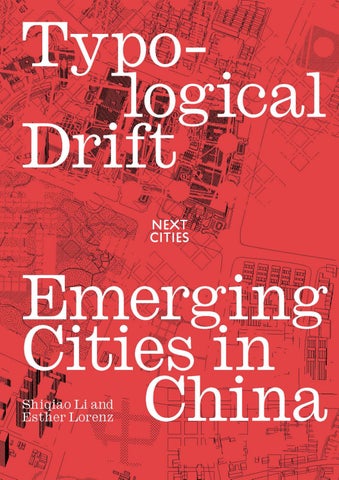
Typological Drift NEXT CITIES
Emerging Cities in China Shiqiao Li and Esther Lorenz
Contents
viii x
Foreword Acknowledgments
2 4 8
Introduction Drift of City Types Drift Triggers
Drift Trigger One: Ten Thousand Things
28 64 82
Yiwu: Postmodern Sublime Xintang: Stitching the Global Casual Gurao: The Underworld of Underwear
22
Drift Trigger Two: Figuration
104 122 140 168 186 222
Thames Town: The Lives of Others Minmetals Hallstatt: Gaming the Real Estate Hengdian: The Production of Time CIPEA: Avant-garde as Superfluous Things Lujiazui: The Added Value of Elevation Nanhui New City: The Oversized Circle
98
Drift Trigger Three: Group Action
242 258 278
Jiepai New Village: Harvesting Group Enlargement Huaxi Village: The Rural Chinese Dream Guangzhou University City: Spatializing the Group Intellect
292
The Architectural Profession
298
TJAD: Reinventing Professional Practice
236
SECTION NAME
vi
PROJECT NAME
vii
viii
Foreword Made (Only) in China With an urban population surpassing 800 million, our next global cities are enormously impacted by Chinese urbanization, currently outpacing, by at least three times, the rate of European and American urbanization following the industrial revolution. As China’s urban dwellers have increased from being less than 20% of the population in 1980 to over 60% today, we need to understand not only the catalytic political and economic reforms prompting this massive migration from rural to urban territories, but also the conditions leading to the specific form that the city has taken through this high-speed evolution. While many scholars have focused on China’s globalization, its participation in world trade, and the influence of importing and exporting goods and expertise across the East-West divide, Typological Drift is unique in its exploration of the impact of Chinese culture on the development of a distinct set of urban typologies specific only to this region. Two critical moves set the trajectory for Shiqiao Li’s and Esther Lorenz’s book. The first, is to illuminate China’s response, often presented as a globalized urbanism with undue influence from the West, from within Chinese culture—its value-laden conceptual underpinnings, language system, and social structures—rather than from without. The second, is to consider the evolution of this response through a biological rather than urban model. The authors ingeniously draw upon the concept of genetic drift, the way in which chance events can drive unanticipated evolutionary patterns in species through the changing frequency of distinct hereditary characteristics as these occur through populations over time. Genetic drift as applied to the formation of cities can be responsible for suppressing certain urban phenotypes so that they disappear entirely, while enabling other, perhaps more rare urban configurations to emerge. The documentation of these configurations and the cultural conditions that engender their formation—referred to as “drift triggers”— are the primary focus of this book. At first glance, the three drift triggers that organize this work—ten thousand things, figuration, and group action—seem to have an affinity with Borges’s rendition of a certain Chinese encyclopedia, used by Foucault in The Order of Things to expose the limited logics of
ix
Western taxonomies. The concept of “ten thousand things” makes evident not only how a non-metric idea of quantity becomes a generator of urban quality in the profusion of goods and activities in the world marketplace of Yiwu, but also how the immanence of things, the irreducibility of their figuration, and their material manifestation in the world—conditions intrinsic to Chinese culture and language—operate in direct opposition to the model of transcendence dominating Western thought since Plato. Yiwu’s overwhelming display of commodities is an embodiment of the excesses of global consumer capitalism localized within a single international trade city, where architecture is reduced to an organizing device, an infinite series of hidden micro-frames overflowing with an abundance of objects—from clothing and cameras to car parts—made in specialized Chinese manufacturing cities. Within China, this massive capital-driven enterprise extends to the scale of the city. Global tourist destinations recreated as full-scale urban replicas figure the city itself as a miniaturization of other worlds peddled as exotic commodities in their own right. Whether as reconstructed historic sites drawn from China or abroad—scenographic backdrops generated for filmmaking or real life—or fashioned as a collection of contemporary avant-garde architectural artifacts such as the 100 villas by 100 architects for a Mongolian desert, this multi-scaled catalog of things populating the Chinese landscape undermines Western distinctions by enabling the authentic and fantastic, the past and future, and the vastly different scales and geographies of the handheld object and the city to occupy the same tableaux, all in defiance of occidental logics and their laws of language and geometry. Although perhaps a far cry from the Celestial Emporium described by Borges, the originality of thought organizing this book combined with its extensive grounding in historical research and contemporary empirical analysis, provide us with a truly unique lens through which to think about the material and social systems driving our economies, and the highly nuanced relationship between an evolving culture and its burgeoning cities, constituting a distinctive form of urbanism that, despite all claims to the contrary, should be understood to be made only in China. Ila Berman, Next Cities series editor Dean and Edward E. Elson Professor University of Virginia School of Architecture
x
Acknowledgments This book is nourished by the generosity of institutions and people that in one unique way—stemming from the book’s broad mix of history and theory with extensive field trips and workshops over a period of a decade—embodies the heartening spirit of public scholarship in the area of constructed environment. We are deeply grateful for the help we received, and we hope the resulting book will justify the good faith in the production of knowledge so selflessly demonstrated by institutions, colleagues, students, and the general public. The care at the School of Architecture, University of Virginia, is multifaceted and nurturing, all the more so for a topic that is so distant from the urban realities of Charlottesville. Dean Ila Berman not only brought the book to the ambitious Next Cities series, but also sponsored the production of the book with generous funds. This book is supported by a grant from the East Asia Center of the University of Virginia through its director Dorothy Wong. We are deeply indebted to the unfailing support from the Weedon Foundation; Mary Pollock, Luke Pollock, and Tom Romer have injected a great sense of value to our research through support for the Weedon Professorship in Asian Architecture, the School’s summer program in China, and for the exhibitions, lectures, and symposia associated with this research. Justin O’Jack, the endlessly resourceful director of the Shanghai Office of the University of Virginia, has given our research and teaching a foot in the territory in Shanghai. Handel Lee’s love for cutting-edge architectural and urban research is manifested in his substantial support for the Weedon Professorship. Yunsheng Huang’s foundational endeavor to establish a link with China, since 1993, is instrumental to the School’s tradition of research in Chinese architecture. The librarians and technologists at the University of Virginia have guided us masterfully as we tread apprehensively in the world of complex possessions of data: GIS specialist of the Scholar’s Lab Chris Gist, architectural librarian Rebecca Coleman, East Asia librarian Wei Wang, multimedia teaching and learning librarian Josh Thorud, and library counsel Brandon Butler. At the germination of the project—in the form of research projects on China’s “super practices” (architectural Design Institutes) and “central business districts”—was the support from the Research Grant
xi
Council of the government of Hong Kong, the institutional support from the School of Architecture, The Chinese University of Hong Kong, and the collaboration of colleagues and students. Wang Ying rendered great assistance in background research and logistics. Nelson Chen, Doreen Heng Liu, Gordon Matthews, and Hendrik Tieben continued to share their insights into the makeup of the Chinese city. Colleagues at the School of Architecture, Southeast University, Li Hua, Ge Ming, and Chen Wei have in the past 15 years offered an infrastructure of research without which this book would not have been possible. These included international conferences on indigenous ideas of Asia, the planning of adventurous expeditions to parts of China rarely visited by urban researchers, and everything in between. It was their meticulous care for the intellectual and physical wellbeing—from heated discussions in air-tight conference rooms to elegant tea gatherings in beautiful gardens—that have sustained the research and teaching that ground the content of this book. At the School of Architecture, South China University of Technology, Peng Changxin, whose connection with the University of Virginia was cemented with a year-long visiting scholar position, has hosted us and our students in Guangzhou with a generosity beyond words. It is from this research base at the School of Architecture in Guangzhou that we launched our various research trips in the surrounding Pearl River Delta areas. At the School of Architecture, Hunan University, Wei Chunyu welcomed us with the open joy of a literatus; Lu Jiansong and Jiang Min gave us a memorable occasion, through a design workshop and field trips on the theme of the new Chinese village, to understand Chinese urbanization outside the two major delta areas of the Pearl River and the Yangtze River. Closer to China’s urban realities, it was the frontline leaders of design in architectural offices who gave us invaluable access and insight into the Chinese city: as a leading designer and thinker in contemporary Chinese architecture, Liu Xiaodu (Urbanus) has shared deep knowledge and firsthand experience of the complex realities of urbanization with us for over a decade. Liu Yichun (Atelier Deshaus) gave us thoughtful presentations explaining the cultural meanings behind his architecture. Wang Shu (Amateur Architecture Studio) moved us with his architecture and his delightful conversation. Philip Yuan (Archi-Union) illuminated our thoughts through an infectious radiance he brings to research and
TYPOLOGICAL DRIFT: EMERGING CITIES IN CHINA
xii
design. Over the years we have learned a great deal from many others to whom we are genuinely grateful: Zhang Ke (Standardarchitecture), Gary Chang (Edge Design), Bernard Lim (AD+RG), Humphrey Wong (Meta4), Eunice Seng, Koon Wee, and Darren Zhou (Skew Collaborative), Jasmine Tsoi and Chris Lai (DOffice), Rocco Yim and William Tam (Rocco Design Architects), Han Baoshan (Suzhou Institute of Architectural Design), Zhang Hua (Shanghai Xiandai Architectural Design Group), Liu Erming, Mao Xiaobing, Tongji Architectural Design Group (TJAD), Gensler Shanghai, and KPF Shanghai. Students are engines of research; in 2015 and 2016 when our teaching in China was dedicated to the research on emerging city typologies in China, the participating students made an immense contribution to the book’s theme. In 2015, students from the University of Virginia: Di Chen, Ismaelia Dejoie, Tamara Dennis, Stephanie Granados, Jacqui Kenyon, Xiaoshuo Lei, Yijun Li, Sangyoon Park, Donna Ryu, Seth Salcedo, Michelle Stein, Qintian Wang, Dillon Wilson, Sijia Zhang; students from Southeast University in Nanjing: Zhai Lian, Lu Xi, Chen Yiqian, Liu Yaokun, Jiang Wei, Zhang Yibo, Shao Xingyu, Li Yidan, Liu Xiaodan, Dong Yitong, Wang Jingshu, Wang Ren, Liu Zhaolong, Zhao Yuan, Wu Weiqiao. In 2016, students from University of Virginia: Meredith Blake, John Devine, Scott Getz, Rebecca Good, Meng Huang, Karilyn Johanesen, Boning Luo, McKenzie Rist, Shannon Ruhl; students from Southeast University in Nanjing: Huang Enze, Meng Zheng, Liu Tengxiao, Xing Yifan, Guo Yiwen, Yu Junwang, Ye Zhi, Han Yalan, Wang Qian. Fieldwork is both exciting and at the mercy of circumstances; we are deeply grateful for the guides and drivers who not only took us to where we knew but also where we did not—both have great significance in our research. In Hangzhou, Shi Hongchao organized, often remotely, our complex site visits. In Shanghai, Dijia Chen enabled us to visit many leading architectural offices. In Hangzhou, Wu Yi, aka our “favorite driver,” braved bad weather and dark nights to bring us to all kinds of strange locations with his consummate skill to maneuver his large and immaculately appointed bus. In Shanghai, Yang Hailong at the fabulous Astor House Hotel organized transportation for site visits for many years. In Hengdian, Zhu Teng of Hengdian Group gave us access to parks and film locations that we did not anticipate. Zheng Luting tirelessly explained the intersections between film sets, historical tales, tourism, and life,
ACKNOWLEDGMENTS
and Du Yingkai showed us the nascent real estate market. In Yiwu, trade agent Jack Li helped us navigate the ocean of commodities without which the consequences can be tragic. In Minmetals Hallstatt, Zhu Haoliang patiently showed us all residential unit types and their selling points. In Foshouhu, Nanjing, Li Xinyang explained to us the highlights of cutting-edge art and architecture. In Thames Town, Deng Cheng revealed to us Chinese homes behind British façades. In Huaxi, the Longxi Hotel driver went out of his way to invite us to his home and to show his transition from a farmer to a driver. Our talented team of research assistants have brought the 60 or so drawings to very high standards. Donna Ryu and Meng Huang worked on early drafts of the book. Hutchins Landfair, with creativity, perseverance, commitment, and care, created many of the maps and axonometric drawings often from limited information. Zhou Sicheng contributed through his persistent resourcefulness in visualization. Cheng Chen’s research into the basic data of Chinese urbanization filled several information gaps. Jiawei Chen, Shan Zhu, Xianwen Xu, Zimo Ren, Amelia Lin, and Ted Bazil have helped produce many of the splendid maps and axonometric drawings. Gu Xueping at South China University of Technology provided muchneeded site photography and references. Neil Donnelly, Ben Fehrman-Lee, and Siiri Tännler gave us a privileged view of what a great graphic design looks like, imbuing a deeply appreciated depth to the visual impact of the book. Sneha Patel orchestrated the entire production process amidst all the demanding tasks as the communications director of the School of Architecture. The dedication of Jake Anderson at ORO Editions has greatly facilitated the progress of the book. We are humbled by the collective efforts behind the book, and are invigorated by the documentation and tentative framing of urban realities, with all the vitality of their spatial and formal idiosyncrasies that seem to escape normative urban theory. This book is dedicated to the memory of Li Zhongqian. Shiqiao Li and Esther Lorenz September 2020 Charlottesville
xiii
SECTION NAME
xiv
PROJECT NAME
1
DRIFT TRIGGER ONE: TEN THOUSAND THINGS
94
1
2
3
4
5
Minmetals Hallstatt, scale 1:5,000
MINMETALS HALLSTATT: GAMING THE REAL ESTATE
139
5
6
8
7