35 The Theory of Architecture and the Intuition of the Architect
43 The Truth of Architecture and the Lies of the Architect
57 The Slowness of Architecture and the Speed of the Architect
77 The Face of Architecture and the Mask of the Architect
87 The Nature of Architecture and the Extinction of the Architect
99 The Fall of the Architect
107 True and Not True: The Architecture of Nothing
119 The Consciousness of the Architect
127 The Fencing of Architecture and the Villa of the Architect
137 The Search for the Universal in the Placelessness of the Architect
149 The (de)Evolution of the Public Realm
159 Architecture, Time and Identity
171 Bridges of Lebab
183 Epilogue: Virus without Vaccine
195 Index
202 Image Credits
205 Acknowledgements
207 Prior Publication
Kenneth Frampton Foreword
Written by a leading Australian architect these essays represent a level of critical awareness rarely found within the architectural profession and one would be hard pressed to find another comparable figure in contemporary architectural practice.
It is significant that the first essay in this collection should be devoted to the theme of melancholy, a frame of mind to which architects are particularly prone due to the multiple environmental conditions that confront us at this particular moment in history. As Francis-Jones puts it:
Today is surely not the time for the loud, over-confidence of dominating master architects, those times and what they achieved, good or bad, have passed. The challenges we now face seem to require the pensiveness and sensitivity of melancholy…The melancholy of the architect may be the only true and authentic ‘place’ from which we can begin to work with the vexed conditions of contemporary life. The architect can start here. Perhaps this is the shore from which our projects can be launched.
Written over the last two decades, the essays reflect on the difficulty of practicing architecture in the first quarter of the twenty-first century. To this end they are as much about the aporia of contemporary society as they are addressed to the difficulty of achieving an ethical and liberative environmental culture in our time. With regard to this last, Francis-Jones finds himself opposed to the various ways in which the profession has attempted to establish its legitimacy in an age dominated by the values of techno-scientific instrumentality. These are the various evasive stratagems by which the profession has presented itself over the past half century as it has oscillated between masquerading as a metier akin to applied science or at another moment as a language or yet again as an abstract culture similar to music or eventually as little more than a ‘decorated shed.’ This last would lead the profession to justify itself by way of branding; as being responsible for designing buildings as if they were primarily spectacular pieces of gigantic sculpture.
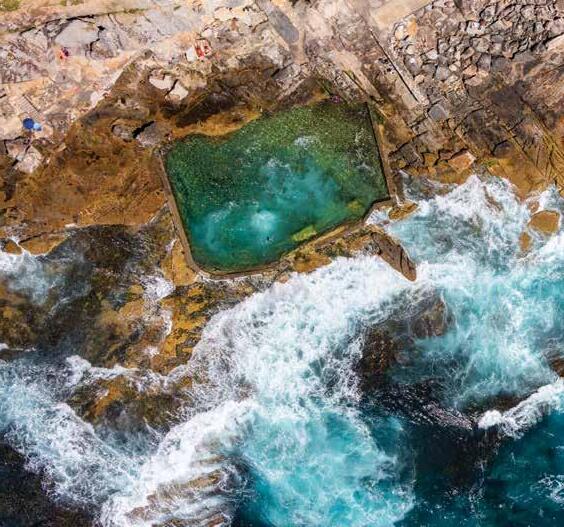
1 Mahon Pool, Maroubra, part of the coastal land south of Sydney for which the Bidjigal and Gadigal people are traditional custodians.
This series of texts was written in Maroubra, a diverse beachside suburb on the south-east coast of Sydney.
The name ‘Maroubra’ may derive from the Dharug word ‘murab-ara’, ‘loud-noise-having’ or ‘like thunder’1 referring perhaps to the loudness of the surf crashing against the rocks which characterise the rugged landscape. It is a beautiful and dramatic meeting of water and land, a long beach and framed by windswept peninsulas. In the rock carvings at the northern headland, there is evidence of the presence of the Muru-ora-dial Aboriginal people, who camped and fished at Maroubra many years ago.
The Bidjigal and Gadigal people are the traditional custodians of this coastal land of Sydney which includes Maroubra, and I acknowledge their custodianship of this land and waters and pay my respects to their Elders past, present and emerging.
Over the last two hundred and thirty years Aboriginal and Torres Strait Islander peoples have been systematically dispossessed, disempowered and marginalised. European occupation and settlement imposed a modern conception of land and animal life purely in instrumental terms of possession, ownership and exploration. Lost has been the concept of custodianship and a human interconnectedness with the land. Deep pre-modern cultural knowledge has been systematically and fatally undermined, overridden, or worse commodified.
An acknowledgement of country represents deference to the deep histories of this place that are beyond our modern understanding. It is an acknowledgement of the injustices and oppression that has been suffered upon First Nations people in Australia. It is an acknowledgement and deference of respect and regret for social, cultural and environmental damage, pain and destruction beyond repair.
1 Jeremy Steele, Morooberra, the person, and Maroubra, the place, Sydney Aboriginal Language Insights <http://naabawinya.blogspot. com/2011/05/morooberra-person-and-maroubra-place.html>, 2011.
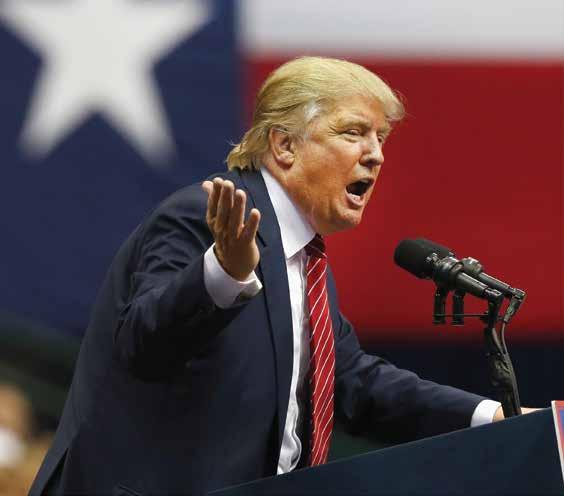
5 Donald Trump at a campaign rally at the American Airlines Centre on September 14, 2015 in Dallas, Texas.
2 According to Oxford Dictionaries, the first time the term post-truth was used was in a 1992 essay by the late Serbian-American playwright Steve Tesich in the Nation magazine. There is evidence of the phrase post-truth being used before Tesich’s article, but apparently with the transparent meaning ‘after the truth was known’, and not with the new implication that truth itself has become irrelevant. The recent expansion in meaning of the prefix “post-”, rather than simply referring to the time after a specified situation or event – as in post-war or post-match”, in post-truth it had taken on the meaning of “belonging to a time in which the specified concept has become unimportant or irrelevant”. The nuance, it said, originated in the mid-20th century, and has been used in formations such as post-national (1945) and post-racial (1971).
Truth and Lies
The concept of ‘truth’ is a perennial and vexed issue for architecture.
Can architecture lay any claim to truth? Can architecture have a moral effect or purpose? Or is architecture indifferent to the intention of its makers and the actions it accommodates?
At this moment, when we are surrounded by so much noise, polarisation, argument and intolerance, questions of fact and accuracy, let alone truth are suppressed, obscured, buried, or most worrying, even irrelevant. We are now living and working as architects in the era of ‘Post-Truth’.
The word Post-Truth was first used in 19922 but it is only in 2016, coincidentally the year of Donald Trump’s election to the US presidency, that it has become commonplace and generally now understood to refer to the shaping of public opinion through emotive appeals to personal beliefs, rather than objective facts. These appeals have been enhanced and amplified through the dominance of social media, which tends to equalise source legitimacy. Volume and frequency of repetition have become key validations over measurable or scientific data. We seek views and opinions that reinforce our own, rather than search for something approaching the truth.
Post-Truth has now become a numbing and exhausting contagion within our political and community ‘discourse’, which for those not located at the extremes, engenders fatigue and apathy further alienating us from any real interest in truth.
Architecture is naturally infected with this bending and distortion of community and cultural discourse. But this is not the only distortion in any conceptual search for truth. Drawing on developments in digital effects in film making and gaming, image production in architecture has become highly advanced and ubiquitous in the consumption and even evaluation of architecture. It is through this digital lens that we now ‘see’ architecture.
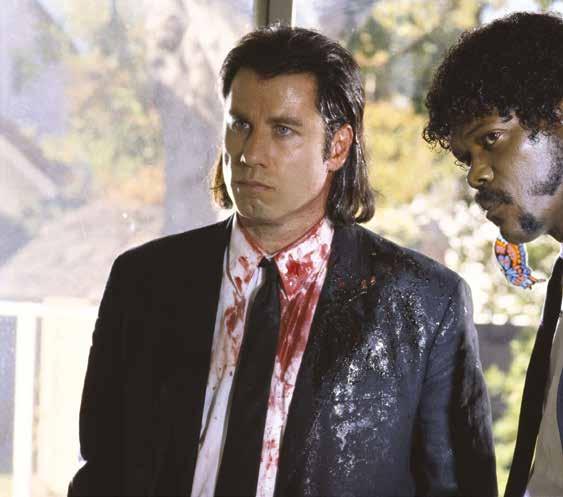
10 John Travolta and Samuel L. Jackson as Vincent Vega and Jules Winnfield in Quentin Tarantino’s Pulp Fiction, 1994.
Quentin Tarantino, the writer and director of two landmark films, Reservoir Dogs and Pulp Fiction, has been acclaimed as one of the most influential filmmakers of our time. Tarantino has detected that speech at speed becomes abstract, a kind of self-referential language game. He presents our conversation as a language game centred around consumerist trivia and product obsession, and illustrates our exceptional ability to say nothing at pedantic length. Interlaced within these flat, continuous, and humorous language games, and seemingly almost more trivial than the content of the conversation, are acts of extreme violence, which disturbingly somehow also seem funny. This distinctive mix of immediacy, consumerist obsession, and extreme violence skillfully interwoven by Tarantino has become a defining expression of contemporary western culture, where our artwork is emptied of all content, stripped of all politics, metaphysics, moral and ethical interest. Tarantino’s films in some ways mirror the conditions and ‘values’ of our contemporary life disconnected from the concreteness of existence, where we are more interested in the price of consumables than questions of being.
The cultural context of our contemporary post-modern crises is an emphasis on the signifier over the signified, and language over being. We have rejected the utopian meta-theories of modernism with its logocentric domination of metaphysics as oppressive ideology, and we seem to have overcome modernity’s existential crisis through simple acquiescence and distraction from our alienation. Alienation no longer bothers us; we accept and indulge in our isolation and separateness. We are suspended within disconnected, universalising zones of consumption and mobility to float above a ground beyond our interest, freed from heaviness, content, and meaning, absorbing ourselves with appearances, immediacy, and image. Only the most extreme acts of transgression, of human violence and environmental vandalism will momentarily disturb us from our abstract floatation.
Our weightless, consumerist, self-absorption is supported through a proliferation of information and communication technology, that breeds an insistence on immediacy and speed.
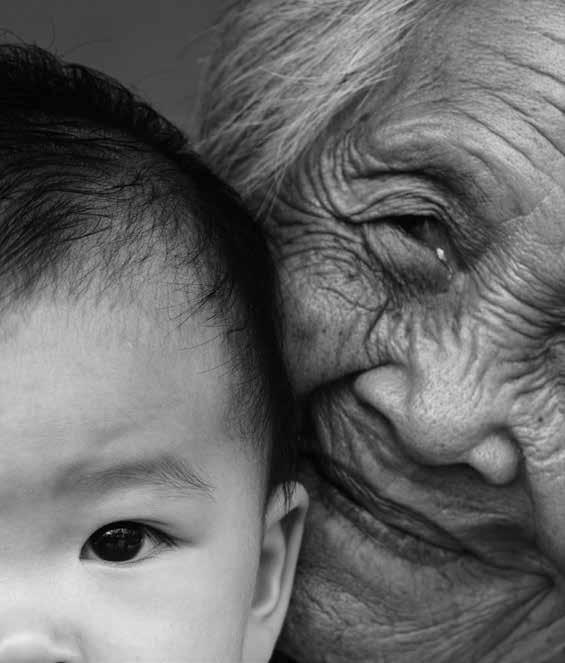
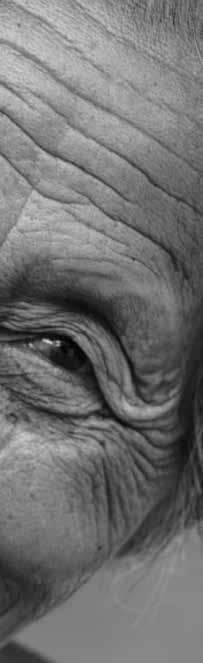
17 The face gives us the perfect innocence and open future of a child, as well as the lines and marks of age and wisdom, both essential to understanding and finally accepting the mortal nature of life rather than merely measuring its duration.
2 Australian Building Codes Board, The National Construction Code NCC, Section J, <https://ncc.abcb.gov. au>, 2021. Department of Planning, Industry and Environment, NSW Government, BASIX,<https://www. planningportal.nsw.gov.au/basix>, 2021.
Surely the façade is the very essence of the architect’s art, and the projection of architecture into the public street, public square or natural landscape. More than any other element of the architect’s craft, this must be ours, to draw and compose a vision and aspiration of our community and of our time.
Or maybe not.
Façade engineering and building envelope performance is now dominant in architecture. We are surrounded by specialists, technicians and experts in the design, production and construction of architectural envelopes. These engineering specialists measure, compute and analyse, a vast array of data about the enclosing surfaces of our buildings. They calculate the performance of our design in terms of: Visible Light Transmittance (VLT), thermal transmittance U-value, solar radiation, Solar Heat Gain Coefficient (SHGC), reflectivity, glare, watertightness and systems of performance coatings and membranes, material science and technology, energy transfer, exchange and generation, and so on. A proliferation of important data and enough to alienate architects to such an extent that we could be forgiven for just stepping back and selecting a Double Glazed Unit (DGU) glazing colour (very limited), and the framing colour (seemingly limitless).
This complex data matrix, when combined with the increasing regulation of the building envelope, in similar terms, but using blunt instruments such NCC Section J and BASIX,2 in many ways reduces the surfaces of architecture to a mere set of performance numbers. Of course, the technical performance of the architectural envelope is important, essential in fact, but there is a risk in our increasing focus of this data-driven design, committees and expert design review that we undermine the essential nature of our art and the very heart of architecture, that we forsake the immeasurable with an obsession for only the measurable. The easy allure of quantification makes comparison and assessment simple, but perhaps misses the point.
I recently spoke at a Façade Engineering conference that embodied the technical depth and specialisation of this expanding field of expertise.
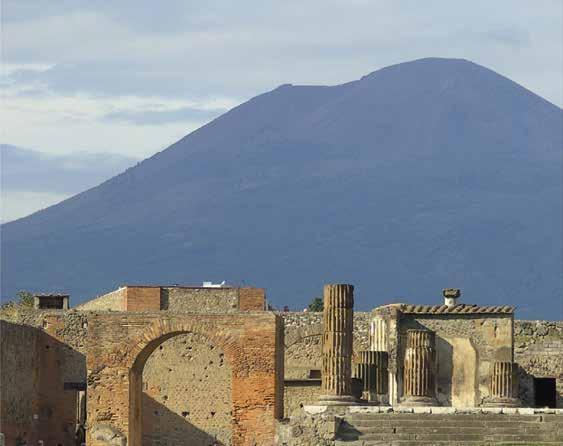
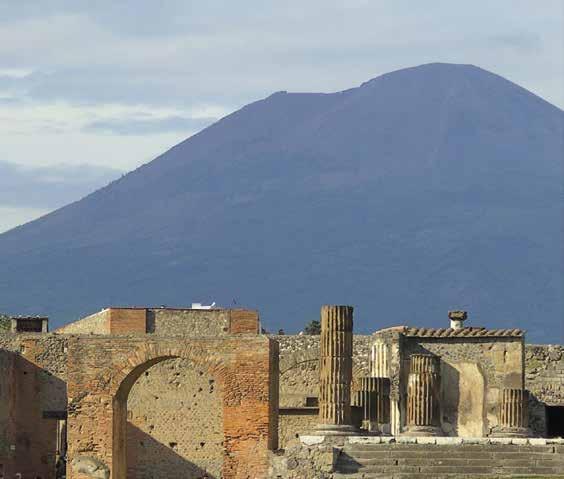
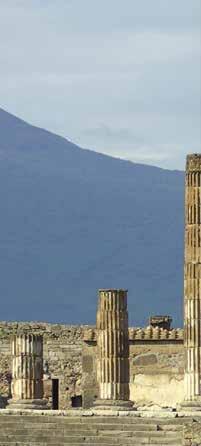
21 Ruins of the Temple of Jupiter in Pompeii with Mount Vesuvius in the background.
Sustainability
The sustainability of our natural environment is perhaps the most critical issue of our time. Almost every day we read of new dimensions to this crisis; melting ice caps, unprecedented bush fires, rising sea levels and global warming, all increasing at faster rates than first predicted. The contemporary human way of life, our settlement patterns, animal life and the character of the natural world, are all under threat.
But what do we mean when we talk of sustainability in this way, and more importantly what are we seeking to sustain and preserve?
Is it the whole of the natural world, the landscape the oceans and the multitude of life? But this is always in a state of flux, always changing and adapting even to our extreme destructive actions, nature will respond, reclaim, and transform.
Is it more about us, is it humanity that must be persevered? Yet again it is unlikely we will all be lost, although our settlement and civilisation maybe dramatically and disturbingly transformed.
The Club of Rome produced a more exact objective in the report of 1972 ‘Limits to Growth’. It sought a world system that is:
1. sustainable without sudden and uncontrolled collapse; and
2. capable of satisfying the basic material requirements of all of its people.2
2 Donella H. Meadows, Dennis L. Meadows, Jørgen Randers, William W. Behrens III, The Limits to Growth: A report for the Club of Rome’s project on the predicament of mankind, p.158 New York: Universe Books, 1972.
3 World Commission on Environment and Development United Nations, Our Common Future also known as the Brundtland Report, p.26, New York and Oxford: Oxford University Press, 1987.
In 1987 this was refined by the Brundtland Report ‘Our Common Future’ to be sustainable development, defined as “development that meets the needs of the present without compromising the ability of future generations to meet their own needs.”3
What is the nature of these ‘basic material requirements’ or intergenerational ‘needs’? In the West, notwithstanding the extreme social inequality, we have moved way beyond basic, to a form of excessive consumption well beyond need.
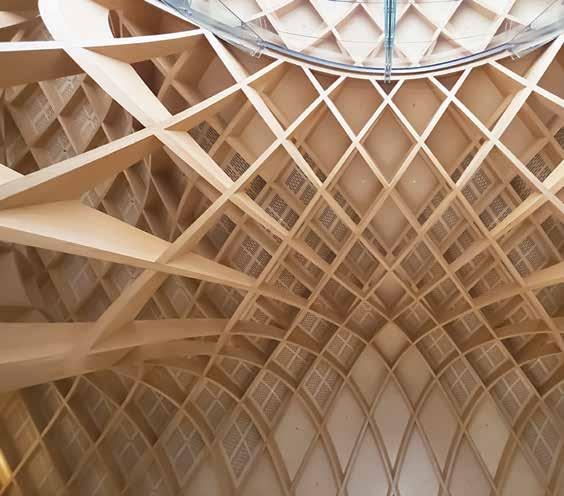
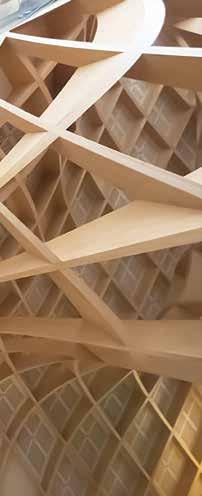
29 Laminated timber grid shell structure of Bunjil Place, a community performing arts, gallery and library in
fjmtstudio.
Narre Warren, Victoria, Australia by
The law of non-contravalence or non-contradiction, has been such a staple of our western thought and logic, that it seems hard to think outside its boundaries. The principal or law of non-contravalence is one of our three fundamentals of logic2 and has been a foundation upon which our scientific inquiry, reasoning and communication are built.
How can something possibility be true and at the same time, not true?
Such logical foundations and seemingly self-evident truths are perhaps not as firm and solid as they first appear. The law of non-contravalence, at least to some extent, is tripped up or trapped by paradox that freezes our established logic. Despite the contradiction, we feel some kind of truth in paradox, a truth that is hard to explain or communicate within the limitations of our language and classical logic. Paradox is not merely a clever manipulation of language, it is a proposition that seems contradictory, but when investigated, when taking the journey through paradox, it seems to reveal some kind of truth. The liar paradox; ‘this sentence is a lie’, 3 is perhaps the most famous example of a trap that seems to reveal the limitation of non-contraction.
Perhaps more profound is the paradox of Quantum Mechanics. The superposition of states that quantum particles can theoretically exist in at the same time, provokes and seemingly challenges non-contravalences.
2 The three laws of western ‘Aristotelian logic’ and rationality include the law of identity, law of non-contradiction or non-contravanence and the law of the excluded middle.
3 A hallmark of classical logic ‘This sentence is a lie’ is paradoxical as it seems to be a statement from a liar but if the statement is true then it cannot be a lie; if on the other hand, the liar is telling a lie, the statement is true and not a lie—a kind of continuous circular contradiction.
The physicist Erwin Schrödinger devised a now famous thought experiment that illustrated or challenged the apparent paradox of quantum superposition: A cat is in a box, its life is dependent on a potential single atom decay that would trigger the release of poison. According to the Copenhagen interpretation of quantum mechanics, after a while the cat is both alive and not alive; until the superposition ends with the opening of the box by an observer.4 Until the atom collapses from non-decay/decay the cat is suspended; alive and not alive, both possible, both true. It is the dependence on and release by the action of the observer that resolves and ends this dual simultaneity, but within the box is there really a cat both alive and not alive, or merely the possibility of either/both?
Such lightness in material is usually offset by an increased labour and technical expertise over more weighty and less precise constructions. While this clearly has a cost implication, we have to ask ourselves if increased labour is actually preferable at this moment of employment stress and social inequity, particularly when compared to the wholistic environmental and social cost of mining material weight from the earth and transporting it across the globe.
The life of the natural world is a rich source of models for lightweight forms of support and enclosure.
Perhaps the most foundational of these forms is the Pneus; internally pressurised envelope forms. It is the cellar structure of life, internally stabilised, remarkably adaptable and reproducible into a vast array of extended and geometric systems of enclosure.
Shell forms, on the other hand, derive their strength from geometric and spatial continuity. They can be continuous in the form of double curved thin surfaces between stiffened ribs or more open interconnected geometric forms of extreme lightness. These surface systems can be extended into exclusively tensile structures to form webs that depend on connections and geometric continuity to create remarkably adaptable and minimal material form in relation to strength.
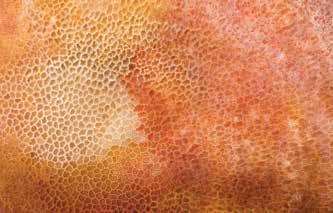
33 Close-up yellow-red colors texture of a fossilised sea sponge with a cellular structure.
8 Michael Hensel and Achim Menges, Morpho-Ecologies p.21, Chapter: Morpho-Ecologies: Towards an inclusive Discourse of Heterogeneous Space, AA Publications, 2006.
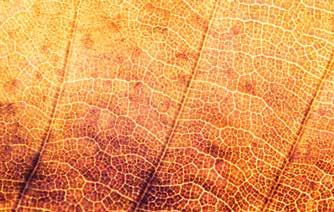
34 Leaf structure, magnified image.
The skeletal systems of lifeforms have both interlocking arched rib and flexible joints that allow for remarkable flexibility and mobility, and also the tetravalent layered three-dimensional grid of the bones themselves, giving directional strength and lightness, at its most optimised perhaps in the natural structure of flight.
Perhaps the most direct, influential, integrated and relatable lightweight structure is the progressive lightness, rise and enclosure of a tree. At the core is the compression of pneumatic cells that harden into tampering curvilinear forms of cantilever, grounded into the earth through tensile anchors, and forming a shade shelter and enclosure through the responsive ribbed shell-like surfaces of the leaf.
Biomimicry, an extension of the form of natural systems into our constructions, has been, in many ways, present from the birth of classical architecture, generally in the weighty forms of bearing wood and stone; lintel and beam.
We now can renew this ‘turn to nature’, but in a purer search for lightness; for a minimum weight of material. The Morpho-Ecologies research work of Michael Hensel and Achim Menges seeks to distill the process of form generation to essential and ‘natural’ parametrics..‘to achieve morphological complexity and performance capacity in material constituents without separating formation from materialisation’. 8
Perhaps the two most destructive architectural typologies we have developed are the fence and the villa. They have (dis)figured land settlement in a way that has partitioned and controlled the landscape for exploitation, driving human alienation, inequality and environmental degradation on a now breathtaking scale.
The Fence
The wall is a device of defence and protection; from the hostilities of nature and our fellow human being. Its efficacy depends on its strength, height, weight and depth. Our settlements over the ages evidence the projection and defence of social power and authority through the walls that enclose them and localise concentrations of authority.
A shortening from the term defence, ‘fens’ is the fourteenth century origin of the word fence. The fence is a distillation of the wall. Perhaps an effective restraint to animal life, but as actual physical protection to natural and human hostilities it is weak and next to useless. Its power is not physical at all; it is symbolic and representational; it is a marker of an invisible force. Fences represent boundaries that will be enforced.
As common feudal fields gave way to legal servitudes, fences defined and partitioned the land for individual private use, or they represented the invasive claiming of land from nature and its human custodians during western colonisation and oppression of First Nation/ Indigenous Peoples, fencing that would be subsequently strengthened with governmental laws and policies. The fencing of land was a quick, economical and efficient instrument of private ownership, power and the associated exclusion. Moreover, in its unequivocal statement of ownership, it serves up this land for independent private purpose and environmental exploitation. The fence has been a remarkable instrument of occupation, control and suspect claims of ownership. We are so conditioned and intimidated by its insidious power and force, that we seem so easily deterred from otherwise entirely rational paths of transgression.
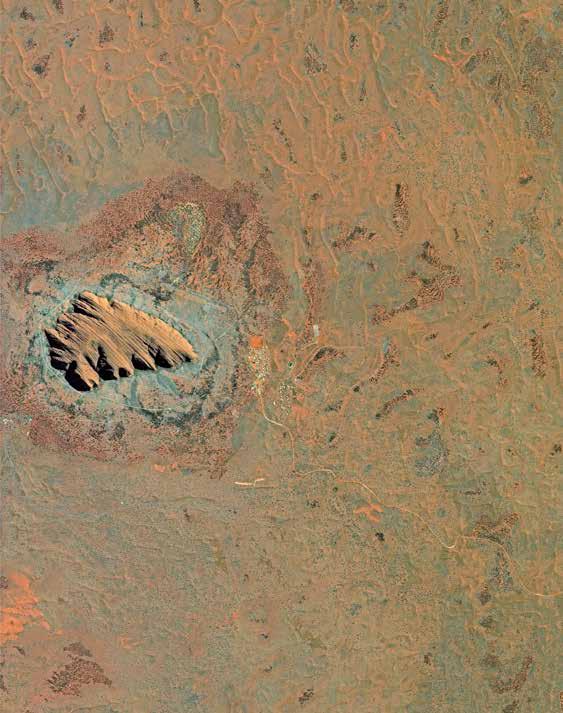
43 Uluru, Kata Tjuta National Park, NT Australia. The Yankunytjatjara and Pitjantjatjara People or Anangu have been custodians of this land for over 30,000 years.
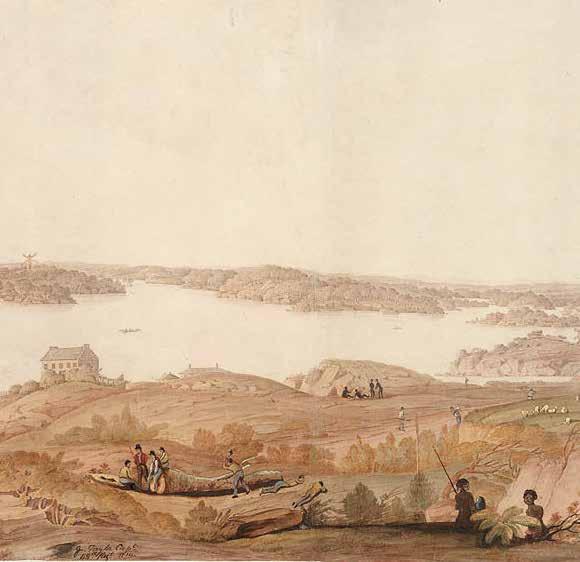
46 James Taylor, View towards Wangal lands, Sydney, ca. 1819-20.