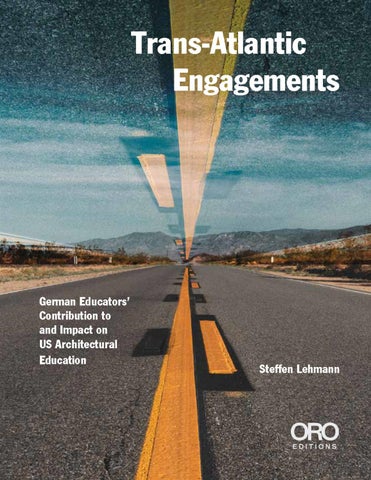
Trans-Atlantic Engagements German Educators’ Contribution to and Impact on US Architectural Education Steffen Lehmann With a Preface by Alexander Eisenschmidt and a Foreword by Peter Bosselmann
ORO Editions Publishers of Architecture, Art, and Design Gordon Goff: Publisher www.oroeditions.com info@oroeditions.com Published by ORO Editions. Copyright © 2021 Steffen Lehmann. All rights reserved. All rights reserved. No part of this book may be reproduced, stored in a retrieval system, or transmitted in any form or by any means, including electronic, mechanical, photocopying or microfilming, recording, or otherwise (except that copying permitted by Sections 107 and 108 of the U.S. Copyright Law and except by reviewers for the public press) without written permission from the publisher. You must not circulate this book in any other binding or cover and you must impose this same condition on any acquirer. Author: Steffen Lehmann, Las Vegas/Berlin Preface: Alexander Eisenschmidt, Chicago Foreword: Peter Bosselmann, Berkeley Book Cover Photo and Design: Cida de Aragon, Las Vegas/Sydney Book Design: Fortino Acosta, Las Vegas Managing Editors: Gordon Goff and Jake Anderson, San Francisco 10 9 8 7 6 5 4 3 2 1 First Edition ISBN: 978-1-951541-31-6 Color Separations and Printing: ORO Group Ltd. Printed in Hong Kong. ORO Editions makes a continuous effort to minimize the overall carbon footprint of its publications. As part of this goal, ORO Editions, in association with Global ReLeaf, arranges to plant trees to replace those used in the manufacturing of the paper produced for its books. Global ReLeaf is an international campaign run by American Forests, one of the world’s oldest nonprofit conservation organizations. Global ReLeaf is American Forests’ education and action program that helps individuals, organizations, agencies, and corporations improve the local and global environment by planting and caring for trees.
This study and publication has been endorsed and supported by the Association of Collegiate Schools of Architecture (ACSA), Washington, D.C.
This study received support from the Graham Foundation for Advanced Studies in the Fine Arts.
ii
Endorsements Bold in scope and packed with detail, the writing presents compelling pedagogical engagements as well as an impressive array of profiles and interviews with constant architectural commitment. It forces us to rethink the Bauhaus legacy, including the likes of Lilly Reich and Ernst Neufert who both stayed in the United States briefly, and alters the way we observe architecture not only through exhibitions but also how we manage data. Its educational strategies endeavors to reshape architectural education for future generations in the United States. “Trans-Atlantic Engagements” is a long overdue survey that steers one in new directions, by rekindling and renewing architectural exchanges across the Atlantic Ocean and beyond. — Annette Condello, Ph.D., Author of The Architecture of Luxury, Curtin University, Perth, Australia Steffen Lehmann’s “Trans-Atlantic Engagements” is a critical study and timely pedagogical research of German architects’ definitive contribution to educating generations of American architects. Broadly focused on world-renowned figures who came to the US following their escape from the Third Reich, as well as on less acclaimed subsequent and contemporary educators, this inquiry puts in perspective a vital collection of case studies. Himself born and raised in Stuttgart, Germany, having devoted years to academia all over the world, and now being a leading educator in the US, Lehmann’s important book presents the in-depth personal quest. Tracing both contrasts and commonalities the author brings to light various teaching models based on increasingly relevant cultural, regional and national identities. — Vladimir Belogolovsky, Curator and Author of Conversations with Architects, New York City There is a need for more analytical histories of architectural pedagogy to advance the understanding of how to educate the next generation of architects, and the ACSA strongly endorses this book. It investigates the influence of German educators on US architecture schools and on architectural pedagogy over the last eighty years, featuring profiles and interviews with current professors; it explores how two pivotal German architects and educators—Walter Gropius and Ludwig Mies van der Rohe influenced contemporary educational strategies and shaped their relevance. The book makes a significant contribution to the understanding of architectural education in the US and its historical cross-fertilisation with innovative German educational concepts at large. — Michael J. Monti, Ph.D., Executive Director, ACSA, Washington, D.C. Critical aspects of the original Bauhaus curriculum –aimed to balance interdisciplinary learning with a process-driven focus on method, material craft, and industrial production in response to cities, and a society, in crisis– can be easily identified in contemporary approaches to pedagogy in US architecture schools. Yet, these trajectories have seemingly developed into independent strands within architecture education today rather than working in concert. Steffen Lehmann’s exploration of the legacy of Bauhaus pedagogies offers a timely reflection on parallels and differences at a time when a new crisis in the form of a global pandemic poses uniquely spatial problems and forces educators to question both how, and what we teach in schools of architecture. — Antje Steinmuller, Chair in Architecture, California College of the Arts, San Francisco
iv
The contribution and impact of German educators in the United States can be directly connected to teachers and students of the Bauhaus, a topic that this book unfolds. What is also relevant and of current interest is the legacy of the Bauhaus-related ideas, which is a self-standing research topic that this book uncovers. Following the recent Bauhaus centennial, this book arrives as a mature and wellcooked treatment of some critical episodes of architectural education, and sheds light on the trans-Atlantic exchange of ideas that had a strong impact on the discipline. The book fills a gap in the history of US architectural education. — Andres Lepik, Ph.D., Chair in Architectural History and Curatorial Practice; Director of the Architecture Museum, Technical University of Munich, Germany “Trans-Atlantic Engagements” is a fascinating book and a valuable body of work. I am sure that it will become a standard reference whenever considering the history and future trajectory of architecture education in the US, or the time and impact of the Bauhaus philosophies outside of Germany. I found it immensely entertaining and captivating, which cannot be said often when it comes to subject books. The book is well written and it is a joy to read, casting a broad and expansive big picture while still uncovering thought-provoking details. — Mark Mueckenheim, Graduate Director of the School of Architecture, Academy of Art University, and Principal, MCKNHM Architekten, San Francisco
This engaging study of the contributions of German architects, past and present, to architectural education in the United States is relevant to any design related field, not only to architecture. Given the focus of the book on the influence of cultural, regional and national perspectives on teaching philosophies and pedagogical models, it is of interest to any educator committed to the notion that new times require new thinking—and there could not be a more relevant time for Steffen Lehmann’s book than ours. — Sabine O’Hara, Ph.D., Distinguished Professor and Ph.D.-Program Director Urban Leadership and Entrepreneurship, College of Agriculture, Urban Sustainability and Environmental Science, University of the District of Columbia, Washington, D.C.
“Trans-Atlantic Engagements” offers a long-awaited critical analysis of the pedagogical influences of German educators within schools of architecture across the United States. As an American architectural practitioner from German descent, I personally find this forward-thinking appraisal both relevant to our time and fascinating in its connection of history with the contemporary. The legacy of the century old Bauhaus and notable protégés, Gropius and Mies van der Rohe are amply understood. Steffen Lehmann eloquently cross-examines the pedagogy of his German/Austrian/Swiss contemporaries and interprets their reach and influence on American architecture today. — Dwayne R. Eshenbaugh, AIA, 2020 President of the AIA Nevada Chapter; Principal, NOVUS Architecture, Las Vegas, Nevada
v
Contents Synopsis Acknowledgements Preface Alexander Eisenschmidt
4 5
9
Foreword Beyond the Bauhaus: Towards an Interdisciplinary Environmental Design Education Peter Bosselmann
14
Introduction Part I. Early German Influences, Immigration and Assimilation
24
29 36 41 47 49 53
1. Drawing from two different European systems of architectural education 2. The development of German architectural education in the 19th century 3. Modest beginnings: The first US departments and curricula of architecture 4. Other German influences 5. The legacy of Gropius and Mies and the influential Bauhaus methods 6. The Bauhaus movement’s transformative pedagogical ideals
Appendix Part I. The Historical Cases and a Timeline of 200 Years 61 Biographies of 52 recognised 19th and 20th century German-speaking architects in the US Part II. Consolidation of the Modernist Approach in US Architectural Education 1. Leaving Germany, embracing new challenges: First to the UK, then coming to America 2. Gropius’s power struggles at the GSD at Harvard 3. The lasting legacy of Mies van der Rohe at the IIT in Chicago 4. Teaching Mies: The Miesian step-by-step approach to learning 5. Critcal reflection on Gropius and Mies 6. The language of space: Other places, where the Bauhaus pedagogy blossomed 7. The Bauhaus pedagogy reflected back to Europe through Hoesli at the ETH
86 91 98 100 107 110 115
8. Consolidation of the Modernist approach in 1950s US architectural education 116 9. The banality of Modernism and the end of the Modernist doctrine of Functionalism 118
Appendix Part II. The Current Context and a Map A contemporary overview: short biographies of 39 immigrated educators currently active in the US Part III. Trans-Atlantic Engagements Today: German Educators Currently at US Schools of Architecture 1. Examining the current context: a diversity of pedagogical positions 2. Immigration and positive assimilation into American society 3. Why teaching? On the attractiveness of being an educator and writer 4. German educators influencing contemporary architectural education and future practice 5. The dilemma of research and scholarship in architectural education 6. An impact-driven and research-based curriculum for 21st-century architectural education?
124
135 139 145 150 155 162
Appendix Part III. The Interviews with Current Educators Conversations with the Author: Six German-trained Educators
167
Conversation with Professor Martin Bechthold, Cambridge Conversation with Professor Peter Bosselmann, Berkeley Conversation with Professor Ulrike Heine, Clemson Conversation with Professor Barbara Klinkhammer, Philadelphia Conversation with Professor Mark Mueckenheim, San Francisco Conversation with Professor Antje Steinmuller, San Francisco
169 174 179 184 189 194
References Notes Supporting Institutions About the Author Index of Names
199 204 205 206 208
Synopsis Trans-Atlantic Engagements: German Educators’ Contribution to and Impact on US Architectural Education takes a critical look at the influence of German educators. It is a long overdue survey and publication that explores the history of pedagogical concepts of German-born and -trained professors of architecture at schools in the United States. The research and book publication are structured in three parts: Part I. Early German Influences, Immigration and Assimilation; Part II. Consolidation of the Modernist Approach in US Architectural Education; Part III. Trans-Atlantic Engagements Today: German Educators Currently at US Schools (including the interviews). It aims to make a significant contribution to the understanding of architectural education in the US and its historical cross-fertilisation with German educational concepts at large, with research outcomes responding directly to current and future educational and societal challenges. The ideals of the Bauhaus school shaped more than just design and architecture around the world; these guiding principles and pedagogy also transformed design teaching. The project examines the post-Bauhaus influence on these German-born educators today and how the Bauhaus model has evolved over the last fifty years. The Bauhaus aimed to unite all creative arts through direct field and workshop experience; it was a school of art and design which included architecture, and not a school of architecture per se. Gropius resigned in 1928, and it was largely under the directorship of Ludwig Mies van der Rohe from 1930 to 1933 that the Bauhaus developed into a school of architecture with subsidiary art and workshop departments. There are currently over fifty German-speaking educators (born in Germany, Austria or Switzerland) , active in shaping architectural and design education in the US, influencing thousands of students as the next generation of architects in this country. Compared to other professions, succeeding in studies of architecture is known as a long endeavor that requires a strong commitment and dedication from the student. The task for the educators is to turn the studies into a positive experience and fun to become part of a demanding profession. The book features interviews (conversations) with six selected professors and explores if the Bauhaus legacy of Gropius and Mies van der Rohe is still relevant for their educational strategies and design teaching today. The pedagogical experiments of the Bauhaus, imported by Gropius, Mies, Hilberseimer, Albers, Moholy-Nagy and others to the US system, challenged traditional Beaux-Arts thinking and played a crucial role in shaping and consolidating 1950s modern architectural education. Historically, the German architectural training has always been different from the French tradition. These new interdisciplinary and technology-focused modes of teaching architecture and design had long-lasting impact, however, are now again transformed by the contemporary educators currently active in reshaping curricula. The conversations reveal the critical and independent thinking of this group and how they make a meaningful contribution to the discourse of architectural education appropriate to the 21st century. Authored by an internationally-recognised scholar with personal insight into the topic, the six selected educators interviewed in this volume render visible a broad array of discursive pedagogical strategies that only partially build on the seminal educational model of the Bauhaus; they have transformed it to new contemporary pedagogical models. The study provides insight into the ways in which these German-trained educators influence architectural and design education in the United States to this day. 4
Acknowledgements This book is the outcome of many months of work and commitment of numerous people. I would like to express my thank you for the generosity of everyone involved, especially all the experts and colleagues who made this comprehensive study possible. I always knew that there were many of us and that our contribution to architectural education worldwide—not only in the US—is enormous. Firstly, in our increasingly digital world, I would like to thank my fearless publisher and his very competent team at ORO Editions: Gordon Goff, Federica Ewing, Jake Anderson, and Alejandro Guzman-Avila. Your trust and experience in managing the production of this publication was crucial. You believed in the project from start to finish, and it has been a joy to work with you. I owe a tremendous debt to the immensely talented colleagues, the German-born professors of architecture teaching in the United States of America. I am grateful for their participation and contribution of significant interviews (that make up such an important part of the book) and insight presented in this book. Your tireless concern, pursuit of design excellence and dedication to the best possible education for the next generation of architects inspires me every day. Getting this project done would have been impossible without the collaboration of these educators; especially a big “thank you” to the six educators profiled in the interview section in Part III: Martin Bechthold, Peter Bosselmann, Ulrike Heine, Barbara Klinkhammer, Mark Mueckenheim and Antje Steinmuller (in alphabetical order). I thank you for your time out of your busy schedules! My warmest thanks go to two valuable contributors of ideas: to Peter Bosselmann at UC Berkeley and Alexander Eisenschmidt in Chicago, for providing an interesting and critical Foreword and Preface to this book. Especially professors Peter Bosselmann and Mark Mueckenheim provided critical feedback to an early draft of the manuscript which made this a better book. I worked on this book during the 2020-pandemic, when we had a stay-at-home order, and was all focused on the project that it made my quarantine time fly. This book would not have been possible without the generosity of the University of Nevada Las Vegas. Many colleagues have been supportive and I am grateful for their wise comments; and the conversations we had, which were relevant for the direction of this publication. My committed Ph.D. student Fortino Acosta was instrumental in the design of the book. ― You all made this a better book! I would like to thank the colleagues at the Association of Collegiate Schools of Architecture (ACSA), especially the ACSA’s Executive Director, Michael J. Monti, for their support and endorsement. Also thanks to the Goethe-Institut in the US, particularly the Goethe-Institut in Washington, D.C., and in Los Angeles. Without their strong support this study would not have been possible. My thank you goes also to the Graham Foundation for Advanced Studies in the Fine Arts, Chicago, for their support of this study. And a big thank you to the AIA Las Vegas, Randy Lavigne, and the following Las Vegas-based companies for their great support: Marnell Corporation, Tom Schoeman, LG Architects and KGA Architecture.
5
Many thanks go to Cida de Aragon for her support, encouragement and understanding over the last thirty years; and the beautiful book cover photo of Route 66 and book cover design. My friendship with many other colleagues and scholars provided me thoughtful guidance and is a daily inspiration. I thank you all for your encouragement and relentless curiosity during the preparation of this book: Fortino Acosta, Heiko Achilles, Pal Ahluwalia, Iman Ansari, Erieta Attali, Martin Bechthold, Eike Becker, Vladimir Belogolovsky, Kai-Uwe Bergmann, Leonard and George Bergman, Paola Boarin, Peter Bosselmann, Peter Brandon, Keith Brewis, Andrea Brizzi, Andreas Bruemmel, Niccolo Casas, Cesar Ceballos, Bill Chapman, Javier Castanon, Edwin Chan, Akhtar Chauhan, Rafaella Colombo, Annette Condello, Peter Cook, Edoardo Croci, Mario Cucinella, Mahesh Daas, Luca D’Acci, Cida de Aragon, Cees de Bont, Neil Denari, Antonino Di Raimo, Paolo Di Nardo, Khoa Do, Markus Dochantschi, Harry Edelman, Hisham Elkadi, Sura El-Maiyah, Dwayne Eshenbaugh, George Ferguson, Galya Gerina, Georg Gewers, Edward Glaeser, Tigran Haas, Catherine Harper, John Hartley, Peter Head, Ulrike Heine, Peter Herrle, Richard Horden, Simi Hoque, Donald Houston, Alvin Huang, Kurt Hunker, Claus-Peter Hutter, Yasuhiro Imai, Arata Isozaki, Helmut Jahn, Dieter Janssen, Mike Jenks, Mitchell Joachim, Charles O. Job, Ahmed Z. Kahn, K.K. Philip Kang, Irma Karjalainen, Louis Kavouras, Kisa Kawakami, Lance Kirk, Thomas Kiwitt, John Klai, Barbara Klinkhammer, Joerg Knieling, Branko Kolarevic, Franz Krenn, Ralph Krohmer, Norbert Lechner, Margit and Werner Lehmann, Andres Lepik, Pekka Leviakangas, Nina and Daniel Libeskind, Bob and Vicki Liljestrand, Dirk Lohan, Bart Lootsma, Piotr Lorens, Winy Maas, Adrian McGregor, Dale Medearis, Peter Murray, Antonello Marotta, Alessandro Melis, Walter Menteth, Michael J. Monti, Mark Mueckenheim, Gjoko Muratovski, Ethan Nelson, Boonlay Ong, Sabine O’Hara, Dominic Papa, Mita Patel, Emily Penn, Dario Pedrabissi, Igor Peraza Curiel, Ralph Dlugosz, Rodrigo Perez d’Arce, Antoine Predock, Samia Rab Kirchner, Karim Rashid, Carlo Ratti, Victor A. Regnier, Charles Renfro, Saffa Riffat, Tom Rivard, Paco Francisco J. Rodriguez-Suarez, Stefan Rossner, Paola Ruotolo, David J. Sailor, Norma Saldivar, Matheos Santamouris, Saskia Sassen, Tom and Susan Schoeman, Ehsan Sharifi, Brigitte Shim and Howard Sutcliffe, Charlotte Skene Caitling, Dean Sakamoto, Peter Cachola Schmal, Bleyer Schneider, Malcolm Smith, Werner Sobek, Thomas Spiegelhalter, Antje Steinmuller, Monika Szopinska-Mularz, David Turnbull, Ed Vance, Thomas Vonier, Frank Werner, Jenny Wu and Atiq U. Zaman. ― You are all incredible! I would also like to thank all photographers, architects and archives for making images and information available. Every effort has been made to trace the copyright holders, and we apologise for any unintentional omission; the publisher would be pleased to insert the appropriate acknowledgement in any subsequent edition. Lastly, as a full professor of architecture for the last two decades, I am fortunate to be working on three continents, including as Director of the UNLV School of Architecture in Las Vegas (USA) and Head of the School of Architecture in Perth (Australia). Hence, this book is partially autobiographical and relevant to my own work as German-born and -trained educator and architectural researcher. I am grateful to have been able to work with over a thousand inspirational, talented and hard-working students of architecture and design at various schools in the US, Australia, Germany, UK, Singapore, China, India and the UK over the last decades. The history and influence of German-trained educators in the United States is obviously of particular relevance to me. Much remains to be done. My hope is that we will work together to turn the study into a future exhibition and symposium on the topic. Euch allen: gutes Gelingen! 6
― Steffen Lehmann, September 2020
Introduction
Image A: American settlers moving towards the West: a painting by German-born painter John Gast entitled “American Progress” (1872). This painting has become a seminal example of American Western art that portrays the westward expansion (which occurred from 1812 to 1860). This 19th-century movement of settlers into the West, began with the Louisiana Purchase and was fueled by the Gold Rush, the Oregon Trail and a belief in "manifest destiny." Many of the settlers were immigrants from Germany. The figure of Progress is ushering an era of modernisation, development and advancement to the West, leading white settlers who follow her either on foot or by horseback, coach or train. Progress lays a telegraph wire with one hand and carries a school book in the other. As she moves westward, indigenous people and a herd of buffalo are seen fleeing her.
Image B: The steel-frame high-rise building was invented in Chicago in the 1880s. As steel is stronger and lighter in weight than iron, the use of a steel frame made the construction of truly tall buildings possible. William LeBaron Jenney’s 10-story Home Insurance Company building (1884–1885) was the first to use steel-girder construction, and also the first to employ a curtain wall façade (an outer covering of masonry or other material that bears only its own weight and is affixed to and supported by the steel skeleton). It is considered the first modern high-rise building. It was not until the invention of the passenger elevator in 1852 that high-rise towers became possible and practical. 24
Image C: Suburbanisation, the rapid growth of US suburbia: in the post-war era, many Americans moved away from cities, into car-dependent suburbs. Techniques of mass production made it possible to build homes faster and more affordable than ever before, using one- or two-storey timber construction and assembly-line systems. Since the late 19th century, Americans as well as immigrants had flocked to American cities in search of factory work. In the post-war era, however, that trend reversed thanks to low housing costs: even working-class Americans could now afford to own a home in the suburbs.
Image D: Ground floor with the buildings set back behind a series of columns, creating a visual effect of the buildings “floating” above the site: The 26-floor apartment buildings at 860-900 Lake Shore Drive in Chicago (1949―1951), an elegant composition of four minimalist glass-and-steel towers designed by Ludwig Mies van der Rohe. (Photo by the author, 2020). 25
Trans-Atlantic Engagements Introduction
Today, in the United States and Canada alone there are more than 140 professional degree programs in architecture with over 6,000 academic faculty members educating more than 40,000 students. The subject of this book is the history of architectural education, in particular the evolution of architectural education in the United States today. “Trans-Atlantic Engagements: German Educators’ Contribution to and Impact on US Architectural Education” is a publication project that explores the influence of pedagogical concepts of German-born professors on architecture schools in the US. Historically, the German architectural training has always been historically different from the Franco-Italian or British traditions. It’s not often that the history of architectural pedagogy is the subject of study. This report and study conducted for the ACSA traces the significant, influential and sometimes controversial contribution of German professors of architecture and design, from the 1930s to today, at universities in the US. With over two centuries of significant cultural exchange between both countries in the fields of architecture and design, there has been a considerable German influence on American architecture as well as on architectural education (and vice versa). The study takes a critical look and explores the important role that the Bauhaus—as a place, idea and culture—played in the formation of one of the most influential intellectual projects in 20th-century architectural pedagogy. The historical impact of Bauhaus pedagogy on the teaching and learning of design cannot be overstated. Over a century ago, starting out in Weimar in 1919 as an avant-garde academy of arts and crafts led by Gropius, the school progressively transformed, over its 14-year lifespan, into a lived experiment in the combination of technology and art – an endeavour fuelled by the optimism of the emerging Modern Movement. The ideals of the Bauhaus School shaped more than just design and architecture around the world. Its guiding principles also transformed teaching. Not limited to the personalities of the generation of 1930s immigrants Walter Gropius, Ludwig Mies van der Rohe, Ludwig Hilberseimer, and Erich Mendelsohn, there has been a constant flow of eminent German architects crossing the Atlantic. After the Bauhaus’s closing in 1933, several of its protagonists moved to the United States and their influence can still be felt today in numerous buildings, artworks, concepts and curricula. Frequently, they have led the innovative development of US curricula, effected significant impact on architectural education and were subsequently influential both in their capacities as educators and as practitioners. Some of these schools operated according to the new pedagogical principles introduced by the Bauhaus’s legacy and had a lasting influence on the entire American system.
26
Remarkable mid-century figures of charismatic architects with strong principles come to mind, who were influenced by the Bauhaus model of interdisciplinary education. This book examines a couple of key questions: What makes these architects come to the US, and do they consider themselves German or American architects? What are the particular qualities that German architects might bring to the education of architects in the US? Are such national attributes, specialisations and identities, including preserving German cultural values, still relevant in a globally inter-connected society and profession? Which concepts do they import, and how do these architects assimilate to their new home country? While the historic cases of the last century (the Bauhaus, Gropius, Mies, Mendelsohn, and others) have previously been well covered by numerous authors, and there is an extremely rich body of scholarship available in German and English language, the main contribution of this book is in the discussion concerning the current context. It examines not only their many built works and projects but also their contributions to teaching and writings. Therefore, the key questions for the second part of the book and following interviews with selected educators, are:
• How have early German-influenced pedagogies changed or transitioned, and what is their relevance between contemporary German-born educators today? • How are more recent German-trained transplants influencing US schools now?
The book profiles 52 historical cases of German-born architects, and 39 contemporary German-trained professors currently active in the US; it concludes with a feature of conversations with selected influential educators, devoting their careers to the education of architects. These German-born architects had their upbringing, education and cultural formation in Germany, and frequently had a successful career before immigrating to the United States, where they took up important teaching positions. Their biographies are accompanied by in-depth conversations on their educational philosophies and strategies. This is a generation that is actively shaping architectural education today. The study is relevant to the educational sector and the general public. It brings together available (but currently fragmented) knowledge to address relevant questions about the education of architects, and enables a better understanding of imported pedagogical models that were contributing to the future of US architectural education. Hence, the aims of this study are: to develop relevant research that gives an overview of German-trained educators in the US (historical and contemporary); and gathering, analysing, and synthesising the knowledge, connecting researchers to create dialogue and develop future joint research initiatives. The goal is to make a meaningful contribution to the discourse by producing a high quality scholarly book to widely communicate the project findings. The project audience is likely to include people interested in design education, academics and students in the US and Germany, and German Americans. The book fills a current knowledge gap. The book is different from earlier work, tracing the sometimes controversial contributions of German professors at US universities since 1930s. The evaluation of German influences post-Bauhaus on US schools of architecture highlights the imported excellence in design and architecture and celebrates the individual contributions that German-trained architects have made and keep making to the North American vibrant 27
educational scene trough their design research, teaching and pedagogy. This generation is as diverse as the country. The in-depth interviews with six selected architecture professors shed light on their intentions, and showcase their different educational philosophies and accomplishments, while providing an overview of their unusual international careers. The book argues that, although the educators’ positions in between two cultural spheres creates discontinuities in their work, it also facilitates a mutual exchange between their European backgrounds and their North American peers, and thereby helps to shape the development and reception of the educational projects on either side of the Atlantic. The pedagogical experiments of the Bauhaus, first imported by Gropius, Mies, Albers and others to the US system, challenged traditional Beaux-Arts thinking and played a crucial role in reshaping modern design education over the last eighty years. Their move to the United States led to a change in American architectural education, away from historicism and Beaux-Arts ideas to an architecture that relied on craft, innovation and modern industrial techniques. These new modes of teaching architecture and design had a long-lasting impact, however, are now being again transformed. The book’s research outcomes respond directly to current and future educational and societal challenges by untangling legacies that started in 1937, with Gropius and van der Rohe’s arrivals, and that continue with German educators today. Overall, the research aims to contribute to the better understanding of architectural education in the United States and advances the knowledge of architectural education by illuminating various educational strategies deployed at a range of architecture schools. Authored by an established scholar with personal insight into the topic, the selected educators profiled in this volume render visible a broad array of discursive pedagogical strategies that partially build on the seminal educational model of the Bauhaus. The study provides insight into the ways in which these German-trained educators have influenced architectural and design education in the United States to this day.
28
The Historical Cases Biographies of 52 recognised 19th and 20th century German-speaking architects in the US who made important contributions over the last two hundred years―a long overdue survey of the continuous influence of these architects in the US (the listing is in alphabetical order. Please note: a few Austrian and Swiss-German cases are included, as they shared a similar cultural background and the German language). Raimund Abraham (Lienz, Tyrol, 1933―Los Angeles, 2010), New York City) Abraham was an influential architect in his native Austria and part of the New York avant-garde. His poetic architectural vision was influenced by the Viennese tradition to understand architecture as sculpture, along with other Austrian masters including Hollein, Pichler and Domenig. Throughout a 40-year career, he created visionary and enigmatic projects and built works in Europe and the US. From 1952 to 1958, Abraham studied at the Technical University of Graz, and in 1959, he established a studio in Vienna. From 1960 to 1964 he worked in Vienna with Walter Pichler. Abraham's first book, the 1963 publication "Elementare Architektur" was made at a time of his transition from architecture studies to practice. In 1964, Abraham immigrated to the United States. After arriving in 1971 in New York, he taught at the Rhode Island School of Design and was a professor of architecture at the Cooper Union School of Art and Architecture in New York. He was also adjunct faculty at Pratt Institute in Brooklyn, and a visiting professor at numerous other institutions worldwide. He became known as a strong critic of mainstream architecture's preoccupation with style, its indifference to history, and the rigid definition of Modernism at that time. Abraham went on to influence generations of professional architects through his poetic architectural drawing style and teaching. Dankmar Adler (Lengfeld, Thuringia, 1844―Chicago, 1900), Chicago Adler was an architect and civil engineer best known for his fifteen-year partnership with Louis Sullivan, as Adler & Sullivan in Chicago, during which they designed some of the first high-rise towers. Adler came to the US in 1854 with his father, who was a Jewish rabbi. He became a draftsman before working in the practice of architect Augustus Bauer in Chicago. In 1871, Adler formed a partnership with Edward Burling that ultimately created more than 100 buildings. In 1880, he eventually established his own firm; in the same year, he hired Louis Sullivan as a draftsman and made him a partner three years later. Adler's partnership with Sullivan was very productive but ended around 1895 due to a slump in their architectural practice brought on by the Panic of 1893. Adler & Sullivan produced more than 180 buildings and some of Chicago’s most important architecture. With his partner Burling and thereafter, as a partner in Adler & Sullivan, he was instrumental in rebuilding much of Chicago following the Great Fire of 1871 (the city government improved building codes to stop the rapid spread of future fires, stopped timber construction, and rebuilt the city rapidly to higher standards). Buildings in Chicago have always been different from New York: tough, more durable and uncompromising. Adler is considered a leader in the Chicago school of architecture through pioneering accomplishments with steel-framed buildings and high-rise construction. Dankmar 62
Adler and Louis Sullivan were early employers and mentors of architect Frank Lloyd Wright. A victim of the financial depression, Adler left the partnership in 1895, but returned to architecture in partnership with his two sons; he never regained the prominence he had earlier. Sullivan continued to practice and died in 1924 penniless. Augustus Bauer (Darmstadt, 1827―Chicago, 1894), Chicago Augustus Bauer was among Chicago’s most prominent early architects and one of the city’s earliest professional architects. Quoting a Chicago Tribune article published in 1873, the writer notes that in his day, Bauer was considered one of Chicago’s “best educated and most experienced architects.” A German immigrant, Bauer graduated with high honours from the Polytechnic School in Darmstadt, and immigrated to New York in 1851, where he worked for the firm of Carstensen & Gildmeister on plans for the great Crystal Palace. In 1853, Bauer moved to Chicago at the suggestion of Frederick Baumann, who would later serve briefly as architect for the Chicago Board of Education. Bauer soon joined forces with Asher Carter, the second professional architect to practice in the City. Carter & Bauer designed many residences and public buildings, including Old St. Patrick’s Catholic Church (1856), now a monument. Beginning in 1863, Bauer practiced alone for several years, during which time he became an expert in school buildings and designed numerous brick schools including the old Wells and Dore schools. These are among the oldest public school buildings in Chicago still in use. In 1866, Bauer became associated with Robert Loebnitz (young Dankmar Adler worked as a draftsman in their firm). They produced a great deal of work between 1871, immediately after the Great Fire, and 1874, when Loebnitz retired to Europe. Bauer again practiced solo from 1874 to 1881. Throughout this period, he designed twenty school buildings for the Chicago Board of Education (see image), including the Mark Sheridan and James Otis Schools. Bauer served as the president of the Chicago Chapter from 1879 through 1885. Cajetan J.B. Baumann (Ravensburg, 1899―New York City, 1969), New York City Brother Baumann was a Franciscan friar and architect. His designs were progressive, providing modern interpretations of Gothic architecture. He was born in 1899 in Baden-Württemberg in South Germany, and in 1922 entered the novitiate of the Order of Friars Minor in Sigmaringen, where he was given the name by which he is known. He remained a member of this Province throughout his life. In 1925, Baumann was sent to the US to help with his skills as a cabinetmaker and wood carver. He first served the community at St. Bonaventure Friary in Paterson, New Jersey for ten years (1926―1936); and then went on to earn a bachelor's degree from St. Bonaventure University (1941) and a Master of Architecture from Columbia University. He later served on the Board of Governors of Columbia’s School of Architecture. He was active in the National Committee on Religious Buildings, the Architectural League of New York, the New York Building Congress and the National Council of Architectural Registration Boards. Baumann was the American representative of the International Commission for the Restoration of the Basilica of the Holy Sepulcher in Jerusalem. He became the first 63
AIA member of a religious Order. He headed an architectural firm based in New York City for the Order of Friars Minor, the Office of Franciscan Art and Architecture, designing numerous religious structures worldwide, including churches, convents, schools, college residences, retreat houses and seminaries. Although he was not engaged in general practice, Baumann’s firm attracted a number of young architects who later earned national reputations, including: Paul Damaz, who worked on the UN headquarters, and German architect Gottfried Boehm, who received the Pritzker Prize in 1986. Frederick Baumann (Berlin, 1826―Chicago, 1921), Chicago Born and educated at the Berlin Polytechnic Academy of Arts, Frederick Baumann arrived in 1850 via New York in Chicago. In 1851, he joined the office of one of Chicago’s first professional architects, John Van Osdel as draftsman. The following year, Baumann formed a partnership with his cousin, Edward Burling, and they built Chicago’s first large office building, known as the Marine Building, located at Lake and LaSalle streets. The office building, with its cut stone front, rose to a height of seven stories. The Marine foreshadowed Baumann’s later expertise in designing tall, heavy buildings in Chicago’s difficult lakeside soil. He is recognised for his contributions to the development of the skyscraper typology through the publication of numerous articles, including Improvement in the Construction of Tall Buildings (1884), and for his innovative structural designs. He also designed the First Chicago Courthouse and other prestigious commissions. Baumann had an enduring relationship with the Chicago Board of Education. Between 1857 and 1859, he served on the Board and a decade later, he designed the Franklin School and the Hayes School buildings. Mid-way through his long and prolific career, in 1882 Baumann was named the first official Architect and Superintendent of the Chicago Board of Education. It is unlikely that any of his Chicago school buildings exist today. Herbert Bayer (Haag, Austria, 1900―Montecito, California, 1985), New York City; Aspen, Colorado Austrian-born graphic artist, painter, photographer and architect, Herbert Bayer taught at the Bauhaus and became influential in spreading European principles of advertising in the United States. Bayer was first trained as an architect, but from 1921 to 1923 he studied typography and mural painting at the Bauhaus. In 1924 he became a master of typography and advertising at the Bauhaus, and simultaneously was an art director with Vogue, the American-French fashion magazine. In 1928 he moved to Berlin, where he worked in advertising, painting, exhibition design, typography, and photography until 1938, when he moved to New York City and concentrated on advertising design. In the same year, he arranged the exhibition "Bauhaus 1919―1928" at the New York Museum of Modern Art (together with Gropius). He became an American citizen in 1944. In 1946, Bayer became chairman of the department of design of the Container Corporation of America; and a design consultant for Aspen Development, a corporation that stages an annual festival of the arts in Aspen, Colorado. In the latter capacity he designed several architectural projects. 64