Essays and Contributions by David Marshall Grant, George Negroponte, Marthe Jocelyn, and Anne Pasternak Foreword by Glenn Lowry The Artist Book Foundation North Adams
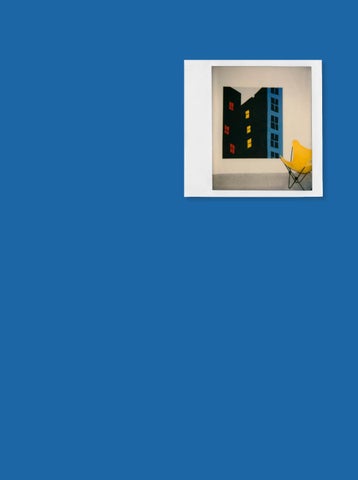
One of the thousands of Polaroids, dating from 1981 on, that lined the hallway of Tom’s studio.
FOREWORD
8
by Glenn Lowry
INTRODUCING TOM SLAUGHTER
12
by Hannah and Nell Jocelyn
THE NEGATIVE SPACE
18
by David Marshall Grant
1980–1990
24
THE OBJECT MAKER
68
by George Negroponte
1990–1998
74
EVERY SUMMER
128
by Marthe Jocelyn
1998–2006
138
OBJECTS
174
LOOK, AND REALLY SEE
186
by Anne Pasternak
2006–2014
192
UNMISTAKABLY HIS
242
Interview with Stephen Hannock, Jean-Paul Russell, Robert Harms, Ray Charles White, and Scott Kilgour
LIST OF PLATES
256
CHRONOLOGY
262
SELECTED PUBLICATIONS
264
Children’s Books, Artists’ Books, Print Series, Catalogues, Books and Magazines
SELECTED SOLO EXHIBITIONS
266
SELECTED GROUP EXHIBITIONS
267
SELECTED PUBLIC & PRIVATE COLLECTIONS
268
PHOTOGRAPHY CREDITS
269
ACKNOWLEDGMENTS
271
FOREWORD
Shortly before Tom died on October 24, 2014, he sent me a drawing of a semi-naked woman unclipping her bra. It was typical Tom. Drawn over a letter that I had sent him several months earlier acknowledging his support of the Museum of Modern Art’s exhibition of Henri Matisse’s cutouts, the drawing was a thank you for a thank you. Simultaneously cheeky and alluring, and realized in Tom’s fluid, almost effortless hand, the drawing turned my letter into a striptease. He knew I would love it and I have kept it by my desk since the day it arrived—a reminder of how much I loved Tom and how grateful I was to him for his friendship and support. I find myself still thinking about him. I see art that he was interested in and wish he was here so we could talk about it together; I go to the beach and lie on one of the towels he designed and remember how much fun it was to hang out with him. From the moment I met him twelve years ago, I felt like I had not only made a great new friend, but found the brother I never had. Tom, I think, felt differently—he was not short of brothers—but we bonded quickly. He had an easygoing quality to him that masked a more tightly coiled personality. He could be funny and irreverent, and affected a laid-back attitude, but underneath that casualness he was as determined and driven as anyone I have ever met.
Glenn Lowry
Tom loved his daughters, he loved making art, he loved elegant, sexy women, he loved riding his crazy bike—I kept trying to convince him that the last thirty years had seen many important innovations including gears and lighter frames, but he would have none of it—he loved his family and his friends, and he loved a good party, all pretty much in that order. In short, he loved life and lived it full throttle. I got to know Tom well when he joined the board of PS1, shortly after it merged with the Museum of Modern Art. He quickly became one of the most active and vocal trustees. He immersed himself in the life of the institution and always pushed for us to be better, and more daring. He was allergic to the status quo and to the establishment. He bristled at the idea of convention. He was also a closet engineer and architect, and never stopped opining about our various architectural projects. Over the years, he emerged as perhaps PS1’s most valued and important trustee, joining the executive committee in 2008 and chairing the nominating committee from 2008 until 2013. His gift to PS1, and then as PS1 became MoMA PS1, was that he always spoke his mind, he spoke the truth, he worked hard, and he was dedicated to making the place better. His were always the sharpest comments at board meetings and he caught every one of my mistakes. He was generous with his opinions—and they
9
were not in short supply—but he was equally generous in his openness to other people’s ideas. He saved us on many occasions from ourselves, and he supported, unstintingly, the artistic and political causes he believed in. It would be easy to think of Tom as first and foremost a talented philanthropist given the range of institutions and projects he supported through the Horace W. Goldsmith Foundation. But Tom was, above all, an artist. He thought like an artist and he acted like one. He had a gift for drawing and reducing a form to its essential shape. He loved to look at art, to turn it around and dissect it, and he was endlessly curious about how things were made—not just constructed but conceived. When I visited him not long before he died, as he was struggling and clearly exhausted, he was still drawing, forcing himself not to forget how to do what he loved. It was always exciting to talk to Tom about the art he was making or the artists that turned him on. We shared an admiration for Ellsworth Kelly and especially for Matisse, artists from whom he took a sense of line and color and rhythm. He was so excited that the Museum of Modern Art was going to present Matisse’s cutouts in the fall of 2014; I only wish he had had the chance to see the show—I think he would have been enthralled. Tom’s art could be serious or jubilant, but it was always probing. He was so gifted that he could make anything look good. His designs found their way into books, onto posters, T-shirts, skateboard decks, and even towels. I think he enjoyed making illustrated children’s books the most, because they let him share his own childlike enthusiasm with the world. He published ten and each is a gem. As I think about Tom and how much I liked him, I realize that there are very few people with whom you can develop a deep personal affinity. Tom and I began our relationship on a professional level but it quickly became intensely personal. We shared being married to Canadian wives—with all that entailed, and believe me that was a lot—we shared the stories of our children, and we shared many common friends. I will never forget a dinner in Williamstown, Massachusetts, several years ago with Tom and my mother and sister, two intense women who can grill a stranger to the point of singing. I would have run screaming—in fact I usually did—but Tom charmed them both and my mother still wonders why I can’t be more like him! He made everyone he met part of his community and he made his community an indispensable part of his life. His art is joyous, even exuberant, and it brings pleasure to all who encounter it. No one can ask for a greater legacy.
Glenn Lowry Director of the Museum of Modern Art New York, NY 2016
11
INTRODUCING TOM SLAUGHTER When our father did his first run of prints with Durham Press, in 1989, Henry Geldzahler, the curator of American Art for The Met, wrote an introduction to the series entitled “Introducing Tom Slaughter.” In it he wrote: “The quality of freshness, the familiar world re-seen, from the water towers of New York City to the rural pleasures of boating, is the most immediately arresting aspect of Tom Slaughter’s art. Strongly depicted large forms, most often in black over bold, bright colors, swiftly laid down, echo with resonances; Léger and Stuart Davis, Raoul Dufy and Roy Lichtenstein. All are artists who live their lives in the brilliant life of imagined skies where the time is always high noon or midnight. . . .One device developed by artists whose work is memorable is the creation over many years of an invented world, an identifiable place, that we need but glimpse to succumb to his spell. Tom’s world is South-Eastern [sic] Canada, Ontario to be specific, on a hot summer day, and New York seen clearly, with the cunning of a New Yorker, from the vantage point of the rural, the Arcadian. The personality of his work is vigorous and bold, the alert attention of hard worker hard at rest, typically rowing his anonymous boat. . . . The strength, the gestural muscle of the drawing, telegraphs its information and its mood with equal clarity, reinforcing the quality of freshness with which we began this note.”1 In his thank-you note to Henry, typed on lined paper with a typewriter and signed with his iconic hat, Tom wrote, “My 15 minutes may be over but I will always cherish your introduction to T. Slaughter cause you nailed it. A 16 penny nail one shot from a 28 oz hammer.” Henry’s description captured something so true about Tom’s work and Tom’s response captured something so true about Tom. In his metaphors as in his art and in his life, he was straightforward and vivid. Tom was born in New York City in 1955. When he was eight, his family moved to Connecticut where he went to high school, and eventually to Connecticut College
Hannah and Nell Jocelyn
where he majored in art history. After graduating, he drove his pickup truck west, prospecting for tin in New Mexico and then working construction in Seattle. He met our mother, Marthe, during a visit home in January 1981 and decided it was time to come back to the city. Just a few months later, they moved in together—to the loft in SoHo, a retired garment factory that had a special dispensation from the city for artists. He lived there for the rest of his life. In the early eighties, his work started to appear in group shows; by the early nineties, he was established in the
13
downtown New York art world and having solo shows around the world. His lines were loose, his scenes dynamic. He was making six-foot canvases, depicting the city in royal blues, vibrant reds and yellows, deep black—bright windows in a dark night, water-tower silhouettes, the chaos of construction. To the world at large, Tom’s work was an iconic representation of New York City. To us, it was just our life, rendered bright in primary colors. The walls (if you can call them that, at only six feet high) in our loft were collages themselves— covered in paintings, and photos, and photos of paintings; the flat surfaces were covered with matchbooks, Ray-Bans, Sclafani cans filled with brushes, and then sketches of those glasses, that can. For every object scattered around the house, a drawing could be found of the same, so that every scene we saw every day, we saw a hundred times more on paper. We played with carved and painted wood toys on wheels attached with wood glue; he illustrated our walks to school— the streetlights on the corner of Prince and Broadway, the neighborhood restaurant signage. We can remember chasing cousins through suited legs at gallery openings, sitting on the back of the bike as our dad rode slow circles around the studio waiting for inspiration, painting on our own miniature easels next to him working on his. He, along with our mother, filled our lives with things both beautiful and practical. When we set out to create a monograph of our father’s life and work, we were overwhelmed. Tom was prolific. If he painted one valentine, he painted twenty— then twenty more the next year. There was a repeating motion, almost a muscle memory, with which he created and refined his images. It was part of what made his work so recognizable, so unmistakable. We were stymied, too, by how to capture Tom’s distinct sense of art direction. It was important to us that he be represented not just by his work, but by his style. There are facts we could share—that his pieces appear in the permanent collections of MoMA, Cooper-Hewitt, and the Whitney; that he had an uncanny memory for art history, art works, and faces; that he liked the shade cast by the negative space in his paper-cuts when framed in a floating shadow box—but these facts don’t communicate who he was as an artist and as a person: cleareyed, sometimes blustery, full of humor. In his work, he valued simplicity without preciousness. It is stark and serene, graphic and handmade—riding the line between crisp and careless. In these pages, he is most often likened to Matisse (a comparison he would be honored by) we think because, like Matisse, he wasn’t afraid of a crooked cut, or a color too rich, or an imperfect pattern. This lack of hesitation meant that in every piece, his hand is evident. In the end, we, along with Jimmy Mezei, decided to try to make the book Tom would have made—designing and editing it in the loft, surrounded by his work, and trying to tell a simple story of a life in pictures. Over the years, Tom’s style changed subtly, but his work always kept its immediacy and its vibrancy. He continued his practice of observation and distillation. As we grew up, he became more prominent as an artist, but he also began to illustrate children’s books, for
15
which his style was particularly well suited. He became a philanthropist, joining the board of the Horace W. Goldsmith Foundation in the nineties, but he was never entirely comfortable in his dual roles, never wanting his work making art to be influenced by his responsibility in supporting it. We saw fewer large-scale canvases and more notebooks, more watercolor, more brush pen. Less night, more day. More white space, more fluidity. Less southeastern Canada, more Suffolk County, Long Island. More design, more wallpaper, beach towels, and skateboard decks. He wasn’t afraid to be commercial, knowing, as he had seen with his children’s book illustrations, that his work was adaptable. Tom was a dweller in the day-to-day world, and so wanted his work to be accessible in any way possible, to as many people as possible. If someone was more likely to acquire a Tom Slaughter umbrella than a Tom Slaughter print or painting, that was fine with him. Like the subjects of the work itself, he did not want his images and art to feel exclusive. Throughout, always, and in whatever medium, he approached each piece with certainty. His lines and his cuts are bold, decisive. Whether he was branding BookExpo America, sketching the view from a sunny bench, painting a bike over blocks of color, illustrating a letter for a friend, cutting out the planks of a dock—he did so with strength.
Hannah and Nell Jocelyn Tom Slaughter’s daughters New York, NY 2018
1
Henry Geldzahler, “Introducing Tom Slaughter” in Tom Slaughter: New York View, Construction Work,
Hats and Boats, exhibition catalogue (Amsterdam and New York: George Mulder Fine Arts, 1989).
17