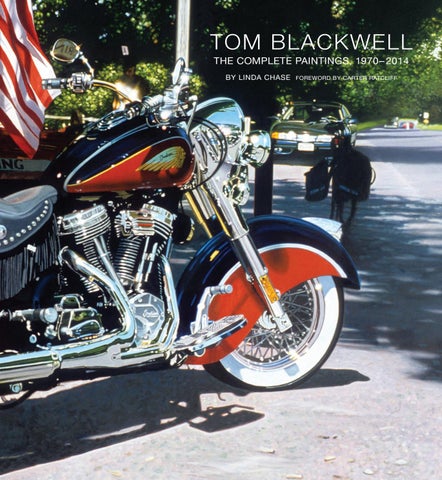
TOM BLACKWELL THE COMPLETE PAINTINGS, 1970 – 2014 BY LINDA CHASE
FOREWORD BY CARTER RATCLIFF
4
5
CONTENTS
PREFACE 9
EASY RIDER IN HIGH ART LOUIS K. MEISEL FOREWORD 11
THE REFLECTIVE SURFACE: ON THE ART OF TOM BLACKWELL CARTER RATCLIFF TOM BLACKWELL: A LIFE IN ART LINDA CHASE THE EARLY YEARS 15 POST-POP TO PHOTOREALISM 25 PAINTING FROM THE PHOTOGRAPH 33 THE MANNEQUIN SERIES 43 THE MONTAGE PAINTINGS 55 PRESENT AND FUTURE TENSE 61
IN THE ARTIST’S WORDS MY PAINTING PROCESS 67 THOUGHTS ON A NEW YORK ART CAREER 73
PLATES 79 LIST OF WORKS NOT ILLUSTRATED 207 ACKNOWLEDGMENTS 209 CHRONOLOGY 211 EXHIBITIONS 215 COLLECTIONS 223 BIBLIOGRAPHY 225 PHOTOGRAPH CREDITS 233 INDEX 235
The artist on a ladder painting Broadway, 1982.
32
PAINTING FROM THE PHOTOGRAPH WHILE THE PUBLIC has been consistently intrigued with both the subject matter and verisimilitude
of Photorealist paintings, the arbiters of art-world taste have remained highly critical if not outright dismissive of the work of these artists. In the context of contemporary art of the late twentieth and early twenty-first centuries, so much of which is based on photo-derived images and for which appropriation has been embraced as a hallmark of the contemporary sensibility, it may seem surprising that the embrace of the photographic source remains an area of contention. To understand both the Photorealist impulse and the art world’s reaction to it, it is worthwhile to look back at the invention of photography in the mid-nineteenth century and to consider the complex and thorny relationship that existed between the two mediums. The impact of the invention of photography on the visual arts was immediate and profound. For painters, it was a love/hate relationship from the start. Many nineteenth-century artists, like the English landscape painter J.M.W. Turner, saw photography as a threat. “This is the end of Art. I am glad I have had my day,” he is said to have declared upon his first viewing of a daguerreotype.5 Other artists, however, found it an aid and an inspiration. Such noted artists as Delacroix, Courbet, Manet, Degas, and Gauguin frequently used photographic source material, but few admitted to doing so for fear that their use of the photograph would be misunderstood. Then, as now, an artist’s use of the photograph was equated with imitation and was apt to be interpreted as a failure of imagination and lack of skill. In spite of the prejudices against such aids, artists since at least the fifteenth century had employed innumerable visual devices in an attempt to achieve a more accurate representation of nature, and the arguments that soon raged over the painter’s use of the photograph had been prefigured by the arguments of eighteenth-century artists over the use of the camera obscura, a boxlike device that used a convex lens to project an image onto a flat surface, known to have been employed by Vermeer and other Dutch masters. Underlying the conflict between the directly perceived and the mechanically derived image is the conflict between imagination and reality as the province of art. Yet, it is essential to note that while those who opposed the use of visual devices always claimed that such representations of nature were inadequate and could not take the place of art, those who supported their use saw them precisely as aids that would serve, not replace, art or the artist. From the first cave paintings until the invention of photography, the history of painting had largely been the history of the artist’s attempt to accurately capture some aspect of the three-dimensional world on a two-dimensional surface. Changes in style reflected both modifications of technique, which built on previous artistic experiments, and different modes of seeing, which reflected the artist’s cultural heritage. Photography altered not only the appearance of art, but also its goals. By seeming to eliminate the need for the artist to reproduce reality and by establishing a new and universal visual language, the invention of photography broke the continuum of art history toward ever greater feats of replication. At the same time that photography, by accomplishing an accurate replication of reality, freed the artist from this historical task, it also enabled him to explore other realms and helped to set in motion the march from Impressionism to Cubism and abstraction. The relationship between photography and the emergence of abstraction is explored in detail by Dorothy Kosinski in her informative work, The Artist and the Camera: Degas to Picasso, an invaluable resource for anyone interested in this topic.6 Suffice it to say that by creating a climate inhospitable to Realism, yet at the same time opening exciting avenues of inspiration to the artist, photography
33
72
THOUGHTS ON A NEW YORK ART CAREER YOU DON’T READ MUCH about the nuts and bolts of an art career but it’s an important part of an
artist’s life and something students often ask about when I talk at colleges. My experience as a Photorealist is probably different from the experience of other artists in some ways because although Photorealism got a lot of attention at first, the mainstream art establishment discounted it and only now is starting to acknowledge its importance. But even getting to the point of having anything you could call a career at all was something. As I’ve said before, just to get a gallery to even look at your work was a daunting process back in the sixties. I remember one incident that I think says it all—my painting Gook had been included in the Human Concern/Personal Torment show at the Whitney Museum in 1969. I had read about the show in one of the art magazines and had sent in some slides, not really expecting much because I didn’t know anybody and nobody knew me. So when I got a call that Robert “Mac” Doty, the curator, was coming down to the loft to look at the work, I was thrilled. Actually, that’s a funny story in itself. The painting was hanging on a big white wall in the loft and was the first thing you saw when you walked in the door. I became pretty good friends with Mac Doty later on, but at the time I found him totally intimidating. I would have found any museum person intimidating, but he had a kind of presence that was particularly daunting. He came in in his gray suit and gray crew cut, and stood in front of the painting and just looked and didn’t say anything, no expression on his face. These were my hippie days so just confronting someone so corporate looking would have made me nervous, not to mention someone with so much power over my career. Or that’s how I saw it at the time. Anyway, he’s standing there like a statue and in the meantime Albert, this little beagle we had, comes running up to him and starts to hump his leg. To say I was mortified is putting it mildly. So I grabbed him by the collar and started to pull him away and poor Albert, who was just a very friendly little dog, was terrified and left a stream of pee as I dragged him across the floor. And all this time, while this little drama was going on, Mac never moved or even twitched. After a few minutes of just staring, he asked me the size of the painting and left.
Tom Blackwell: Solo Exhibition, 1977, Louis K. Meisel Gallery, New York, NY. Photograph: Kenneth Snelson.
Opposite: Blackwell in the studio with Swiss Miss (2008) in progress.
73
PLATE 5
Orphan Annie, 1971. Oil on canvas, 72 × 96 in. (182.9 × 243.8 cm). Private collection.
PLATE 6
Gary’s “Hustler”, 1972. Oil on canvas, 65 ¾ × 66 in. (167 × 167.6 cm). Sentra Museum, Lisbon, Portugal.
84
PLATE 7
Indian’s Chopper II, 1971. Oil on canvas, 96 × 78 in. (243.8 × 198.1 cm). Private collection.
85
PLATE 130
Sagaponack Sunday, 2003. Oil on linen, 48 × 72 in. (121.9 × 182.9 cm). Private collection.
150
151
PLATE 168
Exiting Celine, Monaco, 2014. Oil on canvas, 52 × 80 in. (132.1 × 203.2 cm). Private collection.
177
First Edition © 2015 The Artist Book Foundation All rights reserved under International and Pan-American Copyright Convention. Except for legitimate excerpts customary in review or scholarly publications, no part of this publication may be reproduced or transmitted in any form or by any means, electronic or mechanical, including photocopying, recording, or information storage or retrieval systems, without permission in writing from the publisher. Published in the United States by The Artist Book Foundation 115 East 57th Street, 11th floor, New York, New York 10022 Distributed in the United States, its territories and possessions, and Canada by ARTBOOK LLC D.A.P. | Distributed Art Publishers, Inc. www.artbook.com Distributed outside North America by ACC Distribution www.accdistribution.com/uk Publisher and Co-founder: Leslie Pell van Breen Co-founder: H. Gibbs Taylor, Jr. Production Manager: David Skolkin Design: David Skolkin & Masumi Shabata Editor: Deborah Thompson Proofreader: Marisa Crumb Indexer: Barbara E. Smith Printed and bound by Elcograf Manufactured in Italy ISBN 978-0-9888557-7-9 Library of Congress Cataloging-in-Publication Data Chase, Linda, 1942- author. Tom Blackwell : the complete paintings, 1970/2014 / By Linda Chase ; Preface By Louis K. Meisel ; Foreword By Carter Ratcliff ; Research And Documentation By Elizabeth K. Harris. -- First Edition. pages cm Includes bibliographical references and index. ISBN 978-0-9888557-7-9 1. Blackwell, Tom, 1938---Catalogues raisonnés. I. Meisel, Louis K., writer of preface. II. Ratcliff, Carter, writer of foreword. III. Harris, Elizabeth K. IV. Blackwell, Tom, 1938- Paintings. V. Title. ND237.B5957A4 2015 759.13--dc23 2015010262 Cover: Sagaponack Sunday, 2003. Oil on linen, 48 x 72 in. (121.9 x 182.9 cm). Private collection. Plate 130. Frontispiece: Kiss Kiss (Self-Portrait), 2014. Oil on canvas, 9 x 6 in. (22.9 x 15.2 cm). Collection of the artist. Plate 167. Spread (pp. 4–5): The artist working on Exiting Celine, Monaco, 2014. Plate 168.