CONTENTS Foreword
vii
Explanation of Cataloguing Terms
viii
Important Chippendale Customers and Commissions Represented in this Catalogue Exhibition Catalogue
1 9–201
omas Chippendale’s Life and Career
10
Chippendale and Rococo
32
‘Chinese Chippendale’
56
Gothic
74
Classicism and the Transition to the Antique 84 e Antique Style
96
Customers
148
Legacy
182
Postscript
202
References and Bibliography
205
Picture Credits
208
F O R E WO R D omas Chippendale is still without doubt the most famous furniture maker and designer of Georgian Britain. For at least 150 years his name has been synonymous with beautifully made furniture in a restrained (or sometimes notso-restrained) Rococo style, and very obviously British. e fact that some of his finest work, and that of his workshop, belongs to the later neo-Classical period has also long been recognised and has only served to add to his reputation. It seems appropriate that a major exhibition should be held in Leeds in 2018, the tercentenary of Chippendale’s birth in Otley, just twelve miles north-west of the city. e Chippendale Society, founded in 1965 to promote appreciation of the work of omas Chippendale Senior and Junior, has taken the lead in co-ordinating a nation-wide celebration of his work and legacy with a group of historic houses and organisations collectively known as Chippendale 300. Each of the participating members is arranging its own programme of events to bring the achievements of the ‘Shakespeare’ of English cabinet-makers to a wider public. e exhibition omas Chippendale: a celebration of British crasmanship and design 1718–1779 is the first of these events and is intended to be a flagship for the rest of the project. It is a partnership between Leeds Museums and Galleries and the Chippendale Society: the former providing the exhibition organisation, and the latter most of the funding and the curatorial expertise. e Society is greatly indebted to John Roles, Head of Service, and his dedicated team for their hard work and forbearance during the long period of preparation, particularly Ruth Martin, Exhibitions Curator, Jen Kaines, Collections Manager, and Christine Bradley, Project Registrar. Leeds Museums and Galleries are supported by Leeds City Council and Arts Council England. ere have been several exhibitions devoted to Chippendale: since 1951 they have almost all been held at Leeds and it is instructive to see how their approach has changed. We hope that this exhibition, being held in a neutral space at the Museum in which the objects can be appreciated as individual works of art on their own terms and in interesting juxtapositions, will enable visitors to enjoy some of the finest English furniture of the eighteenth century. We have tried not to be dogmatic: not everything in the exhibition is by
Chippendale, or even from his workshop. Even so, they all have a story to tell of their relationship to the great man. By bringing the tale up to the present day we have suggested how his legacy has permeated into our collective national consciousness. is publication has been generously supported by Ronald Phillips, John Morton Morris, the Nicholas and Judith Goodison Charitable Trust, the Furniture History Society, Mr and Mrs Patrick Walker, Mr and Mrs David Kirkby, Lisa White and Mr omas Lange, to all of whom we are very grateful. e principal sponsor of the exhibition is e Monument Trust which has been a long-term supporter of the Chippendale Society. We have also been generously supported by the Leeds Art Fund (Christopher Gilbert Fund), Ronald Phillips, Tomasso Brothers Fine Art, Last Cawthra Feather, Godson and Coles Ltd, Apter Fredericks Ltd, the Leeds Philosophical and Literary Society, Charles Lumb & Son, T. L. Phelps Fine Furniture Restoration, the Verdon Smith Charitable Trust, Lisa White, Butchoff Antiques, Arthur Brett, omas Coulborn and Sons, the Friends of Leeds City Museums, the Friends of the Historic Houses Association, de Gournay, and by others who wish to remain anonymous. We have been greatly encouraged by their enthusiasm and help. We are indebted to the lenders to the exhibition and their staff who have facilitated our requests for loans, led by Her Majesty e Queen and the Royal Collections Trust; the Prince of Wales and the Great Steward of Scotland’s Dumfries House Trust (Charlotte Rostek); the Marquis of Downshire; the Earl and Countess of Harewood and the staff of the Harewood House Trust (Ann Sumner, MarieAstrid Martin, Rebecca Burton); Lord Ronaldshay; Lord St Oswald (President of the Chippendale Society); Mr and Mrs Richard Compton; Michael Lipitch; the Trustees of the Victoria and Albert Museum (Leela Meinertas); the National Museums on Merseyside at the Lady Lever Art Gallery (Alyson Pollard); the National Trust at Nostell Priory (Christopher Rowell, Sarah Crane and Simon McCormack); the Trustees of the Firle Settled Estates and Deborah Gage; the Paxton House Trust (Fiona Salvesen vii
I M P O RTA N T C H I P P E N D A L E C U S TO M E R S A N D C O M M I S S I O N S R E P R E S E N T E D I N T H I S C ATA LO G U E William Constable (Cat. 6.16, 7.10) William Constable (1721–1791) inherited the Tudor mansion of Burton Constable Hall in 1747 (1). He was a highly intelligent, intellectually curious and cultured man who undertook three Grand Tours of Europe. As a Catholic he was barred from public office and so devoted his energies to intellectual and artistic pursuits, and to improving his rambling, old fashioned house. Having considered more prestigious London-based architects, Constable in the end chose a local man, Timothy Lightoler, to carry out the work. Much of the furniture was also supplied by local crasmen from Hull and York, and this part of the collection remains one of the unique features of the house. For his London house in Mansfield Street Constable chose Chippendale. William Constable’s account with Chippendale opened in 1768, with a payment for a ‘Walnut Gouty Chair’ and matching stool. It was followed in 1772 by an unusual horseshoe-shaped table ordered by William’s sister Winifred. In 1774 Chippendale’s men completely furnished three rooms at Mansfield Street – bedchamber, ante-room and drawing room. e style was neat and fashionable, but not opulent, as befitted a bachelor of a certain age. When Constable gave up the house in 1784 the furniture was sent up to Burton Constable where, despite disposals over the years, a large proportion of it remains. When Constable married in 1775 he embarked on a new phase of work at Burton Constable, this time under the supervision of James Wyatt, whose ambitious plans probably reflected Constable’s newly married status. For furniture Constable turned once again to Chippendale, who fitted out the Great Drawing Room with gilt pier glasses, tables, a matching chimney glass and a large suite of seat furniture, almost all of which survives. Chippendale also supplied smaller objects such as fire screens and occasional tables. By the time the room was completed in 1778 Constable had spent at least £1,106, not including the cost of the vast mirror plates nor the specimen marble pier table tops. As with many
1
commissions of the mid to late 1770s it is likely that omas Chippendale Jnr. was responsible for much of it, including designing the pier and chimney glasses to match Wyatt’s decorative plaster and woodwork. Burton Constable Hall is still the home of William Constable’s descendants, but the house and most of its collections are now owned by Leeds Museums and Galleries and managed by a charitable trust, the Burton Constable Foundation.
The 5th Earl of Dumfries (Cat. 2.2, 2.3, 2.4, 7.3) William Dalrymple-Crichton (1699–1769) inherited the title of Earl of Dumfries in 1742. He commissioned John and Robert Adam to build a new house on his estate near Cumnock, in southwest Scotland, in 1754, and the house was completed in 1759 (2). Furniture for the new house was supplied by a combination of London and Edinburgh makers, but it was Chippendale who supplied the bulk of the furniture for the principal rooms. Because the Earl was in a hurry to complete his house, and because he wanted to avoid undue expense, it is likely that most of the Dumfries furniture was made to standard workshop designs rather Commissions | 1
2
than specially commissioned, and hence the Dumfries commission may be said fairly to represent the Chippendale workshop style of the late 1750s and early 1760s. Among the furniture made for Dumfries were several pieces relating either directly or closely to designs in the 1762 Director, including a pair of girandoles (pl. LXXVIII), a hall lantern (pl. CLIII) and a state bed (pl. XXXIX). Both the latter explicitly refer to the Earl of Dumfries, suggesting one way in which Chippendale used his patron’s prestige to 3
2 | Commissions
promote his business. Equally significant is the fact that the Edinburgh maker Alexander Peter supplied furniture to the Earl based on Director designs; whether Chippendale was flattered or incensed by such plagiarism is not known, but presumably he understood the risks of making his designs so widely available. Virtually all the furniture supplied by Chippendale to Dumfries has survived. e collection’s remarkable integrity is largely due to a period of benign neglect aer the house was inherited by the 2nd Marquess of Bute in 1814. Since the Bute family’s principal house was at Mount Stuart, Isle of Bute, Dumfries was little used for most of the 19th and 20th centuries. In 2007 it was sold, complete with its contents, to a consortium led by the Prince of Wales, the Scottish government and several heritage charities. It is now managed and maintained by e Great Steward of Scotland’s Dumfries House Trust.
Sir Lawrence Dundas (Cat. 5.1, 5.2, 5.3, 6.2, 7.22) Sir Lawrence Dundas (c. 1710–1781) was a Scottish landowner, politician and businessman who made a fortune from military supply contracts during the Seven Years War (1756–63). In 1762 he bought Aske Hall (3), near Richmond, Yorkshire, thereby acquiring the Parliamentary seat of Richmond. In the following decade Dundas used his new
7.22 Bill for furniture supplied to Sir Lawrence Dundas, July 1763 – January 1766 Foolscap, 13 × 8 (33 × 20) Handwritten, ink on paper Provenance: Sir Lawrence Dundas, and thence by descent Literature: Gilbert (1978), I, pp. 154–9 Exhibitions: Temple Newsam, 1968 (14) Lent by North Yorkshire County Record Office
A successful furniture business relied as heavily on its paperwork and book keeping as it did on its crasmanship. is neatly written document, covering just over five sides of foolscap, would have been the last in a long trail of paperwork generated by the Dundas commission, including correspondence between Chippendale and Sir Lawrence Dundas, preparatory drawings for approval, estimates, revisions, orders to subcontractors and suppliers, jotted tallies of materials consumed and workmen’s time spent, payments and receipts, and fair copies finally written into large, leatherbound ledgers. is fair copy was sent to Sir Lawrence Dundas as a receipt, to record the final payment of Chippendale’s account on 1 August 1766. It is signed by omas Haig, Chippendale’s principal book-keeper, who in 1771 also became his business partner. e bill covers almost all the furniture supplied by the Chippendale workshop to Sir Lawrence Dundas in the 1760s. Most of the furniture was for the London house in Arlington Street but some was destined for Aske Hall in Yorkshire. e latter items can be identified by the carefully enumerated charges for packing, which included packing cases and ‘Matts’ to pad and protect goods in transit. Even the nails and screws used for the packing cases were charged, and there were also charges for cartage to get the goods to the wharfe at the London docks and to cover incidental costs there. e total of £1123 was substantial, but in fact Chippendale was only one of several top London furniture makers used by Dundas, and his bill was one of the smaller ones. With the exception of two spectacular suites of seat furniture (Cat 5.1 & 5.2), the majority of furniture which Chippendale supplied was cabinet-work, mostly in mahogany and much of it described as
178 | Customers
‘fine’ or ‘very fine’ wood. Dundas was highly selective in his patronage and divided it between several of the capital’s top furniture firms. As well as Chippendale, he employed John Cobb and William Vile, Samuel Norman, James Lawson and William France. ere were several advantages to this division of his custom. First, it was a kind of insurance, so that Dundas was not too dependent on any one tradesman, and each knew that if the work was not satisfactory Dundas could go elsewhere. Second, different furniture makers had different
strengths and weaknesses; Dundas clearly thought that cabinet work was one of Chippendale’s strengths. Most of the upholstery, on the other hand, went to William France and Samuel Norman. Norman was also responsible for much of the carved and gilded work at several Dundas houses. All but Aske Hall have since been sold and most of Sir Lawrence’s furnishings have been lost, but fortunately most of Chippendale’s work survives, having been moved to Aske in the 19th and 20th centuries.
3
2
Customers | 179
8.2 American furniture derived from Chippendale designs Images lent by Mrs Linda H. Kaufman; Museum of Early Southern Decorative Arts; Winterthur Museum, Garden and Library
By the middle of the 18th century there were well-established furniture making traditions in most British North American colonies, each with a distinctive regional style developed to suit a mainly local clientele. Nevertheless, both the makers and their customers kept an eye on London, which was still regarded as the source of all that was new and fashionable in furniture design. As well as regular importations of London-made furniture, there was a steady flow of immigrant English crasmen bringing with them the latest London styles and techniques, while booksellers retailed printed design books from the presses of London and other European capitals. e Director may have reached North America as early as 1755. A number of prominent 18th century American furniture-makers are known to have owned copies and some even used Chippendale’s designs for their own trade cards. However, the highly-wrought Rococo style did not find universal favour among the generally pragmatic colonists. ere is little evidence of Director influence in Boston (although a decade later Robert Manwaring’s Cabinet and Chairmaker’s Real Friend and Companion was certainly influential), and scarcely more in New York, but in Philadelphia and Charleston the book had a definite impact, particularly the third edition of 1762. By 1760 Philadelphia was the largest and most populous city in British North America, and one where the Rococo style in furniture was enthusiastically adopted. omas Affleck and Benjamin Randolph, two of Philadelphia’s most prominent furniture makers, owned copies of the Director, and chairs attributed to them and other Philadelphia makers demonstrate a close relationship with several Chippendale designs. As in Britain, the design was rarely copied without modification, and the result was Chippendale with a pronounced Philadelphia accent (1, 2, 3). is ultimately became the style most closely associated with the late 19th- and early 20th-century American Chippendale revival (Cat 8.10). Examples of Philadelphia case furniture made to Chippendale designs also survive (4).
1
Further south, the port of Charleston, South Carolina, was probably as closely connected, both commercially and politically, to London as to American cities further north. Some Charleston furniture is almost indistinguishable from that made in London, and at least one surviving example was taken from a Director plate (5). Other examples attributed to makers in the southern and middle colonies are also known, such as the table attributed to William Buckland, of Richmond County, Virginia, who had a copy of the 1754 Director in his possession when he died in 1774 (6). Isolated examples by unknown makers also occur elsewhere in the south (7). (Continued on page 188) 1a 186 | Legacy
2
3
2a
3a Key to images: 1
Chair, c. 1770, Philadelphia, by Thomas Affleck
1a Detail from the Director (1754), pl. XVI 2
Chair, 1765–75, Philadelphia, attributed to Martin Jugiez and Nicholas Bernard,
2a Detail from the Director (1754), pl. XI 3
Chair, 1763–80, Philadelphia, unknown maker
3a Detail from the Director (1762), pl. IX
Legacy | 187
8.12 Bookcase, c. 2000 98½ × 79 × 25 (250 × 201× 63) Mahogany, ebony and other woods Provenance: Arthur Brett Lent by Arthur Brett
e design of this bookcase is inspired by a combination of Chippendale designs, especially those made for the Earl of Pembroke at Wilton House near Salisbury, c. 1760–2. It was made by crasmen from Arthur Brett, a Norwich-based furniture company which dates back to the 1870s. In 1921 the original company, J. Brett & Sons, split into an antiques business and a furniture-making business which became Arthur Brett & Sons. Aer the Second World War Arthur Brett & Sons established a reputation for making top quality English furniture, much of it modelled on historic furniture of the 18th and early 19th centuries. As Arthur Brett, the modern firm continues to make furniture for customers from every continent. In 1995 the bookcase design was awarded the cra Guildmark from the Worshipful Company of Furniture Makers (2). It took more than 600 hours to complete and involved the work of expert cabinet makers, carvers and polishers. In order to keep alive the skills necessary to produce work of this kind, the firm has its own apprentice scheme. A number of independent British furniture makers, restorers and conservators started their careers with Arthur Brett in Norwich. Sourcing the timber necessary for work of this kind is increasingly difficult. e trade in all species of American mahogany, as well as many other tropical hardwoods, is restricted by CITES agreements and it is difficult to find wood of the quality available in the 18th and 19th centuries. It is possible that in the near future furniture of this kind, based on 18th-century designs and using the same materials as in the 18th century, will either no longer be made or will be made with alternative materials and methods.
200 | Legacy
2
Legacy | 201
POSTSCR IPT omas Chippendale died of consumption (tuberculosis) and was buried in the North Old Ground of St Martin-inthe Fields on 13 November 1779 (1 Chippendale’s name highlighted). e National Gallery now stands on the site. According to his probate inventory he was in lodgings at Hoxton, east London, when he died. What was Chippendale doing in Hoxton? Given the nature of his illness it is probable he went there for treatment. Since the 17th century the area had become a place of retirement for city merchants and tradesmen, and a number of almshouses had been built to shelter the less affluent. In the 18th century it was still a quiet village, with a reputation for good air and healthy living. According to an account of expenses attached to Chippendale’s probate inventory, his son, omas Jnr, had to settle a lodging bill of four guineas and a physician’s bill of five guineas. e body was presumably removed to St Martin’s Lane for the funeral, which cost £24 1s, a considerable sum. At the churchyard the sexton charged £2 7s 4d for burial and prayers. Chippendale’s probate inventory and its associated documents reveal that despite and long and celebrated career he was not a rich man. His household goods were valued at £28 2s 9d, and his one-third share in the business was worth a further £288 19s 8d. In combination with the shares of his partners, omas Haig and Henry Ferguson, the whole business was valued at less than £1000, ‘exclusive of bad debts’. By contrast, in 1757 the business had been insured for £5100. Even had the bad debts been paid, they would have added only £1600, but there was probably little prospect of that. What was worse, Chippendale’s widow was being sued for a bond of more than £1100 which, even if divided equally among the partners, would have wiped out all her remaining assets.
died in 1766 Chippendale found himself exposed to Rannie’s creditors, owing money which he could not pay except by selling off the partnership’s stock in trade: TO be SOLD by AUCTION By MR. PERVIL On Monday, the 24th instant, and the following days. THE entire genuine and valuable Stock in Trade of Mr. CHIPPENDALE and his late Partner Mr. RENNIE, deceased, Cabinet-makers and Upholsterers, at their House in St Martin’s Lane, consisting of a great Variety of fine Mahogany and Tulup Wood, Cabinets, Desks, and Book-Cases, Cloaths Presses, double Chests of Drawers, Commodes, Buroes, fine Library, Writing, Card, Dining and other Tables, Turky and other Carpets, one of which is 13 Feet by 19 Feet six, fine Pattern chairs, and sundry other Pieces of curious Cabinet Work, a large parcel of fine season’t Feathers; as also all the large unwrought Stock, consisting of fine Mahogany and other Woods, in Plank, Boards, Vanier, and Wainscot.
Chippendale was still trying to pay off Rannie’s creditors as late as 1770, and this debt must have acted as a drag on the business. e appointment of former book-keeper omas Haig as partner, together with the mysterious Henry Ferguson, about 1771, may have staved off immediate financial difficulties but it probably le Chippendale permanently short of personal capital, as his probate inventory reveals. While the final decade of Chippendale’s life was arguably his most prolific and accomplished as a furniture maker/designer, and the furniture he created for a score of illustrious clients ranks among the finest ever conceived and made in Britain, it did not make him rich.
Chippendale was survived by his second wife, Elizabeth, and four children – omas Jnr, Mary, John and Charles. e latter two were very young, having been born in February 1779 and June 1780 respectively (Elizabeth must have been pregnant when her husband died). omas Jnr (1749–1822), In financial terms, therefore, omas Chippendale’s career now aged thirty, succeeded his father in the business with was not a success. Like many a talented artist and crasman which he had been involved since at least 1767, and before and since, Chippendale lacked capital; that was continued the partnership with omas Haig. As well as his presumably where James Rannie came in, providing the father’s prodigious talent omas Jnr also inherited his money both to publish the Director and to set up the financial burdens, being declared bankrupt when called upon workshops in St Martin’s Lane. But in the light of later events to settle omas Haig’s estate aer the latter’s death in May it is likely that the terms of the partnership were not 1803. He nevertheless continued in trade almost until his favourable to Chippendale and did not enable him to benefit death in 1823; his true worth as a furniture designer is only fully from the firm’s apparent success. Indeed, when Rannie now beginning to be appreciated. 202 | Postscript
Postscript | 203
James Lomax is the Hon Curator of the Chippendale Society and worked as a museum curator at Temple Newsam, Leeds (the home of the Chippendale Society’s collections) for 30 years. He has curated numerous exhibitions and published widely on the decorative arts. He is President of the Silver Society.
The Chippendale Society was founded in Otley in 1965 to promote the appreciation and understanding of the work of omas Chippendale Senior and Junior. http://thechippendalesociety.co.uk/
back: Drawing for a Lady’s Dressing Table, 1761, ink and colour wash. Metropolitan Museum of Art, New York (Rogers Fund, 1920)
ISBN 9781999922917
THE CHIPPENDALE SOCIETY
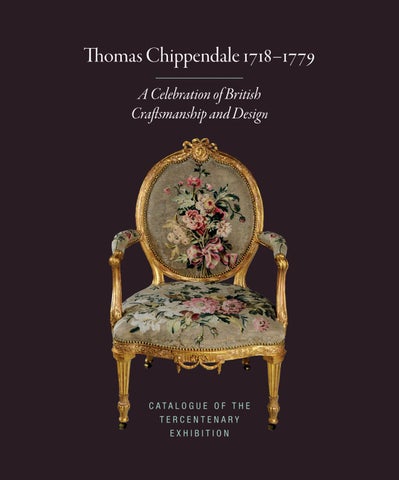
dust jacket illustrations front: Armchair, c. 1774, from the Tapestry Drawing Room, Newby Hall. Mr and Mrs Richard Compton
A Celebrion of Brith Crasmanship and Design
Adam Bowett and James Lomax
e exhibition is the lead event of the Chippendale 300 project, an association of historic houses and organisations with links to Chippendale who are co-ordinating their efforts in providing events, exhibitions and learning opportunities during the tercentenary year 2018. http://chippendale300.co.uk/
omas Chippendale 1718–1779
A Celebration of British Crasmanship and Design
Dr Adam Bowett is the Chairman of the Chippendale Society and an independent furniture historian. He has published widely in popular and scholarly journals and has written three books on English furniture.
omas Chippendale 1718–1779
T
his catalogue accompanies the Chippendale tercentenary exhibition at Leeds City Museum, 9 February – 9 June 2018. Each of the 95 exhibits is fully illustrated with the accompanying text exploring its design, context and significance. e catalogue covers Chippendale’s life and career; the different styles in which he worked – Gothic, Chinese, ‘Modern’ (Rococo), and neo-Classical; his relationship with his customers; and his enduring legacy up to the present day. ere is a wide range of furniture and objects included, some newly discovered and published here for the first time. ey include spectacular pieces from grand interiors to everyday items used by servants and families. Techniques represented range from virtuoso carving and gilding to ‘japanning’, marquetry, and cabinet making. Chippendale’s particular skill as a draughtsman and designer is represented by a number of drawings for his great book e Gentleman and Cabinet-Maker’s Director. Its influence is an underlying theme throughout the exhibition. e catalogue is the first major book on omas Chippendale since Christopher Gilbert’s seminal work of 1978. It celebrates the full range of Chippendale’s genius and justifies his status as the ‘Shakespeare’ of British cabinet makers.
CATALOGUE OF THE TERCENTENARY EXHIBITION