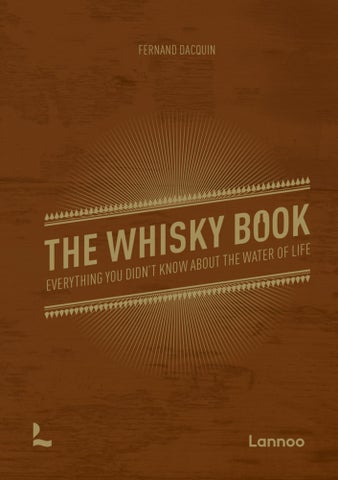
Fernand Dacquin travelled the world for forty years writing for a tourism magazine and for whisky magazines. Wherever he went he collected anecdotes, facts, and stories about whisky. Given its rich whisky heritage, Scotland was a recurrent theme in all of this. From his copious collection of travel notes he distilled about a hundred short whisky stories. They are bundled into this book. When the Dutch edition was published in 2020, Charles MacLean wrote the following in his preface: “The topics Fernand has chosen to write about in this book are staggeringly eclectic and born of his own global travels: entertaining, surprising, informative (I learned a lot!), and opinionated (in a gentle way!).” I don’t know what else can be added to that. It is a bounteous book that you can dip into, starting and finishing on any page. Because of its compact size, an added bonus is that you always have a hand free for a wee dram.
S T N E T N O C
I have no hesitation in recommending this book to every whisky lover, and especially to those who love a good yarn.
6
1 Whisky or whiskey? – What a mess
13
2 Lindores Abbey – Thanks to dear old brother John Cor
17
3 Muckle Flugga – The whisky nabody knows
23
4 Du Kang – The god of whisky (and the rest)
27
5 Thou demon drink – Poetry vs alcohol
29
6 Drambuie – Bonnie Prince Charlies’ whisky
33
7 ‘If by whiskey…’ – The famous whiskey speech
37
8 Borvo – Gallic god of whiskey
41
9 Martin Martin – The father of the first ‘tasting notes’
47
7
2
Y E B B A S LINDORE THANK
L D B RO T H E S TO D E A R O
R J O H N CO R
‘By order of the king, eight bolls of malt for Brother John Cor to make aqua vitae.’ Had no one ever found that little phrase in the Scottish Exchequer Rolls of 1495 (the King’s annual financial report), Lindores Abbey would likely have been lost in history. By ‘the King’, the writer refers to James IV, who we know was a very moderate drinker. ‘Brother John Cor’ refers to the brewer-distiller at Lindores Abbey, and with eight ‘bolls of malt’, that diligent brother is said to have been able to distill about 250 litres of alcohol (according to experts): aqua vitae. And that aqua vitae, or ‘water of life’, would have been called “whisky” today. Not bad as a stock. 17
Monastic atmosphere in the distillery.
Monastic atmosphere in the distillery.
6
E I U B M A DR
CE CHA BONNIE PRIN
RLES’ WHIS
KY
The MacKinnon clan is not one of the largest in Scotland, but it has a nice history. The first King of the Picts and the first King of Scotland was Kenneth MacAlpin. It’s a good start to have such an ancestor. Throughout the history of Scotland, you will occasionally find the name MacKinnon, but it’s usually not associated with the most heroic circumstances. That is, until Bonnie Prince Charles, the most romantic figure in Scottish history, arrives on the scene. This Charles was the grandson of James VII of Scotland, who had to leave the country as a Catholic when the Reformers got the upper hand. James VII was replaced by his son-in-law, William III of Orange, a Protestant. A couple of years later, Bonnie Prince Charles, then living in France and Italy, was convinced that he was the rightful heir to the throne of Scotland.
33
The Battle of Long Island.
The Battle of Long Island.
11
0 3 8 1 G R U COB B E LG THE ‘FIRST’
IAN WHISKY
A colourful full-page advertisement appeared in all Belgian newspapers on March 11, 1999. In both the Dutch and French languages. They brought out the good news: a twelve-year-old single malt was to be marketed in Belgium. The very first whisky ‘made in Belgium’: a whisky called Coburg 1830. The bottle could not have been more Belgian. The headline referred to the Belgian national motto: ‘Eendracht maakt macht’ (‘Unity gives strength’). A three-colored ribbon ran from top to bottom: black, yellow, and red. Belgium’s national colours were repeated all over the bottle. The name of the whisky spoke volumes: ‘1830’ was the year of Belgian independence, and ‘Coburg’ referred to the Royal House: Saxe-Coburg and Gotha. (After the First World War, the descendants changed their name wisely to ‘from Belgium’.) It was a somewhat odd combination. The brand new country, Belgium, made no mention of the Coburgs. At the time, the Belgians were still combing through foreign nobility, 57
Barrels at Ardbeg distillery.
Barrels at Ardbeg distillery.
20
WI
L L I H C R U H C N O T S N A LC O H O L O R
N OT?
On December 12, 1899, during the Boer War in South Africa, a man named Winston Churchill, aged 25, escaped from a prisoner of war camp in Pretoria. He had been captured with British soldiers a month earlier. He was there as a reporter for the Morning Post and, being a journalist, was entitled to be released immediately. But the Boers believed he had fought (he had a weapon in his possession) and they would not let him go. Churchill escaped through the toilets. The Boers immediately put a £25 bounty on his head. But he was already far away, riding on trains as a stowaway and eventually knocking on the door of a coalmine manager, who happened to be a Brit. The manager hid him in a mine shaft for three days and then put him on a train to Mozambique. Churchill immediately returned to South Africa and re-joined the British.
95
44
TAIWAN STRONG RIS
ER
In Taiwan, it was ear-splittingly quiet on the whisky front, unlike in Japan where the industry had been booming for a long time. When we compare the countries’ whisky histories, there is a clear difference. 1923: first whisky at Yamazaki in Japan. 2006: first whisky at Kavalan in Taiwan. Barley grows well in Japan. There is very little barley in Taiwan. But that’s not the real reason. In 1901, when the Japanese occupied Taiwan, they established a state company that controlled just about everything that could be controlled: The Monopoly Bureau of the Taiwan Governor’s Office. That company had the monopoly on the production and sale of cigarettes, wines, beers, distillates and petroleum products. Even the standardization of weights and measures was decided by that Bureau. After World War II, Taiwan was ruled by the Chinese nationalists who took over the office. They renamed it The Taiwan Provincial Monopoly Bureau. The objectives remained the same as before. Wines and spirits are still not allowed to be produced or imported in Taiwan. 173
Andy Watts.
Andy Watts.
www.lannoo.com Register on our website and we will regularly send you a newsletter with information about our latest books as well as interesting, exclusive offers. Text: Fernand Dacquin Graphic design: EHBOntwerp Typesetting: Keppie & Keppie Photography: Fernand Dacquin: all, except Shutterstock: 22, 41, 60, 86-87, 102, 124, 130, 157, 192, 230 / Wikimedia Commons: 30, 33, 37, 40, 94, 98, 113, 114, 116, 132, 144, 153, 167, 198, 214, 217, 256, 259, 260, 276, 311 / Wivine Vernieuwe: 46, 190, 234, 339, 341, 343 / Dr Macro: 61, 62, 64 / Kavalan Distillery: 176 / Buena Vista Winery: 92, 93 / Hergé-Moulinsart 2013: 100, 101 / Shannon Tofts: 110, 145, 146 / Ralph Steadman: 126, 129 / Lost Clock Productions: 148 / Firmin Lemaître: 151, 163, 338, 345, 349 / Stefaan Lesage: 168 / William Grant & Sons: 196 / Glenfarclas Distillery: 80, 159 / James Sedgwick Distillery: 318-319 / American Whiskey Trail: 219, 220 / Archive.org: 48, 49 / City of Vancouver Archives: 71 / Clyde Maritime: 88 / Banknote index: 89 / Welcome Library London: 122 / National Galleries of Scotland: 144. If you have any comments or questions, please contact our editors: redactielifestyle@lannoo.com © Fernand Dacquin & Uitgeverij Lannoo nv, Tielt, 20211 D/2021/45/622 – NUR 440, 447 ISBN: 978 94 014 7958 5 All rights reserved. Nothing from this edition may be reproduced, recorded in an automated database and/or published in any form or in any way, whether electronic, mechanical or in any other manner without the prior written permission of the publisher.