CONTENTS INTRODUCTION Paul Michael Taylor
6
PART I. THE JAPJI IN CONTEXT
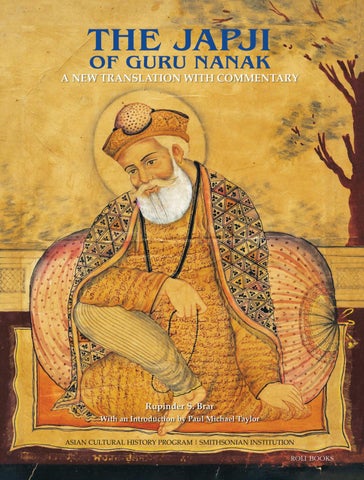
First Indian Edition Translation and text (except Introduction) © 2019 Rupinder Singh Brar The publication of this translation and commentary has been carried out as an activity of the Sikh Heritage Project, an initiative of the Smithsonian’s Asian Cultural History Program, in conjunction with the commemoration of the 550th anniversary of the birth of Guru Nanak (1469-2019). Originally published by Asian Cultural History Program, Smithsonian Institution (Washington, DC, USA), 2019. Original design by KI Graphics (Springfield, Virginia). ISBN: 978-81-942959-3-8 Published in India by Roli Books M-75, Greater Kailash II Market New Delhi 110 048, India. Phone: ++91-11-40682000 Email: info@rolibooks.com Website: www.rolibooks.com Printed and bound in India by Samrat Offset Pvt. Ltd., New Delhi
Frontispiece: The Ten Gurus and Guru Gobind Singh’s Four Sons Artist Unknown Gouache on paper, 20.6 x 16.6 cm Early 19th century Courtesy of the Kapany Collection of Sikh Art
Chapter 1. Reading Guru Nanak in the Third Millennium
15
Chapter 2. “As Appeared the True Guru Nanak“
21
Chapter 3. The Japji as Literature
29
Chapter 4. The Japji as Philosophy: Between Reason and Faith
35
PART II. THE JAPJI: TEXT, TRANSLITERATION, AND TRANSLATION Chapter 5. The Japji Verses
46
PART III. INTERPRETING THE JAPJI: VIRTUE AND GRACE Chapter 6. Being Human: Understanding the Five Khands of Japji
95
Chapter 7. Cultivating Virtue: The Dharam Khand
105
Chapter 8. Shattering Ego: The Gyan Khand
113
Chapter 9. Creating Mindfulness: The Saram Khand
121
Chapter 10. Taming Desire: The Karam Khand
127
Chapter 11. Transcendence and Eternity: The Sach Khand
135
Chapter 12. Virtue and Grace: Living in Harmony with the Five Khands
141
PART IV. EPILOGUE Chapter 13. The House of Nanak
149
ACKNOWLEDGMENTS
155
NOTES
157
BIBLIOGRAPHY
163
INTRODUCTION Paul Michael Taylor One: all pervading, fundamental reality, is True Naam. Mover and shaker, without fear or rival. Timeless. Beyond life and death, Self-created. By his grace.
Covering for the Guru Granth Sahib, depicting the Ten Gurus Embroidered silk, 78 x 81 cm c. 19th century The Khanuja Family Collection Photography by Mike Lundgren Courtesy of Phoenix Art Museum
So begins the Japji, by far the best-known work of Guru Nanak (1469-1539) – poet, philosopher, historian, composer, First Sikh Guru and founder of the Sikh faith. Many Sikhs recite its sacred verses daily. Dr. Rupinder Singh Brar provides in this book a compelling new translation with commentary on this work (whose title derives from the root “jap-” meaning to recite or chant). He also examines its core concepts including Naam (meaning both “name” and “substance”), and presents the Japji as a condensed summary of Guru Nanak’s philosophy. The Japji composition constitutes the initial verses of the Sikh holy book, the Guru Granth Sahib, which was compiled during the time of the ten Sikh Gurus, beginning with Guru Nanak, and which is considered the successor of the human Gurus themselves. The earliest compilation of Sikh scripture was completed by the fifth Guru, Guru Arjan, in the first decade of the seventeenth century and included the writings of not only the first five Gurus (including the Japji verses), but also of Muslim, Hindu, and other Sikh holy men and poets. This early compilation was installed in the Darbar Sahib Gurdwara (now known as the “Golden Temple,” Amritsar) by Guru Arjan in 1604. The final compilation of Sikh scripture was brought together by the tenth and last human Guru, Guru Gobind Singh, who added the writings of his predecessor, Guru Tegh Bahadur, then ended the line of human Gurus by installing the compiled scripture as his own successor. It is this final compilation that became known as the Guru Granth Sahib and remains the eternal Guru and sacred text of the Sikhs. Dr. Brar notes that, perhaps due to its exalted status as a sacred religious text, the Japji remains under-appreciated as a literary and philosophical gem, and that its importance within South Asia’s literary and cultural heritage is still little
7
as Dr. Brar so clearly recounts. This was the foundation of the Sikh religion, and Guru Nanak’s nine successor Gurus developed Guru Nanak’s followers into a cohesive community with its own literature, beliefs, art, traditions, and institutions. Dr. Brar’s first great accomplishment in the present volume is that he has made Guru Nanak’s life and particularly his writing so accessible and understandable to today’s audiences. Surely his skills in this area must have been developed not only through his personal devotion and study, but also his years of teaching Sunday School classes to Sikh-American and other students of all ages. A second very worthwhile accomplishment is this book’s exploration of the many ways in which Guru Nanak’s philosophy is as relevant to us all in the twenty-first century, as it was 550 years ago. On behalf of the Smithsonian’s Asian Cultural History Program, I sincerely thank Dr. Rupinder S. Brar for his scholarly contribution in creating this book, and his patience throughout the review and editorial process. Our Program’s past work with art publications and exhibitions (for which we thank all past supporters of the Smithsonian Sikh Heritage Fund) enabled us to supplement his writing with illustrations that will surely add to the reader’s experience. This would not have been possible without the generosity of the collectors who gave permission to use images of their artworks. We especially thank the Kapany Collection of Sikh Art (Dr. Narinder S. Kapany and Sonia Dhami), and the Khanuja Family Collection (Dr. Parvinder S. Khanuja and the Phoenix Art Museum, especially curator Janet Baker). We also sincerely thank the artists Arpana Caur and Sumeet Aurora who generously gave permission to include their compelling artworks. I echo Dr. Brar’s thanks, within his own acknowledgments below, to graphic designer Sooki Moon and to my Smithsonian colleagues (especially Dr. Robert Pontsioen) with whom I have had the honor and pleasure of working on this publication. I know we all thank him in return for his patience and support.
The Spiritual Sphere of Five Realms in the Japji Sumeet D. Aurora Poster and gouache on paper, 35.6 x 30.5 cm 2016 Courtesy of Sumeet D. Aurora
Paul Michael Taylor Research Anthropologist / Curator (and) Director, Asian Cultural History Program Smithsonian Institution September, 2019
13
Chapter 2
“AS APPEARED THE TRUE GURU NANAK” Sat Guru Nanak Pargatiya, Mi i Dhund Jag Chanan Hoya. (As appeared the true Guru Nanak, fog abated and there was light.) - Singh, Vir 2012: 2844 More than two decades before Martin Luther nailed his ninety-five theses to the church door in Germany and inspired the European reformation, half a world away in India a mere boy had already begun a revolution of his own against empty rituals and age-old socio-religious traditions. That boy was Nanak. In time, his followers would come to refer to him as Guru Nanak or Nanak the teacher. Compared to Luther’s very public form of protest, Nanak’s was modest and far more personal. Having mastered the Vedas,5 he was offered the sacred Janeu; a cotton thread worn by all upper caste Hindu males as a sign of learning, social status, and symbolic of their authority. Women and lower castes were excluded. Nanak had no use for such discriminatory tokens and refused the sacrament.6 True signs of learning and wisdom, he said, were personal humility, compassion and wisdom, something that mere tokens were incapable of transmitting. “Social status,” he wrote, “meant nothing to him without those” (SGGS: 471).
Guru Nanak Artist Unknown India, probably Lucknow or Faizabad, Uttar Pradesh state Opaque watercolor on paper, 49 × 33.7 cm c. 1770–1800 Asian Art Museum of San Francisco Gift of the Kapany Collection, 1998.60
That small act of personal rebellion set Nanak on the path to becoming a ‘Guru’ to his followers and the leading light of the Bhakti movement, a renaissance-like religious development that was then sweeping across India (Singh, Khushwant 1999). In time, he would be declared a prophet of a new faith, although some contend, he never claimed that himself.7 The Bhakti movement began centuries before his time and though it was couched in the language of metaphysical poetry, at its heart it was a protest movement spearheaded by the poet-saints called the Bhaktas, many of whom came from the lower castes of society. The Bhaktas used the power of words to declare their love for a universal God and question the ancient Vedic traditions that divided mankind into castes and forever condemned some people to a second-class status (Novetzke 2007). However, the movement was hardly unified, and was limited to an intellectual challenge alone, lacking any stated social agenda or organized program for social transformation. It was left to Nanak to change all that. Nanak began by writing in the genre of the Bhakti poets but differed with them in that he was not satisfied with being merely a poet. Like Luther, he was an
21
CHAPTER 4
THE JAPJI AS PHILOSOPHY: BETWEEN REASON AND FAITH Philosophical discourse has historically included an attempt to explain humanity’s place in the world, such as our purpose or meaning, or providing answers to ethical, metaphysical or cosmological questions. Any such philosophical explanation requires premises leading to a justification, as it does others a disservice to assert simply that a philosophical theory should be accepted. These premises require further explanation themselves, however, and cannot be taken on faith alone—they require setting out further explanations, elucidations, and clarifications. Depending on those basic assumptions and the questions posed, the beginnings of a framework of a philosophical school emerges, and subsequent work by other thinkers help to refine, elaborate on, and occasionally reject or substantially revise these assumptions. Oftentimes, when reconstructing the history of Western philosophy, the narrative that is frequently taught is that Western philosophy is epistemology-first, namely that it begins with questions concerning what we know, how we know it, and the limits of knowledge. In this reconstruction of Western philosophy, it is often thought that it is constructed on the methodological rule of radical doubt, first advanced by René Descartes (1596-1650): nothing that is reasoned or perceived by the senses can be accepted unless a series of justifications can be provided that ultimately culminate in a belief that cannot be doubted. Whether this conception of history of philosophy is correct or not, Descartes’ influence on Western civilization is generally considered immense. Accordingly, his treatise Meditations on First Philosophy (1641) remains a standard text in most philosophy departments around the world to this day. The beauty of Cartesianism comes from the method of radical doubt, according to which it is thought that no beliefs are presupposed or assumed—every belief will ultimately be connected through a great chain of reasoning to firm foundations.
Guru Nanak Arpana Caur (Caur, b. 1954) Oil on canvas, 137.16 × 154.94 cm 2004 Courtesy of the Rajinder S. Kapany Collection
Descartes begins his Meditations by setting out two central arguments that, working in tandem, provide unshakable grounds for knowledge. He begins by jettisoning beliefs that could conceivably be false. Since we can imagine an evil daemon influencing our beliefs about the physical world, much of what we know through the senses is immediately dismissed. However, Descartes realizes that a form of argument provides reason to believe the activity exists. Take the following argument: “If there is a movement occurring, then there is a thing that moves. There is movement occurring. Therefore, there exists at least one thing
35
CHAPTER 6
BEING HUMAN: UNDERSTANDING THE FIVE KHANDS OF JAPJI
PART III
Interpreting the japji: VIRTUE and grace
Having described the nature of God, the universe, and mankind in the previous pauris, in the final section of the Japji Guru Nanak lays out the task facing humanity. According to him, being human means to be born weak, not only lacking free will but also controlled by an ego which is petty and selfish. However, it also means receiving hidden strengths, not only the Naam within but the intelligence to comprehend for ourselves our place within the divine order. That understanding may not cure the human condition, but it allows one to flourish. How one can develop character consistent with the Hukam to achieve liberation is spelt out at length in the SGGS itself, but because the Japji is the essence of the Guru Granth Sahib, this issue is emphasized in the pauris dealing with the five metaphoric Khands here. However, since the Japji is structured in the format of a poem, the Khands are discussed only briefly and without specific details. Nevertheless, the reference provides a roadmap to character development even as the message is both logical yet lyrical. No power to say or to silently stay, No power to seek or to concede. No power has one, over life nor death. No power over realm, nor over wealth. No Free Will, over mind nor reason, helpless are we to escape, this (human) condition. Only one has the power; that who calmly surveys. So call none high nor low, Nanak says. (Japji: Pauri 33) There is perhaps no philosophical dispute as old or as well known as that between the proponents and deniers of the existence of free will: indeterminism and its opposite, determinism. One conception of ‘free will’ is that we are acting freely (and thus are morally culpable for our actions) if we have the capacity to choose among alternatives or to act in certain situations independently of natural, social, or divine restraints. Other conceptions of ‘free will’ rely on modal or counterfactual accounts; that is, we are freely acting if, hypothetically, under similar circumstances, we could have acted otherwise. ‘Man,’ wrote the French Existential philosopher, Jean Paul Sartre, “is condemned to be free, because once thrown into the world, he is responsible for everything he does” (Sartre 1946: 5). As opposed to this understanding of free will, some philosophers believe that free will is an 95
CHAPTER 7
CULTIVATING VIRTUE: THE DHARAM KHAND STEP 34 Nights and days, seasons and dates; winds, the waters, and fires he made. Amidst it all; is a virtuous workshop, this flawless dust – Planet Earth. Animals and worms, so colorful, with so many names, all wonderful. By word and deed, all will be judged, for Righteous is He; his tribunal just. ‘The Accepted ones there seek his grace, on sands of time they leave a trace’ Those ripe or not, too will be discovered, This, O Nanak, will eventually occur. Virtue is duty; in the Realm of Righteousness.
CENTRAL CONCEPT Dharam Khand is mentioned for the first time in the Japji in the opening line of the thirty fifth stanza. ‘Dharam Khand ka eho dharam’ writes Guru Nanak, which is often interpreted as implying ‘this is all I have to say about the realm of Dharma.’ This might seem strange, as it would mean that not only was the concept of Dharam Khand discussed in the preceding stanza, but also this concluding line was inadvertently carried over to the beginning of the next stanza.
Portrait of Guru Nanak with other divinities Artist Unknown Ink and color on paper, Matted: 53.3 x 43.2 cm c. 19th century The Khanuja Family Collection Photography by Mike Lundgren Courtesy of Phoenix Art Museum
However, there are other ways to interpret this. First, the concept of the Khands in the Japji are fluid and overlapping so that they flow into each other. Therefore, they must not be understood separately as standalone realms but together so that the whole is much bigger than the sum of its parts. Second, if one understands the multiple meanings of Dharma and its use in the context of Nanakian philosophy, perhaps the words ‘Dharam Khand ka eho dharam’ can be interpreted as follows: ‘Dharma (Duty) of the Dharam Khand (Realm of Dharma or Righteousness) is eho (just that), i.e. Dharma (Virtuosity). Read in this way, the complete sentence becomes an important doctrinal statement when rewritten as: ‘In the Realm of Righteousness, Virtue is Duty.’ One unusual feature of the Guru Granth Sahib in general and the Japji in particular is that, although it is a sacred text, there is a virtual absence of prescribed moral or social obligations, rigid religious laws or injunctions, or formal ethical imperatives
105
CHAPTER 11
TRANSCENDENCE AND ETERNITY: THE SACH KHAND STEP 37 In realm of Truth is manifest the Formless one, The Creator, the creations; all graceful visions, planets and stars; galaxies afar. To an observer, endless beyond end, suns and moons, immense heavenly shapes. Each following the Hukam, as ordained. One watches, admires and contemplates; yet to describe it, is a task too great.
CENTRAL CONCEPT The final realm, the Sach Khand, is discussed in the same stanza as the Karam Khand, once again highlighting the overlap among these realms of the mind. Interestingly, the focus here is exclusively on the Creator and his Creation, the abundant universe. There is no reference to any person within this realm, symbolizing a complete lack of a separate identity or self-awareness. The Sach Khand is not only a difficult stage to arrive at, but even to describe; admits Guru Nanak. One arrives here presumably after internalizing and mastering the lessons of the previous Khands, Righteousness and Enlightenment, Flow and Equipoise. The theme is the enormity of the universe, suns, moons, galaxies, and stars. Here the Creator-Creation is in its full form, a place beyond not only the anxieties of daily life but beyond even life and death. It is a celebration of Nirgun-Sargun in which human life is perceived to be a gift. Here one can truly experience and appreciate the beauty and power of the Creator. There is no self or other: the ‘other’ is so much larger that it absorbs the self. It is the final stage of humanity and the first step to transcendence. The Ten Gurus and Guru Gobind Singh’s Four Sons Artist Unknown Gouache on paper, 20.6 x 16.6 cm Early 19th century Courtesy of the Kapany Collection of Sikh Art
THE FINAL ABODE Sach Khand Vaase Nirankaar, kaar kaar vekhe nadaar nihaal. (In Saach Khand lives Nirankaar, watching admiring his creation) 135
acknowledgments Writing a book is a humbling experience, not only because it exposes how much more there is to learn but also how dependent we are, on our communities, loved ones and supporters. This book came out of my involvement at the Sikh Community Center (SCC) in Yuba City, California and therefore credit is deserved most of all by the students and volunteers there, notably the five extraordinary ones whom I christened my ‘Panj Piarian.’ They are Harsimran, Harleen, Jasmine, Jaskiran and Ahdeesh (who once surprised me by stating in fact, that she had been reciting the Japji ‘as long as she could remember’). Similarly, credit is due to all of my present students, like Saihaj, Komalpreet, Simranjot, Harjot, Jaskirat, Amit, Gurtaran, and especially Sargun, whose discipline, humility and virtues restores one’s faith in humanity. Next, I want to acknowledge a special debt to two wonderfully warm human beings. Professor Nikky Guninder Kaur, who reviewed my first essay and my friend and mentor, Professor Nicole Ranganath, a truly unique individual with deep community links, who reviewed my early essays. Without her those essays would not have become a manuscript and manuscript would not have become a book. I would also like to thank her mother, Mrs. Ryavec, for many hours of reviewing early drafts and her very insightful suggestions.
Bhai Mardana in Trance in the Footsteps of Guru Nanak Arpana Caur, b. 1954 Oil on canvas, 106.7 x 182.9 cm The Khanuja Family Collection Photography by Mike Lundgren Courtesy of Phoenix Art Museum
Similarly, I want to acknowledge the founding members of the Punjabi American Heritage Society (PAHS) Dr. and Mrs. Ghuman, Dr. and Mrs. Kang, Dr. and Mrs. Bajwa, (the last named is also my professional partner, guide and role model) and their wives, for their vision, dedication, leadership and support to the PAHS over the last quarter century, and the other members and founders of the SCC, especially Mr. and Mrs. Sarbjit Johl, Mr. and Mrs. Kulwant Johl, Mr. and Mrs. Hitpal Deol and Mr. and Mrs. Hardeep Dhadli. My special thanks to the admirable couple, Dr. and Mrs. Everest for their decades long selfless services, the indefatigable volunteer couple Harjeet and Paramjit, to Rajpreet and Anita Dhesi, for encouraging me to write; and to Aman Azad, Birendar Dhaliwal, Siri Pritam Khalsa and GuruKirin Kaur, for their kind reviews of my essays and valuable comments. Also thanks are due to Mr. Jaswant Singh Bains, a scion of the original Bains family of Yuba City for his encouragement and ongoing support for the SCC. Above all, I want to thank Dr. Singh and Mrs. Hardeep K. Singh, for their unstinting support to the project. At the Smithsonian’s Asian Cultural History Program (ACHP), I owe very special thanks to director Dr. Paul Michael Taylor for the quiet confidence and gentle
155
Guru Nanak Detail from painting illustrated on p. 119: Portrait of Guru Nanak Artist Unknown Ink and color on paper c. 19th century The Khanuja Family Collection Photography by Mike Lundgren Courtesy of Phoenix Art Museum
168