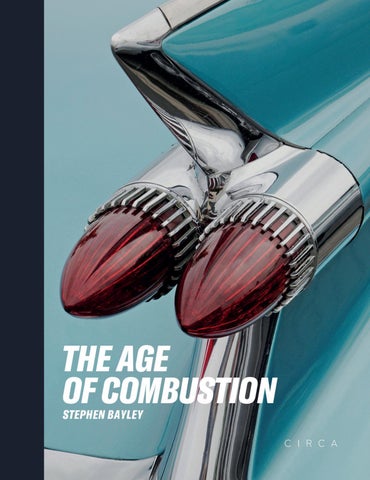
Yet design as a whole was my real subject and I confess that I am not a keen driver nor an amateur of workshop activities. A slight stigma, a reputational stain, still attaches to those who profess an interest in motoring. But how can you study design without studying cars, since they are the most designed product of them all? For good or for bad, and I think mostly for good, cars demand more creative investment than any other product we buy. If you want to be intellectually responsible, it would be intellectually irresponsible not to attempt to understand the forces which create them and the powers we use to interpret them. What follows here is an edited and revised selection of the monthly ‘Aesthete’ column I have written in Octane magazine for more than ten years. One way or another, it is perhaps the most consistent commentary on car design ever. And Octane is perhaps the world’s outstanding classic car magazine whose global popularity confirms, if confirmation were needed, that classic cars perform extraordinary feats in our collective imaginations. Vehicles of desire? Maybe. Certainly, they represent a paradise that is lost. As Proust, something of a car man himself, put it ‘Les vrais paradis sont les paradis qu’on a perdus’. Proust’s countryman, the critic Sainte-Beuve, defined classic as something which is ‘universal and permanent’. It’s good to remember that as chilly, bloodless electricity takes over from the hot, smelly noisy Age of Combustion.
BRITISHNESS Queen Elizabeth, Fidei Defender, 1954 Queen Elizabeth II in a Land Rover, Tobruk, 1954. When Maurice Wilks, a member of the family that owned Rover, and a collaborator on the development of the Whittle jet engine, acquired an Army surplus American Jeep, he decided he could improve it. Wilks’ idea was presented to the world at the 1948 Amsterdam Motor Show. It is a near-perfect geometrical composition, using only straight lines and very simple radii. There is no frivolous decoration, nor anything not determined by purpose, but so far from being banal and utilitarian, the Land Rover is evocative and delightful. The Prince of Wales in his birthday present, 1971 As Defender of the Faith, the future King Charles III also needs to defend the British motor industry. This AstonMartin DB6 Volante was given to him by his mother as a twenty-first birthday present, in 1969. However, the DB6 was a ham-fisted development of the elegant DB4, based on an original design by Touring of Milan. The Kammback tail in racing style is incongruous and a desperate nod towards technological fashion. Even at its launch, in 1965, commentators noted how dated the DB6 was. Prince Charles loved it and had the petrol engine converted to use bioethanol made from British grapes. A Greek engineer in Birmingham, 1965 The Mini was the greatest, perhaps the only, triumph of the forlorn British Motor Corporation. So, it is delightful t o note that its creator, Alex Issigonis, was a lugubrious Greek from Smyrna, its body was influenced by the Longbridge house-style established by an ArgentineItalian, called Riccardo Burzi, and its nearest relation, in engineering terms, was the curious German Kleinwagen – bubble car – of the fifties. The Mini was technically ingenious, commercially bold, ergonomically revolutionary, fun to drive, and ineffably chic. It was the first small car to transcend the stigma of class. And it became perhaps the most admired and imitated design of all time.
8
9
come’. We are still smiling. Yet the vision persists. In every annual news cycle, endearing eccentrics emerge to claim they have perfected a flying car, only to disappear again. In 1909, EM Forster wrote his short story ‘The Machine Stops’. It’s a gloomy tale. People live underground, paying tribute to a remote and scary technical entity known as The Machine. They no longer travel because they use video conferencing and text. Sound familiar? Those disenchanted with the system are stigmatised as ‘unmechanical’, just as social-media-refusers are today stigmatised as neo-Luddites. And then do you know what happens? The Machine Stops. When the hot server farms in the Arizona desert melt because there is no more diesel or gasoline to power the generators that power the air-con they greedily devour, our machine will stop too. The economist, John Maynard Keynes, said by about now we would all be so rich, no one would have to work. He was wrong too. The Poet Laureate of Dystopia, JG Ballard, predicted by about now, private cars would not be allowed on public roads. Instead, ‘enthusiasts’ would use them under psychiatric supervision in enclosed ‘motoring parks’. Ballard was more nearly right: the only time you can actually use even a fraction of the potential of your ludicrous supercar is on a private track day. The great adventure of the car is over. Never again will a cinnamon-linensuited Detroit executive, with highly polished brogues, instruct his studio: ‘I want that line to have a duflunky, to come across, have a little hook in it, and then do a rashoom or zong’, as GM’s Harley Earl once did. Since Barthes’s bold equivalence of cars with cathedrals, our reverence for the automobile has been adjusted. But they remain as the Sorbonne savant put it ‘the best messenger of a world superior to that of Nature’. Thing is, that message has now changed. No longer majestically enthroned, drivers are more nearly humiliatingly entombed in congestion. The promise of freedom has been broken. Dreams of escape are not today based on wheeled transport. Distant horizons no longer exist, and a road trip is an ordeal not a pleasure. Petrol stinks and adventure has been replaced by sorrow.
DETAILS T43, a mechanical ballet, 1931 When the Bugatti T43 appeared, in 1931, Modernist architects, designers and artists were preoccupied with the beauty of machinery. The ‘Tubist’ painter Fernand Léger had made a film, Ballet Mécanique, which featured whizzing components. Marcel Duchamp declared the contents of a plumber’s merchant to be ‘art’. US Customs had insisted a Brancusi sculpture was an industrial component. And Ettore Bugatti returned the compliment by first modelling his engines in wood, to check that the style was right. Buckminster Fuller’s Dymaxion car, 1934 The racing-driver, Francis Turner, was killed in 1932 while testing Buckminster Fuller’s cynically under-developed prototype Dymaxion car, a vehicle that its designer held to be a herald of a technology-rich future of his own interpretation. Despite his blowhard prophecies, Fuller had no grasp of the engineering or aerodynamic fundamentals of car design. The ludicrous three-wheeled Dymaxion would lift at speed, rendering steering and brakes useless, as Turner discovered. The contrast between euphoric potential and dire reality in Buckminster Fuller’s technocratic universe is revealing. Mustang instruments, 1965 The 1965 Ford Mustang, an exercise in consumer psychology as much as vehicle engineering, included the option of a ‘Rally-Pac’. The presence of this extra was indicated by two additional instruments in pods around the steering column, partially concealing the speedometer … perhaps not something an authentic rally driver would wish to do. But if Ford capo Lee Iacocca cared very little for ergonomics, he understood his customers with genius insight. Every option available on the Mustang calibrated not just engine speed or water temperature, but mysterious human desire itself.
Some say the world will end in fire/Some say in ice. Robert Frost, 1923
24
25
pattern Halibrand wheel was used in most Briggs Cunningham specials and was standard fit on factory Ford GT40s and Carroll Shelby’s Daytona Cobras. With their wildly exaggerated three-ear spinners, these Halibrands became immediate identifiers of some of the greatest sports cars of the sixties. The classic threaded wire wheels which cast magnesium eventually replaced found their scriptural home in Milan at Ruote Borrani, founded in 1922. But Borrani’s design for a lockable wheel on a splined shaft was based on a British bicycle patent. Indeed, Borrani emerged from an earlier entity called RudgeWhitworth Milano. So, with its origins in Coventry, the classic seventy-two-spoke Borrani wire wheel was the standard fit on Ferraris made between 1946 and 1966. Porsche too was distinguished by its wheels. Before adopting discs, Porsche had a unique system where, to avoid duplicating components, the studs carrying the wheel were integral with the brake drum, meaning that the ‘wheel’ was in fact just a steel rim, an annular device, carrying the tyre. This made, say, a 550 RSK, look exceptionally technological underneath the arches, although the great Porsche expert, Karl Ludvigsen, tells me the design was copied from a Ford truck seen by Porsche when visiting America. So, Midlands bicycles influenced Ferrari and Midwest trucks influenced Porsche. Again, in the sixties, the classic 911 was defined by its alloy wheels designed by Heinrich Klie for the Otto Fuchs Metallwerke. Other wonderful examples include the laboratory-precise Dunlop ventilated wheels on the Jaguar D-types, and the idiosyncratic ‘Wobbly Web’, designed by Lotus’s Gilbert McIntosh and inspired by a nineteenth-century pulley, but made famous by the egregious and sharp-elbowed Colin Chapman. On road cars today, size alone seems the chief determinant of wheel design. And I think this is a very German thing since it lends a sense of aggression – rather than delicacy – to a car. And this is enhanced by the absurdity of extremely low-profile tyres. Certainly, less flexible low-profile tyres behave in ways which can enhance performance, but if they were dynamically essential, Formula One cars would have them too. Instead, Formula One cars have notably high-profile tyres because the compliance of the sidewall adds a measure of ‘comfort’ which the nearly solid suspension does not allow. Design is always about a compromise. Certainly, design students today are still busy drawing concepts with wheels that look like rollers smeared in rubber rather than discs wearing tyres. But pausing recently to stare mournfully at a photograph of the crashed Facel Vega in which Albert Camus died, it’s remarkable how vast were the tyres (at least until one of them exploded). It occurred to me how ridiculous an Audi A8 would look with balloon-like tyres on small wheels. And that got me thinking ... maybe it is time for another aesthetic direction in wheel design. 48
FACTORIES Ford’s Highland Park assembly line, 1913 Karl Marx noted that ‘nature makes no machines’. But men do. Albert Kahn, America’s master factory designer, built Ford’s second assembly plant on Woodward Avenue, in Detroit, between 1909 and 1914. Although Henry Ford himself was perhaps was not the engineer, the moving assembly line was a clear demonstration of his principles: division of labour, process optimisation, time-and-motion, cost cutting, and integrated supply chain. The brutality of the system was satirised by John Dos Passos, but its efficiencies meant the cost of a Model-T was halved between 1910 and 1917. Ford may have brutalised his workers, but in compensation paid them three times the Detroit average. FIAT’s Lingotto pista, 1930s The greatest contribution FIAT made to Turin’s architecture was the astonishing Lingotto factory on via Nizza. This was a uniquely ambitious project, begun in 1916, and the sole building of note designed by a naval architect from the Ansaldo conglomerate, called Giovanni Matte Trucco (1869-1934). Inspired by the ravings of the Futurists and the unrealised architectural visions of Antonio Sant’Elia, Matte Trucco created a vast 400,000-square-metre concrete factory. At each end, helicoidal ramps rise five storeys to the rooftop pista. Le Corbusier was so impressed by this expression of the new spirit in building design, he cited Lingotto in Vers une architecture (1923). Volkswagen’s Wolfsburg factory, 1951 This is where the sinister KdF-Wagen became the lovable VW Beetle. The cornerstone of the Stadt Des KdF-Wagens bei Fallersleben was laid on 26th May 1938: a ceremony conducted with maximum Nazi pomp. Military Kubelwagen and Schwimmwagen were also made here. Porsche had, indeed, conceded that his Volkswagen might well have military applications. In 1945, British Occupation Forces renamed Fallersleben ‘Wolfsburg’. The British, advised by experts from Humber, questioned the Volkswagen’s commercial prospects. Soon, however, the plant became symbolic of Germany’s remarkable Wirtschaftswunder. The Volkswagen Group now comprises, not only VW, but Audi, SEAT, Skoda, Bentley and Lamborghini. Humber is no more.
49
Always? I grew up with a V8 rumble in the background and remember going to circuits and getting that prickly sensation in the pineal gland as you approached, when you could just begin to hear the yelps and howls of racing engines in the distance, long before you could see the cars themselves. My father once owned a glorious curio: a 33rpm long-playing vinyl disc of the Ferrari test-driver, Mike Parkes, at Monza. In comedic contrast, there was Peter Ustinov’s glorious recording of the fictional ‘Grand Prix of Gibraltar’ where he made all the commentary and engine noises himself. For those who find the deathly hush of today’s Formula One dull, I recommend it. In car design, noise tends to be a by-product rather than an end in itself, but I wonder if the coming acoustic crisis will force people to think about it a little more systematically. In 1916, the Futurist Luigi Russolo published a book called L’Arte dei Rumori (The Art of Noises). Of course, the Futurists were mad about machine guns and speed, but Russolo’s argument was a very thoughtful one. Before the arrival of machinery, the world, save for the odd thunderclap, volcanic explosion or little passage of insistent birdsong, was ... silent. Only when steam hammers, trains, drills and petrol engines came along was Nature augmented, or some would say defeated, by a mechanical symphony. Russolo thought this raised the game for composers who, in his view, would have to work very hard to make a more artistic noise than, say, a howitzer. As I write this, I am thinking about the pretty mechanical noises that we will soon lose or have already lost. The whine of a Porsche fan and the clatter of valves or the wheeze of a carburettor. Of course, noise is a form of pollution and chastening evidence of wasted energy. Noise is aggressive and, etymologically, perhaps derives from the Latin nausea: it sickens and is aggressive. But it is also engaging and expressive. Tesla was, himself, out there in the blurred margins of sanity. He said his eyes had turned blue because his brain was used so much. He was obsessed with a ‘death ray’ that would transmit electricity and believed that flexing your toes increased the IQ. Additionally, he kept pigeons in the New York hotel room where he led a life of well-publicised chastity. Would you buy a car named after this man?
88
MOTORSHOWS Hitler and Porsche at the Fallersleben factory, 1938 Ferdinand Porsche was an independent design consultant, long before his name became attached to famous sportscars. His relationship with Hitler was ambivalent, although he did not scruple about designing the Silberpfeil (Silver Arrows) racing-cars for MercedesBenz and Auto Union as propaganda tools … nor for designing the Wehrmacht’s Nazi tanks and the Luftwaffe’s V-1 buzz-bomb. But the greatest success of the Porsche Konstruktionsbüro für Motoren Fahrzeug, Luftfahrzeug und Wasserfahrzeug was the Volkswagen, the Fuhrer’s Strength-through-Joy car. General Motors Motorama, 1953 Motor shows became one of the quasi-religious events where the rites of the automobile were celebrated. General Motors’ Motorama ran from 1949 to 1961, almost exactly matching Harley Earl’s hegemony as Detroit’s chief wizard of design. Here, before television became the dominant medium, a fascinated public could gasp at ‘Dream Cars’ in this nomadic circus of kitsch. The 1954 Firebird – a crazy jet-powered nonsense – was, for example, presented on a giant velvet cushion under cinema lights. In this way, several generations had the coordinates of The American Dream mapped for them. The London Motor Show, 1966 It does no honour to the deep cultural history of the Ford Cortina that it became known as the ‘Dagenham Dustbin’. It was more complicated than that. When the Edsel failed so calamitously in the US, its designer, Roy Brown, was sent to the Siberia that was Ford of Britain’s Essex operation. The result was the Cortina, commercially speaking, perhaps the most successful British car dynasty ever. Even its name was significant: in the early days of package holidays, it evoked a Dolomites ski resort. John Betjeman, the Poet Laureate, paid tribute: ‘I am a young executive. No cuffs than mine are cleaner; I have a Slimline briefcase and I use the firm’s Cortina’. Seen here is a Mark II, designed by Roy Haynes, with a soft top conversion by Crayford.
I imagine Facel’s wily Jean Daninos saw value in having Stirling Moss as an ambassador. He arranged for Picasso (who did not drive) to have an HK500 too. Stirling Moss and Pablo Picasso had much in common: unique geniuses who created identities as great as their gifts.
CULTURE Carl Benz and family with the very first car, 1891 Carl Benz was the son of a train driver. His first ambition was to be a locksmith, but soon diverted to iron foundries and sheet-metal works. But ‘gas engines’ were his hobby and soon they came to dominate his life … and later the world. In 1882, he founded the Gasmotoren Fabrik Mannheim and three years later filed his patent for the ur-Auto. In 1888, his wife, Bertha, made the first ever car journey: the 104 kilometres from Mannheim to Pforzheim. She was visiting her mother. Via Roma, Turin, 1964 The Alfa Romeo badge may incorporate Milan’s coat of arms, but there is no city more identified than Turin with its most famous product: the Italian car. The ‘T’ in FIAT stands for the city … Fabbrica Italiana Automobili Torino. Historically, the presence of the royal stables, the Cavalerizza Reale, designed by Benedetto Alfieri in 1740, created an unusually heavy demand for fine carriages to transport local royalty in suitable pomp and style. These coachbuilders became the city’s famous carrozzerie, now designers as well as coachbuilders. When the world turned from horse-drawn to horse-less carriages, they were ready. Every car in this picture is Italian. Rod Stewart with his latest Lamborghini, 1971 In 1971, Rod Stewart released his third and careerdefining album, Every Picture Tells a Story. To celebrate, he bought his second Lamborghini Miura.
200
THE AGE OF COMBUSTION