DIRECTOR’S CHOICE
THE ABBEY LIBRARY OF ST GALLEN
Cornel Dora Philipp Lenz Franziska Schnoor
DC_Abbey_library_st_gall_English_OP.indd 3
15/10/21 14:03
DC_Abbey_library_st_gall_English_OP.indd 4
15/10/21 14:03
DC_Abbey_library_st_gall_English_OP.indd 5
15/10/21 14:03
FOREWORD
The Abbey Library of St Gallen was not founded as such, but came into being over several centuries. Beginning with the arrival of the Irish monk Gall (also known by the Latinised name of Gallus) at the river Steinach in 612 AD, it took shape gradually and became permanently established in the ninth century as an important part of the infrastructure of one of the leading monastic communities in Europe. It survived with highs and lows over the centuries until the dissolution of the Benedictine monastery in 1805. Today it is run by the democratic lay organisation of the Roman Catholics of the Canton of St Gallen as an academic library that is highly valued by researchers. Because of its age and its stock of early medieval manuscripts, which have survived in a uniquely complete state of preservation and were for the most part produced in the Abbey’s own scriptorium, the library is one of the most important historical collections in the world. It represents over 1,200 years of uninterrupted activity. This miraculous work of history, endowed with the most beautiful library hall imaginable, forms the core of the Abbey District of St Gallen, which was added to the UNESCO list of World Heritage sites in 1983. Together with the store of documents and records in the Abbey Archive, its historical collection of books from before 1805 was also listed in UNESCO’s Memory of the World Register in 2017. No other community of people from the eighth to the eleventh century is better substantiated in written sources than that of the monks of the Abbey of St Gall. In this overview, the management team of the Abbey Library presents a personal selection of the most important items from the book collection, as well as a few other objects in and around the library that are worth seeing.
Gregory the Great – ceiling painting in the Baroque Hall of the Abbey Library.
Cornel Dora, Director of the Abbey Library
6
|
THE ABBEY LIBRARY OF ST GALLEN
DC_Abbey_library_st_gall_English_OP.indd 6
15/10/21 14:03
DC_Abbey_library_st_gall_English_OP.indd 7
15/10/21 14:03
The healing-place of the soul Franz Anton Dirr, 1781 ΨΥΧΗΣ ΙΑΤΡΕΙΟΝ (Psyches Iatreion) Library entrance with supraporte
On the baroque overdoor above the magnificent entrance to the Abbey Library of St Gallen is the Greek inscription ΨΥΧΗΣ ΙΑΤΡΕΙΟΝ (Psyches Iatreion), which has developed into our modern word ‘psychiatry’. The most usual English translation is ‘healing-place of the soul’, but it can also be rendered slightly more freely as ‘pharmacy of the soul’. Just as we select medicines from the shelves in the pharmacy in order to restore our bodies to health, here we take books from the shelves in order to heal our souls. The idea of healing is associated with the culture of reading and knowledge, and also with our spiritual being. The motto inscribed on the panel was probably taken from an early baroque treatise on libraries by Claude Clément. However, it goes further back to the ancient Greek author of a universal history Diodorus Siculus (first half of first century BC), who reported in his Bibliotheca Historica (Historical Library) that this saying – presumably in the Egyptian language – was mounted above the temple library of the great pharaoh Rameses II (1303–1213 BC) near Thebes. This inscription is found not only in St Gallen but also in a number of other places, for instance in the baroque libraries of Uppsala, Vienna and Modena. The healing power of books is particularly noticeable in this delightful place and it is sensually celebrated and reinforced throughout the uniquely beautiful baroque Library Hall to which the portal gives access. Cornel Dora
8
|
THE ABBEY LIBRARY OF ST GALLEN
DC_Abbey_library_st_gall_English_OP.indd 8
15/10/21 14:03
DC_Abbey_library_st_gall_English_OP.indd 9
15/10/21 14:03
One of the oldest dated manuscripts in Switzerland – the Wandalgarius Manuscript Lyon (?), 793 Cod. Sang. 731, p. 234
The Codex Sangallensis 731 stands out from the crowd of early medieval manuscripts because both the scribe, Wandalgarius, and the date of its completion, 1 November 793, were noted in it. It is the third oldest dated manuscript held in any Swiss library. It is thought to have originated in the Burgundy region, possibly at the Collegiate Church in Lyon. The manuscript contains three collections of early medieval law, which are described as Leges or tribal laws. First there are extracts from the Lex Romana Visigothorum, i.e. the legal code issued early in the sixth century by Alaric II, King of the Visigoths, for the Roman part of the population. This is followed by the Lex Salica, a legal code of the Franks of approximately the same age, in which the Latin text has been infiltrated by a few Old Frankish vernacular terms. The last item is the Lex Alamannorum, the Law of the Alemanni, which dates from around 200 years later. The aim of the latter two tribal laws was often to direct conflicts along organised paths and settle damages suffered, such as manslaughter and theft, through the payment of compensation. The manuscript is decorated with numerous initials depicting human forms and animals. A full-page illustration on p. 234 shows a man holding a staff in his right hand and a tablet or a book in his left. Below it are the words Uandalgarius fecit hec – ‘Wandalgarius made this’. Philipp Lenz
24
|
THE ABBEY LIBRARY OF ST GALLEN
DC_Abbey_library_st_gall_English_OP.indd 24
15/10/21 14:03
DC_Abbey_library_st_gall_English_OP.indd 25
15/10/21 14:03
DC_Abbey_library_st_gall_English_OP.indd 32
15/10/21 14:04
The Abbey Plan of St Gall Reichenau Abbey, c.820/30 Cod. Sang. 1092, recto
The physic garden (herbularius).
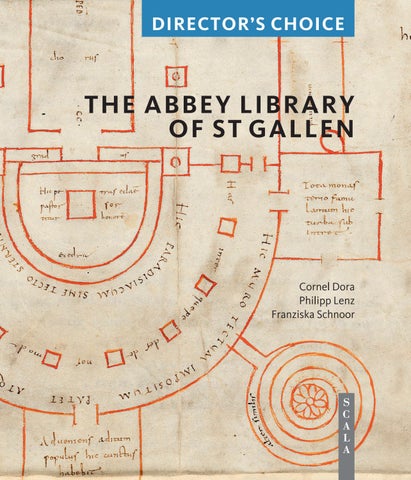
‘My dearest son Gozbert, I am sending you this plan of the monastery buildings, sketched with a few strokes.’ Thus begins the anonymous dedication accompanying this unique ‘blueprint’, which is ascribed to Abbot Haito († 836) of Reichenau Abbey. The plan was created under the direction of the Reichenau librarian Reginbert († 847), who worked on it together with a younger monk – as has been shown by analysis of the handwriting. The drawing is of great importance for the history of early medieval culture and architecture, as nothing else exists that is of comparable significance. There are 45 buildings, including a large church, a school, rooms for monks and visitors, a facility for medical treatment, various workshops and barns, as well as six gardens of different kinds. The plan is explained in detail with 334 Latin captions. It is for a Benedictine monastery with about one hundred monks and possibly the same number again of servants, pupils and guests. The drawing shows us what they needed in the way of architectural infrastructure and how this was organised. This document has been arousing the interest of researchers for centuries. According to the current state of knowledge it is a design concept that was produced on the monastic island of Reichenau in order to help Abbot Gozbert of St Gall (Abbot 816–37) with the preparation of new monastery buildings. Built between 830 and 837, Gozbert’s abbey church on the river Steinach actually became one of the largest north of the Alps. This is proved not only by excavations but also by the capitals, which are exhibited in the Vaulted Cellar of the Abbey Library. Cornel Dora
THE ABBEY PLAN OF ST GALL
DC_Abbey_library_st_gall_English_OP.indd 33
|
33
15/10/21 14:04
Carolingian bindings – 1,000-year-old objects of everyday use Abbey of St Gall, c.850/70 or shortly after Cod. Sang. 254, Carolingian binding
Medieval and early modern manuscripts usually now have a binding with boards of wood or pasteboard, more rarely a covering of parchment or leather, which serve mainly to protect the bookblock but are also decorative. Over the centuries, the majority of original bindings have been replaced, because they were imperfect or no longer fulfilled new requirements for uniformity, aesthetics or functionality. The Abbey Library boasts a unique and valuable collection of historical bindings that were produced using Carolingian, Romanesque or Gothic techniques. Of particular interest is the world’s largest known collection of Carolingian bindings, which numbers 110 examples dating from the eighth to twelfth centuries. These bindings have survived for so long because the materials and sewing techniques are very robust. The sheets of parchment were sewn quire by quire in herringbone pattern to cords that were pulled through channels bored in the front board. The loose ends of the cords were then threaded through similar channels in the back board and fixed in place with wooden wedges. The endbands were either unsupported, that is, sewn directly to the bookblock with link stitch, or supported, that is, sewn in herringbone pattern onto two cords that were anchored in the boards. Characteristic features are the heavy oak boards, the covering of chamois leather, the flat spine with protruding pieces of leather at top and bottom, the horizontal inscription on the leather of the spine and the clasps with eyelets that fastened over iron pegs inserted in the edge of the board. Philipp Lenz
38
|
THE ABBEY LIBRARY OF ST GALLEN
DC_Abbey_library_st_gall_English_OP.indd 38
15/10/21 14:04
CAROLINGIAN BINDINGS
DC_Abbey_library_st_gall_English_OP.indd 39
|
39
15/10/21 14:04
The Folchart Psalter – a miracle of illuminated initials Abbey of St Gall, c.872/83 Cod. Sang. 23, p. 134–35
The Folchart Psalter, which was created between 872 and 883, is among the most splendid works produced in the St Gall scriptorium. It is named after the scribe Folchart († 903), who probably wrote and decorated all the 368 pages himself. With the initials of each of the 151 psalms, which look almost baroque in their variety and abundance, he succeeded in producing a masterpiece of medieval initial illumination. Among the most beautiful in the entire history of art is the double page at the start of Psalm 51 (Psalm 52 in modern editions of the Bible). On the left is the introductory titulus in gold and silver on a purple ground: In finem intellectus ipsi David… (At the end, an insight of David). The frame consists of long rectangular fields with gold tendrils and squares with flowers in gold and silver; the latter appears dark because it has oxydised. On the opposite page is the beginning of the psalm: Quid gloriaris in malitia (Why boastest thou thyself in mischief). The Q in gold on a purple ground is made perfectly symmetrical by the repetition of the tail of the Q (cauda) on the left and the perfectly mirrored ornaments with tendrils and a total of eight dogs’ heads. Behind the Q is a fine cross in pale blue and green. The frame is decorated with acanthus leaves. Along the top margin Folchart placed a curse on thieves in elegiac distich: Auferat hunc librum nullus hinc omne per aevum / Cum Gallo partem quisquis habere velit (Let no man who wishes to enjoy salvation with Gallus ever steal this book from here.) The volume was probably one of the 13 books of Psalms that were to be found in the choir of the Abbey church in around 900, according to an account of Ekkehart IV († c.1060). Cornel Dora
48
|
THE ABBEY LIBRARY OF ST GALLEN
DC_Abbey_library_st_gall_English_OP.indd 48
15/10/21 14:04
THE FOLCHART PSALTER
DC_Abbey_library_st_gall_English_OP.indd 49
|
49
15/10/21 14:05
The Liturgy of the Hours in Neume notation – the Hartker Antiphonary St Gall, c.990/1000 Cod. Sang. 390, p. 13
The Hartker Antiphonary is the oldest manuscript of the chants for the monks’ Canonical Hours that is complete with musical notation known as neumes (the fine signs between the lines). It gets its name from Hartker († 1011), the St Gall monk and recluse who, from 980 to 1011, lived immured as an incluse in a cell in St Georgen above St Gallen. The delicate neumes were written by five different people. Hartker may possibly have written the text and part of the neumes but collaborated with others on the musical notation. In any event, there must have been a number of monks at St Gall around the year 1000 who had mastered neumatic notation at this very high level. The Antiphonary consists of two volumes, a winter section and a summer section. It contains a total of six wholepage images. Four of these depict important holy days in the ecclesiastical year: the Last Supper and the washing of the disciples’ feet (Maundy Thursday), the Crucifixion (Good Friday) and the Empty Tomb (Easter Sunday). At the start of the winter section there are two further illustrations. One is a dedicatory picture showing Hartker presenting his book to Saint Gall. The second is the earliest surviving representation of the inspiration of Pope Gregory the Great, after whom Gregorian Chant is named. The Holy Spirit in the form of a dove is perched on his shoulder, whispering the chants in his ear. Gregory dictates them to a scribe, who notes them down with a stylus on a wax tablet. If you look very closely, you can make out individual neumes on the wax tablet. Franziska Schnoor
56
|
THE ABBEY LIBRARY OF ST GALLEN
DC_Abbey_library_st_gall_English_BH 22.10.21_Pag56e80_OP.indd 56
25/10/21 13:56
DC_Abbey_library_st_gall_English_OP.indd 57
15/10/21 14:05
A manuscript from the possessions of Pope Nicholas V Florence, c.1440 Cod. Sang. 850, p. 3
This volume of philosophical works of the Ancient Roman orator and statesman Marcus Tullius Cicero (106–43 BC) once belonged to the future Pope Nicholas V (1397–1455, pope 1447–55), born Tommaso Parentucelli. This is revealed by the coat of arms with the four bearded male heads on the first page. Parentucelli adopted this coat of arms when he was elected Bishop of Bologna in 1444 as, not being of noble birth, he had no family coat of arms. When he became pope he changed his coat of arms again. The decoration of the manuscript was probably by Bartolomeo Varnucci (born around 1412/13). In any event, in terms of art history, this codex fits into the period of Florence in the 1430s and 1440s. From 1439 to 1444 a council was held there, in which Parentucelli participated as secretary to one of the cardinals. He evidently used his stay in Florence to acquire manuscripts of texts by the Fathers of the Church and other authors. This codex is the only manuscript in the Abbey Library in humanist minuscule. Italian humanists developed this script in the early fifteenth century. They based it on the Carolingian minuscule, as used in Italian codices of the eleventh and twelfth centuries. In turn, from 1460 on, humanist minuscule was used by the first book printers in Italy as a model for the characters of their typeface. Consequently many typefaces that are still common today go back indirectly to Carolingian minuscule. Franziska Schnoor
68
|
THE ABBEY LIBRARY OF ST GALLEN
DC_Abbey_library_st_gall_English_OP.indd 68
15/10/21 14:05
DC_Abbey_library_st_gall_English_OP.indd 69
15/10/21 14:05
78
|
THE ABBEY LIBRARY OF ST GALLEN
DC_Abbey_library_st_gall_English_OP.indd 78
15/10/21 14:05
Saint Gall and his ‘bookcase of the heart’ Grisaille painting by Josef Wannenmacher, c.1761/63 Baroque Hall of the Abbey Library, next to shelf EE
Without the Irishman Gall († c.640) who, together with his Abbot Columbanus of Bobbio († 615), came to Lake Constance as a missionary in around 612, settled by the river Steinach and founded a community of monks, neither St Gallen nor the Abbey Library would exist. Being an educated man he owned books, and the library can trace its origin back to these. In the baroque library, Josef Wannenmacher (1722–1780) depicted a scene from the early medieval life of St Gall by Walahfrid Strabo († 849), in which the study of manuscripts plays an important part. Gall had only just begun his secluded life in the forest when he had to defend himself against being elected Bishop of Constance. In doing so he proposed that his place should be taken by Deacon Johannes, who came from the area and who did indeed eventually take over the position. However, before that, Gallus instructed him in Christian doctrine: ‘So follow my advice, my son. Stay with me and read the books of divine knowledge and, by the grace of God, I will teach you to understand the scriptures.’ These lessons lasted three whole years, and books were of course part of it. The study and discussion of books was the method of teaching, so Walahfrid uses metaphors from the library in his portrayal of the scene. Bibles and Christian literature are a ‘storeroom of the scriptures’ (celleraria scripturarum) and Johannes entrusts the knowledge he has gained to his ‘bookcase of the heart’ (armario cordis). From outside to inside, into the heart – what a beautiful image, and a first echo of the idea of the healing place of the soul. Cornel Dora
SAINT GALL AND HIS ‘BOOKCASE OF THE HEART’
DC_Abbey_library_st_gall_English_OP.indd 79
|
79
15/10/21 14:06
This edition © Scala Arts & Heritage Publishers Ltd, 2021 Text and images © Abbey Library of St Gallen First published in 2021 by Scala Arts & Heritage Publishers Ltd 305 Access House, 157 Acre Lane London SW2 5UA, UK www.scalapublishers.com In association with the Abbey Library of St Gallen www.stiftsbezirk.ch/en/stiftsbibliothek ISBN: 978 1 78551 378 7 Project editor: Sandra Pisano (Scala Arts & Heritage Publishers Ltd) Designer: Heather Bowen Translation: Rae Walter in association with First Edition Translations Ltd, Cambridge, UK Printed in Turkey 10 9 8 7 6 5 4 3 2 1 Front cover: All rights reserved. No part of this book may be reproduced, stored
The Q initial from the Folchart-Psalter,
in a retrieval system or transmitted in any form or by any means
Cod. Sang. 23, p. 135 (see pp. 48/49)
electronic, mechanical, photocopying, recording or otherwise, without the written permission of the Abbey Library of St Gallen and
Front cover flap:
Scala Arts & Heritage Publishers Ltd.
The Abbey Library of St Gallen
Every effort has been made to acknowledge correct copyright of
Frontispiece:
images where applicable. Any errors or omissions are unintentional
The Abbey Plan of St Gall, Cod. Sang. 1092
and should be notified to the Publisher, who will arrange for
recto (see pp. 32/33)
corrections to appear in any reprints. Back cover:
80
Director’s Choice® is a registered trademark of Scala Arts
Four-part mass chants by Manfred Barbarini
& Heritage Publishers Ltd.
Lupus, Cod. Sang. 542, p. 362 (see pp. 72/73)
|
THE ABBEY LIBRARY OF ST GALLEN
DC_Abbey_library_st_gall_English_BH 22.10.21_Pag56e80_OP.indd 80
25/10/21 13:58