THE WINES OF PROVENCE
ELIZABETH GABAY MW
BEN BERNHEIM


APPELLATIONS
Côtes de Provence Sainte-Victoire
Côtes de Provence Fréjus
Côtes de Provence La Londe
Côtes de Provence Pierrefeu
Notre-Dame-des-Anges
MEDITERRANEAN
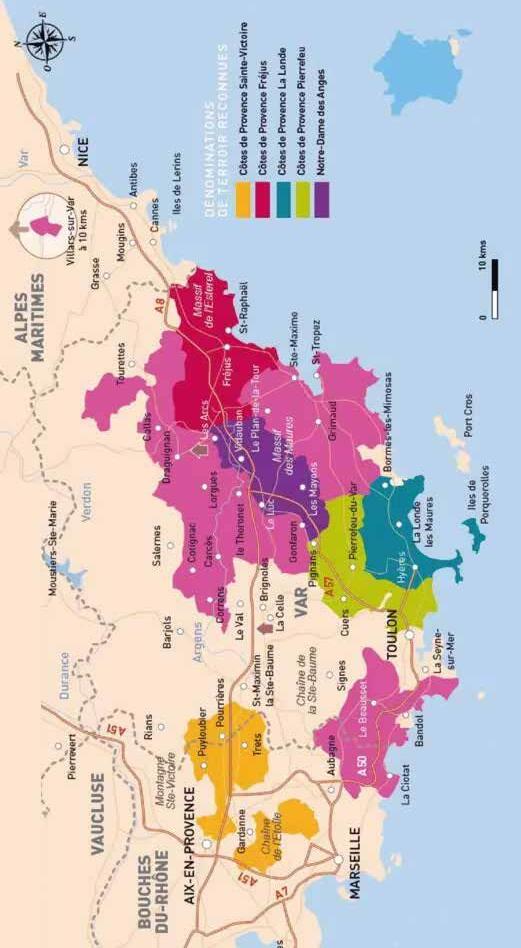
Map 3: The DGCs of Côtes de Provence
4 COASTAL PROVENCE: THE WINES OF THE CÔTE
D’AZUR
Although most people think that Côtes de Provence includes vineyards only in the two departments of the Var and the Bouches-du-Rhône, it also includes the third, and all-too-often forgotten, department of the Alpes-Maritimes.
Today, the Alpes-Maritimes makes almost no wine. A smattering of small estates still exist between Grasse and Vence, remnants of a oncevibrant wine country. Saint Jeannet (once a famous cru) is now reduced to a single producer, as is Villars-sur-Var (although a second producer is imminent). Thanks to a quirk of history, the latter is an isolated exclave of Côtes de Provence with almost nothing in common with the rest of the appellation. Even if, once, an almost uninterrupted sea of vines nearly connected it with the rest of Provence, Bellet alone remains as the Alpes-Maritimes’ major claim to viticultural fame, a small but ancient appellation of more than 50 hectares nestled into the town limits of Nice itself.
The department of the Alpes-Maritimes was created in 1860, a merger of the newly-annexed Comté de Nice (County of Nice) and of the Var’s arrondissement of Grasse. Only the latter is truly a part of Provence, with the county of Nice included in this book only for modern convenience. The Var river, while hardly one of France’s great fleuves (rivers which flow directly into the sea), is still considered to be one of the natural, or geographical borders between France and Italy, although as with all international boundaries, there have been many dissenting opinions
Florent Audibert arrived as winemaker in 2015. Wine styles are slowly evolving: experiments are ongoing for ageing the wine on the seafloor, although so far this has been limited to the whites, and there is a move from Mourvèdre-based rosés towards a new style that is riper, rounder, and in our mind, a much more successful wine.
CASSIS
Cassis, similarly to Bellet, has a long recorded viticultural history, and was one of France’s first six AOCs, on a par with Châteauneufdu-Pape. The first mention of wines around the port of Cassis was in 1430, when Good King René was credited with the introduction of the Muscat grape to the region. At the time of the arrival of the Abizzi family from Florence, local archives mentioned sweet Muscat wine. In 1867, Frédéric Mistral described its sweetness in his poem ‘Calendal’: “The bee has no honey sweeter, it shines like a limpid diamond, smells of the rosemary, heather and myrtle that covers our hills.”
In the early nineteenth century, marseillais industry increasingly left the city for the coastal areas around Cassis, a mere 22 kilometres away, as well as the shores of the Étang de Berre, to the west. Until well into the twentieth century, more than twenty factories were located in what is today the Calanques National Park. As in La Londe, there were heavy chemical and metallurgical industries: lead, soda, sulphur, tartaric acid, sulphuric acid, silver and glass, as well as bauxite mines, and sand and stone quarries. The stone quarries for the brilliantly white limestone had been exploited since ancient times, most famously contributing the stone used for the pedestal of the Statue of Liberty in New York. The brightness of the stone gives a bleak moonscape feeling to the windswept landscape between Cassis and Marseille, and is described as ‘blinding stones’ by Simone de Beauvoir and ‘arid and desolate’ by Jean Giono. All agree on its savage beauty and the intense aromas of the resinous garrigue.
The area’s natural beauty made it a refuge and haven for nearby citydwellers and aristocrats, especially during times of bubonic plague and cholera epidemics (1720 and 1835), when the wealthy moved to villas surrounded by olive groves and vineyards. The arrival of the Canal de Marseille in 1840 helped irrigate their luxuriant gardens. Many of these families left viticultural legacies still evident today, including: Domaine de la Ferme Blanche, founded by Count François de Garnier,
a shipbuilder who moved out in 1714; the Domaine du Bagnol, founded by Marquis de Fresque in 1867, and the Domaine Cassis Bodin, founded by the Bodin family who moved, in 1883, following an outbreak of cholera, to their villa Mas Calandal.
The arrival of the railway in 1859 made both industry and country houses even more accessible and opened up a market for local wines. In the 1860s, the Marseille town hall served red, white and sweet Muscat wine, but not the local clairet, which was described as ‘neither red, nor white, but between the two.’ The area was prosperous, and in 1895 the Lumière brothers made a short film of the steam train arriving at La Ciotat station in the region of Cassis. In 1899, they opened the world’s first cinema in La Ciotat, halfway between Cassis and Bandol.
The vineyards were wiped out by phylloxera like the rest of Provence in the 1880s, and replanting began in 1892, but without Muscatel, which was apparently incompatible with the rootstocks used. In 1901, Émile Bodin, with his friend, Marseille merchant Joseph Savon, started to replant his domaine, Mas Calendal, on rootstocks he had brought back from Texas. By 1929 the vineyards of Cassis were completely renovated, primarily with Clairette and Marsanne.
The heavy industry of the nineteenth century faded away, and in the 1920s, writers and artists described the natural beauty of the region. Virginia Woolf described the Cassidian vineyards in her diary entry for
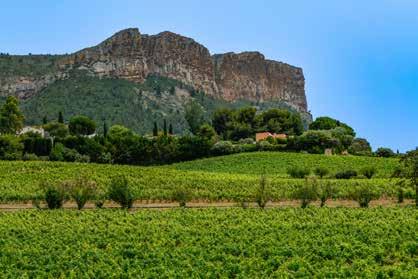
Vineyards of Domaine du Bagnol, Cassis
Cassis is a bastion of white wine in Provence. Although the share of rosé grew steadily throughout the second decade of the twenty-first century, this trend began to reverse around 2018. In 2019, white made up 67 per cent of production, rising by 2024 to 80 per cent (alongside 16 per cent rosé and 3 per cent red).
The proportion of white, rosé and red wine produced in Cassis
Producers are working hard to tread the fine line between soft, rich and sometimes flabby wines, and crisp, crunchy modern styles. However, to our taste, many wines have gone too far in the pursuit of freshness, resulting in fresh but thiol-laden whites. Some of these crisp, fresh whites are reminiscent in style of the south of France’s other white wine appellation: Picpoul de Pinet. Although Picpoul is certainly an indemand style among consumers, Cassis, with its ultra-premium image, typically retails for about six times the average price of Picpoul, leading us to expect more complexity and depth from these wines. Oak-ageing (or amphora) and riper grapes result in wines that retain greater richness and, to our mind, more of the ripeness and sunshine that the best Cassis is capable of.
Provence is not a cool-climate area capable of making highly acidic wines, and producers need to recognize this. This is not a new feeling developed in recent rosé-influenced years: it has been commented on at every vintage for 30 years, not only by Elizabeth but also by other local tasters. It is unfortunate that while Picpoul is working hard to elevate its image with lees-aged, serious whites, Cassis risks drifting toward a simpler style that betrays its terroir and pedigree.
The two principal varieties are Clairette and Marsanne which, together or singly, must make up 60 per cent or more of an estate’s plantings. Marsanne alone must make up between 30 and 80 per cent of plantations. There are five secondary varieties, Bourboulenc (known locally
as Doucillon or, more rarely, Doucillon Blanc), Sauvignon Blanc, Ugni Blanc, Pascal Blanc and Terret Blanc – the last two cannot exceed 5 per cent of plantations, and are rare. Attitudes to Clairette echo those in Bandol: it is thought to be flabby and prone to oxidation. By the late 1990s it was becoming increasingly unpopular and was mostly replaced with Bourboulenc and Marsanne. Grenache Blanc and Roussanne have been discussed by producers, but are not currently allowed. Ugni Blanc and Sauvignon Blanc were planted for acidity, but have struggled in recent years due to climate change, and are less popular than they once were. Since the mid 1990s, Marsanne has regained popularity, and the area still remains a haven from the encroaching dominance of Rolle, found seemingly everywhere else in Provence.
Despite the appellation’s small size, the soils and aspects of the vineyards are quite varied, with various varieties thought to do best on different micro-terroirs. Clairette does better on stonier, poorer soils, which Olivier Santini at Domaine du Paternel feels give the variety balance, a more stony, austere fruit and a dry finish. Marsanne does better on deeper soils, planted at the bottom of the valley where the soil is damper and more mineral, and Sauvignon Blanc thrives on cool, clay soils with a northerly exposure. These conditions are, however, rare in Cassis and it is felt that there are not enough cooler, damper parcels.
Instead, many producers are harvesting ever earlier to preserve acidity, playing with low yields instead to create complexity in the wines. Earlier harvests lend wines neutrality and zesty freshness. When grapes are harvested slightly later or from cooler sites, expect rather lovely ripe apple, peach, pineapple, herbal and tropical notes from Clairette, as well as a hint of bitterness, giving the impression of freshness.
Marsanne can be prone to flabbiness in sites that are too hot, but when fully ripe it produces wines of a deeper gold: higher in alcohol, rich and nutty, with spice and pear notes, and working well with oak. Bourboulenc retains acidity with some citrus notes. Ugni Blanc, which grows well on limestone, contributes acidity with some sour, salty notes and a touch of green pears. The proportions of the different varieties contribute further to the subtle differences in style between each estate.
Small percentages of Grenache, Cinsault and Mourvèdre are planted for the rosés and reds, which together account for around 20 per cent of production (see table above), but it is rare to hear producers talk about them with any passion. It remains to be seen whether the recent drop is a momentary blip, or the market turning away from Cassis’ rosé and
that’s gone into improving the wines and exploring amphoras and jarres. The Amorevolezza is a stunning blend of Tibouren and Mourvèdre and a recent vertical showed just how well this wine ages.
Château la Tour de l’Evêque
www.toureveque.com
The Sumeire family, already owners of the Domaine de Font-Freye, bought this estate in 1958. As the name suggests, this was an ecclesiastical property and the summer residence of the bishops of Toulon, leaving it with the particularity of having two names, the second being Château La Tour Sainte Anne. At the end of 2010, a major project began, to expand the cellar and the bottling and storage rooms according to the principles of gravity. The cellar was operational for the 2011 harvest. The vineyard is farmed biodynamically and the wines are classic, benchmark style, including Régine Sumeire’s historic Pétale de Rose rosé. Since Régine retired, the property has been run by her nephew Pierre-François de Bernardi, along with the family’s Saint-Tropez property, Château Barbeyrolles (see p. 180).
Domaine de la Portanière
www.domainedelaportaniere.com
Hilarion Blancard de Léoube left the family estate Domaine Léoube in 1850, and bought this country house, farm and magnanerie for silk worms on the banks of the Réal Collobrier in the forested foothills of the Maures. Vineyards had originally been planted in 1838 with Clairette, Grand Noir and Cinsault. The first wine was bottled in 1953 as Domaine du Peyrol. The estate is still owned by the Blancard family. The consultant oenologist is Emmanuel Baugnet, from les Arcs, who helps produce an excellent range of red, white and rosé, with a new range of oaked white and rosé in the pipeline. The vineyards are in small parcels surrounded by woods and polyculture has been maintained with olive trees, fruit trees and 1 hectare of apples, across eight different varieties.
Domaine Rostangue
www.domainerostangue.com
This 10-hectare estate, named after a local medieval troubadour, lies close to Domaine de la Portanière at the western edge of the Maures. The poor, rocky schistous soils are known locally as ‘Réal Martin blue
phyllite’, according to owner Jean-Charles Buffet. Yields are low and viticulture is organic and manual. His top rosé is a single vineyard blend of old vines.
Terra Provincia
Facebook: Terra-Provincia
After a two-year merger process, the two cooperatives of Saint-Roch les Vignes, in Cuers, and Saint-Sidoine, in Puget-Ville, finally became one in 2019, under the new name Terra Provincia. Together they are among the largest producers in Provence: their 300 members farm 1,200 hectares. They supply nearly one-third of the Maîtres Vignerons de SaintTropez volume and partner with them to produce Gallo’s Fleur de Mer brand (which sells about 1 million bottles in the United States alone). They have been making considerable strides towards sustainability, with a number of members adopting organic, biodynamic and even regenerative viticulture practices. Through their sustainability initiatives, they have been able to work with Maison Mirabeau on their latest label, One Day, and with Galoupet on their second label, G, bridging the gap between négociant brands and sustainable small-estate viticulture. Their Quintessence oak-aged blend of Syrah and Mourvèdre is also worth looking out for.
Chestnut cultivation
The cultivation of sweet chestnuts or castaneiculture has been an important tradition in Provence since their introduction to the region by the Carthusians in the tenth century. Its flexibility as an ingredient, ground for flour, served salty or sweet, growing where little else grew, made it a popular food, especially for the poor. Consumption declined after the Second World War when many locals associated them with ‘war food’; cultivation of chestnut forests declined and production plummeted. Since the 1980s, cultivation has been revived and there are now 2,500 hectares of chestnut forests the length and breadth of the Maures. The chestnut is now an important product of the Massif des Maures with Collobrières at the centre, supported by three local partners: the Collobrières town council, the Association Castanéicole de l’Espace Forestier Collobriérois and the Syndicat des Producteurs de Châtaignes du Var. Wellmaintained chestnut groves have proved their worth as firebreaks in recent years. The growth in fêtes de la châtaigne are part of this revival.