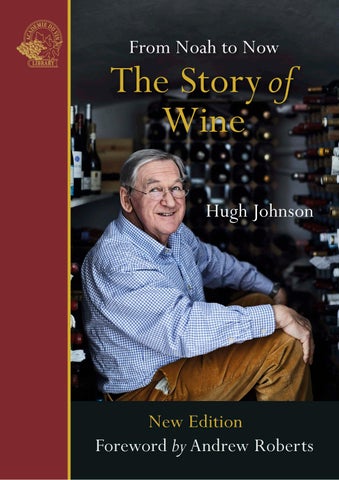
From Noah to Now
The Story of Wine Hugh Johnson
To Women & Song
ACADEMIE DU VIN LIBRARY 2
3
From Noah to Now
The Story of Wine Hugh Johnson
To Women & Song
ACADEMIE DU VIN LIBRARY 2
3
CONTENTS
PA RT T WO
PA RT T H R E E
Foreword 7
C HA P T E R 1 0
Inheritors of the Empire 114
C HA P T E R 2 0
Bordeaux Reborn 202
Preface 11
Charlemagne and the Rebirth of Europe’s Vineyards
The First Châteaux Wines and their Markets
PA RT ON E
C HA P T E R 1 1
The First Perfectionist 212
Vineyard and Cellar Skills are Refined
Dom Pérignon and the Refinement of Champagne
C HA P T E R 1
The Power to Banish Care 18 Man’s First Experience of Alcohol
C HA P T E R 2
Where Grapes Were First Trodden 22 The Misty Origins of Wine
C HA P T E R 3
The Pharaohs and their Wine 31 The Ancient Empires Master the Vine
C HA P T E R 4
First published 1989 by Mitchell Beazley Published 2020 by Académie du Vin Library Ltd academieduvinlibrary.com For the 2020 edition Publisher: Simon McMurtrie Editor: Susan Keevil Art Director: Tim Foster Index: Hilary Bird Commissioned photography: Lucy Pope Text © Hugh Johnson ISBN: 978-1-913141-06-6 Printed and bound in Germany by Kösel, Krugzell © 2020 Académie du Vin Library Ltd. All rights reserved. No parts of this publication may be reproduced, stored in a retrieval system or transmitted, in any form or by any means, electronic, mechanical, photocopying, recording or otherwise, without the prior permission of the publishers.
4
Greece: the Wine-Dark Sea 41 Dionysus and the First Theatre
C HA P T E R 5
Drinking the God 53 Wine and Sea-trade Flourish Together
C HA P T E R 6
De Re Rustica 65 Wine in Roman Italy
C HA P T E R 7
Jewish Life and Christian Ritual 80 ‘Wine Makes Glad the Heart of Man’
C HA P T E R 8
A Greener Country 86 Rome Expands – and Europe’s Vineyards are Founded
Making and Tasting Medieval Wine 125 C HA P T E R 1 2
C HA P T E R 2 2
The Cloister and the Press 132
Anything But Port 222
The Monks’ Superlative Burgundy
The Accidental Birth of a Classic
C HA P T E R 1 3
C HA P T E R 2 3
England and Gascony: the Birth of Claret 141 When the English Owned Bordeaux
C HA P T E R 1 4
Merchants of Venice 154 Trade in the Rich Wines of the Mediterranean
C HA P T E R 1 5
Castilian Conquest 163 Further Frontiers in Spain and the New World
C HA P T E R 1 6
‘Good Store of Fertile Sherris’ 172 Sack, the Wine of Falstaff and Drake
C HA P T E R 1 7
The Beverage Revolution 179 New Rivals to the Vine
Tokaji Essence 232 Great Wine from Europe’s Furthest Frontier
C HA P T E R 2 4
Groot Constantia 238 A Short-lived Wonder from the Cape
C HA P T E R 2 5
Island of the Immortals 245 Madeira’s Masochist Wine
C HA P T E R 2 6
Le Grand Théâtre 254 The Age of Confidence in Bordeaux
C HA P T E R 2 7
Mapping the Côte 270 Burgundy – the Pattern is Established
C HA P T E R 2 8
Paris Cabaret 281
C HA P T E R 1 8
Taxes Distort the Wine Map of the Ancien Régime
The Dutch and the Growing Wine Trade
Cabinet Wine 288
Waggoners of the Sea 186
C HA P T E R 1 9
C HA P T E R 9
Jug and Bottle 193
Mohammed Condemns Wine
Great Steps in the Technology of Glassmaking
The Hope of Some Diviner Drink 102
C HA P T E R 2 1
C HA P T E R 2 9
Germany Discovers Riesling
C HA P T E R 3 0
Three-bottle Men 297 Connoisseurship in Georgian England
5
CONTENTS
PA RT T WO
PA RT T H R E E
Foreword 7
C HA P T E R 1 0
Inheritors of the Empire 114
C HA P T E R 2 0
Bordeaux Reborn 202
Preface 11
Charlemagne and the Rebirth of Europe’s Vineyards
The First Châteaux Wines and their Markets
PA RT ON E
C HA P T E R 1 1
The First Perfectionist 212
Vineyard and Cellar Skills are Refined
Dom Pérignon and the Refinement of Champagne
C HA P T E R 1
The Power to Banish Care 18 Man’s First Experience of Alcohol
C HA P T E R 2
Where Grapes Were First Trodden 22 The Misty Origins of Wine
C HA P T E R 3
The Pharaohs and their Wine 31 The Ancient Empires Master the Vine
C HA P T E R 4
First published 1989 by Mitchell Beazley Published 2020 by Académie du Vin Library Ltd academieduvinlibrary.com For the 2020 edition Publisher: Simon McMurtrie Editor: Susan Keevil Art Director: Tim Foster Index: Hilary Bird Commissioned photography: Lucy Pope Text © Hugh Johnson ISBN: 978-1-913141-06-6 Printed and bound in Germany by Kösel, Krugzell © 2020 Académie du Vin Library Ltd. All rights reserved. No parts of this publication may be reproduced, stored in a retrieval system or transmitted, in any form or by any means, electronic, mechanical, photocopying, recording or otherwise, without the prior permission of the publishers.
4
Greece: the Wine-Dark Sea 41 Dionysus and the First Theatre
C HA P T E R 5
Drinking the God 53 Wine and Sea-trade Flourish Together
C HA P T E R 6
De Re Rustica 65 Wine in Roman Italy
C HA P T E R 7
Jewish Life and Christian Ritual 80 ‘Wine Makes Glad the Heart of Man’
C HA P T E R 8
A Greener Country 86 Rome Expands – and Europe’s Vineyards are Founded
Making and Tasting Medieval Wine 125 C HA P T E R 1 2
C HA P T E R 2 2
The Cloister and the Press 132
Anything But Port 222
The Monks’ Superlative Burgundy
The Accidental Birth of a Classic
C HA P T E R 1 3
C HA P T E R 2 3
England and Gascony: the Birth of Claret 141 When the English Owned Bordeaux
C HA P T E R 1 4
Merchants of Venice 154 Trade in the Rich Wines of the Mediterranean
C HA P T E R 1 5
Castilian Conquest 163 Further Frontiers in Spain and the New World
C HA P T E R 1 6
‘Good Store of Fertile Sherris’ 172 Sack, the Wine of Falstaff and Drake
C HA P T E R 1 7
The Beverage Revolution 179 New Rivals to the Vine
Tokaji Essence 232 Great Wine from Europe’s Furthest Frontier
C HA P T E R 2 4
Groot Constantia 238 A Short-lived Wonder from the Cape
C HA P T E R 2 5
Island of the Immortals 245 Madeira’s Masochist Wine
C HA P T E R 2 6
Le Grand Théâtre 254 The Age of Confidence in Bordeaux
C HA P T E R 2 7
Mapping the Côte 270 Burgundy – the Pattern is Established
C HA P T E R 2 8
Paris Cabaret 281
C HA P T E R 1 8
Taxes Distort the Wine Map of the Ancien Régime
The Dutch and the Growing Wine Trade
Cabinet Wine 288
Waggoners of the Sea 186
C HA P T E R 1 9
C HA P T E R 9
Jug and Bottle 193
Mohammed Condemns Wine
Great Steps in the Technology of Glassmaking
The Hope of Some Diviner Drink 102
C HA P T E R 2 1
C HA P T E R 2 9
Germany Discovers Riesling
C HA P T E R 3 0
Three-bottle Men 297 Connoisseurship in Georgian England
5
PA RT F OU R
PA RT F I V E
C HA P T E R 3 1
C HA P T E R 4 1
Revolution and After 310
Fifty Years of Crisis 436
Napoleon’s Wars Herald a New Age
War, Slump, Poor Weather and Prohibition
C HA P T E R 3 2
C HA P T E R 4 2
Bodegas and Lodges 320
The New World Challenges 449
The Rise of Sherry – and Port’s Response
The Dramatic Renaissance of California and Australia
C HA P T E R 3 3
C HA P T E R 4 3
Méthode Champenoise 332
The Old World Responds 459
Champagne Profits from the Booming 19th Century
Tradition, Technology and the Search for Market Identity
C HA P T E R 3 4
John Bull’s Vineyard 343 Australia – Discovery and Development
C HA P T E R 3 5
East Coast, West Coast 354 Spanish and Anglo-Saxon Traditions Merge in America
C HA P T E R 3 6
The Golden Age 373 Bordeaux and Burgundy at the Height of their Powers
C HA P T E R 3 7
Zollverein 388
Germany’s Unification Widens the Horizon
C HA P T E R 3 8
When Sorrows Come 400 Oidium and Phylloxera Devastate Europe
C HA P T E R 3 9
Risorgimento 413 Wine and Politics in 19th-century Italy
C HA P T E R 4 0
Hispanic Revival 424 Spain and South America in the 19th Century
6
Bibliography 466 Index 476 Acknowledgements 495
FOREWORD No one could be better qualified to write the story of wine than Hugh Johnson, whose name is virtually synonymous with wine writing. Others may argue whether his masterpiece was The World Atlas of Wine (with its sales of over 4.7 million copies), or his Wine Companion (now in its sixth edition) or his invaluable Pocket Wine Book (which is still the best-selling annual wine guide of all time), but for me it will always be The Story of Wine. I first read it when I was 27, coincidentally the same age that Hugh was when he made his sensational debut on the wine-writing scene with his first book, Wine, that established him as a world authority despite his relative youth. The genius of The Story of Wine derives from the fact that it is emphatically not some dry-as-dust academic history – there are dozens of those – but an adventure story, full of mysteries, art and culture, the rise and fall of empires, and a good dash of autobiography there too, if one reads between the lines. There is tremendous scholarship to be found in these pages, but the immense learning is never ponderous. It is erudite, but never pompous. Although it encompasses thousands of years of vital, dynamic and often curious human history, The Story of Wine never plods. Revisiting the book after half a lifetime as an historian, I recognize that Hugh was right not to have written a history book, but rather a celebration of a passion. Hugh discovered his vocation as a member of the Cambridge University Wine and Food Society in the 1950s, recalling vividly his first tasting of two glasses of burgundy: ‘One was ordinary and one was magic. That was my Damascene moment.’ After graduating, he began writing about wine for Vogue and House and Garden, and at the age of just 23 was made editor of Wine and Food magazine. His immense knowledge and extraordinary ability to convey delight have subsequently introduced millions of people around the world to what Plato determined was the most ‘excellent and valuable’ gift ever granted by the gods to man. Although I became a member of Cambridge University Wine and Food Society in the early 1980s, I sadly missed any Damascene moments there. Indeed, discernment in wine entirely passed me by when I was at university. Excepting vintage port, which the colleges sold at cost price and which my friends and I drank at unsuitable times of day in correspondingly unsuitable quantities, my own tastes were embarrassingly unsophisticated. Today, I am proud to be a member of the prestigious and venerable oenophile society, the Saintsbury Club – whose ornament is Hugh, amongst several other masters of wine – but back then, growing up in the Home Counties in the 1970s, wine was simply not an important part of many people’s lives. Looking at the variety, quality and sheer accessibility of wines avail7
PA RT F OU R
PA RT F I V E
C HA P T E R 3 1
C HA P T E R 4 1
Revolution and After 310
Fifty Years of Crisis 436
Napoleon’s Wars Herald a New Age
War, Slump, Poor Weather and Prohibition
C HA P T E R 3 2
C HA P T E R 4 2
Bodegas and Lodges 320
The New World Challenges 449
The Rise of Sherry – and Port’s Response
The Dramatic Renaissance of California and Australia
C HA P T E R 3 3
C HA P T E R 4 3
Méthode Champenoise 332
The Old World Responds 459
Champagne Profits from the Booming 19th Century
Tradition, Technology and the Search for Market Identity
C HA P T E R 3 4
John Bull’s Vineyard 343 Australia – Discovery and Development
C HA P T E R 3 5
East Coast, West Coast 354 Spanish and Anglo-Saxon Traditions Merge in America
C HA P T E R 3 6
The Golden Age 373 Bordeaux and Burgundy at the Height of their Powers
C HA P T E R 3 7
Zollverein 388
Germany’s Unification Widens the Horizon
C HA P T E R 3 8
When Sorrows Come 400 Oidium and Phylloxera Devastate Europe
C HA P T E R 3 9
Risorgimento 413 Wine and Politics in 19th-century Italy
C HA P T E R 4 0
Hispanic Revival 424 Spain and South America in the 19th Century
6
Bibliography 466 Index 476 Acknowledgements 495
FOREWORD No one could be better qualified to write the story of wine than Hugh Johnson, whose name is virtually synonymous with wine writing. Others may argue whether his masterpiece was The World Atlas of Wine (with its sales of over 4.7 million copies), or his Wine Companion (now in its sixth edition) or his invaluable Pocket Wine Book (which is still the best-selling annual wine guide of all time), but for me it will always be The Story of Wine. I first read it when I was 27, coincidentally the same age that Hugh was when he made his sensational debut on the wine-writing scene with his first book, Wine, that established him as a world authority despite his relative youth. The genius of The Story of Wine derives from the fact that it is emphatically not some dry-as-dust academic history – there are dozens of those – but an adventure story, full of mysteries, art and culture, the rise and fall of empires, and a good dash of autobiography there too, if one reads between the lines. There is tremendous scholarship to be found in these pages, but the immense learning is never ponderous. It is erudite, but never pompous. Although it encompasses thousands of years of vital, dynamic and often curious human history, The Story of Wine never plods. Revisiting the book after half a lifetime as an historian, I recognize that Hugh was right not to have written a history book, but rather a celebration of a passion. Hugh discovered his vocation as a member of the Cambridge University Wine and Food Society in the 1950s, recalling vividly his first tasting of two glasses of burgundy: ‘One was ordinary and one was magic. That was my Damascene moment.’ After graduating, he began writing about wine for Vogue and House and Garden, and at the age of just 23 was made editor of Wine and Food magazine. His immense knowledge and extraordinary ability to convey delight have subsequently introduced millions of people around the world to what Plato determined was the most ‘excellent and valuable’ gift ever granted by the gods to man. Although I became a member of Cambridge University Wine and Food Society in the early 1980s, I sadly missed any Damascene moments there. Indeed, discernment in wine entirely passed me by when I was at university. Excepting vintage port, which the colleges sold at cost price and which my friends and I drank at unsuitable times of day in correspondingly unsuitable quantities, my own tastes were embarrassingly unsophisticated. Today, I am proud to be a member of the prestigious and venerable oenophile society, the Saintsbury Club – whose ornament is Hugh, amongst several other masters of wine – but back then, growing up in the Home Counties in the 1970s, wine was simply not an important part of many people’s lives. Looking at the variety, quality and sheer accessibility of wines avail7
THE STORY OF WINE
able now, it astonishes me to remember that Liebfraumilch was once considered perfectly usual and acceptable to serve at a dinner party half a century ago. Not only were choices limited in those days, but there was an intimidating snobbery around wine which discouraged many from exploring its pleasures. I recall with pain the sheer angst involved in taking a would-be girlfriend to a restaurant and being confronted with both the hefty, darkly bound tome of the wine list and the supercilious eyebrow of the sommelier. Thanks in great part to Hugh, the absurd, elitist fussing over wine has largely disappeared, as has the ridiculous sexism which once insisted that mastery of the list was the sole province of men. Hugh’s co-authoring of The World Atlas of Wine with Jancis Robinson, from its 5th edition two decades ago, was one of the first great steps towards dissipating this. When it was published, The Story of Wine won every one of the most important literary awards that the wine industry had to bestow. Encountering it for the first time was a delight for me, both as an historian and a wine enthusiast. Hugh’s method provided a unique approach to recounting the history of civilization, one that is just as valid now as it was in 1989. Writing of the taste of olives, Lawrence Durrell famously sought to describe the sheer ancientness of certain flavours: ‘The whole Mediterranean, the sculpture, the palm, the gold beads, the bearded heroes, the wine, the ideas, the ships, the moonlight, the winged gorgons, the bronze men, the philosophers – all of it seems to rise in the sour, pungent taste of these black olives between the teeth. A taste older than meat, older than wine. A taste as old as cold water.’ Yet Hugh would disagree. Wine, he argues, has been part of humanity’s story since the very beginning. It was ‘the foremost of luxuries to millennia of mankind.’ Unlike other foodstuffs, wine has always possessed a numinous quality, its substance connecting body and spirit. Wine is sacred, wine is magical. Without an understanding of the story of wine, it is impossible to grasp the complexities of the interconnected trade and culture of the ancient world. Lebanon, Syria and Turkey demonstrate archaeological evidence of winemaking even in the Stone Age, and by 7000bc viticulture was established in Georgia. This book includes wonderful vignettes of archaic practices: the Egyptians gleefully slurping their wine directly from jars through straws; the bustle and energy of the ports of Ugarit, Tyre and Sidon, so vividly described that one can almost hear the shouts from the quays as the amphorae are unloaded. However different the preferences of Phoenicians or Greeks in matters of taste – I’m not sure I should enjoy my wine mixed with frankincense or seawater, even if, as Pliny suggests, it was prudently gathered far from the harbour – Hugh also identifies remarkable historical consistencies. In Egypt 3,000 years ago, the year, vintner, vineyard and owner were specified on the bungs of wine jars, whilst a suitably moderate daily measure, three glasses, was prescribed by Eubolus in 375bc and has made its way into the modern size of the wine bottle, based on two people sharing. 8
FOR EWOR D
Hugh’s commitment to his research is nothing if not thorough: the author even goes so far as to have a kottabos stand constructed to practise the fashionable Greek game of throwing wine, though he concedes that his efforts did not extend so far as providing a young servant dressed only in a garland to collect the cups. After the fall of Rome – and Hugh suggests that wine was not irrelevant to the popular pastime of sacking that city – wine routes and wine fairs were instrumental in the rebirth of Europe. By 1400, wine’s story had swelled to an ‘economic epic’, though supply could not always keep pace with demand. St Benedict was obliged to specify to his acolytes that when their daily allotted measure of half a pint of wine was not forthcoming, ‘let the monks not murmur. Above all…let them abstain from murmuring’. Since prohibition implies infraction, one can only assume that the wineless monks did a good deal of murmuring. A story which is truly global in scope, this book reminds us that wine has never been an exclusively European phenomenon. In a glorious image from the 17th century, the traveller Sir John Chardin describes the Shah of Persia’s touring bar, which featured a gold basin filled with snow to keep crystal jugs of light red wine at the correct temperature. As a biographer of Napoleon, I can only wish I had thought of marking the great man’s progress through the vintages of his reign – the first post-Revolutionary Lafite which marked the conquest of Italy in 1796–97, for instance, or the superlative 1811 vintage which did something to assuage his regret at the French retreat from Portugal. The dextrous charm with which The Story of Wine communicates its rich mastery of technical information italicizes the superficiality of a certain kind of hierarchical wine-writing. Rating wine on a scale of points only serves to encourage the kind of meaningless competition which has pushed producers in the past to homogenize both their style and their choice of grapes. Today, as the independent winemakers fight back, the concept of terroir is well-known, and the effects of soil on vines has led to increasing interest in the topographical precision of vineyard information: Hugh was always an early and passionate champion of communicating how ‘intimately and emphatically’ Nature can subtly change wines even within a relatively small geographical area. It is the market, he observes, that revolutionizes taste, yet for the historian, taste can also be an indicator of profound cultural shifts, and as Charles Ludington puts it in The Politics of Wine in Britain, wine can be ‘a battleground for those who want to maintain or change the social order’. The overtaking of port by domestic, respectable sherry, Hugh notes, heralded the advent of Victorian morality in Britain. The period also saw the Golden Age of Bordeaux, with the reduction in wine duties introduced by William Gladstone encouraging the British to increase their consumption of French wines a full eightfold. 9
THE STORY OF WINE
able now, it astonishes me to remember that Liebfraumilch was once considered perfectly usual and acceptable to serve at a dinner party half a century ago. Not only were choices limited in those days, but there was an intimidating snobbery around wine which discouraged many from exploring its pleasures. I recall with pain the sheer angst involved in taking a would-be girlfriend to a restaurant and being confronted with both the hefty, darkly bound tome of the wine list and the supercilious eyebrow of the sommelier. Thanks in great part to Hugh, the absurd, elitist fussing over wine has largely disappeared, as has the ridiculous sexism which once insisted that mastery of the list was the sole province of men. Hugh’s co-authoring of The World Atlas of Wine with Jancis Robinson, from its 5th edition two decades ago, was one of the first great steps towards dissipating this. When it was published, The Story of Wine won every one of the most important literary awards that the wine industry had to bestow. Encountering it for the first time was a delight for me, both as an historian and a wine enthusiast. Hugh’s method provided a unique approach to recounting the history of civilization, one that is just as valid now as it was in 1989. Writing of the taste of olives, Lawrence Durrell famously sought to describe the sheer ancientness of certain flavours: ‘The whole Mediterranean, the sculpture, the palm, the gold beads, the bearded heroes, the wine, the ideas, the ships, the moonlight, the winged gorgons, the bronze men, the philosophers – all of it seems to rise in the sour, pungent taste of these black olives between the teeth. A taste older than meat, older than wine. A taste as old as cold water.’ Yet Hugh would disagree. Wine, he argues, has been part of humanity’s story since the very beginning. It was ‘the foremost of luxuries to millennia of mankind.’ Unlike other foodstuffs, wine has always possessed a numinous quality, its substance connecting body and spirit. Wine is sacred, wine is magical. Without an understanding of the story of wine, it is impossible to grasp the complexities of the interconnected trade and culture of the ancient world. Lebanon, Syria and Turkey demonstrate archaeological evidence of winemaking even in the Stone Age, and by 7000bc viticulture was established in Georgia. This book includes wonderful vignettes of archaic practices: the Egyptians gleefully slurping their wine directly from jars through straws; the bustle and energy of the ports of Ugarit, Tyre and Sidon, so vividly described that one can almost hear the shouts from the quays as the amphorae are unloaded. However different the preferences of Phoenicians or Greeks in matters of taste – I’m not sure I should enjoy my wine mixed with frankincense or seawater, even if, as Pliny suggests, it was prudently gathered far from the harbour – Hugh also identifies remarkable historical consistencies. In Egypt 3,000 years ago, the year, vintner, vineyard and owner were specified on the bungs of wine jars, whilst a suitably moderate daily measure, three glasses, was prescribed by Eubolus in 375bc and has made its way into the modern size of the wine bottle, based on two people sharing. 8
FOR EWOR D
Hugh’s commitment to his research is nothing if not thorough: the author even goes so far as to have a kottabos stand constructed to practise the fashionable Greek game of throwing wine, though he concedes that his efforts did not extend so far as providing a young servant dressed only in a garland to collect the cups. After the fall of Rome – and Hugh suggests that wine was not irrelevant to the popular pastime of sacking that city – wine routes and wine fairs were instrumental in the rebirth of Europe. By 1400, wine’s story had swelled to an ‘economic epic’, though supply could not always keep pace with demand. St Benedict was obliged to specify to his acolytes that when their daily allotted measure of half a pint of wine was not forthcoming, ‘let the monks not murmur. Above all…let them abstain from murmuring’. Since prohibition implies infraction, one can only assume that the wineless monks did a good deal of murmuring. A story which is truly global in scope, this book reminds us that wine has never been an exclusively European phenomenon. In a glorious image from the 17th century, the traveller Sir John Chardin describes the Shah of Persia’s touring bar, which featured a gold basin filled with snow to keep crystal jugs of light red wine at the correct temperature. As a biographer of Napoleon, I can only wish I had thought of marking the great man’s progress through the vintages of his reign – the first post-Revolutionary Lafite which marked the conquest of Italy in 1796–97, for instance, or the superlative 1811 vintage which did something to assuage his regret at the French retreat from Portugal. The dextrous charm with which The Story of Wine communicates its rich mastery of technical information italicizes the superficiality of a certain kind of hierarchical wine-writing. Rating wine on a scale of points only serves to encourage the kind of meaningless competition which has pushed producers in the past to homogenize both their style and their choice of grapes. Today, as the independent winemakers fight back, the concept of terroir is well-known, and the effects of soil on vines has led to increasing interest in the topographical precision of vineyard information: Hugh was always an early and passionate champion of communicating how ‘intimately and emphatically’ Nature can subtly change wines even within a relatively small geographical area. It is the market, he observes, that revolutionizes taste, yet for the historian, taste can also be an indicator of profound cultural shifts, and as Charles Ludington puts it in The Politics of Wine in Britain, wine can be ‘a battleground for those who want to maintain or change the social order’. The overtaking of port by domestic, respectable sherry, Hugh notes, heralded the advent of Victorian morality in Britain. The period also saw the Golden Age of Bordeaux, with the reduction in wine duties introduced by William Gladstone encouraging the British to increase their consumption of French wines a full eightfold. 9
THE STORY OF WINE
A vast range of compelling characters, from medieval scientists to 18th-century adventurers, populate this book. Their stories are as individual and intriguing as the lost vintages that Hugh conjures – amber Falernia, the drink of the Roman emperors, or the yellow wines of Kafiristan enjoyed by Sultan Babur, the founder of the Moghul empire, or the sweet, Malaga-style wine sampled by James Boswell on his journey to Corsica. Describing a dinner with Talleyrand, Lady Shelley recalled that ‘the antiquity of every bottle of wine supplied the most eloquent annotations’, and how the great diplomatic survivor treated them with ‘as much interest and seriousness as if he had been discussing some political question of importance’. After re-reading The Story of Wine, I was joyfully reminded of how wine remains at the centre of our communal, convivial life. To enjoy this book with a glass in one’s hand is to relish all its subtle and varied delights in the company of the most entertaining and comforting of friends, and the Académie du Vin Library is to be congratulated in republishing it in such a beautiful edition.
Andrew Roberts London May 2020
10
PREFACE
The title is deliberate. I am wary of the word ‘history’; scholars have made it their own and will challenge any unqualified pretender. Still, it’s in my blood. My father breathed it all his life. He went to Cambridge with a history scholarship before the First World War, and after a distinguished career in the law and insurance, retired to research in Lambeth Palace Library for the Victoria County Histories with Sir Lewis Namier. In the 1980s I had already paid many tributes to wine: its beauty and variety, its complex geography, and the sheer fun of it, before I realized that it is, or rather can be, bottled history. Why is it that Burgundians never drink Bordeaux and in Bordeaux they scarcely acknowledge Burgundy? The finest (and first) Rieslings come from river valleys in the north of Germany, Madeira wine keeps virtually for ever, Chile is wedded to Cabernet, champagne is unique to a district near Paris, the church developed many of the greatest vineyards (and the vines they grow). The fact that we have such a wonderful choice of what to drink is thanks to the tastes, beliefs, politics and problems of a hundred generations. Wine embodies their decisions. It expresses traditions, place and time as nothing else does – certainly nothing we eat or drink. Nor, of course, does this process of finding new classics and creating new traditions ever stop. I only had inklings, 30 years ago, of the potential greatness of some of our new icons, whether they are Australian or Kiwi, North or South American, or new creations out of the old resources of Italy or Spain or Greece. Some I could foresee: Napa, Barossa, certain Italian wines, and indeed French wines that had no public profile or received any investment for years were on track to be recognized. But New Zealand was an unknown quantity, we had no notion that Greek islands could make great wines, Hungary’s legendary Tokaji was almost extinct, Argentina was nowhere and South Africa in disgrace. We were about to enter a new age, and that is not even to mention the new technology that was in the pipeline. Every year now we are introduced to a neglected grape variety, or a classic being grown in a new place and challenging all received ideas. Not that everything in the modern vineyard is perfect. With so many novices in the business there are inevitably stumbles. There was a notion prevalent for a few years that good wines should taste of oak. Countless dollars were wasted on new barrels that sadly denatured many aspiring wines. A far more dangerous notion is still in circulation: American critics, liking to make everything consumer-friendly, cut and dried, claimed that the quality of wine could be somehow ‘scored’ in points 11
THE STORY OF WINE
A vast range of compelling characters, from medieval scientists to 18th-century adventurers, populate this book. Their stories are as individual and intriguing as the lost vintages that Hugh conjures – amber Falernia, the drink of the Roman emperors, or the yellow wines of Kafiristan enjoyed by Sultan Babur, the founder of the Moghul empire, or the sweet, Malaga-style wine sampled by James Boswell on his journey to Corsica. Describing a dinner with Talleyrand, Lady Shelley recalled that ‘the antiquity of every bottle of wine supplied the most eloquent annotations’, and how the great diplomatic survivor treated them with ‘as much interest and seriousness as if he had been discussing some political question of importance’. After re-reading The Story of Wine, I was joyfully reminded of how wine remains at the centre of our communal, convivial life. To enjoy this book with a glass in one’s hand is to relish all its subtle and varied delights in the company of the most entertaining and comforting of friends, and the Académie du Vin Library is to be congratulated in republishing it in such a beautiful edition.
Andrew Roberts London May 2020
10
PREFACE
The title is deliberate. I am wary of the word ‘history’; scholars have made it their own and will challenge any unqualified pretender. Still, it’s in my blood. My father breathed it all his life. He went to Cambridge with a history scholarship before the First World War, and after a distinguished career in the law and insurance, retired to research in Lambeth Palace Library for the Victoria County Histories with Sir Lewis Namier. In the 1980s I had already paid many tributes to wine: its beauty and variety, its complex geography, and the sheer fun of it, before I realized that it is, or rather can be, bottled history. Why is it that Burgundians never drink Bordeaux and in Bordeaux they scarcely acknowledge Burgundy? The finest (and first) Rieslings come from river valleys in the north of Germany, Madeira wine keeps virtually for ever, Chile is wedded to Cabernet, champagne is unique to a district near Paris, the church developed many of the greatest vineyards (and the vines they grow). The fact that we have such a wonderful choice of what to drink is thanks to the tastes, beliefs, politics and problems of a hundred generations. Wine embodies their decisions. It expresses traditions, place and time as nothing else does – certainly nothing we eat or drink. Nor, of course, does this process of finding new classics and creating new traditions ever stop. I only had inklings, 30 years ago, of the potential greatness of some of our new icons, whether they are Australian or Kiwi, North or South American, or new creations out of the old resources of Italy or Spain or Greece. Some I could foresee: Napa, Barossa, certain Italian wines, and indeed French wines that had no public profile or received any investment for years were on track to be recognized. But New Zealand was an unknown quantity, we had no notion that Greek islands could make great wines, Hungary’s legendary Tokaji was almost extinct, Argentina was nowhere and South Africa in disgrace. We were about to enter a new age, and that is not even to mention the new technology that was in the pipeline. Every year now we are introduced to a neglected grape variety, or a classic being grown in a new place and challenging all received ideas. Not that everything in the modern vineyard is perfect. With so many novices in the business there are inevitably stumbles. There was a notion prevalent for a few years that good wines should taste of oak. Countless dollars were wasted on new barrels that sadly denatured many aspiring wines. A far more dangerous notion is still in circulation: American critics, liking to make everything consumer-friendly, cut and dried, claimed that the quality of wine could be somehow ‘scored’ in points 11
THE STORY OF WINE
out of a hundred. They offered easy-to-grasp off-the-peg personal opinions masquerading as something objective and absolute. High scores affected prices, and in due course even winemaking methods. For a while more powerful and obvious wines were the winners. Sanity started to return when drinkers found there was no refreshment in them; they looked again for the old virtues of harmony and balance, the urge for another sip. But it may take years yet to disabuse the wine trade of the numbers game. More important, by far, is the fact of a changing climate. If it is the precise interaction of climate and soil, or location, or terroir, which makes a fine wine possible, then changing any factor in this equation changes the wine. In classical vineyards everything is marginal: they are just so. A warm summer gives ripe grapes; ripe grapes give the result everyone is looking for. Up to this point the effect of warmer weather on the great marginal vineyards has on the whole been benign. But it has got wine-growers worried – to the extent that some are buying land in cooler areas; some at higher altitudes, others at higher latitudes. Some are reconsidering the grape varieties they grow. The situation is, shall we say, fluid. The question of what is ‘natural’ is another that currently bothers many people, both those concerned with health and the environment and those looking for a new angle in a competitive market. No great wines are really natural; nature does not provide the investment, the effort and the fine judgements that it takes to make La Tâche. To call or label a wine ‘natural’, on the other hand, just because you use no or less sulphur dioxide to keep it fresh, is getting close to deceiving the public. ‘Orange’ wine is a definable style; ‘natural’ wine has no definition; it generates more heat than light. We got to where we are through slow evolution, by following and trying to understand nature. There can be natural masterpieces. I once drank a wine 400 years old. Its strength and sweetness – its whole existence – was created by sunshine on a hillside in Bavaria before Shakespeare was born. As for the differences in value between one label and another: on what basis, scarcity apart, is one bottle of wine worth 50 times as much as its next door neighbour? This is not something you can invent. Man proposes; God disposes. There is a story, a hundred stories, behind all this. Knowing them is key to understanding wine – and a great deal else about who we are and where we came from. They are stories I wanted to tell more than 30 years ago, and television seemed the obvious medium. But wine has had a hard time on television, and for years got no traction at all. It just isn’t a graphic subject; that at least is what the BBC maintained. Nor a popular one, 30 years ago, either. It is everywhere now, as popular as beer, almost part of everyday culture. There is plenty for a light-hearted magazine programme. My stories, though, were not about noses and palates and what to choose 12
PR EFACE
in a supermarket. TV companies were sceptical. My supreme piece of good fortune was meeting Michael Gill, the producer who had given the BBC its first cultural masterpiece, Kenneth Clark’s Civilization. Michael saw the point straight away. On the basis of my pretty shaky knowledge, and many assumptions, we sketched out a series of episodes taking us from the supposed origins of wine in the Caucasus 8,000 years ago to the latest craze, in the 1980s, the Japanese obsession with the new vintage of Beaujolais. Of course, I needed facts. A nephew, just graduated from Cambridge, introduced me to a girl called Helen who had got a First in history that year and was looking for work. She agreed to read and précis everything I hadn’t time to read. I learned how narrow the scope of a history degree then was when, after a week’s reading, she said ‘Hugh, I never knew the Greeks came before the Romans!’ It was not the scope, though, it was the method. I often thought, as I wrote the scripts using her research, and later the book, that Helen Bettinson’s name should be on the cover alongside mine. The series, 13 half-hours, was two years’ work. Michael knew the best technicians, from cameramen and sound engineers to editors. We travelled together to 40 or 50 locations, from California to Japan. I soon learnt the subject-matter had real appeal; wherever we went the crew wanted to learn everything (and taste it). After a long day’s filming I was often quizzed until after bedtime. Some topics were completely new to me; ancient Greek drama, for example, and the mysterious banning of wine in the Koran. I say mysterious, because the Imam I interviewed in the Oriental surroundings of Lord Leighton’s tiled patio in Kensington, while a houri (or at least a lightly clad young lady) filled my goblet, was quite unable to explain it. There are two verses that counsel against wine, both of them in conjunction with gambling. Was this so conclusive, I asked? He more or less told me that as an infidel I had no business reading the holy book at all. I, and my audience, were left in the dark. I was on familiar ground with the world’s wine regions, and could often call on friends to help. They were two absorbing years, but I couldn’t help thinking a mighty inefficient way of telling a story. A hundred weeks of work for six and a half hours of narration. Books are quicker. By halfway through I realized that Helen’s indefatigable delving was giving me a library of material, far more than I could possibly use on film. At that point this book began to take shape. When I finished the book, nearly two years later, there were still files of research to spare. They are now at UC Davis, in the University of California’s Shields wine library, a collection unparalleled in its scope. The films we made were broadcast in 1989 by Channel 4 in Britain, by WGBH, the Boston Public Broadcasting Service in the US, and in France, Germany, Spain and even Japan. In England The Observer called it ‘the first food and drink masterpiece on TV’. I knew, though, that filming was not for me. The more history I 13
THE STORY OF WINE
out of a hundred. They offered easy-to-grasp off-the-peg personal opinions masquerading as something objective and absolute. High scores affected prices, and in due course even winemaking methods. For a while more powerful and obvious wines were the winners. Sanity started to return when drinkers found there was no refreshment in them; they looked again for the old virtues of harmony and balance, the urge for another sip. But it may take years yet to disabuse the wine trade of the numbers game. More important, by far, is the fact of a changing climate. If it is the precise interaction of climate and soil, or location, or terroir, which makes a fine wine possible, then changing any factor in this equation changes the wine. In classical vineyards everything is marginal: they are just so. A warm summer gives ripe grapes; ripe grapes give the result everyone is looking for. Up to this point the effect of warmer weather on the great marginal vineyards has on the whole been benign. But it has got wine-growers worried – to the extent that some are buying land in cooler areas; some at higher altitudes, others at higher latitudes. Some are reconsidering the grape varieties they grow. The situation is, shall we say, fluid. The question of what is ‘natural’ is another that currently bothers many people, both those concerned with health and the environment and those looking for a new angle in a competitive market. No great wines are really natural; nature does not provide the investment, the effort and the fine judgements that it takes to make La Tâche. To call or label a wine ‘natural’, on the other hand, just because you use no or less sulphur dioxide to keep it fresh, is getting close to deceiving the public. ‘Orange’ wine is a definable style; ‘natural’ wine has no definition; it generates more heat than light. We got to where we are through slow evolution, by following and trying to understand nature. There can be natural masterpieces. I once drank a wine 400 years old. Its strength and sweetness – its whole existence – was created by sunshine on a hillside in Bavaria before Shakespeare was born. As for the differences in value between one label and another: on what basis, scarcity apart, is one bottle of wine worth 50 times as much as its next door neighbour? This is not something you can invent. Man proposes; God disposes. There is a story, a hundred stories, behind all this. Knowing them is key to understanding wine – and a great deal else about who we are and where we came from. They are stories I wanted to tell more than 30 years ago, and television seemed the obvious medium. But wine has had a hard time on television, and for years got no traction at all. It just isn’t a graphic subject; that at least is what the BBC maintained. Nor a popular one, 30 years ago, either. It is everywhere now, as popular as beer, almost part of everyday culture. There is plenty for a light-hearted magazine programme. My stories, though, were not about noses and palates and what to choose 12
PR EFACE
in a supermarket. TV companies were sceptical. My supreme piece of good fortune was meeting Michael Gill, the producer who had given the BBC its first cultural masterpiece, Kenneth Clark’s Civilization. Michael saw the point straight away. On the basis of my pretty shaky knowledge, and many assumptions, we sketched out a series of episodes taking us from the supposed origins of wine in the Caucasus 8,000 years ago to the latest craze, in the 1980s, the Japanese obsession with the new vintage of Beaujolais. Of course, I needed facts. A nephew, just graduated from Cambridge, introduced me to a girl called Helen who had got a First in history that year and was looking for work. She agreed to read and précis everything I hadn’t time to read. I learned how narrow the scope of a history degree then was when, after a week’s reading, she said ‘Hugh, I never knew the Greeks came before the Romans!’ It was not the scope, though, it was the method. I often thought, as I wrote the scripts using her research, and later the book, that Helen Bettinson’s name should be on the cover alongside mine. The series, 13 half-hours, was two years’ work. Michael knew the best technicians, from cameramen and sound engineers to editors. We travelled together to 40 or 50 locations, from California to Japan. I soon learnt the subject-matter had real appeal; wherever we went the crew wanted to learn everything (and taste it). After a long day’s filming I was often quizzed until after bedtime. Some topics were completely new to me; ancient Greek drama, for example, and the mysterious banning of wine in the Koran. I say mysterious, because the Imam I interviewed in the Oriental surroundings of Lord Leighton’s tiled patio in Kensington, while a houri (or at least a lightly clad young lady) filled my goblet, was quite unable to explain it. There are two verses that counsel against wine, both of them in conjunction with gambling. Was this so conclusive, I asked? He more or less told me that as an infidel I had no business reading the holy book at all. I, and my audience, were left in the dark. I was on familiar ground with the world’s wine regions, and could often call on friends to help. They were two absorbing years, but I couldn’t help thinking a mighty inefficient way of telling a story. A hundred weeks of work for six and a half hours of narration. Books are quicker. By halfway through I realized that Helen’s indefatigable delving was giving me a library of material, far more than I could possibly use on film. At that point this book began to take shape. When I finished the book, nearly two years later, there were still files of research to spare. They are now at UC Davis, in the University of California’s Shields wine library, a collection unparalleled in its scope. The films we made were broadcast in 1989 by Channel 4 in Britain, by WGBH, the Boston Public Broadcasting Service in the US, and in France, Germany, Spain and even Japan. In England The Observer called it ‘the first food and drink masterpiece on TV’. I knew, though, that filming was not for me. The more history I 13
THE STORY OF WINE
learned, the more I wanted to learn. And teach – or rather pass on for the added pleasure it could give other wine lovers. So this is in no way a book of the series. It is my understanding of how wine, my constant delight, came to be the way it is – or rather was in 1989. The book won every prize offered for wine literature. I have been asked to update it many times; indeed, I must explain why I have never agreed to do it. History, after all, never stops. But stories do, and the conclusion of my stories is the state of the wine world when I met it, and when it first beguiled me. Champagne was a perfectly formed work of art. Claret had defined itself for all time. Port had given shape to a whole after-dinner culture. Burgundy had convinced the world of the unique characters and qualities of its tiny fields. Many of the classic wine regions of Europe had their origins in the Roman Empire. To say that they had a settled look is an understatement – and that is exactly how their proprietors and farmers liked them; to that extent immune from comparison or competition. They had set the standards; they had identified and perfected the best grape varieties for their own conditions. They had given mankind the notion of good wine and better wine, and even of great wine. Then came the New World wanting wine of its own – wine as like the standard-setter as possible under different, usually less marginal, conditions. I have been taken to task for using the term ‘New World’ and making this distinction. It was a key argument of my first book, in 1966. Some readers seemed to think I was relegating everything new to second rank. Far from it; I was drawing a line between regions where wine had evolved through history and regions where it was an import based on what was being done elsewhere – almost all in Europe. The last chapters of the book relate how this happened. Challenged to go on with the story, I was, and am, reluctant. The massive strides taken, almost all in the 20th century, are technically fascinating, and have given new impetus to wine in the ‘Old’ World as well as the New. The studies of climate, above all, and much more recently of what the Old World calls ‘terroir’, have increased our knowledge of growing conditions beyond measure. Very often they discover the science behind practices considered just ‘traditions’. There is no doubt that they give rise to some superlative wines. As I have thought over the years since I wrote this text, though, about what story I would have to tell, I realized that it as much about money as it is about wine, or taste or pleasure. As the business of wine, like most other businesses, has become global it has consolidated. Yes, more and more grape varieties from Europe are tried out in new regions, from Pinot Noir in New Zealand to Tannat in Uruguay. In some cases they give wines better than their Old World originals. I can’t deny that there is a story there. The other side of it, the commercial side, has become more and more a saga of what the City calls Mergers and Acquisitions, as wine has joined 14
PR EFACE
the tedious world of luxury goods. It would further our knowledge – but does it further our understanding? In any case, dear reader, I have limited myself to the story of wine at the time when it took over a large part of my life, and became my enduring pleasure. ‘Enduring’ is a key word. Wine does not come and go like the rest of our diet. It lives, like my 16th century bottle – though rarely that long. The right wines will be transmuted by age into characters as distinct as human faces. If they lack the power of speech they can still tell stories. There has been an extraordinary consensus throughout our history that wine has qualities that set it apart from other drinks, and other substances. Every culture that has left a record of using wine has shown it special respect, elevated it in philosophical discourse, in poetry, into a royal privilege, even the ultimate religious symbol, God’s blood. It has played a unique role in advancing civilization, in medicine, in art and simply in facilitating and inspiring our mutual intercourse. This, to me, is the reason why its own story is worth telling and retelling. Why, indeed, I believe this book is as valid now as it was when I wrote it.
Hugh Johnson London May 2020
15
THE STORY OF WINE
learned, the more I wanted to learn. And teach – or rather pass on for the added pleasure it could give other wine lovers. So this is in no way a book of the series. It is my understanding of how wine, my constant delight, came to be the way it is – or rather was in 1989. The book won every prize offered for wine literature. I have been asked to update it many times; indeed, I must explain why I have never agreed to do it. History, after all, never stops. But stories do, and the conclusion of my stories is the state of the wine world when I met it, and when it first beguiled me. Champagne was a perfectly formed work of art. Claret had defined itself for all time. Port had given shape to a whole after-dinner culture. Burgundy had convinced the world of the unique characters and qualities of its tiny fields. Many of the classic wine regions of Europe had their origins in the Roman Empire. To say that they had a settled look is an understatement – and that is exactly how their proprietors and farmers liked them; to that extent immune from comparison or competition. They had set the standards; they had identified and perfected the best grape varieties for their own conditions. They had given mankind the notion of good wine and better wine, and even of great wine. Then came the New World wanting wine of its own – wine as like the standard-setter as possible under different, usually less marginal, conditions. I have been taken to task for using the term ‘New World’ and making this distinction. It was a key argument of my first book, in 1966. Some readers seemed to think I was relegating everything new to second rank. Far from it; I was drawing a line between regions where wine had evolved through history and regions where it was an import based on what was being done elsewhere – almost all in Europe. The last chapters of the book relate how this happened. Challenged to go on with the story, I was, and am, reluctant. The massive strides taken, almost all in the 20th century, are technically fascinating, and have given new impetus to wine in the ‘Old’ World as well as the New. The studies of climate, above all, and much more recently of what the Old World calls ‘terroir’, have increased our knowledge of growing conditions beyond measure. Very often they discover the science behind practices considered just ‘traditions’. There is no doubt that they give rise to some superlative wines. As I have thought over the years since I wrote this text, though, about what story I would have to tell, I realized that it as much about money as it is about wine, or taste or pleasure. As the business of wine, like most other businesses, has become global it has consolidated. Yes, more and more grape varieties from Europe are tried out in new regions, from Pinot Noir in New Zealand to Tannat in Uruguay. In some cases they give wines better than their Old World originals. I can’t deny that there is a story there. The other side of it, the commercial side, has become more and more a saga of what the City calls Mergers and Acquisitions, as wine has joined 14
PR EFACE
the tedious world of luxury goods. It would further our knowledge – but does it further our understanding? In any case, dear reader, I have limited myself to the story of wine at the time when it took over a large part of my life, and became my enduring pleasure. ‘Enduring’ is a key word. Wine does not come and go like the rest of our diet. It lives, like my 16th century bottle – though rarely that long. The right wines will be transmuted by age into characters as distinct as human faces. If they lack the power of speech they can still tell stories. There has been an extraordinary consensus throughout our history that wine has qualities that set it apart from other drinks, and other substances. Every culture that has left a record of using wine has shown it special respect, elevated it in philosophical discourse, in poetry, into a royal privilege, even the ultimate religious symbol, God’s blood. It has played a unique role in advancing civilization, in medicine, in art and simply in facilitating and inspiring our mutual intercourse. This, to me, is the reason why its own story is worth telling and retelling. Why, indeed, I believe this book is as valid now as it was when I wrote it.
Hugh Johnson London May 2020
15