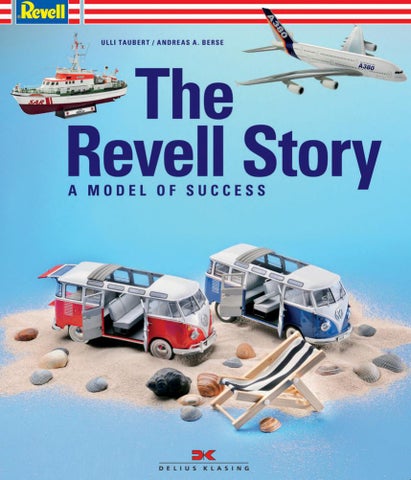
Creativity counts For more than 60 years, Revell has been a success story of creativity – with our customers and within our own company.
M
an’s desire to create something lasting is as old as humanity itself. Even the oldest known artifacts from human culture are testimony to the creativity of our species. Throughout the ages, techniques, materials and, above all, objects that were always relicts of their time have changed. When Revell first “saw the light of day” mid last century, it didn’t take long before creative people discovered that Revell was the brand that helped them live their dreams and allowed them to enjoy their
hobby. However, modelmaking wasn’t the only hobby in which Revell was involved. This book outlines the anecdotes and adventures of the last 70 years since the founding of the company in Venice, California. It’s a gripping story not only of a company that has become the epitome of plastic kits, but also one that “migrated” to other continents and kept reinventing itself with new products. This book allows a glimpse into the world of those dedicated people who stand behind the Revell name. And I, who had the great fortune of meeting some of these people personally, can underline that this Revell brand is the product of great and devoted people. They have all followed the values of the brand, exactly as I’d always imagined when I joined the company in January 2016. The stories in this book are fascinating, true and moving. They prove why the brand and the company have inspired employees and model builders for decades, and will continue to do so. I wish you a great deal of enjoyment as you dip into the enthralling history of Revell and perhaps we’ll meet personally some day at a trade fair, at your favorite model kit shop, or at the place where you indulge your Revell creativity.
Building the future: Stefan Krings took over the helm of the kit flagship Revell in January 2016 and is determined to steer the market leader in creativity into the future with new product lines.
Warm regards, Stefan Krings
Getting the hang of it: Junior Kits are one of the new product lines of Revell Germany that clearly points a way to the future. Shown here is the Lightning McQueen car from the successful and internationally renowned Disney movie Cars, which can also be easily assembled by very young modelmakers.
6 / 7
Jaap has lots of boxes Model kit collector Jaap Zwart from the Netherlands is not just a nice guy. Without him, it would have been all but impossible to make this Revell book.
W
hile researching for this book I was also on the lookout for vintage kits that we had not yet archived at Revell. The background: Revell’s archive only started in the mid-seventies with the completion of our new building – before this there was simply no suitable space. Hence, Revell only began archiving in earnest from this point in time. Over the years I’ve hunted high and low for collectors for this book who were willing to help us find those missing
The Revell collector: Jaap Zwart, shown here on the left with Revell veteran Ulli Taubert, has collected over 2,500 of the brand’s vintage model kits over the years.
models from the early years. An old friend, Gert Vlaanderen from IPMS Netherlands, offered to help me and put a request for collectors to contact him in his magazine Modelbouw in Plastic. We were lucky. Jaap Zwart agreed to give us his full support. We arranged an appointment at very short notice, sent a wish list of old model kits we were trying to track down, which we then wanted to photograph at his home. What the author found at Jaap’s house simply took his breath away. By irony of fate, it took me 50 years of working at Revell to meet the man who officially owns the world’s largest and most complete collection of our products from 1942 to 1967. The truly most valuable models are the first toys from the pre-1945 era: products and model kits that even I had never seen before. In his collection, Jaap had merchandise from a time when Revell kits had not yet arrived in the USA, just toys to buy. And from 1949, at the start of model kit production, he acquired everything that came on the market there. Insiders know that there is a whole series of products, pre-1956 and beyond, that never found their way onto the German market, model kits like the much sought-after aircraft and ship sets. Also in Jaap Zwart’s incredible collection are extremely rare and now priceless gems such as the Atomic Power Plant and the Space Station. Even before Revell itself became active on the Dutch market with its own travelling salesmen, Jaap had
Magnificent assortment: Jaap Zwart has been an acknowledged Revell chronologist for decades. Although he enjoys assembling the plastic kits (see above) – and this is the key to his collection – he usually leaves the vintage model sets unopened and keeps them well-preserved on shelves.
obtained all the Revell kits through the respective importers, first Suls, then Tenco. Jaap, too, has his own interesting story. The sprightly Dutchman, now in his late seventies, was born in 1940 in Surabaya, those days part of the Dutch East Indies. His father was a member of the Dutch Navy and was captured by the Japanese during the occupation. He and his mother were also detained. After the war he arrived in Singapore, where he lived near the Changi Royal Air Force airfield, and developed an interest in the aircraft and f lying boats that were stationed there. And that was when he was bitten by the aircraft bug. After several years, his parents moved back to the Netherlands very close to an airport near Hilversum. As a child he used to cycle to nearby airports with his camera and take photos. Jaap has stayed true to his hobby all his life. On the side, he also compiled a for-
midable collection of model kit sets – with a preference for Revell products – now totaling around 2,500 models. Note: Write a book and you get to meet the nicest people. Ulli Taubert 8 / 9
Yeah! Yeah! Yeah! Yes, it’s true: Revell also made the legendary Beatles in a scale of 1:8 and not out of ‘Norwegian Wood’!
S
hortly after I started working at Revell in 1968 I noticed something peculiar that many modelers are unaware of even today: one catalog, namely from 1965, features an illustration of the Beatles, four individual figurines on a scale of 1:8 – as plastic model kits. I managed to buy the one remaining kit privately. However, during my many years at Revell, this matter continued to play on my mind. Over the course of my career I obtained a second kit from the bankruptcy assets of a German toy retailer, and subsequently had the other two figures sent from abroad.
Today, I can call all “Fab Four” my own, each still unassembled in their original packaging. In the seventies, I tried to locate where the tools were made and I found out that they had traveled from Venice/California in 1986 with the entire Revell molds to the Monogram facility in Chicago and they were still there. We then brought two tools back to Bünde – each mold included two figures – and we tested them. The quality was excellent and Revell then did all it could to reissue them.
John Lennon’s widow was always the one to hamper this initiative. We only had permission to portray the Beatles as a comic adaption of the movie Yellow Submarine, but we didn’t want that. While writing this book, I became interested in the background story of the Beatles. I had to refer to existing literature, especially the works of Thomas Graham and Jean-Christophe Carbonel, who both made mention of this topic in their respective Revell books. In 1963, the year the Beatles made their breakthrough in England, Lewis “Lew” and Royle Glaser visited the Potters Bar branch as part of their European tour. During their stay in England, they discovered that people, particularly teenage girls, screamed hysterically at the wild concerts of a band called The Beatles. The Glasers liked neither the group’s moptop hairstyle nor their music, but were convinced that it wouldn’t be long before the Beatles phenomenon made its way across the pond to America. Back in New York, the pair popped in to the newly opened Beatles office and signed an exclusive contract for hobby products for the U.S. market. Royle was convinced that she’d finally found a product for the company’s female target group. The contract came with a 15 percent cut instead of Revell’s customary five percent. Because of this license fee, the contract was initially capped at just one year, which is why the figurines can only be found in the catalog and price list of 1965. In 1966 they disappeared from
Revellution: In 1965, the ‘Fab Four’ made their debut in the Revell catalog – in spite of the record license fee for those times. Revell thought they’d found an ideal product for girls with the figurines – which very quickly proved to be a mistake.
the catalog, with only three figures (excluding Ringo) mentioned in the price list. Royle Glaser gave herself a pat on the back for this coup, but later admitted: “I was surprised that the figurines weren’t popular.”
Whether it’s John, Paul, George or Ringo: Today, the 1:8-scale Beatles model kits from Revell are extremely rare collectors’ items.
Thus, it came about that these characters were sold predominantly in the USA and only in small quantities. Only a few boxes made it to Europe. Today, the four figures are sought-after treasures that fetch phenomenal prices amongst collectors and at auctions. Far out! Dazzling: With its Beatles packaging, Revell succeeded in creating a small pop art masterpiece. Well-preserved boxes boost the already high value enormously.
10 / 11
The plastics pioneer The story of Revell Deutschland began on a wet and cold March day in Nuremberg and Heinz-Georg Schöneberg was in the right place at the right time.
T
he door of the Hotel Deutscher Kaiser in Nuremberg swung open and a cold, damp wind swept through the room. A small man in a coat, his collar turned up and his hat pulled low over his forehead, entered the lobby as if stepping from the movie The Third Man. It was Lewis “Lew” H. Glaser and under his arm he carried a parcel, whose contents would transform children’s bedrooms for the next three generations: plastic kits – made in the USA.
Great teamwork: After founding Revell Plastics in 1956, the managing director Heinz-Georg Schöneberg immediately puts together a strong team of employees.
In the pleasantly warm hotel lounge, Heinz-Georg Schöneberg sat with three colleagues from the company Richard Schreiber, a successful toy retailer of that time. Schöneberg, as it would turn out, had definitely picked the right time and the right place – and his English wasn’t half bad either. He greeted the new arrival warmly, helped him check-in to his room, and asked the American what he had in his package. The mystery was quickly revealed. Glaser was given the chance to showcase his plastic model kits ‘unofficially’ to the German public at the Schreiber stand at a toy fair, where Schöneberg and his colleagues would then sell them. When the German sold almost three times more in the north than his colleagues did in the south over the next months, one thing became clear: If Lewis Glaser ever decided to establish a German subsidiary of his Revell company, Schöneberg would be the managing director. Thus, not long after, Glaser decided to set up a distribution warehouse in Germany. The time was ripe in 1956: The German company Revell Plastics was listed in the trade register in Bielefeld, and the company began operations in an old cigar factory on the Kaiser-Wilhelm-Straße in the town of Bünde. This year, Schöneberg would have turned 86 years old. As the undisputed pioneer at Revell Deutschland, he built from scratch a business that would eventually achieve international fame. It took, however, quite some time before he traveled to his first meeting in the land of endless opportunity:
Germany’s chief: At Schreiber, Heinz-Georg Schöneberg sells more Revell goods than any other salesman. As managing director, the self-made man determinedly continues to strengthen the position of Revell Germany.
Schöneberg, a former Heinkel bomber pilot, traveled by boat, his youngest daughter Andrea recalls. There was no way he would entrust his life to some pilot he didn’t know. He and Lewis Glaser clicked immediately and over the years they established a deep, lasting friendship. The mood in Germany at this time was optimistic and the Revell products sold like hotcakes. When the staffing situation in the distribution department became tight, the sales staff would throw on some overalls after hours and help out with the packaging. This was the time of the so-called economic miracle. Standing at the forefront of all this was “Uncle” Schöneberg, as the workers fondly called behind closed doors. He was also a visionary. Very soon, when the cigar factory premises became too cramped, Revell moved out. Thanks once again to
Schöneberg, the company found its permanent headquarters in the early seventies in the industrial area on Henschelstraße. In the truest sense of the word, Schöneberg was a patriarch and had earned a great deal of respect. Ulli Taubert, development guru amongst the East-Westphalians, recalls: “When I received my first invitation to the company party, I made very sure that my suit and tie were looking perfect.” However, the manager also knew how to celebrate. On one occasion, Marlène Charell danced as the main attraction at a Revell reception one evening on the occasion of the toy fair at Nuremberg. And, Schöneberg had a knack of bringing the right people together. Kurt Haubrok earned his trust, and many other Revell veterans joined the model kit manufacturer at a young age and stayed in East Westphalia for a long time. 12 / 13
2000 In a scale of 1:144, the Revell designers even venture into the realm of the International Space Station (ISS) at the turn of the millennium and include a tiny astronaut as a suitable size comparison.
W
ith the turn of the millennium, I turned more and more of my attention to marketing matters in product development, and the projects were increasingly taken care of by project managers. I cut back on the number of models I developed myself to concentrate more on general matters such as exhibitions, club meetings, trade fairs and looking after interns. However, I also helped with selected new developments. One of these was the first CAD project, a benchmark project so to speak, the model of a Russian vehicle, the Ekranoplan. We had to implement this project with virtually no technical material, only with images and photos
from publications. This then became our first inhouse CAD project. We also took the sensational newcomer from BMW for our catalog title, the new BMW Z8, which also played an important role in a James Bond movie. A new Mini was also designed as a 1:24 model, but this was done by a project manager. Because of my contacts to Munster and Augustdorf trucks of the German army, I developed 10, 7 and 5-ton trucks, namely from the MAN family, as 1:35-scale models for our military range. The die-cast line, which I was still responsible for, took off with the Buckel-Volvo PV series and the NSU TT. This, too, resulted in top quality finished models thanks to excellent assistance from Volvo “guru� Paul Uckelmann from Coesfeld and Ralph Plagmann from Audi Tradition.
The BMW Z8 plays a major role in the James Bond spy movie The World Is Not Enough. Revell develops the white-and-blue retro roadster from Munich as a 1:24-model with an authentic-looking V8 under the hood.
These three products emphasis the sheer breadth of Revell’s range in the year 2000: The legendary Buckel-Volvo PV series (top) is produced as a ready-made metal model in the 1:18 scale. The Zeppelin NT (bottom left) attracts attention as a 1:200-scale plastic kit, and the Ekranoplan A-90 Orljonok hovers over the water in 1:144.
90 / 91
2001 Revell and the four rings go well together. In 2001, a 1:18-scale die-cast model of the Auto Union Type C Streamline joins the range as a newcomer.
O
nce again I was lucky enough to receive help from my friends at the Army Aviation Corp in Bückeburg. Revell wanted to release the German army training version of the new EC-135 so we conducted the product research there. In the car segment we expanded our horizons this year to include not only Formula One racers but a new series of road-going Ferrari sports cars. Revell’s good and long-standing contact with Maranello put us in the position of having the exclusive right to create these models. Apart from Revell, only Tamiya in Japan received the occasional Ferrari license. I also developed a new series of aircraft for young modelers, and we called them Easy Kits. The main priority with these kits was that they should be colorful and simple to assemble. Revell had realized at this time that it was very important to look after our young customers so that there would be enough modelers in the future. This series has survived to this day and over the years has been successfully adopted by teenagers in hundreds of model-making activities. The die-cast sector boomed this year with six completely new developments, the highlight of which was Revell’s New Mini in the super-scale 1:12. But one project was to be another very special experience: The Red Porsche Killer, arguably the most famous motorbike of the Werners. I could fill pages with the story of how this model came about. Thank goodness this
time we got an original to use as the basis, which we easily reproduced into a 1:9 model. An anecdote on the side: We were forbidden by Porsche to call the model the same as the “Oginool”, hence we used the name Red XXXXXXX Killer on both the packaging and the decals. On the occasion of the Revell show we invited the “Red Porsche Killer”, the Satte Literschüssel and the two creators Rötger and Andi Feldmann to Bünde – an unforgettable experience.
In the large 1:12 scale, Revell takes on the new Mini and produces the tiny cult car as a die-cast miniature.
2002 Dubbed the NSU TTS, Revell adds this brawny little guy to its program, which is launched on market as a 1:18 finished model sporting a variety of new race liveries.
R
evell launched its “fascination model-making” campaign this year and clearly emphasized this in its catalog. The idea was also about making model-making interesting to a broader public. I was again involved mainly in new developments in the car sector, particularly in the die-cast segment. Once again we had illustrated the title of the catalog with a zinc die-cast model, the original of which would ultimately never go into mass production: it was the VW W12, a spectacular design from Wolfsburg that was unveiled to the public at the Tokyo Motor Show late in 2001. Thanks to our wonderful contact at Volkswagen, Klaus-Jürgen Glaser, we received all the documentation we needed and were even permitted to photograph the original. At this point in time, the plan was to produce the W12. However, the board made the decision to abandon this project and thus it died for us, as well. After all, we would only have been able to sell the required quantities if it had gone into production. Another concept was presented at Detroit in 2001 and realized
by us: the VW Microbus, which was in fact a retro-car cross between a T1 and T2. As a large sedan it was supposed to fill the gap between the Sharan and T5. After we’d produced the model, VW decided that this car, too, would not go into production. If we’d received this information earlier, we would never have made this model. Positive news in the die-cast range was the launch of a series of racers based on the NSUTT, a series that would run successfully for years.
Revell often uses spectacular new developments in aviation to come up with awesome kits. The new Airbus 380 makes its final approach. Revell miniaturizes this aircraft in the scale of 1:144 (bottom and right page).
Bibliographic information published by the Deutsche Nationalbibliothek The Deutsche Nationalbibliothek lists this publication in the Deutsche Nationalbibliografie; detailed bibliographic data are available in the Internet at http://dnb.dnb.de.
1st edition ISBN 978-3-667-11393-1 © Delius Klasing & Co. KG, Bielefeld (Germany) Overall concept/idea/wording: Andreas A. Berse Translation: Kaye Mueller Editor: Hanno Vienken Cover design and layout: Jörg Weusthoff, Weusthoff Noël, Hamburg Photos Bildarchiv Revell: 11, 16, 18, 19, 42-49, 52, 54, 58-129, 132-135, 141, 143, 156, 158, 161-163, 168/169, 171-173 Sarah Böke: 8, 9, 11, 18, 20, 21, 24-60, 62-70, 72-75, 79, 81, 89, 96, 117, 145-147, 155, 157 Markus Bolsinger: 128, 136-139, 148-153, 164-167, 174-175 Privatarchiv Schöneberg: 12-15, 37, 38, 40, 41, 42, 46, 47 Ulli Taubert: 130-131, 140, 144, 154, 159-160, 170 Christian Hoffmann: 17, 141 K.D. Nowack: cover, 128, 162, back cover These photo credits were compiled with utmost care, however it cannot be ruled out that some copyright holders have not been identified. Information about possible claims should be addressed to the publisher. Lithography: Mohn Media, Gütersloh Printed by: print consult, Munich Printed in Czech Republic 2018 All rights reserved. The work may neither be entirely nor partially reproduced, transmitted or copied – such as manually or by means of electronic and mechanical systems, including photo-copying, tape recording and data storage – without explicit permission of the publisher. Delius Klasing Verlag, Siekerwall 21, 33602 Bielefeld, Germany Phone: +49-521-559-0, Fax: +49-521-559-115 Email: info@delius-klasing.de www.delius-klasing.de