‘She tells the tale so well. I kept thinking of superior journalism, the way the Insight team used to tell stories, the way that Bernstein and Woodward described the Watergate shenanigans. She has a way of pinning down place and time with a few brushstrokes, whilst never letting the tension slip. At the same time it is unquestionably her story, and her thoughts, hopes, triumphs and setbacks give the story a beating heart. It has clarity of intention—and the tribulations and trial of the three girls (who all come across as very strong well-drawn characters) is what binds it all together. The Rock Bottom trial is interesting and important in its implications and as a milestone along the rocky road of defending creative independence. And the good guys win, and immediately end up squabbling.’ MICHAEL PALIN ‘A deeply personal David and Goliath story, full of blazing attitude, about three women who had their lives, identities and ideas appropriated. But against all expectation the High Court recognised that wasn’t right. It has a dash of The Commitments, a pinch of Gypsy, a peppering of Rocky Horror, a splash of 9 to 5, and a smidgen of Bowie, but it’s very much its own thing. And the context—70s London glam-pop-meets-theatre culture, the rock chick, the British Girl Group—is fabulous. Rock Bottom had something new for the time. They were, and are, three flamboyant and tenacious individuals. They were flawed, they had heart, they had flair, they were different— Annabel is blonde, middle-height, middle class, tenacious, the driving force; Gaye Brown is red-headed, tall and posh, a lethal wit; Diane Langton is working class, dark-haired and as infuriatingly unreliable but easy-to-forgive as Judy Garland. It’s a terrific read.’ SAMUEL ADAMSON
‘I think that it would work really well as a TV series. Maybe the Bakeoff slot. Please let me know when you are casting, as I would like to audition for the part of me.’ NICK STRAUSS QC ‘Attention-grabbing right from the start. The triumphs, disasters and wiles of these hard-working, hilarious and heart-warming ladies are told with a smooth naturalness, charm and easy readability. What plots, what schemes, what surprises! Read it!’ SIR DEREK JACOBI
‘She tells the tale so well. I kept thinking of superior journalism, the way the Insight team used to tell stories, the way that Bernstein and Woodward described the Watergate shenanigans. She has a way of pinning down place and time with a few brushstrokes, whilst never letting the tension slip. At the same time it is unquestionably her story, and her thoughts, hopes, triumphs and setbacks give the story a beating heart. It has clarity of intention—and the tribulations and trial of the three girls (who all come across as very strong well-drawn characters) is what binds it all together. The Rock Bottom trial is interesting and important in its implications and as a milestone along the rocky road of defending creative independence. And the good guys win, and immediately end up squabbling.’ MICHAEL PALIN ‘A deeply personal David and Goliath story, full of blazing attitude, about three women who had their lives, identities and ideas appropriated. But against all expectation the High Court recognised that wasn’t right. It has a dash of The Commitments, a pinch of Gypsy, a peppering of Rocky Horror, a splash of 9 to 5, and a smidgen of Bowie, but it’s very much its own thing. And the context—70s London glam-pop-meets-theatre culture, the rock chick, the British Girl Group—is fabulous. Rock Bottom had something new for the time. They were, and are, three flamboyant and tenacious individuals. They were flawed, they had heart, they had flair, they were different— Annabel is blonde, middle-height, middle class, tenacious, the driving force; Gaye Brown is red-headed, tall and posh, a lethal wit; Diane Langton is working class, dark-haired and as infuriatingly unreliable but easy-to-forgive as Judy Garland. It’s a terrific read.’ SAMUEL ADAMSON
‘I think that it would work really well as a TV series. Maybe the Bakeoff slot. Please let me know when you are casting, as I would like to audition for the part of me.’ NICK STRAUSS QC ‘Attention-grabbing right from the start. The triumphs, disasters and wiles of these hard-working, hilarious and heart-warming ladies are told with a smooth naturalness, charm and easy readability. What plots, what schemes, what surprises! Read it!’ SIR DEREK JACOBI
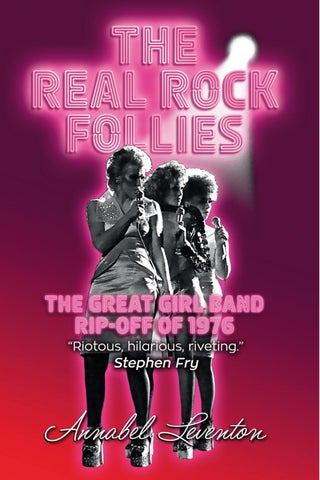
THE REAL ROCK FOLLIES The great girl band rip-off of 1976
Annabel Leventon
THE REAL ROCK FOLLIES The great girl band rip-off of 1976
Annabel Leventon
NW1Books Copyright © Annabel Leventon, 2017 Annabel Leventon has asserted her right under the Copyright, Design and Patents Act 1988 to be identified as the author of this work All rights reserved. No part of this publication may be reproduced, stored in a retrieval system, or transmitted, in any form or by any means, electronic, mechanical, photocopying, recording or otherwise, without the prior permission of both the copyright owner and the publisher. Every effort has been made to trace copyright holders of material quoted or used. Please contact the publishers in case of omission, which will be corrected in future editions. Show photos, including cover image, by permission of Straker Welds, publicity shots for RCA by permission of John Haynes, cartoons by permission of Stephen Jeffers, song lyrics from ‘Laziest Gal in Town’ and ‘Proud Mary’ by permission of Warner Chappell A CIP catalogue copy of this book is available from the British Library. ISBN 978-1-9997054-0-4 Typesetting by Pallas Athene (Publishers) Ltd Printed in England info@nw1books.co.uk
For GB, Di-Di, Don and Harry, who carries the musical torch
NW1Books Copyright © Annabel Leventon, 2017 Annabel Leventon has asserted her right under the Copyright, Design and Patents Act 1988 to be identified as the author of this work All rights reserved. No part of this publication may be reproduced, stored in a retrieval system, or transmitted, in any form or by any means, electronic, mechanical, photocopying, recording or otherwise, without the prior permission of both the copyright owner and the publisher. Every effort has been made to trace copyright holders of material quoted or used. Please contact the publishers in case of omission, which will be corrected in future editions. Show photos, including cover image, by permission of Straker Welds, publicity shots for RCA by permission of John Haynes, cartoons by permission of Stephen Jeffers, song lyrics from ‘Laziest Gal in Town’ and ‘Proud Mary’ by permission of Warner Chappell A CIP catalogue copy of this book is available from the British Library. ISBN 978-1-9997054-0-4 Typesetting by Pallas Athene (Publishers) Ltd Printed in England info@nw1books.co.uk
For GB, Di-Di, Don and Harry, who carries the musical torch
Contents
List of Illustrations Dramatis Personae
x xi
Prologue Chapter 1 Chapter 2 Chapter 3 Chapter 4 Chapter 5 Chapter 6 Chapter 7 Chapter 8 Chapter 9 Chapter 10 Chapter 11 Chapter 12 Chapter 13 Chapter 14 Chapter 15 Chapter 16 Chapter 17 Chapter 18 Chapter 19 Chapter 20 Chapter 21
1 5 21 35 61 71 83 103 123 141 159 173 185 193 203 219 233 247 263 279 289 295
A Group is Born The Master Gruppenplan Television Dreaming Making It Real The Smell of Success Cloud Nine Thames Television Extended Honeymoon Rock and a Hard Place At Rock Bottom Fight Back High Court Unravelling Ravelling Witnesses Recall Judgement Day Aftermath Fallout Phone Call Reunion
Acknowledgements About the Author
302 303
Contents
List of Illustrations Dramatis Personae
x xi
Prologue Chapter 1 Chapter 2 Chapter 3 Chapter 4 Chapter 5 Chapter 6 Chapter 7 Chapter 8 Chapter 9 Chapter 10 Chapter 11 Chapter 12 Chapter 13 Chapter 14 Chapter 15 Chapter 16 Chapter 17 Chapter 18 Chapter 19 Chapter 20 Chapter 21
1 5 21 35 61 71 83 103 123 141 159 173 185 193 203 219 233 247 263 279 289 295
A Group is Born The Master Gruppenplan Television Dreaming Making It Real The Smell of Success Cloud Nine Thames Television Extended Honeymoon Rock and a Hard Place At Rock Bottom Fight Back High Court Unravelling Ravelling Witnesses Recall Judgement Day Aftermath Fallout Phone Call Reunion
Acknowledgements About the Author
302 303
List of Illustrations
Dramatis Personae
1 The Fourbeats at Oxford, 1963, with Petula Clark 2, 3, 4, 5, 6 Hair!—Shaftesbury Theatre, London, 1968, and le théatre de la Porte St Martin, Paris, 1969 7 Our first agreement, January, 1974 8 Rock Bottom, Evening Standard, June, 1974 (photo: Tim Graham) 9 Our first concert, Kings Road Theatre, July 14, 1974 (all photos: Straker Welds) a) As Peter’s backing singers, the Strakettes b) Don at the piano, in his regulation white jacket c), d) As Rock Bottom e) Di-Di, solo f) GB, solo g) Annie, solo h) In our silks and our fines 10, 11 Selsdon Park concert for RCA, September, 1974 (photos: Straker Welds), Rock Bottom in improvised costumes—see Di-Di’s skirt 12, 13 Rock Bottom publicity shots for RCA (photos: John Haynes) 14 Cartoon of GB (Stephen Jeffers) 15 Cartoon of Annie (Stephen Jeffers) 16 GB and Annie in The Rocky Horror Picture Show, 1975 17 GB, Di-Di and Annie in The Rag Trade pilot, BBC, 1975 (Youtube: https://youtu.be/RxZ0qjewgIY) 18 Rock Bottom outside the High Court, October 21, 1982 (photos: Jack Mainwaring)
Rock Bottom: Annabel Leventon—Annie in the group Gaye Brown—GB in the group Diane Langton—Di-Di in the group Donald Fraser—composer, arranger, pianist, manager Peter Straker: singer in Hair! Shares concerts with Rock Bottom Julie Covington: actress, singer. First big break—Rock Follies David Toguri: assistant director on Hair! Stages Rock Bottom Larry Fenton: music publisher and mentor to Don Fraser Sandra Fraser: secretary to Larry Fenton and Don’s sister Douglas Trout: hairdresser for Rock Bottom Petra, his wife: model, make-up artist for Rock Bottom Michael White: theatre impresario Jack Rosenthal: television writer and producer Maureen Lipman, Jack’s wife: actress and friend Howard Schuman: television writer and friend Jenne Casarotto: Howard’s agent Brian Degas: BBC Light Entertainment producer Andrew Brown: producer of Verité, Rock Follies Verity Lambert: Head of Drama, Thames Television Liz Sadler: Head of Casting, Thames Television Oscar Beuselinck: show-biz solicitor for Hair! and Rock Bottom Nick Strauss: barrister, junior counsel for Rock Bottom
List of Illustrations
Dramatis Personae
1 The Fourbeats at Oxford, 1963, with Petula Clark 2, 3, 4, 5, 6 Hair!—Shaftesbury Theatre, London, 1968, and le théatre de la Porte St Martin, Paris, 1969 7 Our first agreement, January, 1974 8 Rock Bottom, Evening Standard, June, 1974 (photo: Tim Graham) 9 Our first concert, Kings Road Theatre, July 14, 1974 (all photos: Straker Welds) a) As Peter’s backing singers, the Strakettes b) Don at the piano, in his regulation white jacket c), d) As Rock Bottom e) Di-Di, solo f) GB, solo g) Annie, solo h) In our silks and our fines 10, 11 Selsdon Park concert for RCA, September, 1974 (photos: Straker Welds), Rock Bottom in improvised costumes—see Di-Di’s skirt 12, 13 Rock Bottom publicity shots for RCA (photos: John Haynes) 14 Cartoon of GB (Stephen Jeffers) 15 Cartoon of Annie (Stephen Jeffers) 16 GB and Annie in The Rocky Horror Picture Show, 1975 17 GB, Di-Di and Annie in The Rag Trade pilot, BBC, 1975 (Youtube: https://youtu.be/RxZ0qjewgIY) 18 Rock Bottom outside the High Court, October 21, 1982 (photos: Jack Mainwaring)
Rock Bottom: Annabel Leventon—Annie in the group Gaye Brown—GB in the group Diane Langton—Di-Di in the group Donald Fraser—composer, arranger, pianist, manager Peter Straker: singer in Hair! Shares concerts with Rock Bottom Julie Covington: actress, singer. First big break—Rock Follies David Toguri: assistant director on Hair! Stages Rock Bottom Larry Fenton: music publisher and mentor to Don Fraser Sandra Fraser: secretary to Larry Fenton and Don’s sister Douglas Trout: hairdresser for Rock Bottom Petra, his wife: model, make-up artist for Rock Bottom Michael White: theatre impresario Jack Rosenthal: television writer and producer Maureen Lipman, Jack’s wife: actress and friend Howard Schuman: television writer and friend Jenne Casarotto: Howard’s agent Brian Degas: BBC Light Entertainment producer Andrew Brown: producer of Verité, Rock Follies Verity Lambert: Head of Drama, Thames Television Liz Sadler: Head of Casting, Thames Television Oscar Beuselinck: show-biz solicitor for Hair! and Rock Bottom Nick Strauss: barrister, junior counsel for Rock Bottom
Keith Schilling: solicitor in Oscar’s office, prepares the Rock Bottom case John Wilmers: QC, Counsel for the Prosecution David Hirst: High Court Judge Gordon: Judge’s Clerk Jeremiah Herman: QC, Counsel for the Defence Fraser et al v Thames TV [1982] Claimants had idea for TV series concerning a female rock group. Was partly fictional and partly based on experiences of Claimants. Idea was communicated to Defendant 1 (a scriptwriter), who then communicated it to Defendant 2 (a producer). D1 D2 and D3 (Thames Television) went on to produce TV show based on idea, but using different actresses. Claimants sued for breach of confidence.
Keith Schilling: solicitor in Oscar’s office, prepares the Rock Bottom case John Wilmers: QC, Counsel for the Prosecution David Hirst: High Court Judge Gordon: Judge’s Clerk Jeremiah Herman: QC, Counsel for the Defence Fraser et al v Thames TV [1982] Claimants had idea for TV series concerning a female rock group. Was partly fictional and partly based on experiences of Claimants. Idea was communicated to Defendant 1 (a scriptwriter), who then communicated it to Defendant 2 (a producer). D1 D2 and D3 (Thames Television) went on to produce TV show based on idea, but using different actresses. Claimants sued for breach of confidence.
Prologue
Kilburn, London, 2004 Before she rang, I was settled. Before she rang, I hardly ever thought of her. Twenty years is long enough, even for me. Okay, I’m not good at letting things go, saying goodbye. I tend to cling to the driftwood of a failed romance, for instance, treading water, believing the boat will right itself, given time. It hardly ever does, of course. It ’s more practical to strike out for land, swim away before it drags you down with it. With friends, it ’s a different matter, I haven’t lost many of those. We might drift apart from circumstance, like going to another school or off to live in Australia. But most of the time, a friend is a friend. That ’s that. Settled, did I say? Yes, to my surprise, that ’s the right word. After a disastrous two years living in the country, I ’d found a place to live in North London for me, my son Harry and Purdey the dog. I feel cast adrift anywhere else. A little maisonette on the Horton Gardens Housing Estate in Swiss Cottage. Technically Kilburn but it ’s closer to Swiss Cottage. I could do my weekly shop at Waitrose on the Finchley Road just as I always had. John Barnes, it was called once. Horton Gardens Estate is on the wrong side of the Finchley Road, where the roads all take a sudden lurch downhill. I prefer to be a bit higher up. But as homes go, mine was fine. Tiny, but with a pretty, west-facing, walled garden and behind that, a little enclosed park just for residents. No-one ever went there till I moved in. A fox or two. Quite a few birds. There was no way in 1
Prologue
Kilburn, London, 2004 Before she rang, I was settled. Before she rang, I hardly ever thought of her. Twenty years is long enough, even for me. Okay, I’m not good at letting things go, saying goodbye. I tend to cling to the driftwood of a failed romance, for instance, treading water, believing the boat will right itself, given time. It hardly ever does, of course. It ’s more practical to strike out for land, swim away before it drags you down with it. With friends, it ’s a different matter, I haven’t lost many of those. We might drift apart from circumstance, like going to another school or off to live in Australia. But most of the time, a friend is a friend. That ’s that. Settled, did I say? Yes, to my surprise, that ’s the right word. After a disastrous two years living in the country, I ’d found a place to live in North London for me, my son Harry and Purdey the dog. I feel cast adrift anywhere else. A little maisonette on the Horton Gardens Housing Estate in Swiss Cottage. Technically Kilburn but it ’s closer to Swiss Cottage. I could do my weekly shop at Waitrose on the Finchley Road just as I always had. John Barnes, it was called once. Horton Gardens Estate is on the wrong side of the Finchley Road, where the roads all take a sudden lurch downhill. I prefer to be a bit higher up. But as homes go, mine was fine. Tiny, but with a pretty, west-facing, walled garden and behind that, a little enclosed park just for residents. No-one ever went there till I moved in. A fox or two. Quite a few birds. There was no way in 1
The Real Rock Follies
Prologue
except through my garden gate and climb over the fence. Purdey loved it. She leapt the fence, chased the foxes, rolled in the grass. She didn’t mind the thunder of the Metropolitan Line beneath. She didn’t mind the green metal signs screwed into every wall: Camden Council—No Ball Games. Camden Council—No Dogs Allowed. Dogs can’t read, but I minded. What did it matter if a child kicked a ball on a deserted patch of long grass with no windows to break anywhere near? Why shouldn’t my dog run round in a space no-one ever used except her and me? I snuck out one night with a screwdriver, took them all down and binned them. I began to feel more at home once I ’d done that. Most of my neighbours had lived there since the estate was built forty years before. One elderly couple told me they used to drive over to watch it going up. They served on the Residents’ Committee, they said, had done for years. They were ready to step down, it was getting too much for them, but nobody new ever volunteered. ‘I will,’ I said. ‘That ’d be fun.’ They smiled. ‘It’s very dull, dear,’ said Mildred. ‘I’m not sure it ’d be up your street, not with you being so busy with your acting.’ ‘I could have a go. There are plenty of gaps between jobs, you know. And I ’d get to know more people here. I ’d like that.’ Mildred looked pleased. ‘I’ll invite you to the next meeting, dear. We’re getting on, you know, all a bit mutt’n’jeff now. You ’d have to speak up a bit.’ ‘Speaking up is what I’m trained to do,’ I said. That ’s where I ’d been, the evening Di rang, to a committee meeting. I was desperate to pee, trotting back to my front door, hunched over, holding on very tight, fumbling for my keys. Damn, damn. Should’ve gone before I left. ‘Shut up, Purdey, shut up. Sssh. It ’s me.’ Key in lock, door half open, Purdey barking through the gap and my mobile phone ringing. I scrabble round inside my bag. It
could have gone off in the meeting. I must remember to switch it off in future. ‘Hello?’ A little gasp at the other end. ‘Annie? Annie?’ I know that voice. It ’s in my bones, in my DNA. Nobody except my long-dead father calls me Annie. Except the girls. It ’s Di. Di from Rock Bottom. My darling ex-friend. The one I never speak to. Who never speaks to me. ‘Annie? It ’s Di. Di Langton.’ I can no more move than fly. I sit down hard on the doorstep. Purdey pushes through the open door, snuffles at me, licking the cascade of tears. It ’s Di.
2
Di and Gaye and me. The three of us. What we lost. What we won. What we were.
3
The Real Rock Follies
Prologue
except through my garden gate and climb over the fence. Purdey loved it. She leapt the fence, chased the foxes, rolled in the grass. She didn’t mind the thunder of the Metropolitan Line beneath. She didn’t mind the green metal signs screwed into every wall: Camden Council—No Ball Games. Camden Council—No Dogs Allowed. Dogs can’t read, but I minded. What did it matter if a child kicked a ball on a deserted patch of long grass with no windows to break anywhere near? Why shouldn’t my dog run round in a space no-one ever used except her and me? I snuck out one night with a screwdriver, took them all down and binned them. I began to feel more at home once I ’d done that. Most of my neighbours had lived there since the estate was built forty years before. One elderly couple told me they used to drive over to watch it going up. They served on the Residents’ Committee, they said, had done for years. They were ready to step down, it was getting too much for them, but nobody new ever volunteered. ‘I will,’ I said. ‘That ’d be fun.’ They smiled. ‘It’s very dull, dear,’ said Mildred. ‘I’m not sure it ’d be up your street, not with you being so busy with your acting.’ ‘I could have a go. There are plenty of gaps between jobs, you know. And I ’d get to know more people here. I ’d like that.’ Mildred looked pleased. ‘I’ll invite you to the next meeting, dear. We’re getting on, you know, all a bit mutt’n’jeff now. You ’d have to speak up a bit.’ ‘Speaking up is what I’m trained to do,’ I said. That ’s where I ’d been, the evening Di rang, to a committee meeting. I was desperate to pee, trotting back to my front door, hunched over, holding on very tight, fumbling for my keys. Damn, damn. Should’ve gone before I left. ‘Shut up, Purdey, shut up. Sssh. It ’s me.’ Key in lock, door half open, Purdey barking through the gap and my mobile phone ringing. I scrabble round inside my bag. It
could have gone off in the meeting. I must remember to switch it off in future. ‘Hello?’ A little gasp at the other end. ‘Annie? Annie?’ I know that voice. It ’s in my bones, in my DNA. Nobody except my long-dead father calls me Annie. Except the girls. It ’s Di. Di from Rock Bottom. My darling ex-friend. The one I never speak to. Who never speaks to me. ‘Annie? It ’s Di. Di Langton.’ I can no more move than fly. I sit down hard on the doorstep. Purdey pushes through the open door, snuffles at me, licking the cascade of tears. It ’s Di.
2
Di and Gaye and me. The three of us. What we lost. What we won. What we were.
3
1 A Group is Born
West Kensington, 1971 What does an impecunious, provincial grammar-school girl do when she leaves Oxford, apart from becoming an actress and moving to London? She forms a rock group, of course. At least, that ’s what I did, a long time ago now. In the summer of 1973, we dreamed up the first three-woman rock group in England: Gaye Brown, Diane Langton and me. Or to be more precise: Gaye, me and Di— I was always in the middle. Not because I was the lead singer— far from it. Di, deaf in one ear, stood on the far right so she could hear us, Gaye needed to be next to me so she could get my harmonies. I had to be the one in the middle. We were all as different as three girls could be—red-haired, six foot, upper-crust, (Gaye); blonde, middle-sized, middle-class, (me); dark-haired, tiny, working-class (Diane). Together we were electric—raunchy and rude and funny. We called ourselves Rock Bottom. And we nearly made it. 1973. RULES for FORMING FEMALE ROCK GROUPS 1) Don’t. Wait for a manager to package you, choose your material, choose the lead singer, groom you for stardom, market you and then drop you when he ’s made enough money out of you. 5
1 A Group is Born
West Kensington, 1971 What does an impecunious, provincial grammar-school girl do when she leaves Oxford, apart from becoming an actress and moving to London? She forms a rock group, of course. At least, that ’s what I did, a long time ago now. In the summer of 1973, we dreamed up the first three-woman rock group in England: Gaye Brown, Diane Langton and me. Or to be more precise: Gaye, me and Di— I was always in the middle. Not because I was the lead singer— far from it. Di, deaf in one ear, stood on the far right so she could hear us, Gaye needed to be next to me so she could get my harmonies. I had to be the one in the middle. We were all as different as three girls could be—red-haired, six foot, upper-crust, (Gaye); blonde, middle-sized, middle-class, (me); dark-haired, tiny, working-class (Diane). Together we were electric—raunchy and rude and funny. We called ourselves Rock Bottom. And we nearly made it. 1973. RULES for FORMING FEMALE ROCK GROUPS 1) Don’t. Wait for a manager to package you, choose your material, choose the lead singer, groom you for stardom, market you and then drop you when he ’s made enough money out of you. 5
The Real Rock Follies
A Group is Born
2) Start when teenagers. You’re over the hill by 30. 3) Be sisters or look as if you’re sisters. 4) Be black and American, look alike, dress alike, sound alike. 5) Do as you’re told. Shut up. 6) Don’t write your own material. You have nothing to say. Shut up. 7) Look sexy and keep your mouth shut. 8) When your first and only brilliant idea gets stolen, accept it and move on. 9) Shut up.
happened: I fell in love. It was my first teenage party, in someone’s front room. The lights dimmed, someone put a record on and a boy asked me to dance. I no longer remember who he was, but I’ll never forget what we danced to: Dream, Dream, Dream by The Everly Brothers. It was the very first pop song I ’d ever heard. I fell in love with it and all their other songs. And Buddy Holly, Elvis Presley, Little Eva, Edith Piaf, Carole King … Now I had two passions—acting and pop-singing. Pop was banned in our house, my mother loathed it, so the singing stayed secret till I got to Oxford. Till I got to Oxford. It sounds so easy, doesn’t it? How did that happen? Nobody in my family had ever been to university. I don’t think I would have tried very hard, or at all, if it hadn’t been for my headmistress. ‘You?’ she said, head flung back, prominent front teeth bared. ‘Oxford? Cambridge? The best you ’d get is a place at London.’ That did it. I discovered a stubborn streak. And I got lucky again. St Anne’s College believed in my potential enough to give me a minor scholarship. Once there, I acted in everything I could—Chekhov, Shakespeare, Brecht, revue. And I sang. Sang with a student dance band, The Fourbeats, sang anything and everything on the Top 20 and the jukebox—Elvis, Buddy Holly, Piaf, Cilla Black, the Beatles. Acting gave me, to my astonishment, national reviews in all the main papers, while singing was the best fun I ’d ever had and paid my way through university. I forged life-long friendships with other grammar-school kids who also couldn’t believe their luck. And when that was over, I went to drama school to learn to be a proper actress. I still loved pop, but it was another world. You couldn’t do both, it seemed. Never the twain would meet. Till one day in 1968, along came a new show into the West End, the American Tribal Love-rock Musical Hair! My two passions rolled into one—acting and rock-singing. I got the female
Tough. We broke every single one. We didn’t mean to, it’s the way it worked out. It all seemed random at the time. Random and inevitable, glorious and new. Looking back now, it doesn’t seem so accidental. I needed a group, for reasons I didn’t then know. I never liked being a solo singer. Gaye and Di gave me strength. They were both huge personalities. On stage I felt I was being pulled apart by two horses galloping in opposite directions. But that’s what a middle child does—hold things together. So I had my role. As a child I always sang. It was natural, my mother always sang. Hummed when she was annoyed, sang full out when she was happy. I sang too. I never thought about it, certainly not as a possible career. I knew what I wanted to be—I was going to be an actress. I never thought of anything else. Life after the war was tough, especially if you had no money. We lived outside London, we never went to musicals or pantos, we had no television. So when my aunt took me to see Peter Pan on stage one Christmas when I was five, and took me backstage afterwards to meet the actress playing Peter, I was awestruck. Bowled over. Hooked. Acting was what I was born to do. I was lucky. I somehow passed the eleven-plus and went to grammar school. And when I was fourteen, something momentous 6
7
The Real Rock Follies
A Group is Born
2) Start when teenagers. You’re over the hill by 30. 3) Be sisters or look as if you’re sisters. 4) Be black and American, look alike, dress alike, sound alike. 5) Do as you’re told. Shut up. 6) Don’t write your own material. You have nothing to say. Shut up. 7) Look sexy and keep your mouth shut. 8) When your first and only brilliant idea gets stolen, accept it and move on. 9) Shut up.
happened: I fell in love. It was my first teenage party, in someone’s front room. The lights dimmed, someone put a record on and a boy asked me to dance. I no longer remember who he was, but I’ll never forget what we danced to: Dream, Dream, Dream by The Everly Brothers. It was the very first pop song I ’d ever heard. I fell in love with it and all their other songs. And Buddy Holly, Elvis Presley, Little Eva, Edith Piaf, Carole King … Now I had two passions—acting and pop-singing. Pop was banned in our house, my mother loathed it, so the singing stayed secret till I got to Oxford. Till I got to Oxford. It sounds so easy, doesn’t it? How did that happen? Nobody in my family had ever been to university. I don’t think I would have tried very hard, or at all, if it hadn’t been for my headmistress. ‘You?’ she said, head flung back, prominent front teeth bared. ‘Oxford? Cambridge? The best you ’d get is a place at London.’ That did it. I discovered a stubborn streak. And I got lucky again. St Anne’s College believed in my potential enough to give me a minor scholarship. Once there, I acted in everything I could—Chekhov, Shakespeare, Brecht, revue. And I sang. Sang with a student dance band, The Fourbeats, sang anything and everything on the Top 20 and the jukebox—Elvis, Buddy Holly, Piaf, Cilla Black, the Beatles. Acting gave me, to my astonishment, national reviews in all the main papers, while singing was the best fun I ’d ever had and paid my way through university. I forged life-long friendships with other grammar-school kids who also couldn’t believe their luck. And when that was over, I went to drama school to learn to be a proper actress. I still loved pop, but it was another world. You couldn’t do both, it seemed. Never the twain would meet. Till one day in 1968, along came a new show into the West End, the American Tribal Love-rock Musical Hair! My two passions rolled into one—acting and rock-singing. I got the female
Tough. We broke every single one. We didn’t mean to, it’s the way it worked out. It all seemed random at the time. Random and inevitable, glorious and new. Looking back now, it doesn’t seem so accidental. I needed a group, for reasons I didn’t then know. I never liked being a solo singer. Gaye and Di gave me strength. They were both huge personalities. On stage I felt I was being pulled apart by two horses galloping in opposite directions. But that’s what a middle child does—hold things together. So I had my role. As a child I always sang. It was natural, my mother always sang. Hummed when she was annoyed, sang full out when she was happy. I sang too. I never thought about it, certainly not as a possible career. I knew what I wanted to be—I was going to be an actress. I never thought of anything else. Life after the war was tough, especially if you had no money. We lived outside London, we never went to musicals or pantos, we had no television. So when my aunt took me to see Peter Pan on stage one Christmas when I was five, and took me backstage afterwards to meet the actress playing Peter, I was awestruck. Bowled over. Hooked. Acting was what I was born to do. I was lucky. I somehow passed the eleven-plus and went to grammar school. And when I was fourteen, something momentous 6
7
Di-Di, solo
GB, solo
Di-Di, solo
GB, solo
Rock Bottom publicity shot for RCA (John Haynes)
Rock Bottom publicity shot for RCA (John Haynes)
Rock Bottom publicity shot for RCA (John Haynes)
Rock Bottom publicity shot for RCA (John Haynes)
The Real Rock Follies
Unravelling
‘I swear to tell the truth, the whole truth and nothing but the truth.’ My voice is steady and clear. I’ve waited over seven years for this. I’m ready. The blood beating in my ears drowns out Wilmer’s earlier homily: ‘Listen hard, answer the questions, don’t give too much detail till I ask for more, stick to the point’. I trust Hirst, he was kind to Don and he reminds me of my brother Patrick, who I ’d trust with my life. There’s Keith, there’s Nick, there’s Wilmers, all on my side, all there for me. Forget Harman and his mob. From far, far below, Gaye and Don gaze up at me. Gaye winks. I’ll do my best for them. Wilmers first, to establish who I am, my background, education, credentials, experience. I’ve rehearsed all of that a hundred times. There’s one bit I’m dreading: the new evidence. Freshly discovered. Buried for nine years. Then boom! It surfaced a week or so before the trial began. The reason for Rock Bottom’s entire existence. The baby I ’d so longed for, was so ready for and got rid of, is still here, but in the form of a three-girl group—my group. Having it snatched away in infancy and brought up by someone else is hard to bear, impossible to accept. That’s what I’m fighting for. Wilmers takes me through Oxford, my career, meeting Don. I know what’s next. ‘Miss Leventon, would you tell the court in your own words how the idea for the group Rock Bottom came into being?’ I take a deep breath. ‘In April, 1973, I discovered I was pregnant.’ Pause. ‘We had no money. Don’s career wasn’t established. I was the principal breadwinner, we ’d only been … ’ I hear the wobble in my voice, feel it on my lower lip. The judge, pen hovering over the page, turns his head.
Wilmers gives me a steady look. ‘Please continue, Miss Leventon.’ The court is very quiet. ‘So I agreed to have a termination.’ ‘I can’t hear you, Miss Leventon. Would you repeat that, please?’ I clear my throat. ‘Sorry. I had a termination. I terminated the pregnancy.’ ‘And?’ Wilmers voice is calm and insistent. ‘It was out of this that Rock Bottom was created, the empty space left between us, between Don and me. It had to be filled. The group was born directly out of that need. It became our baby. The one we would have had if … ’ Pause. Tears drip on to the polished wood of the witness stand. Hirst mutters to his clerk, Gordon, who passes me a box of Kleenex. I blow my nose loudly and wipe my eyes. Below me, as my vision clears, I see Howard, Verity and Andrew mime throwing up. ‘Would you like a moment before we continue, Miss Leventon?’ ‘No thank you, my lord, I’m all right.’ That’s the worst bit over. We continue. How Don and I dreamt up the group, how it developed, how we saw the contrast between the three of us as a bonus, highlighting it in performance till we became a sort of fictional creation of ourselves, adding anarchy and humour to and around our songs, how a television series would use and develop all that. My relationship with Howard. The glaring similarities between Rock Bottom and the three-girl group in the actual television series. Compare and contrast, like A-Level English. Our hair colour, our heights, our backgrounds, our class, our jokes. My mother as The Widow with her undermining remarks, my contact lenses, my diets, my affair with Don. The pianist being also the manager. It’s two very long days before Wilmers finishes. Now Harman’s turn. I’ve already decided he’s a pompous old
198
199
The Real Rock Follies
Unravelling
‘I swear to tell the truth, the whole truth and nothing but the truth.’ My voice is steady and clear. I’ve waited over seven years for this. I’m ready. The blood beating in my ears drowns out Wilmer’s earlier homily: ‘Listen hard, answer the questions, don’t give too much detail till I ask for more, stick to the point’. I trust Hirst, he was kind to Don and he reminds me of my brother Patrick, who I ’d trust with my life. There’s Keith, there’s Nick, there’s Wilmers, all on my side, all there for me. Forget Harman and his mob. From far, far below, Gaye and Don gaze up at me. Gaye winks. I’ll do my best for them. Wilmers first, to establish who I am, my background, education, credentials, experience. I’ve rehearsed all of that a hundred times. There’s one bit I’m dreading: the new evidence. Freshly discovered. Buried for nine years. Then boom! It surfaced a week or so before the trial began. The reason for Rock Bottom’s entire existence. The baby I ’d so longed for, was so ready for and got rid of, is still here, but in the form of a three-girl group—my group. Having it snatched away in infancy and brought up by someone else is hard to bear, impossible to accept. That’s what I’m fighting for. Wilmers takes me through Oxford, my career, meeting Don. I know what’s next. ‘Miss Leventon, would you tell the court in your own words how the idea for the group Rock Bottom came into being?’ I take a deep breath. ‘In April, 1973, I discovered I was pregnant.’ Pause. ‘We had no money. Don’s career wasn’t established. I was the principal breadwinner, we ’d only been … ’ I hear the wobble in my voice, feel it on my lower lip. The judge, pen hovering over the page, turns his head.
Wilmers gives me a steady look. ‘Please continue, Miss Leventon.’ The court is very quiet. ‘So I agreed to have a termination.’ ‘I can’t hear you, Miss Leventon. Would you repeat that, please?’ I clear my throat. ‘Sorry. I had a termination. I terminated the pregnancy.’ ‘And?’ Wilmers voice is calm and insistent. ‘It was out of this that Rock Bottom was created, the empty space left between us, between Don and me. It had to be filled. The group was born directly out of that need. It became our baby. The one we would have had if … ’ Pause. Tears drip on to the polished wood of the witness stand. Hirst mutters to his clerk, Gordon, who passes me a box of Kleenex. I blow my nose loudly and wipe my eyes. Below me, as my vision clears, I see Howard, Verity and Andrew mime throwing up. ‘Would you like a moment before we continue, Miss Leventon?’ ‘No thank you, my lord, I’m all right.’ That’s the worst bit over. We continue. How Don and I dreamt up the group, how it developed, how we saw the contrast between the three of us as a bonus, highlighting it in performance till we became a sort of fictional creation of ourselves, adding anarchy and humour to and around our songs, how a television series would use and develop all that. My relationship with Howard. The glaring similarities between Rock Bottom and the three-girl group in the actual television series. Compare and contrast, like A-Level English. Our hair colour, our heights, our backgrounds, our class, our jokes. My mother as The Widow with her undermining remarks, my contact lenses, my diets, my affair with Don. The pianist being also the manager. It’s two very long days before Wilmers finishes. Now Harman’s turn. I’ve already decided he’s a pompous old
198
199
The Real Rock Follies
Unravelling
Victorian who hasn’t prepared his case very well. His treatment of Don was brutal and heavy-handed. I can expect nothing less. ‘Miss, ah, Levington,’ he drawls, heaving his gown into place as he lumbers to his feet. Powerful features, lopsided mouth, as if a sneer is his default mode. ‘Leventon, Mr Harman. It’s pronounced Leventon.’ ‘Miss, ah, Leventon, then.’ Can he say a sentence without ‘ah’? ‘Now then, Miss, ah, Leventon, I suggest we stop the acting and come to the facts, shall we?’ I bristle. Before I can think of a suitable reply, Mr Justice Hirst sits bolt upright, looking outraged. ‘That was a most improper observation, Mr. Harman.’ ‘Much obliged, my lord,’ says Harman and gives a deep bow towards the bench. His wig flies off, hitting a minion in the bench in front. I am dumbfounded. You couldn’t make this up. I daren’t even think of Gaye. Harman then makes an obscure reference to my reading English at Oxford, something to do with Beowulf and Grendel, to which I make a puzzled reply, wondering where this might possibly lead. Hirst starts shuffling papers and puffing his cheeks out. Harman presumably thinks better of it and moves on. ‘With regard to the show, ah, Hair!’ Of course. The dreaded nude scene. My heart turns over, rights itself. I knew this would be an issue. ‘Isn’t it, ah, correct that this show, in which you played a starring role, is not only full of blasphemy, foul language and nudity, but also is a diatribe against social values, an iconoclastic show which in essence rebels against the state?’ ‘Yes.’ ‘Wouldn’t it be right to say, Miss Leventon, that you espoused—wholeheartedly—all its hippie values, if I may put it that way?’ ‘Yes.’
‘Then I put it to you that you are anti-establishment, despite your Oxford University education. You have brought this case because Thames is a powerful company and you wish to bring it down simply because you detest authority in any form.’ Wilmers leaps up, growling. Before he can speak, I hear myself snap back with utter clarity: ‘Certainly not. I loved doing Hair! and I also have the utmost respect for authority. Why do you think I brought this case to the highest authority in the land?’ Scribble, scribble goes the judge. I can breathe again. By lunchtime, I’m freewheeling. Harman is going for simple targets. I have less and less respect for him and more and more for Hirst, who gives me room to get everything off my chest. ‘Miss ah Leventon, is it not the case that you knew perfectly well that Thames were unable to work round Miss Langton’s schedule in A Little Night Music?’ ‘Absolutely not. I knew exactly the opposite. When we were filming Howard’s play Verité for Thames the year before, all recording stopped when Tim Curry left for his performance of The Rocky Horror Show.’ The defendants whisper and mutter amongst themselves. A note goes back to Harman, who clears his throat and frowns over it. Perhaps he can’t read their writing. ‘Do you need some time, Mr Harman?’ asks Hirst, sounding tetchy. He’s quicker to get cross with Harman than I am. ‘I beg your indulgence, my lord, just a second.’ ‘Hmm,’ snorts Hirst, leaning back against his vast throne and stretching his arms above his head. ‘Ah, Miss Leventon.’ Harman comes in for the kill. ‘Is it not the case that Tim Curry’s show, The Rocky um Horror Show, was in fact playing in the Kings Road, Chelsea, not in the West End at all, unlike A Little Night Music?’ ‘Can’t see that makes much difference if you’re coming from Teddington.’
200
201
The Real Rock Follies
Unravelling
Victorian who hasn’t prepared his case very well. His treatment of Don was brutal and heavy-handed. I can expect nothing less. ‘Miss, ah, Levington,’ he drawls, heaving his gown into place as he lumbers to his feet. Powerful features, lopsided mouth, as if a sneer is his default mode. ‘Leventon, Mr Harman. It’s pronounced Leventon.’ ‘Miss, ah, Leventon, then.’ Can he say a sentence without ‘ah’? ‘Now then, Miss, ah, Leventon, I suggest we stop the acting and come to the facts, shall we?’ I bristle. Before I can think of a suitable reply, Mr Justice Hirst sits bolt upright, looking outraged. ‘That was a most improper observation, Mr. Harman.’ ‘Much obliged, my lord,’ says Harman and gives a deep bow towards the bench. His wig flies off, hitting a minion in the bench in front. I am dumbfounded. You couldn’t make this up. I daren’t even think of Gaye. Harman then makes an obscure reference to my reading English at Oxford, something to do with Beowulf and Grendel, to which I make a puzzled reply, wondering where this might possibly lead. Hirst starts shuffling papers and puffing his cheeks out. Harman presumably thinks better of it and moves on. ‘With regard to the show, ah, Hair!’ Of course. The dreaded nude scene. My heart turns over, rights itself. I knew this would be an issue. ‘Isn’t it, ah, correct that this show, in which you played a starring role, is not only full of blasphemy, foul language and nudity, but also is a diatribe against social values, an iconoclastic show which in essence rebels against the state?’ ‘Yes.’ ‘Wouldn’t it be right to say, Miss Leventon, that you espoused—wholeheartedly—all its hippie values, if I may put it that way?’ ‘Yes.’
‘Then I put it to you that you are anti-establishment, despite your Oxford University education. You have brought this case because Thames is a powerful company and you wish to bring it down simply because you detest authority in any form.’ Wilmers leaps up, growling. Before he can speak, I hear myself snap back with utter clarity: ‘Certainly not. I loved doing Hair! and I also have the utmost respect for authority. Why do you think I brought this case to the highest authority in the land?’ Scribble, scribble goes the judge. I can breathe again. By lunchtime, I’m freewheeling. Harman is going for simple targets. I have less and less respect for him and more and more for Hirst, who gives me room to get everything off my chest. ‘Miss ah Leventon, is it not the case that you knew perfectly well that Thames were unable to work round Miss Langton’s schedule in A Little Night Music?’ ‘Absolutely not. I knew exactly the opposite. When we were filming Howard’s play Verité for Thames the year before, all recording stopped when Tim Curry left for his performance of The Rocky Horror Show.’ The defendants whisper and mutter amongst themselves. A note goes back to Harman, who clears his throat and frowns over it. Perhaps he can’t read their writing. ‘Do you need some time, Mr Harman?’ asks Hirst, sounding tetchy. He’s quicker to get cross with Harman than I am. ‘I beg your indulgence, my lord, just a second.’ ‘Hmm,’ snorts Hirst, leaning back against his vast throne and stretching his arms above his head. ‘Ah, Miss Leventon.’ Harman comes in for the kill. ‘Is it not the case that Tim Curry’s show, The Rocky um Horror Show, was in fact playing in the Kings Road, Chelsea, not in the West End at all, unlike A Little Night Music?’ ‘Can’t see that makes much difference if you’re coming from Teddington.’
200
201
The Real Rock Follies
More shuffling and muttering from Howard and co, like a University Challenge team conferring. Another scrap of paper goes back. ‘But,’ says Harman in a triumphant tone, having peered at the note, ‘Is it not also the case that Tim Curry’s show began later than A Little Night Music?’ ‘I have no idea what time it began, only that they released Tim from the recordings to get there.’ ‘Come now, Miss Leventon, this is obfuscation. I put it to you that you knew perfectly well, did you not, that it would be “Curtains” for Tim Curry at nine o’clock.’ Heavy emphasis on curtains. I explode into laughter. ‘Curtains for Tim Curry?’ ‘Perhaps you would tell the court what you find so amusing, Miss ah Leventon?’ ‘Sorry, it conjured up an unfortunate picture.’ ‘I beg your pardon?’ ‘Curtains for someone generally means they’re brown bread.’ ‘I beg your pardon?’ ‘Brown bread. Dead.’ Gaye snorts. ‘And?’ Poor Harman. He’s only got the phrase a bit wrong. It’s mean of me. I can’t restrain myself. ‘Perhaps,’ I say in a friendly tone, ‘Perhaps you meant it would be “curtain up” for Tim at nine o’clock. That’s the phrase we use.’ It’s a cheap jibe. Harman looks discomforted. He glares. ‘Thank you for the enlightenment, Miss Leventon. I’m sure the court is deeply grateful.’ Wilmers frowns at me and mimes ‘calm down’. Hirst sighs. ‘Perhaps this is the moment when we might take a break for lunch.’ All rise. 202
14 Ravelling
In the lift going down to the canteen Wilmers, who has warned us he’s not allowed to tell us what to say, manages a grim, ‘Don’t get cocky, don’t look as if you’re enjoying yourself ’ out of the side of his mouth. He looks furious. The truth is I am enjoying myself. Eight years of tension, anxiety and heartache and I’m finally letting go. I nod and try to keep a straight face. Gaye says, ‘You’re brilliant, sweet girl. Woo. Does he dislike you!’ That startles me. ‘Wilmers?’ ‘Jerry Harman, idiot.’ ‘Can’t help that. He’s a fool.’ I try to sober up, though. The afternoon goes through without incident, till Harman tries to get me on confidentiality. ‘Isn’t it a fact, Miss Leventon, that you knew this idea was Mr Schuman’s all along?’ ‘No. That isn’t the case. Don and I told Howard about the series idea, not the other way round. Months after we ’d taken it to Jack Rosenthal, asking him if he ’d develop it. It had nothing to do with Howard. He wasn’t even interested in it. It was only after our first concert in July, 1974, when Andrew Brown was enthusiastic, it was only after that, that Howard expressed any real interest in it.’ 203
The Real Rock Follies
More shuffling and muttering from Howard and co, like a University Challenge team conferring. Another scrap of paper goes back. ‘But,’ says Harman in a triumphant tone, having peered at the note, ‘Is it not also the case that Tim Curry’s show began later than A Little Night Music?’ ‘I have no idea what time it began, only that they released Tim from the recordings to get there.’ ‘Come now, Miss Leventon, this is obfuscation. I put it to you that you knew perfectly well, did you not, that it would be “Curtains” for Tim Curry at nine o’clock.’ Heavy emphasis on curtains. I explode into laughter. ‘Curtains for Tim Curry?’ ‘Perhaps you would tell the court what you find so amusing, Miss ah Leventon?’ ‘Sorry, it conjured up an unfortunate picture.’ ‘I beg your pardon?’ ‘Curtains for someone generally means they’re brown bread.’ ‘I beg your pardon?’ ‘Brown bread. Dead.’ Gaye snorts. ‘And?’ Poor Harman. He’s only got the phrase a bit wrong. It’s mean of me. I can’t restrain myself. ‘Perhaps,’ I say in a friendly tone, ‘Perhaps you meant it would be “curtain up” for Tim at nine o’clock. That’s the phrase we use.’ It’s a cheap jibe. Harman looks discomforted. He glares. ‘Thank you for the enlightenment, Miss Leventon. I’m sure the court is deeply grateful.’ Wilmers frowns at me and mimes ‘calm down’. Hirst sighs. ‘Perhaps this is the moment when we might take a break for lunch.’ All rise. 202
14 Ravelling
In the lift going down to the canteen Wilmers, who has warned us he’s not allowed to tell us what to say, manages a grim, ‘Don’t get cocky, don’t look as if you’re enjoying yourself ’ out of the side of his mouth. He looks furious. The truth is I am enjoying myself. Eight years of tension, anxiety and heartache and I’m finally letting go. I nod and try to keep a straight face. Gaye says, ‘You’re brilliant, sweet girl. Woo. Does he dislike you!’ That startles me. ‘Wilmers?’ ‘Jerry Harman, idiot.’ ‘Can’t help that. He’s a fool.’ I try to sober up, though. The afternoon goes through without incident, till Harman tries to get me on confidentiality. ‘Isn’t it a fact, Miss Leventon, that you knew this idea was Mr Schuman’s all along?’ ‘No. That isn’t the case. Don and I told Howard about the series idea, not the other way round. Months after we ’d taken it to Jack Rosenthal, asking him if he ’d develop it. It had nothing to do with Howard. He wasn’t even interested in it. It was only after our first concert in July, 1974, when Andrew Brown was enthusiastic, it was only after that, that Howard expressed any real interest in it.’ 203
Acknowledgements
I have had as much support writing this book as we had getting the group off the ground in the first place, especially from: GB and Di-Di, for their extraordinary recall of vital moments; Susan Elderkin, the best creative writing teacher and mentor anyone could have; and her Pennard House group, who carry on the good work; Judy Rich, in whose front room I acquired the habit of writing; Susan Pleat, for giving up her own writing time to look at my efforts; Claire Fennell, whose editing skills made this book a whole lot more readable; Keith Schilling and Nick Strauss for their generosity, kindness and expert advice; Brian Winston, who, as a hugely respected professor of film, found time to edit the book for me; David Fowler of Farthings Publishing, who courteously pushed me towards publication; Robert Lipson and Trish Bertram for their endless support with social media, music and technical stuff. Finally and especially: David Aukin and Nancy Meckler, whose unending support, kindness, counsel, humour, wisdom and analytical skills helped me rework a rough draft into a complete script.
Photo: Sukey Parnell
Annabel Leventon Won a scholarship to Oxford and then to LAMDA. Nominated as Actress of the Year for her first leading role in London in the original production of rock musical Hair!, she has since played many times in the West End, including Jeffrey Bernard Is Unwell (with Peter O’Toole), The Dresser (directed by Sir Peter Hall) and Noel and Gertie. She played Sir Andrew Aguecheek for the Royal Shakespeare Company, a dyke chicken for The National Theatre and many roles in television and film, including M. Butterfly (directed by David Cronenberg) Le Mur de l’Atlantique and The Rocky Horror Picture Show. She regularly performs cabaret at Brasserie Zedel and The Pheasantry. She has devised and written several shows for theatre, directed several others and co-produced and co-written a film, Camille and Ben. This is her first book.
Acknowledgements
I have had as much support writing this book as we had getting the group off the ground in the first place, especially from: GB and Di-Di, for their extraordinary recall of vital moments; Susan Elderkin, the best creative writing teacher and mentor anyone could have; and her Pennard House group, who carry on the good work; Judy Rich, in whose front room I acquired the habit of writing; Susan Pleat, for giving up her own writing time to look at my efforts; Claire Fennell, whose editing skills made this book a whole lot more readable; Keith Schilling and Nick Strauss for their generosity, kindness and expert advice; Brian Winston, who, as a hugely respected professor of film, found time to edit the book for me; David Fowler of Farthings Publishing, who courteously pushed me towards publication; Robert Lipson and Trish Bertram for their endless support with social media, music and technical stuff. Finally and especially: David Aukin and Nancy Meckler, whose unending support, kindness, counsel, humour, wisdom and analytical skills helped me rework a rough draft into a complete script.
Photo: Sukey Parnell
Annabel Leventon Won a scholarship to Oxford and then to LAMDA. Nominated as Actress of the Year for her first leading role in London in the original production of rock musical Hair!, she has since played many times in the West End, including Jeffrey Bernard Is Unwell (with Peter O’Toole), The Dresser (directed by Sir Peter Hall) and Noel and Gertie. She played Sir Andrew Aguecheek for the Royal Shakespeare Company, a dyke chicken for The National Theatre and many roles in television and film, including M. Butterfly (directed by David Cronenberg) Le Mur de l’Atlantique and The Rocky Horror Picture Show. She regularly performs cabaret at Brasserie Zedel and The Pheasantry. She has devised and written several shows for theatre, directed several others and co-produced and co-written a film, Camille and Ben. This is her first book.