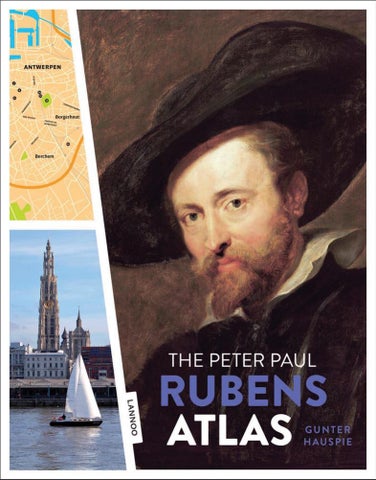
A TRAVELLING ARTIST and seeks to locate and identify those traces. In this way, readers can discover for themselves how foreign influences helped to shape both his art and his thinking. They will also learn how Rubens introduced many of these new insights into Flanders, thereby helping to set the region’s world-famous artistic heritage firmly on the map. The Rubens Atlas is neither a pure art book nor a pure biography. Nor is it a straightforward travel guide. Instead, it is an atlas, collecting the different pieces of the puzzle created by Rubens from the many different places where he left his footprint. Each piece helps to give us a clearer picture of this tireless artist and diplomat, who even on his deathbed was sorry that his travelling days had finally come to an end, once and for all... Gunter Hauspie
PETER PAUL RUBENS
The greatest painter of the Baroque. It is with this title that Peter Paul Rubens earned his place in history. For most people, this would be enough to regard their life as a success, but Rubens was so much more than ‘just’ an artist. He was also an outstanding entrepreneur, a skilful diplomat and a seasoned traveller. The combination of all these talents often took him away from his beloved Antwerp. To Italy and Spain. To the royal palaces in Madrid, Paris and London. Wherever he went, he was asked to stay longer than he originally planned. But always in vain, for Rubens always longed to return to his native city. No matter how great his love of new places and his desire to learn new things, his devotion to the ‘city on the Scheldt’ never failed to draw him back home. Rubens’ travels have left their traces on many places in Europe. The Rubens Atlas follows in the footsteps of the Flemish master
9
ANTWERP
1561-1568
The Iconoclastic Fury in Antwerp on 20 August 1566, Frans Hogenberg, 1570, Rijksmuseum, Amsterdam. This cartographer sympathizes with the rebels and flees to Bartholomeus Rubens and Barbara Arents, Jacob Claesz. van Utrecht, 1530, Rubens House, Antwerp. These are the wedding portraits of the parents of Jan Rubens. The attributes shown tell us that Bartholomeus is a pharmacist. Bar-
Cologne, where in 1570 he makes this engraving of the destruction of the interior of an Antwerp church.
bara comes from a family of senior civic officials and jurists. Their only child, Jan, is born in 1530, the year of their marriage. Bartholomeus dies just eight years later, in 1538. The young widow Barbara remarries the same year. This second marriage results in the births of a step-brother and two step-sisters for Jan Rubens. The fact that Jan’s parents have their wedding portraits painted by a well-known artist of the day shows that they already belong to the well-respected upper circles of Antwerp society.
FLEMISH MASTERS
WELL-TO-DO PARENTS
10
In 1577, Peter Paul Rubens is born as the sixth child of Jan Rubens and Maria Pypelinckx. The decade before his birth has been a difficult one for the family, and its effects make themselves felt during the early years of the artist’s life. Jan (°1530) is the son of a wealthy Antwerp family of pharmacists. He
studies, amongst other places, in Rome, becomes a lawyer, and from 1562 to 1567 serves as an alderman in his native city. Maria (°1538) is the daughter of a wealthy tapestry merchant. She is born in Kuringen, near Hasselt, from where her family originates, but she spends her youth in Antwerp. Jan and Maria marry in 1561.
UNREST IN ANTWERP These are years of great unrest in the Netherlands. During the 16th century, the Low Countries are under the control of King Philip II of Spain. He sees it as his divine mission to defend the Catholic Church against the encroachments of Protestantism. In the Spanish Netherlands, many noblemen and ordinary people are also increasingly influenced by Calvinism, a form of Protestantism based on the teachings of the reformer John Calvin. Calvinism is opposed to the power, wealth and splendour of the Church
and the Pope, and wants to return to a simpler form of faith based on the Bible. In August 1566, the so-called Iconoclastic Fury rages through the Low Countries. Calvinist iconoclasts - those who oppose the veneration of images - destroy many religious paintings and statues in Catholic churches. They justify their actions with passages in the Bible forbidding the worship of ‘false images’. On 20 August, the stained-glass windows, statues, reliquaries, ceremonial tombs and altars in the Cathedral of Our Lady in Antwerp are all destroyed. The cathedral’s Gothic interior is lost forever.
The Duke of Alva, Peter Paul Rubens, 1628, Liria Palace, Madrid. Rubens makes this portrait, based on a painting by Titian, more than 35 years after the death of the Netherlands’ Public Enemy No. 1 at the time when the artist’s parents
1561
fled to Cologne. By now, Rubens is on close terms with the Spanish royal court. The choice of Alva as the subject for this
1568
painting not only shows that Rubens was a brilliant artist, but also an astute businessman and a shrewd diplomat.
ALVA’S REIGN OF TERROR
1640
PETER PAUL RUBENS
In the 16th century, Antwerp is a thriving metropolis, with a self-confident elite and many prosperous merchants and craftsmen. Its population of 100,000 makes it the largest city in the Netherlands. As well as its religious dimension, Calvinism is also a form of economic resistance by the growing urban middle class to the centralist royal authority of Philip II. Opposition to the Spanish king and his tyranny in the assertive ‘City on the Scheldt’ is considerable. Philip decides to crush the rebellion and appoints the cruel and hard-hearted Duke of Alva as the new governor of the Netherlands. Alva initiates a reign of terror and publically executes a number of leading local officials as a warning to the rest of the people. In September 1568, this is the fate of Antoon van Stralen, a former burgomaster of Antwerp. Many merchants and other members of the local elite decide to leave the city. Jan Rubens is among them. He has never hidden his sympathies for the new religion and, as a result, now fears for his life.
11
GERMANY
1568-1589
7 ANTWERP
5
2
1 KURINGEN
COLOGNE
SIEGEN DILLENBURG
6
Jan Rubens and Maria Pypelinckx marry.
FLEMISH MASTERS
1561
12
1
Jan Rubens is a confidant of William of Orange and defends the interests of William’s wife, Anne of Saxony, in the city.
2
1569 1568
3
Jan Rubens and Maria Pypelinckx flee from Antwerp. During their flight they stop in Kuringen, where Maria has family.
3
4
After the death of Jan Rubens, Maria Pypelinckx returns with her three surviving children, including Peter Paul, to Antwerp.
It is probably in Siegen that Peter Paul is born on 29 June 1577.
1577
4
6
1571 Jan Rubens has a child with Anne of Saxony. As a result, he is placed under house arrest, first in Dillenburg and, from 1573, in Siegen.
1589
1583 5
The Rubens family is allowed to return to Cologne.
7
residence with his family in the stately Rinkenhof in Cologne. This is a great privilege in a city where the many refugees from the crisis in the Netherlands are not always welcome. Jan lives in the Rinkenhof with his wife, their four children and two children of Anne of Saxony and William of Orange. Maria takes good care of them all. The Rinkenhof, with its striking tower resembling a campanile, is eventually demolished in 1911. Nowadays, the only reminder of its existence is the street name Am Rinkenpfuhl, one of whose side streets is the Rubensstrasse.
THE FLIGHT TO COLOGNE
HOUSE ARREST IN SIEGEN
Jan Rubens first travels with his wife and children to the County of Loon (in present-day Belgian Limburg), where his wife’s family lives. Here they are safe. The county is part of the episcopal principality of Liege, where the Spanish king has no authority. Later, the Rubens family, like many refugees from Antwerp, continue their journey to the rich and free city of Cologne. At this time, the family consists of four children: Jan-Baptist, Blandina, Clara and Hendrik. In Cologne, the jurist Jan Rubens is appointed to administer the commercial interests of Anne of Saxony. She is the wife of Prince William of Orange, one of the leaders of the revolt against the Spanish. Jan becomes a close associate and adviser of the prince, winning him great respect and esteem. The family moves into the Rinkenhof, an impressive patrician mansion owned by Anne of Saxony.
The relationship between the jurist and his client goes beyond mere business. In August 1571, Anne of Saxony gives birth to Jan’s illegitimate child. William of Orange is furious. Jan Rubens is arrested and imprisoned in the dungeon of Dillenburg castle, the ancestral home of the Orange-Nassau family, and it is only through the courageous intervention of Maria that her husband is able to escape execution. In two remarkable letters, Maria forgives Jan his indiscretion and pleads for his release to Count John of Nassau, Prince William’s brother. In 1573, the death sentence is commuted to banishment to Siegen, where Jan lives under house arrest with his family. However, to secure this leniency, they have to surrender a large part of the family fortune.
1568
1577
*
1589
1640
↓ Dillenburg Castle in 1575. It is from this castle that William of Orange organizes resistance to the oppression of the Spanish king in the Netherlands. Jan Rubens is held prisoner here for two years, from 1571 to 1573.
PETER PAUL RUBENS
In 1570, Jan Rubens takes up
13
A PALAZZO IN ANTWERP
0
50 m
2
1
N
4
1 2 3 4
3
5
Portico Garden pavilion Residence Workshop Statue gallery
WAP PER
PETER PAUL RUBENS
5
91
able that he also adds the semi-circular gallery 5 behind the house, where he houses (amongst other things) his collection of statues acquired in Italy, including his bust of Seneca. A bust of Seneca is still part of the collection in the Rubens House and the artist also depicted it in his painting of The Four Philosophers (see p. 52).
A BUSY WORKSHOP
FLEMISH MASTERS
No matter how much he travels, Rubens’ palatial mansion in the Wapper is destined to anchor him in Antwerp for the rest of his life. Most of his children are born there and his first wife, Isabella Brant, dies there. It is also the place where he welcomes his important patrons and admirers, including some of the richest and most powerful figures of the day, such as Archduke Albrecht, Archduchess Isabella and Maria de’ Medici. Above all, it is the place where he develops his workshop into one of the most important production centres of art in Europe. Some 1,000 paintings, both large and small, have been attributed to Rubens. This is a phenomenal level of output. One of his most famous contemporaries, Rembrandt, only has a known and confirmed oeuvre of some 150 paintings. In addition, museums and private collections throughout the world contain Rubens drawings, sketches and engravings. It is self-evident that the master is unable to accomplish all of this alone. In his workshop, he gathers around him a number of assistants and pupils who are all excellent artists in their own right.
Isabella Brant, Anthony van Dyck, 1621, National Gallery of Art, Washington. The portico of the Rubens House is clearly visible in the background.
92
1561
1608
1622
PETER PAUL RUBENS
1640
93
PETER PAUL RUBENS
1561
1640
195