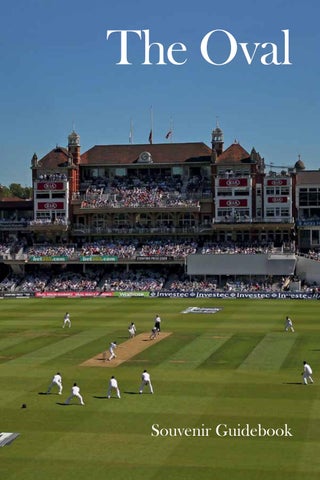
Souvenir Guidebook  1
This edition © 2018 Scala Arts & Heritage Publishers Ltd Text © 2018 Kennington Oval Ltd First published in 2018 by Scala Arts & Heritage Publishers Ltd 10 Lion Yard, Tremadoc Road London SW4 7NQ www.scalapublishers.com
Printed and bound in Spain ISBN: 978-1-78551-171-4 10 9 8 7 6 5 4 3 2 1 Text by Richard Spiller Design by James Alexander at Jade Design Project editor: Oliver Craske
in association with Kennington Oval Ltd
All images © Getty Images except
The Kia Oval, London SE11 5SS
as follows:
www.kiaoval.com
Photo by Ian Marriott-Smith
All rights reserved. No part of this book may be reproduced, stored in a retrieval system or transmitted in any form or
Photography: flaps, 2–3, 7, 8 (top), 10, 25, 31, 32, 36–38, 40, 41, 50, 51. Kennington Oval Ltd: 28, 30, 56, 57, 64.
by any means electronic, mechanical,
Page 1: The pavilion in full splendour
photocopying, recording or otherwise,
as Pakistan bat against England in the
without the written permission of Scala
Oval Test match, 12 August 2016.
Arts & Heritage Publishers Ltd and
This page: The Oval in 2015.
Kennington Oval Ltd.
2
Contents Foreword by Alec Stewart 4 The Oval and the Ashes 6 International Cricket at The Oval 14 Best Performances at The Oval 23 How The Oval Grew 24 Surrey and the Wider World 38 Legends of The Oval 48 Men on the Roller 54 The Oval: An All-Rounder 58 2020 and the Future 64
Contents 3
Foreword by Alec Stewart
F Opposite: Alec Stewart avoids a bouncer from Wasim Akram of Pakistan during the 1996 Test at The Oval. Below: Alec Stewart celebrates England's win in the final match of his career, the Oval Test against South Africa in 2003, along with Martin Bicknell, Ed Smith, Steve Harmison, Andrew Flintoff, Graham Thorpe and Michael Vaughan.
or over 50 years I have been lucky enough to be able to call The Oval my second home. It was my home ground for 23 years as a player for Surrey and it also played a huge part in my international cricketing career. I played twelve Test matches and ten One-Day Internationals here. The century I scored in a Texaco Trophy ODI against Pakistan in 1992 remains a very special memory. The Oval is one of sport’s most iconic venues. Not only can the story of modern day cricket be told through its rich history but in the early days it also hosted a wealth of blue-riband sporting events such as the first FA Cup Final and England football and rugby’s first home fixtures. We have been privileged to have witnessed some of cricket’s most iconic matches featuring some of the sport’s greatest heroes. From Grace, Bradman and Hobbs to Botham and Kohli, a wealth of cricket’s legends have helped to write The Oval’s unique story. This fascinating guide will give you an insight into the history of this grand venue and how we are looking forward to the future.
5
T
The Oval and the Ashes
Opposite: England captain Michael Vaughan (left) raises the replica Ashes urn at The Oval after winning the great 2005 series. Alongside are Kevin Pietersen and Marcus Trescothick, who is holding the MCC Waterford Crystal Ashes Trophy. Below: A pair of sculpted urns herald the entrance to the ground through the Hobbs Gates.
6 The Oval and the Ashes
here is a good reason why urns adorn the Hobbs Gates: world cricket’s most ancient battle, between England and Australia, is inextricably linked to The Oval. The first touring side ever to visit England was an Australian Aboriginal side who arrived in 1868. They had opened their tour at The Oval in front of a crowd of 20,000. The ground then staged the inaugural Test Match in this country, in September 1880, three years after England and Australia had met for the first time in Melbourne. England, led by Lord Harris and including not just WG Grace but his two brothers as well, avenged their 45-run defeat down under with victory by five wickets. When Australia returned two years later and won an exciting encounter at The Oval by seven runs, the Sporting Times newspaper published a mock obituary of English cricket which concluded that: ‘The body will be cremated and the ashes taken to Australia’. The Ashes legend had begun. It wasn’t until the following winter that an urn actually came into existence – Australia this time the losers, England captain Ivo Bligh being presented with the miniature prize by his hosts – but The Oval has been the scene for many of the most famous battles ever since, traditionally hosting the final match of each Ashes series in this country. In 1902, Gilbert Jessop – ‘The Croucher’ – hammered 104 in 80 balls to earn England victory by one wicket. This became known as ‘Jessop’s Match’, although it needed the last pair of Wilfred Rhodes and George Hirst to knock off the final 15 runs amid scenes of high tension. While not every contest has been as thrilling as that one, some of the most memorable moments in sporting history
The Oval and the Ashes 7
Ironically, Bradman’s most famous innings at the ground was his shortest, ten years and another war later, with his side – dubbed the ‘Invincibles’ – already 3-0 up and heading for a fourth triumph. Needing just four runs to finish with a Test average of 100, applauded wildly to the crease and given three cheers by his opponents, he was bowled second ball by leg-spinner Eric Hollies to finish with his immortal career mark of 99.94. The door through which he emerged before heading down the pavilion steps for his brief farewell has now been named after the world’s greatest batsman. Hutton – a sculpture of whom adorns the entrance by the Edrich Gate – was captain in 1953 as England won the Ashes back for the first time since 1934, an eight-wicket triumph inside four days led by Surrey’s spin twins Jim Laker and Tony Lock. When Denis Compton made the winning hit, a flood of emotion saw the crowd rush on to the outfield to celebrate yet another highlight of Queen Elizabeth II’s coronation year. There were marvellous moments of a different sort in the 1960s. Yorkshire’s Fred Trueman made Test history in 1964 by becoming the first man to claim 300 wickets, while four years later England needed help from the crowd to mop up following a huge thunderstorm before Derek Underwood’s 7-51 forced victory in the final moments of the match, squaring the series after Australia had already retained the urn. Above: Donald Bradman after being bowled second ball for no score in his final Test innings, at The Oval in 1948. Right: Fred Trueman relaxes in the pavilion in 1964 after dismissing four Australian batsmen to take his Test wickets tally to 301. He was the first cricketer to take 300 Test wickets. Opposite: The doors through which Donald Bradman left the pavilion to play his last Test innings.
10 The Oval and the Ashes
The Oval and the Ashes 11
Below: On the last day of the 2005 Ashes series Kevin Pietersen leaves the field after his innings that sealed England’s series victory.
Echoing Jessop’s innings, Kevin Pietersen played one of the great innings in Oval history in 2005 as the hosts again fought to end another long stretch without the Ashes. England had surrendered them in 1989 and been heavily under the cosh in the seven series which followed it. They arrived at The Oval 2-1 up but their summer’s work was still under threat on the final day until Pietersen’s electrifying 158 caught the imagination of a generation to ensure a draw and launch massive celebrations. Having surrendered the Ashes 18 months later in Australia, when they were thrashed 5-0, England had to win them back again in 2009 and duly did so with a 197-run success at The Oval, Australia failing to recover from being skittled in their first innings by Stuart Broad’s 5-37. In the next two home series the Ashes had already been sewn up by England before the sides arrived at The Oval. In 2013, Alastair Cook’s men were deprived of a fourth win in five matches only by bad light when just 21 runs short. Two years later Steve Smith’s 143 enabled the Australians to inflict defeat by an innings and 46 runs. Arriving 3-1 down, Australia’s 481 all out was met by a tame response from the hosts who were bowled out for 149 and 286.
David Gower relished his own moment of glory as captain when his England side won by an innings and 94 runs to secure the 1985 series 3-1 as again the Ashes swapped hands. Although Australia dominated in the final years of the 20th century, they were still beaten in Kennington in 1993 and 1997. Steve Waugh’s side was in no mood to suffer likewise in 2001, the hard-bitten skipper and his brother Mark both scoring centuries – as Ian and Greg Chappell had done on the ground in 1972 – in a total of 641-4. Only Mark Ramprakash’s 133, on his adopted home ground, delayed the great leg-spinner Shane Warne for long as he claimed 11 wickets in an innings wipe-out. Above: Champagne and beer flow as Mike Gatting, Ian Botham, David Gower (captain) and Paul Downton celebrate winning the 1985 Ashes on the pavilion balcony. Left: England captain Alastair Cook kisses a replica Ashes urn after England win the 2015 Ashes.
12 The Oval and the Ashes
The Oval and the Ashes 13
W
International Cricket at The Oval
Opposite: On 18 June 2017 The Oval hosted the Champions Trophy final between Pakistan and India. Below: Moeen Ali celebrates taking a hat-trick to win the 100th Test at The Oval, England v South Africa, 2017.
14 International Cricket at The Oval
hen The Oval celebrated its 100th Test Match in July 2017, England rose to the occasion. Their win over South Africa by 239 runs was sealed in the most dramatic way possible as Moeen Ali claimed a hat-trick. The off-spinner’s huge appeal to have Morne Morkel LBW for his final wicket was initially turned down but the roar which greeted the overturned decision almost shook the ground. Staging matches between the best players in the world is a monumental operation, requiring planning in the years and months up to the match, while each day requires up to 1,600 stewards, security staff, caterers and groundstaff. While many of the great international moments at The Oval have involved Australia – not surprisingly given they were the opposition for the first 11 Tests, and they remain probably the biggest draw – many other countries have conspired to produce dramatic moments and landmarks in the history of the game. One-Day Internationals, including two Champions Trophy finals, and Twenty20 clashes have added to that harvest. It was appropriate that South Africa should be the opponents for the 100th Test given they were the first nonantipodean opponents in 1907, when they claimed a draw despite CB Fry’s century in England’s first innings. Five years later they had rather less reason to celebrate when they were routed by 10 wickets and failed to reach 100 in either innings, SF Barnes showing his mastery of the seaming ball by claiming 13 wickets in the match including 8-29 in the second innings. They have generally been on the back foot in visits to the ground ever since, needing Bruce Mitchell’s marathon sevenhour 189 to save them in 1947 after being set 451 to win.
International Cricket at The Oval 15
Right: Pakistan captain Misbah-ul-Haq leads his team on a lap of honour after winning the 2016 Test against England. Below: Muttiah Muralitharan took 16 wickets as Sri Lanka beat England in the 1998 Oval Test.
Dinesh Karthik, Sachin Tendulkar and Rahul Dravid of India celebrate their Test series win against England, 13 August 2007.
The Oval staged the final of a world trophy for the first time in 2004. Although West Indies were no longer regarded as one of the world’s leading sides, it did not stop them producing a remarkable upset to win the Champions Trophy. Thrashed by England in the Test series leading up to the tournament, they worked their way through to the climax of the competition, held on a damp late September day, restricting Michael Vaughan’s hot favourites to 217 all out, which owed much to Marcus Trescothick’s 104. When the reply slid to 147-8 with 16 overs left, there seemed only one winner. But with dusk closing in fast plus a steady drizzle, wicketkeeper Courtney Browne (35 not out) and Ian Bradshaw (34 not out) inched their way to victory by two wickets with seven balls remaining. Skipper Brian Lara scooped up the trophy and, when his men finally found their way off the outfield, led them into one of the nearby pubs to celebrate. Among the other ODI highlights was Jimmy Anderson becoming the first England player to claim a hat-trick in the format, finishing off the Pakistan innings in 2003 by having Abdul Razzaq and Shoaib Akhtar caught and then bowling Mohammad Sami. Four years later Dimitri Mascarenhas gave the home side’s innings a late surge by crashing India’s Yuvraj Singh for five sixes in an over, although the final total of 316-6 still wasn’t enough to save England from losing by two wickets in the final over. 20 International Cricket at The Oval
The Oval’s second Champions Trophy final, in 2017, also kicked up a surprise when Fakhar Zaman (114) inspired Pakistan – who had toppled England in the semi-final – to 338-4 before they rolled over India for 158. T20 internationals came to The Oval in 2007 – four years after the first domestic tournament had started, in this country – and it was West Indies who once again were the first visitors, drawing a two-match series 1-1. Two years later, the ground hosted nine games in the format’s first World Cup, the highlight for many being Chris Gayle lashing six sixes – including one
International Cricket at The Oval 21
G
How The Oval Grew Opposite: Aerial view during the 1989 Ashes Test, showing building work on the new Bedser Stand and Ken Barrington Centre to the left of the pavilion. Four of the original five gasholders remain. In the distance are Lambeth and Westminster Bridges, and the Houses of Parliament and Westminster Abbey on the north bank of the River Thames. Below: Contemporary engraving marking the opening of The Oval in 1845.
24 How The Oval Grew
rowing fruit and vegetables rather than high-quality grass pitches fit for the world’s best cricketers had been the priority at The Oval in the decade running up to 1845. Not that the game was unknown in the area. The county of Surrey was acknowledged as one of the cradles of the game, and for a number of years matches had been a regular sight on both Kennington Common – where hangings were often staged too – and Walworth Common. The county club’s predecessor, the Montpelier Club, proved an able midwife. Having lost their ground in Walworth for building – a familiar refrain in more modern times – the club members approached the Otter family, who had taken out a lease on The Oval from the Duchy of Cornwall, owners of the land then and still to this day. That explains why all Surrey players bear the crest of the Prince of Wales, otherwise known as the Duke of Cornwall. Ambitious plans for the site drawn up a decade earlier had not come to fruition and in 1845 it hosted only a moderately successful market garden, so the Montpelier approach proved welcome. A remarkable transition was effected between the signing of the lease in March 1845 and the start of cricket in May as contractor M Turtle – handily located nearby – transported 10,000 turfs from Tooting Common for a fee of £300. Not having a home worthy of the name had been one of the main obstacles to the creation of a county club, but that was put right by two packed meetings at the Horns Tavern
How The Oval Grew 25
Below: Aerial view from the north during 2017. In the foreground is the OCS Stand with its ‘living wall’ of shrubs and plants. Overleaf: A view of the OCS Stand under floodlights during the T20 Blast match between Surrey and Glamorgan on 4 August 2017.
completed, a programme which stretched over more than two years saw the creation of a first-floor balcony instead of the much-loved but single-row ‘shelf ’. The Committee Room was swapped from the eastern to the western side and extended. The roof was also lifted, creating additional seats plus space for a new members’ restaurant, which was instantly popular and provides one of world cricket’s best places to eat while watching the game. Work was completed in time for Surrey’s 150th birthday in 1995 and even if the county’s cricket that year was dire, there was plenty of room for members to enjoy the surge of success which began in 1996 under a team led by Alec Stewart and Adam Hollioake. While one end of The Oval had been updated, almost beyond recognition, the other was badly in need of improvement. Siting the Barrington Centre at the Pavilion End had been an inspired move as it made room for a more radical solution. Next to the increasingly aged Vauxhall Stand was a block which included corporate boxes for big matches. The ‘semi-permanent’ structure had a life of 15 years when it was put up in 1988 and it was prone to creak rather worryingly when it was windy. Both were swept away in the winter of 2003–4 to provide space for the OCS Stand, a revolutionary building which included an iconic curved roof. To borrow the money needed for the £25 million cost, Surrey secured an unprecedented 15-year agreement which guaranteed Tests and One-Day Internationals. Eating up a slice of the outfield, which meant the view from the Vauxhall End was no longer so distant, the new OCS Stand 32 How The Oval Grew
provided spectators with a superb perspective on the action, increased the capacity of the ground to more than 23,000, and provided conference and dining facilities which could be used all year round. The roof terrace offers a remarkable view and is popular with spectators. The stand also had new homes for the media. The Brian Johnston Broadcasting Centre – which had been opened at the top of the pavilion in 1994 to commemorate the great Test Match Special commentator and all-round broadcaster – was moved and extended for TV and radio. Meanwhile the written press had a view from over the sightscreen, their gallery now named after legendary Wisden Cricketers’ Almanack editor Sydney Pardon. Again constructed over two years around the fixture list, the OCS Stand was completed in time for the 2005 season and proved the perfect background as England won back the Ashes for the first time in 18 years. Inevitably, not every project can be consummated yet the ground has continued to evolve. The Surrey Tavern was swept away in 2008, its pub long closed and banqueting suite now obsolete. It offered the opportunity for The Oval to present a much happier face to the many visitors making their way from Oval Tube Station, allowing the Hobbs Gates to be relocated
The heart of the pavilion is the Long Room, built in 1898 and renovated during the works completed in 1995.
How The Oval Grew 33
34 How The Oval Grew
How The Oval Grew 35
34 How The Oval Grew
How The Oval Grew 35
W
Surrey and the Wider World Opposite: John Raynes’s portrait of Adam Hollioake in the Long Room. Hollioake is depicted lifting the County Championship trophy in 1999 following the 10-wicket win over Nottinghamshire. Below: George Beldam’s photograph of Australia’s Victor Trumper is one of cricket’s most famous images. It was taken at The Oval before play one day during Surrey’s match against the Australians in May 1905.
38 Surrey and the Wider World
alk around The Oval and you can feel the history of Surrey County Cricket Club. It’s not only the great players whose pictures gaze down from the walls of the pavilion and the perimeter wall, marking their achievements at international and domestic level. The county’s most successful teams are in evidence too. The ground is the headquarters for cricket in the whole county of Surrey, which takes in a massive chunk of south London too, given that the English game still sticks to the ancient county borders. The Surrey Cricket Foundation, which is a charitable body, supports communities, schools and clubs throughout the county with funding, expertise and coaching aimed at getting as many people to play the game as possible. The Foundation promotes health and well-being for all ages, particularly youngsters, and its agenda includes the strength of the recreational game and identification of young talent. For those who rise through the county’s coaching network, which leads into the Academy, there is the chance to join Surrey’s professional staff and follow a tradition which has taken in the likes of Sir Jack Hobbs, Peter May, Sir Alec Bedser, Alec Stewart, Adam Hollioake and Tom Curran, plus overseas stars of the calibre of Sylvester Clarke, Saqlain Mushtaq and Kumar Sangakkara.
Surrey and the Wider World 39
County cricket itself only became more organised in the second half of the 19th century and when the first semi-official competition was staged in 1864 it was Surrey who were hailed as winners. And although lean years were to follow, Surrey were commanding the summit again when the competition was formalised in 1890, John Shuter having assembled a side which had claimed or shared top spot in the previous three seasons. Under Shuter and his successor KJ Key, they were to be champions another five times in the following nine years as prolific run-getters like Bobby Abel – whose unbeaten 357 against Somerset remains the county’s highest score – and Tom Hayward were matched with outstanding bowlers in Bill Lockwood, Tom Richardson and George Lohmann. How the ground and the players who bestrode it have dominated the surrounding community is underlined by the way the blocks of neighbouring flats were named after cricketers, among them England captains WG Grace and AE Stoddart plus Surrey men Lohmann, Abel, Walter Read and influential president Lord Alverstone, who demanded at least three amateurs should be included in each game. One of the features of Surrey’s history, though, is that they have mixed intensive spells of success with long periods when trophies have been scarce. Other than a solitary title in 1914, when the climax of the Championship understandably took second billing to the outbreak of the First World War, there was no team success to toast in the first half of the 20th century despite the presence of master batsman Jack Hobbs, among many other fine players, and the brilliant tactical nous of captain Percy Fender over 11 campaigns. Picking up after the Second World War was not made easy by the choice of skipper. Nigel Bennett had only played club cricket before the conflict but was surprisingly offered the
40 Surrey and the Wider World
Opposite: Surrey’s William Roller is still the only player to score a double century and take a hat-trick in the same match, which he achieved against Sussex at The Oval in 1885. This striking portrait of him going out to bat, by his brother George Roller, hangs in the pavilion. Below: The team, members and officers of Surrey County Cricket Club pictured in 1911, in the painting by Charles H. Parker that hangs in the Long Room today.
Surrey and the Wider World 41
Legends of The Oval
Ken Barrington and the Bedser Twins
K
en Barrington formed the backbone of Surrey and England’s batting through much of the 1950s and 1960s, a Test average of just under 60 testament to his stature. He was part of the Surrey side which won seven successive County Championships, and for county and country he often took on the unglamorous role of sheet anchor, forsaking his own ability to play all the shots. One Australian opponent reckoned that you could see the Union Jack trailing behind him. His career was ended by one heart attack aged 38, but he went on to become an England selector and much-loved coach, and a father figure to young players, before he died of a second heart attack aged just 50 while assistant manager for England’s 1981 tour of West Indies. His love of cricket and relish for coaching young players has its legacy today in the Ken Barrington Indoor Centre at The Oval. The Bedser twins first joined Surrey in 1938 but almost immediately found their careers put on hold by the Second World War. When cricket resumed afterwards Alec Bedser quickly became the mainstay of England’s attack, his Test debut being only his 13th first-class match, and his control of seam and swing relentlessly tested batsmen. He went on to play 51 Tests, taking what was then a record 236 wickets – often with little support – and claiming 1,924 first-class victims. Don Bradman rated him among his doughtiest opponents. Eric Bedser’s role in Surrey’s glory years could easily be overlooked but his 14,716 runs and 833 wickets were a considerable contribution for an off-spinner who often had to take second billing behind Jim Laker. He might easily have been envious of his twin’s success but instead was proud that
Opposite: Alec Bedser in 1950, when he was the undisputed leader of the England bowling attack. Right: Ken Barrington in 1966. Having emerged through Surrey’s allconquering 1950s team, he became a formidable Test batsman.
48 Legends of The Oval
Legends of The Oval 49
Men on the Roller
I Opposite: Head groundsman Lee Fortis prepares the pitch ahead of Surrey’s first match of the 2017 County Championship season. Below: Groundsman ‘Bosser’ Martin with his roller during the 1938 Oval Test. England’s 903–7 declared was a world record total and included Len Hutton’s new individual record score of 364.
54 Men on the Roller
t is nigh on impossible to please everyone but a very special group have been trying to do their best since The Oval was created – the groundsmen. From George Brockwell, who took charge in the early years, all the way through to Lee Fortis, who assumed office in 2012, they have faced a variety of challenges with the most important being the need to supply top-class pitches for the best players in the world. For the likes of Sam Apted (who held the job from 1888 to 1912), there was the requirement to accommodate not just cricket each year but football as well, given that The Oval remained the venue for the FA Cup Final until 1892. Apted’s determination to give himself the maximum possible time to get the square into shape resulted in brushes with the Surrey committee. He was succeeded by his deputy, Tom Martin (1912–25), but it was the latter’s brother, an imposing man known as ‘Bosser’, who rose to fame. His chief weapon was a massive heavy roller known as ‘Bosser’s Pet’, and while the pitches he provided were the ideal stage for Jack Hobbs and his fellow
Men on the Roller 55
I
The Oval: An All-Rounder
n the decade before Australia arrived for the first Ashes Test in England, The Oval was already hosting international sport. Cricket grounds in England have always faced the challenge of how to generate income beyond the season and Surrey were already feeling the strain by 1870. The secretary, William Burrup, hit upon the idea of staging a football match between England and Scotland – the first time the sides had met, producing a 1-1 draw on 5 March – but it was his successor, Charles Alcock, who developed the idea. Alcock was well placed, given that he was also secretary of the Football Association. The Oval not only became the national team’s regular home until 1889 but also hosted the first-ever FA Cup Final in 1872, a crowd of just 2,000 witnessing Wanderers overcome Royal Engineers 1-0. The military side were to reach each of the first three finals and it was only in the last that they finally enjoyed success by seeing off Old Etonians 2-0 in a replay. Until 1892 every FA Cup Final bar one was to be played in Kennington. Rugby union also made its debut at the ground in 1872 and seven full internationals – against Scotland or Ireland – were played here by England up to 1879. With most of the revenue from football cup finals being taken by the FA, Surrey’s committee decided in 1893 that they were not worth the damage done to the playing surface, much to the relief of groundsman Sam Apted. Rugby continued, however, to make sporadic appearances until just after the Second World War. Cycle racing proved highly popular for spectators up to the First World War, the Surrey Bicycle Club and South London
Opposite: In November 2012 the first FA Cup Final was re-enacted at The Oval. This time Royal Engineers beat Wanderers 7-1. Right: Charles Alcock (right), secretary of both Surrey County Cricket Club and the Football Association, with WG Grace.
58 The Oval: An All-Rounder
The Oval: An All-Rounder 59
2020 and the Future
A
s The Oval heads towards its 200th birthday, the challenges of remaining one of the finest cricket grounds in the world become even greater. Tests and County Championship matches were the sole fare until 1963 and county clubs depended for the vast majority of their income on spectators turning up. Sponsorship and commercial activity were barely pipedreams for most. Now the varying formats mean games last for anything from five days to 20 overs per side. With the new T20 competition being introduced in England from 2020 by the ECB, the shape of the summer schedule is likely to see further revolutionary changes. Hard hats as well as hard-headed thinking will be necessary at The Oval but current chief executive Richard Gould maintains: ‘We’re a cricket ground, not a stadium, and we always keep that in mind.’ Imaginative designs are vital if the capacity is to be increased from 25,500 towards Surrey’s ambition of 40,000. The first stage will be to replace the Lock & Laker Stand, with the aim to start at the close of the 2019 season and to complete it in phases by 2021. Then the attention will move to the other side of the Micky Stewart Members’ Pavilion, where another large project will succeed the current Bedser Stand and Ken Barrington Centre. ‘We can’t expand the size of The Oval, so everything has to be done in the space we have,’ says Gould, adding: ‘In partnership with the Duchy of Cornwall, our landlords, we want any new developments to be sympathetic to the ground, our history and surroundings and the environment.’ The market garden which existed in 1845 might be long gone but what replaced it continues to flourish.
Artist’s impression of The Oval’s planned developments.
64