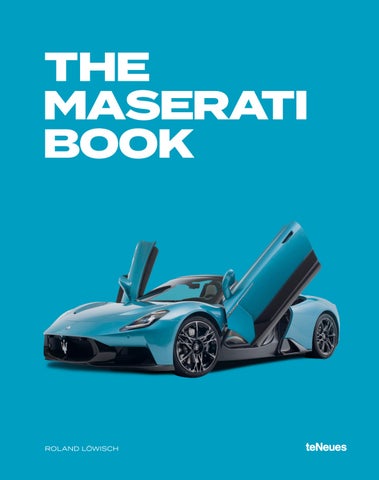
THE MASERATI BOOK
ROLAND LÖWISCH
by
Photo
Maserati S.p.A.
Photo by Maserati S.p.A.
Maserati
ROLAND LÖWISCH
by
Chief designer Klaus Busse (56) has been at Maserati for more than 20 years, for more than ten of those as head of design. That makes him one of the world’s most knowledgeable people about the brand.
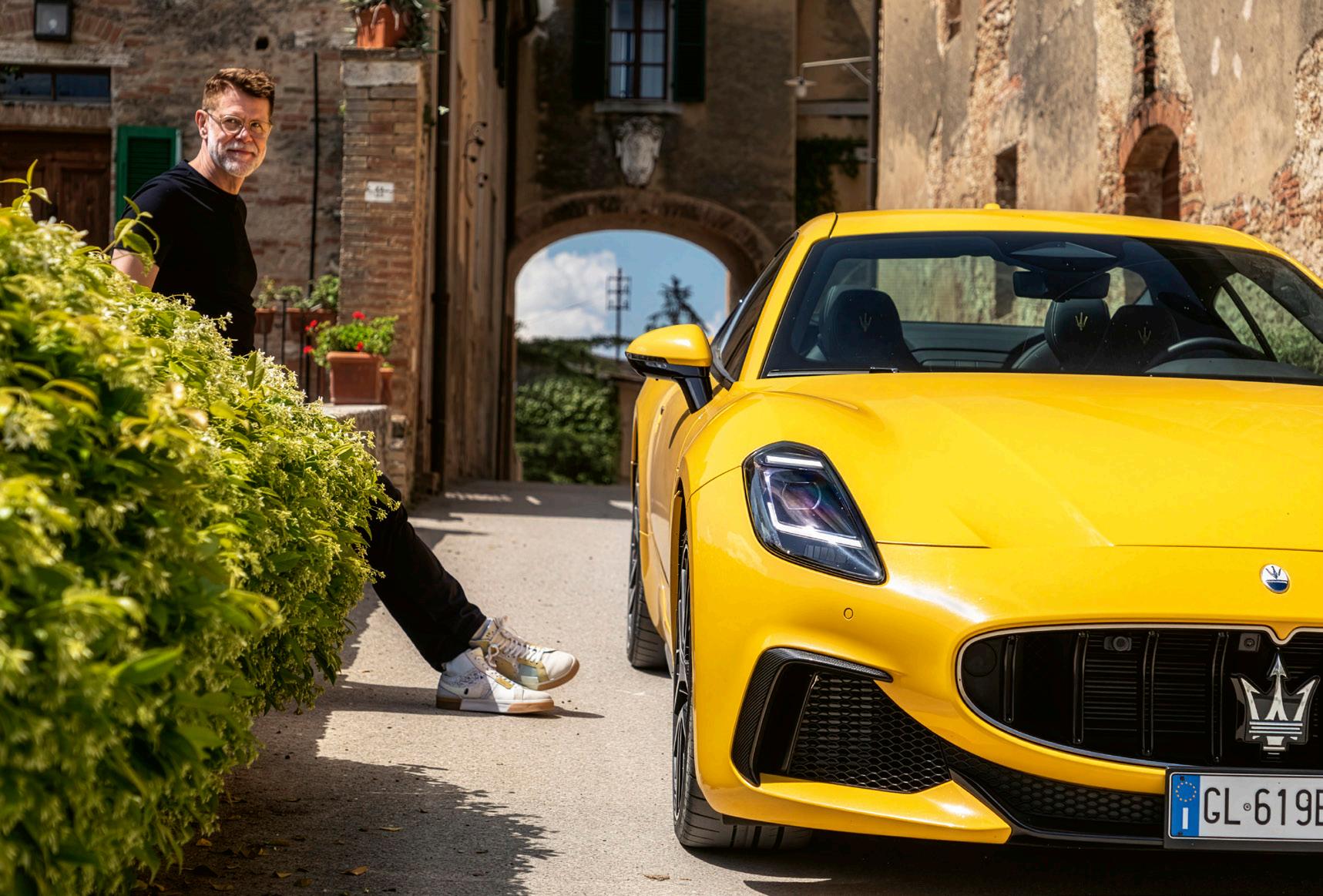
KKlaus Busse lives near Turin with his family. When he’s not immersed in cars, he makes the most of living in Italy, taking in the mountains, wine regions, Lake Maggiore, Liguria, and the Mediterranean lifestyle in general.
Mr. Busse, how is Maserati doing?
Klaus Busse: From a design standpoint, we’re extremely busy, with more work than my current team can handle. We’re hiring designers.
In terms of design, what makes a Maserati?
Klaus Busse: Italian design, which means elegance that moves you. We’re one of perhaps only three brands with a true grand tourer in the lineup. The
GranTurismo strikes the ideal balance of style, comfort, and performance. It makes for an effortless drive from Munich to Hamburg, complete with a detour to the Nürburgring for a hot lap. And I’ll still look good on YouTube doing it.
Does that also apply to the era before the GranTurismo?
Klaus Busse: Over the past 111 years, Maserati has reinvented itself dramatically every decade or two. But the line, the elegance, has remained. You see it in the 1950s with the 3500 GT, in
the 1960s with the Ghibli, in the 1970s with Bora and Merak, then with Shamal and Biturbo in the 1980s. After that came the romantic phase with the 3200 GT. Today we’re in a sculptural phase. Whatever design language Maserati explores, the theme is always elegance. We don’t do unnecessary spoilers or air intakes, and we don’t use exhaust tips without function. What matters most is beautiful proportions and clean surfaces executed with Italian finesse.
Is there a name for your design language?
Klaus Busse: No. We design for the moment, at a generational level. Look at Mercedes, which follows an evolu-
Maserati head of design Klaus Busse with the GranTurismo: “We design for the moment, at a generational level.”
Maserati Designchef Klaus Busse mit dem GranTurismo: „Wir machen ein Generationendesign.“
tionary approach: When a new model launches, previous generations are shown alongside it. You can literally see the evolution toward perfection. It’s a strong philosophy. But in Italy we take a different view. I align with Giorgetto Giugiaro, who said he always did “the best, right now.” Applied across generations, this means that in the 1950s pronounced shoulder lines were required, because the side glass was flat and there had to be room for that inside the doors. When curved side glass arrived in the early to mid-1960s, it could be integrated into the door structure—which led to flatter shoulders. That marked the birth of a new aesthetic, especially with the first Maserati Ghibli. Culture played a role
too. Fashion took a different direction in the 1960s. And proportions changed completely with the move to mid-engine layouts in the 1970s. That once again enabled a different aesthetic. Pragmatism entered the picture in the 1980s and 1990s. The cars became more compact and more holistic, with the 3200 GT something of an exception. Then came the GranTurismo, Levante, Ghibli, and Quattroporte, cars defined largely by pairing an assertive front end with a dramatic V8 soundtrack. Now we’re in a sculptural phase. Technology and society have always been the drivers of the design.
Since you mentioned it, society can be quite critical of cars.
Klaus Busse: We can’t lose sight of the limited role now assigned to a sports car in an urban environment. That debate is especially intense in Germany. Which brings us back to elegance: I want the wearer of the suit—the driver of the car—to be seen. If you wear an Armani, I see the person as elegant and tasteful. If I see people sporting brands and defining themselves that way, what I perceive first is a fashion statement and maybe a cool look. It’s only on the second or third pass that I can actually recognize the wearer. A Maserati is like an Armani suit.
How do you integrate artificial intelligence into your work?
Klaus Busse: We’ve been using it for several years. Once when it was new
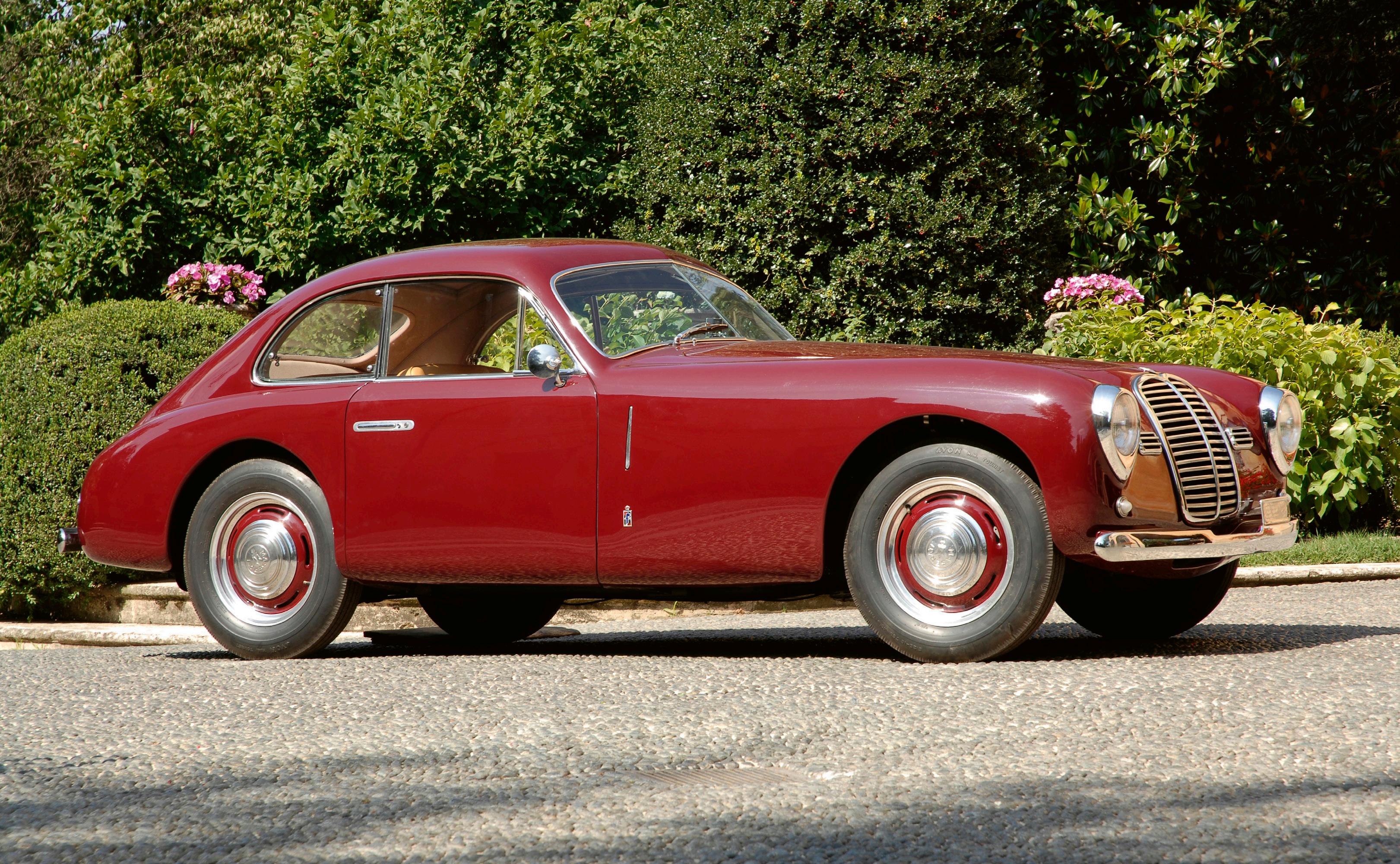
1966–1972
By the mid-1960s, Maserati had established a strong reputation for building attractive, fast, and reliable grand tourers and sedans. The Mexico was intended to reinforce that standing as a two-door 2+2 coupé.
Mitte der 1960er-Jahre hat sich Maserati einen hervorragenden Ruf als Schöpfer von schönen, schnellen und zuverlässigen Grand Tourern und Limousinen erarbeitet. Der soll gefestigt werden mit dem Mexico – ein zweitüriger 2+2-Sitzer in Coupéform.
The prototype, completed in 1965 and built by Vignale, still used a powerful V8 displacing just under five liters. The production model introduced a year later was limited to 4.7 liters and was later described by Maserati as intended “for the connoisseur with a taste for understatement.” Drawing on the positive experience with the Quattroporte, the engineers gave the Mexico a steel monocoque body with a front subframe. The front suspension was independent. At the rear, a rigid axle with semi-elliptical leaf springs and telescopic dampers was used. Interior space was adequate; the rear seats were more than occasional accommodations. The elegant car was also available with a 4.2-liter V8 that produced 290 hp rather than 300 hp. With the 4.2-liter engine, the 1.5-ton car reached “merely” 250 km/h instead of 260 km/h. Total production amounted to 485 units. Giorgetto
Giugiaro later used the Mexico as the basis for the one-off “Simun”, named after a wind that blasts across the Sahara. It was his final project at Ghia before he founded Italdesign.
Der Prototyp des Maserati Mexico, schon 1965 fertig und von Vignale gebaut, besitzt noch einen mächtigen, knapp fünf Liter großen V8, das Serienmodell ein Jahr später – „für den Connaisseur mit Hang zum Understatement“, wie es Maserati später selbst formuliert – ist dagegen auf 4,7 Liter beschränkt. Aufgrund der gu-
ten Erfahrungen mit dem Quattroporte spendieren die Ingenieure dem Mexico eine selbsttragende Stahlkarosserie mit vorderem Hilfsrahmen. Die Räder vorn sind wieder einzeln aufgehängt, als Hinterachse kommt eine starre Konstruktion mit halbelliptischen Blattfedern und Teleskopstoßdämpfern zum Einsatz. Die Platzverhältnisse sind ausreichend – die Sitze im Fond sind tatsächlich mehr als nur Notbehelfe. Wer will, kann den eleganten Wagen auch mit 4,2-Liter V8 bekommen, der dann aber nur 290 statt 300 PS leistet. Dann schafft der 1,5 Tonnen leichte Wagen auch „nur“ 250 statt 260 km/h Spitze. Insgesamt entstehen 485 Stück. Stardesigner Giorgetto Giugiaro übrigens entwarf auf Mexico-Basis das Einzelstück „Simun“, benannt nach dem Nordwind der Sahara – sein letztes Werk bei Ghia, bevor er sich mit seiner eigenen Firma Italdesign selbstständig machte.
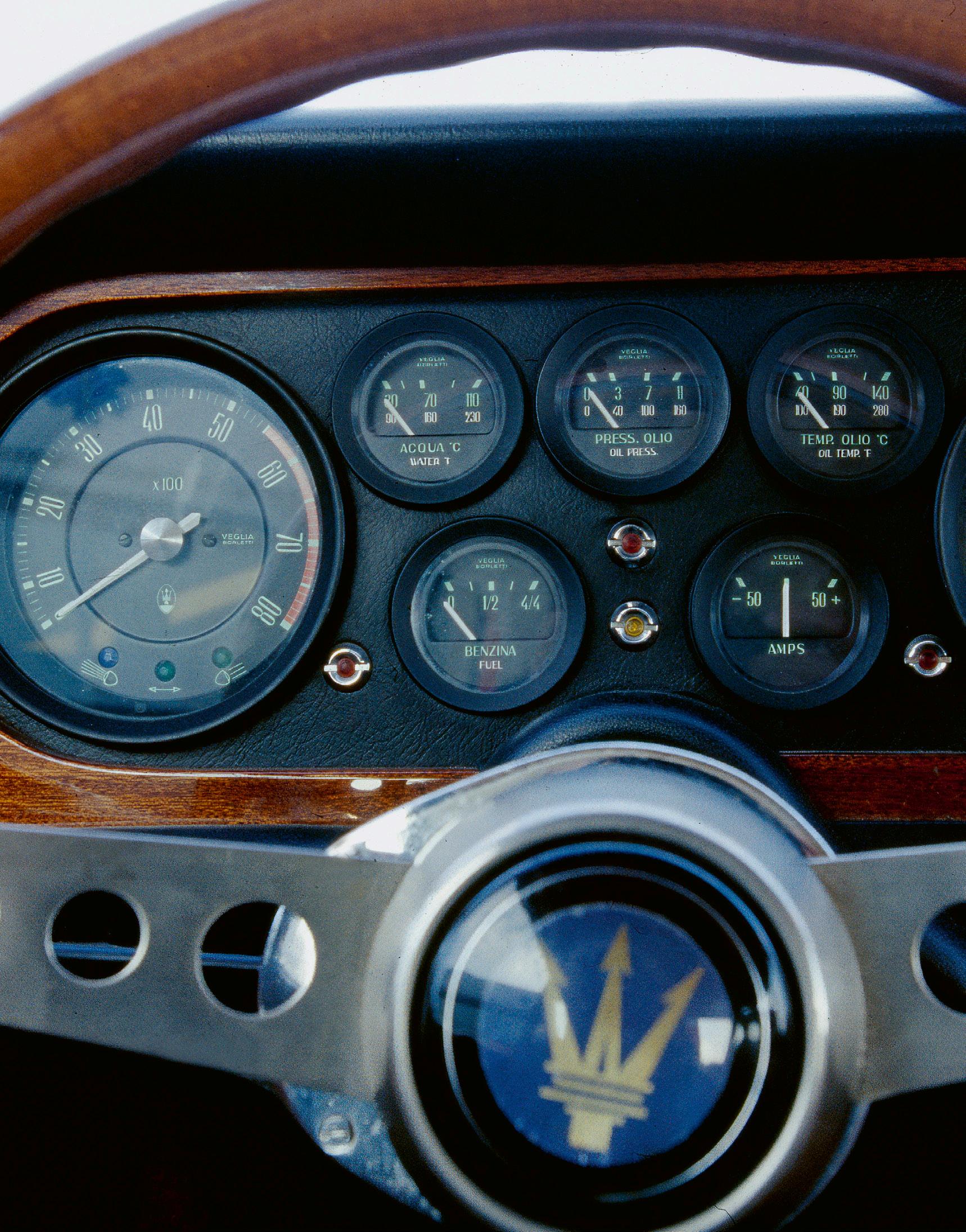
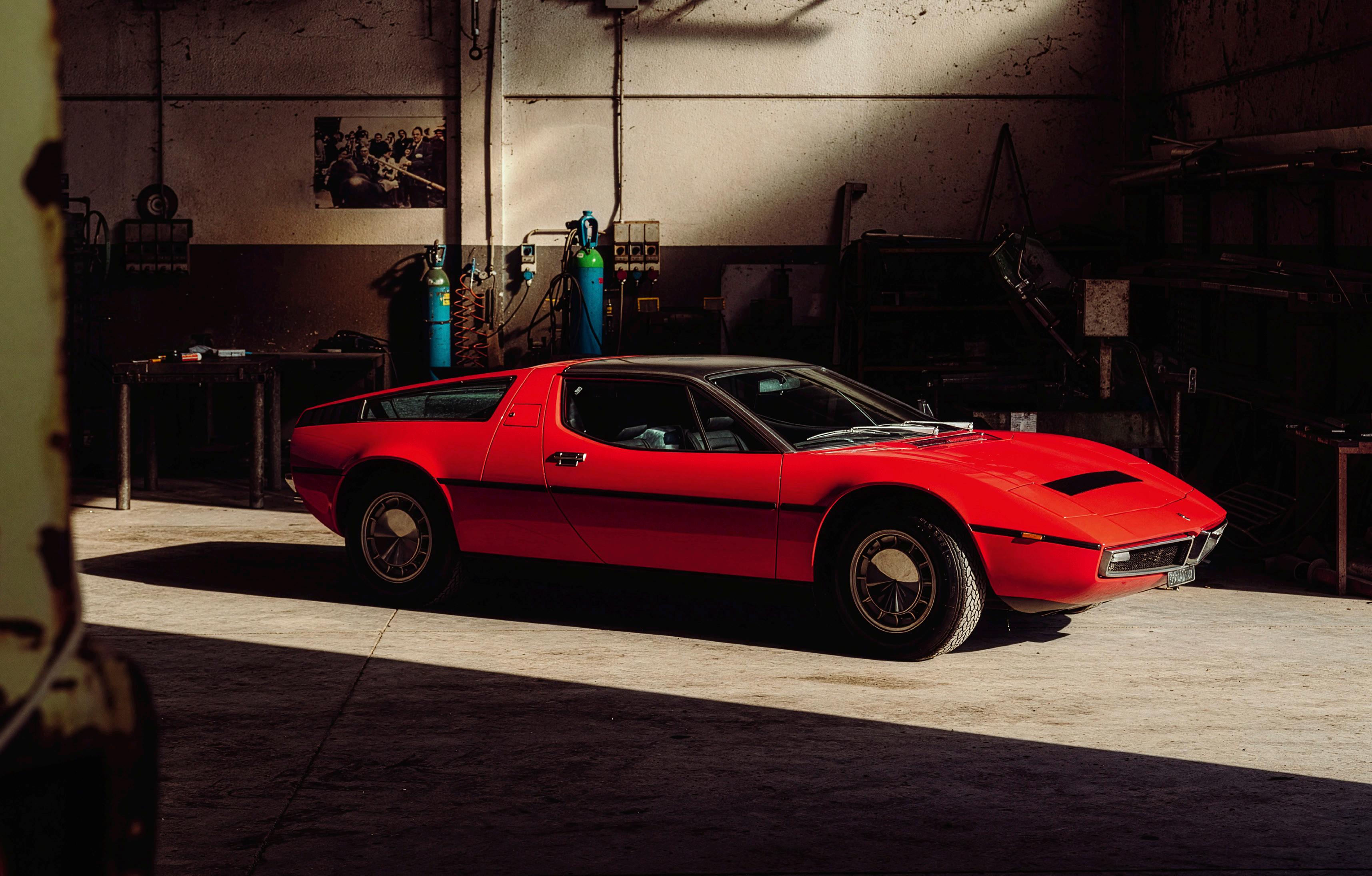
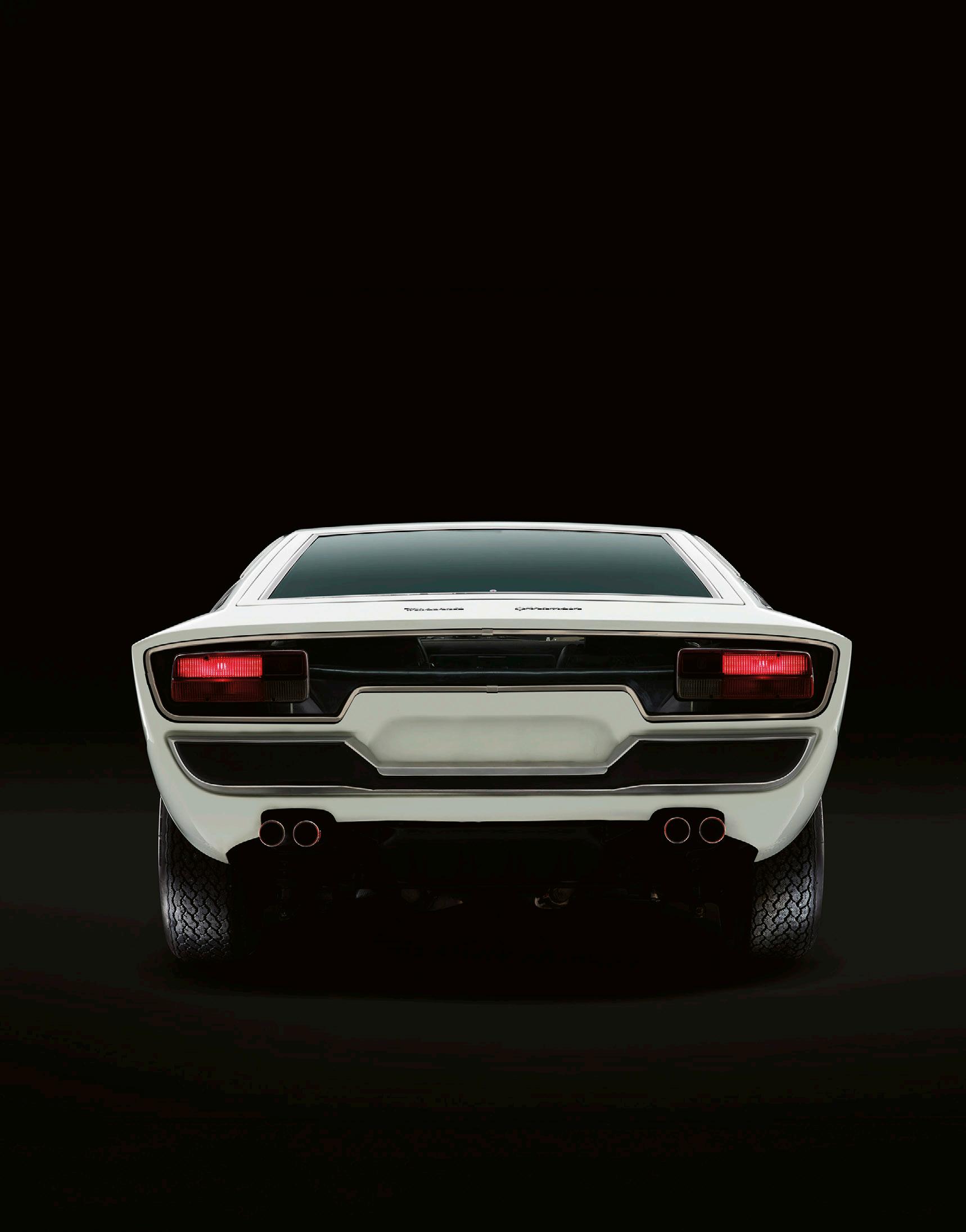
The Khamsin, successor to the Ghibli, was Maserati’s last classic front-engine coupé. It was also the final model developed under chief engineer Giulio Alfieri and the last to incorporate Citroën technology.
Der Khamsin als Nachfolger des Ghibli markiert das letzte klassische Frontmotor-Coupé von Maserati, das letzte Modell, das unter der Regie von Chefingenieur Giulio Alfieri entsteht, und den letzten Maserati mit Citroën-Technologie unterm Blech.
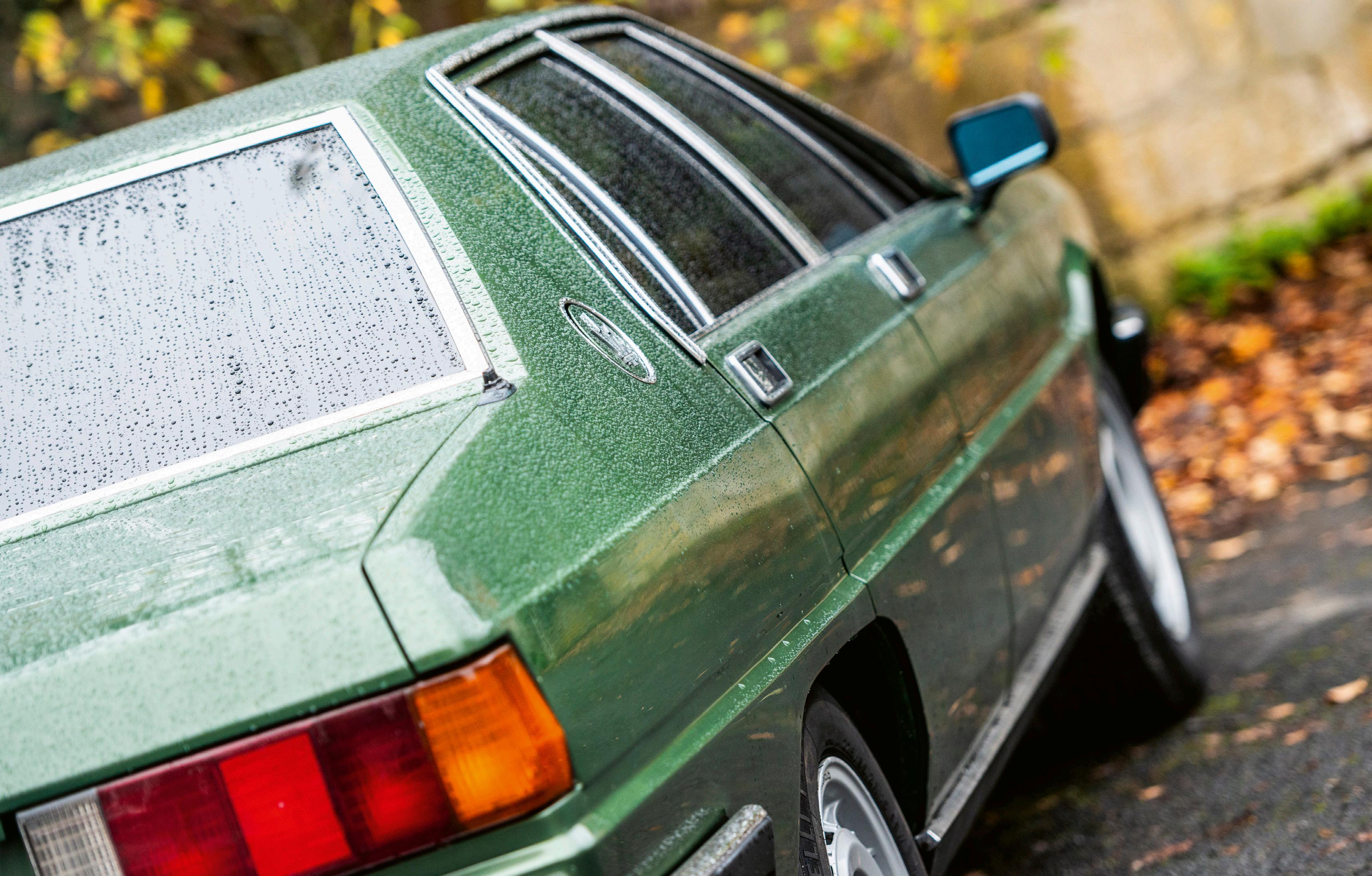
Bertone was commissioned to design the body for the new 2+2. As racy as the Khamsin named after an Arabian desert wind may be, it was introduced at a time when oil and energy crises curtailed demand for high-performance cars. Yet its performance was outstanding: It produced 320 hp, which allowed for a maximum speed of approximately 275 km/h. The Bertone body combined elegance with sharp, angular lines that emphasized its performance, making it appear fast even when it wasn’t moving. The silhouette followed a pronounced wedge profile. In the closed position, the popup headlights reduced aerodynamic drag. The rear window also functioned as the lid of the trunk. For the American market, the rear design had to be revised, including relocating the tail-
lights from the glass panel considerably lower into the bodywork. The additional effort did not pay off very well; production ended at just over 400 units.
Diesmal darf Bertone als Karosseriebauer die Idee eines neuen 2+2-Sitzers realisieren. So rassig der Sportwagen – benannt nach einem Wind in der arabischen Wüste – auch gerät, die Einschränkung des Individualverkehrs als Folge der Öl- und Energiekrise steht einem guten Verkauf des Coupés entgegen. Dabei sind die Fahrleistungen aus-
gezeichnet – dank 320 PS, die eine Höchstgeschwindigkeit von etwa 275 km/h möglich machen. Was bestens zur eleganten, aber dennoch aggressiven Bertone-Karosserie passt, die den Wagen bereits im Stand schneller aussehen lässt, als es die StraßenverkehrsZulassungs-Ordnung erlaubt. Denn die Silhouette ist extrem keilförmig ausgefallen. Vorne vermeiden Klappscheinwerfer in Ruhestellung größere Windverwirbelungen, die Heckscheibe ist zugleich die Kofferraumklappe. Für den amerikanischen Markt muss Maserati das Heck allerdings anders gestalten und zum Beispiel die ins Glas eingelassenen Heckleuchten wesentlich tiefer ins Blech versetzen. Die Mühe hilft jedoch nicht viel: Nach nur gut 400 Exemplaren wird die Produktion schließlich eingestellt.
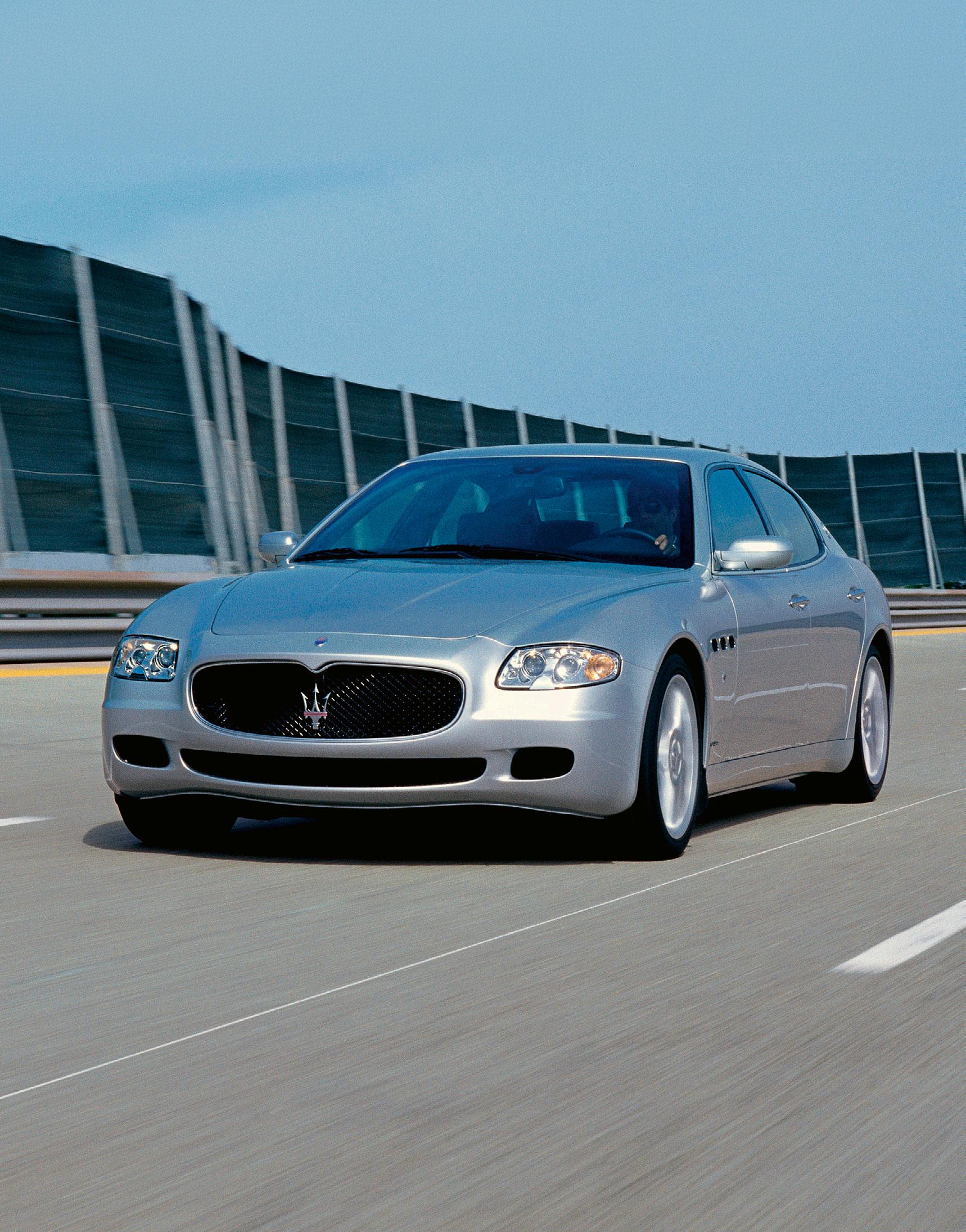
The new Quattroporte, now five meters long and powered by a newly developed naturally aspirated V8 producing 400 hp, arrived as an elegant and convincingly upscale sedan.
Der neue, jetzt fünf Meter lange Quattroporte, den natürlich auch der neuentwickelte V8-Saugmotor antreibt, diesmal aber mit 400 PS, gelingt ausgesprochen elegant und hochwertig.
With much fanfare, Maserati’s marketing described the Quattroporte as “a vibrant personality, combining the soul of a luxury sedan with that of a dynamic sports car”. In this case, that was not overstated. The fifth-generation design once again came from Pininfarina, whose earlier work under the name Pinin Farina included Maseratis such as the A6 1500 and 2000 in the 1950s. The studio deliberately revisited elements from that era, including the oval grille projecting forward with the trident at its center. The car debuted at the 2003 IAA in Frankfurt and stood as the only Italian entrant in the luxury sedan segment at the time. A 3,046-millimeter wheelbase provided generous interior space, and the trunk offered 450 liters of capacity. The cabin included luxuries such as fourteen-way power-adjustable front seats and power-adjustable individual seats in the rear. Dual-zone climate control adjusted to external conditions, and buyers could select mahogany, rosewood, or walnut trim. Small wonder that the result was a curb weight approaching two tons. It’s not a bad life, especially at top speeds of 275 km/h. Electronic systems now included ABS, EBD, and ASR. With these systems, braking the heavy car from 100 km/h to a standstill required only an astonishing 36.9 meters. The initially offered DuoSelect automated manual transmission did not satisfy every customer. Consequently, beginning in January 2007, the Quattroporte Automatica adopted a ZF six-
speed torque-converter automatic mounted directly to the engine. Starting in fall 2005, two additional variants joined the range: the Executive GT and the Sport GT. The former emphasized comfort equipment, the latter a sport-oriented specification. The model also entered official service in Italy. Both the president and the prime minister used armored versions prepared by Carrozzeria Pavesi.
„Der Maserati Quattroporte besitzt eine außergewöhnliche Persönlichkeit, in der die Seele einer beeindruckenden Luxuslimousine mit der eines dynamischen Sportwagens vereint wird“ –große Worte des Maserati-Marketings. Aber nicht übertrieben. Es ist mal wieder Pininfarina, der für die Optik der fünften Generation des Quattroporte verantwortlich ist – noch als „Pinin Farina“ hat das Designstudio schon in den 1950er-Jahren Autos wie A6 1500 und 2000 eingekleidet. Absichtlich spielt der Meister jetzt mit Designelementen der damaligen Zeit wie dem ovalen, nach vorn ausgebildeten Kühlergrill mit dem Dreizack in der Mitte. Das Auto steht erstmals auf der IAA 2003 in Frankfurt und ist die einzige italienische Oberklasselimousine seiner Zeit. Der 3046 Millimeter lange Radstand verspricht Platz in Hülle und Fülle, der Kofferraum bietet 450 Liter Stauraum an. Natürlich gibt es innen
allen erdenklichen Luxus wie vierzehnfach elektrisch verstellbare Vordersitze und einzeln elektrisch einstellbare Rücksitze. Die Zweizonenklimaanlage orientiert sich an den Außenbedingungen, der Kunde kann zwischen Mahagoni-, Rosenholz- und Walnuss-Verkleidungen wählen. Es ist allerdings kein Wunder, dass die Limousine damit fast zwei Tonnen auf die Waage bringt. So lässt es sich gut leben, erst recht bei möglichen 275 km/h Spitze. Inzwischen ist auch sämtliche Fahrwerkselektronik in den Maserati eingezogen wie ABS, EBD (elektronische Bremskraftverteilung) und ASR (Antischlupfregelung). Dank dieser Hilfen steht der schwere Wagen bei einer Vollbremsung von 100 km/h auf 0 in beeindruckenden 36,9 Metern. Mit dem zuerst angebotenen, sehr sportlichen „DuoSelect“-Schaltgetriebe werden nicht alle Kunden glücklich. Deswegen gibt es ab Januar 2007 im Maserati Quattroporte Automatica eine direkt am Motor angeflanschte Sechsgang-Wandlerautomatik von ZF. Ab Herbst 2005 flankieren zwei weitere Quattroporte die Basis, der Executive GT und der Sport GT. Sie enthalten Ausstattungspakete – einer in Richtung Luxus (Executive GT), der andere in Richtung Sportlichkeit. Übrigens macht Maserati mit dem neuen Quattroporte auch die italienische Regierung glücklich: Sie setzt das Auto als Dienstwagen ein. So fahren der Präsident und der Regierungschef eine durch die Carrozzeria Pavesi gepanzerte Version dieses Modells.
© teNeues, an Imprint of
Die Gestalten Verlag GmbH & Co. KG, Berlin 2026
TEXTS by Roland Löwisch
EDITORIAL MANAGEMENT: Eva Stadler
TRANSLATION by John A. Foulks
PROOF READING: Anja Klaffenbach, Ingra Orthober
DESIGN: Eva Stadler
LAYOUT: Michaela Fischer
PRODUCTION: Alwine Krebber, gestalten
IMAGE EDITING: Jens Grundei
Printed in Germany by aprinta druck GmbH
Produced in Europe
Published by gestalten, Berlin 2026
ISBN 978-3-96171-758-3
1st printing, 2026
All rights reserved. No part of this publication may be reproduced or transmitted in any form or by any means, electronic or mechanical, including photocopy or any storage and retrieval system, without permission in writing from the publisher.
No part of this book may be used or reproduced in any manner for the purpose of training artificial intelligence technologies or systems. This work is reserved from text and data mining (Article 4(3) Directive (EU) 2019/790).
Respect copyrights, encourage creativity! For more information and to order books, please visit
www.teneues.com and www.gestalten.com
Die Gestalten Verlag GmbH & Co. KG Mariannenstraße 9–10 10999 Berlin, Germany hello@gestalten.com
Krefeld Office
Uerdinger Strasse 265 / Vitta Pattberg 47800 Krefeld, Germany verlag@teneues.com
teNeues Press Department press@gestalten.com
Bibliographic information published by the Deutsche Nationalbibliothek. The Deutsche Nationalbibliothek lists this publication in the Deutsche Nationalbibliografie; detailed bibliographic data is available online at www.dnb.de
instagram.com/teneuespublishing www.teneues.com