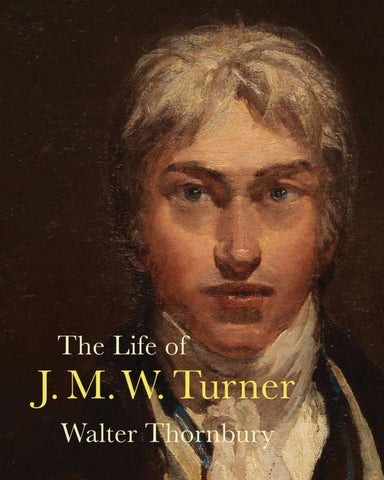
THE LIFE OF J. M. W. TURNER WALTER THORNBURY Selections chosen, edited, and introduced by IAN WARRELL
PA L L A S
ATHENE
THE LIFE OF J. M. W. TURNER WALTER THORNBURY Selections chosen, edited, and introduced by IAN WARRELL
PA L L A S
ATHENE
CONTENTS Introduction by IAN WARRELL
p. 7 Some further reading, p. 38
Selections from The Life and Correspondence of J. M. W. Turner WALTER THORNBURY
The Curtain Rises, p. 41 Maiden Lane, Covent Garden (London vs Venice), p. 45 Early Ambitions, p. 47 Brentford: The Country Eden, p. 48 Margate, p. 49 Architects and Blue Skies, p. 49 Opposite: St Erasmus in Bishop Islip’s Chapel, Westminster Abbey, 1796
CONTENTS Introduction by IAN WARRELL
p. 7 Some further reading, p. 38
Selections from The Life and Correspondence of J. M. W. Turner WALTER THORNBURY
The Curtain Rises, p. 41 Maiden Lane, Covent Garden (London vs Venice), p. 45 Early Ambitions, p. 47 Brentford: The Country Eden, p. 48 Margate, p. 49 Architects and Blue Skies, p. 49 Opposite: St Erasmus in Bishop Islip’s Chapel, Westminster Abbey, 1796
CONTENTS
CONTENTS The Royal Academy, p. 51
Sandycombe Lodge, p. 108
First Tour to Bristol, 1791, p. 52
The Yorkshire Frost, p. 112
First Painting in Oils, p. 53
Carthage and Claude, p. 114
Turner and Girtin at Dr Thomas Monro’s ‘academy’, p. 55
The Old Masters, p. 120 Cuyp and Turner, p. 121
Thomas Girtin (1775–1802), p. 56
Work for the Engravers, p. 125
Embarking on Travels in England, p. 59
Italy 1819, p. 129
Turner Portraits, 1800, p. 62
Plagiarism, p. 132
Summary of Turner’s Art Life, p. 64
Bay of Baiæ, p. 133
Vandervelde’s Rival, 1801, p. 65
Working to Order—Sights Unseen, p. 136
The First Foreign Tour, p. 69
Varnishing Days (1): The Black Cloud, p. 137
The Shipwreck, p. 72
Fishing, p. 141
Turner’s Liber Studiorum, p. 73
Petworth, Sussex, p. 144
Claude and the Liber, p. 77
Floating Carrots, p. 146
John Dillon on the Liber, p. 82
Chantrey’s Trick, p. 146
Appreciations of Turner’s Early Paintings, p. 83
Francis Chantrey, p. 148
Teaching Perspective, p. 88
Rome 1828, p. 149
Turner and Poetry, p. 90
The Polyphemus, p. 153
Walter Fawkes (1769–1825), p. 91
Death of William Turner Senior, p. 159
Devon and Plein Air Painting (1811–14), p. 100
The Benevolent Hoarder [row of 1829], p. 160
Pictures of Nothing: Turner and the Critics, p. 105
Engraving on Steel, p. 162
CONTENTS
CONTENTS The Royal Academy, p. 51
Sandycombe Lodge, p. 108
First Tour to Bristol, 1791, p. 52
The Yorkshire Frost, p. 112
First Painting in Oils, p. 53
Carthage and Claude, p. 114
Turner and Girtin at Dr Thomas Monro’s ‘academy’, p. 55
The Old Masters, p. 120 Cuyp and Turner, p. 121
Thomas Girtin (1775–1802), p. 56
Work for the Engravers, p. 125
Embarking on Travels in England, p. 59
Italy 1819, p. 129
Turner Portraits, 1800, p. 62
Plagiarism, p. 132
Summary of Turner’s Art Life, p. 64
Bay of Baiæ, p. 133
Vandervelde’s Rival, 1801, p. 65
Working to Order—Sights Unseen, p. 136
The First Foreign Tour, p. 69
Varnishing Days (1): The Black Cloud, p. 137
The Shipwreck, p. 72
Fishing, p. 141
Turner’s Liber Studiorum, p. 73
Petworth, Sussex, p. 144
Claude and the Liber, p. 77
Floating Carrots, p. 146
John Dillon on the Liber, p. 82
Chantrey’s Trick, p. 146
Appreciations of Turner’s Early Paintings, p. 83
Francis Chantrey, p. 148
Teaching Perspective, p. 88
Rome 1828, p. 149
Turner and Poetry, p. 90
The Polyphemus, p. 153
Walter Fawkes (1769–1825), p. 91
Death of William Turner Senior, p. 159
Devon and Plein Air Painting (1811–14), p. 100
The Benevolent Hoarder [row of 1829], p. 160
Pictures of Nothing: Turner and the Critics, p. 105
Engraving on Steel, p. 162
CONTENTS
CONTENTS Turner in Scott-land, p. 168
Varnishing Days (2): Constable vs Turner, p. 173 Constable, p. 179 Varnishing Days (3): George Jones, p. 180 Chantrey and the Fire Office, p. 186 New Patrons, p. 186 The Money Spider, p. 187 Varnishing Days (4): A Venetian Painting, p. 189
James Astbury Hammersley’s Visit to the Gallery in 1844, p. 224 Frustrated Hopes, p. 227 Turner’s Prices, p. 228 Last Works, p. 233 Drawn into Society, p. 235 John Jabez Edwin Mayall and Photography, p. 237 Twilight at Chelsea, p. 241 The Last Sunshine, p. 248
Varnishing Days (5): The Burning of the Houses of Parliament, p. 192
The Empty Gallery, p. 249
Indifferent, p. 197
Turner’s Painting Room, p. 251
Travelling with H. A. J. Munro, 1836, p. 199
The Grand Funeral, p. 255
The Old Temeraire, p. 204
Old Mortality: An Assessment, p. 259
Later Travels, p. 210 The Slave Ship, p. 213 Mr Ruskin and Modern Painters, p. 214 Soapsuds and White-wash, p. 215
List of illustrations, p. 268 Note on the text, p. 272
A Critic Chastened, p. 219 Wider Criticisms, p. 220 The Gallery on Queen Anne Street in the 1840s, p. 223
Overleaf: Staffa, Fingal’s Cave, 1832
CONTENTS
CONTENTS Turner in Scott-land, p. 168
Varnishing Days (2): Constable vs Turner, p. 173 Constable, p. 179 Varnishing Days (3): George Jones, p. 180 Chantrey and the Fire Office, p. 186 New Patrons, p. 186 The Money Spider, p. 187 Varnishing Days (4): A Venetian Painting, p. 189
James Astbury Hammersley’s Visit to the Gallery in 1844, p. 224 Frustrated Hopes, p. 227 Turner’s Prices, p. 228 Last Works, p. 233 Drawn into Society, p. 235 John Jabez Edwin Mayall and Photography, p. 237 Twilight at Chelsea, p. 241 The Last Sunshine, p. 248
Varnishing Days (5): The Burning of the Houses of Parliament, p. 192
The Empty Gallery, p. 249
Indifferent, p. 197
Turner’s Painting Room, p. 251
Travelling with H. A. J. Munro, 1836, p. 199
The Grand Funeral, p. 255
The Old Temeraire, p. 204
Old Mortality: An Assessment, p. 259
Later Travels, p. 210 The Slave Ship, p. 213 Mr Ruskin and Modern Painters, p. 214 Soapsuds and White-wash, p. 215
List of illustrations, p. 268 Note on the text, p. 272
A Critic Chastened, p. 219 Wider Criticisms, p. 220 The Gallery on Queen Anne Street in the 1840s, p. 223
Overleaf: Staffa, Fingal’s Cave, 1832
INTRODUCTION
J. M. W. Turner by C. R. Leslie, 1816 (reproduced actual size)
ON AN OVERCAST DECEMBER DAY, right at the end of 1851, the body of Joseph Mallord William Turner was buried in the crypt of St Paul’s Cathedral, after a service attended by the foremost names of the London art world, but no discernible family members. He was thought to have been seventy-nine years old, but was actually seventy-six, having been born in 1775 (perhaps on 23 April – notably both St George’s Day, and Shakespeare’s birthday). Contemporary notices of his death routinely described him as the ‘father of the Royal Academy, and in spite of the peculiarities of his latter manner, one of the most eminent artists of his age’. But the Daily News cautioned that ‘We have properly not yet arrived at the time when a just estimate can be formed of this artist’s great talents. That he founded our present school of landscape, by mingled example and influence, there is no shadow of a doubt’ (23 December 1851). On the same day, the Saint James’s Chronicle proposed that Turner had ‘lived long enough to see his greatest productions rise to uncontested supremacy, however imperfectly
INTRODUCTION
J. M. W. Turner by C. R. Leslie, 1816 (reproduced actual size)
ON AN OVERCAST DECEMBER DAY, right at the end of 1851, the body of Joseph Mallord William Turner was buried in the crypt of St Paul’s Cathedral, after a service attended by the foremost names of the London art world, but no discernible family members. He was thought to have been seventy-nine years old, but was actually seventy-six, having been born in 1775 (perhaps on 23 April – notably both St George’s Day, and Shakespeare’s birthday). Contemporary notices of his death routinely described him as the ‘father of the Royal Academy, and in spite of the peculiarities of his latter manner, one of the most eminent artists of his age’. But the Daily News cautioned that ‘We have properly not yet arrived at the time when a just estimate can be formed of this artist’s great talents. That he founded our present school of landscape, by mingled example and influence, there is no shadow of a doubt’ (23 December 1851). On the same day, the Saint James’s Chronicle proposed that Turner had ‘lived long enough to see his greatest productions rise to uncontested supremacy, however imperfectly
IAN WARRELL they were understood when they first appeared in the earlier years of this century; and, though in his later works, and in advanced age, force and precision of execution have not accompanied his vivacity of conception, public opinion has gradually and steadily advanced to a more just appreciation of his power.’ It was common knowledge that Turner had retained many of his most successful paintings, notably Dido Building Carthage (1815) and The Fighting Temeraire tugged to her last berth to be broken up, 1838 (1839), along with some of his commercially popular views of Venice, as well as many larger canvases that failed to attract buyers while on display at the Royal Academy exhibitions. So even as the news broke of his death, there was excited speculation about the fate of the collection stored haphazardly in his gallery on Queen Anne Street, and whether some of the pictures might have been left to the nation. Such uncertainties about the nature of Turner’s legacy were, however, only a fragment of the bigger mystery: who exactly was Turner, and what was he really like? Despite his prominence at the Royal Academy, where he had served as Deputy President in recent years, as he noticeably aged, he had increasingly lived privately. Consequently the chief perceptions of him were that he was secretive, anti-social, eccentric (like his boldly coloured paintings), penurious, yet sharp in business matters. By 1851 many of those who
INTRODUCTION had been his closest friends or patrons had already died. So it was only gradually that the trajectory of his life was once again uncovered in obituaries and personal recollections. His origins, as the son of a barber in Covent Garden, appealed especially to the mid-Victorian taste for rags-toriches narratives, and this modest, but not impoverished background was sometimes exaggerated for effect. In fact, as Martin Myrone has recently demonstrated, Turner’s social position was actually not exceptional among his artistic peers. Unlike most of them, however, Turner’s precocious talents were spotted and nurtured quickly, so that he gained regular employment as a draughtsman, entered the Royal Academy schools, and soon after, at the age of only fifteen, submitted the first of the over 250 works he showed in the Academy’s annual exhibitions. Instilled with professional values by his father, Turner was already involved in the print trade by 1794, producing watercolour designs that were translated into black and white book illustrations. This type of work became the mainstay of his output throughout his career, so much so that he was able to dictate the terms to publishers, who competed to secure work from him (though this was always a risk financially in a volatile market). As he gained in experience, he became an exacting taskmaster, habitually revising tiny details while seeking to perfect each engraved image. His designs were often the main attraction,
IAN WARRELL they were understood when they first appeared in the earlier years of this century; and, though in his later works, and in advanced age, force and precision of execution have not accompanied his vivacity of conception, public opinion has gradually and steadily advanced to a more just appreciation of his power.’ It was common knowledge that Turner had retained many of his most successful paintings, notably Dido Building Carthage (1815) and The Fighting Temeraire tugged to her last berth to be broken up, 1838 (1839), along with some of his commercially popular views of Venice, as well as many larger canvases that failed to attract buyers while on display at the Royal Academy exhibitions. So even as the news broke of his death, there was excited speculation about the fate of the collection stored haphazardly in his gallery on Queen Anne Street, and whether some of the pictures might have been left to the nation. Such uncertainties about the nature of Turner’s legacy were, however, only a fragment of the bigger mystery: who exactly was Turner, and what was he really like? Despite his prominence at the Royal Academy, where he had served as Deputy President in recent years, as he noticeably aged, he had increasingly lived privately. Consequently the chief perceptions of him were that he was secretive, anti-social, eccentric (like his boldly coloured paintings), penurious, yet sharp in business matters. By 1851 many of those who
INTRODUCTION had been his closest friends or patrons had already died. So it was only gradually that the trajectory of his life was once again uncovered in obituaries and personal recollections. His origins, as the son of a barber in Covent Garden, appealed especially to the mid-Victorian taste for rags-toriches narratives, and this modest, but not impoverished background was sometimes exaggerated for effect. In fact, as Martin Myrone has recently demonstrated, Turner’s social position was actually not exceptional among his artistic peers. Unlike most of them, however, Turner’s precocious talents were spotted and nurtured quickly, so that he gained regular employment as a draughtsman, entered the Royal Academy schools, and soon after, at the age of only fifteen, submitted the first of the over 250 works he showed in the Academy’s annual exhibitions. Instilled with professional values by his father, Turner was already involved in the print trade by 1794, producing watercolour designs that were translated into black and white book illustrations. This type of work became the mainstay of his output throughout his career, so much so that he was able to dictate the terms to publishers, who competed to secure work from him (though this was always a risk financially in a volatile market). As he gained in experience, he became an exacting taskmaster, habitually revising tiny details while seeking to perfect each engraved image. His designs were often the main attraction,
IAN WARRELL even when paired with a celebrated writer like Sir Walter Scott, who was bluntly told that by employing Turner’s images his poems would sell considerably more than double what they might do on their own. From 1793 (and more consistently after 1796) Turner had begun exhibiting oil paintings, alongside his technically inventive watercolours, which eventually gained him recognition as an Associate of the Royal Academy in 1799. By then he was receiving commissions from wealthy aristocratic patrons, such as William Beckford, John Julius Angerstein and the Duke of Bridgewater, along with Lord Elgin, whose meagre and onerous terms, seeking the artist to join his team for his controversial trip to Greece, Turner was able to decline. A couple of years after becoming a full member of the Academy in 1802 (then the youngest to receive this accolade), he opened his own gallery on Harley Street, later expanded around the corner at Queen Anne Street. There he was able to promote his latest paintings along with his ambitious series of mezzotints known as the Liber Studiorum (which in 1851 many believed would be his most significant artistic legacy). It was there also that he displayed his experimental naturalistic canvases, inspired by the plein air studies painted during his excursions on the River Thames from 1805 onwards, some of which found favour with Lord Egremont, later a close friend.
INTRODUCTION In addition to his home and gallery in central London, Turner’s success enabled him to construct a small villa – Sandycombe Lodge – close to the river at Twickenham, which became a regular retreat until the mid-1820s. Further afield, at Farnley Hall, near Otley, in Yorkshire, he became a regular guest of Walter Fawkes, a progressiveminded landowner with an interest in history, who proved to be the most enthusiastic collector of Turner’s art. It was apparently while visiting Farnley that Turner conceived the first of his series of paintings evoking the rise and fall of the Carthaginian empire (see pp. 106–7, 116–17). In the meantime the long wars with France were settled by the peace following the Battle of Waterloo in 1815, which enabled British artists to travel on the continent more freely. Turner took full advantage of this, as was plain in his resulting oil paintings, and in numerous carefully crafted watercolours for the book trade. His exposure to Italy in 1819, both in terms of its dazzling light and its cultural associations (particularly the landscape paintings of Claude Lorrain), consolidated his achievements and gave a new impetus to his work, which was further augmented in a later stay in Rome in 1828–9, plus three visits to Venice (1819, 1833 and 1840). Since the mid-1810s Turner had made use of new pigments, which gave his palette a much higher tonality, most notably in terms of his preference for yellow. By the
IAN WARRELL even when paired with a celebrated writer like Sir Walter Scott, who was bluntly told that by employing Turner’s images his poems would sell considerably more than double what they might do on their own. From 1793 (and more consistently after 1796) Turner had begun exhibiting oil paintings, alongside his technically inventive watercolours, which eventually gained him recognition as an Associate of the Royal Academy in 1799. By then he was receiving commissions from wealthy aristocratic patrons, such as William Beckford, John Julius Angerstein and the Duke of Bridgewater, along with Lord Elgin, whose meagre and onerous terms, seeking the artist to join his team for his controversial trip to Greece, Turner was able to decline. A couple of years after becoming a full member of the Academy in 1802 (then the youngest to receive this accolade), he opened his own gallery on Harley Street, later expanded around the corner at Queen Anne Street. There he was able to promote his latest paintings along with his ambitious series of mezzotints known as the Liber Studiorum (which in 1851 many believed would be his most significant artistic legacy). It was there also that he displayed his experimental naturalistic canvases, inspired by the plein air studies painted during his excursions on the River Thames from 1805 onwards, some of which found favour with Lord Egremont, later a close friend.
INTRODUCTION In addition to his home and gallery in central London, Turner’s success enabled him to construct a small villa – Sandycombe Lodge – close to the river at Twickenham, which became a regular retreat until the mid-1820s. Further afield, at Farnley Hall, near Otley, in Yorkshire, he became a regular guest of Walter Fawkes, a progressiveminded landowner with an interest in history, who proved to be the most enthusiastic collector of Turner’s art. It was apparently while visiting Farnley that Turner conceived the first of his series of paintings evoking the rise and fall of the Carthaginian empire (see pp. 106–7, 116–17). In the meantime the long wars with France were settled by the peace following the Battle of Waterloo in 1815, which enabled British artists to travel on the continent more freely. Turner took full advantage of this, as was plain in his resulting oil paintings, and in numerous carefully crafted watercolours for the book trade. His exposure to Italy in 1819, both in terms of its dazzling light and its cultural associations (particularly the landscape paintings of Claude Lorrain), consolidated his achievements and gave a new impetus to his work, which was further augmented in a later stay in Rome in 1828–9, plus three visits to Venice (1819, 1833 and 1840). Since the mid-1810s Turner had made use of new pigments, which gave his palette a much higher tonality, most notably in terms of his preference for yellow. By the
WALTER THORNBURY
LIFE OF J. M. W. TURNER sordid hunks and miser the scandal of the time made him. He used to say to an intimate friend: ‘Don’t wish for money; you will not be the happier, and you know you can have any money of me you want.’(II, 130–1)
TRAVELLING WITH H. A. J. MUNRO,
John Scarlett Davis, Interior of ‘The Library at Tottenham’, the seat of Benjamin Godfrey Windus, 1835
looking at so intently?’ said the host. ‘At those boards,’ was the reply; ‘the fellow that did that must have known how to paint.’ And nothing would induce him to turn to the magnificent pictures that sparkled on the walls. He never talked about his own pictures, but would occasionally give hints to other artists; and when these were adopted, they were always certain improvements. We never heard of his saying anything, however, that would give pain, though he felt keenly the ignorant criticisms and ridicule with which his own pictures were sometimes treated. Turner’s was a good and kind nature; he was not the
Of all Turner’s tours, we have most records of that which he took with [the wealthy Scottish collector] Mr. Munro in 1836. The very circumstance that gave rise to the tour is a proof of the painter’s almost womanly tenderness for those he really received into friendship. A great and serious depression of spirits had fallen on Mr. Munro, and it became gradually a burden he could not shake off. Turner proposed a sketching tour to divert his friend’s mind into fresh channels. They started through a part of France which Turner wanted to visit, and after visiting Chamonix and Mont Blanc, which Turner had a great desire to see, they went by the Valley of Aosta into Italy, returning home afterwards by Turin. Mr. Munro found that Turner enjoyed himself in his way—a sort of honest Diogenes way. He disliked teasing questions as to how he got this or that colour. On one occasion, in the Aosta Valley, Turner was dissatisfied with a sketch. He altered and sponged till the drawing got a sort of white greenness about it which was not pleasant. He
WALTER THORNBURY
LIFE OF J. M. W. TURNER sordid hunks and miser the scandal of the time made him. He used to say to an intimate friend: ‘Don’t wish for money; you will not be the happier, and you know you can have any money of me you want.’(II, 130–1)
TRAVELLING WITH H. A. J. MUNRO,
John Scarlett Davis, Interior of ‘The Library at Tottenham’, the seat of Benjamin Godfrey Windus, 1835
looking at so intently?’ said the host. ‘At those boards,’ was the reply; ‘the fellow that did that must have known how to paint.’ And nothing would induce him to turn to the magnificent pictures that sparkled on the walls. He never talked about his own pictures, but would occasionally give hints to other artists; and when these were adopted, they were always certain improvements. We never heard of his saying anything, however, that would give pain, though he felt keenly the ignorant criticisms and ridicule with which his own pictures were sometimes treated. Turner’s was a good and kind nature; he was not the
Of all Turner’s tours, we have most records of that which he took with [the wealthy Scottish collector] Mr. Munro in 1836. The very circumstance that gave rise to the tour is a proof of the painter’s almost womanly tenderness for those he really received into friendship. A great and serious depression of spirits had fallen on Mr. Munro, and it became gradually a burden he could not shake off. Turner proposed a sketching tour to divert his friend’s mind into fresh channels. They started through a part of France which Turner wanted to visit, and after visiting Chamonix and Mont Blanc, which Turner had a great desire to see, they went by the Valley of Aosta into Italy, returning home afterwards by Turin. Mr. Munro found that Turner enjoyed himself in his way—a sort of honest Diogenes way. He disliked teasing questions as to how he got this or that colour. On one occasion, in the Aosta Valley, Turner was dissatisfied with a sketch. He altered and sponged till the drawing got a sort of white greenness about it which was not pleasant. He
WALTER THORNBURY
LIFE OF J. M. W. TURNER got quite fretful about this, and began to abuse coloursketching, saying, ‘I could have done twice as much with the pencil.’ His first inquiry in the morning, when they started to sketch, was always, ‘Have you got the sponge?’ because it was with the sponge he obtained many of his misty and ærial effects. He never rhapsodized about scenery, but set hard at work at some distance from Mr. Munro, silent, concentrated (and generally a good deal higher), so as to obtain more distance and more of a bird’s-eye view. He took quick sketches, and then finished them afterwards quietly (by help of his tremendous memory) at the inn. He had a horror of what he said Wilson called ‘being too mappy.’ If you bore with his way, it was easy to get on very pleasantly with him; indeed, there was a sort of half resolution come to that Turner and Mr. Munro should visit the East together.(I, 229–30) It was in this tour Turner made a sketch* which he afterwards turned into his picture (now in Mr. Munro’s gallery) of the Avalanche, one of his grandest and wildest flights of imagination.†(I, 231) * Museum of Fine Arts, Boston, MA † Art Institute of Chicago, Chicago, IL
Valley of Aosta, 1836
Overleaf: Valley of Aosta: Snowstorm, Avalanche, and Thunderstorm, 1836
WALTER THORNBURY
LIFE OF J. M. W. TURNER got quite fretful about this, and began to abuse coloursketching, saying, ‘I could have done twice as much with the pencil.’ His first inquiry in the morning, when they started to sketch, was always, ‘Have you got the sponge?’ because it was with the sponge he obtained many of his misty and ærial effects. He never rhapsodized about scenery, but set hard at work at some distance from Mr. Munro, silent, concentrated (and generally a good deal higher), so as to obtain more distance and more of a bird’s-eye view. He took quick sketches, and then finished them afterwards quietly (by help of his tremendous memory) at the inn. He had a horror of what he said Wilson called ‘being too mappy.’ If you bore with his way, it was easy to get on very pleasantly with him; indeed, there was a sort of half resolution come to that Turner and Mr. Munro should visit the East together.(I, 229–30) It was in this tour Turner made a sketch* which he afterwards turned into his picture (now in Mr. Munro’s gallery) of the Avalanche, one of his grandest and wildest flights of imagination.†(I, 231) * Museum of Fine Arts, Boston, MA † Art Institute of Chicago, Chicago, IL
Valley of Aosta, 1836
Overleaf: Valley of Aosta: Snowstorm, Avalanche, and Thunderstorm, 1836
WALTER THORNBURY
LIFE OF J. M. W. TURNER
WALTER THORNBURY
LIFE OF J. M. W. TURNER
WALTER THORNBURY THE OLD TEMERAIRE From the day that, as a boy, he first boated up and down the Thames, to the day that, at Chelsea, he turned his dying eyes on the river that he loved, Turner had all an Englishman’s love for the water. He loved the Thames and its ‘black barges, patched red sails, and every possible condition of blue and white fog’; he loved them, because he had a tenacious love all his life through for what had been known to him in childhood.(I, 333) The Temeraire picture* was exhibited by Turner at the Royal Academy in 1839. The subject was suggested to the painter by [Clarkson] Stanfield.† In 1838 Turner was with Stanfield and a party of brother artists on one of those holiday excursions in which he so delighted, probably to end with whitebait and champagne at Greenwich. It was at these times that Turner talked and joked his best, snatching now and then a moment to print on his quick brain some tone of sky, some gleam of water, some sprinkling light of oar, some glancing sunshine cross-barring a sail. Suddenly there moved down upon the artists’ boat the grand old vessel that had been taken prisoner at the Nile, and that led the van at Trafalgar. She loomed pale * National Gallery, London † Turner is now thought to have been travelling abroad when this event took place.
LIFE OF J. M. W. TURNER and ghostly, and was being towed to her last moorings at Deptford by a little fiery, puny steam-tug. ‘There’s a fine subject, Turner,’ said Stanfield. So Turner painted it, and it proved one of his most poetical pictures.(I, 335–6) Mr. Ruskin considers this picture of 1839 the last picture Turner executed with his entire and perfect power. The Polyphemus, painted in 1829, he claims as marking the beginning of Turner’s central and best period of ten years. Singularly enough, the picture of 1829 is a sunrise; the picture of 1839 a sunset. I extract from the Athenæum of three years ago a criticism of mine on this picture, chiefly considered as a matchless tableau of colour: The crown and paragon of the collection is the Fighting Temeraire tugged to her last Berth, which stands out from amongst them as a great flame-coloured Mexican cactus, the very emperor of flowers, would do in a nosegay of simple primroses. We place it first of all his works, because it excels in colour all landscapes, we might almost say, in the world;—we place it first, because it excels in colour, and it was as a colourist that Turner excelled almost all painters. It is wonderful for all the qualities of colour, for brilliancy, contrast, breadth, tone, transparency,
WALTER THORNBURY THE OLD TEMERAIRE From the day that, as a boy, he first boated up and down the Thames, to the day that, at Chelsea, he turned his dying eyes on the river that he loved, Turner had all an Englishman’s love for the water. He loved the Thames and its ‘black barges, patched red sails, and every possible condition of blue and white fog’; he loved them, because he had a tenacious love all his life through for what had been known to him in childhood.(I, 333) The Temeraire picture* was exhibited by Turner at the Royal Academy in 1839. The subject was suggested to the painter by [Clarkson] Stanfield.† In 1838 Turner was with Stanfield and a party of brother artists on one of those holiday excursions in which he so delighted, probably to end with whitebait and champagne at Greenwich. It was at these times that Turner talked and joked his best, snatching now and then a moment to print on his quick brain some tone of sky, some gleam of water, some sprinkling light of oar, some glancing sunshine cross-barring a sail. Suddenly there moved down upon the artists’ boat the grand old vessel that had been taken prisoner at the Nile, and that led the van at Trafalgar. She loomed pale * National Gallery, London † Turner is now thought to have been travelling abroad when this event took place.
LIFE OF J. M. W. TURNER and ghostly, and was being towed to her last moorings at Deptford by a little fiery, puny steam-tug. ‘There’s a fine subject, Turner,’ said Stanfield. So Turner painted it, and it proved one of his most poetical pictures.(I, 335–6) Mr. Ruskin considers this picture of 1839 the last picture Turner executed with his entire and perfect power. The Polyphemus, painted in 1829, he claims as marking the beginning of Turner’s central and best period of ten years. Singularly enough, the picture of 1829 is a sunrise; the picture of 1839 a sunset. I extract from the Athenæum of three years ago a criticism of mine on this picture, chiefly considered as a matchless tableau of colour: The crown and paragon of the collection is the Fighting Temeraire tugged to her last Berth, which stands out from amongst them as a great flame-coloured Mexican cactus, the very emperor of flowers, would do in a nosegay of simple primroses. We place it first of all his works, because it excels in colour all landscapes, we might almost say, in the world;—we place it first, because it excels in colour, and it was as a colourist that Turner excelled almost all painters. It is wonderful for all the qualities of colour, for brilliancy, contrast, breadth, tone, transparency,
WALTER THORNBURY
LIFE OF J. M. W. TURNER
WALTER THORNBURY
LIFE OF J. M. W. TURNER
WALTER THORNBURY and light. And these fantasies are lavished on one of the simplest of heroic themes:—an old manof-war being towed to her last moorings,—her grave,—where, her life well spent, she will return to those primitive elements from whence her oaks first sprang. She is towed by a steamer, late in the sunset, which is smouldering fiercely out of the sky; beyond the whirlpool of crimson and yellow, and flamestreaks of vermilion, a blue haze is creeping up the river to meet the night. Grand and warrior-like, stern, like an unconquered veteran, proud of trophy and scar, the Temeraire moves on, with its lance-like masts erect, its broad, pale, spectral hull looming stupendous and threatening over a water red as with the blood of past battles. A grand and touching sight is the old ship, so vast and thunderous in its sleeping and now well-nigh exhausted might,— so staunch, so true, and indomitable it is. The tug seems to convoy it gently and lovingly, as the enormous bulk whitens and troubles the water.(II, 337–8) In no picture we have ever seen can you pass through so far, and yet come to no wall that orders back the impatient and forth-flying imagination. Through a thousand semitones and half-notes of Previous pages: The Fighting Temeraire tugged to her last berth to be broken up, 1838
LIFE OF J. M. W. TURNER grey and neutral tint we reach the sovereign colours that rule the picture. The very relaxations and freedoms of the drawing seem true to the aerial witchery and beguilement of such an hour and such an evening.(I, 339) As a picture it is the most glorious consummation of colouring ever painted by English fingers, or seen by English eyes. In exquisite transparency it surpasses water-colours; in strength and purity it transcends oil. It is the noblest English poem, founded on English scenery and English events, ever thrown on canvas. He who painted this deserves indeed a central seat in our wide Pantheon.(I, 339–40) At Deptford she was to cease to be a ship, and to become a hospital hulk for the sailors of all nations. But Turner looked at her not as an old friend going to the grave, but as an old warrior going to his rest; he did, to celebrate its grand apotheosis, turn the sky and earth into a gory battle-field, and in gorgeous sunset she moves in pomp to her burial. In Turner’s eyes she was then no longer the pale ghost of her former self, but a warship moving through the sulphurous flame at Trafalgar, with the blood oozing through her planks as the wine pours from the wine-press at vintage-time. He knew, when he painted this picture, that he should touch the heart of England, because his own heart was touched as he painted.(I, 340)
WALTER THORNBURY and light. And these fantasies are lavished on one of the simplest of heroic themes:—an old manof-war being towed to her last moorings,—her grave,—where, her life well spent, she will return to those primitive elements from whence her oaks first sprang. She is towed by a steamer, late in the sunset, which is smouldering fiercely out of the sky; beyond the whirlpool of crimson and yellow, and flamestreaks of vermilion, a blue haze is creeping up the river to meet the night. Grand and warrior-like, stern, like an unconquered veteran, proud of trophy and scar, the Temeraire moves on, with its lance-like masts erect, its broad, pale, spectral hull looming stupendous and threatening over a water red as with the blood of past battles. A grand and touching sight is the old ship, so vast and thunderous in its sleeping and now well-nigh exhausted might,— so staunch, so true, and indomitable it is. The tug seems to convoy it gently and lovingly, as the enormous bulk whitens and troubles the water.(II, 337–8) In no picture we have ever seen can you pass through so far, and yet come to no wall that orders back the impatient and forth-flying imagination. Through a thousand semitones and half-notes of Previous pages: The Fighting Temeraire tugged to her last berth to be broken up, 1838
LIFE OF J. M. W. TURNER grey and neutral tint we reach the sovereign colours that rule the picture. The very relaxations and freedoms of the drawing seem true to the aerial witchery and beguilement of such an hour and such an evening.(I, 339) As a picture it is the most glorious consummation of colouring ever painted by English fingers, or seen by English eyes. In exquisite transparency it surpasses water-colours; in strength and purity it transcends oil. It is the noblest English poem, founded on English scenery and English events, ever thrown on canvas. He who painted this deserves indeed a central seat in our wide Pantheon.(I, 339–40) At Deptford she was to cease to be a ship, and to become a hospital hulk for the sailors of all nations. But Turner looked at her not as an old friend going to the grave, but as an old warrior going to his rest; he did, to celebrate its grand apotheosis, turn the sky and earth into a gory battle-field, and in gorgeous sunset she moves in pomp to her burial. In Turner’s eyes she was then no longer the pale ghost of her former self, but a warship moving through the sulphurous flame at Trafalgar, with the blood oozing through her planks as the wine pours from the wine-press at vintage-time. He knew, when he painted this picture, that he should touch the heart of England, because his own heart was touched as he painted.(I, 340)
WALTER THORNBURY
LIFE OF J. M. W. TURNER
[Thornbury relates attempts to buy the Temeraire, describing it as ‘this Koh-i-noor of a picture’:]— Some years after the Exhibition, Mr. Leslie tried to buy it for Mr. James Lenox, of New York; but Turner would not part with it. In 1831 [sic] it had already been mentally placed by him among the pictures he would leave to the nation. Sacks of gold would not have shaken him on this point.(I, 342)
LATER TRAVELS The Swiss and Venetian sketches are very numerous. Turner drew Lausanne, bathed in a rosy sunset; a morning view, looking from Brennen [Brunnen]; Fluelen on the Lake of Lucerne, looking from Kussnach towards the Bernese Alps; and Mons Pilatus, dark against the sunset. Then comes his last visit to Venice; and for the hundredth time he sits down to make notes of San Giorgio, Santa Maria del Salute, the Bridge of the Riva del Schiavoni, and the lagoon between San Giorgio and the Cantieri.(I, 323) Mr. Ruskin had given Turner, on one of his late tours, a commission for a drawing of Venice, but it was so unfinished that it did not please him.(II, 284–5) Opposite: The Church of Santo Stefano, Venice, from the Rio del Santissimo, 1840
WALTER THORNBURY
LIFE OF J. M. W. TURNER
[Thornbury relates attempts to buy the Temeraire, describing it as ‘this Koh-i-noor of a picture’:]— Some years after the Exhibition, Mr. Leslie tried to buy it for Mr. James Lenox, of New York; but Turner would not part with it. In 1831 [sic] it had already been mentally placed by him among the pictures he would leave to the nation. Sacks of gold would not have shaken him on this point.(I, 342)
LATER TRAVELS The Swiss and Venetian sketches are very numerous. Turner drew Lausanne, bathed in a rosy sunset; a morning view, looking from Brennen [Brunnen]; Fluelen on the Lake of Lucerne, looking from Kussnach towards the Bernese Alps; and Mons Pilatus, dark against the sunset. Then comes his last visit to Venice; and for the hundredth time he sits down to make notes of San Giorgio, Santa Maria del Salute, the Bridge of the Riva del Schiavoni, and the lagoon between San Giorgio and the Cantieri.(I, 323) Mr. Ruskin had given Turner, on one of his late tours, a commission for a drawing of Venice, but it was so unfinished that it did not please him.(II, 284–5) Opposite: The Church of Santo Stefano, Venice, from the Rio del Santissimo, 1840
WALTER THORNBURY
LIFE OF J. M. W. TURNER THE SLAVE SHIP Generally speaking, I have abstained from quoting any passages of Mr. Ruskin’s for their mere poetry, unless they really contained some exposition of Turner’s style and mind; but the following I cannot pass by, especially as I have not myself seen the picture alluded to.
Slavers Throwing overboard the Dead and Dying—Typhon coming on (‘The Slave Ship’), 1840
But I think the noblest sea that Turner has ever painted, and if so, the noblest certainly ever painted by man, is that of the Slave Ship, the chief Academy picture of the Exhibition of 1840. It is a sunset on the Atlantic, after prolonged storm; but the storm is partially lulled, and the torn and streaming rain clouds are moving in scarlet lines to lose themselves in the hollow of the night. The whole surface of sea included in the picture is divided into two ridges of enormous swell, not high nor local, but a low, broad heaving of the whole ocean, like the lifting of its bosom by deep-drawn breath after the torture of the storm. Between these two ridges the fire of the sunset falls along the trough of the sea, dyeing it with an awful but glorious light, the intense and lurid splendour which burns like gold, and bathes like blood.’(II, 335)
WALTER THORNBURY
LIFE OF J. M. W. TURNER THE SLAVE SHIP Generally speaking, I have abstained from quoting any passages of Mr. Ruskin’s for their mere poetry, unless they really contained some exposition of Turner’s style and mind; but the following I cannot pass by, especially as I have not myself seen the picture alluded to.
Slavers Throwing overboard the Dead and Dying—Typhon coming on (‘The Slave Ship’), 1840
But I think the noblest sea that Turner has ever painted, and if so, the noblest certainly ever painted by man, is that of the Slave Ship, the chief Academy picture of the Exhibition of 1840. It is a sunset on the Atlantic, after prolonged storm; but the storm is partially lulled, and the torn and streaming rain clouds are moving in scarlet lines to lose themselves in the hollow of the night. The whole surface of sea included in the picture is divided into two ridges of enormous swell, not high nor local, but a low, broad heaving of the whole ocean, like the lifting of its bosom by deep-drawn breath after the torture of the storm. Between these two ridges the fire of the sunset falls along the trough of the sea, dyeing it with an awful but glorious light, the intense and lurid splendour which burns like gold, and bathes like blood.’(II, 335)
LIST OF ILLUSTRATIONS List of illustrations All works are by J. M. W. Turner and oil on canvas unless stated otherwise. Measurements given height before width. Turner’s spellings have been retained. Images from holding institutions unless noted.
p. 1 Richard (‘Dicky’) Doyle, Turner Painting one of his Pictures, 1846 (published in Almanac of the Month). Woodcut, approx. 45 x 55 mm. National Portrait Gallery, London p. 2 Self-Portrait, c. 1799. 74 x 58 cm. Tate, London p. 4 St Erasmus in Bishop Islip’s Chapel, Westminster Abbey, 1796. Watercolour and graphite on paper, 546 x 398 mm. British Museum, London pp. 10–11 Staffa, Fingal’s Cave, 1832. 100 x 121 cm. Yale Center for British Art, New Haven, CT p. 12 Charles Robert Leslie, J. M. W. Turner, 1816. Pencil on paper, 108 x 86 mm. National Portrait Gallery, London pp. 36 & 37 Scenes from Mr. Turner, 2014, written and directed by Mike Leigh, designed by Suzie Davies. Still photographs courtesy of Mike Leigh p. 40 George Dance, Portrait of J. M. W. Turner, 31 March 1800. Pencil and faint pink chalk on cream wove paper, 250 x 188 mm. Royal Academy, London
p. 44 Old Man with a Donkey, ?c. 1810–15. Watercolour on paper, 260 x 195 mm. Private collection, image courtesy Sotheby’s p. 50 A View of the Archbishop’s Palace, Lambeth, 1790. Watercolour on paper, 267 x 381 mm. Indianapolis Museum of Art, Indianapolis, IN p. 53 View of Stoke House, near Bristol, c. 1790. Pencil, pen and grey ink and watercolour on paper, 295 x 410 mm. Private collection, image courtesy Christie’s p. 54 The Rising Squall, Hot Wells, from St Vincent’s Rock, Bristol, 1792. 60 x 74 cm. Private collection, image courtesy Sotheby’s pp. 60–1 Norham Castle: Sunrise, c. 1797. Pencil and watercolour heightened with gum arabic and with scratching out, on paper, 517 x 744 mm. Private collection, image courtesy |Christies pp. 66–7 Dutch Boat in a Gale; Fishermen Putting Fish on Board (‘The Bridgewater Seapiece’), 1801. 163 x 221 cm. National Gallery, London (on
loan from The Capricorn Foundation) p. 68 The Devil’s Bridge and the Schöllenen Gorge, 1802. Graphite, watercolour and gouache on paper, 471 x 318 mm. Tate, London pp. 70–1 Chateaux de St Michael, Bonneville, Savoy, 1803. 91 x 122 cm. Yale Center for British Art, Paul Mellon Collection pp. 74–75 The Shipwreck, 1805. 170 x 241 cm. Tate, London pp. 80–1 Hedging and Ditching, part X, plate 47 from ‘Liber Studiorum’, 1812. Etching and mezzotint, 186 x 260 mm (plate size). Metropolitan Museum of Art, New York, NY pp. 86–7 Sun Rising through Vapour: Fishermen Cleaning and Selling Fish, 1807. 135 x 179 cm. National Gallery, London p. 89 (top) Lecture Diagram 65: Interior of a Prison, c. 1810. Pencil, watercolour and gouache over transfer ink on white wove paper, 487 x 687 mm. Tate, London p. 89 (bottom) Lecture Diagram 66: Interior of a Prison (after Giovanni Battista Piranesi), c. 1810. Pencil, pen and ink and watercolour on white wove paper, 443 x 595 mm. Tate, London pp. 92–3 Farnley Hall from the Junction of the Wharfe and the Washburn, with fisherman, 1818. Watercolour
and bodycolour on paper, 321 x 455 mm. Ashmolean Museum, Oxford. Photo Alamy pp. 95 Dead Grouse, 1817. Watercolour and bodycolour on paper, 260 x 375 cm. Indianapolis Museum of Art, Indianapolis, IN pp. 98–9 Lurleiberg, 1817. Watercolour over black chalk, some scraping, on paper, 197 x 250 mm. Morgan Library, New York, NY p. 101 View in Devonshire, 1813. Oil on paper mounted on wood, 160 x 309 mm. Dayton Art Institute, Dayton, OH p. 102 Crossing the Brook, 1815. 193 x 165 cm. Tate, London pp. 106–7 Snow Storm: Hannibal and his Army Crossing the Alps, 1812. 146 x 238 cm. Tate, London p. 109 Page from a sketchbook of possible designs for Sandycombe Lodge, c. 1809–11. Pencil and pen and ink on paper, 87 x 117 mm. Tate, London p. 111 Hampton Court from the Thames, c. 1806–7. 86 x 120 cm. Tate, London p. 113 Frosty Morning, 1813. 114 x 175 cm. Tate, London pp. 116–17 Dido building Carthage, or The Rise of the Carthaginian Empire, 1815. 156 x 230 cm. National Gallery, London pp. 122–3 Dort, or Dordrecht: The Dort Packet-Boat from Rotterdam Becalmed 1818. 158 x 234 cm. Yale Center for
LIST OF ILLUSTRATIONS List of illustrations All works are by J. M. W. Turner and oil on canvas unless stated otherwise. Measurements given height before width. Turner’s spellings have been retained. Images from holding institutions unless noted.
p. 1 Richard (‘Dicky’) Doyle, Turner Painting one of his Pictures, 1846 (published in Almanac of the Month). Woodcut, approx. 45 x 55 mm. National Portrait Gallery, London p. 2 Self-Portrait, c. 1799. 74 x 58 cm. Tate, London p. 4 St Erasmus in Bishop Islip’s Chapel, Westminster Abbey, 1796. Watercolour and graphite on paper, 546 x 398 mm. British Museum, London pp. 10–11 Staffa, Fingal’s Cave, 1832. 100 x 121 cm. Yale Center for British Art, New Haven, CT p. 12 Charles Robert Leslie, J. M. W. Turner, 1816. Pencil on paper, 108 x 86 mm. National Portrait Gallery, London pp. 36 & 37 Scenes from Mr. Turner, 2014, written and directed by Mike Leigh, designed by Suzie Davies. Still photographs courtesy of Mike Leigh p. 40 George Dance, Portrait of J. M. W. Turner, 31 March 1800. Pencil and faint pink chalk on cream wove paper, 250 x 188 mm. Royal Academy, London
p. 44 Old Man with a Donkey, ?c. 1810–15. Watercolour on paper, 260 x 195 mm. Private collection, image courtesy Sotheby’s p. 50 A View of the Archbishop’s Palace, Lambeth, 1790. Watercolour on paper, 267 x 381 mm. Indianapolis Museum of Art, Indianapolis, IN p. 53 View of Stoke House, near Bristol, c. 1790. Pencil, pen and grey ink and watercolour on paper, 295 x 410 mm. Private collection, image courtesy Christie’s p. 54 The Rising Squall, Hot Wells, from St Vincent’s Rock, Bristol, 1792. 60 x 74 cm. Private collection, image courtesy Sotheby’s pp. 60–1 Norham Castle: Sunrise, c. 1797. Pencil and watercolour heightened with gum arabic and with scratching out, on paper, 517 x 744 mm. Private collection, image courtesy |Christies pp. 66–7 Dutch Boat in a Gale; Fishermen Putting Fish on Board (‘The Bridgewater Seapiece’), 1801. 163 x 221 cm. National Gallery, London (on
loan from The Capricorn Foundation) p. 68 The Devil’s Bridge and the Schöllenen Gorge, 1802. Graphite, watercolour and gouache on paper, 471 x 318 mm. Tate, London pp. 70–1 Chateaux de St Michael, Bonneville, Savoy, 1803. 91 x 122 cm. Yale Center for British Art, Paul Mellon Collection pp. 74–75 The Shipwreck, 1805. 170 x 241 cm. Tate, London pp. 80–1 Hedging and Ditching, part X, plate 47 from ‘Liber Studiorum’, 1812. Etching and mezzotint, 186 x 260 mm (plate size). Metropolitan Museum of Art, New York, NY pp. 86–7 Sun Rising through Vapour: Fishermen Cleaning and Selling Fish, 1807. 135 x 179 cm. National Gallery, London p. 89 (top) Lecture Diagram 65: Interior of a Prison, c. 1810. Pencil, watercolour and gouache over transfer ink on white wove paper, 487 x 687 mm. Tate, London p. 89 (bottom) Lecture Diagram 66: Interior of a Prison (after Giovanni Battista Piranesi), c. 1810. Pencil, pen and ink and watercolour on white wove paper, 443 x 595 mm. Tate, London pp. 92–3 Farnley Hall from the Junction of the Wharfe and the Washburn, with fisherman, 1818. Watercolour
and bodycolour on paper, 321 x 455 mm. Ashmolean Museum, Oxford. Photo Alamy pp. 95 Dead Grouse, 1817. Watercolour and bodycolour on paper, 260 x 375 cm. Indianapolis Museum of Art, Indianapolis, IN pp. 98–9 Lurleiberg, 1817. Watercolour over black chalk, some scraping, on paper, 197 x 250 mm. Morgan Library, New York, NY p. 101 View in Devonshire, 1813. Oil on paper mounted on wood, 160 x 309 mm. Dayton Art Institute, Dayton, OH p. 102 Crossing the Brook, 1815. 193 x 165 cm. Tate, London pp. 106–7 Snow Storm: Hannibal and his Army Crossing the Alps, 1812. 146 x 238 cm. Tate, London p. 109 Page from a sketchbook of possible designs for Sandycombe Lodge, c. 1809–11. Pencil and pen and ink on paper, 87 x 117 mm. Tate, London p. 111 Hampton Court from the Thames, c. 1806–7. 86 x 120 cm. Tate, London p. 113 Frosty Morning, 1813. 114 x 175 cm. Tate, London pp. 116–17 Dido building Carthage, or The Rise of the Carthaginian Empire, 1815. 156 x 230 cm. National Gallery, London pp. 122–3 Dort, or Dordrecht: The Dort Packet-Boat from Rotterdam Becalmed 1818. 158 x 234 cm. Yale Center for
LIST OF ILLUSTRATIONS British Art, New Haven, CT pp. 126–7 Crook of Lune, Looking towards Hornby Castle, c. 1816–18. Graphite, watercolour and bodycolour on paper, laid on tissue, 291 x 429 mm. The Courtauld, London pp. 130–1 An opening from Turner’s Vatican Museum sketchbook, 1819. Pencil on paper, approx. 16.1 x 10 cm (page size). Tate, London pp. 134–5 The Bay of Baiæ, with Apollo and the Sibyl, 1823. 145 x 238 cm. Tate, London pp. 138–9 Cologne, the Arrival of a Packet Boat in the Evening, 1826. 169 x 224 cm. Frick Collection, New York, NY pp. 142–3 Study of Fish: Two Tench, a Trout and a Perch, c. 1822–4. Graphite, watercolour and bodycolour on paper, 275 x 470 mm. Tate, London p. 144 Study for Petworth Park: Tillington Church in the Distance, c. 1828. 60 x 146 cm. Tate p. 145 Study for The Chain Pier, Brighton, c. 1828. 71 x 137 cm. Tate, London p. 147 Petworth House: The Old Library (‘The Artist and his Admirers’), 1827. Watercolour and bodycolour on paper, 138 x 190 mm. Tate, London pp. 150–1 View of Orvieto, Painted in Rome, 1828, reworked 1830. 91 x 123 cm. Tate, London pp. 154–5 Ulysses Deriding Polyphemus – Homer’s Odyssey, 1829. 133 x 203
LIST OF ILLUSTRATIONS cm. National Gallery, London p. 164 A Villa. Moon-Light (A Villa on the Night of a Festa di Ballo), vignette for Samuel Rogers’ Italy, c. 1826–7. Pen and ink, graphite and watercolour on paper, 246 x 309 mm. Tate, London pp. 166–5 Saumur from the Île d’Offart, with the Pont Cessart and the Château in the Distance, c. 1830. Watercolour and gouache with pen and ink over traces of graphite on paper, 127 x 192 mm. Sterling and Francine Clark Art Institute, Williamstown, MA pp. 170–1 Loch Coruisk, Skye, 1831–4. Watercolour with scraping out on paper, 89 x 143 mm. National Galleries of Scotland, Edinburgh pp. 176–7 Helvoetsluys; the City of Utrecht, 64, Going to Sea, 1832. 91 x 122 cm. Tokyo Fuji Art Museum, Tokyo p. 181 Peace – Burial at Sea, 1842. 87 cm x 86.7 cm. Tate, London pp. 184 Shadrach, Meschach and Abednego in the Burning Fiery Furnace, 1832. Oil on mahogany, 92 x 70 cm. Tate, London pp. 185 George Jones, The Burning Fiery Furnace, 1832. Oil on mahogany, 92 x 70 cm. Tate, London pp. 190–1 Bridge of Sighs, Ducal Palace and Custom-House, Venice: Canaletti Painting, 1833. 51 x 82 cm.Tate, London pp. 194–5 The Burning of the Houses of Lords and Commons, 16 October 1834,
1835. 92 x 123 cm. Cleveland Museum of Art, Cleveland, OH pp. 196 William Parrott, Turner on Varnishing Day, c. 1840. Oil on panel, 45 x 44 cm. Collection of the Guild of St George, Museums Sheffield p. 198 John Scarlett Davis, Interior of ‘The Library at Tottenham’, the seat of Benjamin Godfrey Windus, 1835. Watercolour strengthened with gum arabic on paper, 288 x 551 mm. British Museum, London p. 200 Valley of Aosta, 1836. Transparent and opaque watercolour on paper, 251 x 277 mm. Metropolitan Museum of Art, New York, NY pp. 202–3 Valley of Aosta: Snowstorm, Avalanche and Thunderstorm, 1836. 92 x 123 cm. Art Institute of Chicago, Chicago, IL pp. 206–7 The Fighting Temeraire tugged to her last berth to be broken up, 1838, 1839. 91 x 122 cm. National Gallery, London p. 211 The Church of Santo Stefano, Venice, from the Rio del Santissimo, 1840. Gouache, pencil and watercolour on grey wove paper, 278 x 191 mm. Tate, London p. 212 Slavers Throwing overboard the Dead and Dying – Typhon coming on (‘The Slave Ship’), 1840. 91 x 123 cm. Museum of Fine Arts, Boston, MA pp. 216–7 Snow Storm – Steam-Boat off a Harbour’s Mouth Making Signals in
Shallow Water, and going by the Lead. The Author was in this Storm on the Night the ‘Ariel’ left Harwich, 1842. 91 x 122 cm. Tate, London pp. 225 Unknown artist, Turner’s Residence, Art Journal, 1859 p. 226 George Jones, Interior of Turner’s Gallery: The Artist showing his works, Oil on millboard, c. 1852. 14 x 23 cm. Ashmolean Museum, Oxford pp. 230–1 Approach to Venice, 1844. 62 x 94 cm. National Gallery of Art, Washington, DC p. 232 The Wreck Buoy, c. 1849. 93 x 123 cm. Sudley House, Liverpool p. 244 John Wykeham Archer, House of J. M. W. Turner at 6 Davis Place, Chelsea, 1852. Watercolour on paper, 375 x 273 mm. British Museum, London pp. 246–7 Sunrise over the Sea, perhaps at Margate, c. 1845. Watercolour on paper, 228 x 294 mm. With Christies 4 July 2023 p. 226 George Jones, Turner’s Burial in the Crypt of St Paul’s, c. 1852. Oil on millboard 23 x 18 cm. Ashmolean Museum, Oxford p. 258 Daniel Maclise, A design for the obverse of the Turner medal, 1858, pencil on card, 190 mm. Royal Academy, London pp. 264–5 Norham Castle, Sunrise, c. 1845. 91 x 122 cm. Tate, London. Photo Alamy
LIST OF ILLUSTRATIONS British Art, New Haven, CT pp. 126–7 Crook of Lune, Looking towards Hornby Castle, c. 1816–18. Graphite, watercolour and bodycolour on paper, laid on tissue, 291 x 429 mm. The Courtauld, London pp. 130–1 An opening from Turner’s Vatican Museum sketchbook, 1819. Pencil on paper, approx. 16.1 x 10 cm (page size). Tate, London pp. 134–5 The Bay of Baiæ, with Apollo and the Sibyl, 1823. 145 x 238 cm. Tate, London pp. 138–9 Cologne, the Arrival of a Packet Boat in the Evening, 1826. 169 x 224 cm. Frick Collection, New York, NY pp. 142–3 Study of Fish: Two Tench, a Trout and a Perch, c. 1822–4. Graphite, watercolour and bodycolour on paper, 275 x 470 mm. Tate, London p. 144 Study for Petworth Park: Tillington Church in the Distance, c. 1828. 60 x 146 cm. Tate p. 145 Study for The Chain Pier, Brighton, c. 1828. 71 x 137 cm. Tate, London p. 147 Petworth House: The Old Library (‘The Artist and his Admirers’), 1827. Watercolour and bodycolour on paper, 138 x 190 mm. Tate, London pp. 150–1 View of Orvieto, Painted in Rome, 1828, reworked 1830. 91 x 123 cm. Tate, London pp. 154–5 Ulysses Deriding Polyphemus – Homer’s Odyssey, 1829. 133 x 203
LIST OF ILLUSTRATIONS cm. National Gallery, London p. 164 A Villa. Moon-Light (A Villa on the Night of a Festa di Ballo), vignette for Samuel Rogers’ Italy, c. 1826–7. Pen and ink, graphite and watercolour on paper, 246 x 309 mm. Tate, London pp. 166–5 Saumur from the Île d’Offart, with the Pont Cessart and the Château in the Distance, c. 1830. Watercolour and gouache with pen and ink over traces of graphite on paper, 127 x 192 mm. Sterling and Francine Clark Art Institute, Williamstown, MA pp. 170–1 Loch Coruisk, Skye, 1831–4. Watercolour with scraping out on paper, 89 x 143 mm. National Galleries of Scotland, Edinburgh pp. 176–7 Helvoetsluys; the City of Utrecht, 64, Going to Sea, 1832. 91 x 122 cm. Tokyo Fuji Art Museum, Tokyo p. 181 Peace – Burial at Sea, 1842. 87 cm x 86.7 cm. Tate, London pp. 184 Shadrach, Meschach and Abednego in the Burning Fiery Furnace, 1832. Oil on mahogany, 92 x 70 cm. Tate, London pp. 185 George Jones, The Burning Fiery Furnace, 1832. Oil on mahogany, 92 x 70 cm. Tate, London pp. 190–1 Bridge of Sighs, Ducal Palace and Custom-House, Venice: Canaletti Painting, 1833. 51 x 82 cm.Tate, London pp. 194–5 The Burning of the Houses of Lords and Commons, 16 October 1834,
1835. 92 x 123 cm. Cleveland Museum of Art, Cleveland, OH pp. 196 William Parrott, Turner on Varnishing Day, c. 1840. Oil on panel, 45 x 44 cm. Collection of the Guild of St George, Museums Sheffield p. 198 John Scarlett Davis, Interior of ‘The Library at Tottenham’, the seat of Benjamin Godfrey Windus, 1835. Watercolour strengthened with gum arabic on paper, 288 x 551 mm. British Museum, London p. 200 Valley of Aosta, 1836. Transparent and opaque watercolour on paper, 251 x 277 mm. Metropolitan Museum of Art, New York, NY pp. 202–3 Valley of Aosta: Snowstorm, Avalanche and Thunderstorm, 1836. 92 x 123 cm. Art Institute of Chicago, Chicago, IL pp. 206–7 The Fighting Temeraire tugged to her last berth to be broken up, 1838, 1839. 91 x 122 cm. National Gallery, London p. 211 The Church of Santo Stefano, Venice, from the Rio del Santissimo, 1840. Gouache, pencil and watercolour on grey wove paper, 278 x 191 mm. Tate, London p. 212 Slavers Throwing overboard the Dead and Dying – Typhon coming on (‘The Slave Ship’), 1840. 91 x 123 cm. Museum of Fine Arts, Boston, MA pp. 216–7 Snow Storm – Steam-Boat off a Harbour’s Mouth Making Signals in
Shallow Water, and going by the Lead. The Author was in this Storm on the Night the ‘Ariel’ left Harwich, 1842. 91 x 122 cm. Tate, London pp. 225 Unknown artist, Turner’s Residence, Art Journal, 1859 p. 226 George Jones, Interior of Turner’s Gallery: The Artist showing his works, Oil on millboard, c. 1852. 14 x 23 cm. Ashmolean Museum, Oxford pp. 230–1 Approach to Venice, 1844. 62 x 94 cm. National Gallery of Art, Washington, DC p. 232 The Wreck Buoy, c. 1849. 93 x 123 cm. Sudley House, Liverpool p. 244 John Wykeham Archer, House of J. M. W. Turner at 6 Davis Place, Chelsea, 1852. Watercolour on paper, 375 x 273 mm. British Museum, London pp. 246–7 Sunrise over the Sea, perhaps at Margate, c. 1845. Watercolour on paper, 228 x 294 mm. With Christies 4 July 2023 p. 226 George Jones, Turner’s Burial in the Crypt of St Paul’s, c. 1852. Oil on millboard 23 x 18 cm. Ashmolean Museum, Oxford p. 258 Daniel Maclise, A design for the obverse of the Turner medal, 1858, pencil on card, 190 mm. Royal Academy, London pp. 264–5 Norham Castle, Sunrise, c. 1845. 91 x 122 cm. Tate, London. Photo Alamy
NOTE ON THE TEXT As many of its first readers noted, Walter Thornbury’s two-volume Life of Turner of nearly pages, published on November , was padded out with long quotations from other authors, or historical material about the artist’s era, and institutions and places associated with him. Another much-criticised flaw was Thornbury’s tendency to repeat stories, sometimes to completely different effect. In this selection of extracts I have dispensed with extraneous material to concentrate largely on incidents (arranged here roughly in chronological order) that have subsequently become part of standard accounts of Turner’s career and private life, regardless of whether they are verifiable or not. Indeed, some of them have been shown to be flawed (at best) or downright impossible, such as the celebrated account of Turner supposedly watching the Temeraire tugged up the Thames in . The interested reader is encouraged to explore more recent biographies, or the Oxford Companion to Turner (), to corroborate anything they read here. I have retained some of Thornbury’s characteristic page headers as section titles to help pinpoint specific narratives. Thornbury’s sloppy, uncorrected details are supplemented in square brackets. References are to the volume and page of the first edition. I. W. ______________ First published 2026 by Pallas Athene (Publishers) Limited 2 Birch Close, N19 5XD www.pallasathene.co.uk © Pallas Athene 2026 ISBN 978 1 84368 286 8 Printed in China through WorldPrint Series editor: Alexander Fyjis-Walker Editorial assistants: Patrick Davies and Caroline Brooke Johnson