THE CHALLENGE
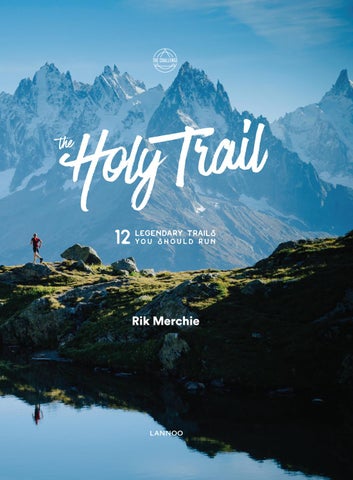
Trail running is the new runner’s high! Go deep into nature, empty your head and push your limits, mile after mile. With down-to-earth testimonials and stunning visual material, Rik Merchie gives you a target list of international trail races. He also takes you off road with his personal running story, interspersed with running facts and fables, human interest and piles of good will.
Rik Merchie
AN ESSENTIAL BOOK FOR THE EXPERIENCED TRAIL RUNNER, MOUNTAIN SPORTS ENTHUSIAST, SPORTS FAN KEEN TO ENLARGE HIS HORIZONS, MUSIC FANATIC OR ANYONE ELSE WANTING TO TEST THEIR COURAGE AND ENDURANCE.
12 Rik Merchie (1983) is a historian with a predilection for anthropology. He has worked, among other things, as a teacher, documentary maker, youth coach and freelance editor.
With interviews and photos from, among others, Tromsø Skyrace, El Cruce Columbia, The Barkley Marathons, Ultra-Trail Cape Town®, Ultra-Trail du Mont-Blanc®, Tor des Géants®, Everest Trail Race®, Festival des Templiers, Marathon des Sables, Otter African Trail Run.
w w w . l a n n o o . c o m
9
789401
449205
legendary trails
yo u s h o u l d r u n
Rik Merchie
Table of contents ULTRA TOUR MONTE ROSA MY PUB HARDROCK HUNDRED MILE ENDURANCE RUN 3, 2, 1... GO! TOR DES GÉANTS ® BACKPACK TROMSØ SKYRACE FOOTBALL EL CRUCE COLUMBIA JOTIE SALOMON GLEN COE SKYLINE DAD BARKLEY MARATHONS BELGICANO THE NORTH FACE ® LAVAREDO ULTRA TRAIL SCREEN WORKER MARATHON DU MONT-BLANC INFLAMMATION LEADVILLE TRAIL 100 RUN SEX ZEGAMA-AIZKORRI POOP WESTERN STATES 100-MILE ENDURANCE RUN JUNGLE
6 8 10 12 16 18 20 24 28 36 40 42 44 50 54 58 62 64 68 76 80 86 90 92
SALOMON CAPPADOCIA ULTRA-TRAIL ® MILESTONE TARAWERA ULTRAMARATHON GOD EVEREST TRAIL RACE ® STORM VIBRAM HONG KONG 100 ULTRA TRAIL RACE FAR WEST ULTRA-TRAIL CAPE TOWN ® PREGNANT MATTERHORN ULTRAKS ULTRA-TRAIL DU MONT-BLANC ® SUMMER MUSTANG MOUNTAIN TRAIL RACE SHEPHERD FESTIVAL DES TEMPLIERS PARTY MARATHON DES SABLES WOLF OTTER AFRICAN TRAIL RUN TITLE
98 106 110 116 120 122 128 136 140 148 152 154 160 164 170 174 176 182 184 190 192
WORD OF THANKS BIBLIOGRAPHY
199 201
Table of contents ULTRA TOUR MONTE ROSA MY PUB HARDROCK HUNDRED MILE ENDURANCE RUN 3, 2, 1... GO! TOR DES GÉANTS ® BACKPACK TROMSØ SKYRACE FOOTBALL EL CRUCE COLUMBIA JOTIE SALOMON GLEN COE SKYLINE DAD BARKLEY MARATHONS BELGICANO THE NORTH FACE ® LAVAREDO ULTRA TRAIL SCREEN WORKER MARATHON DU MONT-BLANC INFLAMMATION LEADVILLE TRAIL 100 RUN SEX ZEGAMA-AIZKORRI POOP WESTERN STATES 100-MILE ENDURANCE RUN JUNGLE
6 8 10 12 16 18 20 24 28 36 40 42 44 50 54 58 62 64 68 76 80 86 90 92
SALOMON CAPPADOCIA ULTRA-TRAIL ® MILESTONE TARAWERA ULTRAMARATHON GOD EVEREST TRAIL RACE ® STORM VIBRAM HONG KONG 100 ULTRA TRAIL RACE FAR WEST ULTRA-TRAIL CAPE TOWN ® PREGNANT MATTERHORN ULTRAKS ULTRA-TRAIL DU MONT-BLANC ® SUMMER MUSTANG MOUNTAIN TRAIL RACE SHEPHERD FESTIVAL DES TEMPLIERS PARTY MARATHON DES SABLES WOLF OTTER AFRICAN TRAIL RUN TITLE
98 106 110 116 120 122 128 136 140 148 152 154 160 164 170 174 176 182 184 190 192
WORD OF THANKS BIBLIOGRAPHY
199 201
Italy & Switzerland ULTRA TOUR MONTE ROSA 170km | 105mi • D+ 11,300m | 37,073ft ULTRA & 4-STAGE RACE 100 km | 62mi • D+ 6,100 m | 20,013ft
“While I was running these trails around Monte Rosa, my training ground for the UTMB®, I thought this is the race I would really l i k e t o r u n . I t d i d n’ t exist so I’ve created i t f o r y o u t o e n j o y. ” L i z z y H a w ke r
6
Italy & Switzerland ULTRA TOUR MONTE ROSA 170km | 105mi • D+ 11,300m | 37,073ft ULTRA & 4-STAGE RACE 100 km | 62mi • D+ 6,100 m | 20,013ft
“While I was running these trails around Monte Rosa, my training ground for the UTMB®, I thought this is the race I would really l i k e t o r u n . I t d i d n’ t exist so I’ve created i t f o r y o u t o e n j o y. ” L i z z y H a w ke r
6
MY PUB ‘If dogs run free, then why not we?' Bob Dylan
I
t’s daybreak when my train worms out of the station of the Swiss town of St. Niklaus. I dive sleepy-eyed into the hood of my sweater. The past days have been a combination of kilometres, denivelations and hundreds of little orange flags. I’d not come to the Ultra Tour Monte Rosa (UTMR) to race, I’m not top runner enough for that, but rather to mark the route and help as a volunteer in an aid station. But with a mission: I wanted to listen to as many trailers as possible, to let drop the basic idea of my book and see if it took root in the international trail running community. And ask myself out loud what criteria I would use in selecting the trails for my book. Such editorial issues are better solved in the shadow of the Matterhorn than at a desk.
8
the
holy
trail
My publisher sent me off with the message that, for him, twelve races were more than enough. I nodded, but I had no idea of the standards that I would apply. Yes, to dis regard the geographical boundaries of my home country - ce plat pays Flanders - seemed to me obvious even before I left. It’s more fun to write about exotic trail races than about competitions in your own backyard. Nor did I want to limit myself to existing competition series like the Migu Run Skyrunner World Series and the Ultra-Trail World Tour. And to discuss only the classic summer races in the Alps also seemed to me a too narrowly Western European framework. It was also clear to me that I wanted to cover as many distances and disciplines of trail running as possible - after all, ultra isn’t the only thing that shines.
The blare of the train horn on entering a dark tunnel splits my head open. I blink and stare out crumpled. The reflection of my sunburned face in the window is interrupted only by the flickering fluorescent lamps hanging on the tunnel wall. I’m thinking. In conversations with UTMR racers, I was challenged by the fact that in existing books about trail running it’s often professional athletes who do all the talking. Inspiring, but I find stories of ordinary mortals more interesting. The stories of butchers, bakers and bankers who, in their spare time, retreat into nature to grind out running kilometres on unpaved paths. A human interest approach, with focus on the belly and tail of the race. “Deal,” my publisher said, “fits perfectly with the literary character of your personal texts for the book. And in this way the reader has some variety, with something else besides your own running adventures.” “OK, but I’ve written twenty texts. And you want twelve portraits of trail races in that book. How are we going to mix them? Do you want me to drop eight texts?” “No, because I don’t want to cut your story. We’ll keep those twelve races and alternate with full-page photos of other races that are mentioned in the interviews or your texts. It’s all about experience, isn’t it?” “That’s pretty much it. OK, I’ll buy it.” “And one more thing…” “Yes?” “You’re writing not just for the world’s diehards. Choose some competitions that normal mortals can handle after a year’s training.” “Of course.” In my head I delete the words classification and ranking. The International Trail Running Association (ITRA) website lists hundreds of races. I’ve absolutely no intention of writing The Holy Trail Bible ...
How in God’s name do I decide which will be the first one? By distance or denivelation? With the organization and atmosphere as extra parameters? No, I’d rather make an anthology of what is going on in this sport. What interests me is the poetry, not the rankings. More a pot pourri with different tastes and smells than a straight ranking. Just like how a bartender tackles it. A collection of 12 Grand Crus you can fall in love with. Without claiming there’s no love outside the list, because every list is incomplete, and here and there with some extras as snacks. Sorry, don’t get you? You expect a good bartender to have a number of classic cocktails on his menu. A margarita, a mojito and a Bloody Mary. You also hope he can recommend a tasty SaintEmilion. A strong stout maybe? Or an exclusive whiskey from an obscure island with an unpronounceable name? Possibly a nip of the liqueur he homebrews from orange peelings? And concluding with an unknown artisan beer? Welcome to The Holy Trail, my bar. No compulsory purchasing from brewing multinationals. No promo deals. Just stuff that has attracted my attention in recent years, which I’ve gathered in my cellar as being good value and which I’d like to serve you.
rik merchie SEPTEMBER 2017, CHAMONIX-MONT BLANC, FR
my
pub
ppp
9
MY PUB ‘If dogs run free, then why not we?' Bob Dylan
I
t’s daybreak when my train worms out of the station of the Swiss town of St. Niklaus. I dive sleepy-eyed into the hood of my sweater. The past days have been a combination of kilometres, denivelations and hundreds of little orange flags. I’d not come to the Ultra Tour Monte Rosa (UTMR) to race, I’m not top runner enough for that, but rather to mark the route and help as a volunteer in an aid station. But with a mission: I wanted to listen to as many trailers as possible, to let drop the basic idea of my book and see if it took root in the international trail running community. And ask myself out loud what criteria I would use in selecting the trails for my book. Such editorial issues are better solved in the shadow of the Matterhorn than at a desk.
8
the
holy
trail
My publisher sent me off with the message that, for him, twelve races were more than enough. I nodded, but I had no idea of the standards that I would apply. Yes, to dis regard the geographical boundaries of my home country - ce plat pays Flanders - seemed to me obvious even before I left. It’s more fun to write about exotic trail races than about competitions in your own backyard. Nor did I want to limit myself to existing competition series like the Migu Run Skyrunner World Series and the Ultra-Trail World Tour. And to discuss only the classic summer races in the Alps also seemed to me a too narrowly Western European framework. It was also clear to me that I wanted to cover as many distances and disciplines of trail running as possible - after all, ultra isn’t the only thing that shines.
The blare of the train horn on entering a dark tunnel splits my head open. I blink and stare out crumpled. The reflection of my sunburned face in the window is interrupted only by the flickering fluorescent lamps hanging on the tunnel wall. I’m thinking. In conversations with UTMR racers, I was challenged by the fact that in existing books about trail running it’s often professional athletes who do all the talking. Inspiring, but I find stories of ordinary mortals more interesting. The stories of butchers, bakers and bankers who, in their spare time, retreat into nature to grind out running kilometres on unpaved paths. A human interest approach, with focus on the belly and tail of the race. “Deal,” my publisher said, “fits perfectly with the literary character of your personal texts for the book. And in this way the reader has some variety, with something else besides your own running adventures.” “OK, but I’ve written twenty texts. And you want twelve portraits of trail races in that book. How are we going to mix them? Do you want me to drop eight texts?” “No, because I don’t want to cut your story. We’ll keep those twelve races and alternate with full-page photos of other races that are mentioned in the interviews or your texts. It’s all about experience, isn’t it?” “That’s pretty much it. OK, I’ll buy it.” “And one more thing…” “Yes?” “You’re writing not just for the world’s diehards. Choose some competitions that normal mortals can handle after a year’s training.” “Of course.” In my head I delete the words classification and ranking. The International Trail Running Association (ITRA) website lists hundreds of races. I’ve absolutely no intention of writing The Holy Trail Bible ...
How in God’s name do I decide which will be the first one? By distance or denivelation? With the organization and atmosphere as extra parameters? No, I’d rather make an anthology of what is going on in this sport. What interests me is the poetry, not the rankings. More a pot pourri with different tastes and smells than a straight ranking. Just like how a bartender tackles it. A collection of 12 Grand Crus you can fall in love with. Without claiming there’s no love outside the list, because every list is incomplete, and here and there with some extras as snacks. Sorry, don’t get you? You expect a good bartender to have a number of classic cocktails on his menu. A margarita, a mojito and a Bloody Mary. You also hope he can recommend a tasty SaintEmilion. A strong stout maybe? Or an exclusive whiskey from an obscure island with an unpronounceable name? Possibly a nip of the liqueur he homebrews from orange peelings? And concluding with an unknown artisan beer? Welcome to The Holy Trail, my bar. No compulsory purchasing from brewing multinationals. No promo deals. Just stuff that has attracted my attention in recent years, which I’ve gathered in my cellar as being good value and which I’d like to serve you.
rik merchie SEPTEMBER 2017, CHAMONIX-MONT BLANC, FR
my
pub
ppp
9
USA
HARDROCK HUNDRED MILE ENDURANCE RUN 161.7km | 100mi • D+ 10,000m | 32,808ft
“ Yo u r e a l l y h a v e to embrace the u n k n o w n . Yo u c a n tr y all you want to script it - how you see the day going and have these plans. But the mountains don't care. They're indifferent to whatever plans, whatever hopes you have...” Timothy Olson
10
USA
HARDROCK HUNDRED MILE ENDURANCE RUN 161.7km | 100mi • D+ 10,000m | 32,808ft
“ Yo u r e a l l y h a v e to embrace the u n k n o w n . Yo u c a n tr y all you want to script it - how you see the day going and have these plans. But the mountains don't care. They're indifferent to whatever plans, whatever hopes you have...” Timothy Olson
10
3, 2, 1…GO! OR
almost... 12 legendary trail races you should run?
For me there’s no ‘need to’ about it, but yes, you’ve got up out of your armchair. Otherwise you would not have read this. Maybe you bought this book online or in a bookstore. Or you were given it as a present - maybe when you were sitting in your armchair, but the wrapping paper had to go into the waste bin. So yes, you had to get out of that armchair. * Well done! * You regularly participate in trail races? Just finished a long distance run with hundred of metres of ascent and descent? Then stay the rest of the day in your armchair....
Now put on your running shoes and drag yourself outside. Again: well done! That was the hardest obstacle. You’re halfway there already. Walk around a block. Stretch out on the way. Breathe deeply, in and out. Start jogging. The choice is yours: 5 minutes, 10 minutes... Then walk for a few minutes and repeat the previous step. And again. Return home after half an hour. Repeat the above the day after tomorrow. And again a few days later, but with up and down stairs. Or in a park with hills. A forest
12
the
holy
trail
in a nature reserve? Even better! A mountain path? Absolutely! Congratulations, you’re a trail runner... Now choose a race from the twelve legendary trail races in this book! Excuse me? Hold your horses! Dreams are licit and necessary, but the races in this book are no walk in the park. All require solid training. Some trail races also demand specific technical knowledge and equipment. A well built-up running condition is an absolute pre-condition, even to consider taking part in these trail races. Without a good physical basis, you are likely to hurt yourself pretty fast. Or you will be disqualified from the race for being too slow. Or, from the first minutes you will be busy surviving rather than enjoying. Each of these scenarios has a great likelihood of legendary failure. And that’s not what this book is about. But (re)start trail running. From 5 kilometres on to 10 kilometres. From 10 kilometres on to 20 kilometres. From 20 kilometres on to...* * Are you having trouble counting in (kilo)metres? Have a look at page 209 for a conversion table.
Find the paths and play. So you’re already a road runner and are now moving to trail running? Again, hold your horses! You may already have sturdy running legs, but trails place different stresses on your body than asphalt does. On the road, your foot always lands in the same way, but not on an uneven trail. The constant search for balance on technical trails contorts your upper body into curves it’s not accustomed to. In short: jump in, but for the first times, limit the number of kilometres to 50-75% of your usual distance. Sign up for trail races that match your current physical condition. Who said that a 10 km race cannot be legendary? Check these calendars for a race in your neighbourhood:
the average speed on your sports watch, tell you whether your pace is right. Message to road runners: walking on trails is normal and nothing to be ashamed of.
2. KM, D+ & DThe technical term in trail running is the letter D. This tells something about the level of difficulty of the race. In full, D stands for denivelation, which is the difference in height between two geographical points. This designation exists in two variants: a positive (D+) and a negative (D-). An example: A 30 km race with D+ 1,300 and D- 800 means that you will have to climb
www . betrail . run www . mudsweattrails . nl www . i - tra . org
Afterwards, crawl back into your armchair with your acidic legs. Then take this book and fantasize which trail will disappear under your feet. Thousands of trail runners did so before you. Why couldn’t you be one of them? These ten pieces of advice should definitely help you on your way:
1. WALKING IS OK Every trail runner is confronted with it sooner or later: a steep climb, where you simply have to walk. In fact, a practised trail runner will often prefer to walk rather than run uphill. This way he saves his strength, because usually there is more than one climb. Your heart rate and breathing, not
“ I t’s j u s t r u n n i n g . Yo u k n o w h o w t o r u n . N o , r e a l l y, y o u d o . Left right.” Anton Krupicka
3, 2, 1…go!
13
3, 2, 1…GO! OR
almost... 12 legendary trail races you should run?
For me there’s no ‘need to’ about it, but yes, you’ve got up out of your armchair. Otherwise you would not have read this. Maybe you bought this book online or in a bookstore. Or you were given it as a present - maybe when you were sitting in your armchair, but the wrapping paper had to go into the waste bin. So yes, you had to get out of that armchair. * Well done! * You regularly participate in trail races? Just finished a long distance run with hundred of metres of ascent and descent? Then stay the rest of the day in your armchair....
Now put on your running shoes and drag yourself outside. Again: well done! That was the hardest obstacle. You’re halfway there already. Walk around a block. Stretch out on the way. Breathe deeply, in and out. Start jogging. The choice is yours: 5 minutes, 10 minutes... Then walk for a few minutes and repeat the previous step. And again. Return home after half an hour. Repeat the above the day after tomorrow. And again a few days later, but with up and down stairs. Or in a park with hills. A forest
12
the
holy
trail
in a nature reserve? Even better! A mountain path? Absolutely! Congratulations, you’re a trail runner... Now choose a race from the twelve legendary trail races in this book! Excuse me? Hold your horses! Dreams are licit and necessary, but the races in this book are no walk in the park. All require solid training. Some trail races also demand specific technical knowledge and equipment. A well built-up running condition is an absolute pre-condition, even to consider taking part in these trail races. Without a good physical basis, you are likely to hurt yourself pretty fast. Or you will be disqualified from the race for being too slow. Or, from the first minutes you will be busy surviving rather than enjoying. Each of these scenarios has a great likelihood of legendary failure. And that’s not what this book is about. But (re)start trail running. From 5 kilometres on to 10 kilometres. From 10 kilometres on to 20 kilometres. From 20 kilometres on to...* * Are you having trouble counting in (kilo)metres? Have a look at page 209 for a conversion table.
Find the paths and play. So you’re already a road runner and are now moving to trail running? Again, hold your horses! You may already have sturdy running legs, but trails place different stresses on your body than asphalt does. On the road, your foot always lands in the same way, but not on an uneven trail. The constant search for balance on technical trails contorts your upper body into curves it’s not accustomed to. In short: jump in, but for the first times, limit the number of kilometres to 50-75% of your usual distance. Sign up for trail races that match your current physical condition. Who said that a 10 km race cannot be legendary? Check these calendars for a race in your neighbourhood:
the average speed on your sports watch, tell you whether your pace is right. Message to road runners: walking on trails is normal and nothing to be ashamed of.
2. KM, D+ & DThe technical term in trail running is the letter D. This tells something about the level of difficulty of the race. In full, D stands for denivelation, which is the difference in height between two geographical points. This designation exists in two variants: a positive (D+) and a negative (D-). An example: A 30 km race with D+ 1,300 and D- 800 means that you will have to climb
www . betrail . run www . mudsweattrails . nl www . i - tra . org
Afterwards, crawl back into your armchair with your acidic legs. Then take this book and fantasize which trail will disappear under your feet. Thousands of trail runners did so before you. Why couldn’t you be one of them? These ten pieces of advice should definitely help you on your way:
1. WALKING IS OK Every trail runner is confronted with it sooner or later: a steep climb, where you simply have to walk. In fact, a practised trail runner will often prefer to walk rather than run uphill. This way he saves his strength, because usually there is more than one climb. Your heart rate and breathing, not
“ I t’s j u s t r u n n i n g . Yo u k n o w h o w t o r u n . N o , r e a l l y, y o u d o . Left right.” Anton Krupicka
3, 2, 1…go!
13
South Africa
ULTRA-TRAIL CAPE TOWN ®
I felt more athletic there than at other races.
South Africa
ULTRA-TRAIL CAPE TOWN ®
I felt more athletic there than at other races.
“Ultra distances require training commitment; people ultimately want to be rewarded by racing in iconic destinations, a n d i n C a p e To w n w e h a v e t h e w o r l d ’s m o s t p o p u l a r c i t y a n d r u n n i n g o n Ta b l e M o u n t a i n , a Wo r l d N a t u r a l Wo n d e r, i s a hard destination to beat.” Ni c B o r n m a n r ace direc tor u tc t®
146
the
holy
trail
ultra
-trail
cape
town®
147
“Ultra distances require training commitment; people ultimately want to be rewarded by racing in iconic destinations, a n d i n C a p e To w n w e h a v e t h e w o r l d ’s m o s t p o p u l a r c i t y a n d r u n n i n g o n Ta b l e M o u n t a i n , a Wo r l d N a t u r a l Wo n d e r, i s a hard destination to beat.” Ni c B o r n m a n r ace direc tor u tc t®
146
the
holy
trail
ultra
-trail
cape
town®
147
PREGNANT
G
oddamnit! Screw it! Monday morning. I thought I’d leave in good time, including breakfast. Not just coffee, but also solid food. Even a piece of fruit. A jumble of hopping rabbits and rabid pheasants on the towpath. Lockkeepers still rubbing the morning out of their eyes and skippers who answer my greeting with a nod from their unwieldy barges. The Scheldt is still evaporating from the night and gathering mists that glide low over the fields. Another commuting cyclist crosses me. Also smartly clad in proper gear, with a backpack with work clothing. Only then does it dawn on me. I’ve covered a third of the route in my shower gear with my work clothes still on the kitchen table. I look at my GPS, start calculating and run through my options. Fast home? And then? I don’t own a car any more. The train? Nope, by the time I get to the station, it’ll be gone. Rik Merchie, you dumb monkey! Telling them I’m coming later is not an option. I quit my office job in Brussels a few months ago and returned to an old love.
148
the
holy
trail
I’m a schoolteacher again, mijnheer (Mr) Rik, pronounced variously as moeneer, menner, sometimes also mevrouw (Mrs) Rik - I have only female colleagues and the students regularly slip up. Education is punctuality, including in a reception class for nonDutch-speaking newcomers. I experienced this by twice appearing late for lessons. I’ve exhausted all my credit. In 1 hour and 10 minutes, 15 young people bursting with hormones will be in my classroom. If I’m late, the director will most likely want to see me. Can a teacher be kept in detention?
FORMER RUNNING LEGS Because you can’t miss a bike, like you can miss a train, I leave public transport for what it is. Loudly gasping, I close my front door and I crawl back onto the saddle. I quickly fish two forgotten energy gels with caffeine out of my dusty running gear box, push them down with a sip of water, click myself fast and start pedalling like a madman. Come on, legs, stomp! Moeneer Rik is no longer a runner. Let alone a trail runner.
A frame between my reduced-to-pulp ex-running legs. 35 flat kilometres one way: not even a marathon. In the distance the wooded hills of the Flemish Ardennes gleam. I miss the game with the winding paths, but I don’t make it. On the other hand, my stomach is turning from running-running-running. Is it so bad not to have run a trail race one weekend? The adventurous little online clips on which I once slaked my thirst seem to me irrelevant product placement today. Why should I also reflect those professional athletes? I don’t have a sponsored Mercedes Marco Polo motorhome, like Kilian Jornet, to move nomadically from one massif to another. I feel overtaken by real life and like I’m standing back at the bottom of the ladder. A Sisyphus who has to roll his stone back uphill again.
Have you ever heard of an injured swimmer raging because his doctor told him to run as an alternative? No, I didn’t think so. According to Ian Corless, photographer and living encyclopaedia of everything that breathes trail running, there are only three types of runners: the injured runner; the almost injured runner; the runner who starts again after an injury.
“Come on, legs, stomp!”
A young lady in a Belgian cycling championship jersey shoots past me. “Hey... may... I... slipstream you?” She gestures that I can. I bend low over my handlebars and dive behind her ass. I scream out of breath something about class, students, too late and problem. No idea if she understood anything about it. I look at her gear apparatus and switch to the smallest gearwheel. The tricolour sweater for me hardly moves. I swing from side to side as I struggle to keep up. Runners and cyclists have never been a good marriage – leaving aside hybrid duathletes and triathletes. Tell an injured runner that he has to change his running shoes for a bike or the swimming pool and you can guarantee you’ll be told where to get off.
No long-distance runner will deny that long-lasting pounding and banging does something to the lower limbs. Sometimes a few days of rest are enough to ward off emerging aches and pains. At other times usually in full build-up to the one big race - we break. If you want to be a good runner, you have to run. But cycling can help you: no impact on those bones, no stress on those tendons. Other benefits: impact-free and active recovery after a tough race or uphill-downhill as interval training, cycling as an extension of your long-distance running. In the saddle you burn only half the calories, but these
pregnant
149
PREGNANT
G
oddamnit! Screw it! Monday morning. I thought I’d leave in good time, including breakfast. Not just coffee, but also solid food. Even a piece of fruit. A jumble of hopping rabbits and rabid pheasants on the towpath. Lockkeepers still rubbing the morning out of their eyes and skippers who answer my greeting with a nod from their unwieldy barges. The Scheldt is still evaporating from the night and gathering mists that glide low over the fields. Another commuting cyclist crosses me. Also smartly clad in proper gear, with a backpack with work clothing. Only then does it dawn on me. I’ve covered a third of the route in my shower gear with my work clothes still on the kitchen table. I look at my GPS, start calculating and run through my options. Fast home? And then? I don’t own a car any more. The train? Nope, by the time I get to the station, it’ll be gone. Rik Merchie, you dumb monkey! Telling them I’m coming later is not an option. I quit my office job in Brussels a few months ago and returned to an old love.
148
the
holy
trail
I’m a schoolteacher again, mijnheer (Mr) Rik, pronounced variously as moeneer, menner, sometimes also mevrouw (Mrs) Rik - I have only female colleagues and the students regularly slip up. Education is punctuality, including in a reception class for nonDutch-speaking newcomers. I experienced this by twice appearing late for lessons. I’ve exhausted all my credit. In 1 hour and 10 minutes, 15 young people bursting with hormones will be in my classroom. If I’m late, the director will most likely want to see me. Can a teacher be kept in detention?
FORMER RUNNING LEGS Because you can’t miss a bike, like you can miss a train, I leave public transport for what it is. Loudly gasping, I close my front door and I crawl back onto the saddle. I quickly fish two forgotten energy gels with caffeine out of my dusty running gear box, push them down with a sip of water, click myself fast and start pedalling like a madman. Come on, legs, stomp! Moeneer Rik is no longer a runner. Let alone a trail runner.
A frame between my reduced-to-pulp ex-running legs. 35 flat kilometres one way: not even a marathon. In the distance the wooded hills of the Flemish Ardennes gleam. I miss the game with the winding paths, but I don’t make it. On the other hand, my stomach is turning from running-running-running. Is it so bad not to have run a trail race one weekend? The adventurous little online clips on which I once slaked my thirst seem to me irrelevant product placement today. Why should I also reflect those professional athletes? I don’t have a sponsored Mercedes Marco Polo motorhome, like Kilian Jornet, to move nomadically from one massif to another. I feel overtaken by real life and like I’m standing back at the bottom of the ladder. A Sisyphus who has to roll his stone back uphill again.
Have you ever heard of an injured swimmer raging because his doctor told him to run as an alternative? No, I didn’t think so. According to Ian Corless, photographer and living encyclopaedia of everything that breathes trail running, there are only three types of runners: the injured runner; the almost injured runner; the runner who starts again after an injury.
“Come on, legs, stomp!”
A young lady in a Belgian cycling championship jersey shoots past me. “Hey... may... I... slipstream you?” She gestures that I can. I bend low over my handlebars and dive behind her ass. I scream out of breath something about class, students, too late and problem. No idea if she understood anything about it. I look at her gear apparatus and switch to the smallest gearwheel. The tricolour sweater for me hardly moves. I swing from side to side as I struggle to keep up. Runners and cyclists have never been a good marriage – leaving aside hybrid duathletes and triathletes. Tell an injured runner that he has to change his running shoes for a bike or the swimming pool and you can guarantee you’ll be told where to get off.
No long-distance runner will deny that long-lasting pounding and banging does something to the lower limbs. Sometimes a few days of rest are enough to ward off emerging aches and pains. At other times usually in full build-up to the one big race - we break. If you want to be a good runner, you have to run. But cycling can help you: no impact on those bones, no stress on those tendons. Other benefits: impact-free and active recovery after a tough race or uphill-downhill as interval training, cycling as an extension of your long-distance running. In the saddle you burn only half the calories, but these
pregnant
149