would have had to be in the East and it is highly likely it remained in Constantinople until being brought back to Italy when the city at last fell to the Ottomans in 1453. Indeed, Angelo Poliziano saw it in 1458 in Naples at the court of Alfonso V of Aragon (Giuliano 1994). From there it was taken to Rome, where, as we have seen, Lorenzo de’ Medici himself states he bought it in 1471. From the Florentine family’s collection, in 1537 it then seems to have passed into the possession of Margaret of Austria, Charles V’s natural daughter, together with a certain number of gems as part of the dower of Alessandro de’ Medici, Duke of Florence. Margaret was widowed after only one year and her second marriage to Ottavio Farnese saw the treasures of the Medici’s engraved gem collection, including the cup, transferred to the family of the dukes of Parma. The cup soon changed hands once again, being inherited by Charles of Bourbon, the son of Elisabetta, the last heir of the House of Farnese. As if the technical quality of its complex decoration in relief and its sheer size, which make it totally unique, were not extraordinary enough, this piece’s vicissitudes as it was swapped between courts around Europe and beyond add a further intriguing layer of interest to an artefact whose raw material originally came from India. The skilled engraver exploited the variations in the colour of the agate’s multiple layers, the different tones of the chalcedony showing through in various areas, which can be seen in their natural sequence in the
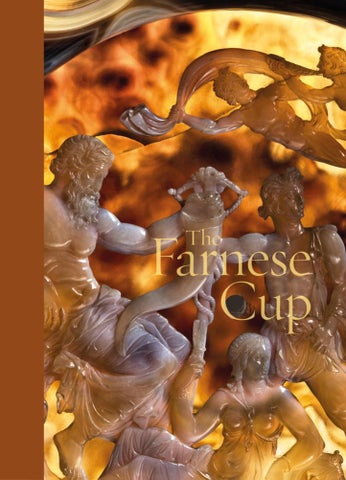
irregular outline on the edge of the cup, and turned them into figures ranging in colour from honey brown with red and gold shades on the outside to cerulean with pearlescent hues and gingery gold shading into reddish brown marbling on the inside. Confident in his own ability, the artist has created an aegis (shield) on the outside with the head of Medusa at its centre. The thick, flowing locks spread over the entire surface of the skin, which is shown to be covered in scales where it is folded back on the edges, perhaps to indicate it belongs to the Giant Pallas that Athena flayed alive, then placing the head of the Gorgon in the middle; these sinuous undulations conceal the two snakes that emerge on either side of the head, as well as others depicted in varied writhing spirals around the edges, adding menace to the monstrous creature’s petrifying stare. But this animal skin is also a symbol of power, the sacred royal power descended from Jupiter, and a talisman that, like Medusa, sows terror among the enemy’s ranks, which is why Alexander of Macedon adopted it as his symbol and wore it into battle. Following his example, the Ptolemaic dynasty did the same in Egypt. On the inner face a stern male figure is shown holding an empty cornucopia and sitting on the gnarled stump of a sycamore, the only tree with a woody trunk to grow in the Nile region. Next to him stands an athletic-looking young man with his hair ruffled by the wind, wearing a chiton tied at his shoulder. He holds the beam of a
68
69
cup. Taking his cue from previous scholars’ observations, François Queyrel (2017) is convinced the figure cannot have royal status since he is not wearing the tell-tale headband and instead takes a closer look at the ethnic features that can be identified. This leads him to conclude that the figure displays many traits typical of the Galatians: the moustache (though there is actually no sign of one here), the thick hair and their considerable height. He also notes that the standing figure is wearing the short labourer’s tunic and although he is holding the beam of a plough in his right hand, his left grips a sword, not a sickle, as is often thought; furthermore, he is carrying a bag of seeds. All these details identify him as a soldier-labourer. His presence in the scene completes the allegory of the rich land of Egypt, producer of multiple grain harvests, evoked by the other figures. In Ptolemaic Egypt, the clerouchoi were soldiers who doubled as farmers in provincial areas, and once the Galatians had been defeated by Ptolemy II in 275 BC they proved to be excellent clerouchoi and were rewarded with plots of land, especially in the nome (nomos, district) of Arsinoe, corresponding to the Fayyum area. On this reading the cup would amount to a retrospective celebration of the achievements of the reign of the ruler who first cultivated this land, naming its capital after his wife. The figures of Isis and the sphinx would thus represent Arsinoe and Ptolemy II, and the cup, for which Queyrel does not hazard a date, is actually a posthumous celebration of
the couple who reigned during the Ptolemaic dynasty’s golden years. Another of the cup’s outstanding distinctions is that it has survived virtually intact to the present day, as Bernardo Quaranta stresses in his long commentary on the artefact, which was added to the collection of the Real Museo Borbonico (now National Archaeological Museum of Naples) in 1817. In fact, we know it wasn’t interfered with in the slightest way until the fifteenth century, since in Mohammed-al-Khayyām’s drawing it is shown without the hole that was probably added later to attach a support, to the detriment of the Gorgon’s face in particular. This hole was probably made by the Medici’s skilled engravers, who had no qualms about adding LAV.R.MED to underline ownership even on the greatest and most beautiful ancient gems in Lorenzo the Magnificent’s collection. This alteration is first mentioned in the Farnese inventory drawn up in Ortona on February 26, 1586, after Margaret of Austria’s death, which reads: “An engraved, decorated agate cup, with eight figures in low relief within, and on the outer surface the head of Medusa, with a hole in the middle.” This virtually unblemished condition lasted until the night between October 1 and 2, 1925, when a guard in the museum lost his head and struck the cabinet housing the work with an umbrella, breaking off the righthand portion of the cup. The pieces were quickly collected and the restoration completed by October 11 that same year, but further work was required in 1951
74
75
5 CONTINENTS EDITIONS
Editorial Coordination Laura Maggioni Art Direction Annarita De Sanctis Translations Julian Comoy Editing Emily Ligniti Colour Separation Maurizio Brivio, Milan
Text by Valeria Sampaolo/Museo Archeologico Nazionale di Napoli Š photographs Luigi Spina 2018 Š 5 Continents Editions, Milano, 2018 for the present edition. All rights reserved
MUSEO ARCHEOLOGICO NAZIONALE DI NAPOLI
Director Paolo Giulierini Valeria Sampaolo Contracts Department Luigi Di Caprio Angelo Diomaiuti Alfonso Lopez
Acknowledgments Monica Romano Ufficio dei Consegnatari, Museo Archeologico di Napoli
No part of this book may be reproduced or utilized in any form or by any means, electronic or mechanical, including photocopying, recording, or any information storage and retrieval system, without permission in writing from the publisher.
5 Continents Editions Piazza Caiazzo, 1 20124 Milan, Italy www.fivecontinentseditions.com ISBN: 978-88-7439-851-5 Distributed by ACC Art Books throughout the world, excluding Italy and Canton Ticino Printed and bound in Italy in June 2018 by Tecnostampa, Pigini Group Printing Division Loreto - Trevi, Italy for 5 Continents Editions, Milan
Pages 65, 72 and 78: Drawing and engraving by Francesco Pesante, from Real Museo Borbonico, vol. XII, Stamperia Reale, Naples 1839