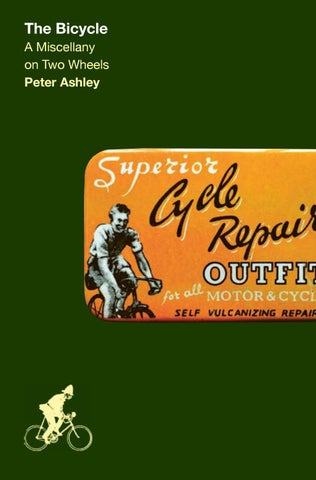
The Bicycle A Miscellany on Two Wheels Peter Ashley
The Bicycle A Miscellany on Two Wheels Peter Ashley
ACC ART BOOKS
The Bicycle A Miscellany on Two Wheels Peter Ashley
ACC ART BOOKS
Dedicated to everybody who rides a bicycle, keeps one in the shed or just remembers the exhilaration and sense of freedom when the stabilisers came off
Dedicated to everybody who rides a bicycle, keeps one in the shed or just remembers the exhilaration and sense of freedom when the stabilisers came off
Introduction
undertook expeditions to remote country churches with bananas and Vimto in our saddlebags. Until
suddenly I appeared to be seventeen, and a rusting Ford Thames van was quietly leaking oil onto the I graduated from three wheels to two when my father
driveway.
The bicycle has its origins in the impossibly heavy
brought home an anonymous fixed-wheel bicycle
wood and metal velocipedes at the beginning of
lost the photograph of me standing very proudly
contemporary engravings to be slightly slower
from Friswell’s in Applegate Street, Leicester. I’ve
with it, but it may have been scribbled on after I’d
ridden it into the lamppost opposite our house and
slid down the crossbar into the handlebar pillar with devastating and painful effect. But soon it was the
memorable Christmas morning when I was led down the lane to Mr. Dalby’s bungalow where a purple and green Elswick was hiding in his greenhouse.
And so my hitherto limited horizons widened. The
interminable journeys to and from school with mates, being shouted at by prefects for not wearing our
caps, being ignored by girls as we whistled at them
on their Triumph Pink Witches. The slightly subversive air of the bike shed (“Don’t stay too long in there,” warned my mother enigmatically), the Elswicks
jostling with Phillips, Dawes and Carlton bicycles. On
Saturdays and holidays we rode along the towpath of the Grand Union Canal, annoying fishermen, and
the nineteenth century, which would appear from than walking – this was the motive power for them
anyway. How it became to be mechanically propelled appears to be claimed by any number of inventors,
usually French, but I plumb for Scottish blacksmith Kirkpatrick Macmillan in 1830. Then James Starley brought us the ‘ordinary’ bicycle in 1870, quickly
dubbed the ‘penny farthing’ owing to the massive
disparity in size between the front and back wheels. This was the first machine to be called a ‘bicycle’ but it was his nephew John Kemp Starley who
welded the frame into the triangular shape we now recognise and put the still standard 26ʺ wheels on it. He called it the Rover, which summed up all the
possibilities as nicely as it did for his first car in 1904. Have we ever become such a single entity with a
machine? My mother, a Baptist minister’s daughter, flying on her cycle down The Avenue, a steep tree-
lined walk in Wellingborough, doing her circus
ambient prop and talking point rather than being
outstretched until having an umbrella waved at her
myself with the thought of cycling, more parcel-
act of standing up on the saddle with her arms
by a member of her father’s congregation. I took for
granted that the wretched lamppost I embraced was lit every night and extinguished every morning by a lamplighter from the local gasworks arriving on a bicycle with a ladder sticking out front and back. The policeman who quizzed me about a broken window leaning his obligatory bike against our
ridden for muscular long distances. So I content
laden postman and whistling butcher’s delivery boy than a mountain biker on The Fens; more country
vicar with communion wine in the wicker basket and a squeaking cotter pin than being submerged in a
peloton of would-be Touristes de France shouting through villages.
As you will see, the art of balancing on two wheels
garden fence under billowing hydrangeas. Arthur
will be viewed here through the lens of my doubtful
to his Raleigh factory lathe in Saturday Night
tin is just as appealing as a Boris bike outside an
Seaton sullenly riding over Nottingham cobbles and Sunday Morning, the baker’s boy in Ridley
Scott’s Hovis commercial labouring up Gold Hill in Shaftesbury and joyously flying back down again.
And possibly the most angst-ridden bicycle in fiction
– Leo Colston’s carefully wrapped birthday present in L.P. Hartley’s The Go-Between.
It was the early 1980s before I ventured out on a
bicycle again, a large and exceptionally sturdy black Raleigh as ridden by my broken-window nemesis.
Curiously I fell off it after cycling around the interior
of The Clifton pub in St. John’s Wood one lunchtime. There are still bikes that appeal to me now, but I know that if I bought one it would be seen as an
prejudices, where a yellow Dunlop Repair Outfit
Underground station, and the joke of sitting on a
bicycle not knowing that the saddle’s been removed is just as childishly funny sixty years on. But cycling really is healthy, life-affirming and great fun and
all you need is a well-oiled bicycle with the tyres pumped up. And a saddle.
Amorous Cycling Lessons above ‘A Labour of Love’ posted in Forest Gate, London in 1908 opposite Only the first lesson and he’s already taking off his bowler
Amorous Cycling Lessons above ‘A Labour of Love’ posted in Forest Gate, London in 1908 opposite Only the first lesson and he’s already taking off his bowler
The Bicycle at War 1 above Recruiting poster for the South Midland Divisional Cyclist Company, active in both world wars opposite A 1900 print of the Lancashire Fusiliers, cycling into the Boer War in South Africa
The Bicycle at War 1 above Recruiting poster for the South Midland Divisional Cyclist Company, active in both world wars opposite A 1900 print of the Lancashire Fusiliers, cycling into the Boer War in South Africa
The Bicycle has been with us for over two hundred years, becoming the first truly democratic means of transport. Here you will see how this remarkable machine has been cycled for pleasure, put to work, sent to war and ridden very fast. This is an eclectic peloton of fascinating images, including writer Thomas Hardy pedalling around Wessex, the mysteries of the puncture repair outfit, postcards and touring guides. And a squirrel on a bike.
ISBN: 978-1-78884-094-1
Ă‹xHSLHSIy840941zv;:,:(:&:! ÂŁ12.00/$17.50
www.accartbooks.com