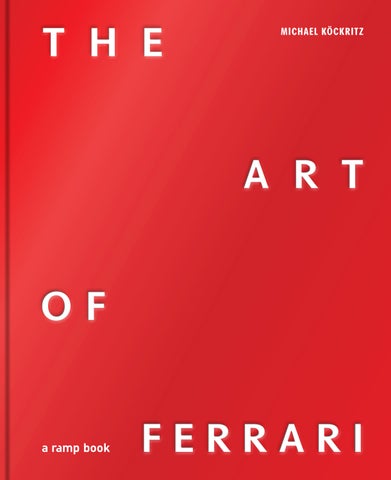
T H E
MICHAEL KÖCKRITZ
A R T OF FERRARI
042
The Art of Ferrari
043
004
INTRO
040
PREFACE
044 ON THE ROAD IN MODENA
In the footsteps of Enzo Ferrari
060 ENGINE BUILDING
The making of the V12
092
CAR WASH
104
FERRARI CLASSICHE
134
ARCHIVE
With Flavio Manzoni, Senior Vice President of Design Preserving an automotive legacy Exclusive insights
155 SHORT STORIES
Drivers, myths and wow effects
171
SCULPTURES OF SPEED
Milestones in model history
196 DRAWING LESSON
Flavio Manzoni with the California T in Monaco
204 COMING HOME
A journey through the factory grounds
214 CUSTOMER NUMBER 1
Test driver Raffaele de Simone
224
PISTA DI FIORANO
252
THE RHYTHM OF THE ROAD
264
F1 CLIENTI
288
AZZURRO LA PLATA
Formula One’s most exclusive test facility Amalfi
The exclusive customer racing programme with dedicated trackside support Roma Spider
304 SUPER MEGA ROAD TEST Look! At! Us!
320 SPORT PROTOTIPI CLIENTI 499P Modificata
CONTENTS
336
EVERYTHING’S UNITED
346
ACTING AS ONE
358
LET THERE BE LUCE
376
OUTRO
849 Testarossa 430 “Scud”
Ferrari Luce
042
The Art of Ferrari
043
004
INTRO
040
PREFACE
044 ON THE ROAD IN MODENA
In the footsteps of Enzo Ferrari
060 ENGINE BUILDING
The making of the V12
092
CAR WASH
104
FERRARI CLASSICHE
134
ARCHIVE
With Flavio Manzoni, Senior Vice President of Design Preserving an automotive legacy Exclusive insights
155 SHORT STORIES
Drivers, myths and wow effects
171
SCULPTURES OF SPEED
Milestones in model history
196 DRAWING LESSON
Flavio Manzoni with the California T in Monaco
204 COMING HOME
A journey through the factory grounds
214 CUSTOMER NUMBER 1
Test driver Raffaele de Simone
224
PISTA DI FIORANO
252
THE RHYTHM OF THE ROAD
264
F1 CLIENTI
288
AZZURRO LA PLATA
Formula One’s most exclusive test facility Amalfi
The exclusive customer racing programme with dedicated trackside support Roma Spider
304 SUPER MEGA ROAD TEST Look! At! Us!
320 SPORT PROTOTIPI CLIENTI 499P Modificata
CONTENTS
336
EVERYTHING’S UNITED
346
ACTING AS ONE
358
LET THERE BE LUCE
376
OUTRO
849 Testarossa 430 “Scud”
Ferrari Luce
050
The Art of Ferrari
On the Road in Modena
051
050
The Art of Ferrari
On the Road in Modena
051
066
The Art of Ferrari
Engine Building
067
Honour where honour is due: in the engine shop, past and present stand side by side as equals. While the poster celebrates Ferrari’s road cars, the trophies bear witness to the dominance of an engine philosophy that is con tinually being refined. It is the perfect symbiosis of engineering and ambition: every engine that begins life here is destined to add another chapter to that record of success.
066
The Art of Ferrari
Engine Building
067
Honour where honour is due: in the engine shop, past and present stand side by side as equals. While the poster celebrates Ferrari’s road cars, the trophies bear witness to the dominance of an engine philosophy that is con tinually being refined. It is the perfect symbiosis of engineering and ambition: every engine that begins life here is destined to add another chapter to that record of success.
092
The Art of Ferrari
CAR WASH THERE IT STANDS. THE FERRARI DAYTONA SP3. WE’RE AT CENTRO STILE, HOME TO THE DESIGN ACTIVITIES AT MARANELLO. CHIEF DESIGN OFFICER FLAVIO MANZONI GENTLY RUNS A CLOTH OVER THE CAR’S BODY. AND MUSES ABOUT DIRTY RACE CARS, POINTLESS DIFFUSERS AND THE ALL-PERVASIVE SPIRIT OF ENZO FERRARI.
092
The Art of Ferrari
CAR WASH THERE IT STANDS. THE FERRARI DAYTONA SP3. WE’RE AT CENTRO STILE, HOME TO THE DESIGN ACTIVITIES AT MARANELLO. CHIEF DESIGN OFFICER FLAVIO MANZONI GENTLY RUNS A CLOTH OVER THE CAR’S BODY. AND MUSES ABOUT DIRTY RACE CARS, POINTLESS DIFFUSERS AND THE ALL-PERVASIVE SPIRIT OF ENZO FERRARI.
148
The Art of Ferrari
Archive
149
148
The Art of Ferrari
Archive
149
158
IL GIORNALE DI MODENA
The Art of Ferrari
The car that was never allowed to be a GT – yet still made history Ferrari to be Enzo Ferrari. He threatened to withdraw from GT racing altogether. It changed nothing. The 250 LM was forced to compete against pure prototypes. More powerful rivals. Rules that were never written in its favour. For the 250 LM, that meant ending up somewhere Ferrari never really imagined: in the hands of private teams. NART. Scuderia Filipinetti. Écurie Francor champs. Maranello Concessionaires. The LM lacked the power of the 275 P and 330 P prototypes, but its driving experi ence be came legendary. The engine, mount ed back to front behind the cockpit, was muscular, deafening and ferociously hot. The cockpit itself was cramped, the heat relentless, the soundtrack little short of a mechanical thunderstorm raging just be hind the driver’s shoulder blades.
GRAHAM HILL
The defining moment in the story of the Ferrari 250 LM came at the 1964 12 Hours of Reims. A Le Mans-style start at midnight. A high-speed circuit, narrow and unforgiving. Graham Hill and Joakim Bonnier driving like men possessed. Ford was there. And John Surtees, driving a 250 LM for NART. Hill would later write: “It was motor racing par excellence – pretty hair-raising.” By the finish, the Maranello Concessionaires Ferrari 250 LM had covered 1,522 miles at an average speed of more than 126 mph to claim victory.
The Ferrari 250 LM carrying number 7 was the eventual winner, driven by Graham Hill and Joakim Bonnier. Together, the pair completed 296 laps during the 1964 12 Hours of Reims.
LE MANS 1965 – THE UNEXPECTED TRIUMPH
Graham Hill described his first night start at Reims as sheer mad ness: “You find yourself rushing out at full bat into the blackness . . . I couldn’t see a damned thing.” And yet drivers loved it. It was sensitive, but honest. Demanding, yet deeply rewarding. Everything enthusiasts sought in an early-1960s Ferrari had been distilled to its purest form. The 250 LM was never a brute-force powerhouse, but it possessed exactly the blend of balance, pace and durability that wins endurance races – the qualities that determine wheth er you reach the finish or end up stranded in the darkness beside a trail of smoke and broken machinery. Jochen Rindt once de scribed motor racing as “a dance between courage and mechanics”. The Ferrari 250 LM embodied precisely that.
“You find yourself rushing out at full bat into the blackness . . . I couldn’t see a damned thing.”
159
CRONACHE DA MODENA, TERRA DI FERRARI
REIMS 1964 – THE PROLOGUE
THE 250 LM OCCUPIES A WORLD OF ITS OWN. IT WAS CONCEIVED AS THE NEXT EVOLUTIONARY STEP FOR FERRARI’S SUCCESSFUL GRAN TURISMO CARS, YET THE FIA REFUSED TO LET IT COMPETE IN GT RACING. SO IT DID WHAT FERRARIS HAVE ALWAYS DONE WHEN CORNERED: IT ATTACKED.
Imagine being asked to w rite Beethoven’s Tenth Symphony after the Ninth. Or becoming the next basketball icon after Michael Jordan. Wonder what that feels like? Ask Lionel Messi, arguably the greatest footballer of all time, who – at least in Argentina – will never quite escape the shadow of Diego Armando Maradona. The Ferrari 250 LM found it self in much the same emotional predic ament. Its predecessor was the Ferrari 250 GTO, still regarded as the most expen sive Ferrari ever built and, by common con sent, the marque’s ultimate icon. Perhaps rightly so. Even within the Scuderia, the question was asked: “How do you replace the greatest Ferrari in the world?” The honest answer: you don’t. Yet the 250 LM found its own path. It was conceived as the road-going evolution of the 250 P, the rac ing prototype that conquered Le Mans in 1963. When Ferrari unveiled the 250 LM in Paris, it was immediately clear that it represented a radical break with tradition. It marked the first time a V12 was placed in the rear of a GT instead of a prototype. At its core, the 250 LM was a 250 P with a roof: a Berlinetta uncompromisingly engineered for performance. Pininfarina penned the shape, Scaglietti hammered it into aluminium. The result was one of the purest silhouettes ever to emerge from Maranello. But the FIA said no. No ho mologation. No GT status. No Le Mans? The charge was simple: Ferrari had failed to build the one hundred required cars. It was the perfect opportunity for Enzo
Short Stories
Only thirty-two Ferrari 250 LMs were ever built, making the model even rarer than the 250 GTO. To this day, it is regarded as the car that ushered in Ferrari’s mid-engined era. Until the arrival of the 250 LM, Ferrari’s twelve-cylinder engines had always been mounted ahead of the driver.
A year later came the great est race of them all: Le Mans. A NART-en tered Ferrari 250 LM, driven by Jochen Rindt and Masten Gregory, lined up only eleventh on the grid and had been twelve seconds slower than the fastest Ford GT40 in qualifying. Nobody seriously considered it a contender. Then the race began. Ford’s much-vaunted challengers retired early with engine and gearbox failures. Ferrari’s works-entered 330 P2s briefly looked like the inevitable winners – until their new disc brakes overheated. An attempt to evaluate innovative brake-cooling ducts turned into a spectacularly ill-timed experiment. Instead, it was the Ferrari 250 LM that prevailed. Richard Attwood later recalled the sound of the car charg ing down the straight: “It absolutely shrieked . . . you didn’t need a lap chart to know we were still in the race.” The 250 LM eventually crossed the finish line five laps clear of the field. Another 250 LM followed in second, ahead of a 275 GTB. A Ferrari
Virage de Mulsanne
Courbe des Hunaudières
Ligne Droite des Hunaudières
Courbe du Golf
Virage du Tertre Rouge
Courbe d’Antares
“Esses” d’Indianapolis
“S” du Tertre Rouge
Courbe du Buisson
Virage d’Arnage
Maison Blanche
Courbe Dunlop
one-two-three. But not one that anyone would have wagered on. In the words of a contemporary chronicler: “It should never have happened.” The 250 LM thus became the last V12 Ferrari to win Le Mans. But Le Mans wasn’t its only success. The LM also claimed victories at Reims and Kyalami in 1964, together with strong results in endurance races across three continents. Yet it was more than simply another chapter in Ferrari’s motor sport history. Its design left a lasting mark on the marque, visible today in the Ferrari 296 GTB, whose proportions and silhou ette deliberately echo those of the 250 LM.
Technically, too, it was a landmark: Ferrari’s first coupé with a mid-mounted V12, a fundamental shift in the marque’s engineer ing philosophy that would later become the norm. Above all, however, it re mained Ferrari’s last overall victory at Le Mans until the 499P revived the tradition in 2023. Decades separate those two wins. Today, the 250 LM is regard ed as one of Ferrari’s most coveted col lector’s cars. Perhaps precisely because it never took the easy road. It never had to become the next 250 GTO. It became something else.
Le Mans is the queen of endurance racing. For more than a century, the legendary 24-hour event in France has captivated the world as the ultimate of endurance races, testing the limits of both man and machine.
158
IL GIORNALE DI MODENA
The Art of Ferrari
The car that was never allowed to be a GT – yet still made history Ferrari to be Enzo Ferrari. He threatened to withdraw from GT racing altogether. It changed nothing. The 250 LM was forced to compete against pure prototypes. More powerful rivals. Rules that were never written in its favour. For the 250 LM, that meant ending up somewhere Ferrari never really imagined: in the hands of private teams. NART. Scuderia Filipinetti. Écurie Francor champs. Maranello Concessionaires. The LM lacked the power of the 275 P and 330 P prototypes, but its driving experi ence be came legendary. The engine, mount ed back to front behind the cockpit, was muscular, deafening and ferociously hot. The cockpit itself was cramped, the heat relentless, the soundtrack little short of a mechanical thunderstorm raging just be hind the driver’s shoulder blades.
GRAHAM HILL
The defining moment in the story of the Ferrari 250 LM came at the 1964 12 Hours of Reims. A Le Mans-style start at midnight. A high-speed circuit, narrow and unforgiving. Graham Hill and Joakim Bonnier driving like men possessed. Ford was there. And John Surtees, driving a 250 LM for NART. Hill would later write: “It was motor racing par excellence – pretty hair-raising.” By the finish, the Maranello Concessionaires Ferrari 250 LM had covered 1,522 miles at an average speed of more than 126 mph to claim victory.
The Ferrari 250 LM carrying number 7 was the eventual winner, driven by Graham Hill and Joakim Bonnier. Together, the pair completed 296 laps during the 1964 12 Hours of Reims.
LE MANS 1965 – THE UNEXPECTED TRIUMPH
Graham Hill described his first night start at Reims as sheer mad ness: “You find yourself rushing out at full bat into the blackness . . . I couldn’t see a damned thing.” And yet drivers loved it. It was sensitive, but honest. Demanding, yet deeply rewarding. Everything enthusiasts sought in an early-1960s Ferrari had been distilled to its purest form. The 250 LM was never a brute-force powerhouse, but it possessed exactly the blend of balance, pace and durability that wins endurance races – the qualities that determine wheth er you reach the finish or end up stranded in the darkness beside a trail of smoke and broken machinery. Jochen Rindt once de scribed motor racing as “a dance between courage and mechanics”. The Ferrari 250 LM embodied precisely that.
“You find yourself rushing out at full bat into the blackness . . . I couldn’t see a damned thing.”
159
CRONACHE DA MODENA, TERRA DI FERRARI
REIMS 1964 – THE PROLOGUE
THE 250 LM OCCUPIES A WORLD OF ITS OWN. IT WAS CONCEIVED AS THE NEXT EVOLUTIONARY STEP FOR FERRARI’S SUCCESSFUL GRAN TURISMO CARS, YET THE FIA REFUSED TO LET IT COMPETE IN GT RACING. SO IT DID WHAT FERRARIS HAVE ALWAYS DONE WHEN CORNERED: IT ATTACKED.
Imagine being asked to w rite Beethoven’s Tenth Symphony after the Ninth. Or becoming the next basketball icon after Michael Jordan. Wonder what that feels like? Ask Lionel Messi, arguably the greatest footballer of all time, who – at least in Argentina – will never quite escape the shadow of Diego Armando Maradona. The Ferrari 250 LM found it self in much the same emotional predic ament. Its predecessor was the Ferrari 250 GTO, still regarded as the most expen sive Ferrari ever built and, by common con sent, the marque’s ultimate icon. Perhaps rightly so. Even within the Scuderia, the question was asked: “How do you replace the greatest Ferrari in the world?” The honest answer: you don’t. Yet the 250 LM found its own path. It was conceived as the road-going evolution of the 250 P, the rac ing prototype that conquered Le Mans in 1963. When Ferrari unveiled the 250 LM in Paris, it was immediately clear that it represented a radical break with tradition. It marked the first time a V12 was placed in the rear of a GT instead of a prototype. At its core, the 250 LM was a 250 P with a roof: a Berlinetta uncompromisingly engineered for performance. Pininfarina penned the shape, Scaglietti hammered it into aluminium. The result was one of the purest silhouettes ever to emerge from Maranello. But the FIA said no. No ho mologation. No GT status. No Le Mans? The charge was simple: Ferrari had failed to build the one hundred required cars. It was the perfect opportunity for Enzo
Short Stories
Only thirty-two Ferrari 250 LMs were ever built, making the model even rarer than the 250 GTO. To this day, it is regarded as the car that ushered in Ferrari’s mid-engined era. Until the arrival of the 250 LM, Ferrari’s twelve-cylinder engines had always been mounted ahead of the driver.
A year later came the great est race of them all: Le Mans. A NART-en tered Ferrari 250 LM, driven by Jochen Rindt and Masten Gregory, lined up only eleventh on the grid and had been twelve seconds slower than the fastest Ford GT40 in qualifying. Nobody seriously considered it a contender. Then the race began. Ford’s much-vaunted challengers retired early with engine and gearbox failures. Ferrari’s works-entered 330 P2s briefly looked like the inevitable winners – until their new disc brakes overheated. An attempt to evaluate innovative brake-cooling ducts turned into a spectacularly ill-timed experiment. Instead, it was the Ferrari 250 LM that prevailed. Richard Attwood later recalled the sound of the car charg ing down the straight: “It absolutely shrieked . . . you didn’t need a lap chart to know we were still in the race.” The 250 LM eventually crossed the finish line five laps clear of the field. Another 250 LM followed in second, ahead of a 275 GTB. A Ferrari
Virage de Mulsanne
Courbe des Hunaudières
Ligne Droite des Hunaudières
Courbe du Golf
Virage du Tertre Rouge
Courbe d’Antares
“Esses” d’Indianapolis
“S” du Tertre Rouge
Courbe du Buisson
Virage d’Arnage
Maison Blanche
Courbe Dunlop
one-two-three. But not one that anyone would have wagered on. In the words of a contemporary chronicler: “It should never have happened.” The 250 LM thus became the last V12 Ferrari to win Le Mans. But Le Mans wasn’t its only success. The LM also claimed victories at Reims and Kyalami in 1964, together with strong results in endurance races across three continents. Yet it was more than simply another chapter in Ferrari’s motor sport history. Its design left a lasting mark on the marque, visible today in the Ferrari 296 GTB, whose proportions and silhou ette deliberately echo those of the 250 LM.
Technically, too, it was a landmark: Ferrari’s first coupé with a mid-mounted V12, a fundamental shift in the marque’s engineer ing philosophy that would later become the norm. Above all, however, it re mained Ferrari’s last overall victory at Le Mans until the 499P revived the tradition in 2023. Decades separate those two wins. Today, the 250 LM is regard ed as one of Ferrari’s most coveted col lector’s cars. Perhaps precisely because it never took the easy road. It never had to become the next 250 GTO. It became something else.
Le Mans is the queen of endurance racing. For more than a century, the legendary 24-hour event in France has captivated the world as the ultimate of endurance races, testing the limits of both man and machine.
226
The Art of Ferrari
Pista di Fiorano
227
The iron law of exclusivity: officially classified as an experimental circuit, Fiorano was never permitted to host a race. One principle still applies today: only a single car may be on the track at any one time. That is why the pit building contains just a single garage bay. This isolation allows Ferrari’s engineers to analyse every nuance of the aerodynamics and every note of the engine in controlled silence.
226
The Art of Ferrari
Pista di Fiorano
227
The iron law of exclusivity: officially classified as an experimental circuit, Fiorano was never permitted to host a race. One principle still applies today: only a single car may be on the track at any one time. That is why the pit building contains just a single garage bay. This isolation allows Ferrari’s engineers to analyse every nuance of the aerodynamics and every note of the engine in controlled silence.
318
The Art of Ferrari
Public holidays are a wonderful institution, especially for anyone who finally wants to drive through a big city like Berlin without sitting in traffic. There’s one drawback to travelling around town in two Ferraris: the number of people available to envy you your sports cars is distinctly limited.
Super Mega Road Test
319
318
The Art of Ferrari
Public holidays are a wonderful institution, especially for anyone who finally wants to drive through a big city like Berlin without sitting in traffic. There’s one drawback to travelling around town in two Ferraris: the number of people available to envy you your sports cars is distinctly limited.
Super Mega Road Test
319
The Ferrari name stands for pioneering design, ingenious sophistication, technological innovation and an unrivalled record of racing success. The marque’s founder, Enzo Ferrari, is regarded as one of the most influential figures in automotive history. Ferrari once famously stated: “You cannot describe passion. You can only live it.” This conviction continues to define the marque from Maranello to this day. THE ART OF FERRARI follows the trail of that passion. Conceived by Michael Köckritz, the publisher and editor-in-chief of automotive culture magazine ramp, as an avant-garde visual manifesto of Ferrari style, it captures the fascination and essence of the luxury marque with a finely tuned sense of nuance and a compelling dramatic mix. The book vividly brings to life Ferrari’s formative history, as well as its most iconic creations, with substance and desirability in equal measure. In the marque’s homeland. On the roads of the world. In insightful interviews. And in many more stories that give the Ferrari myth such seductive depth. Photographed by leading automotive, fashion, design and architectural photographers, the visual narratives unfold like road movies in CinemaScope, making tangible what, according to Enzo Ferrari, cannot be described in words: passion.