INTRODUCTION My relationship with the A. G. Leventis Gallery collections has been one of infatuation. I was first acquainted with the personal collection of Anastasios G. Leventis in 1984, during my first visit to the offices of the A. G. Leventis Foundation in Paris. An initial encounter – then as newly appointed Director of the Leventis Municipal Museum of Nicosia – with hidden wonders by Canaletto, Murillo, Gainsborough, Monet and Chagall, unseen for decades by any but Anastasios G. Leventis’s immediate circle, as they were to be seen amidst the ambience of the antiques and objets d’art in the beautiful apartment overlooking the Parisian skyline … A few years later, in 1993, I had the pleasure of seeing the Foundation’s Greek Collection at its first ever presentation in Nicosia, in an exhibition curated by Evita Arapoglou at Famagusta Gate, in the Cultural Centre of Nicosia Municipality. My acquaintance with the third of the main collections was equally long-standing, but more familiar, as much of it has, since 1998, graced the offices of the A. G. Leventis Foundation in Nicosia, at the period building in Gladstone Street. In 2007, however, things took a more serious turn, with the Foundation’s decision to proceed with the establishment of the A. G. Leventis Gallery – the creation of a permanent home for the three collections in the Cypriot capital. The focus was now on the in-depth study of each collection, and on the ways in which the works could be best presented to the public. How were they to be best viewed by a local and international public? Trips to Paris and to the Avenue Foch apartment enabled me to begin a more detailed study. Together with the curators of each collection we began to think of the transition, from a private collection to a permanent museum display. Hidden stories and nuances began to emerge, interconnections and associations linking works across the collections in unforeseen ways; the personal archives and documents of the collector revealed details of provenance and exhibition history, and
4
|
THE A. G. LEVENTIS GALLERY
A view of the impressionists room of the A. G. Leventis Gallery
international experts contributed with invaluable research. The creation of a short, user-friendly guide that offers an insight into the Gallery’s Collections from a different, more personal angle, has been on my mind – and on the A. G. Leventis Gallery’s publishing programme – since even before our official opening in 2014. But the hectic exhibition and events programme, the need to promote the new, fledgling Gallery both within Cyprus and internationally and the necessity of fine-tuning our strategic planning for the Gallery's first formative years, have not allowed us to take that plan forwards, until now. The experience of these years, however, was rewarding, and in some way is reflected in the present volume. Setting up a new museum involves the pleasure of watching it grow, within its first years, to becoming a well-loved space for the arts. A space with a vision of not only safeguarding history and art for future generations, but also of functioning as a platform for the exchange of ideas, and a forum for debate and discussion. We hope that the A. G. Leventis Gallery, in the years to come, will continue to contribute to advancing social cohesion by supporting public participation; that by opening minds to art, it will motivate particularly a younger generation to relate, through art, to a wider European identity in an increasingly globalised world. This publication is partly inspired by this vision, and this journey. It is intended to enable the reader to discover our Gallery and some of its bestloved gems. The selected works draw on the highlights of the collection, but they also place particular emphasis on Greek and Cypriot painting within the wider context of art history and the European artistic tradition – hence an emphasis on individual artists, their oeuvres and artistic journeys, and the additional biographical reference to Greek and Cypriot artists who are perhaps less well known to an international public, though their work often strongly references, reflects or even contributes to the broader European history of art. The volume also touches upon particular, personal favourites spanning the journey of over 400 years of art history that is presented in the A. G. Leventis Gallery, and bringing together the Cypriot, Greek and Paris Collections – the latter named after the Parisian apartment that housed the paintings acquired by Anastasios G. Leventis which first formed the core of his collection. I would like to thank the curators of the three Collections, Dr Eleni Nikita of the Cyprus Collection, Dr Myrto Hatzaki of the Paris
INTRODUCTION
|
5
Collection and Dr Evita Arapoglou of the Greek Collection for sharing their thoughts and insights in the works presented here; and my team at the A. G. Leventis Gallery for making this journey through the collections such a delight. Museums – and all of us who work behind museum doors – are chiefly tasked with offering windows into art and culture, offering new interpretations into the familiar, highlighting new and exciting narratives. We hope to make the unknown familiar, seek to make art real, tangible and understandable in all its layers and nuances – and this lies at the heart of this short volume, which I hope that you will enjoy reading. Educational programmes at the A. G. Leventis Gallery
6
|
THE A. G. LEVENTIS GALLERY
The A. G. Leventis Gallery Built a few steps from Nicosia’s historic centre, the A. G. Leventis Gallery fills a vacuum in the cultural life of Cyprus, presenting to the Cypriot public, for the first time in the island’s history, an extensive collection of important works of European art, spanning from the sixteenth to the twentieth century. The art treasures housed in the new Gallery introduce visitors to the world of the great masters, whose names are inextricably linked to the art movements that have shaped art history over four centuries. These works also offer insights into the world of the man behind the Collections, the world of Anastasios G. Leventis – businessman, visionary, art collector and true ‘citizen of the world’ who never forgot his homeland, Cyprus. Anastasios G. Leventis was born in Cyprus in 1902 and left the island at a young age in search of broader horizons. By the start of the Second World War he had successfully established himself as a businessman, with enterprises and undertakings in West Africa and England. Towards the end of the 1940s he chose to live increasingly in cosmopolitan Paris. It was there, in the City of Light, that he began to acquire his first works of European art, housed in his apartment overlooking the Avenue Foch. It was these paintings that would later constitute what became known as the Paris Collection. In the 1970s Anastasios G. Leventis travelled frequently to Greece, where he acquired from Greek politician and personal friend Evangelos Averoff-Tossizza what formed the core of the Greek Collection, a collection of works by Greek artists of the nineteenth and twentieth centuries. It was during this time that the idea to display the collections on Cypriot soil was first born, in the hope that his compatriots would also have the opportunity to enjoy the grandeur of European art. The display of these two collections – the Paris Collection and the Greek Collection – at the A. G. Leventis Gallery opened to the public in Mach 2014, alongside a third collection, featuring Cypriot art, which
INTRODUCTION
|
7
has been gradually acquired by the A. G. Leventis Foundation. The Cyprus Collection includes works created by the first generation of Cypriot artists, active from the beginning of the twentieth century until the establishment of the Republic of Cyprus in 1960. In 2019 the Gallery inaugurated another permanent exhibition room: the A. G. Leventis Coin Collection. This collection of gold coins was formed in Paris by Anastasios G. Leventis from the early 1960s to 1976 and numbers more than 605 gold coins and commemorative gold medals. The permanent exhibition presents a large part of the collection – the most important coins – allowing visitors to immerse themselves in the captivating world of coins with the help of digital technology. Within the Gallery, art unfolds in a space where the four collections, unravelling their parallel stories, contribute to the broader narrative of European art, in the firm belief that art helps build bridges between people across time and space.
8
|
THE A. G. LEVENTIS GALLERY
opposite: A view of the A. G. Leventis atrium featuring Michael Anastasiades chandeliers below: A view of the Greek Collection room in the A. G. Leventis Gallery
INTRODUCTION
|
9
Jacquelin De Montluçon 1463–1505
Christ in the House of Simon Levi with Mary Magdalen Anointing his Feet, c. 1496–7 Oil on panel, 110 x 100 cm AGLG 391
Christ sits, like a medieval lord, before a fine canopy of patterned, dark green cloth, surrounded by the haloed heads of his Apostles and with the weeping Magdalen at his feet, in this magnificent panel-painting that has proved, to my mind, one of the most mysterious and fascinating works in the Gallery’s collection. A work that has underlined just how art history can surprise us, and how new discoveries often lie just beneath our fingertips. When this work was first acquired by Anastasios G. Leventis in 1967, it was bought under a hazy attribution to a follower of Martin Schongauer, with the powerful draughtsmanship, expressive faces and bold handling of patterns and textures intriguing the collector, inducing him to acquire this eloquent retelling of one of the most emotive scenes of Christ’s teachings. The attribution was later revised to the German School, and to the artists from Swabia or the Upper Rhine, working in the environs of Strasbourg. But the story of the work had not yet been told. Several years later, the work of Frédéric Elsig of the Université de Genève put forward a new attribution to the hand of Jacquelin de Montluçon – a leading master active in Savoie between 1496 and 1498 – which led to the identification and reattribution of nine panels, dispersed in the collections of four museums: the Musée des Beaux-Arts de Lyon, the Musée des Beaux-Arts de Chambéry, the V&A and the A. G. Leventis Gallery. This unexpected turn enabled the retracing of the long-lost Retable des Antonins, shedding light on the tumultuous history of this celebrated altarpiece commissioned by the Antonine monks of Chambéry. It linked the dispersed, now rediscovered panels, also bringing in science (the Louvre laboratories, and the help of C2RMF) to support the findings of scholarship through the study of materials and techniques. It enabled us, collectively, to join forces in this story of ‘rediscovery’ that remains to be shared with the world in both an exhibition and an academic publication – which will ultimately allow a broader public to appreciate the complexity of this beautiful work, and the eight panels connected to it, beyond Nicosia, in Lyon, Chambéry and London.
10
|
THE A. G. LEVENTIS GALLERY
CHRIST IN THE HOUSE OF SIMON LEVI WITH MARY MAGDALEN ANOINTING HIS FEET
|
11
El Greco (1541–1614) and Studio
St Francis in Ecstasy, c. 1585–90 Oil on canvas, 45 x 35 cm AGLG 455
Against the darkness, the ascetic form of St Francis is illuminated by a cloud of divine light descending upon the figure from the left. It sets the emaciated form of this most popular Catholic saint in what is almost a high relief and highlights the feature that we perhaps most associate with El Greco’s style: the powerful rendering of the figure’s large, expressive eyes, that seem to communicate the spirit of the saint’s soul. Known as ‘the Greek’, El Greco was born Doménikos Theotokópoulos, in Venetian-occupied Candia (Crete) in 1541. After studying in Venice, and then Rome, he settled in Toledo in 1577, where he was to establish a vibrant studio – his workshop attracting the attention of intellectual circles and esteemed patrons. In depicting St Francis, the painting in the A. G. Leventis Gallery Collection portrays a popular theme. The founder of one of the most established and influential religious orders, St Francis of Assisi (1182–1226) gained a vast following in Counter-Reformation Europe, with his Christological piety becoming a particular focus for emulation among the faithful. Images depicting the saint in retreat on Mount La Verna, and experiencing visions of the Passion of Christ that were to mark him with the stigmata, encouraged emotive responses to Christ’s suffering and were popular from the late sixteenth century onwards. This subject, taken on by El Greco and his Toledo workshop on several occasions, led to the creation of around ten works depicting St Francis, as well as several variants and copies. The A. G. Leventis Gallery painting dates from this time, belonging to a group of known works, but standing out from the rest for its superb quality.
12
|
THE A. G. LEVENTIS GALLERY
ST FRANCIS IN ECSTASY
|
13
Ioannis Kissonerghis 1889–1963
Bellapais Abbey Watercolour on paper, 26 x 35.5 cm AGLG 497
A landscape painter par excellence, Ioannis Kissonerghis is justifiably seen as the father of the Cypriot School of painting. This luminous watercolour from the A. G. Leventis Gallery collection exemplifies the painstaking attention to detail, the skilful, clear drawing and the subtlety of line and colour characteristic of this great artist. After studying medicine in Athens for three years, Kissonerghis took lessons at the Athens School of Arts (later known as the School of Fine Arts) for a year and a half, going on to work for Athenian newspapers as a cartoonist. Upon his return to Cyprus, he briefly taught art in a secondary school – one of the few career options available to artists in a country where commissions were few and far between. During this time, Kissonerghis chiefly depicted landscapes and genre subjects inspired by urban and rural Cypriot life. He also produced portraits, still lifes, nudes, mythological and historical scenes and, occasionally, icons. This work, showing the Abbey of Bellapais, is rendered in delicate watercolours – a signature medium for Kissonerghis, who is rightly considered to be the first Cypriot artist to have used watercolour to paint from nature. Established in 1187, the Augustinian abbey, the burial place of King Hugh II of Cyprus, is a Cypriot landmark. In warm tonalities against the pale blues and greens of the landscape, it is here seen as it would appear from the port of Kyrenia, the nearby coastal city privileged with a view of this splendid monastery. The abbey is enclosed by the Pentadaktylos mountain range and its rich greenery, which adds to the idyllic nature of the scenery. In 1953 Kissonerghis moved to Johannesburg, where he lived until his death – but his influence in his native Cyprus remained undiminished.
58
|
THE A. G. LEVENTIS GALLERY
BELLAPAIS ABBEY
|
59
George Pol. Georghiou 1901–1972
Greek-Cypriot Couple, 1963 Turkish-Cypriot Couple, 1963 Two panels, oil on plywood, 80.5 x 28 cm AGLG 467/468
These two works, constituting a diptych, were painted by George Pol. Georghiou in 1963 and communicate the uniqueness of Cyprus’s two communities, which, brutally divided in 1974, remain separated to this day. Two pairs, their elongated forms depicting a Greek-Cypriot and a Turkish-Cypriot couple, are painted on different coloured grounds. Their familiar forms also appear in Georghiou’s Rebirth of Cyprus – an earlier, monumental composition depicting the declaration of the Cypriot Republic, on which the artist noted, in The Times of Cyprus: ‘According to the resettlement map, the Greeks go their way and the Turks go theirs without any hope of coming together under their common flag.’ Prophetic words, as the Constitution given to the Republic of Cyprus contained the seeds of later conflict. When in 1963 Georghiou painted these two couples again, in the two panels now in the A. G. Leventis Gallery, the first inter-community riots had already broken out. Through the gestures, the posture and the colouring of each pair, the artist seeks to denote encoded cultural elements of the two communities. The Greek-Cypriot couple is rendered in shades of blue – the national colour of the Greeks, but also a favourite colour of the artist, who lived between the cloudless blue sky of Famagusta and the blue of its sea: notably, the blue here appears blurred, as if by strong sunlight. The Greek-Cypriot woman, rendered frontally, is portrayed sitting on a chair, leaning her head ‘towards her husband and master’, her oversized hand embracing the child growing in her belly. The Turkish-Cypriot couple is marked by the same aesthetic: their clothes are rendered in reddish tones, evoking Turkey’s national emblems: they are walking with their backs turned to the viewer so their faces remain obscured, as dictated by their religious beliefs.
64
|
THE A. G. LEVENTIS GALLERY
GREEK-CYPRIOT COUPLE, TURKISH-CYPRIOT COUPLE
|
65
This edition © Scala Arts & Heritage Publishers Ltd, 2021 Text and photography © The A. G. Leventis Gallery First published in 2021 by Scala Arts & Heritage Publishers Ltd Registered address: 27 Old Gloucester Street London WC1N 3AX UK www.scalapublishers.com In association with The A. G. Leventis Gallery Anastasiou G. Leventi 5 1097 Nicosia, Cyprus www.leventisgallery.org ISBN: 978-1-78551-339-8 Edited by Laura Fox Series design by Scala Arts & Heritage Publishers Ltd; design implemented by appios creative studio Printed in Czech Republic 10 9 8 7 6 5 4 3 2 1 All rights reserved. No part of this book may be reproduced, stored in a
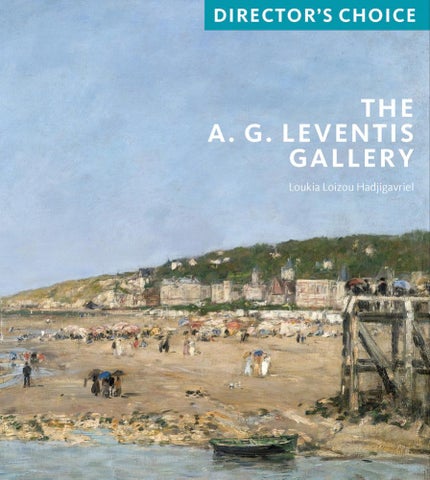
cover:
retrieval system or transmitted in any form or by any means electronic,
eugène boudin
mechanical, photocopying, recording or otherwise, without the written
The Beach at Trouville, 1889
permission of The A. G. Leventis Gallery and Scala Arts & Heritage
(See pp. 36–7)
Publishers Ltd. Every effort has been made to acknowledge correct copyright of images where applicable. Any errors or omissions are unintentional and should be notified to the Publisher, who will arrange for corrections to appear in any reprints. Director's Choice is a registered trademark of Scala Arts & Heritage Publishers Ltd.
80
|
THE A. G. LEVENTIS GALLERY
frontispiece: jean-baptiste-camille corot Valley with Grazing Goats (Sunrise), 1868 (See pp. 30–1)