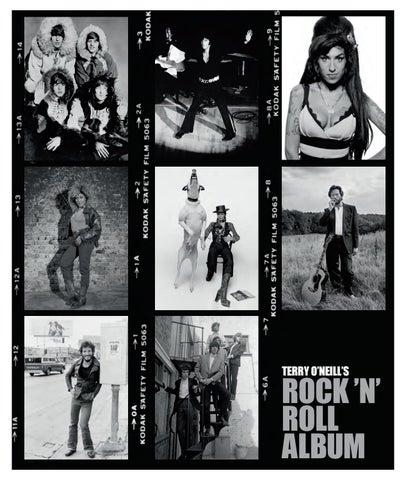
TERRY O’NEILL’S
ROCK ’N’ ROLL ALBUM
TERRY O’NEILL’S
ROCK ’N’ ROLL ALBUM
2
In 2008, I spent a week with the late, great Nelson Mandela, a man who moved me immensely with his charm and grace. It was his 90th birthday and the world was paying homage to him in London. Presidents, prime minsters, Hollywood stars and music greats attended upon him — he was royalty on the world stage, a man who stood for something that brought out the best in all of us — an appreciation of greatness and humility. There was to be a dinner and concert in his honour. I was invited to chronicle the event, in private and public. It kind of summed up my entire life. It was the first time it really struck that I had been enormously lucky to be in the right place, at the right time and witness extraordinary people in extraordinary times. For more than 50 years I have been given a front-row seat to photograph the most iconic people of our times: from my first big stroke of luck, picking a young, unknown band called The Beatles to photograph in 1963, to sitting in the Dorchester hotel with Mr Mandela in his private suite, chatting with the likes of Bill Clinton. The night of the concert in his honour Amy Winehouse was driven from hospital, where she’d been in rehab, to sing for him. I persuaded her to pose for a few shots before she went on stage. For some years I’d thought there was nobody left who I wanted to photograph. I’d become very disillusioned as the age of celebrity became this commercial circus. I’d almost given up taking photographs, because famous people now had managers and lawyers and publicists who wouldn’t let photographers take pictures unless they controlled the images that the public were allowed to see. The digital age meant management wanted photographs to be manipulated by computer technicians to make the subjects look better. Models were slimmed down and given better bodies, actresses’ portraits were Photoshopped to plump-up lips and breasts, to soften wrinkles or lengthen legs. Their heads were being superimposed on body doubles. Management would insist photographers signed contracts, giving away control of their work and placing it in the hands of lawyers and publicity managers, who wanted faked images. The honesty and integrity of photographing the famous and infamous was not only compromised, it was fraudulent. I didn’t want any part of it any more. Photographers became part of a marketing and advertising machine. I always felt it was my job to take photographs that told
“ When it comes to photographic legends, there can be few more prolific or revered than Terry O’Neill, the man who shot the greats”
3
Right: Terry O’Neill, captured in the mirror as he photographs The Animals. Far right: a young Terry, camera in hand, gets in the party spirit, leaping from the steps of the Eros Fountain in London’s Piccadilly Circus while photographing The Searchers
4
a story. I always felt that the stars and their management weren’t the boss. It was the people who bought tickets to the cinema or theatre or concerts, who paid good, hard-earned money for records or books. I thought back to the days when The Rolling Stones, an unknown band in 1963, asked me to help them get noticed. I photographed them all over London. They came to me, because I was too busy to go to them. I remember when I walked up to Frank Sinatra in Miami, then in 1967 the biggest star in the world, and introduced myself. I spent the next three weeks photographing him in private and backstage. I could take pictures of him anywhere after that, and did so for the next 30 years. Nobody ever asked me to sign a contract, to stop taking pictures, to hand over my film or tear up a print. Photographing Nelson Mandela and Amy Winehouse that night persuaded me that there were still people in this world, among the famous, talented, gifted people, who hadn’t sold
out, who were honest enough to understand that a photographer was there to represent and inform the audience, not advertise an image. When I looked at the thousands of photographs I took that week, one of Mr Mandela reading his newspaper with his glasses perched on the end of his nose and another, a portrait of Amy, stood out. And someone said to me — do you realise you’ve photographed everyone from Winston Churchill to Nelson Mandela; John F. Kennedy to Tony Blair? You’ve photographed Elvis, The Beatles and Amy Winehouse; Elizabeth Taylor, Audrey Hepburn and Nicole Kidman. It was the first time I really stopped to think about how long I’d been photographing famous people. The result was that I spent three years going through my negatives — there are millions. They were all stored in cardboard boxes. I was approached to do a book of my life’s work, I call it the Opus. I was stunned when it sold out in four months and had to be reprinted. And then I realised how much I’d left out.
I’d selected hundreds of pages of pictures and there were still thousands of amazing images, spanning 50 years. So many were of the great musicians, rock stars and pop stars of our age, that I was asked to go back through the archive again and do a rock ’n’ roll book. I struggled with this. If I do a book on rock ’n’ roll. How can I include Frank Sinatra’s jazz, or Diana Ross’s soul, or Joan Baez’s folk? They all deserved to be in a book about music — even the Osmonds. But the more I thought about this, the more I realised it was okay to include people not immediately identifiable with our image of sex, drugs and rock ’n’ roll. Rock ’n’ roll is not just about the act and the music, it’s about inspiration. Where would rock ’n’ roll be without jazz? Where would pop be without rhythm and blues? If Freddie Mercury can duet with Montserrat Caballé the great opera diva, if Sting can make an album with the great contemporary jazz musicians, if Paul McCartney can write a symphony, if Amy Winehouse can
sing for Mandela, why can’t my rock ’n’ roll book cover the universe of music? Any great rocker will tell you how much they admire Frank Sinatra or Roy Orbison. Is there any great rock ’n’ roll band out there who hasn’t written a ballad or love song those men could have crooned? Take it from me, Frank Sinatra or Tom Jones could have belted out Born to Run with Springsteen if they’d wanted to. Rock ’n’ roll isn’t just about riffs and amplified electric guitar. It isn’t just Hendrix. It’s a genre of popular music that encompasses passion, expression and exploration. Rock ’n’ roll is the language of youth, the voice of the post-war generations. It’s blues, jazz, country, gospel, pop and folk, rocked and rolled over decades. So, as you leaf through the pages of this book, don’t be surprised to find Shirley Bassey up there with Janis Joplin or Tina Turner. Don’t be surprised to find David Cassidy after David Bowie. Don’t be shocked that Engelbert Humperdinck is in here with Led Zeppelin. They all rocked us, we all rolled with them ■
5
AC/DC
6
7
184
185
MIKE OLDFIELD
188
OZZY OSBOURNE
ISBN 978-1-78884-082-8
ËxHSLHSIy840828zv&:<:;:!:!
£45.00/$65.00
www.accartbooks.com