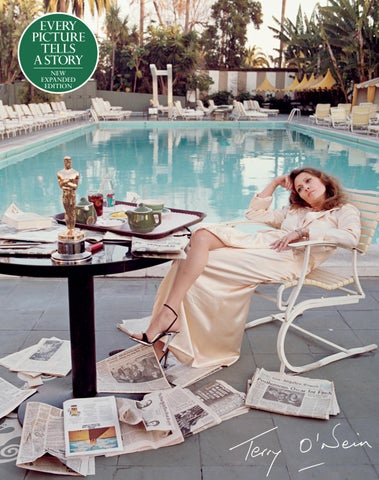
every picture tells a story New Expanded Edition
INTRODUCTION Steve Fairclough, August 2016
If you were writing an identikit for THE perfect portrait photographer—a wonderful eye, the ability to get the most out of the subject, superb use of light, stunning composition skills, charm and patience—you’d probably arrive at Terry O’Neill. It is fitting that this book is called Every Picture Tells a Story as Terry O’Neill’s career grew out of one photograph. A newspaper reporter saw him taking a picture of the then British Foreign Secretary, Rab Butler, sitting asleep amongst African chieftains at Heathrow Airport. It was sent to the Daily Sketch newspaper and Terry was paid “25 quid” for the shot. Following the tragic death of his Daily Sketch colleague Brian Fogarty in a plane crash, Terry was asked to take over Fogarty’s job. His then picture editor, Len Franklin, told him: “We think youth is on the rise in England and is going to change the world…we want you to photograph that.” His first day saw him being sent to Abbey Road Studios to photograph The Beatles recording one of their first singles, and within weeks The Rolling Stones’ manager Andrew Loog Oldham rang and asked him to shoot the band. Terry recalls: “I started at the top and I never looked back.” With typical modesty Terry believes much of his success has been down to being in the right place at the right time. “That’s true—I was. I had no idea I was going to end up where I ended up in life—it was just fate.” Of those heady days in the 1960s he recalls: “I was a young kid who could get people's pictures in the newspaper and that was really important to these pop groups at the time—it was like getting a TV show of your own. We all used
Terry O'Neill taking a photo of David Bowie during his performance at The Marquee Club as Ziggy Stardust, October 1973
—
4
—
to go to this club called the Ad Lib Club…we used to sit there talking about what we were going to do when all this was over. We were all convinced that in a couple of years it would go back to what it was like [before] and we’d have to get proper jobs. I remember Ringo [Starr] wanted to open a chain of hairdressers for his old lady. I mean it was so funny.” Since the 1960s he has shot portraits of the greats from the worlds of cinema, music, politics, fashion, sport, royalty and entertainment—Sinatra, Churchill, Presley, Mandela, Bowie, HM The Queen, Elton John, Hepburn and many, many more—and has an almost forensic recollection of the shoots and the people. He rates Sinatra as probably the most interesting person he has met: “Sinatra was a king to work with—he was a fabulous bloke to work with. But they’re all great people, I mean…I’m just lucky to have met them all. Sinatra was just ‘the guvnor’ wherever he went and you knew if you worked with him and got close to him that you were amongst the top of your tree. He only used the best musicians and I was the photographer— everyone was the best, so you felt good about it.” Although his natural charm is legendary, Terry is not just ‘Mr. Nice Guy’. He has little wish to photograph modern-day celebrities, saying: “I don't really do jobs any more; I’m not really interested in the people.” Also, he has few friends who are photographers (save for David Bailey and Don McCullin) and has a hatred of cameras. “I’m not into photographers and, believe it or not, I hate cameras. If I couldn’t use a camera I’d be happy as a sandboy, because you take the picture in your mind and you just need the bloody camera to capture it. If I could work without cameras it would be ideal.
It sounds ridiculous when you say that but it’s true—I’m not into equipment or anything. I just buy the equipment that I like and I use it.” On the contrary he never gets bored of his archive. “I love the photographs. I love all the pictures and the life that I’ve captured. It just interests me; I’m never bored with it— I should be, but I’m not.” Of the many famous faces in this book the only one missing that he wishes he had photographed is Marilyn Monroe: “I fancied her PA and decided to chase her, which was the wrong mistake [to make].” As for what he is trying to convey in his images, Terry says simply: “I’m trying to show them the world that I’m in at the time. I just blend in with the group or whoever it is and hope that I’m capturing the world that they live in. I don't set out consciously to do it.” Terry O’Neill describes Every Picture Tells a Story as: “…a book of all my best pictures, telling the full story of how they were done—the whole shebang behind them all. It’ll be a really interesting book.” Of that, there is little doubt… Steve Fairclough is a freelance editorial consultant who specialises in covering the worlds of photography and filmmaking in print and online. He is the former Editor-inChief of the pro imaging website Canon Professional Network (CPN) and has edited What Camera? and Amateur Photographer magazines. He has been writing about photography since 1987 and has interviewed many of the world's top photographers, including Don McCullin, Steve McCurry, Martin Parr and Terry O'Neill.
—
5
—
—
6
—
AC/DC Terry O’Neill remembers wanting to capture the talent ‘mid-air’
“They were making a comeback when we took this photo,” remembers Terry O’Neill. AC/DC, formed in the early 1970s, saw a string of hit records and quickly became known for living the rock-and-roll lifestyle they portrayed on stage and through their music. “The 1970s were very excessive for numerous musicians. I was far removed from that in a way, living in Los Angeles at the time. That doesn’t mean the 1970s passed me by musically, I did take numerous shots of David Bowie, Elton John and other brilliant performers during this seminal decade. By the time the 1980s rolled around, bands like AC/DC had crossed over to commercial success, selling out stadiums worldwide. But as the years go by it’s very clear which bands have talent (and I mean real talent) and which bands will simply fade away. That’s why I
took the assignment to photograph AC/DC for these pictures, some time in the 1990s. They had stood the test of time and were very, very talented. “When I shoot studio portraits such as these, I’m always thinking of new ways to present the subject or, in this case, a way to capture the band’s unique style. We did take several photos of the band in a more traditional straight-on way. But I admit that I like these better. Looking at them from the bottom up, it almost feels like I was able to capture the band mid-air. That’s why I love this portrait of Angus Young, clad in his trademark school uniform. That’s the electricity of the band, the performance. By this time, the band had been performing and recording non-stop for more than two decades and they still had that magic.” —
7
—
MUHAMMAD ALI When O’Neill met Ali in Dublin
“It was the start of summer 1972 and Muhammad Ali was in Dublin training for a fight against Alvin Lewis. I flew over to take photographs and interview him for the Daily Express. I was doing some interviews for the papers at the time and remember that they ran that story for three days. That’s how big Ali was, and outside of his early days as a professional, 1972 would be one of the most active periods in his fighting career.” In the 1960s, Muhammad Ali was at the height of the boxing world when the universe changed. As a U.S. citizen, Ali was not immune to the Vietnam conflict and by refusing to be drafted into the armed services (on the principle of being a conscientious objector), caused a systematic denial of his boxing licence in every state. Eventually arrested for draft evasion, he was stripped of his passport and did not fight for more than three years. As opposition to the Vietnam War began to grow, Ali became one of the highest profile objectors and his brave stance gained respect and momentum. He eventually reclaimed the right to fight, and in 1971 the Supreme Court overturned his conviction. Fights were set and Ali was ready to stage an incredible comeback. “Ali was starting to fight again when I had this incredible opportunity to meet him. A year before these photos, he lost the Heavyweight Championship of the World to Joe Frazier in what was billed as ‘The Fight of the Century’. When I met him for these photos, he was in the middle of building his global crusade to recapture the title. “Ali was great to photograph. He paid no attention to me and was either training or raving about being the greatest— or he’d just sit in a room and say nothing for hours, watching training films of himself. He was a funny type of bloke—he was either all giving or saying nothing. He was completely focused. He was like Sinatra in that respect, both driven and determined. “When I started to talk to him and ask him questions for the interview, that’s when he blew up! He swore and said ‘Are you writing a book on me?’ And his brother, who was there, —
8
—
—
9
—
WINSTON CHURCHILL The great leader leaves Middlesex Hospital
“
I noticed a crowd so I went over to see what was going on
”
“I’ve spoken about photography being a combination of an idea, patience and luck. In this case, it was all luck. “It was August 21st, 1962. I know the date because it’s well documented. I was on assignment, I don’t even remember where I was going to or coming from, but I do remember seeing this mass of people causing a commotion over by Middlesex Hospital. Whatever was happening was important, so I ran over and pushed my way through the crowd. “I heard the cheers before I realised what was happening and no less than a foot away from me, Sir Winston Churchill was being carried out of the hospital by four or five policemen, waving to the roaring crowds with a cigar in his hand, to a waiting ambulance that would take him back home. “I only managed to get a few snaps and just three survive today. He passed away in 1965, at the age of 90.” —
48
—
—
49
—
—
50
—
BRIAN CLOUGH The managerial duo watch from the stands
“Besides the musicians and actors, models and politicians, I’ve been able to work with hundreds of sports stars in my life. Usually, when I’ve been asked to take photographs of athletes, it’s in a studio environment, something controlled. But when I first started out, I would often trail around the subject and try to catch those off moments that I knew the papers would want.” Such was the case in 1965. Brian Clough was the new manager of Hartlepools United (the club’s name was changed in 1968 to Hartlepool United) and had hired Peter Taylor as his assistant, a partnership that would last
decades. Clough was only 30 at the time and had just ended his successful playing career due to injury. “Hartlepools United was really struggling, both financially and on the field. And I think you can see that a bit in these photos. From Clough on his feet with his hands in the air, to his head resting on the ledge, most likely in despair over a bad call. “These photos are from the very beginnings of what would become not only an enduring working relationship between Clough and Taylor, but also a managing career that would take him to the heights of the game.” —
51
—
—
52
—
—
184
—
THE WHO An album cover shoot, one of the last photos of Keith Moon
The Who had been together for nearly fifteen years and were widely considered one of the greatest and most influential rock bands of the twentieth century, when Terry O’Neill took their portrait for the cover of their 1978 album Who Are You. It would be one of the last photographs of the band with their original line-up: Roger Daltrey, Pete Townshend, John Entwistle and drummer Keith Moon. “I photographed The Who for their album Who Are You in 1978 at Shepperton film studios outside London. I’ve taken a lot of photos over at Shepperton. I thought it would make a great background. I wanted to have a backstage on tour sort of feel with various boxes and equipment. I am pretty sure I knew they were looking for a possible album cover shot or images they could use for the back or inside, that sort of thing. As we were mucking about the studio lot, I found this chair that had ‘not to be taken away’ on it—so I grabbed it and had Keith (Moon) sit on it.” Three weeks after the release of Who Are You, Keith Moon died aged 32 of a drug overdose. “A lot of critics and press mentioned the irony of the cover photo. Having Keith in the centre of the photo and on that chair with those words stencilled—who could have guessed that is what would happen only a few short weeks later? It’s a terrible irony. Moon overdosed on a drug he’d been prescribed to help him stop drinking. I heard he could barely hold his drumsticks by that time. Another sad, sad loss. He was an amazing drummer.” —
185
—
AMY WINEHOUSE A few minutes and she was gone
Amy Winehouse’s debut album, Frank, received rave critical success on being released when Amy was just twenty years old, and announced the arrival of a new singer—one whose vocal styling won her comparisons to bluesy artists such as Nina Simone and Sarah Vaughan. Her follow-up album, Back to Black, went on to win five Grammy awards and she was predicted by many to be the pre-eminent voice talent of her generation. Unfortunately, a string of personal demons brought more headlines than her album sales and awards. She was very publicly dealing with substance abuse issues. Amy Winehouse was scheduled to perform at Nelson Mandela’s 90th birthday celebration in Hyde Park in 2008. “I was there, photographing everything. I spent five or six days trying to get pictures of everyone who came by to wish him well and all the performers at his incredible Hyde Park birthday celebration. Amy Winehouse was scheduled to appear and I was hoping she was going to be there. I had
never taken a photo of her before and she was one of the few modern performers I really wanted to capture. She had this great look about her, a big beehive, the likes of which I haven’t seen since the 1950s, with a bunch of sailor-type tattoos—she looked like she had raw attitude and a lot of sass. How she looked aside, I thought she had a real, genuine talent. "Apparently, she came out of the London clinic to do the concert then went back. She was in the middle of rehab. I only had a few minutes with her at best—so I just asked her to stand still for a second and I got a few shots in before she had to dash off somewhere. “She was really gifted. Another one, like Brian (Jones), Keith (Moon), Janis (Joplin)—the list is too long—it’s a real shame what drugs and alcohol can do. Who knows what she could have gone on to do, to record. I loved her voice—still do. I don’t really go for the modern singers; they are too produced and manufactured. Amy was special.”
—
186
—
If you named a major celebrity from the early 1960s onwards – from the worlds of music, cinema, sport, politics, fashion or royalty – the chances are that Terry O’Neill will have photographed them. … [This book is] a compendium of his most striking imagery [that] has been brought together in one volume … a unique insight into his creative process and the personalities of the superstars he shot *Amateur Photographer
ISBN: 978-1-78884-128-3
ËxHSLHSIy841283zv&:%:&:+:+
£30.00/$45.00
www.accartbooks.com