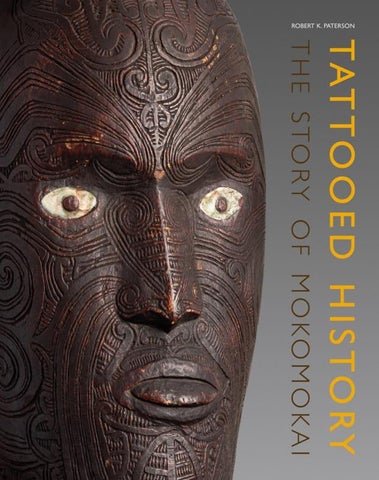
TABLE OF CONTENTS
7 Acknowledgements
9 Introduction
109 Horatio Gordon Robley:
the “Soldier With A Pencil”
15 The First Written Accounts
35 A Question of Language: from Mokomokai and Mokamokai to Toi Moko
41 Colonial Commodities:
Trafficking in Mokomokai, from 1770 to 1840 65 Exhibiting Mokomokai for Profit in Early Nineteenth Century Britain
75 Mokomokai at British Auctions: 1820 to 1988
89 Mokomokai in New Zealand
from 1840 to 1975
123 Mokomokai and the Last Major
British Collectors 135 Carved “Memorial” or “Trespass”
Heads: Mata Rahui 147 Mokomokai and the Law
of Human Remains 155 The Repatriation of Toi Moko
to the Museum of New Zealand Te Papa Tongarewa 162 Documentary Appendices 177 Maori Glossary 178 Selected Bibliography
THE FIRST WRITTEN ACCOUNTS
CHAPTER 1
INTRODUCTION The first European to set foot in New Zealand was the British explorer James Cook in 1769, on the first of three voyages to the Pacific. Afterward, New Zealand was regularly visited by sailors, traders, missionaries, scientists, and adventurers. Until 1840, however, settlement in New Zealand was sparse and random. This early contact period meant that some coastal Maori began to have regular contact with Europeans while other, more remote, tribes (iwi) did not. Maori worked as crew on whaling ships and others visited New South Wales and even England.1 A few Europeans, often escaped convicts, settled in New Zealand and took Maori wives. These men became known as Pakeha Maori. Their knowledge of the Maori language (te reo) meant that they gained insights into Maori culture and custom that casual visitors could not achieve.Their published accounts provide us with valuable information about mokomokai. The earliest book specifically about New Zealand by John Savage does not mention mokomokai but later accounts contain references of varying length and veracity.2 While fragmentary, and sometimes of questionable accuracy, these accounts form the foundation of our understanding of these unique remains.
JOSEPH BANKS AND THE FIRST EUROPEAN COLLECTORS It is usually agreed that the first known instance of the acquisition of a mokomokai by a European occurred at Queen Charlotte Sound, in the South Island, in 1770, during James Cook’s first voyage to New Zealand. On January 16, 1770, preserved Maori heads were first observed by the visitors, and on January 20, Kupaia, the paramount chief of the Motuara pa (village), visited the Endeavour with about four heads, which were those of the occupants of a canoe that had entered the sound a few days earlier. Joseph Banks, the naturalist, purchased one of these: The old man [. . .] was very jealous of shewing them. One I bought tho much against the inclinations of its owner, for tho he likd the price I offerd he hesitated much to send it up, yet having taken the price I insisted either to have that returned or the head given, but could not prevail until I enforc’d my threats by shewing Him a musquet on which he chose to part with the head rather than the price he had got, which was a pair of old Drawers of very white linnen.3
15
Banks records the head as appearing to be that of a person fourteen to fifteen years of age and showing, by contusions on one side, to have received violent blows that had broken part of the skull near one eye. A preserved female head of a relative or friend was seen during Cook’s second voyage at Tolaga Bay in November 1773 but not purchased. No reports of any sightings of heads were made during Cook’s third voyage. The whereabouts of the head acquired by Banks is unknown.4 The renowned collection of the Englishman William Oldman included a head described as: “Head of an important chief [. . .] This belonged to the family of W. Townley Parker, Esq., of Cuerden Hall; it was 1 brought to England by Captain Cook about 1770 and presented to that family.”5 Given the unblemished condition of the Oldman specimen it could not have been the head Banks acquired in 1770.6 Joseph Banks acquired at least two other mokomokai after his visit to Queen Charlotte Sound in 1770. The first was sent to Banks in London by William Bligh in 1807. Bligh was the fourth governor of New South Wales, a position he obtained through Banks’s influence.7 In a letter to Banks, dated November 5, 1807, Bligh states: “A safe and good opportunity now offers for my writing to you by the Duke of Portland. Captain Spence being an obliging person I have sent you under his charge my humble efforts in collecting a few Tubs & Boxes of plants [. . .] I have also sent for you [. . .] A New Zealand Chiefs head preserved.”8 Since Bligh never visited New Zealand, it is likely that he obtained this head in Sydney at the start of what was to become a period of extensive trafficking of mokomokai in that city. Port Jackson had been seen by Cook in 1770 and New South Wales became a British colony in 1788. Sydney’s excellent harbor led it to becoming an important center for shipping and commerce in the South Pacific in the early nineteenth century. The second head Banks obtained reached him around the same time as the first. It was sent to him from Portsmouth by Philip Gidley King, who had been governor of New South Wales from 1800 to 1806. King wrote to Banks on November 26, 1807: The Purser at my desire has required the writer make a present to you before the receipt of yours. The Surgeon who goes to Town tomorrow takes up the Head of To mau o wey coo a Young Chief of the District of Moodoo Whenua [Muriwhenua] at the N. part of New Zealand. Here the Skin & hair &c is so
16
TATTOOED HISTORY: THE STORY OF MOKOMOKAI
fig. 1 Portrait of Joseph Banks by Benjamin West (1773) [Artefact/Alamy Stock Photo]
perfect his scars being clearly explained the hole in the Cheek & under the Ear was his Death Wound.9 King had been lieutenant-governor of Norfolk Island from 1791 to 1796. He had visited New Zealand for ten days in November, 1793, when he returned two Maori men (Tuki Tahua and Ngahuruhuru) who earlier that year had been kidnapped and taken against their will to Norfolk Island.10 King returned to England in 1796 with plant specimens for Banks. King described his exchanges with Maori on his arrival in New Zealand on November 12, 1773: “I gave presents of axes and other articles. A traffic was carried on with a scrupulous honesty on both sides; iron hoops and other articles were exchanged for abundance of manufactured flax, mantles, patoo-patoos, spears, &c.”11 It is possible King acquired a mokomokai during his 1793 visit to New Zealand but it is more likely that he obtained one during his time as governor of New South Wales and sent it to Banks in 1807. The New South Wales government purchased two mokomokai in 1887, which were later presented to the Australian Museum in Sydney. They were purchased by Sir Saul Samuel, the Agent General for New South Wales in London. The seller was John Calvert, a London dealer and collector. Calvert claimed the heads had been part of a collection given by Banks to his secretary, Robert Brown, who later purchased Banks’s “museum” at 32 Soho Square. After Brown’s death, Calvert obtained the collection which included the two heads he later sold to Samuel. Calvert claimed the heads had been acquired by James Cook on his first Pacific voyage but this claim has been discredited.12 It has been suggested that one of the two heads given to the Australian Museum may have been the head sent by Bligh to Banks in 1807.13 Both heads (along with a third held by the Australian Museum) were returned to New Zealand in 1989.
THE EARLIEST DEPICTION OF MOKOMOKAI A pen-and-wash drawing of a war canoe by Sydney Parkinson shows a Maori woman holding up a preserved head. Probably dating from 1770, it is as such the first known depiction of a mokomokai. Of his own sighting of mokomokai Parkinson wrote: The natives also brought us several human bones on board, and offered them to sale, sticking them in their mouths, and, by the signs which they made to us, evinced that they thought human flesh delicious food. One day, in particular, they brought four skulls to sell; but they rated them very high. These skulls had their brains taken out, and some of them their eyes, but the scalp and hair was left upon them.They looked as if they had been dried by the fire, or by the heat of the sun. We also found human bones in the woods, near the ovens, where they used to partake of their horrid midnight repasts: and we saw a canoe the balor of which was made of a man’s skull.14
THE FIRST WRITTEN ACCOUNTS
17
A QUESTION OF LANGUAGE: FROM MOKOMOKAI AND MOKAMOKAI TO TOI MOKO
CHAPTER II
INTRODUCTION One of the most vexing questions surrounding preserved Maori tattooed heads has been what is the Maori word to describe them? Over a period of some two hundred years different Maori words have been used for heads, but there has been little attempt to explain these differences and the forces behind them. Even today debate surrounds the appropriate term. Despite this, the earliest definitions, often obtained after prolonged consultation with Maori, yield valuable clues as to how they understood the meaning of certain words. The following is an attempt to explore some of the issues surrounding the terminology used to describe heads, but more research is needed, including published and unpublished sources and contemporary oral usage.
MOKOMOKAI VERSUS MOKAMOKAI None of the earliest English written accounts of Maori preserved heads contain a Maori word to describe them, even though other Maori words appear.The first printed appearance of the word mokomokai was in 1820 in A Grammar and Vocabulary of the Language of New Zealand, the joint work of the Reverend Thomas Kendall and Professor Samuel Lee.1 This volume was preceded by the first book printed in Maori in 1815, but that work did not contain any Maori term for preserved heads.2 In the 1820 dictionary, moko mokai is defined as: “The tattooed decapitated head of a man.” The word mokaikai also appears and is defined as: “The heads of enemies preserved to look at; name of a person; also the name of a place.” Mokai is defined as “a person in a low situation, poor.” Samuel Lee was a professor of languages at Cambridge University. He and Kendall worked together for two months at Cambridge, with the Maori chiefs Hongi Hika and Waikato, to produce the 1820 dictionary.3 Tooi (or Tui) was Kendall’s first instructor in the Maori language when he went to New South Wales in 1814. Tooi subsequently visited England in 1818 and, with Titore, assisted Professor Lee with Maori vocabulary.4 Despite the existence of the 1820 dictionary, neither of the above terms was commonly used in early published works about New Zealand. In his 1843 work, Ernst Dieffenbach described the preservation of heads and stated: “These heads are called moko-mokai.”5
34
TATTOOED HISTORY: THE STORY OF MOKOMOKAI
35
The first edition of William Williams’s A Dictionary of the New Zealand Language and a Concise Grammar was published in 1844.6 Williams, like Kendall, was also a missionary and arrived in New Zealand in 1826 at the age of twenty-six. His linguistic aptitude led him to produce several Maori translations of Christian tracts, but his most enduring work was the dictionary that was first published at Paihia in 1844. It defines mokomokai as “a dried human head” and states that the word is a synonym of mokaikai. Both definitions were repeated in the second edition of Williams’s dictionary published in 1852.7 The first appearance of the word mokamokai to describe heads appears to be in an 1849 manuscript about Ngapuhi history and genealogy by Aperahama Taonui:8 “Ka mea te kai patu kia kotia te matenga hei [mokamokai]. Ka mea etahi kaua e kotia he matenga kino ka hore he moko[.] Ka mahue ia te kai patu.” (The killer said the head should be cut off to be preserved; others said, “Don’t cut it off, it’s a bad head, there’s no tattooing.” He was left by the killer.)9 Aperahama Taonui was the son of a Ngapuhi chief and a teacher, historian, and prophet. He was born around 1815 and was a signatory of the Treaty of Waitangi. The Williams dictionaries became a family affair. The third edition of Williams’s dictionary, prepared by his son,William Leonard Williams, was 1 published in 1871. In it, the spelling of mokomokai changes to mokamokai but is still defined as a “dried human head.”10 This spelling is repeated in all subsequent editions.11 Edward Tregear’s The Maori-Polynesian Comparative Dictionary of 1891 also contains the word mokamokai, which is defined, among other ways, as “A curiosity, as a dried human head.”12 There appears to be no explanation for the reasons for the change in spelling of words that have the same meaning. Dr. Jane McRae suggests that perhaps the change was simply to correct what was perceived as a mishearing of a word.13 John White’s fifth volume of The Ancient History of the Maori, His Mythology and Traditions: Tai Nui, published in 1888, includes an example of the use of the word mokomokai in the description of an ancient war party: “Ara ki nga kai patu mo Hotumauea, ‘Kaua e patua ki te pane, kei pakaru te mokomokai.’” (Do not strike him on the head, lest the skull be cracked and the head be ruined when cured.)14 In his famous 1896 work Moko or Maori Tattooing, Horatio Gordon Robley uses the word mokomokai to describe preserved Maori heads.15 In the copy of this work that
36
TATTOOED HISTORY: THE STORY OF MOKOMOKAI
2
fig. 2 Title page, Thomas Kendall and Samuel Lee, A Grammar and Vocabulary of the Language of New Zealand (London, 1820) [private collection]
fig. 1 “Tooi, A Late Chief in New Zealand” (Missionary Papers, 1826).
fig. 3 [Courtesy J. C. Beaglehole Room,Victoria University of Wellington Library]
3
formerly belonged to the bibliophile Horace Fildes, now in the collection of the Victoria University of Wellington library, the word mokomokai appears to have been crossed out in pencil by Fildes and changed to mokamokai. Presumably Fildes did this based on the spelling mokamokai in Williams’s fourth edition, published in 1892. The lips of the preserved heads of relatives were usually sewn together.16 Dr. Hazel Petrie thinks that perhaps the adoption of the spelling mokamokai was with reference to these heads since moka can mean “a muzzle for the mouth.”17 This would mean that mokomokai could still refer to the heads of enemies whose lips were not sewn. The English definitions of mokamokai in Williams’s third edition (1871) and Tregear (1891) both incorporate the word “curiosity,” but it would seem unlikely that the word was used by Maori as meaning something strange or unusual. Another explanation could be that moka, meaning “end or extremity,” was used so that the term mokamokai would include all dried heads, whether tattooed or not.
MAUI POMARE AND THE ADOPTION OF TOI MOKO Maui Ormond Woodbine Pomare was a leader of the modern movement to secure the repatriation to New Zealand of Maori ancestral remains (koiwi tangata) including mokomokai from foreign museums and other institutions. He was the guardian (kaitiaki) of his people’s taonga (treasures) and actively made purchases of Maori material from abroad.18 While chair of the National Museum Council he organized the return of a large number of Maori ancestral remains to New Zealand. Pomare was the first to support the adoption of the words toi moko (“the art of tattooing”) to describe preserved tattooed Maori heads. He said that the accepted Maori term for tattooed preserved heads was nga toi moko. Since preserved heads could be both those of slaves and loved ones, and that mokomokai referred to the heads of slaves, Pomare thought it an appropriate usage.
A QUESTION OF LANGUAGE
37
COLONIAL COMMODITIES: TRAFFICKING IN MOKOMOKAI, FROM 1770 TO 1840
CHAPTER III
INTRODUCTION The history of the earliest exchanges of mokomokai between Maori and outsiders is mostly one of opportunistic transactions occurring in the context of what were later seen to be enormous cultural changes that followed European conflict and settlement. The earliest recorded example involved Joseph Banks’s purchase of a head at Queen Charlotte Sound in 1770.1 Later, Samuel Marsden described how heads were brought back from conflicts as trophies and sometimes restored to former enemies after peace was restored.2 Then preserved heads of enemies could serve as agents of reconciliation between warring sides. On the other hand, if peace was not desired by the victor he might “dispose of the heads of those chiefs whom he kills in battle to ships or any persons who will buy them.”3 In 1819, Marsden wrote: I could hear of no instance of any man ever being killed merely to gratify the appetite; nor of any killed for the purpose of selling their heads to the Europeans or other nations. The heads which are cured and sold are those of the slain in war which are not intended to be returned to their friends. At the same time I am of opinion that it is not safe or prudent for masters of vessels, or any of the crews, to purchase heads from the natives; for if a tribe knew that the head of their chief was on board any vessel it is more than probable they would make an attempt upon the vessel in order to obtain the head, from the high veneration and esteem in which they hold these relics of their departed leaders.4 Despite this assessment of the risks for outsiders in acquiring mokomokai, a brisk trade in heads was already underway.
EARLY TRAFFICKING IN HEADS What appears to be the earliest recorded instance of mokomokai being brought from New Zealand, after Banks, was by William Tucker in 1811. Tucker was an ex-convict who came to Otago in 1809 on a sealing ship.5 “Candor,” a correspondent to the Sydney Gazette, writing about the early trade in mokomokai, said:
40
TATTOOED HISTORY: THE STORY OF MOKOMOKAI
41
The first of these heads that I remember to have been brought up was by a wild fellow of the name of Tucker, in 1811, who got it by plunder; and so tenacious were the natives at that time of these heads, that a whole boat’s crew were nearly cut off for the crime of this villain, which was not known until he exposed the head for sale in Sydney. The crew had an hour before the sacrilege committed by Tucker, been upon the most friendly footing with the natives; when suddenly an alarm burst out, and had the vessel not immediately got away, a hundred war canoes would have boarded her at once.This man has since been killed at New Zealand.6 Since records from this early period of contact are sparse and incomplete, there were almost certainly many other such instances of mokomokai being acquired by non-Maori of which no records remain. Those recorded instances that exist reveal a variety of tactics on the part of outsiders. In 1819 a chief was so eager to obtain an axe that he promised his own head to Marsden:
Samuel Leigh was a Wesleyan missionary in New South Wales and became an acolyte of Marsden. He spent a month in the Bay of Islands in 1819. Leigh entered a village and saw twelve heads displayed along a path. Leigh asked the chief why the heads had been displayed in this manner: “Because I expected you to buy them!” “Buy them!” said Mr. Leigh, with considerable vehemence, “I buy spars, pigs, and flax, but not the heads of men.” On returning through the same village in the evening, he perceived that the heads had been removed. On meeting the chief, he inquired why he had removed the heads. “Because,” he observed, “you did not like to see them, and wished that you might not see any more. But the captain of the next ship will, in all probability, purchase them.”9 Leigh’s experience of being offered mokomokai by a chief is further evidence of how active the trade in heads had become by that time, when they were already being sold at auction in London.10
NEW SOUTH WALES AS A TRANSIT POINT Because of its excellent harbor and other resources, Sydney soon became a transit point for trade in mokomokai between New Zealand and Europe and North America. “Verax,” another Sydney newspaper correspondent, reported seeing two Maori heads on display at a Sydney residence in 1812, which were priced at twenty guineas each:
1
An old chief with a very long beard and his face tattooed all over had accompanied us from where we slept last night. He wanted an axe very much. At last he said if we would give him an axe he would give us his head. Nothing is held in so much veneration by the natives as the head of their chief. I asked him who should have the axe when I had got his head. He replied I might give it to his son. At length he said, “Perhaps you will trust me a little time, and when I die you shall have my head.” I promised him he should have an axe, and he gave me two mats in order to secure one.7 Though Marsden was apparently unwilling to enter into this particular arrangement, he was later accused by a subordinate, the Reverend John Gare Butler, of purchasing two heads.8 Marsden refuted these allegations and their accuracy is uncertain.
42
TATTOOED HISTORY: THE STORY OF MOKOMOKAI
fig. 1 From Anne E. Keeling, What He did For Convicts and Cannibals; Some Account of the Life and Work of the Rev. Samuel Leigh (1896).
In passing through George Street in this town a few days since, my attention was suddenly arrested by a very extraordinary sort of bundle under the arm of a man who was passing me on the footpath. [. . .] I called to and asked him what the handkerchief under his arm contained; judge my astonishment and horror, Sir, at beholding a human head, with long black hair, in a state of perfect preservation. [. . .] As soon as I had recovered myself, I asked the man if what he showed me was really a human head; with perfect indifference as to my feelings and consternation, the man replied it was the head of a New Zealander, which he had purchased from a person lately arrived from that country, and that he was going to dispose of it for two guineas to a gentleman who was about to embark for England. I remember, about 7 or 8 years ago, to have seen in a private house in this town two human heads of the same kind, tattooed and ornamented in a manner customary among the natives of the higher classes in New Zealand, and so far as my recollection serves me, I think they were valued at twenty guineas each head. [. . .] If the import of human heads from New Zealand be so far countenanced and encouraged that the price shall fall, in the course of seven years, from 20 guineas to 2 guineas each, the inference must be, that human heads, having become by
COLONIAL COMMODITIES
43
EXHIBITING MOKOMOKAI FOR PROFIT IN EARLY NINETEENTH-CENTURY BRITAIN
CHAPTER IV
64
TATTOOED HISTORY: THE STORY OF MOKOMOKAI
ANCESTRAL REMAINS AND THE EARLIEST MUSEUMS The mokomokai displayed in Britain at the beginning of the nineteenth century were the forerunners of later permanent displays in museums and other institutions. These first exhibits typically included indigenous remains mixed in with ethnographic artifacts and natural history specimens gathered from non-Western sources.1 As late as the mid-twentieth century they were instrumental in supporting now discredited racist theories such as phrenology and eugenics.2 One of the most tangible results of the age of discovery was the arrival into Europe of vast quantities of natural history specimens and artifacts from newly explored parts of the world. Initially these objects mainly attracted the interest of gentlemen scholars such as Hans Sloane and Joseph Banks, and even royalty, who maintained so-called cabinets of curiosities to impress those privileged enough to see them.3 However, soon such exotica began to be presented to wider audiences. Ashton Lever’s passion for acquiring exotic foreign objects led to him opening the Holophusicon in London in 1775.4 Unlike the British Museum to which it was favorably compared, Lever’s museum lacked government support and, as such, was to be the precursor, over the next few decades, of several similar, though usually less ambitious, establishments. After running into financial difficulties, the contents of what was later to be known as the Leverian Museum were sold at a sixty-day-long auction in 1806.5 There is no record that any mokomokai were among the contents of the sale.6 The dispersal of the contents of the Leverian Museum added to the stream of objects arriving into Britain and coincided with the establishment of several other so-called museums. Some of these were simply private collections to which the general public was not admitted, but others were open to the public and charged admission to anyone curious to see their contents. An example of the latter was the ambitiously named “Museum Humfredianum” or “Humphrey’s Grand Museum,” which contained the extensive ethnographic collection of George Humphrey. The contents of this museum were sold in 1779, but Humphrey continued to collect and sold another large collection to the University of Gottingen in 1782.7 Most of his stock comprised natural history specimens, but there were also Pacific artifacts—most likely from Cook’s voyages. The earliest public displays of mokomokai in Europe were in privately owned premises established for profit. Probably the best-known example was William Bullock’s
65
Egyptian Hall. Bullock was a jeweler-silversmith with a keen interest in natural history. His passion led him to acquire objects from ships arriving in Liverpool, where he held his first public exhibition in 1795.8 Bullock acquired objects from the South Pacific at the Leverian Museum sale in 1806. In 1809 he moved his enterprise to London where it was initially called the Liverpool Museum. By 1812 his London premises, now described as the London Museum, took the form of a building in the style of an Egyptian temple, and became known as the Egyptian Hall. After failing in attempts to interest the British Museum or any similar institution in their purchase, Bullock sold his collections at auction in 1819.9 The sale took twenty-six days and was the largest of its kind since the Leverian sale in 1806. Most of Bullock’s ethnographic objects went to the Berlin Museum.There is no record of mokomokai among the several Maori and Hawaiian objects offered with Cook voyage provenance but since Bullock did not publish details of all the items on offer it is possible that one or more was included. After his successful 1819 sale, Bullock became a full-time auctioneer. Around the same time other entrepreneurs began to organize overtly commercial displays of exotic foreign objects.10 The broadsheets and handbills issued by the proprietors of these establishments were to contain some of the earliest known detailed illustrations of mokomokai. There was an incentive to produce crude banners and handbills since newspaper advertisements were subject to tax. Richard Altick writes of these enterprises as follows: The conditions of the exhibition business being what they were—fiercely competitive, with a long tradition of hyperbolic language and almost routine misrepresentation or suppression of facts—ordinary business ethics were at a deep discount. [. . .] In handbills and placards, however, the showmen threw off whatever restraints may have governed their statements in the Times and the Athenaeum.There they drew upon every trick of the trade as well as every font of type in the printer’s cases: the declaration of the exhibit’s rarity or strict uniqueness [. . .] the grave protestation of the exhibit’s genuineness.”11 Since these individuals were primarily motivated by profit, through charging admission or selling objects on display, and the nature of many of their premises was little more than glorified junk shops, any claims made about the nature of what they possessed, or its provenance, must be treated with suspicion.
THE “HEAD OF WATANGHEON” (TE ARA)—A HOAX OF THE BOYD? The 1934 Catalogue of the Books, Maps and Pictures relating to Australia, New Zealand and the Pacific comprised the vast library of the renowned collector and ethnologist James Edge Partington (1854–1930). Among the listed items (Number 1490) is: “The Head of Watangheon, a Chieftain of New Zealand, one of the Principal Perpetrators of the Massacre of the Ill-fated Ship’s Crew, the Boyd [. . .] now exhibited at the Royal
66
TATTOOED HISTORY: THE STORY OF MOKOMOKAI
1
fig. 1 From Narrative of the Massacre of the Crew of the Ship Boyd, etc. [National Library of Australia, F4115-facsimile, n.d.]
Museum, Engraving. 6½ by 4½ in., Published by G. S. Reddell, 1818, £2 10s.”12 George S. Reddell was for several years the owner of the Royal Museum in London, which was located in various premises between 1810 and perhaps as late as 1822. Reddell was a sword maker and engraver, as well as a friend of the poet John Keats.13 The present whereabouts of this engraving is unknown, but since Reddell was an engraver, it was presumably by his hand. It would also appear that by 1818 this mokomokai was exhibited at the Royal Museum in London. Possibly, the earliest sale of a mokomokai at a British auction occurred on November 8, 1820.14 Reddell’s sale of his museum’s stock extended over several years. On March 19, 1821, a notice of sale appeared in the Morning Chronicle, and the auctioneer was a Mr. C. Dubois, who was King’s successor at the well-known Covent Garden auction premises.15 During the same period that Reddell’s museum was in business, another, probably similar establishment existed in the port city of Liverpool.The Royal Liverpool Museum seems to have been established some time before 1812 and was situated at 1 Church Street. It was originally owned by the silversmith John Mumford, who died in 1812. After his death, his descendants ran into financial difficulties and it was taken over by John Kind. An 1815 catalogue lists the contents of the museum as including objects from Africa and the Pacific but no mokomokai are listed.16 The Liverpool Mercury of June 14, 1822, announced an exhibition at the Liverpool Museum that included the “head of Watangheon [. . .] one of the principal perpetrators of the massacre of the ill-fated ship’s crew, the Boyd,” along with a painting of the massacre.17 Another advertisement for the exhibition appears in The Kaleidoscope; or Literary and Scientific Mirror of November 5, 1822.18 It is not entirely clear whether the head on display in Liverpool in 1822 was owned by Mr. Kind or whether he had merely borrowed it, but given that Reddell was actively selling off the contents of his London premises around that time, a sale to Kind is a possibility. An undated anonymous pamphlet titled Narrative of the Massacre of the Crew of the Ship Boyd, at New Zealand, by Cannibals, Embellished with a Representation of the Real Head of Watangheon, the Principal Murderer, and a Frontispiece, copied from the Grand Painting exhibited in the Royal Liverpool Museum (“The Narrative”) includes a crude image of a mokomokai and was presumably produced to coincide with the 1822 Liverpool exhibition.19 It is also likely that Reddell’s 1818 engraving is the exact image appearing in The Narrative, especially given that it was labeled with exactly the same language used in the 1822 advertisements for the Liverpool exhibition. The Narrative was probably produced sometime between 1818 and 1822. This also means
EXHIBITING MOKOMOKAI FOR PROFIT IN EARLY NINETEENTH-CENTURY BRITAIN
67
Appendix 2
166
TATTOOED HISTORY: THE STORY OF MOKOMOKAI
Appendix 2
DOCUMENTARY APPENDICES
167
5 CONTINENTS EDITIONS ART DIRECTION
Annarita De Sanctis EDITORIAL COORDINATION
Elena Carotti in collaboration with Lucia Moretti EDITING
Charles Gute
PHOTO CREDITS The following images were photographed by Goran Basarić: Introduction: 1 Chapter 1: 5 and 7 Chapter 2: 1 Chapter 3: 1, 2, 4 and 6 Chapter 5: 5 and 7 Chapter 6: 7 Chapter 7: 1, 2, 3, 4, 5, 8 and 9 Chapter 8: 1–5 Chapter 9: 7 and 11 Appendices: 1–5
COLOUR SEPARATION
Maurizio Brivio, Milan
All rights reserved © 2021 – Robert Kirkwood Paterson For the present edition © 2021 – 5 Continents Editions S.r.l. No part of this book may be reproduced or utilized in any form or by any means, electronic or mechanical, including photocopying, recording, or any information storage and retrieval system, without permission in writing from the publisher.
ISBN: 978-88-7439-965-9
Distributed by ACC Art Books throughout the world, excluding Italy. Distributed in Italy and Switzerland by Messaggerie Libri S.p.A. www.fivecontinentseditions.com Printed and bound in Italy in June 2021 by Tecnostampa – Pigini Group Printing Division, Loreto – Trevi for 5 Continents Editions, Milan
The following images were photographed by Brian Carlson: Chapter 2: 2 Chapter 6: 1
While every effort has been made to trace copyright holders for this publication, any enquiries should be directed to the Publisher.