Royal Academy Publications
Florence Dassonville, Production and Distribution Co-ordinator
Carola Krueger, Production and Distribution Manager
Peter Sawbridge, Head of Publishing and Editorial Director
Copy-editing and proofreading: Linda Schofield Design: Patrick Morrissey/Unlimited
Colour origination and printing: Gomer Press, Wales
Printed on 100 gsm Arena Natural Rough
Copyright © 2026 Royal Academy of Arts, London Texts and works of art by Ian McKeever RA copyright © 2026 the artist
Any copy of this book issued by the publisher is sold subject to the condition that it shall not by way of trade or otherwise be lent, re-sold, hired out or otherwise circulated without the publisher’s prior consent in any form of binding or cover other than that in which it is published and without a similar condition including these words being imposed on a subsequent purchaser.
All Rights Reserved. No part of this publication may be reproduced or transmitted in any form or by any means, electronic or mechanical, including photocopy, recording or any other information storage and retrieval system, without prior permission in writing from the publisher.
Royal Academy of Arts Burlington House Piccadilly London W1J 0BD www.royalacademy.org.uk
EU Authorised Representative EAS Europe, Mustamäe tee 50, 10621 Tallinn, Estonia gpsr.requests@easproject.com
British Library Cataloguing-in-Publication Data
A catalogue record for this book is available from the British Library
ISBN 978-1-915815-23-1
Distributed outside the United States and Canada by ACC Art Books Ltd, Riverside House, Dock Lane, Melton, Woodbridge IP12 1PE
Distributed in the United States and Canada by ACC Art Books, 6 West 18th Street, Suite 4B, New York NY 10011
Contents
Early Days (1977)
Field and Flow, the Drawing and the Photograph (1979)
Night Flak (1981)
Black and White ... or How to Paint with a Hammer (1982)
Swedish Lapland (1986)
Grønland (1988)
Papua New Guinea (1991)
Black and White ... and Very Grey Areas (1993)
Marianne North, Olana, Hudson, New York (1995)
Northeast Siberia (1995)
Painting Is Not Flat Art (1995)
Thoughts on Emil Nolde (1995)
Siberia (1996)
Thinking about Georgia O’Keeffe (2002)
For Kehnet Nielsen – In Praise of Painting (2002)
Talking Painting (2004)
Light (2004)
Black (2004)
Kurt Kocherscheidt: Between the Wall and the Floor (2004)
China (2004)
Grønland (1988)
At the Geological Museum, under a display of five chunks of rock with a curved photographic image behind placed so as to resemble a diorama, the label reads: ‘Amitsoq Bay – Western Greenland: ancient crystalline rock called Amitsoq Gneiss, originally a granite pushed up to the surface about 3,800 million years ago.’
28 June
The blurb in the brochure told him that Qaqortoq had a population of about 4,500, Scandinavian-style houses, a fountain in the town square and a number of taxis. From the air he had seen that the roads through the town went nowhere, stopped sharp by the surrounding mountains and fjords. From up there he had also clearly seen the massive bulk of the ice cap bellying up against an intense blue sky.
1 July
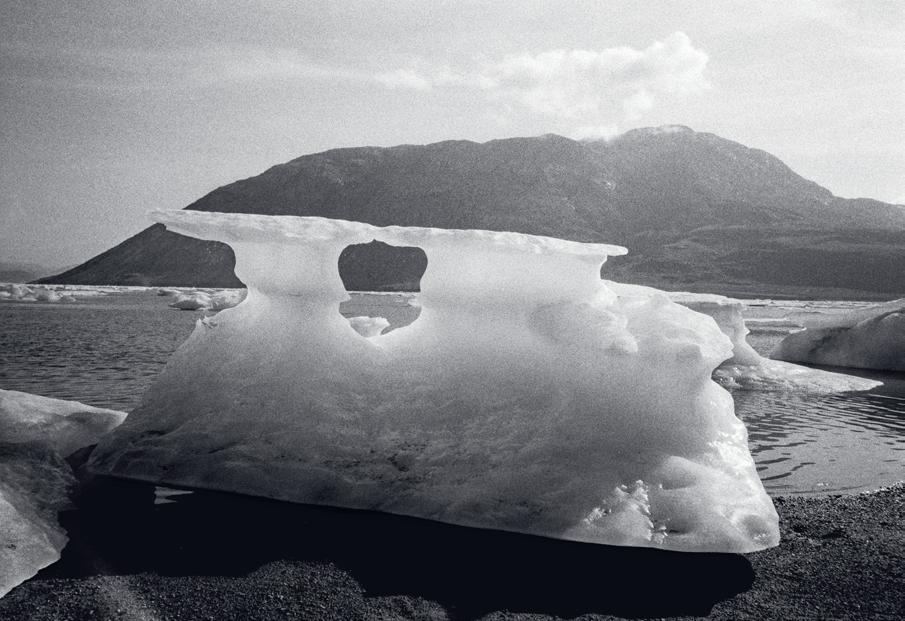
Igaliku, the bay ringed by icebergs the size of houses. He moved from iceberg to iceberg with the scrutiny of a scientist. Searching out the key profiles he made the necessary photographs. Sometime in the future these numerous fragments, in an ever-expanding jigsaw, would be pieced back together again. He had read that scientists believed
Antarctica to be the central mass of Gondwana, the ancient mother continent from which all others separated. They had been torn apart, island continents, gigantic, their rupture too big to be perceived. Around the polar margins this rage still stirred, and even when still, the silence felt like a groan. In the retort of the carving ice and the 3,800 million years of sediments lying ribboned in the folds of Amitsoq Bay he sensed these murmurs, and all things were imaginable. He continued his work moving slowly and systematically until out of vision. Searching for Gondwanaland would in the end be the only way to spend time.
13 July
Talus seeped into the corners of the eyes. Its slow encroachment crept at the speed that was felt. It would take six or more hours to reach the hanging valley. Looking back to Eqalorutsit Kangigdlit, the glacier piled out from between the mountains like a huge gaping mouth, all teeth, animal. Under the lip of the glacier where the river ran into the fjord, he could still see the bright red geodesic dome secured by steel wires, its presence and scale all shot to hell by the size of the glacier. A toy, it looked unreal, creepy, as if from another world. The rain was
Marianne North, Olana, Hudson, New York (1995)
1871
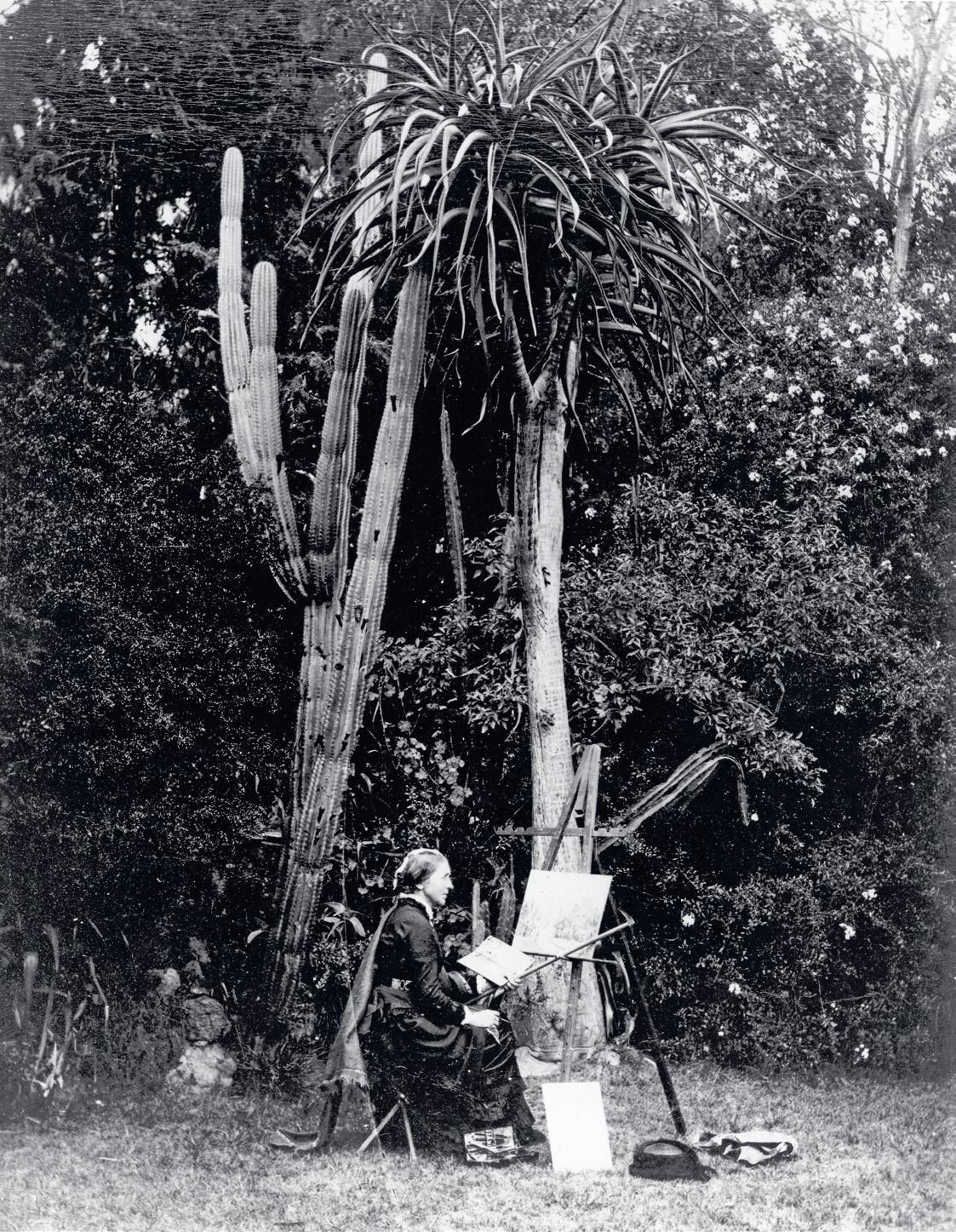
Marianne North is in America on a trip that takes her up along the northeast coast and into Canada. While in the Hudson Bay area she is invited to visit the artist Frederic Church at Olana. After missing the train and one or two other setbacks she arrives a day late, but the Churches are good hosts. Mr Church is particularly keen to show her the two white asses he has recently imported from Damascus. White and distinct like the icebergs he had cajoled in Labrador some years earlier, only this time with a different temperature – a warmth instead of bristling cold.
For Church, whiteness is a kind of luminosity, which is never pure white but rather the white of light or heat, whatever the case may be. But always it is luminous – a means of transmission that makes however precarious a substance out of space, through which things can move. Without it the air is full of holes and pockets of oblivion into which we fall. For Marianne North, white is more the texture and taste of vanilla. This is white from the other side, the inside, sweated out from within, where white is not to do with negotiation, but with the body and how its being is internally self-identified. Through such self-individuation we own our bodies. Here, white can be held and stored as stillness. This was where silence lay. But where now does silence reside in colour?
American white is luminous
Dutch white is strait-laced
Italian white is of the ghost
Spanish white can be knife-edge sharp and English white is like dew, a fleck of flake that drops away as soon as it is touched.
Siberia (1996)
I am back in Magadan. Again, sitting in the kitchen of Berman’s apartment. The television is placed on top of the refrigerator; the same system of stacking hot and cold found in hotel rooms in Cairns. Berman is a scientist working at the Institute for Northern Ecological Research in Magadan. The last time I was here in the summer of 1995 we travelled with a group to the tundra of the northern coastal plains: Pevek and the Chaun Estuary.
This time I am stuck in Magadan. Plans to travel on to the Kamchatka peninsula are stalled by the heavy snow. There are no flights and no one seems to have any idea when there might be one. Magadan under the snow is a different place to when I last saw it. Somehow its crude concrete apartment blocks become a kind of architecture, as they sit up square out of their footings of snow. No doubt a different place to the city Ronald Reagan referred to as the ‘arsehole of the world’, the hub that serviced Joseph Stalin’s labour camps. On Soviet maps, even the ones the scientists had used on my visit the previous year, the locations of the camps are simply identified by anonymous numbers, No. 23, 29 or 37. Those in the slave labour force living in these camps, manually working the neighbouring mines, the raw materials of which were then often shipped out of Magadan, were themselves no more than a number with a life expectancy of perhaps two years to then be replaced by another number. Yet here I am with time on my hands, a lot of hanging around, but that is a part, and often a good part, of travelling. For one travels to be disarmed, and sometimes in those hours, which either have their own time or no time at all, there is the opportunity to just gaze and be open. To register those small details that make up differences. For there is an edge where cultures meet and a second edge where the edges of cultures meet. This second edge – of often more fleeting and disconnected details – is sometimes more poignant and disarming. Moments can then appear to sneak around outside of time.
black moves easily and at times imperceptibly between material and metaphor. In his own writings Motherwell referred to the unexpected contradictory natures of black and white as pigments, which any painter knows well.2 Pick up a full can of black and it is far lighter in weight than all the other colours; pick up a can of titanium white and it is significantly heavier. For the painter, black begins light, taking on another heavier sense of weight as it becomes extended by use.
Kurt
Kocherscheidt:
Between the Wall and the Floor (2004)
Sometime in about 1988, while browsing around a bookshop I came across a small publication concerning the influence of Romanian wooden church architecture on the sculpture of Constantin Brâncuși. The next day, without reading it, I posted the book to Kurt Kocherscheidt. A few days later he called me and during our conversation asked why I had sent it to him. I cannot remember the reply, but it was brief, and we quickly returned to talking about other things. Although when we met, Kocherscheidt and I spoke often about painting, that brief exchange on the telephone alluding to his own concern with sculpture was the only time we ever spoke about the matter. I always sensed that for him the wooden sculptural works were part of a private dialogue with himself as a painter, and that I should leave it as such.
I understand very little about sculpture; I never know how to come to it. With paintings I know where I stand. I like the relationship between a painting’s sense of frontality and my own peculiar frontality. Through that physical relationship of looking at, of being in front of a painting, I can sense my own being. Stepping backwards or moving forwards to look, shifting to the left or the right, I am always aware that the painting and I must at some point face each other: the painting and I must eventually come face to face. Sculpture, however, instead of focusing me leads me to disorientation. In circling a sculpture, I too begin to circle around myself and more often than not rather than finding focus and composure, I wander away from myself. Sculpture makes me restless. Paintings on the other hand give me a sense of my own body, give me back my body. Sculpture, and here I should say not all but most, would seem to steal it away from me.
It has often occurred to me in looking at paintings and sculpture that there are painters who think like sculptors and sculptors who think like painters; that there are sculptors who think flat, so to speak, but whose work comes out three-dimensionally. Here, I might recall some of Anthony Caro’s seminal works of the 1960s, such as Early One Morning (1962) or Yellow Swing (1966), sculptures
Morocco (2010)
I am back in Morocco; it has been many years. The first time, I left Liverpool from Speke Airport simply with the plan to travel. Rucksack, tent and walking boots, thinking I would be going north. Instead, the only flight leaving that day takes me to Malaga and from there I catch the ferry over to Melilla. Then travelling along the coast to Oujda before heading south to Bouarfa, then Figuig along the Algerian border. It now seems such a long time ago; the photographs I took then are still waiting to be processed. Still in their 35 mm small black plastic tubs. I simply did not know what to do with ‘Morocco’. But then it was the same with Italy back in 1967, looking at Giotto’s frescoes in the church of Santa Croce in Florence. I could have been staring at the moon, it all seemed so far away. There is the saying ‘what goes around comes around’, certainly for me this would seem to be the case.
So, I am back in Morocco rereading Paul Bowles’s novel The Spider’s House, the quintessential Western writer about Morocco. Like his fellow countryman Henry James, he used another culture to find himself. Used the foreignness of place to find a voice. Both Bowles and James harnessed distance to reflect on and to speculate as to what it means to be sensate in the world. Touching that brittle edge of identity and the loss of self within the unfolding mesh of circumstance. Both writers employed dialogue, the human voice, to think aloud, their characters voicing more than the prittle-prattle of conversation in order to express ideas. Often deep ideas with real philosophical undertones, and yet this is always expressed with ease, as if to say, ‘isn’t this how we speak with each other’? Larache; I have to get out of here, Chefchaouen that is. The plan was to stay two or three days, wandering around the town looking at the Andalusian influences, but it is overrun with Japanese and Chinese tourists. The next group we pass carry even larger cameras than the last. The town, which is not big, boasts three Chinese restaurants, and somehow reminds me of Dali in the southwest of
China. It has something of that laid-back, let it all hang out druggy feel. So early the next morning we leave, taking the bus south to Quezzane, then head northwest, arriving at Larache on the coast in the early evening. The coastal towns of Morocco are curious, a strange juncture of ocean meeting arid land. One minute you are standing on an almost deserted beach looking out to the sea, the next almost cheek by jowl with people in the medina. The air off the ocean carries an abrasive wind that is both refreshing and scouring.
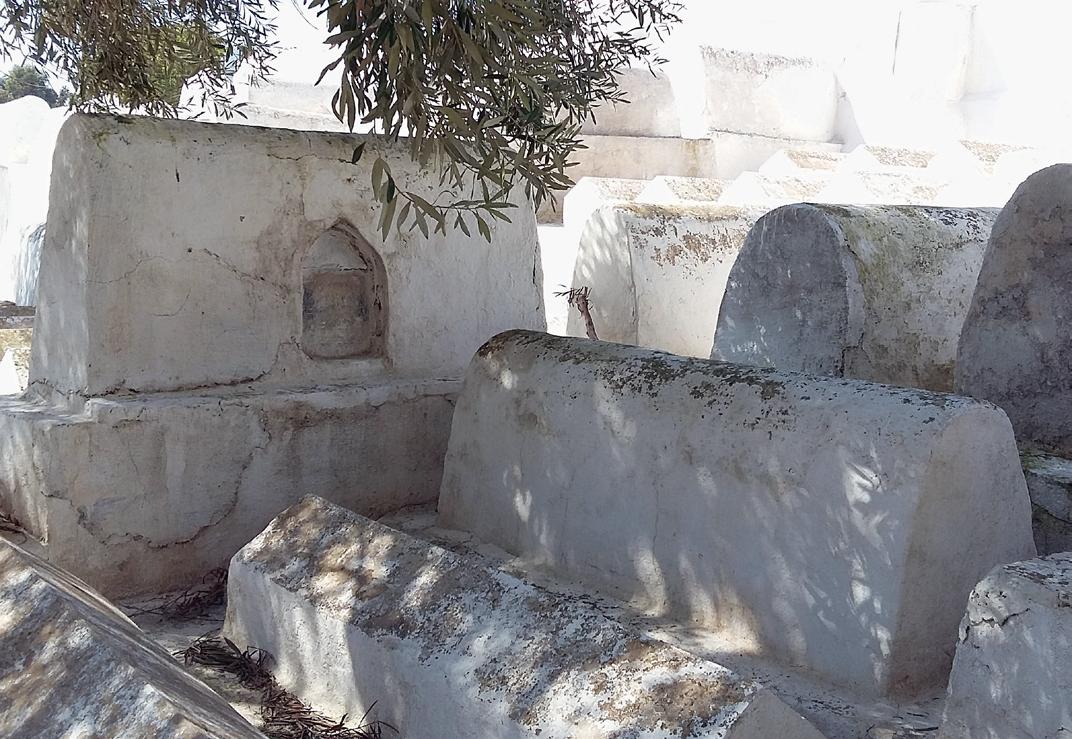
At the southern edge of the town overlooking the ocean is the Christian Cemetery. Jean Genet is buried here. I never read the essay he wrote, ‘What Remains of a Rembrandt Torn into Four Equal Pieces and Flushed Down the Toilet’, but how can one not smile at such irreverence.1 Or his suggestion that Alberto Giacometti’s sculptures should be offered to the dead and buried with them. Trapped in their apparent perversity, such ideas hold the kernel of what has become a forbidden truth. Touch a possible meaning in art that goes beyond the niceties and politeness of the norm, hark back to a more rudimentary, one is tempted to use the word primitive, justification for the making of art which usurps art’s incessant love affair with the museum. Later, in 2017, the Spanish writer Juan Goytisolo would also be buried in the same cemetery. Goytisolo spent many years living and travelling in the Maghreb. Like James and Bowles he too was self-exiled, except
Time and Time Again (2018)
If only he could hold meaning in his hands, he thought; if only meaning were that solid, had matter. Unlike thought that seemed so light, meaning had gravity, a sense of weight. Perhaps not easily measured, but nevertheless a weight and a form; it was graspable. He imagined taking a thought, any thought, folding it as he would a piece of paper, compressing it until it became meaning. Then holding that meaning in his hand, feeling its concreteness, its measure. Afterwards, then slowly unfolding it wide open again until meaning was no longer there, gone, and his earlier thought had reappeared. Or perhaps another thought, with which he could start the whole process of folding and unfolding all over again.
He wondered why meaning was always smaller than thought. What happened in the shrinking transfer from one to the other? Did the shift of thought to meaning open up another kind of gain? Or was that transfer with the passing of time simply the gaining of weight? He knew that time was important in this exchange, yet could not see how. Time was too big, distant, remote even, to be held in any space meaning might occupy. It was so much bigger than space. And anyway, time never settled, never committed to one place, it was always just passing through.
Time and time again, like his piece of paper, he tried to fold the thought, to give it weight. Compressed, it now had meaning yet strangely was displaced outside of time. He held it in his hand, feeling its weight, observing its form. Then slowly he began to prise open the parcel of meaning. Now open, he waited. Waited for time to become thought again.
He looked at the painting on the wall. Thought leant into meaning. It would change things. He did not know how. He could sense it changing shape, becoming more rounded. He would not rush it, no, let it settle. There had been a time when he would have. Not let things settle down first, that is. Now he gave into the lean. Felt its implied heft and mass. Up against it meaning became solid.
two differing worlds feel like separate parts of the brain. Two distinct possibilities as to what it means to be human, to understand. How could it be otherwise? The north goes from long, oppressive, cold winter nights, to summer days that never end. Days relentless in their stifling glow. Days to be shied away from. While further south one is invited out to meet the warm embrace of the morning’s light. The night will be welcomed in its own good time. We are made of where we stand in the world.
Where we stand in the world. So close and yet so far away. The raw edges of our being can either shield ourselves against what is out there or lay us bare. ‘Polish your eyeballs’, he said to me. Most of the time we see things through a haze. Just occasionally do things come into sharp focus, the eye crystal clear in its looking. Then the mind is free. We can see beyond what we already know. The painter looks, incessantly trying, usually in vain, to get to this clarity. To the point where meaning is not a given, but is to be newly seen, felt, as if for the first time. That strange reflection in the mirror is perhaps one point where the painter can begin to do this, to glimpse, to see, to paint and to know again for the first time.
Published as ‘Face to Face: Thoughts on the Self-portrait and Helene Schjerfbeck’, Royal Academy of Arts Magazine, no. 143, Summer 2019, pp. 46–51.
Published as ‘Face to Face: Thoughts on the Self-portrait and Helene Schjerfbeck’, Royal Academy of Arts Magazine, no. 143, Summer 2019, pp. 46–51.
Robert Smithson: Paterson (2019)
He leant the rucksack against a rock, slid his hand deep down into the side pocket and pulled the book out. Unable to face reading it in such an elemental landscape, or perhaps more accurately, rereading it while spending days trekking over the loose moraine, he knew what he should do. Bending down, he wedged the book between sharp rocks and then began to pile more rocks on top. Now buried, this seemed to him to be a fitting end to his engagements with Michel Foucault’s The Archaeology of Knowledge. 1 Somewhere he had read that Greenland is home to some of the oldest rocks known to man. Out there on the tundra would be an appropriate ending to what had been a long engagement.
As a young man several books had stirred him, suggested ways forward, signposted a road to take. Foucault’s writings, especially his thinking around monuments and documents and their ability to morph into each other, had been one such lead. Usually it was thoughts, or lines of abstract enquiry, which set him off. Not so much seeing other works of art, but ideas, or a simple thought, opening up clues suggesting the visible. These were enough.
iteration of the work at AUB as being in many ways a model. Just as an architect would make a model prior to the construction of the building itself. Except, following my usual practice, this procedure of making first the model and then the building has been reversed: the model came later.
A reinterpretation by definition is modified and simplified, becoming a model of that which it represents.
There is no master plan or floor plan for ‘Against Architecture’. Its construction evolves wall by wall, panel by panel, in the process of being built.
Matt’s Gallery, located on the ground floor of an old industrial warehouse, had one gallery entrance; one had to turn left to then enter a rectangular space with windows along one side. The walls of the space carried the random patches of paint, roughly filled-in cracks and holes and half-painted drainpipes left by the previous occupants. Except for one short wall, which had been specifically replastered for the installation, the space was rough and raw.
The three entry points and exits into the built structure of ‘Against Architecture’ led directly back to the gallery entrance.
At AUB there are four entry points into the gallery: the main gallery entrance, two further entry points via the passageway separating the main gallery from the lower gallery with doors at either end, with yet another entrance via the lower gallery. Only two walls meet as a closed right angle, otherwise the space extends into more general walkways. The installation ‘Against Architecture’ was built with multiple entry and exit points to reflect this, each ‘façade’ having a different feel. The gallery space is roughly square in plan and contains two large circular pillars as well as two narrower squaresection pillars. Painted white, the space has something of a neutral feel to it reflecting its role at AUB to serve as a study gallery.
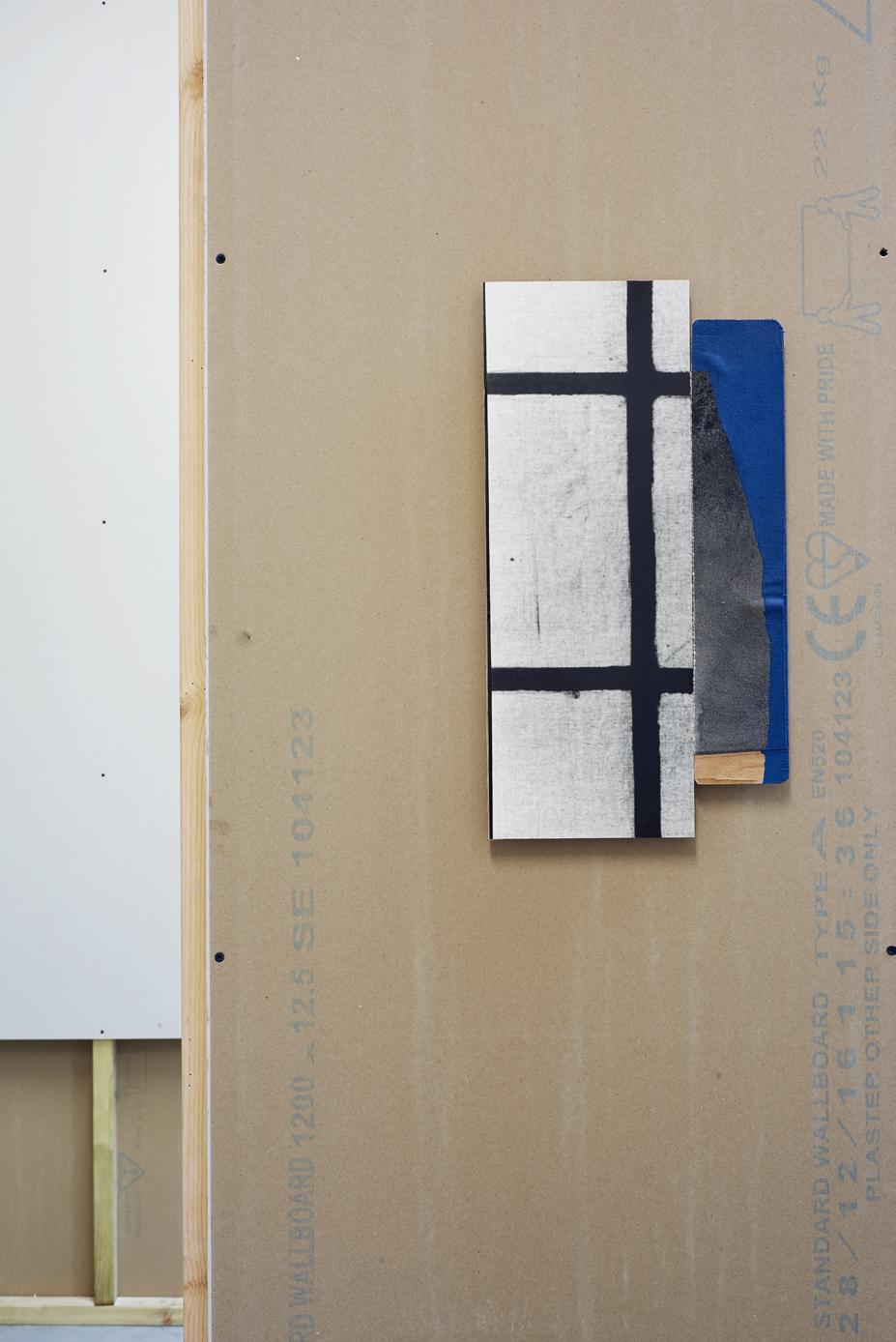
Conventional building materials, 3 x 2 inch (7.6 x 5 cm) stud-wall timber and sheets of 8 x 4 foot (240 x 120 cm) plasterboard, have been used in the construction of both installations. The working module for vertical open and closed sections in the Matt’s Gallery construct was the height of the sheet of plasterboard, 240 cm, while for AUB, the working module became 198 cm, the standard height of a domestic doorway.
Matt’s Gallery established a dialogue between the nature of the rough gallery space, the stud-wall construction and the pictorial language within the photo-painted panels. At AUB the structure of ‘Against Architecture’ functions more hermetically within itself, emphasising the notion of being modelled in a neutral space and establishing a conversation between the two differing languages of a supporting stud-wall construction and the photo-painted panels that are placed in it.
Published in Ian McKeever, , exh. cat., co-published by text + work, TheGallery, Arts University Bournemouth and Anomie Publishing, London, 2024, pp. 135–9.
Published in Ian McKeever, Against Architecture, exh. cat., co-published by text + work, TheGallery, Arts University Bournemouth and Anomie Publishing, London, 2024, pp. 135–9.
... And Now (2024)
The artist’s proximity to his work, the nearness of it. Where the line of separation exists and how to chart that gap which lets us enter. It is usual to chart an artist’s work through his life, the chronology becoming the works’ meaning. Of cause it is a safe bet: A follows B, followed by C. By this system we arrive at a coherence that transfers from one artist to another. We could call it art history by comparison. To step outside of this, avoid a prescribing system of some sort, is difficult. Even the most esoteric writing requires a preordained model in which to then place extended thought, this then, more often than not, reverting to a shoehorning. Who now reads Bernard Berenson, Roberto Longhi or Adrian Stokes? It would seem the artist has relinquished, has had taken away from him, all capacity for the work to be seen outside of or beyond his biography. Thinking, writing about art, has become an exercise in rudimentary history, general knowledge and basic geography. There has ceased to be the critic or writer who understands that art is an abstraction, existing outside of the general state of things. Instead, the artist is now trapped in his biography. It matters little if he would have the wings to fly. The critic, the curator, will keep him tightly tethered to the ground, or held prisoner within a model of their choosing. Art has never been so easily assimilated into popular thought. One could say the artist has been flayed, his skin stretched out across the surface of our culture for all to see. And his body, the spirit inside him, well like the gods it has been superseded by the news and daily weather report, which, like the gods, we can choose to believe in or not.