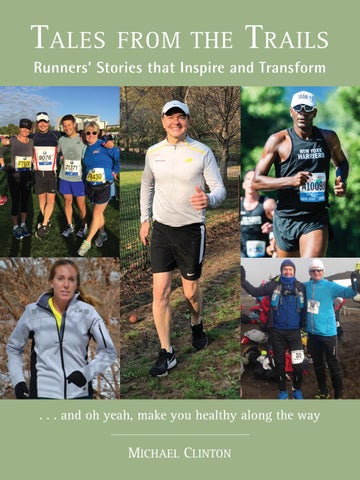
Tales
from the
Trails
Runners’ Stories that Inspire and Transform
. . . and oh yeah, make you healthy along the way
Michael Clinton
Contents
Foreword: Running Michael Capiraso................................................. 11 Preface: The Medicine of Running Jordan D. Metzl, MD..................17 Introduction: Ready, Set, Run Michael Clinton.................................. 21
See Michael Run..........................................................................25 Call Me Runner.................................................................................................27 What Makes Gambrelle and Vincenzo Run?...................................... 31 BFF or BRFF (Best Running Friends Forever)....................................35 Time to Run for Your Life...................................................................39 Running in the Good Air.....................................................................43 Dealing with the Big D (Disappointment)..........................................49 The 3-Day Roundtrip to an Australian Marathon.............................59 Business Decisions (On the Run).........................................................65 Mongolia Madness...............................................................................69 Move Over, Penguins, Marathon Coming Through........................... 81 The Irish Surprise.................................................................................87 An Interview with my (Running) Sister.............................................93 NYC: My Kind of (Running) Town......................................................97
See Michael’s Friends Run................................................... 103 Running with the Dogs Steve Sharp................................................ 105 Meditation Movement Emily Mingenbach-Henry.............................. 109 Diplomacy on the Run Amir Arasta................................................ 115 Running Through Life Jean Chatzky................................................ 121 The Road to Recovery Marc Metrick................................................125 You Could Meet the Love of Your Life George A. Hirsch................ 131 Running Exposed Kelly McLay.........................................................135 Life Is Full of Choices: I Chose to Run Michael Rodgers.................143 When the Finish Line Is Just the Beginning Joe Suntharaphat......153
Track Time with Dad Ilse E. Abusamra............................................159 The Mountain, Marathons, and Me Keith LaScalea........................163 Know Your Why Lucy Danziger........................................................177 Freedom Run Mariusz Szeib..............................................................187 My Years of Magical Running Joe Brereton....................................195 Step Forward in Faith Chris Heiert..................................................203 Running in Color Coach Jenny Hadfield........................................... 207 Oh, the Places You’ll Go Paul Gavriani............................................ 211 42 (K) Running Tips Coach David S. Abusamra................................223
Appendix: See Yourself Run...............................................227 Index...................................................................................................237 Acknowledgments..............................................................................240
TA L E S F R O M T H E TR A I LS
Call Me Runner
Someone once asked me, “When did you start running? And why did you start running?” I was in high school, and it was a reaction to something completely unrelated to a desire to pursue track-and-field or cross-country. In fact, running the streets in my neighborhood wasn’t even a thing. I don’t think I ever saw one person do it! Nor had anyone in my family ever run. The whole idea was a foreign concept. The beginning was based on the realization that in my city high school in Pittsburgh, the go-to sport was football, and there was no way I was ever going to be able to compete with the big sons of steel mill workers who dominated that sport. I’m not so sure I even had an inherent interest. In the neighborhood, we either shot hoops or played softball or volleyball. My crowd wasn’t the football jocks. I’m not even sure how I heard about the cross-country running team, but somehow it sparked an interest in me and I decided to check it out, as I wanted to participate in some type of sport. The idea of being outside in the park near school, as well as traveling to different places around the city to run, had a curious appeal to me. The school issued T-shirts and shorts that all seemed too big, a far cry from today’s high-tech and sleek running gear. The shoes were also very basic. Nike wasn’t even a company yet, and who knows what brand we actually wore in those days. Our coach, also an English teacher, taught us how to move our bodies, how to breathe, and how to develop a stride. All I can remember is that it seemed like a very natural movement for me. It was all pretty basic, unlike the analysis that people go through today to examine how they run so that they can develop their technique. I was never fast nor did I rack up any championship time, but I enjoyed the feeling of it, and it was the beginning of what would become a lifetime pursuit that brought me both emotional and physical enjoyment. Over time, I saw it as a way to take breaks from college exams or deal with anxiety and stress. But my running was occasional with no real goal in mind. It wasn’t until I moved to New York City that my running life took off. A part of it was a byproduct of being in my early twenties with no money for a lot of extras; all
26
27
TA L E S F R O M T H E TR A I LS
you really needed was a pair of shoes and some gym clothes to be a runner! I began to run different distances, learning that if you could run three, you could run five, and if you could run five, you could run eight. It was just a matter of building up the stamina. Finishing my first six-mile run ever, while my friend Barbara bicycled beside me, seemed like a major breakthrough. We were both astonished that I had actually covered that huge amount of distance! Running along the East River or in Central Park gave me a firsthand look at my new city and all of its excitement. I made new friends who were also figuring out what their adult lives would be like, and some of them are still friends today. Forty years later, I still love running around New York, as it provides me with a never-ending spectacle of all kinds of people and scenes, a live video in motion. Whether I run up the West Side to the George Washington Bridge, downtown to the tip of the island, or across to Brooklyn, I am never bored. In fact, running has also become my best way of seeing the world. In traveling to more than 126 countries in my life, I always have my running shoes with me. It has allowed me to run the streets of Stockholm, the parks of Munich, along the Seine in Paris, and more. I’ve run on the beaches of Mozambique, the hills of Corsica, and the mountains of Mongolia. There are challenges, too. The air quality in Beijing can cut a run short, as can venturing into certain neighborhoods in Cairo or Tunis that might not be safe. Then again, those kinds of neighborhoods exist everywhere. The key is to always have some sense of your course before you head out into the unknown. I tend to ask advice from the locals or try to contact a local running club or running organization when I travel.
I began to run different distances, learning that if you could run three, you could run five, and if you could run five, you could run eight. This is a great way to meet people who love to act as tour guides, too. I’ve learned about places like Sarajevo and Cape Town by connecting with runners in those towns. But even if you go it alone, seeing a city at street level, through neighborhoods and parks, will give you an appreciation for a place. The sights and smells and sounds are more magnified, and people are inherently friendlier, as they wave and smile as you pass by. I never set out to become a marathoner; that too happened by chance. As I ran longer miles in New York, I became aware of the running community, as well as the New York Road Runners. Marathoning was just emerging as a phenomenon in those days, and at that time, I was working at a sport magazine and had the opportunity to
28
S E E MI CH AE L RUN
meet running greats like Frank Shorter, Greta Waitz, and Bill Rodgers. They became my heroes and ultimately inspired me to sign up for my first New York marathon. Well, the truth is that, in 1978, I ran as a “bandit” in my very first marathon. I didn’t have an official number—those days, it was easy to get to the starting line without one, as well as cross the finish line. In total, there were only 9,875 marathoners that year. It was also the year that Grete Waitz set a world record for women and subsequently went on to win nine New York Marathons, becoming a running hero to all of us. The running boom was in full swing, and being a part of it was exhilarating. In those days, there were rudimentary training schedules. A lot of the science behind it hadn’t been developed yet, and we didn’t eat energy foods or sport drinks. We just, well, went out and ran and drank some water along the way. I still tease some of my friends who seem to always have a collection of energy bars and jells strapped to their fuel belts, which are filled with sports drinks. God bless, if it works for them. For me, it’s still a few sips of water along the way, no food and no energy boosts (which upset my stomach). However, one trick I did learn is to eat boiled potatoes during a long run. They are a great natural energy boost. I went on to run several New York Marathons (with official numbers) and then didn’t run another marathon for thirty years! Throughout those years, I had run countless 10ks and half marathons, but really hadn’t been interested in marathoning until my sister Peg challenged me to run her first marathon with her. I just might have one more in me, I thought. During that time, I had experimented with triathlons, but the swimming never appealed to me. As I started to focus on the training for the marathon, I fell in love with long-distance running all over again, particularly as I did my fifteen-, eighteen-, and twenty-mile runs. We chose the London Marathon as our first, one year out from the challenge, because it was my sister’s birthday week. The night before the race, we went to a Runner’s World party and met a man who had run all seven continents, and I was inspired. It spawned a marathon reawakening in me, ultimately leading to running my own seven marathons on seven continents (yes, including Antarctica). Once I landed on this goal, I challenged my sister to join me, as well. Ultimately, we ran six of these together in Buenos Aires, Kilimanjaro, Toronto, Surfer’s Paradise in Australia, and Mongolia (since we wanted to add an adventure race to our list). The London race was an incredible spectacle of people and celebrations along the route. The city is all decked out to welcome the more than forty thousand runners who descend on the it every spring. Along the route, I was joyous. How had I forgotten how much I loved running a marathon? My sister crossed the finish line and burst into tears of elation. Anyone who has completed their first marathon can relate.
29
TA L E S F R O M T H E TR A I LS
During our travels, we met amazing people from all over the world, but a group that traveled to Antarctica was the most unique. Twelve of the eighty-six runners on that trip completed all seven continents. We were now proud members of a group of fewer than one thousand people who had completed that goal! In my mind, that feat established me as runner extraordinaire! I’ll tell some of the stories of my experiences chasing the seven-continents dream, as it will be with me for the rest of my life as one of my best achievements. When I meet other runners, there’s always a spark of connection. We share stories about our races, our injuries, and our goals. Some are hoping to run their first 10k, and others are working on fifty marathons in fifty states. But wherever they are in their running lives, I continue to be inspired by so many of their tales that the idea of compiling many of them into a book came to me (of course, during a long run). Hopefully, you, too, will be inspired by so many of the tales told in this collection of runners’ stories, which are also life lessons to be shared, even with non-runners.
In traveling to more than 126 countries in my life, I always have my running shoes with me. I’m not sure when I started to call myself a runner. It’s a part of my identity and is as natural as sleeping or eating. It’s a part of my existence, tightly woven into my being. When I’m asked to describe myself, I’ll often times say that I’m a long-distance runner. I always get an interesting response like, “Is that what you do for a living?” Some people start to run in high school, but others start when they are in their sixties. The beauty of the sport is that you can start at any time, assuming you are healthy and motivated. All it takes is the curiosity. Ask a friend to join you or just go out on a local trail and meet other runners. Start with a mile, even if you have to walk part of it. Like many runners, if I go three days without a run, I feel cranky and overweight and unhappy. Even if I’m feeling tired or unmotivated, I know that once I get out there, I’ll feel euphoric. It’s my natural therapy and way to relax. It helps me make decisions, overcome disappointments, and build dreams for the future. It’s also my own connection to spirituality, as I take in the beauty of trees and parks and lakes, always in awe of God’s creation. So, call me Runner. My wish is that I’ll be able to do it ‘til the end of my days.
30
What Makes Gambrelle and Vincenzo Run?
What makes Gambrelle run? What makes Vincenzo run? What makes anyone run? It has always intrigued me that some people are just downright passionate about running while others don’t understand why anyone would want to run at all. After all, isn’t running tedious and painful and doesn’t it cause injuries? So, I set out to ask any runner I could find just what motivates them to run. It wasn’t a scientific study by any stretch of the imagination, but rather an anecdotal social survey to see if there are common answers or as many answers as there are people. My first request was a simple one: just give me one reason you run. My friend Amir, who has run fifty-five marathons, likes to say “because I can!” His running career took off years ago as a way to cope with a divorce. He has run all over the world, including a marathon in Tehran, Iran, an adventure that he writes about in this book. Like many people, Chuck runs to give himself mental clarity and to escape from his phone and devices. Running makes him feel younger, especially when he focuses on a younger runner on the trail with the goal to outpace him! “I always finish a run with a short sprint to the finish, even if it’s fifty yards out. Sprinting uses a different set of muscles and fast twitch muscles are key as you age,” he said. Like Chuck, the answer that I always give to anyone is: “It’s my therapy.” It’s true that being out on the trails or roads or parks has a way of letting me shed my anxiety, my stress, the issues that I’m dealing with at any given moment. But that’s just me. Tom ran for the first time when he went on a “jogging date” in the 1970s. It started a lifetime of running that was his impetus to stop smoking, find his carbohydrate burner, and create his own personal temple that he used for praying while running. On the morning of 9/11, he was running around Central Park’s reservoir and found out about the tragedy when he stopped at a local bakery. To this day, when he is rounding the north end of the reservoir, he has a special thought for those lost that day. The longest Tom has ever run is seven miles during a 10k that was improperly measured, and he has no real interest in running any distance beyond that. He has running dreams, where he
31
TA L E S F R O M T H E TR A I LS
Running with the Dogs Steve Sharp
In Los Angeles, there were two runs. To my north, four miles of sandstone bluffs, over manicured grass, gravel paths, and under palms. To my south, five miles of sand, level and firm as the ocean would make its retreat. Then I moved to New York. Again, two runs were found. First there was downtown: Solitary Sunday mornings. Quiet streets and closed shops. A feeling as though the city were mine alone. Then came Central Park. Joining that endless procession of runners at dusk. Darkening treetops framed by buildings brightening behind. My childhood sports hero came to New York for a tournament every year for many years. In an interview, he once said that Central Park can teach you everything you need to know about life. At that time, I had not yet seen Central Park, but this stuck with me. One day, after all those days of running, of running alone, of running to outrun myself, I got a dog, and the running changed. Gone were the sacred Sunday mornings, the evening vigils in Central Park, replaced by a hunting dog, a rope between us, and that dragged-across-concrete feeling. Barley is a Wirehaired Pointing Griffon. This as a name sounds fancy, but as a dog is anything but. The American Kennel Club describes Wirehaired Pointing Griffons as the supreme gun dog, known to thrive in both extreme weather and extreme terrain, and with the endurance of a marathon runner. Perfect for the West Village. That first Winter, living downtown, we ran as best we could, Barley and me. Terrorized squirrels in Washington Square Park. Outmaneuvered park cops along the Hudson River and angry parents in sad city playgrounds. Until one day, I heard mention of off-leash hours every early morning at Central Park. And so it was, on that very next Saturday, a fine spring morning, a man and his supreme gun dog arose at first light, and leaving downtown for uptown, a new world opened before them. If someone just came upon Central Park, I suppose they would assume that it’s a bit of Manhattan island preserved. But having read just a little of its history, I knew the opposite was so. Fifteen years and the labor of thousands turned rock and swamp into
104
105
TA L E S F R O M T H E TR A I LS
the artistic vision of two men. A vision of varied scenes, a collection of canvases. Some in harmony, some in discord. I won’t ever forget that first morning when, together, Barley and I came upon Central Park. I’d never seen it under an early morning light. Standing on Umpire Rock, two kings looking for a Kingdom. Fleeing an Egypt behind us to conquer a Jericho before us. Following Barley, I would break free from the unbroken chain of runners. An endless circle trapped within a rectangle. Asphalt would be traded for grass and rocks and streams. The rhythmic shuffling of feet would be replaced by racing and jumping and stopping and looking. The known would be tossed aside for just a little bit of unknown.
One day, after all those days of running, of running alone, of running to outrun myself, I got a dog, and the running changed. First, past a placid Shakespeare, Sir Walter and Robbie Burns, we ran into The Mall. Under its cathedral ceiling of American elms, with Barley racing over green lawns. Crashing down stairs, and for a moment into darkness, but under a glittering ceiling, then out and onto that sanctuary of open sky, Bethesda Terrace, where tourists laughed, and the Angel of Waters disapproved as Barley dove into her baptismal font. Then to The Lake, smooth as stone, and along its north shore, deep coves encircled by The Rambles. Racing over Bow Bridge and lost into that landscape. A mystery of twisted and tangled forest, with its labyrinth of paths, of stairways and steps carved into broken bedrock. Now running upstream, emptying from an unknown above, and at last breaking free and onto Vista Rock, with a towering castle beside us, and lifting Barley so he can catch his own glimpse of The Great Lawn awaiting below. Now racing under cherry trees, bare and brown, and beyond the North Meadow to The Pool. Dark water on that morning but a deep bed of bright green on so many other. Following this same water as it emptied into a ravine. Jumping down steps of bedrock. Under a stone arch, around a bend, and lost into a forest of streams and stones and swamps. A great fallen tree. A single duck moving over thin water. But then aflight, as Barley crashed into The Loch. South now and running for home. Across the slope of Cedar Hill. Perfectly graded for summer reading and winter sledding. But at all mornings of all seasons somehow perfect, too, as the city’s biggest congregation of dogs and dog-owners. Both of all
106
S E E MI CH AE L’ S F RI E N D S RUN
shapes and sizes, but impossibly all of only one mood: friendly, maybe even happy. Despite the harsh reminder of the city still resting in plain view. From that first morning, and on the many mornings after, I have seen all that Central Park has to offer. Time and time again. Yet on every morning run, every time, the lessons keep on coming. Like a great art gallery, where there is something new to discover, something new to learn, each time you go. But I know that without Barley, I would not have learned these lessons. As I know that without Barley, I would still be running the same. Running to outrun myself. Running along the path well-traveled. Maybe Central Park really can teach you everything there is to know about life. But for me, the real lesson was found in running with a dog.
Steve Sharp is a media executive. Barley is a squirrel executive. Together, they’ve run in parks from Milan to Toronto to Monaco. But they’re both happiest on sunny Saturday mornings in Central Park.
107
TA L E S F R O M T H E TR A I LS
slower than my 20-mile training run. As I crossed the finish line, music off since mile 23, I could hear the roar of the crowd, all of it euphoric, all of it as I imagined. The one feeling I didn’t see coming was, “Now what?” Any runner knows what that means. That question is why very few people only run one marathon. I trained harder for the next one, this time for speed. I finished faster but missed my goal. You know what that means, right? This was sort of a windy story, and I’m sorry, I’m not a writer. But I wrote this on an airplane flying back from a business trip to Paris. Just this morning, at 6 a.m., I ran down the Avenue George V, over the Pont de l’Alma to the left bank, down and around the Eiffel Tower, back up the left bank, up and over the Seine by way of Pont des Arts into the courtyard of the Louvre, out through the Jardin des Tuileries and back to my hotel. All I can say about that run is that I knew what I was going to write as my feet hit the ground for the first step into my run; it was like hearing the bottle open, even after all that time, both marathons, 110 pounds of weight loss, 4,169 miles logged, and 2,739 days of sobriety.
Marc Metrick, forty-five, is the president of Saks Fifth Avenue. He resides on the Upper West Side of New York City with his wife, Deborah, and sons, Harrison, fifteen, and Charlie, ten.
130
You Could Meet the Love of Your Life George A. Hirsch
As spring 1988 approached, I and many other New-York-area running fans, began looking forward to the 1988 US Olympic Marathon Trials. The competition was scheduled to take place in April, with a beginning and end at Liberty State Park in New Jersey, just across the Hudson from Manhattan. That meant we could easily gain spectator access to what many believe to be the most exciting race in America. Some of my friends planned to run the open marathon, but I hadn’t gone the distance in four years nor trained for it, so I gave no thought to entering. I was psyched about the Trials marathon. As the April date edged closer, our anticipation grew. Since I would be doing commentary for NBC at that summer’s Olympic Games in Seoul, the Trials represented an important research opportunity for me. I had homework to do in New Jersey. It was a time for focus, attention, and analysis. I didn’t think for a moment about love. But life is so spectacularly unpredictable. The day before the Sunday morning race, I joined several of my Runner’s World colleagues at our booth in the race expo area at The Meadowlands. We were selling books and magazines, but mainly enjoying the chance to make new acquaintances and renew old friendships. Every Trials marathon brings out the most faithful—the runners and spectators who care deeply about US running and the Olympic Games. I’m one of those. I had attended my first Olympic Games in Helsinki in 1952 and have been to many since. My life is filled with other interests and activities, but few make me happier than attending an Olympic Trials or Olympic Games. I think you get the picture. I enjoyed greeting every passerby at the Runner’s World booth. When Frank Shorter showed up, we fell into an elaborate discussion about the next day’s marathon strategies. Who might go out fast and hard? Who would hang back early to save himself for a late charge? How would the American runners fare against their worldwide rivals in Seoul? Frank and I have done this sort of analysis so often that it’s like talking about the weather forecast. We ended our conversation by setting a dinner date for that evening.
131
TA L E S F R O M T H E TR A I LS
I felt equally as engaged when chatting with a Runner’s World subscriber I had just met for the first time. I was deep in conversation with one when, out of the corner of my eye, I spotted a dark-haired woman who paused at the booth. I had never seen her before but was immediately struck by her beauty, especially her radiant blue eyes. We looked at each other briefly—and I know how this sounds; it sounds way too much like a cheesy Hollywood moment—but there was an instant connection between us. It was palpable. Then she continued her stroll through the expo. And all this while, I was still talking with the magazine subscriber.
Start slowly. Run a minute. Walk a minute. Do that five times, then ten times, and reduce your walking breaks. Keep a running diary. As soon as that conversation ended, I hurried down the crowded expo aisles, looking for the radiant woman. After a few twists and turns, I spotted her and made a beeline to her side. “Hello,” I said. She was briefly startled, but then returned my greeting, and asked, “Are you George Hirsch?” Even if I hadn’t been, I would have answered in the affirmative. I was just hoping for an opening that might lead to something more. Lucky for me, she got things rolling. It turned out we had a mutual friend, and several months earlier that friend had asked me to supply a training plan for a first-time marathoner—the very woman I was face to face with now. Her name was Shay, and she simply wanted to thank me for sending along the marathon plan. She had followed it to a T, she told me, and was looking forward to testing its merits in the next morning’s marathon. “What’s your goal time?” I asked, relieved to have such a simple conversation subject. Like all marathon novices, she answered, “I’m just hoping to feel good and go the distance.” She hesitated for a moment, and then continued the thought: “If things go well, maybe I can run New York City in the fall, and try to qualify for Boston.” I should have responded with a few encouraging words, but the only thing that came out of my mouth was: “Would you like to have dinner tonight?” (Yes, I had already made plans with Frank Shorter, but we’ve been friends long enough that I knew he’d understand.) Shay said no, she had to get home for the evening. I was disappointed but didn’t give up, offering to walk her through a drizzle to her car in one of the mammoth parking lots. When we reached the car, wet and chilled, I asked if she would drive me back to the
132
S E E MI CH AE L’ S F RI E N D S RUN
expo. I wasn’t that concerned about the rain; I just wanted a few more minutes with her. The next morning, I pulled on a T-shirt, sweatpants, and my training shoes and went looking for Shay at the start line. The weekend had begun as an Olympic scouting mission. Now I had something entirely different on my mind. I watched the several hundred Trials racers take off, and then turned my attention to the open marathon with its three thousand participants, which started fifteen minutes later. I scanned the throng several times for Shay, but that proved futile. There were simply too many runners dressed in too many different kinds and colors of clothing. That left me only one alternative: I walked to the back of the crowd and, after the starter’s gun, I jogged across the line behind everyone else. Last place, that was me. I was reasonably fit, thank goodness, and figured I would run at a slow steady pace until I caught up with Shay . . . somewhere along the course. As I ran down the middle of the road, I spent so much time looking left and right that I worried my neck muscles might start cramping before my legs. But I was rewarded for my effort. After about five miles, I spotted Shay. She was running solo, deeply absorbed in her tunes, and seemed to be moving along smoothly. Until I sauntered up beside her. “Hi. How you feeling?” I asked as nonchalantly as I could. She was startled, needless to say. It took her a moment to find a response. Then she blurted out, “What are you doing here?” “Well, to be honest, I’m looking for you,” I said.
If you’re just starting to run, the first thing is to get a good pair of shoes. Spend time at a running specialty store to get some good advice. My candor might have scared her off, but fortunately didn’t. It was a damp, windy day, and she was probably happy for the company. We fell into step, side by side, and began telling each other our life stories. The next fifteen miles flew by faster than any other run I had ever taken. Just past the twenty-mile marker, the point of the infamous Wall, she said, “I’m getting tired.” I’m not sure what she wanted from me at that moment. Maybe some cheerleading. Maybe she wanted me to say, “Only six to go. You can do it.” Or: “It’s all downhill from here.” But for some reason, that’s not what came to mind. While I definitely wanted to
133
TA L E S F R O M T H E TR A I LS
help Shay finish her marathon, the words that tumbled out were: “You’re supposed to get tired. This is a marathon.” In retrospect, I’m lucky Shay ever spoke to me again. I remember that our chatter closed down the last six miles, as she turned inward to summon the grit she needed. We slowed a little but kept chugging onward. Eventually we saw the finish-line banner just ahead in a grassy field. Since I wasn’t wearing a race number, I stepped aside before the finish and melted into the spectators. Shay disappeared, too, but into the crowd of happy marathon runners who had successfully completed their day’s business. I held onto my last view of her. As she passed under the timing clock, it read 3:37:01—a Boston qualifying time. Then she was gone. The next morning, it took me twice as long as usual to hobble the fifteen blocks to my office in midtown Manhattan. I was headed for a second cup of coffee when my phone rang. It was Shay. She was calling, she said, to thank me for helping her through the marathon. The rest, as they say, is history. The following year, Shay Scrivner and I got married at The Boathouse in Central Park. That morning, several dozen friends had joined us for an “I ran with Shay and George on their wedding day” jog in the park. And we all have T-shirts to prove it. I have run more than forty marathons in my life, in more than a half-dozen countries. But whenever someone asks me to name the most memorable, I don’t have to think about it at all. I always answer, “That’s an easy one.”
George A. Hirsch, chairman of the New York Road Runners, is a founder of the New York City five-borough marathon in 1976. He has run forty marathons with a personal best of 2:38 in Boston at age forty-four. Hirsch is the founding publisher of New York magazine, the long-time worldwide publisher of Runner’s World, and was the first publishing director of Men’s Health magazine.
134
Running Exposed Kelly McLay
I graduated from a reputable college youthfully invincible, knowing great things were in store. And they were; only the path to greatness was entirely unexpected. The next few years were defined by chaos physically and emotionally, and I was not prepared. For two years, this intense rollercoaster churned undiagnosed. I had no idea what was going on. My behavior was erratic and irrational. I was happy. I was sad. I was tired. I was snappy. I was surging hot only to become soaking wet and freezing cold. I constantly tried to ground myself, but the world kept spinning. I felt crazy. I am, a little bit, but this was out-of-control crazy. My friends and family would define these times as my “hot mess” years, and rightly so. It wasn’t pretty. I wasn’t bleeding profusely from a gaping wound, but this was not me. After a year of gaining almost forty-five pounds, hibernating daily, and finally seeking a second opinion from a physician who would listen, I received the diagnosis. I had gone through menopause. I was twenty-four. Your twenties are meant to be a little crazy, right? Filled with newfound income, city life, parties, sex, alcohol . . .not night sweats, mammograms, and kegel balls. Friends were out partying, avoiding pregnancy at all costs, and I was desperately trying to hold onto any last flicker of fertility. My mind couldn’t digest the full magnitude nor was my body capable of coping. I neither fit in with the twenty-year-old hysterectomy cancer patients nor the fifty-five-year-old menopausal likes of my mom and her friends. Okay, I did attend the play “Menopause” with them at twenty-five, and it was the most awkward and amazing night for me with this group of women who carried me under their hot, sometimes sweaty, wings. But laughs aside, a part of me had died. My womanhood, my female privilege, my future dreams, my physical youthfulness . . . gone. I had always wanted kids, several, and that was gone. My heart broke and so did my body. Guilt consumed my heartache, because this wasn’t a death sentence, but trying to rise above the physical and emotional scars to control this imbalance felt hopeless. That year, and many years to follow, were filled with confusion. And wine. A lot of wine. Maybe too much wine. The spontaneous, athletic, social, outgoing, fun-
135
TA L E S F R O M T H E TR A I LS
42 (K) Running Tips Coach David S. Abusamra
• Run first thing in the morning. Easier to schedule, sunrise, fewer cars, cooler weather in the summer, more animal sightings, but most important, you have the rest of the day to live your life (and to do double sessions, should you want). • Drink one to two glasses of water upon waking. • Be existential in your running: define yourself by what you do, not by what you say you’re going to do. Think: “I’ve done 3 of my 8x800,” not “I’ve got 5 of my 8x800s to do.” • Workouts on a track build so much discipline. On hot days, throw ice in a cooler, add cold water, and a hand towel, and enjoy the relief after every repeat. Even though the best rest between repeats is a slow jog, hot, humid days call for this icy relief. • Accelerations or post-run sprints should be considered part of the workout, not an addition to it.
“Remember that running is a process, and that progress is not linear, so patience is a must.”
• Embrace the freedom running provides by not using devices in your ears. Instead, finetune your senses as you run. This is also a personal security issue. • Run without a timing device at times. Discover your limits. You may very well surprise yourself. Try racing without one, as well. Remember that humans have more endurance than other animals. • Develop a sense of “play” in your running. Run your favorite route backward. See how many falling leaves you can catch in the woods or how many buildings you can touch in a predetermined amount of time. • Incorporate backward (and do this uphill) and side-to-side running to utilize muscles you don’t normally use while running. • A workout on a piece of paper or on a screen is not cast in stone. For various
222
223
TA L E S F R O M T H E TR A I LS
reasons, you should evaluate yourself at the time to determine if changing or delaying it makes sense. As well, once you start said workout and realize it’s not going well, have the fortitude to save it for another day. • Most people follow the “hard day-easy day” schedule. Yet, there is merit to going “hard-medium” two days in a row. Or, by following up a race with some timed repeats with a cooldown before and after. • Add lots of garlic, turmeric, and cinnamon to your food. • Balance on one leg at a time. More advanced: do so with your eyes closed. Use machines with one leg or arm at a time. • Fartleks are a great workout to do with others. Take turns calling out the next sprint, such as to the second telephone pole, or eighth house, or third mailbox. Someone chooses the number of pushups or reverse pushups on a park bench, or a backward run up a hill, or karaoke, or . . . • Run “in the moment.” • There’s a cold, driving rain outside and it’s time for your workout. That voice inside your head is making up all sorts of excuses. Thwart those voices by dressing appropriately and simply go out the door. Accept the weather (even welcome the stinging rain on your face), and think about the hot shower that awaits. But more importantly, think about the sense of accomplishment you’ll get from your “run in the elements.” • Take risks. Do an extra repeat; go an extra fifteen minutes or three miles; do an extra set of burpees. Believe that these mini-challenges may lower your PR by a few seconds and strengthen your mind in addition. • Run in the woods on snow. Enjoy the utter silence as you notice the animal tracks. No woods? Be the first person in your area to lay down tracks in the fresh snow. • Oil or Vaseline your legs in cold, wet conditions if you choose not to wear tights. • Explore new things and evaluate them as they apply to your own body. Calf sleeves, for example. Remember, you are your own person. What others do may not work for you and vice versa. • As you age, just being able to go for a run will sustain you. • Continue to do speedwork as you age. This will prove to be more and more valuable to your racing. • Set goals on three different levels, depending on the quality and quantity of work
224
S E E MI CH AE L’ S F RI E N D S RUN
performed. Identify your weaknesses to eliminate and your strengths to further refine. •D o progressive runs, as do the Kenyans. Start off almost at a jog, and ramp up your pace every mile. •W hen you’re in an unfamiliar area and want to run, but not carry your phone, just leave your starting area, such as your hotel, and take each first righthand turn. When you stop, just retrace your steps taking lefts. Then, play with all the possible versions deriving therefrom. You will make fun discoveries to which you can later return to explore. •S eek out natural resistance training places, such as on sand, snow, trails, and hills. High-knee lifting on snow will leave you gasping for air. Doing your own version of “Chariots of Fire” running is great, but first toughen the soles of your feet over time. It doesn’t take long for sand to excise layers of your skin. •S eek out unnatural resistance training places, such as parking garages, apartment building stairs, and stadium steps. • I t’s never a bore to work on your core. •Y our mind is the key to your running. So, train it. Attitude is everything. Remember that running is a process, and that progress is not linear, so patience is a must. Also, remember that running is not your whole life. Try to look at it holistically. • I f you count your miles as you train, try running minutes instead. If you run 7 miles at 7:00 per mile, run for 50 minutes instead. Don’t stay in a rut. •E xplore all the aspects of running: cross-country, road, trail, mountain, and track. •G ive back to your sport. Volunteer at a road race, help out at a local school’s meet, work with club runners, etc. •F ast-Wave Workout (from a magazine article years ago): It’s a quick, hard workout when you have only 45 minutes and the weather is poor. Ideal for a track or a large field with marked distances. Begin and end with 10-minutes of easy running. Every 400-meter lap can be divided into 100-meter segments. Define “hard” (h) as 85 to 90% of max, and “easy” (e) as 50 to 55%. Thus lap 1 could be 200h 200e; lap 2 100h 100e 100e 100h, lap 3 300h 100e, etc. until the 25 minutes are over. •L ift weights. •L og your workouts: date, weather, venue, time of day, how you felt, splits, etc. •R un where machines can’t go.
225
“ You were born to run. Maybe not that fast, maybe not that far, maybe not as efficiently as others. But to get up and move, to fire up that entire energyproducing, oxygen-delivering, bone-strengthening process we call running.” —Florence Griffith Joyner, Olympic sprinter
From half-marathons, marathons, to even ultramarathons, the road stretches ahead mile after mile, charting the length to be conquered. But as Michael Clinton, premier globetrotter, runner, and author, knows, running is more than just about the physical distance: it’s about the mental, emotional, and spiritual journey to the finish line. In Tales from the Trails, Clinton and numerous contributors, including sports medicine and fitness expert Dr. Jordan Metzl and Michael Capiraso, president and CEO of NYRR (New York Road Runners), offer deeply personal and inspiring stories of running and the ways in which it has helped them race past struggles, challenges, and personal limits. Tales from the Trails is a must read for runners of all types from the casual to the marathoner and is a much-needed reminder to run past the finish line, whether it be toward love, self-realization, or life. SPECIFICATIONS: Tales from the Trails | Michael Clinton | Sports/Memoir September 2019 Release | $30 | 240 pages | 6½ x 8¾ | Jacketed hardcover More than 50 four-color photographs | ISBN: 978-1-943876-61-7
$30.00 ISBN 978-1-943876-61-7
53000>
Published by Glitterati Editions|glitteratieditions.com|Printed and bound in China 9 781943 876617