CH A D O U R-SA M PSO N N E W E L L- S M I T H
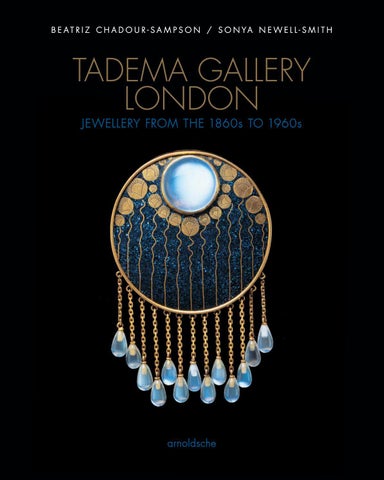
TADEMA GALLERY LONDON JEWELLERY FROM THE 1860s 1860 s TO 1960s 1960 s
TADEMA GALLERY LONDON
Tadema Gallery was founded in 1978 by Sonya and David Newell-Smith in London’s famed Camden Passage in Islington. They were successful photojournalists who ventured into the field of twentieth-century abstract art and the decorative arts of the nineteenth and twentieth centuries. By 1982 they had discovered a passion for artist-designed jewellery and showed in the gallery an eclectic choice of jewels from significant designers of the Revivalist, Art Nouveau, Arts & Crafts, Jugendstil, Art Deco, and Modernist movements. With over 500 unique jewellery pieces from the 1860s to 1960s, the book reflects the forty-year history of the gallery and the superb eye of its inspirational founders.
B E AT R I Z C H A D O U R- S A M P S O N / S O N YA N E W EL L- S M I T H
978-3-89790 -598- 6
9 783897 905986 >
arnoldsche
arnoldsche
TADEMA GALLERY
8
A New Look Gallery: jewellery, Abstract art and Sonya’s trademark orchids in the window, c. 1985 Abstract painting by Renato Righetti (1948)
The history of Tadema Gallery is inseparably linked with the life and work of its extraordinary founders Sonya (born 1946) and David Newell-Smith (1937–2017). Their life’s journey has been one of unexpected but fortuitous events, linked by their continued passion for life and for art. Despite their commitment to the Gallery in later years, both began their careers as professional photographers, and their love of photography has continued throughout their lives. Any opportunity they had, David and Sonya would have their cameras at hand, ready to take photographs. On Sundays, when time allowed, they would go to Brick Lane in the East End of London, drawn by the alternative culture expressed in the street life and colourful graffiti art. The results are well archived in books documenting the many themes and scenes they captured in their art photography. David was born in Chislehurst in Kent and in 1955, aged 18, he joined the Royal Air Force. It was there that he developed his skills as a photographer. After being demobbed in 1960 he worked as a freelance photographer for various picture agencies and the British national tabloid newspaper the Daily Sketch. After receiving occasional jobs from the Observer, he was taken on as a full-time staff photographer for them in 1964. This turned out to be a significant year for him as he also married his fiancée Sonya Hirsch. As happened so often in their married lives, Sonya and David’s first encounter was by chance. On behalf of the Black Star photo agency, David was commissioned to produce a series of photographs on all things occult. Throughout his life he had a fascination for the mystical, supernatural and magical, and he was drawn to spiritualism. During this project he met and photographed Harry Edwards (1893–1976), a renowned spiritual healer whose healing sanctuary is still active, and Mir Bashir (1907–1997) a well-known palmist from Kashmir, who had written How to Read Hands (1955) and other publications. Bashir read David’s hands and foresaw he would meet
9
THE NATURAL WORLD / PEACOCKS
THE NATURAL WORLD / PEACOCKS
48
49
49 CHARLES ROBERT ASHBEE, FOR THE GUILD OF HANDICRAFT Peacock brooch. British, c. 1900. Silver, gold, opals, peridots
50 GEORGE EDWARD HUNT Peacock brooch. British, c. 1930. Silver, gold, enamel, opals, diamonds, pearls
THE NATURAL WORLD / PEACOCKS
THE NATURAL WORLD / PEACOCKS
48
49
49 CHARLES ROBERT ASHBEE, FOR THE GUILD OF HANDICRAFT Peacock brooch. British, c. 1900. Silver, gold, opals, peridots
50 GEORGE EDWARD HUNT Peacock brooch. British, c. 1930. Silver, gold, enamel, opals, diamonds, pearls
THE NATURAL WORLD / SUN, MOON AND STARS
THE NATURAL WORLD / SUN, MOON AND STARS
138
139
229 WILLIAM THOMAS PAVITT Pendant. British, c. 1905. Gold, opals, peridots 228 LÉOPOLD ALBERT MARIN GAUTRAIT Helianthus pendant. French, c. 1900. Gold, plique-à-jour enamel, diamonds, pearl
230 ATTRIBUTED TO EDUARD EGGELIN, FOR CARL M. COHR Brooch. Danish, c. 1905-10. Silver, amber
THE NATURAL WORLD / SUN, MOON AND STARS
THE NATURAL WORLD / SUN, MOON AND STARS
138
139
229 WILLIAM THOMAS PAVITT Pendant. British, c. 1905. Gold, opals, peridots 228 LÉOPOLD ALBERT MARIN GAUTRAIT Helianthus pendant. French, c. 1900. Gold, plique-à-jour enamel, diamonds, pearl
230 ATTRIBUTED TO EDUARD EGGELIN, FOR CARL M. COHR Brooch. Danish, c. 1905-10. Silver, amber
THE HUMAN FIGURE / THE HEAD
THE HUMAN FIGURE / THE HEAD
144
145
232 ALFRED JEAN GARNIER AND PAUL GRANDHOMME Brooch. French, c. 1880. Gold, enamel, diamonds 233 HENRI MENDEL Brooch. French, c. 1880. Gold, silver, enamel, diamonds, pearls 231 POSSIBLY BY GEORGES FOUQUET OR MAISON VEVER, AFTER ALPHONSE MUCHA Byzantine princess diadem/pendant. French, c. 1900. Gold, silver, opals, diamonds
234 PRE-RAPHAELITE Brooch. European, c. 1890. Gold, enamel, pearls
THE HUMAN FIGURE / THE HEAD
THE HUMAN FIGURE / THE HEAD
144
145
232 ALFRED JEAN GARNIER AND PAUL GRANDHOMME Brooch. French, c. 1880. Gold, enamel, diamonds 233 HENRI MENDEL Brooch. French, c. 1880. Gold, silver, enamel, diamonds, pearls 231 POSSIBLY BY GEORGES FOUQUET OR MAISON VEVER, AFTER ALPHONSE MUCHA Byzantine princess diadem/pendant. French, c. 1900. Gold, silver, opals, diamonds
234 PRE-RAPHAELITE Brooch. European, c. 1890. Gold, enamel, pearls
FAITH, MYTHOLOGY AND SYMBOLISM
166
Throughout history humans have handed down ancestral stories from one generation to the next, some based in common experience, others in beliefs. Belief systems, legends, folklore and superstitions have evolved to attempt to clarify or understand things which cannot be explained through reason or scientific observation. They help in the search for the deeper meanings in life and explore the worlds of the spirit, of emotions and instincts. Faith, mythologies and the imagined worlds of fairy tales and fantasy have continually inspired European goldsmiths and sparked inventiveness in design. In Catholic countries such as France, Italy, Spain and Southern Germany, jew ellery featuring religious scenes and figures had always been worn as a sign of faith, particularly pendant crosses and depictions of the Virgin and Child in veneration of motherhood. During the 18th century, religious jewellery design reached its peak with lavish, gem-encrusted crosses and pendants featuring sacred symbols. In predominantly Protestant countries, the wearing of religious jewels was not customary, a legacy of early reformers’ beliefs that deemed excessive ornament inappropriate. As the 19th century progressed, societal changes throughout Europe led jewellery design to be increasingly secular. Britain, however, was to prove an exception. The reinvigoration of ecclesiastical art and architecture from the Gothic Revival period, and new religious movements calling for moral seriousness and expressing faith through works of service and art, led to a surge in church restoration and building. Many of the architects ventured into designing metalwork and jewellery and paved the way for the religious work of British Arts and Crafts jewellers from the 1880s. Other than cross pendants in a variety of styles, Arts and Crafts jewellery also depicted the Passion, the Holy Trinity and local saints such as St. Wenefride. Jewellers were also inspired by the work of the Pre-Raphaelite movement, a secret brotherhood of painters, writers and poets, like Dante Gabriel Rossetti (1828–82), John Everett
cat. no. 387
167
ART MOVEMENTS / ARTS AND CRAFTS: CELTIC KNOTS AND ENTREL ACS
ART MOVEMENTS / ARTS AND CRAFTS: CELTIC KNOTS AND ENTREL ACS
318
319
522 ARCHIBALD KNOX, FOR LIBERTY & CO. Necklace. British, c. 1900. Gold, enamel, pearls, opal
523 ARCHIBALD KNOX, FOR LIBERTY & CO. Pendant. British, c. 1900. Gold, opal, pearls
ART MOVEMENTS / ARTS AND CRAFTS: CELTIC KNOTS AND ENTREL ACS
ART MOVEMENTS / ARTS AND CRAFTS: CELTIC KNOTS AND ENTREL ACS
318
319
522 ARCHIBALD KNOX, FOR LIBERTY & CO. Necklace. British, c. 1900. Gold, enamel, pearls, opal
523 ARCHIBALD KNOX, FOR LIBERTY & CO. Pendant. British, c. 1900. Gold, opal, pearls
ART MOVEMENTS / POST WAR MODERNISM
ART MOVEMENTS / POST WAR MODERNISM
374
375
621 CONSTRUCTIVIST Brooch. Probably American, c. 1950. Gold, diamonds 620 RENATO BASSOLI Constellation necklace. Italian, c. 1955. Platinum, diamonds, pearl
622 GÜBELIN Space Age brooch. Swiss, 1958. Gold, enamel, emeralds, aquamarine
ART MOVEMENTS / POST WAR MODERNISM
ART MOVEMENTS / POST WAR MODERNISM
374
375
621 CONSTRUCTIVIST Brooch. Probably American, c. 1950. Gold, diamonds 620 RENATO BASSOLI Constellation necklace. Italian, c. 1955. Platinum, diamonds, pearl
622 GÜBELIN Space Age brooch. Swiss, 1958. Gold, enamel, emeralds, aquamarine
CH A D O U R-SA M PSO N N E W E L L- S M I T H
TADEMA GALLERY LONDON JEWELLERY FROM THE 1860s 1860 s TO 1960s 1960 s
TADEMA GALLERY LONDON
Tadema Gallery was founded in 1978 by Sonya and David Newell-Smith in London’s famed Camden Passage in Islington. They were successful photojournalists who ventured into the field of twentieth-century abstract art and the decorative arts of the nineteenth and twentieth centuries. By 1982 they had discovered a passion for artist-designed jewellery and showed in the gallery an eclectic choice of jewels from significant designers of the Revivalist, Art Nouveau, Arts & Crafts, Jugendstil, Art Deco, and Modernist movements. With over 500 unique jewellery pieces from the 1860s to 1960s, the book reflects the forty-year history of the gallery and the superb eye of its inspirational founders.
B E AT R I Z C H A D O U R- S A M P S O N / S O N YA N E W EL L- S M I T H
978-3-89790 -598- 6
9 783897 905986 >
arnoldsche
arnoldsche