Foreword Bank Julius Baer has a long and dedicated tradition of involvement with the world of fine art. In the 1930s, Hans E. Mayenfisch, a partner in the Bank at the time, began acquiring works by contemporary Swiss artists. He promptly passed on this passion to his partners, Walter and Werner Bär, who initially confined their activities to creating a private collection. Werner Bär, his wife, Nelly, and my grandmother Ellen Weyl-Bär were all active sculptors as well. Their circle of friends included important contemporary artists such as Otto Charles Bänninger, Germaine Richier, Marino Marini, Rudolf Zender and Hildi Hess. As the Bank increased its office space in the decades that followed, artworks were also purchased to grace its premises. The process of active and systematic acquisition began in 1981 when the art committee was set up: it focused on promoting the younger generation of Swiss artists, and this strategic approach is reflected in the vibrant collection that was assembled, which spans a broad array of media. The presence of this art in the workplace has a stimulating effect on staff. Forty years after the art committee was established, we can now proudly look back upon its achievements. All the major movements in the visual arts since the 1980s have been incorporated in the collection. Walking through the Bank’s business premises today is like visiting a museum, with an impressive “Who’s who” of Swiss art on display. Having art as an everyday feature of one’s working life is truly inspirational: it opens up new ways of looking at the world and encourages dialogue. The art collection is an emblem of a corporate culture that fosters innovation and creativity. Published to coincide with the Bank’s 130th anniversary, this book provides an insight into its extensive collection of more than five thousand works. The passion for art, which is so deeply rooted in the Bär family, is now part of the Bank’s DNA and demonstrates its active sense of responsibility to Switzerland’s artist community. Raymond J. Bär Honorary Chairman of Julius Baer Group & Bank
5
!Mediengruppe Bitnik (b. 1976/b. 1979), Surveillance Chess (2012), single-channel video installation, full HD 16:9, loop, 7’, suitcase, 18.8 × 50.2 × 40 cm, edition of 5
7
!Mediengruppe Bitnik (b. 1976/b. 1979), Surveillance Chess (2012), single-channel video installation, full HD 16:9, loop, 7’, suitcase, 18.8 × 50.2 × 40 cm, edition of 5
7
Terry Adkins (1953–2014), Aquila (1986), copper on wood, 53 × 97 × 12 cm
8
Kevin Aeschbacher (b. 1988), Casus Belli am Apéro (2017), oil and acrylic on cotton, 175 × 115 cm
9
Terry Adkins (1953–2014), Aquila (1986), copper on wood, 53 × 97 × 12 cm
8
Kevin Aeschbacher (b. 1988), Casus Belli am Apéro (2017), oil and acrylic on cotton, 175 × 115 cm
9
Ian Anüll (b. 1948), Summer Paintings (1992), acrylic on fabric, 12 parts, each 18.5 × 30 cm, overall view: 90 × 110 cm
10
John M Armleder (b. 1948), Untitled (1986), oil and acrylic on canvas, 116 × 73 cm
11
Ian Anüll (b. 1948), Summer Paintings (1992), acrylic on fabric, 12 parts, each 18.5 × 30 cm, overall view: 90 × 110 cm
10
John M Armleder (b. 1948), Untitled (1986), oil and acrylic on canvas, 116 × 73 cm
11
John M Armleder (b. 1948) Geneva-born artist John M Armleder teamed up with some friends from his youth to establish the artists’ collective Ecart. The group organised performance festivals, ran a publishing house, brought a bookshop to life and staged exhibitions. Through their endeavours, they played an important part in developing the Swiss arts scene. Expanding their activities and going beyond the boundaries of their practices, these artists came to represent the irreverent and spirited definition of art pursued by the Fluxus movement. Action is one of the keywords applicable to Armleder’s oeuvre – his gestures immediately generate shapes. Discarded paper is used as a support for some elegant abstract constructions, while he uses collage to remind us that a common medium for integrating avant-garde motifs does exist. His abstract constructions are often based on simple geometric forms in different colours, such as we can see in the work Untitled (1983). Yet the meanings they convey challenge our way of seeing. As far as the artist is concerned, all his compositions are equally valid. Their denotation, wonder and element of surprise, however, lie in the eye of the beholder. His like-mindedness with artists such as John Cage makes him hold fast to the idea that establishing a protocol can, paradoxically, have a liberating effect. It was in this spirit that he famously produced Pour Painting (1998). It is part of a series of paintings for which he poured an indeterminate number of different types of paint onto canvases on stretchers, designed to produce random effects while drying. The painting thus turns into a provoked happenstance – what it becomes is up to us. Samuel Gross Independent curator, Geneva
John M Armleder
12
John M Armleder (b. 1948), Pour Painting (1998), acrylic, lacquer, varnish and spray on canvas, 180 × 100 cm
13
Fabian Marti (b. 1979), Capsule (All is All) (2014), textile, casted in polyester, 43 × 34 × 31 cm
214
Sara Masüger (b. 1978), Sitzende (2013), Acrystal, 86 × 90 × 49 cm
215
Fabian Marti (b. 1979), Capsule (All is All) (2014), textile, casted in polyester, 43 × 34 × 31 cm
214
Sara Masüger (b. 1978), Sitzende (2013), Acrystal, 86 × 90 × 49 cm
215
Mario Merz (1925–2003), Untitled (1981), oil and collage on canvas, 100 × 155 cm
217
Mario Merz (1925–2003), Untitled (1981), oil and collage on canvas, 100 × 155 cm
217
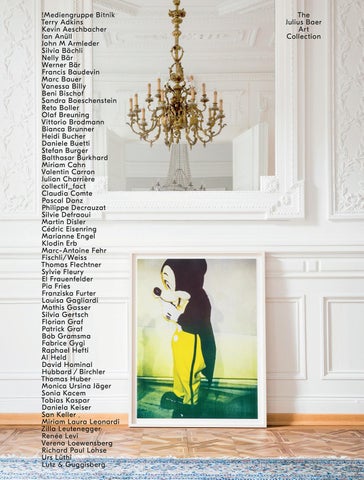
Shirana Shahbazi (b. 1974) Shirana Shahbazi, born in Tehran and now living in Zurich, is constantly expanding the scope of her oeuvre – a process that cannot be explained merely as the unfolding of an individual story – by continuously adding new elements to her already multifaceted image worlds. Her interest in her surroundings – space, people, plants, light – and the question of what the representation of these elements might actually mean, are constants in her work. The question of how to structure the photographic capturing of different realities is only the beginning of Shahbazi’s artistic explorations: the transfer from three-dimensionality to the printing process on paper, as well as the final presentation of one image in relation to others in the exhibition space is a complex process. In a traditional studio setting Shahbazi would place objects such as plants, fruits and skulls in high-intensity colour environments, creating still lifes of tantalising elegance, such as Frucht-07 (2009) from the series ‘Flowers, Fruits & Portraits’. The set-ups then developed into investigations of colour, form and surface that culminated in compositional abstractions such as Komposition-48 (2012). The multifaceted printing processes stand out in such works as Mickey (2014) → front cover and L.A. & Kirishima (2018): the universal cartoon hero is given lemon-yellow shorts; the two-colour lithograph stirs memories yet remains situational. L.A. & Kirishima is a multicoloured screen print that combines urban and natural imagery to create a spherical image world where the form and content of the layers have an enduring resonance. In Monstera-01 (2014), the black leaf in the foreground of the image becomes a silhouette-like emblem that leans out towards the viewer against a colour gradient. A clear link to a specific time or place is consistently thwarted; the non-classifiable, the equivocal develops a tension that is almost impossible to escape. Nadine Wietlisbach Director/curator at Fotomuseum Winterthur
Shirana Shahbazi
338
Shirana Shahbazi (b. 1974), Frucht-07 (2009), from the series ‘Flowers, Fruits & Portraits’, C-print on aluminium, 120 × 150 cm, edition of 5 + 1 AP
339
Shirana Shahbazi (b. 1974), L.A. & Kirishima (2018), silkscreen print on paper, 176 Ă— 120 cm, edition of 3 + 2 AP
342
Francisco Sierra (b. 1977), Ancestors (2014), oil on canvas, 240 Ă— 170 cm
343
Shirana Shahbazi (b. 1974), L.A. & Kirishima (2018), silkscreen print on paper, 176 Ă— 120 cm, edition of 3 + 2 AP
342
Francisco Sierra (b. 1977), Ancestors (2014), oil on canvas, 240 Ă— 170 cm
343
Verlag Scheidegger & Spiess Niederdorfstrasse 54 8001 Zurich Switzerland www.scheidegger-spiess.ch Scheidegger & Spiess is being supported by the Federal Office of Culture with a general subsidy for the years 2016–2020. All rights reserved; no part of this publication may be reproduced, stored in a retrieval system or transmitted in any form or by any means, electronic, mechanical, photocopying, recording, or otherwise, without the prior written consent of the publisher. Printed in Germany ISBN 978-3-85881-874-4
404