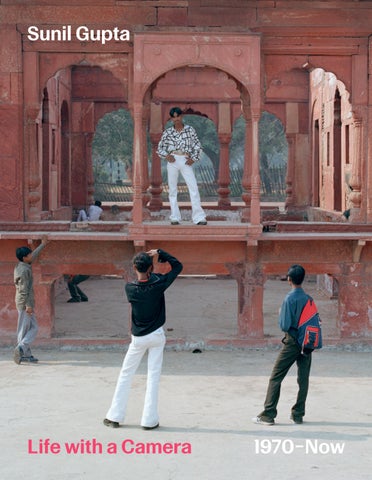
Sunil Gupta
Life with a Camera
1970 – Now
Principal Supporter Will Palley Exhibition Sponsors Vadehra Art Gallery Matèria (Rome) Sunil Gupta: Life with a Camera Exhibition Circle Dr Carol Atack & Alex van Someren Emma Jane Davis Sabine Jaccaud Payal & Anurag Khanna Carlos & Francesca Pinto Durjoy Rahman Ali Smith & Sarah Wood Russell Tovey Tamsin & Stewart Wilkinson
6
Introduction Susie Biller, Guy Haywood and Andrew Nairne
Photographs 1970 – Now 8 22 28 38 44 48 52 56 61 72 78 87 95 102 108 113 124 130 138 144 150 154 161 164
Friends and Lovers: Coming Out in Montréal in the 1970s Pictures and Poems Christopher Street Cruising 1960s Delhi Tilonia Towards an Indian Gay Image Come Out Black Experience ‘Pretended’ Family Relationships Lovers: Ten Years On Exiles From Here to Eternity Homelands Delhi: Tales of a City A Time to Care Country: Portrait of an Indian Village Mr Malhotra’s Party Sun City The New Pre-Raphaelites Dissent and Desire Christopher Street, Helmut Lang Songs of Deliverance, Part II Lovers, Revisited Trans+ Pride
1970–76 1977 1976 1983 1980 1980–82 1985–90 1986 1988 1984–86 1987 1999 2001–03 2004 2005 2007 – ongoing 2007–12 2010 2008–12 2014–18 2020 2022 2023 – ongoing 2025
169
Life: A User’s Manual Tausif Noor
175
Lovers, Past and Future Theo Gordon
181
Delhi: The Imperative of Return Gayatri Sinha
186
Inventing Our Lives: ‘Pretended’ Family Relationships (1988) Gregory Salter
191
The Levity and Depth of an Unintended Consistency Natasha Bissonauth
197 210 213 214
Chronology List of Exhibited Works Acknowledgements Colophon
Principal Supporter Will Palley Exhibition Sponsors Vadehra Art Gallery Matèria (Rome) Sunil Gupta: Life with a Camera Exhibition Circle Dr Carol Atack & Alex van Someren Emma Jane Davis Sabine Jaccaud Payal & Anurag Khanna Carlos & Francesca Pinto Durjoy Rahman Ali Smith & Sarah Wood Russell Tovey Tamsin & Stewart Wilkinson
6
Introduction Susie Biller, Guy Haywood and Andrew Nairne
Photographs 1970 – Now 8 22 28 38 44 48 52 56 61 72 78 87 95 102 108 113 124 130 138 144 150 154 161 164
Friends and Lovers: Coming Out in Montréal in the 1970s Pictures and Poems Christopher Street Cruising 1960s Delhi Tilonia Towards an Indian Gay Image Come Out Black Experience ‘Pretended’ Family Relationships Lovers: Ten Years On Exiles From Here to Eternity Homelands Delhi: Tales of a City A Time to Care Country: Portrait of an Indian Village Mr Malhotra’s Party Sun City The New Pre-Raphaelites Dissent and Desire Christopher Street, Helmut Lang Songs of Deliverance, Part II Lovers, Revisited Trans+ Pride
1970–76 1977 1976 1983 1980 1980–82 1985–90 1986 1988 1984–86 1987 1999 2001–03 2004 2005 2007 – ongoing 2007–12 2010 2008–12 2014–18 2020 2022 2023 – ongoing 2025
169
Life: A User’s Manual Tausif Noor
175
Lovers, Past and Future Theo Gordon
181
Delhi: The Imperative of Return Gayatri Sinha
186
Inventing Our Lives: ‘Pretended’ Family Relationships (1988) Gregory Salter
191
The Levity and Depth of an Unintended Consistency Natasha Bissonauth
197 210 213 214
Chronology List of Exhibited Works Acknowledgements Colophon
Shalini, Rudi, Sunil, Leo, 3425 Stanley
14
15
Fakroon
Shalini, Rudi, Sunil, Leo, 3425 Stanley
14
15
Fakroon
Nikki and Joy
20
21
Gay Rights March
Jerry with Wayne
Nikki and Joy
20
21
Gay Rights March
Jerry with Wayne
Christopher Street
Christopher Street was shot in 1976 when I spent a semester studying photography with Lisette Model* at the New School in New York. I spent my weekends cruising with my camera. I was witness to the aftermath of a defining moment in and around the Stonewall Inn, at 53 Christopher Street, where the modern gay liberation movement was born in 1969. It was the heady days after Stonewall and before AIDS, when we were young and busy creating a gay public space that hadn’t really been seen before. Christopher Street and the neighbourhood was a place where there was an overwhelming public display of young gay men. Here they could safely and freely walk and mingle, dress in the way that they liked, and publicly express their desires for each other. In retrospect, these pictures have become both nostalgic and iconic for a very important moment in my personal history and in the history of gay culture and photographic practice.
1976
* Lisette Model (1901–1983) was a renowned photographer and teacher at the New School for Social Research in New York from 1951 until her death in 1983. Among her pupils were Diane Arbus and Peter Hujar. She was renowned for insisting on directness and passion in making photographs, rather than technical perfection.
30
31
Christopher Street
Christopher Street was shot in 1976 when I spent a semester studying photography with Lisette Model* at the New School in New York. I spent my weekends cruising with my camera. I was witness to the aftermath of a defining moment in and around the Stonewall Inn, at 53 Christopher Street, where the modern gay liberation movement was born in 1969. It was the heady days after Stonewall and before AIDS, when we were young and busy creating a gay public space that hadn’t really been seen before. Christopher Street and the neighbourhood was a place where there was an overwhelming public display of young gay men. Here they could safely and freely walk and mingle, dress in the way that they liked, and publicly express their desires for each other. In retrospect, these pictures have become both nostalgic and iconic for a very important moment in my personal history and in the history of gay culture and photographic practice.
1976
* Lisette Model (1901–1983) was a renowned photographer and teacher at the New School for Social Research in New York from 1951 until her death in 1983. Among her pupils were Diane Arbus and Peter Hujar. She was renowned for insisting on directness and passion in making photographs, rather than technical perfection.
30
31
65
65
Emmanuel and David
Ian and Pavlik
Lisa and Emily
76
77
Series Title #0
Emmanuel and David
Ian and Pavlik
Lisa and Emily
76
77
Series Title #0
Daily wage labourers threshing.
My aunt.
Daily wage labourers threshing.
My aunt.
Ramkali #1
Ramkali #2
148
149
Series Title #0
Ramkali #1
Ramkali #2
148
149
Series Title #0
154
154
Sunil Gupta Trespass 1 Untitled #4 1 / 5, 1992
180
181
landscapes and geographies that were previously latent. In both Mr Malhotra’s Party (2007–12) and Sun City (2010), he teases out the world-making power of identification and fantasy in queer life. Struck by the newfound confidence of people living openly as ‘queer’ in Delhi after his return to live there in 2005, he pictures his subjects in Mr Malhotra’s Party as both germane to the landscapes that surround them, yet centred and monumentalised also. He plays that isolation off the fantasy gathering under the pseudonym ‘Mr Malhotra’, gesturing to the group identification that allows the collection of figures to forge a community power, the imaginary playing an active role in the real. Sun City cuts the other way, charting the plight of the solitary queer Indian figure attempting to navigate the fantasies of the East through which he is positioned in gay Paris. In recent works, such as Songs of Deliverance (2022) and Arrival (2022), the latter completed with Singh, Gupta has continued to foreground trans and queer subjects as formed through and against powerful forces of (xeno) phobia and nationalism that push against them.
I have here begun to suggest some of the ways that Gupta’s practice might be understood as ‘queer photography’. Yet my more fundamental point is that it is simply impossible to understand Gupta’s work without appreciating the impulse to explore possible permutations of relationality, as informed by sexuality and racial difference, that lies at its heart; his open, curious, non-essential approach to the world underlies all his photography. A facile glance at Gupta’s practice would see a celebration of increasing queer visibility and confidence across the past 50 years – the march of progress. His work has indeed contributed to the political imaginary that has led to the striking down of homophobic legislation, both in India, the UK and beyond, the forcing of the hand of history against ‘the deep closets where most hid their queer lives’ prior to the 1970s.¹¹ Gupta has been one of the pioneers in understanding that history and culture are created through visual representations, like Catherine Opie and many others. Yet just as with Opie, Gupta’s work to bear witness also engages more profound, complex questions: how are certain
Sunil Gupta Trespass 1 Untitled #4 1 / 5, 1992
180
181
landscapes and geographies that were previously latent. In both Mr Malhotra’s Party (2007–12) and Sun City (2010), he teases out the world-making power of identification and fantasy in queer life. Struck by the newfound confidence of people living openly as ‘queer’ in Delhi after his return to live there in 2005, he pictures his subjects in Mr Malhotra’s Party as both germane to the landscapes that surround them, yet centred and monumentalised also. He plays that isolation off the fantasy gathering under the pseudonym ‘Mr Malhotra’, gesturing to the group identification that allows the collection of figures to forge a community power, the imaginary playing an active role in the real. Sun City cuts the other way, charting the plight of the solitary queer Indian figure attempting to navigate the fantasies of the East through which he is positioned in gay Paris. In recent works, such as Songs of Deliverance (2022) and Arrival (2022), the latter completed with Singh, Gupta has continued to foreground trans and queer subjects as formed through and against powerful forces of (xeno) phobia and nationalism that push against them.
I have here begun to suggest some of the ways that Gupta’s practice might be understood as ‘queer photography’. Yet my more fundamental point is that it is simply impossible to understand Gupta’s work without appreciating the impulse to explore possible permutations of relationality, as informed by sexuality and racial difference, that lies at its heart; his open, curious, non-essential approach to the world underlies all his photography. A facile glance at Gupta’s practice would see a celebration of increasing queer visibility and confidence across the past 50 years – the march of progress. His work has indeed contributed to the political imaginary that has led to the striking down of homophobic legislation, both in India, the UK and beyond, the forcing of the hand of history against ‘the deep closets where most hid their queer lives’ prior to the 1970s.¹¹ Gupta has been one of the pioneers in understanding that history and culture are created through visual representations, like Catherine Opie and many others. Yet just as with Opie, Gupta’s work to bear witness also engages more profound, complex questions: how are certain
Sunil Gupta is among the most highly regarded photographers of our time. Born in New Delhi, India, in 1953 and now living in London, his pioneering contribution to art and photography, championing the queer community and queer rights, is recognised as exceptional. The inventiveness and exhilarating breadth of his work, from street photography to staged portraits, offers a compelling vision in which art and life are inseparable. With over 150 photographs and five new essays, Life with a Camera, 1970 – Now also includes Gupta’s insightful introductions to each series of his work from 1970 to the present day. This new publication includes contributions from Natasha Bissonauth, Theo Gordon, Sunil Gupta, Tausif Noor, Gregory Salter and Gayatri Sinha.
ISBN 978-1-904561-64-4