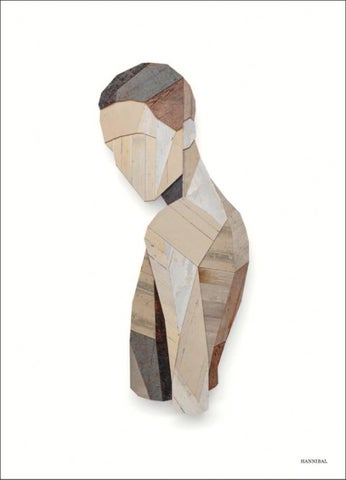
Majoor Tom, 2013, Mixed media on canvas, 80 × 50 cm, Private collection
This Was When the Maker Became the Destroyer, 2015, Mixed media on canvas, 90 × 60 cm, Private collection
Wat als de prins niet meer komt, 2013, Mixed media on canvas, 100 × 200 cm, Private collection
10
verfsoorten, borstelstreek – onder de knie kreeg, groeide ook zijn inherente drang naar experiment. “In mijn eerste reeksen schilderijen zocht ik naar manieren om dat tweedimensionale vlak een zekere diepte te geven. Ik wou structuren toevoegen aan de verf. Ik experimenteerde met verflagen boven elkaar, tot er een patina ontstond dat ik sprekend vond. Vanuit mijn drang naar experiment maakte ik met onorthodoxe methodes composities waar textuur in zat. Op mijn doeken schilderde ik ook soms het patina na dat ik gefotografeerd had bij verweerde muren of op verlaten locaties. Ik begon bewust op zoek te gaan naar doorleefde materialen, omdat ik die texturen wou integreren in mijn schilderijen.”
– layers, drying times, different types of paint, brush strokes – his innate urge to experiment grew apace. ‘In my first series of paintings I was looking for ways to give the two-dimensional surface a certain depth. I wanted to add textures to the paint. I experimented with layers of paint on top of each other, trying to develop a patina that I found evocative. My urge to experiment pushed me to use unorthodox methods to make compositions that had a lot of texture. On my canvases I also sometimes would copy – in paint – a patina that I had photographed on a weathered old wall, or at a derelict location. I started to deliberately look for lived-in materials, because I wanted to integrate those textures into my paintings.’
Tussen fragmentatie en expressie Die zoektocht leverde in 2013 uiteindelijk opnieuw een doorbraak op in zijn oeuvre. Op zoek naar sprekende stukken hout vond hij op een stalzolder in de boerderij van zijn ouders een interessante partij verweerde planken. In plaats van hun patina te fotograferen en na te schilderen, besloot hij om met dat hout zelf een compositie te maken. Vanuit een technische onwetendheid én zonder vooropgesteld plan begon Strook die uitgezaagde houtfragmenten te componeren tot geabstraheerde mensenkoppen. “Het was pure écriture automatique, maar deze keer niet met stift of (spuit)verf, wel met houtfragmenten”, zegt Strook. “Technisch was ik niet onderlegd genoeg, maar met de hulp van mijn vader kon ik de sprekendste stukken uit het hout zagen.” Daarmee maakte hij composities van mensfiguren: zijn eerste aanzetten voor zijn – inmiddels beroemde – series ‘koppen’ in sloophout. “De kleuren en expressies in die composities zijn volledig bepaald door het karakter van het verweerde hout dat ik vond. Ik was volledig afhankelijk van wat ik aantrof. Die nieuwe manier van werken was opnieuw een keuze voor het onverwachte.” De eerste keer dat Strook met dat nieuwe facet van zijn oeuvre naar buiten kwam, was op een expo in 2013 in Oedelem. De reacties op zijn ‘koppen’ waren meteen lovend. Via Fredo De Smet kreeg Strook de kans om in 2014 het monumentale werk Wood & Paint te maken op de gevel van twee aanpalende Brugse huizen die afgebroken zouden worden. Hij realiseerde er in de publieke ruimte een werk dat zijn snelle evolutie in die periode perfect samenvat. Dwars over de gevels van de twee rijwoningen maakte hij een tweeluik van twee personages die elkaar recht in de ogen kijken. Rechts maakte hij een kop in spuitverf. Links vervaardigde hij een monumentale kop in sloophout. Met de diptiek bewees Strook zijn expressieve mogelijkheden binnen twee totaal verschillende media, die hij hier voor het eerst combineerde.
Between fragmentation and expression That search eventually resulted in the next breakthrough in his oeuvre in 2013. Looking for striking pieces of wood, he found an interesting pile of weathered planks in a stable’s attic on his parents’ farm. Instead of photographing and mimicking their patina, he decided to use the wood itself to make a composition. Unhindered by any technical knowhow and without a preconceived plan, Strook started to compose sawn-out fragments of wood into abstracted human heads. ‘It was pure écriture automatique, but this time not with a marker or (spray) paint, but with wood fragments,’ says Strook. ‘Technically I was not skilled enough, but with the help of my father I was able to saw the most expressive pieces out of the wood.’ Using these he made compositions of human figures: his first steps towards his now famous series of ‘heads’ of scrap wood. ‘The colours and expressive qualities of these compositions are determined completely by the character of the weathered wood that I had stumbled across. I was completely dependent on what I could find. This new way of working was once again a conscious choice to work with the unexpected.’ The first time Strook presented this new facet of his oeuvre was at an exhibition in Oedelem in 2013. The reactions to his ‘heads’ were positive from the start. Through Fredo De Smet, in 2014 Strook was given the opportunity to make the monumental work Wood & Paint on the facades of two neighbouring houses that were to be demolished, in Bruges. The work he created here in the public space perfectly sums up his rapid evolution during that period. Spanning across the facades of the two houses, it is a diptych of two people looking straight into each other’s eyes. On the right he painted a head with spray paint. On the left he built a monumental head out of scrap wood. With this diptych, Strook proved his expressive potential within two totally different media, which he combined for the first time here.
Wood & Paint, 2014, Recycled wood sculpture - Spraypaint, Bruges
11
A Stroke of Strook
Everyone Has a Story, 2021, Recycled wood sculpture, 240 × 196 cm, Private collection
20
21
mijn assemblages meng ik stukken sloophout met al heel uiteenlopende provenances. Van de wieg van de Solidarność-beweging in Polen tot de vloer van een bruin café in Kortrijk: het zijn compressies van geschiedenissen, zowel kleine als grote.” Strook verwijst daarmee naar de beroemde compressions van de Franse beeldhouwer César (1921-1998). Met industriële machines perste die vanaf de jaren zestig alledaagse consumptiegoederen – zoals auto’s of frisdrankblikken – samen tot potige sculpturen. “Du déchet industriel, je suis passé au déchet urbain (…) Ces compressions, c’est un peu de la poésie de tous les jours. Les petits riens de la vie”, zei hij daarover in 1974. “Ik zie zelf ook overal poëzie in banale, alledaagse dingen”, zegt Strook. “Onderweg valt mijn oog soms plots op een oude deur, waar iedereen zomaar aan voorbij loopt. Als ik zo’n element met een mooie textuur zie, keer ik onmiddellijk terug op mijn passen. Het is mijn manier om naar de wereld te kijken.” Op zijn tentoonstelling Taxixylogie (2015) in de Kortrijkse Budafabriek ontwierp Strook de scenografie zo dat hij de toeschouwer kon wijzen op het belang van de provenances van zijn materiaal. “In het midden van de grote zaal had ik een paviljoen gebouwd waarin ik vierkante stukjes gezaagd hout presenteerde. Ik wou mensen laten stilstaan bij de poëzie en schoonheid van afvalhout. En waarom ik dat zogezegd banale materiaal toch een nieuw leven geef in mijn kunstwerken. In die white box zag de opstelling van die houten staaltjes er bijna didactisch of wetenschappelijk uit. Vandaar dat ik er ook het neologisme ‘taxixylogie’ bij bedacht: de kunst om stukken afvalhout te bewaren en te monteren in een nieuwe compositie.”
in Gdansk. In my assemblages I mix pieces of scrapwood with very different provenances. From the cradle of the Solidarność movement in Poland to the floor of a brown café in Kortrijk: they are pieces of compressed history, big and small.’ Strook is referring to the famous compressions of the French sculptor César (1921-1998). From the 1960s onwards, using industrial-strength machines, he compressed everyday consumer goods – such as cars or soda cans – into burly sculptures. ‘From industrial waste, I have moved on to urban waste. ... These compressions are little pieces of everyday poetry. The little things in life,’ he said in 1974. ‘I see poetry everywhere too, in banal, everyday things,’ says Strook. ‘On my way somewhere, suddenly an old door will catch my eye for example, which everyone else is just passing by. When I see a piece with such a nice texture, I immediately turn back. It’s my way of looking at the world.’ At his exhibition Taxixylogie (2015) in the Kortrijk Buda factory, Strook designed the scenography in such a way that he could point out to the viewer the importance of the provenances of his material. ‘In the middle of the main hall I had built a pavilion in which I presented square pieces of sawn wood. I wanted people to reflect on the poetry and beauty of scrapwood. And why I give this so-called banal material a new lease on life in my artworks. In that white box, the installation of those wooden samples looked almost didactic or scientific. That is why I also coined the neologism “taxixylogy”: the art of preserving pieces of waste wood and assembling them in a new composition.’
Beeldhouwer van de tijd Strook kan lang niet op alle non-places bruikbaar materiaal vinden voor zijn sculpturen. Maar soms zijn die plekken zelf zo sprekend dat hij een manier wilde vinden om toch de unieke textuur van die onbestemde plaatsen te samplen. Hij ontwikkelde een techniek om het patina van oppervlakken – bijvoorbeeld tegels of een vloer – af te gieten in een mal. Door van die afgietsels stempels te maken kan hij ze op verschillende manieren gebruiken, bijvoorbeeld om in klei te drukken. Via die omweg creëert hij keramiek, die het reliëf heeft van de oppervlakken die hij afgoot. “Die afgietsels zijn exacte kopieën van plaatsen waar niemand naar omkijkt maar waar wel een geschiedenis aan vasthangt”, zegt Strook. Van een mal – een negatieve afdruk van de werkelijkheid – opnieuw een positief beeld maken is een getrapt proces, dat eigen is aan de beeldhouwkunst en aan de fotografie. Strook gebruikt die techniek van de omkering niet om afgewerkte sculpturen serieel af te gieten. Hij ziet het als een tussenstap om zelf nieuw bronmateriaal te samplen, dat later bruikbaar is voor zijn sculpturen of ‘koppen’. Het afgieten maakt deel uit van zijn proces om de textuur van de tijd te vangen. “Voor mij zijn die afgietsels een manier om oppervlaktes of plekken te dupliceren waar ik geen sloopmateriaal kan oogsten”, zegt Strook. “Die techniek opent een hele resem aan nieuwe mogelijkheden in mijn werk. Ik ben niet meer volledig afhankelijk van found footage.” Door met afgietsels te werken herintroduceert Strook niet alleen het performatieve aspect van zijn vroege livetekeningen. Hij draait ook het dadaïstische adagium ‘destructie als creatief proces’ volledig binnenstebuiten. Hij werkt niet meer uitsluitend met exacte fragmenten van de werkelijkheid, maar ook met kopieën van de tijd. Zowel filosofisch als picturaal liggen daar enorme mogelijkheden voor de kunstenaar: hij is niet meer enkel de archeoloog maar ook de beeldhouwer van de tijd.
Sculptor of time Strook does not always find useful material for his sculptures in the non-places he explores. But sometimes those places themselves are so expressive that he wants to find a way to still sample the unique texture of those indefinable places. So he developed a technique for casting the patina of surfaces – tiles for example, or a floor – in a mould. By making stamps from these casts he can use them in various ways, for example to press in clay. In this roundabout way he creates ceramics, which mimic the relief of the surfaces he poured. ‘Those casts are exact copies of places that nobody cares about, but that do contain history within them,’ says Strook. Making a positive image again from a mould – a negative imprint of reality – is a step-by-step process, which is characteristic of sculpture and photography. Strook does not use this reversal technique to cast series of complete sculptures. He sees it as an intermediate step, a way to sample new source material for his collection, which can later be used for his sculptures or ‘heads’. The casting of moulds is part of his method to capture the textures of time. ‘For me, those casts are a way of duplicating surfaces or places from which I can’t take demolition material,’ says Strook. ‘That technique opens up a whole host of new possibilities in my work. I am no longer completely dependent on found footage.’ By working with casts, Strook not only reintroduces the performative aspect of his early live drawings, he also turns the Dadaist adage ‘destruction as a creative process’ completely inside out. He no longer works exclusively with exact fragments of reality, but also with copies of time. Both philosophically and pictorially, this offers enormous opportunities for the artist: he is no longer just the archaeologist but also the sculptor of time.
Portrait F II 21, 2021, Recycled wood sculpture, 340 × 180 cm, Onze-Lieve-Vrouwekerk, Bruges
38
39
Between construction and destruction
Portrait L II 17 2017, Recycled wood sculpture, 110 × 77 cm, Private collection
70
Portrait R IV 19 2019, Recycled wood sculpture, 100 × 73 cm, Private collection
71
xxxxxxxxxxxx xxxxxx xxxxxxxxx xxxxxx xxxxxx xxxx
74
Portrait xxxxxxxxxxxx L III 18 2018, Recycled xxxxxx woodxxxxxxxxx sculpture,xxxxxx 380 × 186 xxxxxx cm, Private xxxx collection
75
Portrait R IV 18 2018, Recycled wood sculpture, 90 × 60 cm, Private collection
104
Lost in a Forest 2017, Mixed media on canvas - Steel frame, 72 × 52 cm, Private collection
105
Portrait xxxxxxxxxxxx R II 19 2019, Recycled xxxxxx woodxxxxxxxxx sculpture,xxxxxx 280 × 172 xxxxxx cm, Private xxxx collection
110
xxxxxxxxxxxx xxxxxx xxxxxxxxx xxxxxx xxxxxx xxxx
111