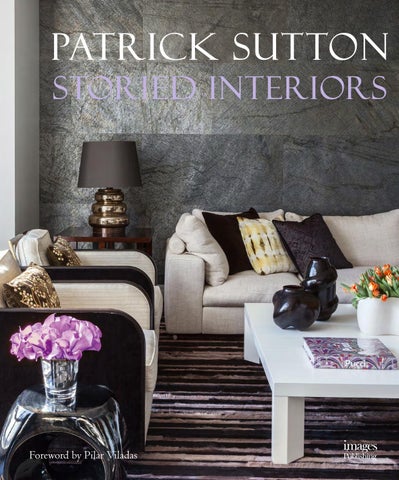
PATRICK SUTTON Storied Interiors
Foreword by Pilar Viladas
6
7
To my father, Horace Sutton, who taught me to see the world as a magical place filled with beauty and adventure waiting to be discovered.
R
foreword
h Pilar Viladas
These days, people in creative fields love to throw the word “storytelling” around, but few actually manage to tell a story in a compelling way. For Patrick Sutton, however, storytelling is the key to his interiors. To him, any design—whether it’s the transformation of a historic Baltimore pier building into an urbane hotel that salutes its storied past; the creation of an expressive interior for a restaurant next to a distillery that revived Baltimore’s tradition of rye whiskey production; or the invention of an elegant house that reflects its owners’ passion for art as well as their extensive travels—must be more than an exercise in form. For Patrick, what he calls “the humanity of a building” must be paramount. Patrick’s early life offered an education in both timeless design and the importance of creating spaces that express their occupants’ histories, enthusiasms, and dreams. As a child, he traveled all over the world with his father, Horace Sutton, a legendary travel writer and magazine editor. (More than thirty years ago, as a young journalist, I was lucky enough to meet Horace, and wrote a couple of articles for him.) Horace, who is credited with being the first writer to use the term “jet lag,” in 1969, was a journalist of the old school: worldly and sophisticated, he went everywhere and knew all the best places. And while Patrick’s parents would be having a leisurely lunch with the owner of a glamorous hotel, Patrick did what any bored young boy would do: he went off and explored. But he also drank in the architecture—and its proportions, materials, and details—and the lush gardens in which these hotels were often set. Patrick was also keenly observant for a child his age—out of necessity. His mother’s battle with mental illness was the family’s “deep, dark secret,” and so as a boy Patrick “learned to watch people and became a good listener.” Aware of the pressures his father was under, he rearranged the family room as a refuge—moving an armchair to face the view outdoors; putting a table next to it for his father’s preferred cocktail, an Old Fashioned; and making sure that Bobby Short was on the stereo when his father arrived.
10
172
173
A faint thread of architectural classicism is the glue that holds this rural Maryland residence together. It is a home that has been shaped by a deep appreciation of life’s offerings and a passion to share them.
174
175
Page 167: This garden room, with its antique brick floor, cement plaster walls, and vintage lighting, was inspired by the orangeries of Europe. Pages 168–69: I like to use stone for residential foyers because it is the one space that transitions between inside and out. Here, highly articulated angled corridors, which lead to a stair hall and master bedroom on one side and the kitchen on the other, make the journey as interesting as the destination. Pages 170–71: The living room is an eclectic mix of furnishings and fixtures, all tied together by a common color palette. The stair and railing, inspired by classic French designs, are composed here in a modern, edited way.
176
$55.00 [USA] £40.00 [GB]