15
Tadeáš Říha
SOME DYSTOPIAS The Begum’s Fortune
Léon Benett, original illustration from the first edition of Jules Verne’s Les cinq cents millions de la Bégum (The Begum’s Fortune, 1879). Photo: Author’s archive. Léon Benett, původní ilustrace z prvního vydání knihy Julese Verna Les cinq cents millions de la Bégum (česky jako Ocelové město) z roku 1879. Foto: archiv autora.
The air is heavy with smoke, and hangs like a pall over the ground. Not a bird not an insect is to be found. In five years there has sprung up on this bare and rocky plain eighteen villages, composed of small wooden houses, all alike, brought ready built from Chicago, and containing a large population of rough workmen. In the midst of these villages, at the very foot of the Coal Buttes, as the inexhaustible mountains of coal are called, rises a dark mass, huge and strange, an agglomeration of regular buildings, pierced with symmetrical windows, covered with red roofs, and surrounded by a forest of cylindrical chimneys, which continually vomit forth clouds of dense smoke. Through the black curtain which veils the sky, dart red lighting-like flames, while a distant roaring is heard resembling that of thunder or the beating of the surf of a rocky shore. This erection Is Stahlstadt – Steeltown! The German city, and the personal property of Professor Schultz…1 This is a description of Stahlstadt, Steel City, in one of Jules Verne’s less acclaimed novels The Begum’s Fortune, published by Pierre Jules Hetzel in 1879. The book narrates at once a utopia and a dystopia, or rather a story in which the utopia prevails—closely but inevitably— over the dystopia. An inherited colonial fortune is split between two opposed characters: Dr. Sarrasin, a distinguished French hygienist, and Professor Schultz, a German chemist from Jena University. The liberal protagonist and the authoritarian antagonist each in its own way caricature the late 19th-century European
16
17
middle-class man, for whom imperialism is a commonplace civilizing mission. While Sarrasin uses his half of the fortune to establish the world’s most hygienic city in “a remote corner of North America,”2 Schultz invests his inheritance to construct the world’s biggest arms manufacture just ten leagues inland from his competitor. Each city is a sovereign and autonomous territory mysteriously carved out of the State of Oregon’s jurisdiction. Sarrasin’s rapidly flourishing Frankville can be defined as a sort of electric liberal democracy, with hygiene as the state ideology. A city where transcripts of council sessions are automatically telegraphed and printed by the local paper, where houses are made of brick and monuments carved out of stone, where fresh water and air flow in abundance and where all immigrants and refugees of war are welcomed, except of course the Chinese who would “otherwise have infallibly lowered the tone and standard of the new city.”3 In proximity and in opposition to this lush (but dull) miracle of 19th-century liberalism stands the Stahlstadt, Steel City, a dark and regular mass of utilitarian buildings, fortified with moats, guarded by armed patrols and surrounded with nothing but slums, mines and industrial wasteland. The city is composed of twenty-four independent, autonomously isolated manufacturing segments, with the exclusive owner, Dr Schultz, orchestrating its precise rhythmical operation from a central tower. Day and night, the world’s finest steel foundry fuels perpetual global conflict by world’s finest weaponry. Rather than a factory, Schulz conceives Stahlstadt as a base, one of many to come, from which the globe can eventually be fully controlled. The first step is to put an
end to Frankville, its quest for health, hygiene and its other “French fancies.” 4 Due to an anticlimactic mathematical error, a doomsday machine designed to destroy Frankville fails and kills Professor Schultz instead. The ultra-hierarchical Stahlstadt cannot function without its all-controlling conductor and halts all production in a matter of days. Fortunately, the prosperous Frankville is not so distant that it cannot reignite the furnaces and adapt the manufacture to its own expansionist fantasies. The last sentence reads: “We may be assured that the future belongs to the efforts of Dr Sarrasin, and that the example of Frankville and Steeltown, as model city and manufactory, will not be lost upon future generations.” 5
Steel and Steel Cities The example was not lost on upon future generations. The city and its manufacture diverged and came back together several times since Verne wrote his novel in the 1879. We could easily follow the line of this divergence through Ebenezer Howard, Tony Garnier to Le Corbusier, or Ludwig Hilberseimer. We could conceptualize the origins of modern European urbanism with the Stahlstadt and Frankville in mind. The familiar dichotomies controlling both the spaces and the people are self-evident: the clean and the dirty, the front and back, the inside and the outside, the French and the German, the Citizens and the Non-Citizens or the “real” Europeans and their others. This journey around Vernemodernism could be illustrative but hardly revelatory. The modernist dichotomies—an abstraction in the first place—have long ago exploded into myriad differences,
18
19
or more accurately transformed into an amorphous mush. Here we are deploying the analogy of the “city for life” and “city for work” in other terms. Verne’s story can instead become a useful analogy for us here and now. Today, the relation between the postmodern city and the post-Fordist factory, the show-room and the don’tshow-room of capitalism,6 is being played out, among other similar zones, in an awkward territory which is not vernacular nor urban or sprawling, suburban or rural, one where architecture is suspended to its absolute minimum and workers are managed like machines, and often, by machines. The ruthless dystopia of Stahlstadt and the naive utopia of Frankville can introduce an exploration into a new type of inhabited space which is to be found off from the urban centers, whether just off to the side, on the other side of the globe, or somewhere in-between. In this publication we are looking at the gargantuan storage sheds sprawling in compounds around the western borders of Eastern Europe and the habitats they create. These new logistics parks growing in the distant corners of Czechia, Poland, Slovakia and Hungary are coincidentally referred to by some of the locals as the Steel Cities. Unlike the original Stahlstadt, these compounds of industrial sheds do not make steel, but are made of it. Here thousands of people work, and some also live. Things are rarely made here, more often they are assembled or stored. Boxes of all kinds are unpacked, reordered and repacked for e-shops in Germany and Western Europe, parts made elsewhere are put together. Instead of coal and iron, this industry is fuelled by cardboard and empty space. The darkness of Verne’s Stahlstadt can
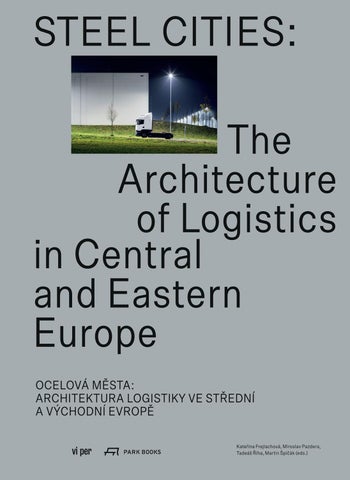
only be matched with dullness here, drama with inactivity, maleficence with indifference. Instead of “showers of brilliant sparks” the Steel Cities accommodate hundred-meter-long shelves, the “almost deafening noise of machinery” was replaced by silence, and where previously “man appeared like a helpless infant” today’s visitor is helplessly bored.7 Compared to Schulze’s Stahlstadt, at least driven by the misplaced futurism of its dictator, the present-day Steel Cities of Central and Eastern Europe (CEE) might well be the true dystopia. Today’s Steel Cities are nothing but polygons of controlled hollowness, operated by thousands of people through a complex of seemingly meaningless tasks. Instead of living in “small wooden houses, all alike, brought ready built from Chicago,” these people either commute from distant towns, or more often, are housed in dormitories set up by branches of global recruitment agencies that also employ them. Workers’ domestic life becomes integral to the immediate sub-contractual network of the logistics park. These parks are in no way shocking. Their conditions are not illegal. Little is known about them not because of secrecy, but through indifference. What exactly are they? What are they a symptom of? What is their physical form? Who inhabits them and what are the conditions of this inhabitation? This publication’s sole ambition is to break this indifference. The Steel Cities, these gargantuan logistics and quasi-industrial compounds in Central and Eastern Europe, are the subject of the following pages.
306
Bob Kuřík
TEMPORAL COLLISIONS: TIME, INFRASTRUCTURE, AND PROTEST IN THE SHADOW OF THE HAMBURG PORT
TEMPORÁLNÍ KOLIZE: ČAS, INFRASTRUKTURA A PROTEST VE STÍNU HAMBURSKÉHO PŘÍSTAVU
Contemporary laws are written in steel structures and not with words. 1
Zákony se dnes vpisují do ocelových struktur, a nikoli na papír.1
“Logistics is a key area in capitalism today. It is no longer the production of a commodity, but its supply chain, that has become the defining element according to which the production process and thus also our working conditions are oriented,” was the explanation given by the post-autonomy left coalition known as…ums Ganze! (All or Nothing, hereinafter as UG) in an open letter to Hamburg port employees as to why it was planning to block the entrance to Germany’s most important port during the Welcome to Hell! days which took place in the early summer of 2017 during the G20 conference, and that it hoped to “hit capital where it hurts: in its logistics” 2 in the process. Inspired by the analysis of contemporary power and strategies of resistance by the anarchist collective The Invisible Committee, which concludes that “power now resides in the infrastructures of this world,” as “power is logistic,” making it necessary to “block everything,” 3 UG organized a blockade during the G20 assembly, named simply Shut Down the Logistics of Capital. During the operation, hundreds of people managed to block one of the driveways for several hours, which symbolically slowed down the traffic from and into the port. Some of the lorry drivers who got stuck in traffic as a result of the action even expressed spontaneous support for the protest. What should we make of this focus on infrastructure, and of the form of the protest? Who (or what) faced each other in the port? These are the central questions that this essay seeks to answer, and they are best unpacked through an understanding of the autonomous anchoring of the UG coalition.
307
The post-autonomous turn towards logistics and infrastructures. Source: Iniciativa Ne Rasismu (No Racism Initiative), 2017. Postautonomní obrat k logistice a infrastrukturám. Zdroj: Iniciativa Ne rasismu, 2017.
„Logistika je pro dnešní kapitalismus klíčovou oblastí. Rozhodujícím prvkem již není výroba komodity, nýbrž dodavatelský řetězec, a ten určuje nastavení celého výrobního procesu i našich pracovních podmínek,“ zdůvodnila koalice postautonomní levice známá jako…ums Ganze! (Všechno nebo nic, dále jako UG) v otevřeném dopise dělníkům hamburského přístavu, proč během akčních dnů Welcome to Hell! (Vítejte v pekle!), pořádaných na začátku léta 2017 proti zasedání G20, hodlá blokovat vjezd do nejvýznamnějšího přístavu Německa a tím „udeřit do místa, kde to kapitál nejvíc zabolí: do logistiky“. 2 Inspirována analýzou soudobé moci a strategie odporu z pera anarchistického kolektivu Neviditelný výbor, jenž dospěl k závěru, že „moc se teď soustřeďuje v infrastrukturách tohoto světa“, respektive, že „moc je logistika“, a proto je třeba „blokovat vše“, 3 zorganizovala UG během sjezdu G20 blokádu s příznačným názvem Shut Down the Logistics of Capital (Zastavme logistiku kapitálu). V rámci akce se stovkám lidí podařilo na několik hodin zablokovat jednu z příjezdových cest a symbolicky tak zbrzdit dopravu z a do přístavu. Někteří řidiči kamionů, kteří kvůli akci uvízli v koloně, protestu na místě dokonce spontánně vyjádřili podporu. Jak tomuto zájmu o infrastrukturu, ale i formě protestu porozumět? Kdo, respektive co se proti sobě postavilo v přístavu? To jsou ústřední otázky, na něž esej hledá odpověď a které je třeba začít rozplétat pochopením autonomního „ukotvení“ koalice UG.
Homo Politicus: The Post-/Autonomists
Autonomen: a peculiar type of political rabble-rouser, straddling non-conformist youth subculture and the bottom-andleft-up movement4 for over 50 years; established in 2007, UG is one of its last emerging post-autonomous variations. 5 For German as well as Danish, Dutch, and (since the 1990s) Czech autonomists, places of work and production were never epicenters of battle, as was the case for Italian autonomists-operaists.6 Instead, they focused on everyday life, housing, urban space, and consumption locations, employing various forms of creative and confrontational direct action to articulate or literally embody a critique of capitalism, gentrification, globalization, authoritarianism, state, climate crisis, patriarchy, nationalism or consumption, all the while attempting to implement into living praxis alternatives such as squats, autonomous or community centers, alternative security structures, local solidarity networks, decentralized means of organization, horizontal decision-making, and collective housing and living.7 Aside from this central political domain, autonomists have had a sporadic interest in modern infrastructure ever since they emerged in the second half of the 1970s: from the infrastructures of global governance,8 production and distribution of energy,9 the army,10 up to transportation.11 The German autonomists’ current focus on the logistical infrastructure of capitalism is simply the latest chapter of a much older story which has yielded only a few pages in the last few years in the history of the post/autonomous12 fight that gravitates around modern infrastructures. Thus, the post/autonomous movement has after a long time finally made some
Homo politicus: Post/autonomové
Autonomen: prapodivný druh politického buřiče rozkročeného již padesát let mezi nonkonformní subkulturou mládeže a zdola-a-zleva-jdoucím hnutím,4 jehož je UG od svého vzniku v roce 2007 jednou z posledních, tzv. postautonomních variací.5 Epicentrem bojů německých, ale i dánských, nizozemských a od devadesátých let i českých autonomů nikdy nebyla místa práce a výroby jako v případě italských autonomistů-operaistů,6 nýbrž místa každodenního života, bydlení, městského prostoru a spotřeby. Právě kolem nich autonomové formou různých kreativních a konfrontačních přímých akcí artikulují, respektive doslova ztělesňují kritiku kapitalismu, gentrifikace, globalizace, autoritářství, státu, klimatické krize, patriarchátu, nacionalismu či konzumu, stejně jako se snaží zavádět do žité praxe alternativy v podobě squatů či autonomních a sociálních center, alternativních bezpečnostních struktur, sousedských solidárních sítí, decentralizovaných způsobů organizace, horizontálního rozhodování či kolektivního bydlení a života.7 Mimo tuto ústřední politickou doménu ale autonomy od jejich počátků v druhé půlce sedmdesátých let minulého století sporadicky zajímaly i moderní infrastruktury – ať už infrastruktury globálního vládnutí,8 výroby a distribuce energie,9 armády10 či dopravy.11 Soudobé zacílení německých autonomů na logistickou infrastrukturu kapitalismu je tak spíše poslední kapitolou staršího příběhu, který ale v posledních letech moc nových stránek do historie post/autonomních12 bojů gravitujících kolem moderních infrastruktur nepřidal. Post/autonomní hnutí tak v Hamburku dalo po delší době opět vědět, že již po několik dekád sporadicky, kampaňovitě, ale o to spektakulárněji vyplňuje levé proudy a spodní vody politik vířených kolem moderních infrastruktur.
310
311
Symbolical blockade of the road used by container trucks to access the port. Photo: Harriet Dohmeyer, Fink.Hamburg, 2017.
BA Demonstration in Bremen mobilizing for the Hamburg protests. Photo: Author’s archive.
Symbolická blokáda cesty, kudy do přístavu jezdí kamiony převážející kontejnery. Foto: Harriet Dohmeyer, Fink.Hamburg, 2017.
Demonstrace BA v Brémách mobilizující na protesty do Hamburku. Foto: archiv autora.
Infrastructural Time Germany since 1988 (West Berlin), and in the world since 1999 (Seattle) in parallel with world summits of transnational organizations such as the International Monetary Fund or the World Trade Organization. The goal of these happenings was (and is) to fill the locations of these congresses with demonstrations and other protest happenings, in order to draw attention to the radical critique of globalization, and to the alternatives. In the case of the port blockade, the point was to impede symbolically the very flow of logistics, which had minimal influence on the port as a whole but was still effective, according to the organizers. This effect was twofold: a) to derail, or expand the fighting strategy of (not only) the autonomous left towards logistics, which could become the new starting point of political struggle in the world where, as the Bremen organization Basisgruppe Antifaschismus (BA; part of UG) says, “goods sail across the oceans while thousands of migrants are drowning;” 18 b) to expose the power of logistical infrastructure in global capitalism, highlighting its presence in public space by means of direct action, in this case a blockade. I want to open the next part of this essay with this strategy of exposing the system by delaying it symbolically via blockade. It shows how exposing the logistics of capitalism as a political problem is manifested as a collision between two different temporal structures, or two different political times: the linear time of neoliberalism on the one hand, and the synchronic autonomous time on the other. Time plays a paramount, albeit neglected, role in the infrastructure arguments. What is meant by that?
akcemi a skrze to přitáhnout pozornost k radikální kritice globalizace a alternativám. V případě blokády přístavu šlo o symbolické zbrzdění plynulého toku logistiky samotné, které sice na chod přístavu jako celku mělo pramalý vliv, ale podle organizátorů mělo sílu vyvolat efekt. A to efekt hned dvojí: a) přesměrovat, respektive rozšířit strategii boje (nejen) autonomní levice vstříc logistice, jež by se mohla stát novým výchozím bodem politického boje ve světě, ve kterém, jak říká brémská organizace Basisgruppe Antifaschismus (dále jako BA), součást koalice UG, „zboží brázdí oceány a mezi tím se topí tisíce migrantů“;18 b) obnažit moc logistické infrastruktury v globálním kapitalismu a tím ji zviditelnit ve veřejném prostoru – a to pomocí přímé akce, jež měla formu blokády. Právě ono obnažení symbolickým zbrzděním pomocí blokády je moment, od kterého bych se rád odrazil do další části eseje, protože poodhaluje, že zviditelnění logistiky kapitalismu coby politického problému nabylo povahy kolize dvou odlišných temporálních struktur, respektive dvou odlišných politických časů – z jedné strany lineárního času neoliberalismu a z druhé synchronního času autonomního. Je to totiž právě čas, který v souvislosti se spory o infrastruktury hraje opomíjenou, byť klíčovou roli. Co se tím přesně myslí?
In the anthropological study of infrastructures, the emphasis until recently lay in the importance of space, materialized in the famous definition from Brian Larkin’s canonical text where he argues that “infrastructures are built networks that facilitate the flow of goods, people, or ideas and allow for their exchange over space.”19 Recently, and especially following the publication of The Promise of Infrastructure,20 the role of “infrastructural time”21 has gathered more attention. As the title reveals, infrastructures serve more than just their technical purpose, here and now, but are also connected to promises, hopes, aspirations, desires or even dreams, described by Rudolf Mrázek in a nod to Søren Kierkegaard as “enthusiasm of the imagination”22—about an improved road, better availability, economic growth towards mass consumption, or catching up with the West, about liberal freedom (or conversely communist equality), about access to global culture. Such varied expectations of the future, which also shape our understanding of the present and the past, which Larkin calls semiotic and aesthetic “poetics of infrastructures,”23 are needed to understand the socio-material life of infrastructures as such, and the various protests it has sparked, as well as the very common failures of these promises and desires. With their unfinished, decaying, or dysfunctional infrastructures or, conversely, with infrastructures that only work for some users, these failures generate different affects, new dreams, or negative and even dystopian visions of a declining and degraded future. In this way, they have the power to undermine the previous enthusiastic narratives. Promises and the changes they undergo over time necessarily
Infrastrukturní čas
V antropologickém studiu infrastruktur až donedávna převládal důraz na význam prostoru, zhmotněný slavnou definicí z kanonického textu Briana Larkina, ve kterém tvrdí, že „infrastruktury jsou vestavěné sítě, které zprostředkovávají pohyb zboží, lidí a myšlenek a umožňují jejich výměnu v prostoru“.19 Až v poslední době a zejména s knížkou The Promise of Infrastructure (Příslib infrastruktury) 20 se více pozornosti dostává i roli „infrastrukturního času“.21 Jak už název knihy napovídá, infrastruktury nemají jenom technickou funkci, tady a teď, ale jsou napojené na různé přísliby, naděje, aspirace, touhy či přímo sny, kterým Rudolf Mrázek s odkazem na Sørena Kierkegaarda říká „nadšení představivosti“ 22 – tu o zpevněné cestě a lepší dostupnosti, tu o ekonomickém růstu k masivní spotřebě či k dohnání Západu, tu o liberální svobodě anebo naopak komunistické rovnosti, tu o připojení ke globální kultuře. Tato různorodá očekávání budoucnosti tvarující i rozumění přítomnosti a minulosti, kterým Larkin říká sémiotická a estetická „poetika infrastruktur“,23 jsou klíčová pro pochopení sociomateriálního života infrastruktur jako takového, ale i různorodých protestů s ním spojených. Stejně tak jsou ale pro pochopení klíčové velmi časté krachy těchto příslibů a tužeb. Ty generují s nedostavěnými, tlejícími či nefunkčními infrastrukturami nebo naopak s infrastrukturami, které sice fungují, ale jenom pro někoho, odlišné afekty, nové sny či naopak negativní až dystopické představy odmítnuté budoucnosti. Mají tak sílu podkopávat výše zmíněné entuziastické narativy. Přísliby a jejich proměny v čase jdou spolu nutně ruku v ruce – a s nimi i krachy snů, které se tak stávají „ruinami příslibů“.24 Jinak řečeno je třeba vzít v potaz to, že „infrastruktury nastavují čas, spouštějí určité druhy společenského času
Editors Editoři Kateřina Frejlachová, Miroslav Pazdera, Tadeáš Říha, Martin Špičák Texts Texty Rutvica Andrijasevic, Kateřina Frejlachová, Adrian Hyrsz, Tomáš Khel, Bob Kuřík, Jesse LeCavalier, Lukáš Likavčan, Petr Mezihorák, Víctor Muñoz Sanz, Tonia Novitz, Miroslav Pazdera, Tadeáš Říha, Hannah Schling, Pavel Suchan, Daniel Šitera, Martin Špičák, Philip Ursprung, Ina Valkanova, Jan Vopravil Photo essays Fotoesej Jan Kolský, Zdeněk Porcal (Studio Flusser) Maps Mapy Martin Špičák Translations Překlad Vít Bohal, Martina Freitagová, Elizabet Kovačeva, Piotr Krasnowolski, Martin Lauer, Tereza Pálková, Anna Plasová, Martin Tharp Proofreading Jazyková korektura Irena Hlinková (Czech / čeština), Martin Tharp (English / angličtina) Copy editing Redakce Irena Lehkoživová Graphic design Grafický design Anežka Hrubá Ciglerová Prepress Předtisková příprava Magdalena Lindaurová Printing and binding Tisk Tiskárna Daniel, Praha Paper Papír Munken Lynx, Munken G-Print Typefaces Písmo Yield (Publikum Type), Scto Grotesk B (Schick Toikka) Co-published by VI PER Gallery, Prague, and Park Books AG, Zurich, 2019 Vydali Galerie VI PER, Praha a Park Books AG, Curych, 2019 First edition První vydání
Distribution in the Czech Republic Distribuce v České republice VI PER Gallery Vítkova 2 186 00 Praha 8 Czech Republic www.vipergallery.org ISBN 978-80-270-7038-1 Distribution in all other countries Distribuce v ostatních zemích Park Books Niederdorfstrasse 54 8001 Zurich Switzerland www.park-books.com ISBN 978-3-03860-189-0 All rights reserved; no part of this publication may be reproduced, stored in a retrieval system or transmitted in any form or by any means, electronic, mechanical, photocopying, recording, or otherwise, without the prior written consent of the publisher. Všechna práva vyhrazena; žádná část této publikace nesmí být reprodukována, uložena v systému ukládání a vyhledávání nebo přenesena v jakékoli formě nebo jakýmikoli způsoby, elektronickými, mechanickými, fotokopírovacími, záznamovými nebo jinými bez předchozího písemného souhlasu vydavatele. Published with support from the Ministry of Culture of the Czech Republic. Vydání knihy podpořilo Ministerstvo kultury České republiky. Park Books is being supported by the Federal Office of Culture with a general subsidy for the years 2016–2020.